BUDAPEST UNIVERSITY OF TECHNOLOGY AND
ECONOMICS
Department of Energy
Student: Mahbod SHAFIEI HHSCIQ
2/6
Topic:
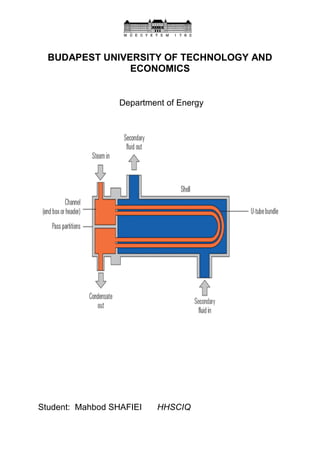
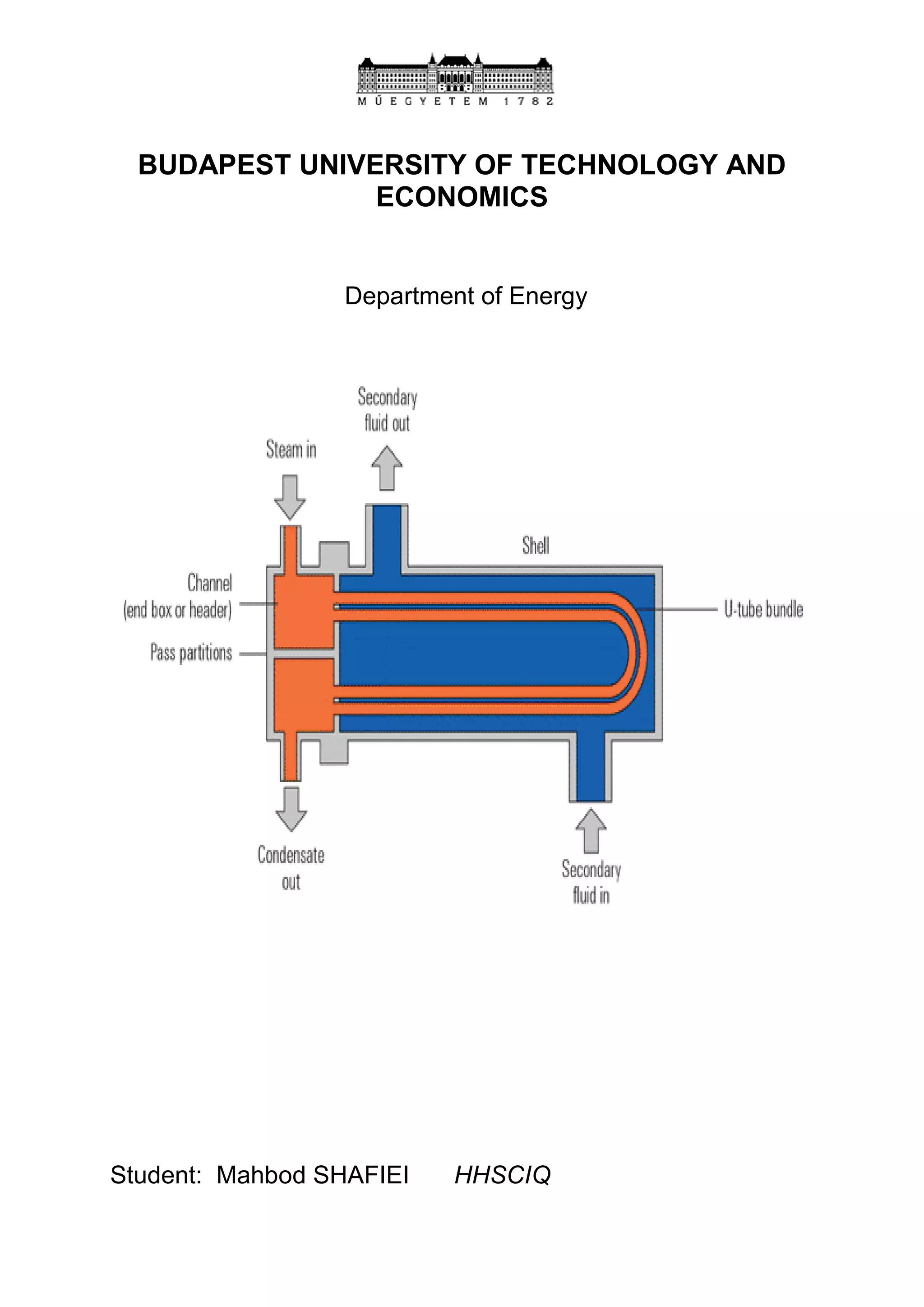
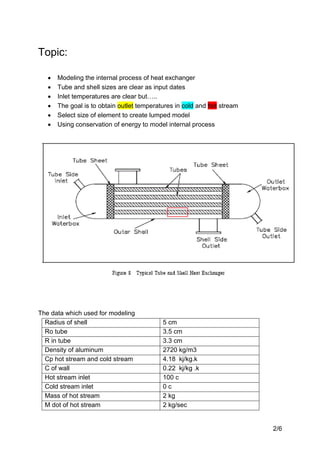
 Modeling the internal process of heat exchanger
 Tube and shell sizes are clear as input dates
 Inlet temperatures are clear but…..
 The goal is to obtain outlet temperatures in cold and hot stream
 Select size of element to create lumped model
 Using conservation of energy to model internal process
The data which used for modeling
Radius of shell 5 cm
Ro tube 3.5 cm
R in tube 3.3 cm
Density of aluminum 2720 kg/m3
Cp hot stream and cold stream 4.18 kj/kg.k
C of wall 0.22 kj/kg .k
Hot stream inlet 100 c
Cold stream inlet 0 c
Mass of hot stream 2 kg
M dot of hot stream 2 kg/sec
3/6
Mass of cold stream 1.41 kg
M dot of cold stream 2 kg/sec
Mass of wall (aluminum tube) 0.57 kg
C hot stream 0.96 kcal/kg.c
C cold stream 0.96 kcal/kg c
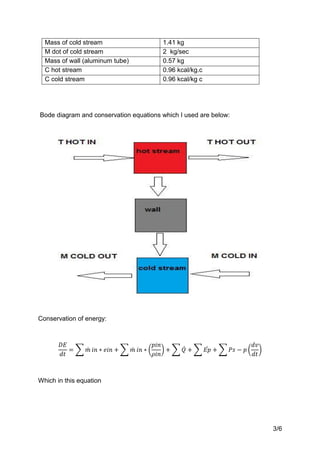
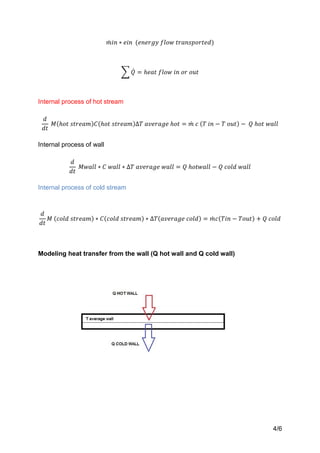
Bode diagram and conservation equations which I used are below:
Conservation of energy:
Which in this equation
4/6
Internal process of hot stream
Internal process of wall
Internal process of cold stream
Modeling heat transfer from the wall (Q hot wall and Q cold wall)
5/6
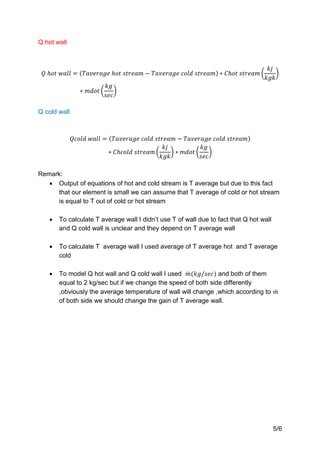
Q hot wall
Q cold wall
Remark:
 Output of equations of hot and cold stream is T average but due to this fact
that our element is small we can assume that T average of cold or hot stream
is equal to T out of cold or hot stream
 To calculate T average wall I didn’t use T of wall due to fact that Q hot wall
and Q cold wall is unclear and they depend on T average wall
 To calculate T average wall I used average of T average hot and T average
cold
 To model Q hot wall and Q cold wall I used and both of them
equal to 2 kg/sec but if we change the speed of both side differently
,obviously the average temperature of wall will change ,which according to
of both side we should change the gain of T average wall.
6/6

HEAT EXCHANGER MODEL

  • 1.
    BUDAPEST UNIVERSITY OFTECHNOLOGY AND ECONOMICS Department of Energy Student: Mahbod SHAFIEI HHSCIQ
  • 2.
    2/6 Topic:  Modeling theinternal process of heat exchanger  Tube and shell sizes are clear as input dates  Inlet temperatures are clear but…..  The goal is to obtain outlet temperatures in cold and hot stream  Select size of element to create lumped model  Using conservation of energy to model internal process The data which used for modeling Radius of shell 5 cm Ro tube 3.5 cm R in tube 3.3 cm Density of aluminum 2720 kg/m3 Cp hot stream and cold stream 4.18 kj/kg.k C of wall 0.22 kj/kg .k Hot stream inlet 100 c Cold stream inlet 0 c Mass of hot stream 2 kg M dot of hot stream 2 kg/sec
  • 3.
    3/6 Mass of coldstream 1.41 kg M dot of cold stream 2 kg/sec Mass of wall (aluminum tube) 0.57 kg C hot stream 0.96 kcal/kg.c C cold stream 0.96 kcal/kg c Bode diagram and conservation equations which I used are below: Conservation of energy: Which in this equation
  • 4.
    4/6 Internal process ofhot stream Internal process of wall Internal process of cold stream Modeling heat transfer from the wall (Q hot wall and Q cold wall)
  • 5.
    5/6 Q hot wall Qcold wall Remark:  Output of equations of hot and cold stream is T average but due to this fact that our element is small we can assume that T average of cold or hot stream is equal to T out of cold or hot stream  To calculate T average wall I didn’t use T of wall due to fact that Q hot wall and Q cold wall is unclear and they depend on T average wall  To calculate T average wall I used average of T average hot and T average cold  To model Q hot wall and Q cold wall I used and both of them equal to 2 kg/sec but if we change the speed of both side differently ,obviously the average temperature of wall will change ,which according to of both side we should change the gain of T average wall.
  • 6.