Two-Dimensional Heat Analysis
Finite Element Method
20 November 2002
Michelle Blunt
Brian Coldwell
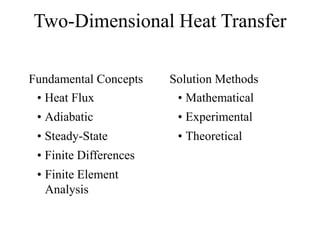
Two-Dimensional Heat Transfer
Fundamental Concepts Solution Methods
• Adiabatic
• Heat Flux
• Steady-State
• Finite Differences
• Finite Element
Analysis
• Mathematical
• Experimental
• Theoretical
dt
A
q
U
dt
dx
A
Q
dt
A
q
E
U
E
E
out
in
out
gen
in















time
t
area
sectional
-
cross
A
energy
stored
U
source
heat
internal
Q
energy
kinetic
E
conducted
heat
q






dt
A
q
U
dt
dx
A
Q
dt
A
q
E
U
E
E
out
in
out
gen
in















time
t
area
sectional
-
cross
A
energy
stored
U
source
heat
internal
Q
energy
kinetic
E
conducted
heat
q






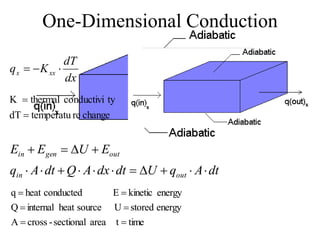
dx
dT
K
q xx
x 


change
re
temperatu
dT
ty
conductivi
thermal
K


One-Dimensional Conduction
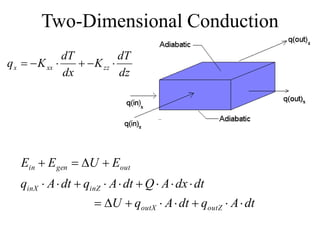
Two-Dimensional Conduction
dt
A
q
dt
A
q
U
dt
dx
A
Q
dt
A
q
dt
A
q
E
U
E
E
outZ
outX
inZ
inX
out
gen
in





















dz
dT
K
dx
dT
K
q zz
xx
x 





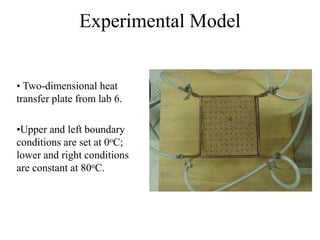
Experimental Model
• Two-dimensional heat
transfer plate from lab 6.
•Upper and left boundary
conditions are set at 0oC;
lower and right conditions
are constant at 80oC.
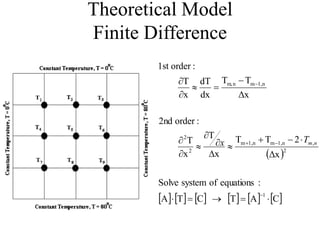
Theoretical Model
Finite Difference
 
           
C
A
T
C
T
A
:
equations
of
system
Solve
Δx
2
T
T
x
T
x
T
:
order
2nd
Δx
T
T
dx
dT
x
T
:
order
1st
1
2
,
n
1,
m
n
1,
m
2
2
n
1,
m
n
m,
























n
m
T
x
f
x
f1
f2
f3 f4
f5 f6
x
f Subdomain We
Domain divided with subdomains
with degrees of freedom
Domain W
x
x
Domain with degrees of freedom
f
f
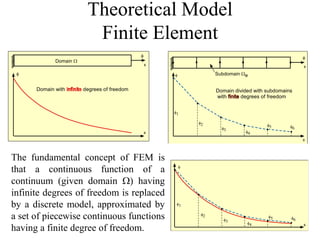
The fundamental concept of FEM is
that a continuous function of a
continuum (given domain W) having
infinite degrees of freedom is replaced
by a discrete model, approximated by
a set of piecewise continuous functions
having a finite degree of freedom.
f6
f5
f4
f3
f2
f1
f
x
Theoretical Model
Finite Element
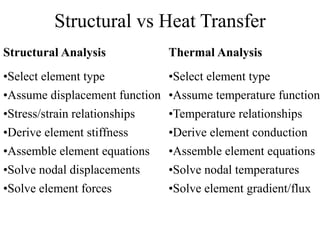
Structural vs Heat Transfer
Structural Analysis Thermal Analysis
•Assume displacement function
•Stress/strain relationships
•Derive element stiffness
•Assemble element equations
•Solve nodal displacements
•Solve element forces
•Select element type
•Assume temperature function
•Temperature relationships
•Derive element conduction
•Assemble element equations
•Solve nodal temperatures
•Solve element gradient/flux
•Select element type
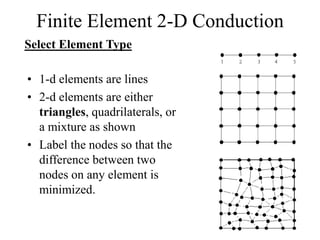
Finite Element 2-D Conduction
• 1-d elements are lines
• 2-d elements are either
triangles, quadrilaterals, or
a mixture as shown
• Label the nodes so that the
difference between two
nodes on any element is
minimized.
Select Element Type
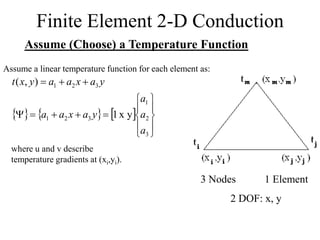
Finite Element 2-D Conduction
Assume (Choose) a Temperature Function
3 Nodes 1 Element
2 DOF: x, y
Assume a linear temperature function for each element as:
     


















3
2
1
3
2
1
3
2
1
y
x
1
)
,
(
a
a
a
y
a
x
a
a
y
a
x
a
a
y
x
t
where u and v describe
temperature gradients at (xi,yi).
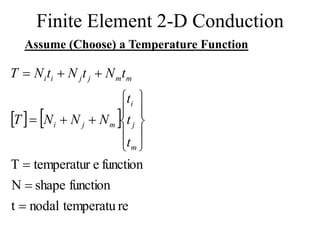
Finite Element 2-D Conduction
Assume (Choose) a Temperature Function
   
re
temperatu
nodal
t
function
shape
N
function
e
temperatur
T



















m
j
i
m
j
i
m
m
j
j
i
i
t
t
t
N
N
N
T
t
N
t
N
t
N
T
Finite Element 2-D Conduction
Define Temperature Gradient Relationships
 
   


































































m
j
i
m
j
i
m
j
i
m
j
i
m
j
i
x
N
x
B
t
t
t
y
N
y
N
y
N
x
N
x
N
x
N
y
T
x
T
g






1
Analogous to strain
matrix: {g}=[B]{t}
[B] is derivative of [N]
    
g
D
g
q
q
y
x
















yy
xx
K
0
0
K
:
Gradient
rature
flux/Tempe
Heat
Finite Element 2-D Conduction
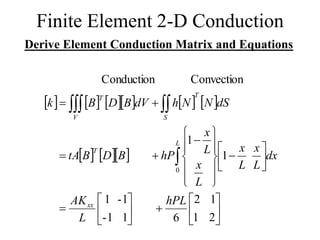
Derive Element Conduction Matrix and Equations
          
    









































 
2
1
1
2
6
1
1
-
1
-
1
1
1
Convection
Conduction
0
hPL
L
AK
dx
L
x
L
x
L
x
L
x
hP
B
D
B
tA
dS
N
N
h
dV
B
D
B
k
xx
L
T
T
V S
T
Finite Element 2-D Conduction
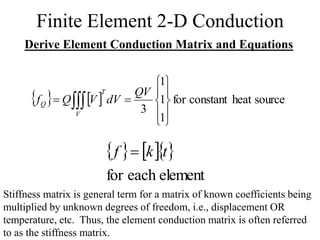
Derive Element Conduction Matrix and Equations
    source
heat
constant
for
1
1
1
3 










 
QV
dV
V
Q
f
T
V
Q
   
element
each
for
t
k
f 
Stiffness matrix is general term for a matrix of known coefficients being
multiplied by unknown degrees of freedom, i.e., displacement OR
temperature, etc. Thus, the element conduction matrix is often referred
to as the stiffness matrix.
Finite Element 2-D Conduction
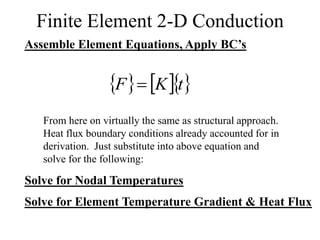
Assemble Element Equations, Apply BC’s
   
t
K
F 
From here on virtually the same as structural approach.
Heat flux boundary conditions already accounted for in
derivation. Just substitute into above equation and
solve for the following:
Solve for Nodal Temperatures
Solve for Element Temperature Gradient & Heat Flux
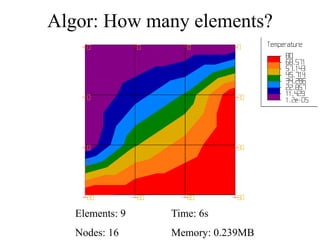
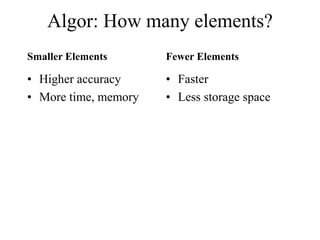
Algor: How many elements?
Elements: 9 Time: 6s
Nodes: 16 Memory: 0.239MB
Algor: How many elements?
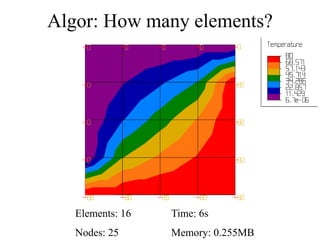
Elements: 16 Time: 6s
Nodes: 25 Memory: 0.255MB
Algor: How many elements?
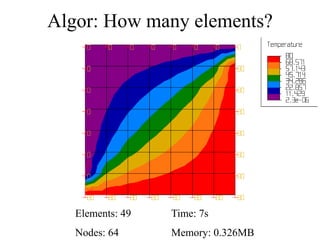
Elements: 49 Time: 7s
Nodes: 64 Memory: 0.326MB
Algor: How many elements?
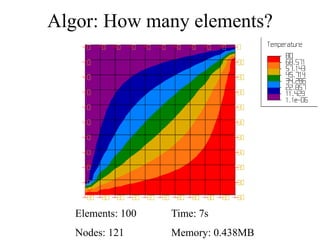
Elements: 100 Time: 7s
Nodes: 121 Memory: 0.438MB
Algor: How many elements?
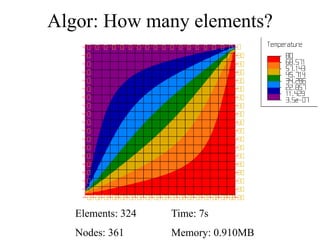
Elements: 324 Time: 7s
Nodes: 361 Memory: 0.910MB
Algor: How many elements?
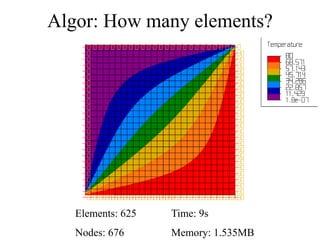
Elements: 625 Time: 9s
Nodes: 676 Memory: 1.535MB
Algor: How many elements?
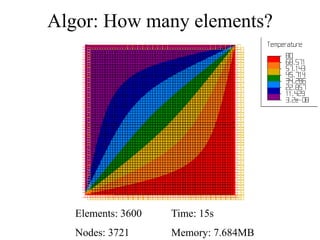
Elements: 3600 Time: 15s
Nodes: 3721 Memory: 7.684MB
Algor: How many elements?
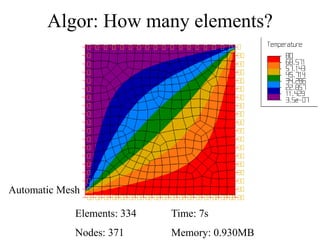
Automatic Mesh
Elements: 334 Time: 7s
Nodes: 371 Memory: 0.930MB
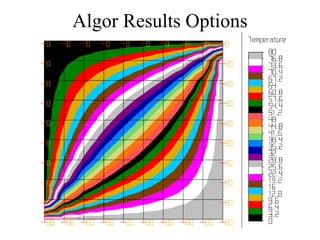
Algor Results Options
• Higher accuracy
• More time, memory
• Faster
• Less storage space
Algor: How many elements?
Smaller Elements Fewer Elements
References
Kreyszig, Erwin. Advanced Engineering
Mathematics, 8th ed.(1999)
Chapters: 8, 9
Logan, Daryl L. A First Course in the Finite
Element Method Using Algor, 2nd ed.(2001)
Chapters: 13
Questions?
Ha ha ha!!!
Here comes your assignment…

Heat analysis finite element method two Dimensional