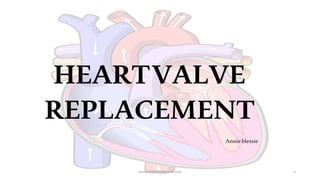
HEARTVALVE
REPLACEMENT
Annieblessie
1
anniet250999@gmail.com
Contents
• Introduction
• Types of heart valve
• Valve replacement :- Need
Procedure
Contraindication
• Artificial valve / mechanical valve
• Plans of post operative physiotherapy
• Exercise program
• References
2
anniet250999@gmail.com
Introduction
• Valve replacement surgery is the replacement of one or more of the
heart valves with an artificial heart valve
• Valve replacement surgery has improved
the outcome of patients with valvular heart disease
• Slow increment exercise is indicated
for patients because of their reduced
functional ability
3
anniet250999@gmail.com
TYPES OF HEART VALVE
Aortic valve
• Valve between
left ventricle
and aorta
• One of the
semilunar valve Mitral valve
• Located
between left
atrium and left
ventricle
Pulmonic valve
• Located
between right
ventricle and
pulmonary
artery Tricuspid valve
• Located
between right
atrium and right
ventricle
4
anniet250999@gmail.com
Aortic valve
replacement
Need :-
Aortic stenosis ,aortic regurgitation
Procedure :-
1) Percutaneous catheter ballon valvuloplasty (PBV)
2) Tran catheter aortic valve replacement (TAVR)
5
anniet250999@gmail.com
6
anniet250999@gmail.com
MITRAL VALVE
REPLACEMENT
Need :-
Mitral stenosis ,Mitral regurgitation
7
anniet250999@gmail.com
8
anniet250999@gmail.com
9
anniet250999@gmail.com
TRICUSPID VALVE
REPLACEMENT
Need :-
Tricuspid valve stenosis , tricuspid
valve regurgitation , tricuspid atresia
Procedure :-
Anuloplasty
10
anniet250999@gmail.com
11
anniet250999@gmail.com
Mechanicalvalves
12
anniet250999@gmail.com
Complications of
surgery
13
anniet250999@gmail.com
Role of the Physiotherapist
• Physiotherapist is concerned with physical aspects of recovery
• Minimizing the deconditioning effects of bed rest
• Enhancing cardiovascular and musculoskeletal functioning
Assessment
Breathing
exercise
Assisted
exercise
Stair climbing
Ambulation
Active exercise Daily activities
Home exercise
program
Follow up
14
anniet250999@gmail.com
Plan of Physiotherapy Care - Pre Operative
15
anniet250999@gmail.com
Plan of Physiotherapy Care - Post Operative
16
anniet250999@gmail.com
Day of operation :-
• Monitor the vitals like
temperature, blood pressure ,
ECG, pulse rate and respiratory
rate
• Help the patient to sit in half
lying position
• Support the incision and
encourage to take deep breaths -3
reps
• Encourage for huffing at least
once
• Patient head and trunk fully
supported with pillow
Day -1
• Breathing exercise
• Coughing and huffing
• Relaxation
• Elevation of arm on operated side
(if medial sternotomy B/L arm)
• Ankle and toe movements
• Hip and knee bending and
stretching
• Incentive spirometry
Day -2
• Same as day 1
• Patient is trained to sit up
himself
• Elevation of arm on
operated side (if medial
sternotomy B/L arm)
Protocol
17
anniet250999@gmail.com
Day - 3
• Same as of day 2
• Arm and trunk exercise
• Short walk in ward
• Swinging exercise during walking
• Chest expansion exercise
Day : 4 - 14
• Patient is encouraged to go
to toilet independently
• Chest expansion exercise
• By day 5-7 ,patient must
ascent stairs
Home exercise program
• Breathing exercise
• Thoracic expansion
exercise
• Walking
• Activities of daily living
• Follow up
18
anniet250999@gmail.com
Precaution
• Incision used in heart surgery is breastbone
(sternum) , so avoid activities that put stress on
your sternum while its healing
• Do not advice to lift push or pull more than
10pounds
• Advice to get in and out of bed without using
arms
• Safely climb stairs without pulling on rails
19
anniet250999@gmail.com
FITT Principle
Frequency :
Minimum of 3 days
per week
Intensity
According to rate of
perceived exertion .
It can also be
monitored by heart
rate and talk test
Type
Aerobic exercise
Resistance exercise
Time
Gradually increase
the duration by 5-10
mins
20
anniet250999@gmail.com
Exercise
Ankle exercise
Move feet up and down at ankles -10 reps
Move feet together in circles -10 reps
Static quadriceps :
Press the back of knee against the bed
.heels should lift off the bed
21
anniet250999@gmail.com
Gluteal exercise
Tighten buttocks together hold for 5
seconds and relax
Straight leg raise
Lift the leg off the bed ,keeping the
knee straight
22
anniet250999@gmail.com
Splinted coughing
Shoulder ROM Exercise
23
anniet250999@gmail.com
Inpatient Activity
24
anniet250999@gmail.com
25
anniet250999@gmail.com
Reference
• 1) Textbook of physiotherapy for cardio-respiratory cardiac surgery
and thoracic surgery conditions – GB Madhuri
• 2) https://drbillsukala.com/heart-valve-surgery-exercise-guidelines/
• 3) physical therapy after cardiac surgery –UW Medicine
• 4) physiotherapy for respiratory and cardiac problems – Jenifer A
Pryor
26
anniet250999@gmail.com

heart valve replacement.pptx

  • 1.
  • 2.
    Contents • Introduction • Typesof heart valve • Valve replacement :- Need Procedure Contraindication • Artificial valve / mechanical valve • Plans of post operative physiotherapy • Exercise program • References 2 anniet250999@gmail.com
  • 3.
    Introduction • Valve replacementsurgery is the replacement of one or more of the heart valves with an artificial heart valve • Valve replacement surgery has improved the outcome of patients with valvular heart disease • Slow increment exercise is indicated for patients because of their reduced functional ability 3 anniet250999@gmail.com
  • 4.
    TYPES OF HEARTVALVE Aortic valve • Valve between left ventricle and aorta • One of the semilunar valve Mitral valve • Located between left atrium and left ventricle Pulmonic valve • Located between right ventricle and pulmonary artery Tricuspid valve • Located between right atrium and right ventricle 4 anniet250999@gmail.com
  • 5.
    Aortic valve replacement Need :- Aorticstenosis ,aortic regurgitation Procedure :- 1) Percutaneous catheter ballon valvuloplasty (PBV) 2) Tran catheter aortic valve replacement (TAVR) 5 anniet250999@gmail.com
  • 6.
  • 7.
    MITRAL VALVE REPLACEMENT Need :- Mitralstenosis ,Mitral regurgitation 7 anniet250999@gmail.com
  • 8.
  • 9.
  • 10.
    TRICUSPID VALVE REPLACEMENT Need :- Tricuspidvalve stenosis , tricuspid valve regurgitation , tricuspid atresia Procedure :- Anuloplasty 10 anniet250999@gmail.com
  • 11.
  • 12.
  • 13.
  • 14.
    Role of thePhysiotherapist • Physiotherapist is concerned with physical aspects of recovery • Minimizing the deconditioning effects of bed rest • Enhancing cardiovascular and musculoskeletal functioning Assessment Breathing exercise Assisted exercise Stair climbing Ambulation Active exercise Daily activities Home exercise program Follow up 14 anniet250999@gmail.com
  • 15.
    Plan of PhysiotherapyCare - Pre Operative 15 anniet250999@gmail.com
  • 16.
    Plan of PhysiotherapyCare - Post Operative 16 anniet250999@gmail.com
  • 17.
    Day of operation:- • Monitor the vitals like temperature, blood pressure , ECG, pulse rate and respiratory rate • Help the patient to sit in half lying position • Support the incision and encourage to take deep breaths -3 reps • Encourage for huffing at least once • Patient head and trunk fully supported with pillow Day -1 • Breathing exercise • Coughing and huffing • Relaxation • Elevation of arm on operated side (if medial sternotomy B/L arm) • Ankle and toe movements • Hip and knee bending and stretching • Incentive spirometry Day -2 • Same as day 1 • Patient is trained to sit up himself • Elevation of arm on operated side (if medial sternotomy B/L arm) Protocol 17 anniet250999@gmail.com
  • 18.
    Day - 3 •Same as of day 2 • Arm and trunk exercise • Short walk in ward • Swinging exercise during walking • Chest expansion exercise Day : 4 - 14 • Patient is encouraged to go to toilet independently • Chest expansion exercise • By day 5-7 ,patient must ascent stairs Home exercise program • Breathing exercise • Thoracic expansion exercise • Walking • Activities of daily living • Follow up 18 anniet250999@gmail.com
  • 19.
    Precaution • Incision usedin heart surgery is breastbone (sternum) , so avoid activities that put stress on your sternum while its healing • Do not advice to lift push or pull more than 10pounds • Advice to get in and out of bed without using arms • Safely climb stairs without pulling on rails 19 anniet250999@gmail.com
  • 20.
    FITT Principle Frequency : Minimumof 3 days per week Intensity According to rate of perceived exertion . It can also be monitored by heart rate and talk test Type Aerobic exercise Resistance exercise Time Gradually increase the duration by 5-10 mins 20 anniet250999@gmail.com
  • 21.
    Exercise Ankle exercise Move feetup and down at ankles -10 reps Move feet together in circles -10 reps Static quadriceps : Press the back of knee against the bed .heels should lift off the bed 21 anniet250999@gmail.com
  • 22.
    Gluteal exercise Tighten buttockstogether hold for 5 seconds and relax Straight leg raise Lift the leg off the bed ,keeping the knee straight 22 anniet250999@gmail.com
  • 23.
    Splinted coughing Shoulder ROMExercise 23 anniet250999@gmail.com
  • 24.
  • 25.
  • 26.
    Reference • 1) Textbookof physiotherapy for cardio-respiratory cardiac surgery and thoracic surgery conditions – GB Madhuri • 2) https://drbillsukala.com/heart-valve-surgery-exercise-guidelines/ • 3) physical therapy after cardiac surgery –UW Medicine • 4) physiotherapy for respiratory and cardiac problems – Jenifer A Pryor 26 anniet250999@gmail.com