Chronic Heart Failure –
Role of
Echocardiography
DR.N.PRAVEEN
Introduction
 Echocardiography is the investigation of choice in imaging
of the heart failure patient.
 Readily available, low cost
 Useful for diagnosis, prognostification
 Limitations – inter observer variability, assumptions of
geometric shapes, heart rate, load dependency.
Use of echocardiography in Heart Failure
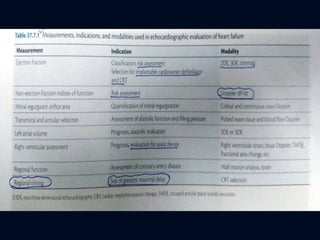
 1.Assessment of ejection fraction
 2.Quantification of Mitral Regurgitation, LV shape
assessment
 3. RV function assessment
 4. LV diastolic function
 5. LV stress – differentiation of ischemic vs nonischemic
 6. Relative wall thickness, LV mass
 7. Handheld USG – intravascular volume, pulmonary
congestion
Left ventricular systolic function
 M mode – accurate assessment of wall, chamber
dimensions.
 2D echo – valve imaging
 Usually qualitative assessment of EF  Quantitative
assessment
 Misleading in irregular rhythm, large and small LVs,
extremes of heart rate (tachycardia, bradycardia)
 Most widely used quantitative method – Biplane Simpson’s
method.
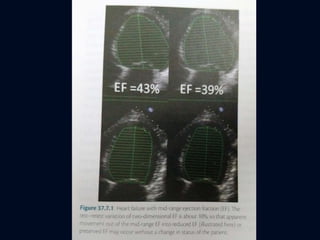
 Repeated testing lead to variable volumes – EF results.
Unfortunately in 2D Echo
All measurements are susceptible to
 Load dependence
 Inaccurate tracing
 Poor test-retest reliability
 Limited prognostic value ( when EF is close to normal
range).
3D Echo is the future – for
assessment
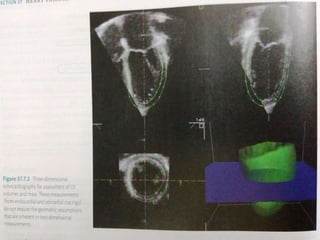
 Accurate assessment of LV volumes, Ejection fraction
 Less test- retest variation
 EF by geometric assumptions of LV is avoided.
HFPEF
 Half of patients with heart failure
 It should not be a diagnosis of exclusion.
 Can be precisely called as disorder of inadequacy of EF
than normal systolic function.
Apart from LVEF… what to be
assessed in HFPEF
 LV performance is dependent on contractility, loading
 During evaluation of ejection phase parameters – systolic
blood pressure (SBP) to be taken into account however
preload assessment is more difficult.
 Two LV function parameters outside the LVEF
 LV myocardial performance index
 LV isovolumic acceleration
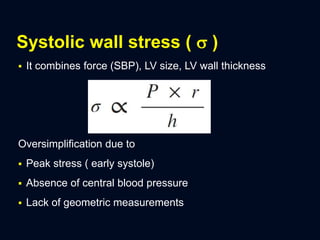
Systolic wall stress (  )
 It combines force (SBP), LV size, LV wall thickness
Oversimplification due to
 Peak stress ( early systole)
 Absence of central blood pressure
 Lack of geometric measurements
 LVESWS= (0.334 P(LVID)/PWT [1 + PWT/LVID])
 LVESWS – LV end systolic wall stress
 LVID – Left ventricle inner diameter
 PWT – posterior wall thickness
 P – SBP
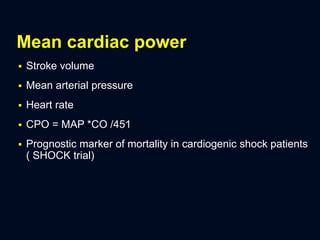
Mean cardiac power
 Stroke volume
 Mean arterial pressure
 Heart rate
 CPO = MAP *CO /451
 Prognostic marker of mortality in cardiogenic shock patients
( SHOCK trial)
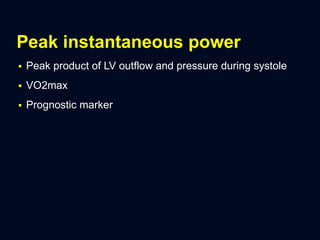
Peak instantaneous power
 Peak product of LV outflow and pressure during systole
 VO2max
 Prognostic marker
LV mid wall shortening
 Less dependent on LV geometry

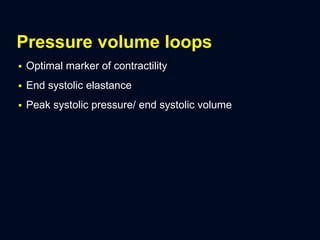
Pressure volume loops
 Optimal marker of contractility
 End systolic elastance
 Peak systolic pressure/ end systolic volume
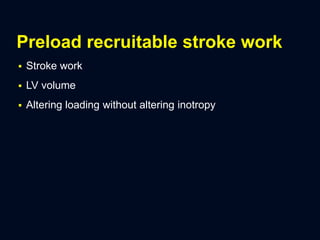
Preload recruitable stroke work
 Stroke work
 LV volume
 Altering loading without altering inotropy
DSE,exercise
 Difficult in dilated failing heart
 Can be used for LV, RV contractile reserve
LV diastolic function
 Assessment of DD – LV filling pressures is limited in
patients with preserved EF
 Septal tissue velocities (preserved)
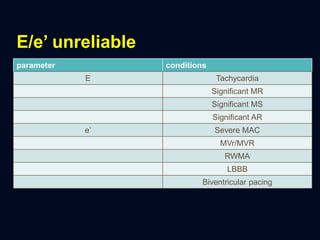
E/e’ unreliable
parameter conditions
E Tachycardia
Significant MR
Significant MS
Significant AR
e’ Severe MAC
MVr/MVR
RWMA
LBBB
Biventricular pacing
Assessment of subclinical
dysfunction
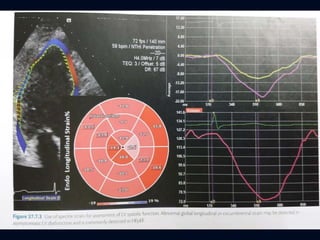
 Global longitudinal strain (GLS)
 Quantitative measure of myocardial deformation
 LV synchrony in overt HF
 RV assessment
 Preclinical phase of HF
 High frequency sampling of strain rate as a marker of
contractility.
 Speckle tracking of grey scale images – since 10 years.
LV morphology
 Sphericity index by 3D ECHO
 LV volumes by 2D echo - geometric assumptions, off-
axis imaging
 Basal septal hypertrophy – hypertensive heart disease
 Amyloidosis- decreased QRS amplitudes, e’< 5 cm/sec,
strain < 10%, apical sparing pattern of LV strain
 Contrast echo – for LV thrombus
Hemodynamics
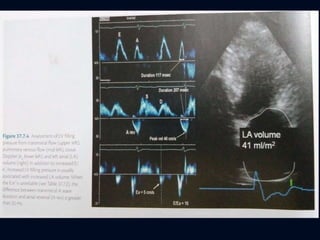
 LV filling pressures – transmitral flow
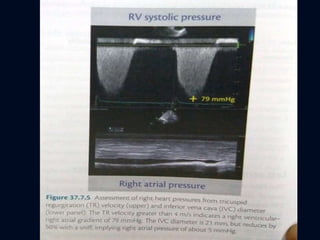
 PASP – by TRJV
 RVSP = PASP + RAP
 Underestimated PASP in severe TR, RAP overestimated
 Stroke volume with doppler derived stroke volume
 dp/dt > 1200mmhg/sec- in case of MR
Left atrial volumes
 LA dilates in non uniform fashion
 Time averaged marker of LV filling pressures
 Left atrial function by transmitral, pulmonary vein doppler
 Left atrial strain – prognostic markers
 Total strain – reservoir function
 Active strain – contractile function
RV function
 Limited reproducibility due to RV shape assessment
 Qualitative
 Quantitative- TAPSE, FAC, MPI, TAPSV
 RV free wall strain
Valvular assessment
 MR quantitatively
 Decreased LVEF + severe MR vs severe MR
 MV morphology
 Regurgitant jet direction
 Functional MR – central jet
 Ischemic MR – commisural jet
Thank you

Heart failure - Echocardiography

  • 1.
    Chronic Heart Failure– Role of Echocardiography DR.N.PRAVEEN
  • 2.
    Introduction  Echocardiography isthe investigation of choice in imaging of the heart failure patient.  Readily available, low cost  Useful for diagnosis, prognostification  Limitations – inter observer variability, assumptions of geometric shapes, heart rate, load dependency.
  • 3.
    Use of echocardiographyin Heart Failure  1.Assessment of ejection fraction  2.Quantification of Mitral Regurgitation, LV shape assessment  3. RV function assessment  4. LV diastolic function  5. LV stress – differentiation of ischemic vs nonischemic  6. Relative wall thickness, LV mass  7. Handheld USG – intravascular volume, pulmonary congestion
  • 4.
    Left ventricular systolicfunction  M mode – accurate assessment of wall, chamber dimensions.  2D echo – valve imaging  Usually qualitative assessment of EF  Quantitative assessment  Misleading in irregular rhythm, large and small LVs, extremes of heart rate (tachycardia, bradycardia)  Most widely used quantitative method – Biplane Simpson’s method.  Repeated testing lead to variable volumes – EF results.
  • 5.
    Unfortunately in 2DEcho All measurements are susceptible to  Load dependence  Inaccurate tracing  Poor test-retest reliability  Limited prognostic value ( when EF is close to normal range).
  • 7.
    3D Echo isthe future – for assessment  Accurate assessment of LV volumes, Ejection fraction  Less test- retest variation  EF by geometric assumptions of LV is avoided.
  • 9.
    HFPEF  Half ofpatients with heart failure  It should not be a diagnosis of exclusion.  Can be precisely called as disorder of inadequacy of EF than normal systolic function.
  • 10.
    Apart from LVEF…what to be assessed in HFPEF  LV performance is dependent on contractility, loading  During evaluation of ejection phase parameters – systolic blood pressure (SBP) to be taken into account however preload assessment is more difficult.  Two LV function parameters outside the LVEF  LV myocardial performance index  LV isovolumic acceleration
  • 11.
    Systolic wall stress(  )  It combines force (SBP), LV size, LV wall thickness Oversimplification due to  Peak stress ( early systole)  Absence of central blood pressure  Lack of geometric measurements
  • 12.
     LVESWS= (0.334P(LVID)/PWT [1 + PWT/LVID])  LVESWS – LV end systolic wall stress  LVID – Left ventricle inner diameter  PWT – posterior wall thickness  P – SBP
  • 13.
    Mean cardiac power Stroke volume  Mean arterial pressure  Heart rate  CPO = MAP *CO /451  Prognostic marker of mortality in cardiogenic shock patients ( SHOCK trial)
  • 14.
    Peak instantaneous power Peak product of LV outflow and pressure during systole  VO2max  Prognostic marker
  • 15.
    LV mid wallshortening  Less dependent on LV geometry 
  • 16.
    Pressure volume loops Optimal marker of contractility  End systolic elastance  Peak systolic pressure/ end systolic volume
  • 17.
    Preload recruitable strokework  Stroke work  LV volume  Altering loading without altering inotropy
  • 18.
    DSE,exercise  Difficult indilated failing heart  Can be used for LV, RV contractile reserve
  • 19.
    LV diastolic function Assessment of DD – LV filling pressures is limited in patients with preserved EF  Septal tissue velocities (preserved)
  • 21.
    E/e’ unreliable parameter conditions ETachycardia Significant MR Significant MS Significant AR e’ Severe MAC MVr/MVR RWMA LBBB Biventricular pacing
  • 22.
    Assessment of subclinical dysfunction Global longitudinal strain (GLS)  Quantitative measure of myocardial deformation  LV synchrony in overt HF  RV assessment  Preclinical phase of HF  High frequency sampling of strain rate as a marker of contractility.  Speckle tracking of grey scale images – since 10 years.
  • 24.
    LV morphology  Sphericityindex by 3D ECHO  LV volumes by 2D echo - geometric assumptions, off- axis imaging  Basal septal hypertrophy – hypertensive heart disease  Amyloidosis- decreased QRS amplitudes, e’< 5 cm/sec, strain < 10%, apical sparing pattern of LV strain  Contrast echo – for LV thrombus
  • 25.
    Hemodynamics  LV fillingpressures – transmitral flow  PASP – by TRJV  RVSP = PASP + RAP  Underestimated PASP in severe TR, RAP overestimated  Stroke volume with doppler derived stroke volume  dp/dt > 1200mmhg/sec- in case of MR
  • 27.
    Left atrial volumes LA dilates in non uniform fashion  Time averaged marker of LV filling pressures  Left atrial function by transmitral, pulmonary vein doppler  Left atrial strain – prognostic markers  Total strain – reservoir function  Active strain – contractile function
  • 28.
    RV function  Limitedreproducibility due to RV shape assessment  Qualitative  Quantitative- TAPSE, FAC, MPI, TAPSV  RV free wall strain
  • 29.
    Valvular assessment  MRquantitatively  Decreased LVEF + severe MR vs severe MR  MV morphology  Regurgitant jet direction  Functional MR – central jet  Ischemic MR – commisural jet
  • 31.