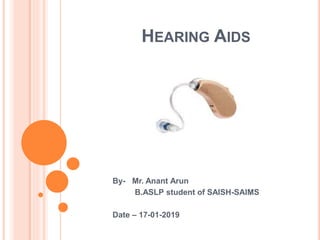
HEARING AIDS
By- Mr. Anant Arun
B.ASLP student of SAISH-SAIMS
Date – 17-01-2019
 Hearing Aids
 How the Hearing Aid work
 Types of Hearing Aids
 Hearing Aid Style
 Hearing Aid Effect
 Hearing Aid Components
 Batteries
 Microphone
 Receiver
 Signal Processer
 Other Aids
1. BAHA
2. CROSS
Topics to be covered
 A hearing aid is a device designed to improve hearing by
making sound audible to a person with hearing loss
 A hearing aid is a battery-powered electronic device
designed to improve your hearing. Small enough to wear
in or behind your ear, they make some sounds louder.
They may help you hear better when it's quiet and when
it's noisy.
Hearing Aids
 A microphone picks up sound around you.
 An amplifier makes the sound louder.
 A receiver sends these amplified sounds into your ear.
How the Hearing Aid work
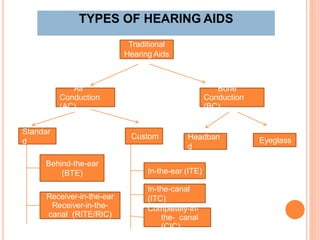
Traditional
Hearing Aids
Air
Conduction
(AC)
Bone
Conduction
(BC)
Standar
d
Custom
EyeglassHeadban
d
Behind-the-ear
(BTE)
Receiver-in-the-ear
Receiver-in-the-
canal (RITE/RIC)
In-the-ear (ITE)
In-the-canal
(ITC)
Completely-in-
the- canal
(CIC)
TYPES OF HEARING AIDS
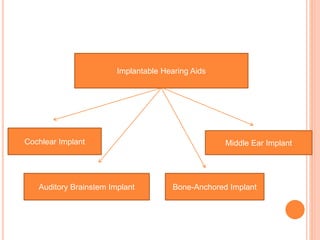
Implantable Hearing Aids
Middle Ear Implant
Bone-Anchored ImplantAuditory Brainstem Implant
Cochlear Implant
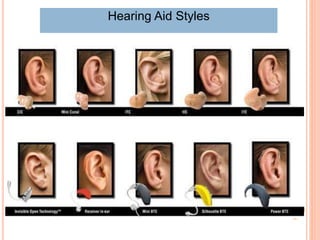
Hearing Aid Styles
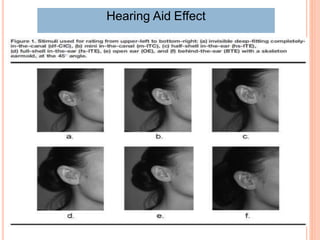
Hearing Aid Effect
Johnson et al 2005
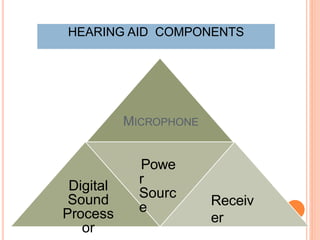
MICROPHONE
Digital
Sound
Process
or
Powe
r
Sourc
e Receiv
er
HEARING AID COMPONENTS
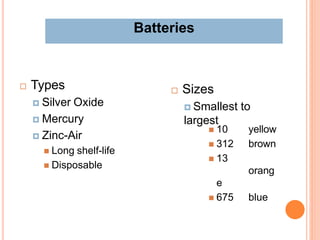
 Types
 Silver Oxide
 Mercury
 Zinc-Air
 Long shelf-life
 Disposable
 Sizes
 Smallest to
largest
 10 yellow
 312 brown
 13
orang
e
 675 blue
Batteries
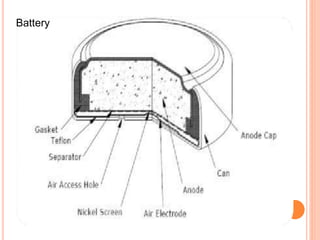
Battery
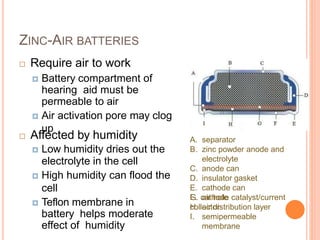
ZINC-AIR BATTERIES
 Require air to work
 Battery compartment of
hearing aid must be
permeable to air
 Air activation pore may clog
up
 Affected by humidity
 Low humidity dries out the
electrolyte in the cell
 High humidity can flood the
cell
 Teflon membrane in
battery helps moderate
effect of humidity
A. separator
B. zinc powder anode and
electrolyte
C. anode can
D. insulator gasket
E. cathode can
F. air holeG. cathode catalyst/current
collectorH. air distribution layer
I. semipermeable
membrane
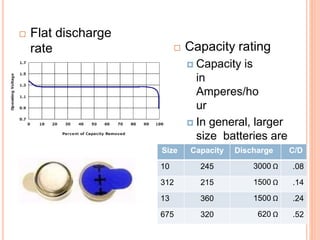
 Flat discharge
rate  Capacity rating
 Capacity is
in
Amperes/ho
ur
 In general, larger
size batteries are
designed for
greater load.
Size Capacity Discharge C/D
10 245 3000 Ω .08
312 215 1500 Ω .14
13 360 1500 Ω .24
675 320 620 Ω .52
 2320 cases of
battery ingestion
 1983 – 1990
 952 were hearing
aid batteries (45%)
 Of those cases, 312
(33%) were batteries
removed from the
hearing aid by the
child
Litovitz & Schmitz, 1992
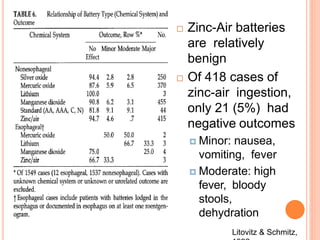
 Zinc-Air batteries
are relatively
benign
 Of 418 cases of
zinc-air ingestion,
only 21 (5%) had
negative outcomes
 Minor: nausea,
vomiting, fever
 Moderate: high
fever, bloody
stools,
dehydration
Litovitz & Schmitz,
 If anyone ingests a battery, this is what you should
do:
 Immediately call the 24-hour National Battery Ingestion
Hotline at 202-625-3333 (call collect if necessary), or
call your poison center at 1-800-222-1222.
 If readily available, provide the battery identification
number, found on the package or from a matching
battery.
 In most cases, an x-ray must be obtained right away to
be sure that the battery has gone through the
esophagus into the stomach. (If the battery remains in
the esophagus, it must be removed immediately. Most
batteries move on to the stomach and can be allowed to
pass by themselves.) Based on the age of
the patient and size of the battery, the National Battery
Ingestion Hotline specialists can help you determine if
 Don't induce vomiting.Don't eat or drink until the x-ray
shows the battery is beyond the esophagus.
 Watch for fever, abdominal pain, vomiting, or blood in the
stools. Report these symptoms immediately.
 Check the stools until the battery has passed.
 Your physician or the emergency room may call the
National Button Battery Ingestion Hotline/National
Capital Poison Center collect at 202-625-3333 for
consultation about button batteries. Expert advice is
available 24 hours a day, 7 days a week.
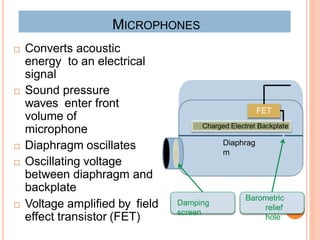
MICROPHONES
 Converts acoustic
energy to an electrical
signal
 Sound pressure
waves enter front
volume of
microphone
 Diaphragm oscillates
 Oscillating voltage
between diaphragm and
backplate
 Voltage amplified by field
effect transistor (FET)
Diaphrag
m
Charged Electret Backplate
FET
Barometric
relief
hole
Damping
screen
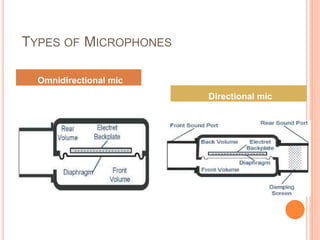
TYPES OF MICROPHONES
Omnidirectional mic
Directional mic
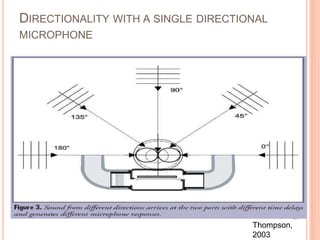
DIRECTIONALITY WITH A SINGLE DIRECTIONAL
MICROPHONE
Thompson,
2003
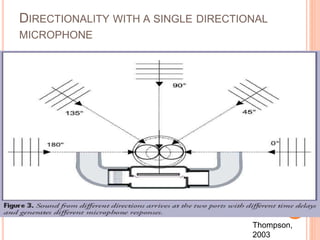
DIRECTIONALITY WITH A SINGLE DIRECTIONAL
MICROPHONE
Thompson,
2003
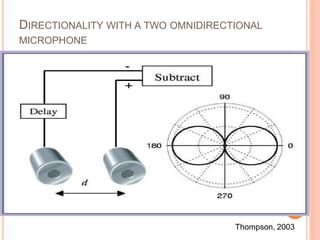
DIRECTIONALITY WITH A TWO OMNIDIRECTIONAL
MICROPHONE
Thompson, 2003
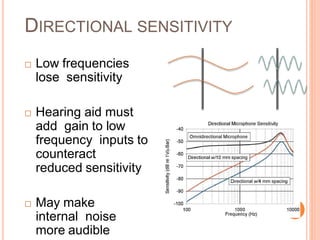
DIRECTIONAL SENSITIVITY
 Low frequencies
lose sensitivity
 Hearing aid must
add gain to low
frequency inputs to
counteract
reduced sensitivity
 May make
internal noise
more audible
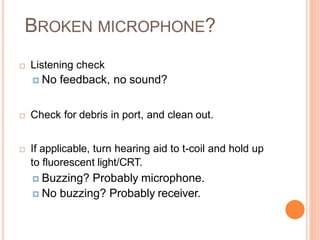
BROKEN MICROPHONE?
 Listening check
 No feedback, no sound?
 Check for debris in port, and clean out.
 If applicable, turn hearing aid to t-coil and hold up
to fluorescent light/CRT.
 Buzzing? Probably microphone.
 No buzzing? Probably receiver.
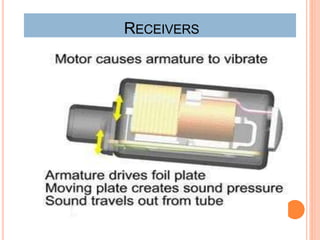
RECEIVERS
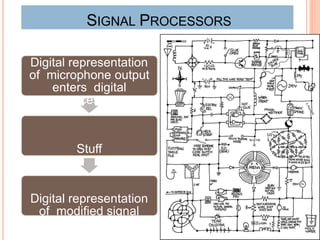
Digital representation
of microphone output
enters digital
processor
Stuff
Digital representation
of modified signal
sent to receiver
SIGNAL PROCESSORS
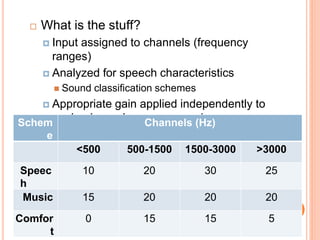
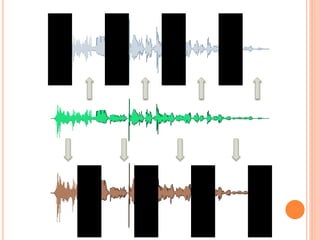
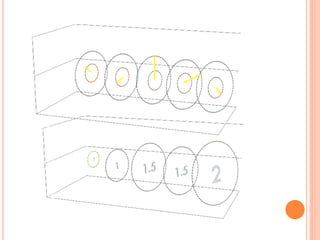
 What is the stuff?
 Input assigned to channels (frequency
ranges)
 Analyzed for speech characteristics
 Sound classification schemes
 Appropriate gain applied independently to
each channel per programmingSchem
e
Channels (Hz)
<500 500-1500 1500-3000 >3000
Speec
h
10 20 30 25
Music 15 20 20 20
Comfor
t
0 15 15 5
1
0
-1
0
-1
1
250 500
1000
2000
4000
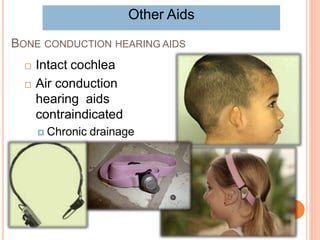
BONE CONDUCTION HEARING AIDS
 Intact cochlea
 Air conduction
hearing aids
contraindicated
 Chronic drainage
 Microtia
Other Aids
250 500
Frequency (Hz)
1000 2000 4000 8000
-10
Intensity(dBHL) 10
20
30
40
50
60
70
80
90
100
110
120
O O
O O
[
[0 [ ]
]
[ ]
]
[ ]
X
O
X X OX
O
X
X
X
O
X
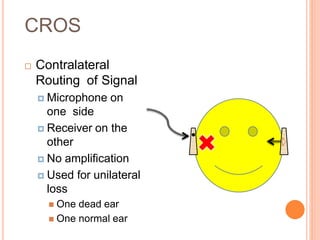
CROS
 Contralateral
Routing of Signal
 Microphone on
one side
 Receiver on the
other
 No amplification
 Used for unilateral
loss
 One dead ear
 One normal ear
Frequency (Hz)
1000 2000 4000 8000
-10
Intensity(dBHL)
0
10
20
30
40
50
60
70
80
90
100
110
120





250 500
<O
<
O
<
O
<O O O
O
O
<
   
]
]
] ] ]
Thank You
For Suggestion – anantarun27@gmail.com
Follow me on Instagram - anant_arun27

Hearing Aid

  • 1.
    HEARING AIDS By- Mr.Anant Arun B.ASLP student of SAISH-SAIMS Date – 17-01-2019
  • 2.
     Hearing Aids How the Hearing Aid work  Types of Hearing Aids  Hearing Aid Style  Hearing Aid Effect  Hearing Aid Components  Batteries  Microphone  Receiver  Signal Processer  Other Aids 1. BAHA 2. CROSS Topics to be covered
  • 3.
     A hearingaid is a device designed to improve hearing by making sound audible to a person with hearing loss  A hearing aid is a battery-powered electronic device designed to improve your hearing. Small enough to wear in or behind your ear, they make some sounds louder. They may help you hear better when it's quiet and when it's noisy. Hearing Aids
  • 4.
     A microphonepicks up sound around you.  An amplifier makes the sound louder.  A receiver sends these amplified sounds into your ear. How the Hearing Aid work
  • 5.
  • 6.
    Implantable Hearing Aids MiddleEar Implant Bone-Anchored ImplantAuditory Brainstem Implant Cochlear Implant
  • 7.
  • 8.
  • 9.
  • 10.
  • 11.
     Types  SilverOxide  Mercury  Zinc-Air  Long shelf-life  Disposable  Sizes  Smallest to largest  10 yellow  312 brown  13 orang e  675 blue Batteries
  • 12.
  • 13.
    ZINC-AIR BATTERIES  Requireair to work  Battery compartment of hearing aid must be permeable to air  Air activation pore may clog up  Affected by humidity  Low humidity dries out the electrolyte in the cell  High humidity can flood the cell  Teflon membrane in battery helps moderate effect of humidity A. separator B. zinc powder anode and electrolyte C. anode can D. insulator gasket E. cathode can F. air holeG. cathode catalyst/current collectorH. air distribution layer I. semipermeable membrane
  • 14.
     Flat discharge rate Capacity rating  Capacity is in Amperes/ho ur  In general, larger size batteries are designed for greater load. Size Capacity Discharge C/D 10 245 3000 Ω .08 312 215 1500 Ω .14 13 360 1500 Ω .24 675 320 620 Ω .52
  • 15.
     2320 casesof battery ingestion  1983 – 1990  952 were hearing aid batteries (45%)  Of those cases, 312 (33%) were batteries removed from the hearing aid by the child Litovitz & Schmitz, 1992
  • 16.
     Zinc-Air batteries arerelatively benign  Of 418 cases of zinc-air ingestion, only 21 (5%) had negative outcomes  Minor: nausea, vomiting, fever  Moderate: high fever, bloody stools, dehydration Litovitz & Schmitz,
  • 17.
     If anyoneingests a battery, this is what you should do:  Immediately call the 24-hour National Battery Ingestion Hotline at 202-625-3333 (call collect if necessary), or call your poison center at 1-800-222-1222.  If readily available, provide the battery identification number, found on the package or from a matching battery.  In most cases, an x-ray must be obtained right away to be sure that the battery has gone through the esophagus into the stomach. (If the battery remains in the esophagus, it must be removed immediately. Most batteries move on to the stomach and can be allowed to pass by themselves.) Based on the age of the patient and size of the battery, the National Battery Ingestion Hotline specialists can help you determine if
  • 18.
     Don't inducevomiting.Don't eat or drink until the x-ray shows the battery is beyond the esophagus.  Watch for fever, abdominal pain, vomiting, or blood in the stools. Report these symptoms immediately.  Check the stools until the battery has passed.  Your physician or the emergency room may call the National Button Battery Ingestion Hotline/National Capital Poison Center collect at 202-625-3333 for consultation about button batteries. Expert advice is available 24 hours a day, 7 days a week.
  • 19.
    MICROPHONES  Converts acoustic energyto an electrical signal  Sound pressure waves enter front volume of microphone  Diaphragm oscillates  Oscillating voltage between diaphragm and backplate  Voltage amplified by field effect transistor (FET) Diaphrag m Charged Electret Backplate FET Barometric relief hole Damping screen
  • 20.
  • 21.
    DIRECTIONALITY WITH ASINGLE DIRECTIONAL MICROPHONE Thompson, 2003
  • 22.
    DIRECTIONALITY WITH ASINGLE DIRECTIONAL MICROPHONE Thompson, 2003
  • 23.
    DIRECTIONALITY WITH ATWO OMNIDIRECTIONAL MICROPHONE Thompson, 2003
  • 24.
    DIRECTIONAL SENSITIVITY  Lowfrequencies lose sensitivity  Hearing aid must add gain to low frequency inputs to counteract reduced sensitivity  May make internal noise more audible
  • 25.
    BROKEN MICROPHONE?  Listeningcheck  No feedback, no sound?  Check for debris in port, and clean out.  If applicable, turn hearing aid to t-coil and hold up to fluorescent light/CRT.  Buzzing? Probably microphone.  No buzzing? Probably receiver.
  • 26.
  • 27.
    Digital representation of microphoneoutput enters digital processor Stuff Digital representation of modified signal sent to receiver SIGNAL PROCESSORS
  • 28.
     What isthe stuff?  Input assigned to channels (frequency ranges)  Analyzed for speech characteristics  Sound classification schemes  Appropriate gain applied independently to each channel per programmingSchem e Channels (Hz) <500 500-1500 1500-3000 >3000 Speec h 10 20 30 25 Music 15 20 20 20 Comfor t 0 15 15 5
  • 30.
  • 32.
    BONE CONDUCTION HEARINGAIDS  Intact cochlea  Air conduction hearing aids contraindicated  Chronic drainage  Microtia Other Aids
  • 33.
    250 500 Frequency (Hz) 10002000 4000 8000 -10 Intensity(dBHL) 10 20 30 40 50 60 70 80 90 100 110 120 O O O O [ [0 [ ] ] [ ] ] [ ] X O X X OX O X X X O X
  • 34.
    CROS  Contralateral Routing ofSignal  Microphone on one side  Receiver on the other  No amplification  Used for unilateral loss  One dead ear  One normal ear
  • 35.
    Frequency (Hz) 1000 20004000 8000 -10 Intensity(dBHL) 0 10 20 30 40 50 60 70 80 90 100 110 120      250 500 <O < O < O <O O O O O <     ] ] ] ] ]
  • 36.
  • 37.
    For Suggestion –anantarun27@gmail.com Follow me on Instagram - anant_arun27

Editor's Notes

  • #8 http://www.jefferson.edu/jmc/departments/otolaryngology/centers/balance_hearing/patient_services/hearing_loss.html