Implantable Auditory Devices
Darius Kohan, M.D.
Director of Otology/Neurotology
Lenox Hill Hospital
Manhattan Eye, Ear, and Throat Hospital
New York City
New York, NY
March 20, 2015
Implantable Auditory Devices
Sophono
Darius Kohan, M.D.
Director of Otology/Neurotology
Lenox Hill Hospital
Manhattan Eye, Ear, and Throat Hospital
New York City
New York, NY
March 20, 2015
Disclosures
• Financial – None
• Some Slides Courtesy of Sophono
Implantable Auditory Devices (IAD) –
Why not a Hearing Aid?
• Inability to wear, tolerate or benefit from
standard amplification
• Not cochlear implant candidate
• Financial considerations
Indications for Bone Conduction Implants
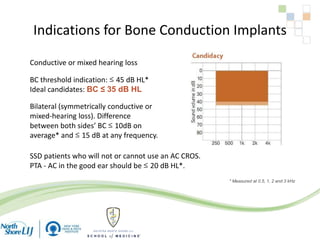
Conductive or mixed hearing loss
BC threshold indication: ≤ 45 dB HL*
Ideal candidates: BC ≤ 35 dB HL
Bilateral (symmetrically conductive or
mixed-hearing loss). Difference
between both sides’ BC ≤ 10dB on
average* and ≤ 15 dB at any frequency.
SSD patients who will not or cannot use an AC CROS.
PTA - AC in the good ear should be ≤ 20 dB HL*.
* Measured at 0.5, 1, 2 and 3 kHz
Transcutaneous Versus Percutaneous
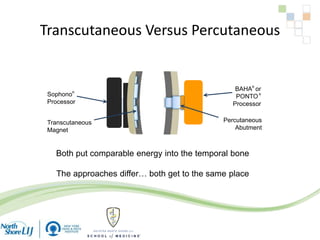
BAHA®
or
PONTO®
Processor
Percutaneous
Abutment
Sophono®
Processor
Transcutaneous
Magnet
Both put comparable energy into the temporal bone
The approaches differ… both get to the same place
The Way Sound Vibrations Travel
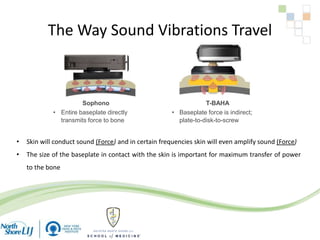
Sophono
• Entire baseplate directly
transmits force to bone
T-BAHA
• Baseplate force is indirect;
plate-to-disk-to-screw
• Skin will conduct sound (Force) and in certain frequencies skin will even amplify sound (Force)
• The size of the baseplate in contact with the skin is important for maximum transfer of power
to the bone
Force (Sound) Wave
propagating in bone
Alpha 2
Force Injected
into skin
Magnetic
Implant
Force (Sound) Wave
propagating in bone
TETTM Technology
TETTM Technology
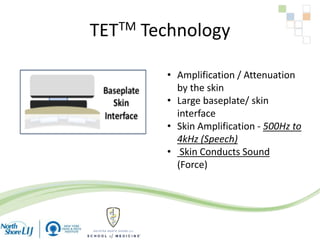
• Amplification / Attenuation
by the skin
• Large baseplate/ skin
interface
• Skin Amplification - 500Hz to
4kHz (Speech)
• Skin Conducts Sound
(Force)
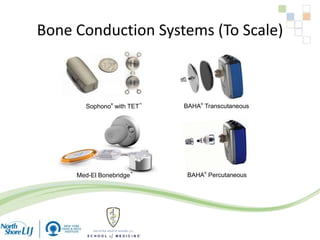
Bone Conduction Systems (To Scale)
Sophono®
with TET™
BAHA®
Transcutaneous
Med-El Bonebridge™
BAHA®
Percutaneous
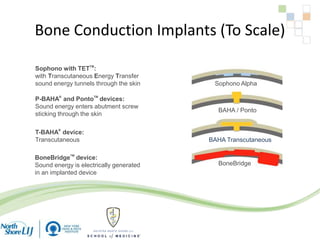
Bone Conduction Implants (To Scale)
BoneBridge
BAHA / Ponto
BAHA Transcutaneous
Sophono Alpha
Sophono with TETTM
:
with Transcutaneous Energy Transfer
sound energy tunnels through the skin
P-BAHA®
and PontoTM
devices:
Sound energy enters abutment screw
sticking through the skin
T-BAHA®
device:
Transcutaneous
BoneBridgeTM
device:
Sound energy is electrically generated
in an implanted device
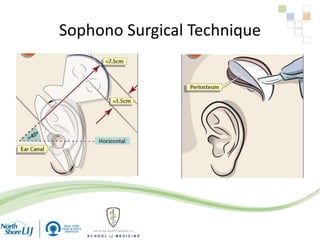
Sophono Surgical Technique
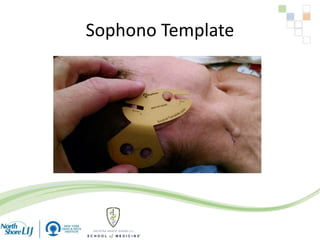
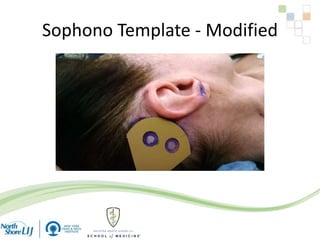
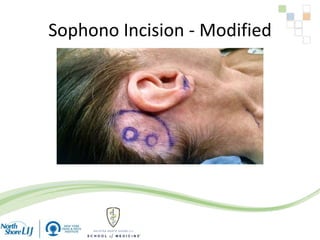
Sophono Template
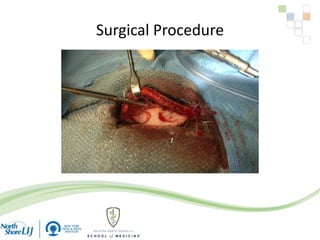
Surgical Procedure
Bone Wells
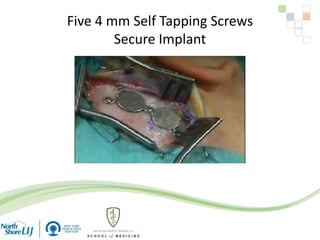
Five 4 mm Self Tapping Screws
Secure Implant
Sophono Template - Modified
Sophono Incision - Modified
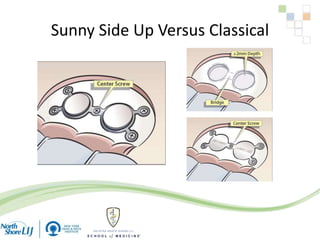
Sunny Side Up Versus Classical
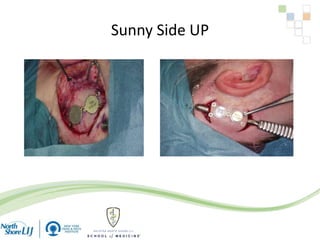
Sunny Side UP
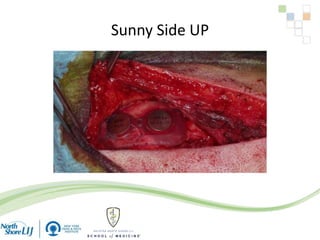
Sunny Side UP
IAD Available in the USA
Osseointegrated Devices:
• BAHA Connect
• BAHA Attract
• Ponto
• Sophono
Bone Conduction Device:
• Bonebridge – close to approval by FDA
Mechanically Driven Devices:
• Vibrant Soundbridge
• Maxum
• Esteem
Other Alternatives:
• Soundbite system
IAD - Which One to Select?
• Indications between devices greatly overlap
• Each company promotes their product as the best and safest!
• Similar dilemma as in CI options: which one is the safest, provides best
audition and reliability
• Doctors and audiologist may guide patient based on patient
medical/auditory status
• Consider financial factors and insurance coverage
• Consider how available is the company support for their particular device
• Does the surgical/audiology teem have the skill and knowhow for all
devices?
• Does the patient really decide on IAD, or does the otologist/audiologist
make the decision for them?
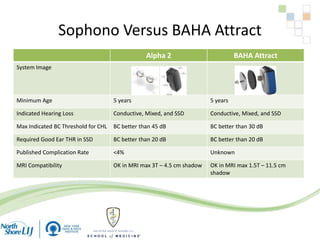
Sophono Versus BAHA Attract
Alpha 2 BAHA Attract
System Image
Minimum Age 5 years 5 years
Indicated Hearing Loss Conductive, Mixed, and SSD Conductive, Mixed, and SSD
Max Indicated BC Threshold for CHL BC better than 45 dB BC better than 30 dB
Required Good Ear THR in SSD BC better than 20 dB BC better than 20 dB
Published Complication Rate <4% Unknown
MRI Compatibility OK in MRI max 3T – 4.5 cm shadow OK in MRI max 1.5T – 11.5 cm
shadow
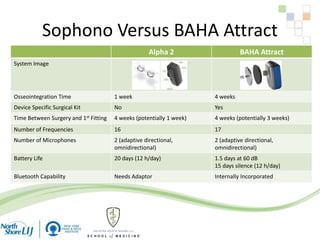
Sophono Versus BAHA Attract
Alpha 2 BAHA Attract
System Image
Osseointegration Time 1 week 4 weeks
Device Specific Surgical Kit No Yes
Time Between Surgery and 1st Fitting 4 weeks (potentially 1 week) 4 weeks (potentially 3 weeks)
Number of Frequencies 16 17
Number of Microphones 2 (adaptive directional,
omnidirectional)
2 (adaptive directional,
omnidirectional)
Battery Life 20 days (12 h/day) 1.5 days at 60 dB
15 days silence (12 h/day)
Bluetooth Capability Needs Adaptor Internally Incorporated
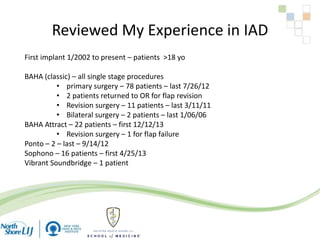
Reviewed My Experience in IAD
First implant 1/2002 to present – patients >18 yo
BAHA (classic) – all single stage procedures
• primary surgery – 78 patients – last 7/26/12
• 2 patients returned to OR for flap revision
• Revision surgery – 11 patients – last 3/11/11
• Bilateral surgery – 2 patients – last 1/06/06
BAHA Attract – 22 patients – first 12/12/13
• Revision surgery – 1 for flap failure
Ponto – 2 – last – 9/14/12
Sophono – 16 patients – first 4/25/13
Vibrant Soundbridge – 1 patient
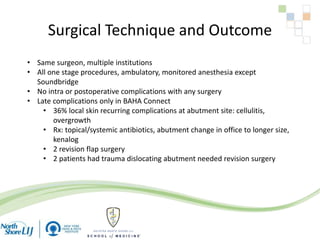
Surgical Technique and Outcome
• Same surgeon, multiple institutions
• All one stage procedures, ambulatory, monitored anesthesia except
Soundbridge
• No intra or postoperative complications with any surgery
• Late complications only in BAHA Connect
• 36% local skin recurring complications at abutment site: cellulitis,
overgrowth
• Rx: topical/systemic antibiotics, abutment change in office to longer size,
kenalog
• 2 revision flap surgery
• 2 patients had trauma dislocating abutment needed revision surgery
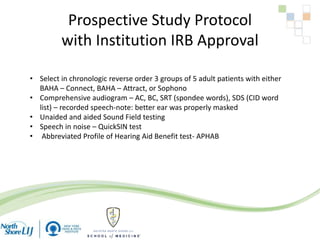
Prospective Study Protocol
with Institution IRB Approval
• Select in chronologic reverse order 3 groups of 5 adult patients with either
BAHA – Connect, BAHA – Attract, or Sophono
• Comprehensive audiogram – AC, BC, SRT (spondee words), SDS (CID word
list) – recorded speech-note: better ear was properly masked
• Unaided and aided Sound Field testing
• Speech in noise – QuickSIN test
• Abbreviated Profile of Hearing Aid Benefit test- APHAB
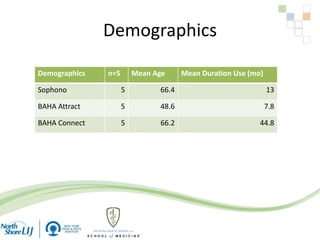
Demographics
Demographics n=5 Mean Age Mean Duration Use (mo)
Sophono 5 66.4 13
BAHA Attract 5 48.6 7.8
BAHA Connect 5 66.2 44.8
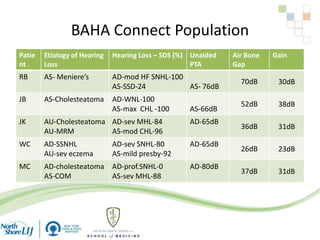
BAHA Connect Population
Patie
nt
Etiology of Hearing
Loss
Hearing Loss – SDS (%) Unaided
PTA
Air Bone
Gap
Gain
RB AS- Meniere’s AD-mod HF SNHL-100
AS-SSD-24 AS- 76dB
70dB 30dB
JB AS-Cholesteatoma AD-WNL-100
AS-max CHL -100 AS-66dB
52dB 38dB
JK AU-Cholesteatoma
AU-MRM
AD-sev MHL-84
AS-mod CHL-96
AD-65dB
36dB 31dB
WC AD-SSNHL
AU-sev eczema
AD-sev SNHL-80
AS-mild presby-92
AD-65dB
26dB 23dB
MC AD-cholesteatoma
AS-COM
AD-prof.SNHL-0
AS-sev MHL-88
AD-80dB
37dB 31dB
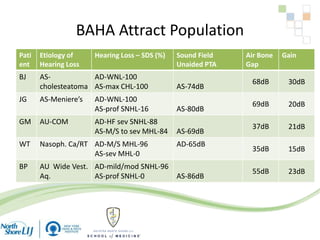
BAHA Attract Population
Pati
ent
Etiology of
Hearing Loss
Hearing Loss – SDS (%) Sound Field
Unaided PTA
Air Bone
Gap
Gain
BJ AS-
cholesteatoma
AD-WNL-100
AS-max CHL-100 AS-74dB
68dB 30dB
JG AS-Meniere’s AD-WNL-100
AS-prof SNHL-16 AS-80dB
69dB 20dB
GM AU-COM AD-HF sev SNHL-88
AS-M/S to sev MHL-84 AS-69dB
37dB 21dB
WT Nasoph. Ca/RT AD-M/S MHL-96
AS-sev MHL-0
AD-65dB
35dB 15dB
BP AU Wide Vest.
Aq.
AD-mild/mod SNHL-96
AS-prof SNHL-0 AS-86dB
55dB 23dB
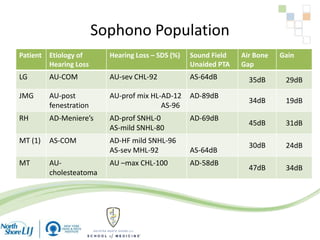
Sophono Population
Patient Etiology of
Hearing Loss
Hearing Loss – SDS (%) Sound Field
Unaided PTA
Air Bone
Gap
Gain
LG AU-COM AU-sev CHL-92 AS-64dB 35dB 29dB
JMG AU-post
fenestration
AU-prof mix HL-AD-12
AS-96
AD-89dB
34dB 19dB
RH AD-Meniere’s AD-prof SNHL-0
AS-mild SNHL-80
AD-69dB
45dB 31dB
MT (1) AS-COM AD-HF mild SNHL-96
AS-sev MHL-92 AS-64dB
30dB 24dB
MT AU-
cholesteatoma
AU –max CHL-100 AD-58dB
47dB 34dB
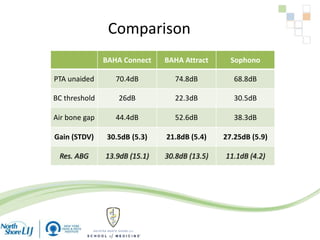
Comparison
BAHA Connect BAHA Attract Sophono
PTA unaided 70.4dB 74.8dB 68.8dB
BC threshold 26dB 22.3dB 30.5dB
Air bone gap 44.4dB 52.6dB 38.3dB
Gain (STDV) 30.5dB (5.3) 21.8dB (5.4) 27.25dB (5.9)
Res. ABG 13.9dB (15.1) 30.8dB (13.5) 11.1dB (4.2)
0
5
10
15
20
25
30
35
40
500 1000 2000 4000
dB
Frequency (Hz)
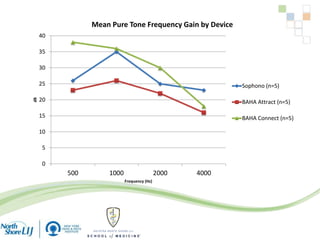
Mean Pure Tone Frequency Gain by Device
Sophono (n=5)
BAHA Attract (n=5)
BAHA Connect (n=5)
-5
0
5
10
15
20
25
30
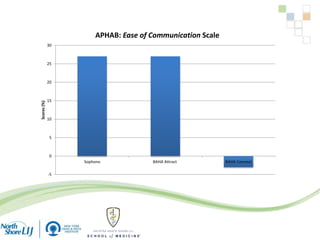
Sophono BAHA Attract BAHA Connect
Scores(%)
APHAB: Ease of Communication Scale
Preliminary Conclusions
• All studies devices were easy to insert in less than 30 minutes
• No operative complications
• Late local complications with the BAHA Connect are common
• All device options provide patient benefit
• Percutaneous Baha Connect provides the best PTA gain of 31dB
• Transcutaneous Sophono provides on average 6 dB better PTA gain vs. Baha
Attract
• Gain at high frequencies drops off for all devices, the least decline for
Sophono

Implantable Course 2015 Sophono

  • 1.
    Implantable Auditory Devices DariusKohan, M.D. Director of Otology/Neurotology Lenox Hill Hospital Manhattan Eye, Ear, and Throat Hospital New York City New York, NY March 20, 2015
  • 2.
    Implantable Auditory Devices Sophono DariusKohan, M.D. Director of Otology/Neurotology Lenox Hill Hospital Manhattan Eye, Ear, and Throat Hospital New York City New York, NY March 20, 2015
  • 3.
    Disclosures • Financial –None • Some Slides Courtesy of Sophono
  • 4.
    Implantable Auditory Devices(IAD) – Why not a Hearing Aid? • Inability to wear, tolerate or benefit from standard amplification • Not cochlear implant candidate • Financial considerations
  • 5.
    Indications for BoneConduction Implants Conductive or mixed hearing loss BC threshold indication: ≤ 45 dB HL* Ideal candidates: BC ≤ 35 dB HL Bilateral (symmetrically conductive or mixed-hearing loss). Difference between both sides’ BC ≤ 10dB on average* and ≤ 15 dB at any frequency. SSD patients who will not or cannot use an AC CROS. PTA - AC in the good ear should be ≤ 20 dB HL*. * Measured at 0.5, 1, 2 and 3 kHz
  • 6.
    Transcutaneous Versus Percutaneous BAHA® or PONTO® Processor Percutaneous Abutment Sophono® Processor Transcutaneous Magnet Bothput comparable energy into the temporal bone The approaches differ… both get to the same place
  • 7.
    The Way SoundVibrations Travel Sophono • Entire baseplate directly transmits force to bone T-BAHA • Baseplate force is indirect; plate-to-disk-to-screw • Skin will conduct sound (Force) and in certain frequencies skin will even amplify sound (Force) • The size of the baseplate in contact with the skin is important for maximum transfer of power to the bone
  • 8.
    Force (Sound) Wave propagatingin bone Alpha 2 Force Injected into skin Magnetic Implant Force (Sound) Wave propagating in bone TETTM Technology
  • 9.
    TETTM Technology • Amplification/ Attenuation by the skin • Large baseplate/ skin interface • Skin Amplification - 500Hz to 4kHz (Speech) • Skin Conducts Sound (Force)
  • 10.
    Bone Conduction Systems(To Scale) Sophono® with TET™ BAHA® Transcutaneous Med-El Bonebridge™ BAHA® Percutaneous
  • 11.
    Bone Conduction Implants(To Scale) BoneBridge BAHA / Ponto BAHA Transcutaneous Sophono Alpha Sophono with TETTM : with Transcutaneous Energy Transfer sound energy tunnels through the skin P-BAHA® and PontoTM devices: Sound energy enters abutment screw sticking through the skin T-BAHA® device: Transcutaneous BoneBridgeTM device: Sound energy is electrically generated in an implanted device
  • 12.
  • 13.
  • 14.
  • 15.
  • 16.
    Five 4 mmSelf Tapping Screws Secure Implant
  • 17.
  • 18.
  • 19.
    Sunny Side UpVersus Classical
  • 20.
  • 21.
  • 22.
    IAD Available inthe USA Osseointegrated Devices: • BAHA Connect • BAHA Attract • Ponto • Sophono Bone Conduction Device: • Bonebridge – close to approval by FDA Mechanically Driven Devices: • Vibrant Soundbridge • Maxum • Esteem Other Alternatives: • Soundbite system
  • 23.
    IAD - WhichOne to Select? • Indications between devices greatly overlap • Each company promotes their product as the best and safest! • Similar dilemma as in CI options: which one is the safest, provides best audition and reliability • Doctors and audiologist may guide patient based on patient medical/auditory status • Consider financial factors and insurance coverage • Consider how available is the company support for their particular device • Does the surgical/audiology teem have the skill and knowhow for all devices? • Does the patient really decide on IAD, or does the otologist/audiologist make the decision for them?
  • 24.
    Sophono Versus BAHAAttract Alpha 2 BAHA Attract System Image Minimum Age 5 years 5 years Indicated Hearing Loss Conductive, Mixed, and SSD Conductive, Mixed, and SSD Max Indicated BC Threshold for CHL BC better than 45 dB BC better than 30 dB Required Good Ear THR in SSD BC better than 20 dB BC better than 20 dB Published Complication Rate <4% Unknown MRI Compatibility OK in MRI max 3T – 4.5 cm shadow OK in MRI max 1.5T – 11.5 cm shadow
  • 25.
    Sophono Versus BAHAAttract Alpha 2 BAHA Attract System Image Osseointegration Time 1 week 4 weeks Device Specific Surgical Kit No Yes Time Between Surgery and 1st Fitting 4 weeks (potentially 1 week) 4 weeks (potentially 3 weeks) Number of Frequencies 16 17 Number of Microphones 2 (adaptive directional, omnidirectional) 2 (adaptive directional, omnidirectional) Battery Life 20 days (12 h/day) 1.5 days at 60 dB 15 days silence (12 h/day) Bluetooth Capability Needs Adaptor Internally Incorporated
  • 26.
    Reviewed My Experiencein IAD First implant 1/2002 to present – patients >18 yo BAHA (classic) – all single stage procedures • primary surgery – 78 patients – last 7/26/12 • 2 patients returned to OR for flap revision • Revision surgery – 11 patients – last 3/11/11 • Bilateral surgery – 2 patients – last 1/06/06 BAHA Attract – 22 patients – first 12/12/13 • Revision surgery – 1 for flap failure Ponto – 2 – last – 9/14/12 Sophono – 16 patients – first 4/25/13 Vibrant Soundbridge – 1 patient
  • 27.
    Surgical Technique andOutcome • Same surgeon, multiple institutions • All one stage procedures, ambulatory, monitored anesthesia except Soundbridge • No intra or postoperative complications with any surgery • Late complications only in BAHA Connect • 36% local skin recurring complications at abutment site: cellulitis, overgrowth • Rx: topical/systemic antibiotics, abutment change in office to longer size, kenalog • 2 revision flap surgery • 2 patients had trauma dislocating abutment needed revision surgery
  • 28.
    Prospective Study Protocol withInstitution IRB Approval • Select in chronologic reverse order 3 groups of 5 adult patients with either BAHA – Connect, BAHA – Attract, or Sophono • Comprehensive audiogram – AC, BC, SRT (spondee words), SDS (CID word list) – recorded speech-note: better ear was properly masked • Unaided and aided Sound Field testing • Speech in noise – QuickSIN test • Abbreviated Profile of Hearing Aid Benefit test- APHAB
  • 29.
    Demographics Demographics n=5 MeanAge Mean Duration Use (mo) Sophono 5 66.4 13 BAHA Attract 5 48.6 7.8 BAHA Connect 5 66.2 44.8
  • 30.
    BAHA Connect Population Patie nt Etiologyof Hearing Loss Hearing Loss – SDS (%) Unaided PTA Air Bone Gap Gain RB AS- Meniere’s AD-mod HF SNHL-100 AS-SSD-24 AS- 76dB 70dB 30dB JB AS-Cholesteatoma AD-WNL-100 AS-max CHL -100 AS-66dB 52dB 38dB JK AU-Cholesteatoma AU-MRM AD-sev MHL-84 AS-mod CHL-96 AD-65dB 36dB 31dB WC AD-SSNHL AU-sev eczema AD-sev SNHL-80 AS-mild presby-92 AD-65dB 26dB 23dB MC AD-cholesteatoma AS-COM AD-prof.SNHL-0 AS-sev MHL-88 AD-80dB 37dB 31dB
  • 31.
    BAHA Attract Population Pati ent Etiologyof Hearing Loss Hearing Loss – SDS (%) Sound Field Unaided PTA Air Bone Gap Gain BJ AS- cholesteatoma AD-WNL-100 AS-max CHL-100 AS-74dB 68dB 30dB JG AS-Meniere’s AD-WNL-100 AS-prof SNHL-16 AS-80dB 69dB 20dB GM AU-COM AD-HF sev SNHL-88 AS-M/S to sev MHL-84 AS-69dB 37dB 21dB WT Nasoph. Ca/RT AD-M/S MHL-96 AS-sev MHL-0 AD-65dB 35dB 15dB BP AU Wide Vest. Aq. AD-mild/mod SNHL-96 AS-prof SNHL-0 AS-86dB 55dB 23dB
  • 32.
    Sophono Population Patient Etiologyof Hearing Loss Hearing Loss – SDS (%) Sound Field Unaided PTA Air Bone Gap Gain LG AU-COM AU-sev CHL-92 AS-64dB 35dB 29dB JMG AU-post fenestration AU-prof mix HL-AD-12 AS-96 AD-89dB 34dB 19dB RH AD-Meniere’s AD-prof SNHL-0 AS-mild SNHL-80 AD-69dB 45dB 31dB MT (1) AS-COM AD-HF mild SNHL-96 AS-sev MHL-92 AS-64dB 30dB 24dB MT AU- cholesteatoma AU –max CHL-100 AD-58dB 47dB 34dB
  • 33.
    Comparison BAHA Connect BAHAAttract Sophono PTA unaided 70.4dB 74.8dB 68.8dB BC threshold 26dB 22.3dB 30.5dB Air bone gap 44.4dB 52.6dB 38.3dB Gain (STDV) 30.5dB (5.3) 21.8dB (5.4) 27.25dB (5.9) Res. ABG 13.9dB (15.1) 30.8dB (13.5) 11.1dB (4.2)
  • 34.
    0 5 10 15 20 25 30 35 40 500 1000 20004000 dB Frequency (Hz) Mean Pure Tone Frequency Gain by Device Sophono (n=5) BAHA Attract (n=5) BAHA Connect (n=5)
  • 35.
    -5 0 5 10 15 20 25 30 Sophono BAHA AttractBAHA Connect Scores(%) APHAB: Ease of Communication Scale
  • 36.
    Preliminary Conclusions • Allstudies devices were easy to insert in less than 30 minutes • No operative complications • Late local complications with the BAHA Connect are common • All device options provide patient benefit • Percutaneous Baha Connect provides the best PTA gain of 31dB • Transcutaneous Sophono provides on average 6 dB better PTA gain vs. Baha Attract • Gain at high frequencies drops off for all devices, the least decline for Sophono

Editor's Notes

  • #15 The bone bed was then marked out on the skull and a well drilled to a depth of approximately 3mm. The inferior well was drilled first. The implant template was used to mark out the superior bone bed. The superior bone bed was drilled. I do go down to dura. I make sure the entire implant is flat
  • #16 Create a bone bed The implant is approximately 2.6 mm thick and optimal tissue thickness over the implant is 4mm to 5 mm. Bone beds are recommended for the implant if the tissue thickness over the implant is less than 3 mm. To create a bone bed, mark the position of the implant magnets on the bone and drill the bone bed to a depth of approximately 3 mm. The implant magnets have a diameter of 10 mm.
  • #17 Implant Placement After creation of the bone bed, install the magnetic implant using the specified screws such that the implant is oriented with the “This Side Up” label facing out. In addition, be sure to place the implant so that the small fiduciary mark is located in the most anterior and superior location. Place one screw in each of the bracket holes to securely attach the implant to the skull. The surface of the implant should be nearly flush with the surface of the mastoid