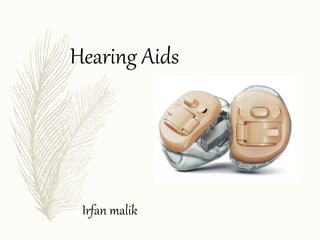
Hearing Aids
Irfan malik
What is a hearing aids
– Small electronic device
– Quiet and noisy situations
– 1 out of 5 who needs, actually uses
– Three Basic Parts
– ▫ Microphone
– ▫ Amplifier
– ▫ Speaker
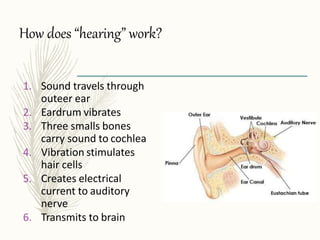
How does “hearing” work?
1. Sound travels through
outeer ear
2. Eardrum vibrates
3. Three smalls bones
carry sound to cochlea
4. Vibration stimulates
hair cells
5. Creates electrical
current to auditory
nerve
6. Transmits to brain
Hearing aid technology
– Telecoil
– ▫ Connect directly to hearing aid
– ▫ Filters background noise
– ▫ Used with telephones, FM systems,
and induction loop systems
– Directional Microphones
– ▫ Amplify sounds more from front
– ▫ Better signal to noise radio
– ▫ Improves speech understanding in noise
What causes hearing loss
– Two types of hearing loss:
– ▫ Conductive hearing loss
– Sound obstructed through the ear
– Treatable with surgery
– ▫ Sensorineural hearing loss
– Damage to the cochlea
– Most common type
– Type helped by hearing aid
How do hearing aids work?
– 2 types of hearing aids
– ▫ Analog
– Converts sound waves into electrical signals
– Custom built for each user
– Less expensive
– ▫ Digital
– Converts sound waves into numerical codes
– Similar to binary code
– More flexibility in adjustment
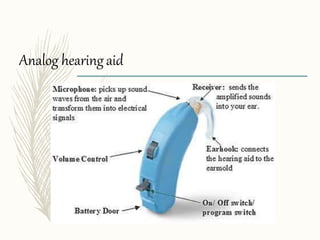
Analog hearingaid
What type of hearing aids arethere?
• ITE (In-the-Ear)
▫ Mild to severe hearing loss
▫ Completely inside outer ear
▫ Not recommended for children
▫ Capable of added features telecoil
• BTE (Behind-the-Ear)
▫ Fits behind pinna(ear)
▫ Consists of case, earmold, & tube
▫ Sound routed from case to earmold
▫ Mini BTE
• ITC(In-the-Canal)
▫ Mild to moderate hearing loss
▫ Customized to recipient
▫ Almost completely hidden
▫ Difficult to adjust and change battery
• CIC(Completely-in-Canal)
▫ Mild to moderate hearing loss
▫ Smaller than ITC
▫ Difficult to adjust and add features
▫ More expensive
Cochlear Implant
– Designed for those who are profoundly deaf
– Can be used alone or with traditional hearing aid
– Two main systems:
– ▫ External
– Sound processer, microphone, and
transmitter
– ▫ Internal
– Receiver and electrode array
Future for hearingaids
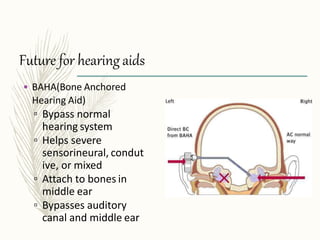
• BAHA(Bone Anchored
Hearing Aid)
▫ Bypass normal
hearing system
▫ Helps severe
sensorineural, condut
ive, or mixed
▫ Attach to bones in
middle ear
▫ Bypasses auditory
canal and middle ear
Hearing aids

Hearing aids

  • 1.
  • 2.
    What is ahearing aids – Small electronic device – Quiet and noisy situations – 1 out of 5 who needs, actually uses – Three Basic Parts – ▫ Microphone – ▫ Amplifier – ▫ Speaker
  • 3.
    How does “hearing”work? 1. Sound travels through outeer ear 2. Eardrum vibrates 3. Three smalls bones carry sound to cochlea 4. Vibration stimulates hair cells 5. Creates electrical current to auditory nerve 6. Transmits to brain
  • 4.
    Hearing aid technology –Telecoil – ▫ Connect directly to hearing aid – ▫ Filters background noise – ▫ Used with telephones, FM systems, and induction loop systems – Directional Microphones – ▫ Amplify sounds more from front – ▫ Better signal to noise radio – ▫ Improves speech understanding in noise
  • 5.
    What causes hearingloss – Two types of hearing loss: – ▫ Conductive hearing loss – Sound obstructed through the ear – Treatable with surgery – ▫ Sensorineural hearing loss – Damage to the cochlea – Most common type – Type helped by hearing aid
  • 6.
    How do hearingaids work? – 2 types of hearing aids – ▫ Analog – Converts sound waves into electrical signals – Custom built for each user – Less expensive – ▫ Digital – Converts sound waves into numerical codes – Similar to binary code – More flexibility in adjustment
  • 7.
  • 8.
    What type ofhearing aids arethere? • ITE (In-the-Ear) ▫ Mild to severe hearing loss ▫ Completely inside outer ear ▫ Not recommended for children ▫ Capable of added features telecoil • BTE (Behind-the-Ear) ▫ Fits behind pinna(ear) ▫ Consists of case, earmold, & tube ▫ Sound routed from case to earmold ▫ Mini BTE
  • 9.
    • ITC(In-the-Canal) ▫ Mildto moderate hearing loss ▫ Customized to recipient ▫ Almost completely hidden ▫ Difficult to adjust and change battery • CIC(Completely-in-Canal) ▫ Mild to moderate hearing loss ▫ Smaller than ITC ▫ Difficult to adjust and add features ▫ More expensive
  • 10.
    Cochlear Implant – Designedfor those who are profoundly deaf – Can be used alone or with traditional hearing aid – Two main systems: – ▫ External – Sound processer, microphone, and transmitter – ▫ Internal – Receiver and electrode array
  • 11.
    Future for hearingaids •BAHA(Bone Anchored Hearing Aid) ▫ Bypass normal hearing system ▫ Helps severe sensorineural, condut ive, or mixed ▫ Attach to bones in middle ear ▫ Bypasses auditory canal and middle ear