Healthy Eating on a Budget
Meal Planning Basics
•Plan meals the week ahead
▫ Takes less time than going back to
the grocery store for forgotten item
▫ Think about your schedule
Meal Planning Basics
• Plan based on what’s in your
refrigerator/pantry
Ask:
▫ What can I make with foods I have?
▫ What needs to be used up first?
▫ Can I mix foods together to make a meal?
▫ Is this healthy?
Meal Planning Basics
• Plan some meals that don’t have meat
 Goal: Twice a week
 Use beans, eggs, peanut butter
• Check grocery ads
▫ Circle foods you need
• Make a list
Plan Ahead: Reduce Waste
• Keep food safe
▫ Put cold foods in cart last, refrigerate
immediately
▫ Look for older expiration date
• Waste less
▫ Use oldest first
▫ Recreate foods that are about to spoil
▫ Throw away spoiled food!
Plan Ahead: Leftovers
•Leftovers
▫ Eat
▫ Freeze for another meal
▫ Recreate
▫ Example: Cooked ground beef,
tacos, chili, meatloaf
Shopping: Plan Ahead!
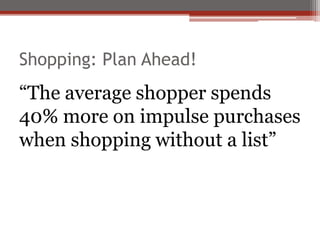
“The average shopper spends
40% more on impulse purchases
when shopping without a list”
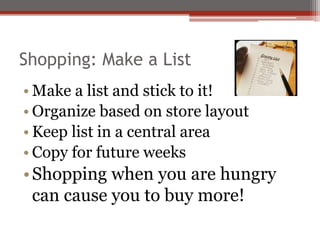
Shopping: Make a List
• Make a list and stick to it!
• Organize based on store layout
• Keep list in a central area
• Copy for future weeks
•Shopping when you are hungry
can cause you to buy more!
Shopping
Discounts only save you money if the
product is something you actually
need and would normally buy!
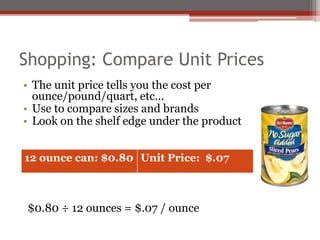
Shopping: Compare Unit Prices
• The unit price tells you the cost per
ounce/pound/quart, etc…
• Use to compare sizes and brands
• Look on the shelf edge under the product
• Example: canned pears
$0.80 ÷ 12 ounces = $.07 / ounce
Unit Price: $.08
12 ounce can: $0.80 Unit Price: $.07
Shopping: Buy in bulk!
• Take advantage of sales
• Buy in bulk
• Cook in bulk. Freeze leftovers for
future meals.
• Coupons
▫ Ask for rain check if store is out
▫ Caution: sometimes coupons are for store
brands. Off brands may still be cheaper.
Shopping: Tips to Stretch your dollar
• Purchase fruits and vegetables from produce
section, not salad bar
• Purchase fruits and vegetables in season
• Add vegetables to costly dishes with meats
• Grocery bargains: often on top and bottom
shelves, and in out of the way spaces.
• Most store or generic brands are cheaper
• If you buy name brands- look for coupons in the
paper, store ads, or online. Only use coupons for
foods that are already on your list
Tips to Stretch your dollar
• Lean cuts of meat provide more for your dollar.
• Less tender cuts are cheaper.
▫ Marinade or cook with liquid in a slow cooker.
▫ Chuck, round, flank, plank, brisket
• Prepare meat yourself
▫ Hamburger patties
▫ Kabob pieces
▫ Cooking meat
Cooking on a Budget
• The average adult purchases a meal/snack from
a restaurant 5.8 times per week!
• Why?
▫ Time
▫ Convenience
▫ Certain foods
Cooking on a Budget
• Consider eating more at home
• Time factor: prepare ahead of time
▫ Freezer meals
▫ Pack to go meals
▫ Purchase snacks and bag yourself
• Start small:
▫ Eat 1-2 less meals per week at restaurants to save
money and a whole days worth of calories!
Cooking: Homemade or purchased?
• Beware of frozen dinners (“TV dinners”)
• Make your own frozen dinners
▫ Double the recipe of main dish you’re making
▫ Freeze in meal sized portions
 Cool quickly and freeze
 Discard food left out longer than 2
▫ Label package
▫ Keep a list
Make the most out of boxed meals
• Decrease Fat
▫ Use half the margarine
 macaroni and cheese, rice, stuffing, potatoes
▫ Hamburger helper: Drain & rinse meat
▫ Brownies: substitute unsweetened apple sauce
for vegetable oil
 Use 2 egg whites for 1 whole egg
Make the most out of boxed meals
• Decrease Sodium
▫ Use half the seasoning packet
• Add vegetables
▫ Canned soup (low sodium soup)
▫ Pasta sauces
▫ Add canned fruit to yogurt, jello or pudding

Eating on a budget

  • 1.
  • 3.
    Meal Planning Basics •Planmeals the week ahead ▫ Takes less time than going back to the grocery store for forgotten item ▫ Think about your schedule
  • 4.
    Meal Planning Basics •Plan based on what’s in your refrigerator/pantry Ask: ▫ What can I make with foods I have? ▫ What needs to be used up first? ▫ Can I mix foods together to make a meal? ▫ Is this healthy?
  • 5.
    Meal Planning Basics •Plan some meals that don’t have meat  Goal: Twice a week  Use beans, eggs, peanut butter • Check grocery ads ▫ Circle foods you need • Make a list
  • 6.
    Plan Ahead: ReduceWaste • Keep food safe ▫ Put cold foods in cart last, refrigerate immediately ▫ Look for older expiration date • Waste less ▫ Use oldest first ▫ Recreate foods that are about to spoil ▫ Throw away spoiled food!
  • 7.
    Plan Ahead: Leftovers •Leftovers ▫Eat ▫ Freeze for another meal ▫ Recreate ▫ Example: Cooked ground beef, tacos, chili, meatloaf
  • 8.
    Shopping: Plan Ahead! “Theaverage shopper spends 40% more on impulse purchases when shopping without a list”
  • 9.
    Shopping: Make aList • Make a list and stick to it! • Organize based on store layout • Keep list in a central area • Copy for future weeks •Shopping when you are hungry can cause you to buy more!
  • 10.
    Shopping Discounts only saveyou money if the product is something you actually need and would normally buy!
  • 11.
    Shopping: Compare UnitPrices • The unit price tells you the cost per ounce/pound/quart, etc… • Use to compare sizes and brands • Look on the shelf edge under the product • Example: canned pears $0.80 ÷ 12 ounces = $.07 / ounce Unit Price: $.08 12 ounce can: $0.80 Unit Price: $.07
  • 12.
    Shopping: Buy inbulk! • Take advantage of sales • Buy in bulk • Cook in bulk. Freeze leftovers for future meals. • Coupons ▫ Ask for rain check if store is out ▫ Caution: sometimes coupons are for store brands. Off brands may still be cheaper.
  • 13.
    Shopping: Tips toStretch your dollar • Purchase fruits and vegetables from produce section, not salad bar • Purchase fruits and vegetables in season • Add vegetables to costly dishes with meats
  • 14.
    • Grocery bargains:often on top and bottom shelves, and in out of the way spaces. • Most store or generic brands are cheaper • If you buy name brands- look for coupons in the paper, store ads, or online. Only use coupons for foods that are already on your list
  • 15.
    Tips to Stretchyour dollar • Lean cuts of meat provide more for your dollar. • Less tender cuts are cheaper. ▫ Marinade or cook with liquid in a slow cooker. ▫ Chuck, round, flank, plank, brisket • Prepare meat yourself ▫ Hamburger patties ▫ Kabob pieces ▫ Cooking meat
  • 16.
    Cooking on aBudget • The average adult purchases a meal/snack from a restaurant 5.8 times per week! • Why? ▫ Time ▫ Convenience ▫ Certain foods
  • 17.
    Cooking on aBudget • Consider eating more at home • Time factor: prepare ahead of time ▫ Freezer meals ▫ Pack to go meals ▫ Purchase snacks and bag yourself • Start small: ▫ Eat 1-2 less meals per week at restaurants to save money and a whole days worth of calories!
  • 18.
    Cooking: Homemade orpurchased? • Beware of frozen dinners (“TV dinners”) • Make your own frozen dinners ▫ Double the recipe of main dish you’re making ▫ Freeze in meal sized portions  Cool quickly and freeze  Discard food left out longer than 2 ▫ Label package ▫ Keep a list
  • 19.
    Make the mostout of boxed meals • Decrease Fat ▫ Use half the margarine  macaroni and cheese, rice, stuffing, potatoes ▫ Hamburger helper: Drain & rinse meat ▫ Brownies: substitute unsweetened apple sauce for vegetable oil  Use 2 egg whites for 1 whole egg
  • 20.
    Make the mostout of boxed meals • Decrease Sodium ▫ Use half the seasoning packet • Add vegetables ▫ Canned soup (low sodium soup) ▫ Pasta sauces ▫ Add canned fruit to yogurt, jello or pudding

Editor's Notes

  • #4 Planning meals the week before can help determine what you need to get at the store and prevents you from having to go back to the store multiple times it helps you prepare for leftovers and hopefully encourages you to eat at home. A lot of grocery ads come out on wed and run thru next tues, so planning on a Tuesday might be a good way to do this.
  • #5 Then purchase missing foods
  • #6 Meals w/o meat: get protein in other ways… List: central area.
  • #7 Recreate foods that are about to spoil Example: 1-2 day stale bread: salad croutons Vegetables: soup Mushy bananas: muffins
  • #10 Make a list to prevent frequent “emergency” trips to the store: often end up spending more by picking up extra this way. Check your kitchen before shopping-look for amounts and ingredients. helps prevent buying extra items and possible spoilage. Keep your list in a central area-hang on refrigerator Check your kitchen before shopping
  • #12 Unit price help determine if getting good deal for shopping. price: 2 labels: 1. amount you pay for the total item 2. amount you pay for ounce. The unit price can vary-it can be ounces, pounds, quarts, etc…. This helps you to compare which is the best buy-in this case it is cheaper to buy the 24 ounce can. Often you may find it is cheaper to buy the larger product.
  • #13 Take advantage of sales and buy when prices are low. It can also be cheaper to buy products I bulk. Be careful of buying perishables in bulk. Cook in bulk. Freeze leftovers for future meals
  • #14 Grocery bargains: often on top and bottom shelves, and in out of the way spaces. Middle shelves and center don’t always hold the best buys , look in grocery carts in the back of the store out of the way.
  • #16 Less tender cuts are cheaper. Marinade or cook with liquid in a slow cooker. Chuck, round, flank, plank, brisket make your own hamburger patties, cut your own meat for kabobs, cook your own meat, etc… Grocery bargains: often on top and bottom shelves, and in out of the way spaces. Middle shelves and center don’t always hold the best buys
  • #19 Be ware of processed frozen dinners (“TV dinners”): high fat, high sodium, high priced Prepare homemade frozen dinners - great option for when you don’t have time to cook, want dinner immediately and great alternative to TV dinners Freeze in meal sized portions Cool quickly and freeze Discard food left out longer than 2 Label package with food’s name and date Keep a list of foods you have
  • #20 OR NO MARG Use 2 egg whites for 1 whole egg Hamburger helper: Drain & rinse meat in colander, rinse with warm water.
  • #21 Decrease Sodium Use half the seasoning packet rice, ramen noodles, soup, stir-fry Decrease sodium: Add plain rice or noodles Canned soup (look for low sodium soup) Add chopped frozen vegetables to pasta sauces Add canned fruit to yogurt, jello or pudding