Implementing Healthy Eating
            Programs in the Workplace
                           October 13, 2010

                      Heather Harvey MHSc, RD
                          Program Coordinator
                   Nutrition Resource Centre, OPHA


CCOHS – October 13, 2010
Outline
1. Current nutrition issues and their affect on
   workplaces
2. Business case supporting health promotion and
   healthy eating in the workplace
3. Best practices for promoting healthy eating in the
   workplace
4. Case Study: Eat Smart!® Workplace Program
5. Making it happen at your workplace
6. Resources
CCOHS – October 13, 2010
• Think about your day so far. How many eating
  decisions have you made?


CCOHS – October 13, 2010
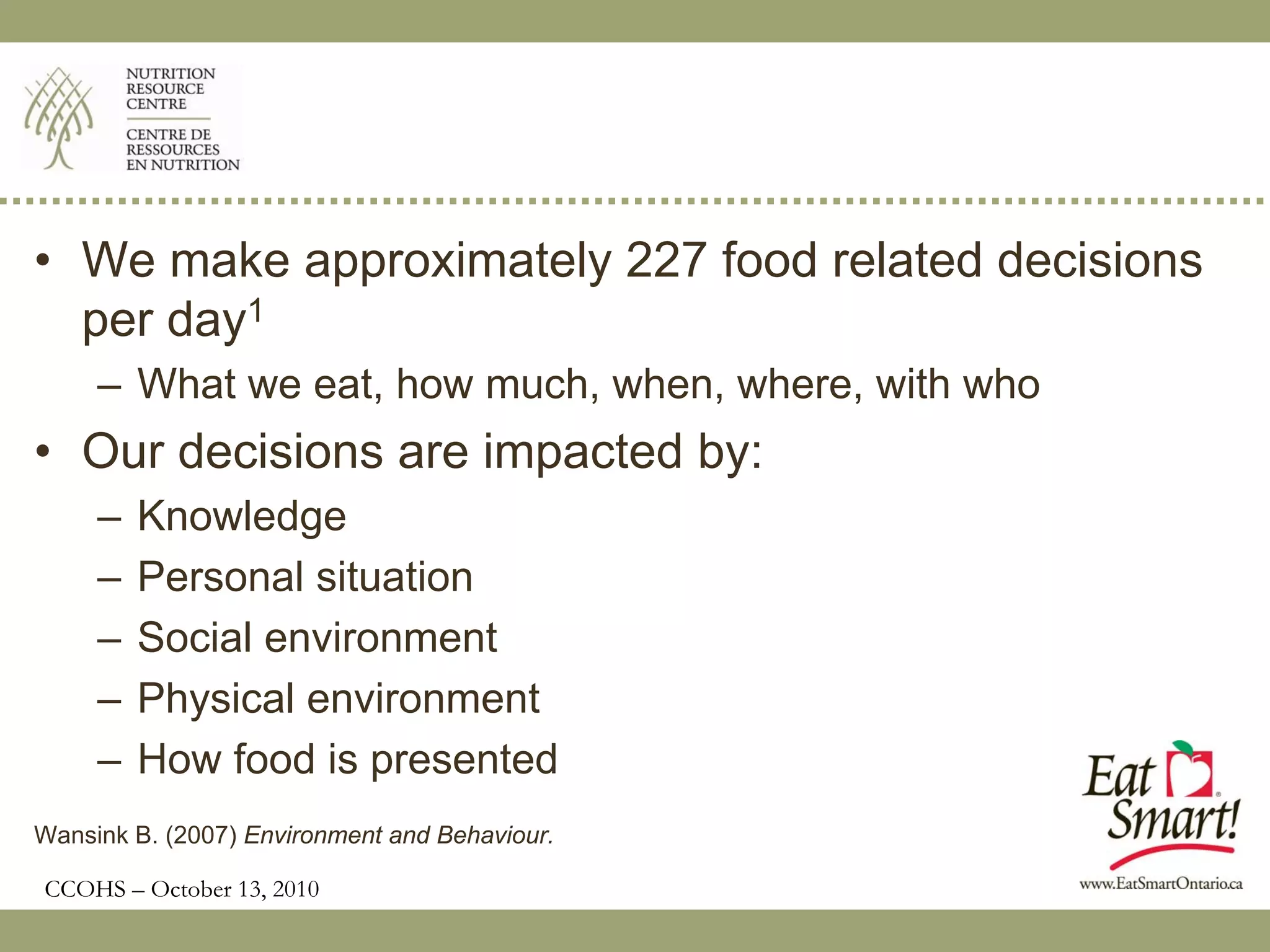
• We make approximately 227 food related decisions
  per day1
     – What we eat, how much, when, where, with who
• Our decisions are impacted by:
     –   Knowledge
     –   Personal situation
     –   Social environment
     –   Physical environment
     –   How food is presented
Wansink B. (2007) Environment and Behaviour.

CCOHS – October 13, 2010
Food and Workplaces
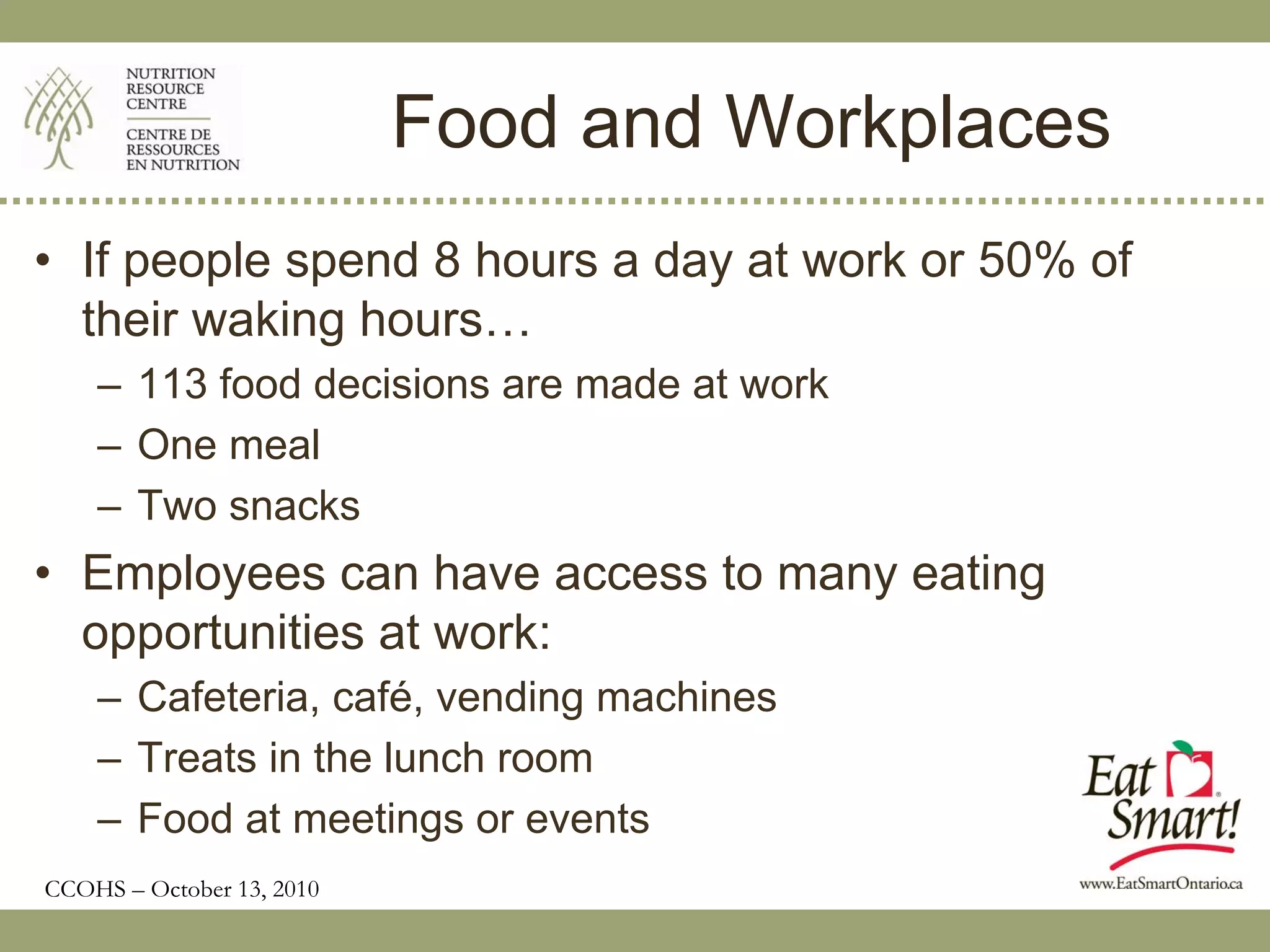
• If people spend 8 hours a day at work or 50% of
  their waking hours…
    – 113 food decisions are made at work
    – One meal
    – Two snacks
• Employees can have access to many eating
  opportunities at work:
    – Cafeteria, café, vending machines
    – Treats in the lunch room
    – Food at meetings or events
CCOHS – October 13, 2010
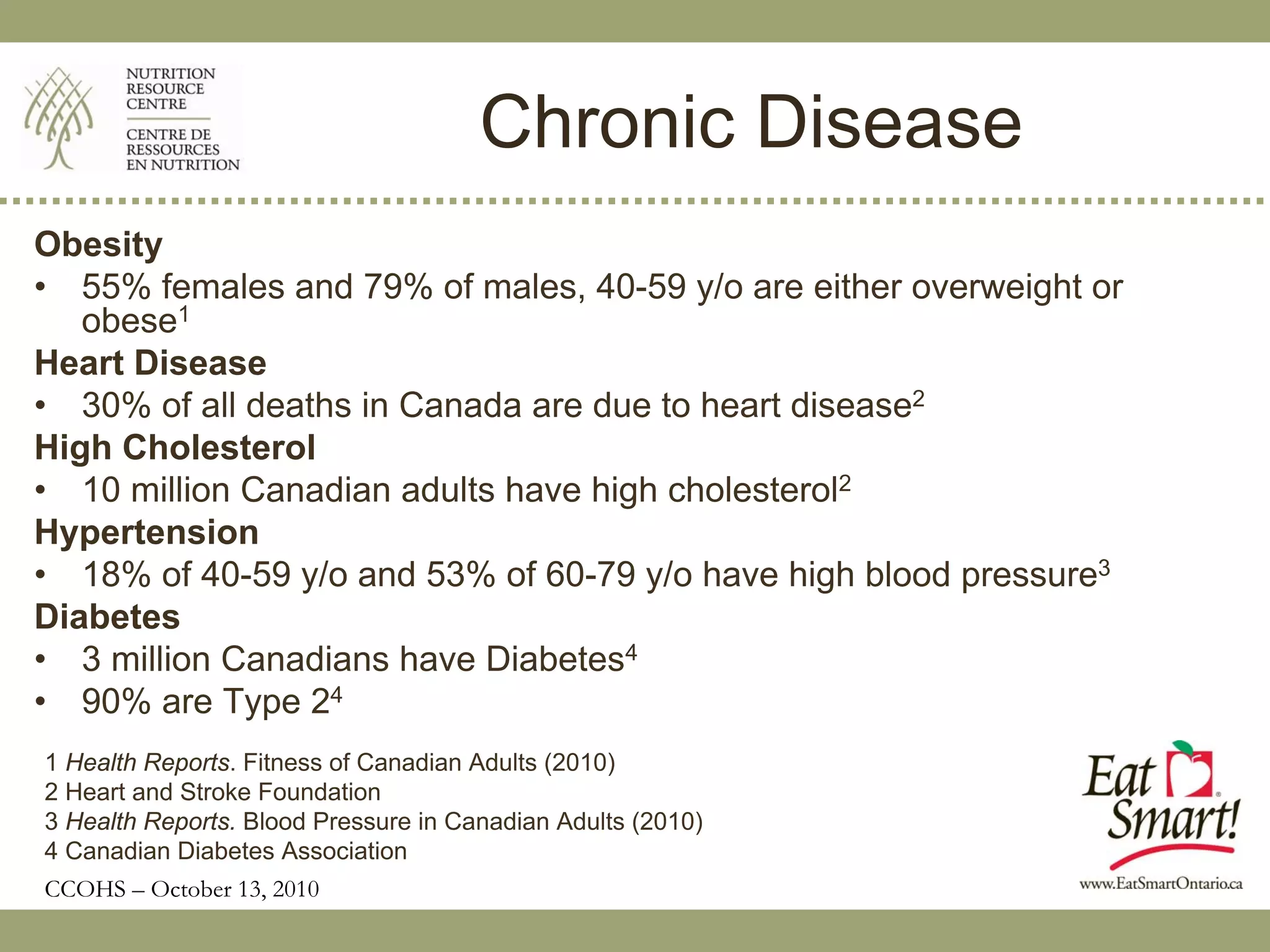
Chronic Disease
Obesity
• 55% females and 79% of males, 40-59 y/o are either overweight or
   obese1
Heart Disease
• 30% of all deaths in Canada are due to heart disease2
High Cholesterol
• 10 million Canadian adults have high cholesterol2
Hypertension
• 18% of 40-59 y/o and 53% of 60-79 y/o have high blood pressure3
Diabetes
• 3 million Canadians have Diabetes4
• 90% are Type 24
1 Health Reports. Fitness of Canadian Adults (2010)
2 Heart and Stroke Foundation
3 Health Reports. Blood Pressure in Canadian Adults (2010)
4 Canadian Diabetes Association
CCOHS – October 13, 2010
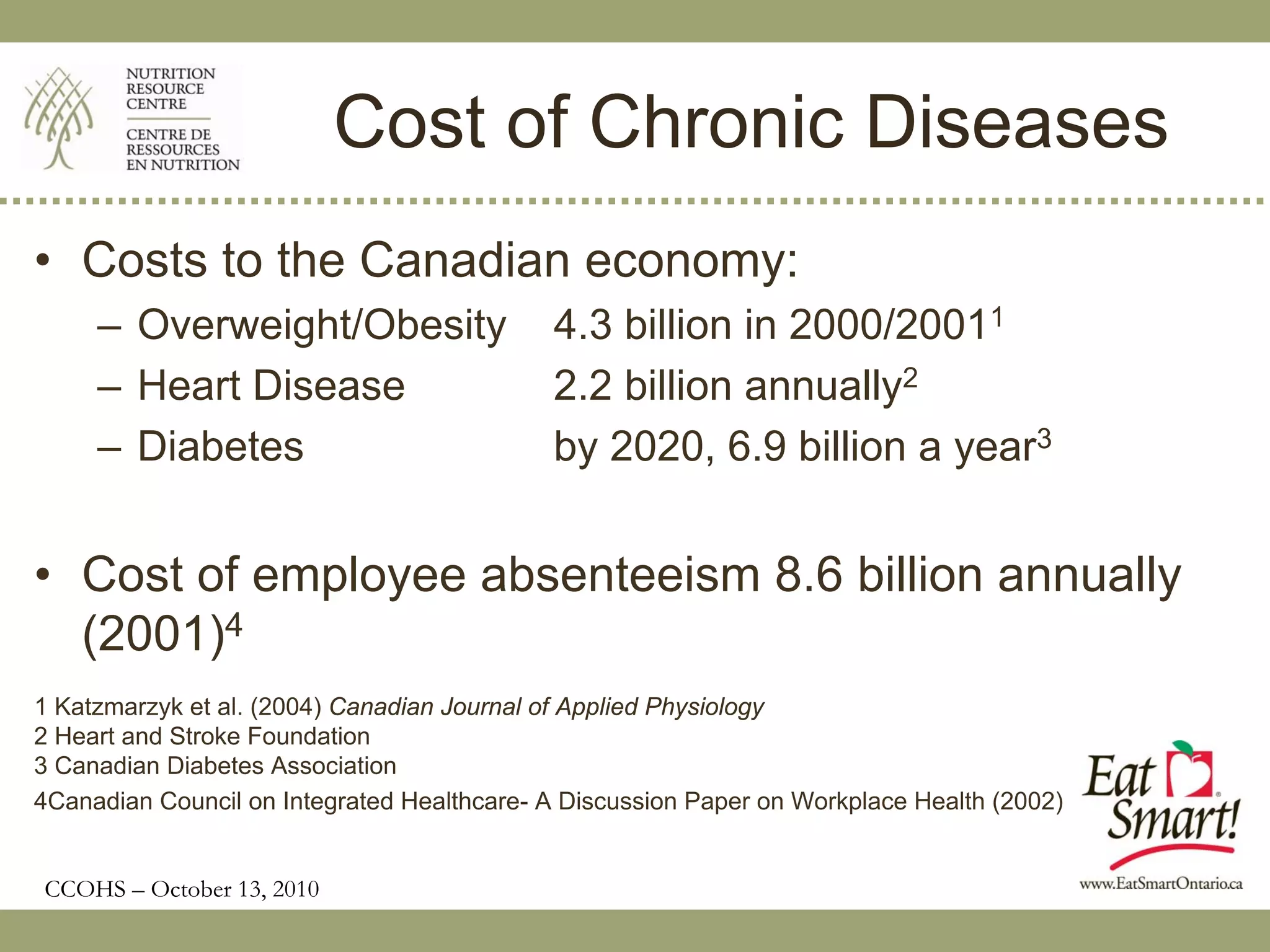
Cost of Chronic Diseases
• Costs to the Canadian economy:
     – Overweight/Obesity                   4.3 billion in 2000/20011
     – Heart Disease                        2.2 billion annually2
     – Diabetes                             by 2020, 6.9 billion a year3


• Cost of employee absenteeism 8.6 billion annually
  (2001)4
1 Katzmarzyk et al. (2004) Canadian Journal of Applied Physiology
2 Heart and Stroke Foundation
3 Canadian Diabetes Association
4Canadian Council on Integrated Healthcare- A Discussion Paper on Workplace Health (2002)


CCOHS – October 13, 2010
The Business Case


CCOHS – October 13, 2010
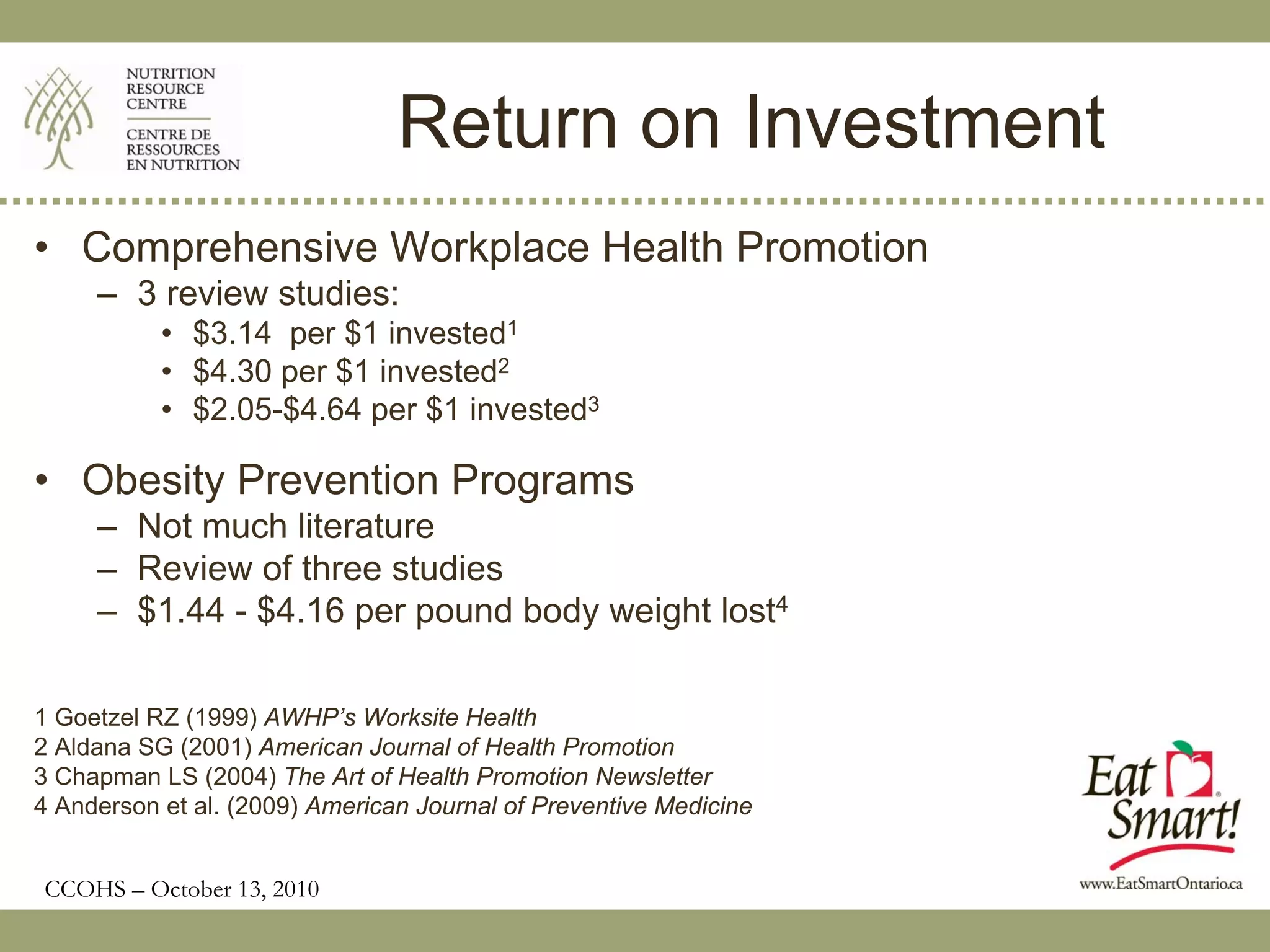
Return on Investment
• Comprehensive Workplace Health Promotion
     – 3 review studies:
           • $3.14 per $1 invested1
           • $4.30 per $1 invested2
           • $2.05-$4.64 per $1 invested3

• Obesity Prevention Programs
     – Not much literature
     – Review of three studies
     – $1.44 - $4.16 per pound body weight lost4

1 Goetzel RZ (1999) AWHP’s Worksite Health
2 Aldana SG (2001) American Journal of Health Promotion
3 Chapman LS (2004) The Art of Health Promotion Newsletter
4 Anderson et al. (2009) American Journal of Preventive Medicine


CCOHS – October 13, 2010
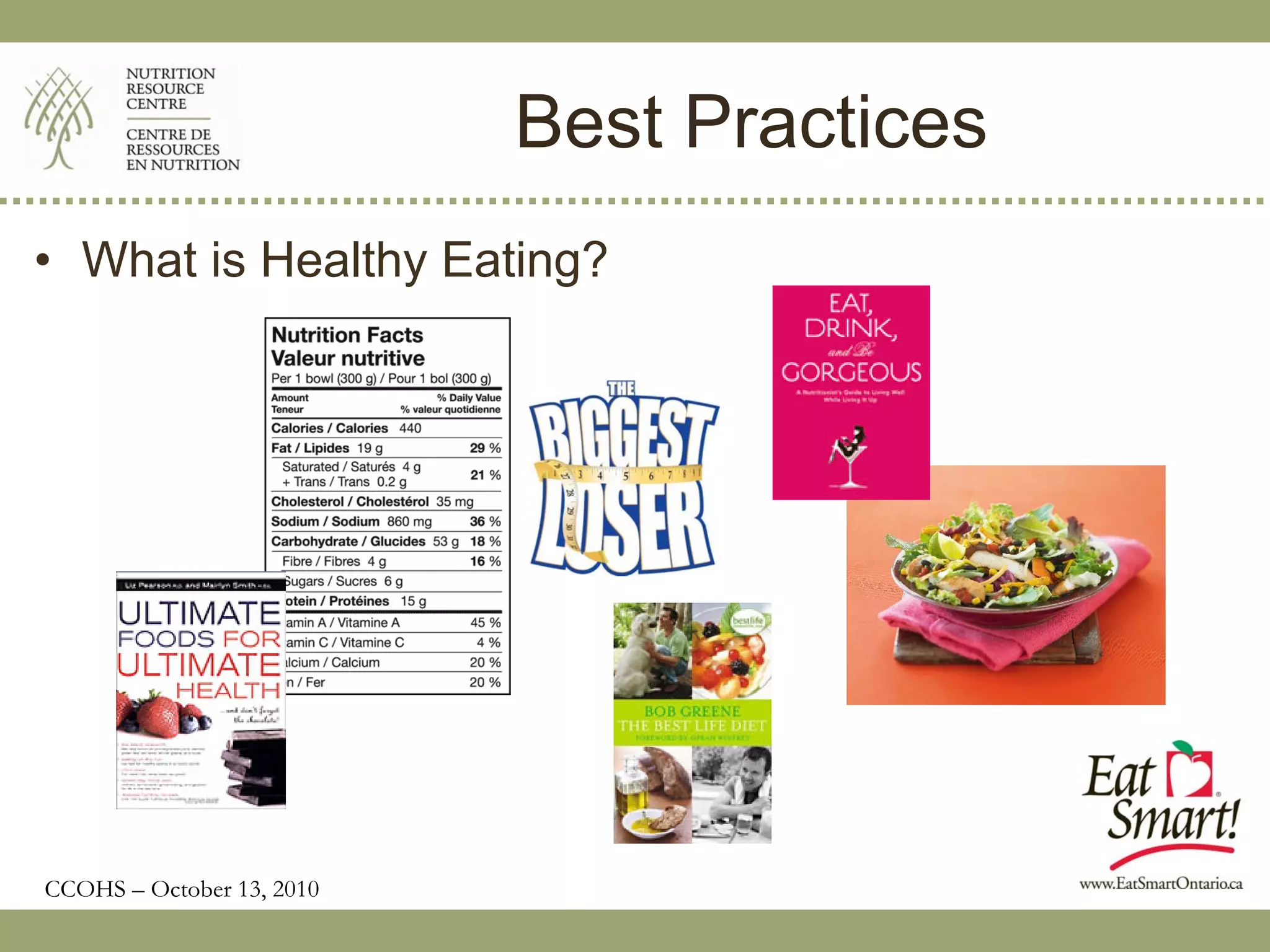
Best Practices
• What is Healthy Eating?


CCOHS – October 13, 2010
Canada’s Food Guide
Emphasis on:
    –   Vegetables and fruit
    –   Whole grains
    –   Lean meats
    –   Low fat milk products
    –   Healthy fats
    –   Moderate portion sizes


CCOHS – October 13, 2010
Vegetables and Fruit
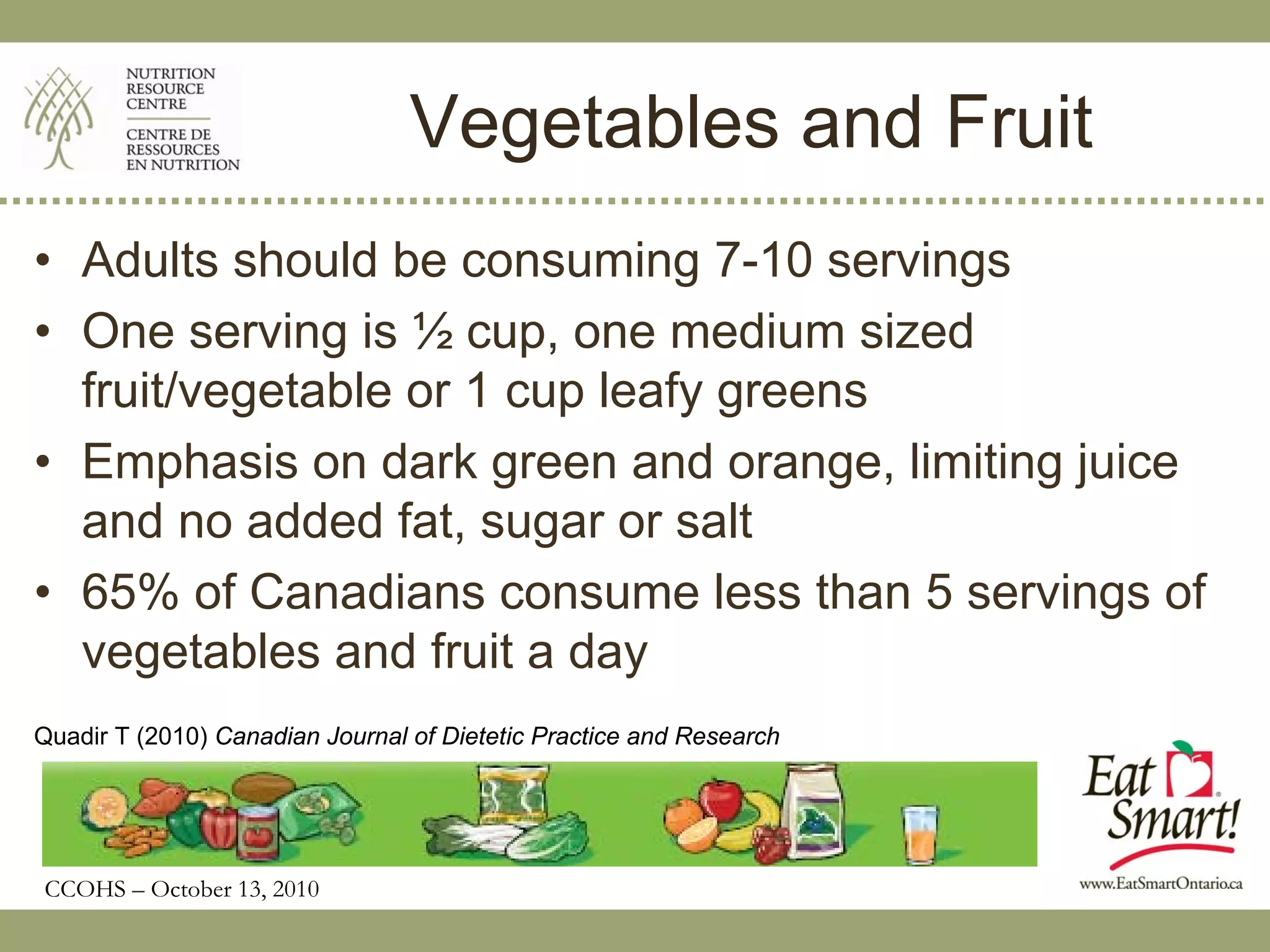
• Adults should be consuming 7-10 servings
• One serving is ½ cup, one medium sized
  fruit/vegetable or 1 cup leafy greens
• Emphasis on dark green and orange, limiting juice
  and no added fat, sugar or salt
• 65% of Canadians consume less than 5 servings of
  vegetables and fruit a day
Quadir T (2010) Canadian Journal of Dietetic Practice and Research


CCOHS – October 13, 2010
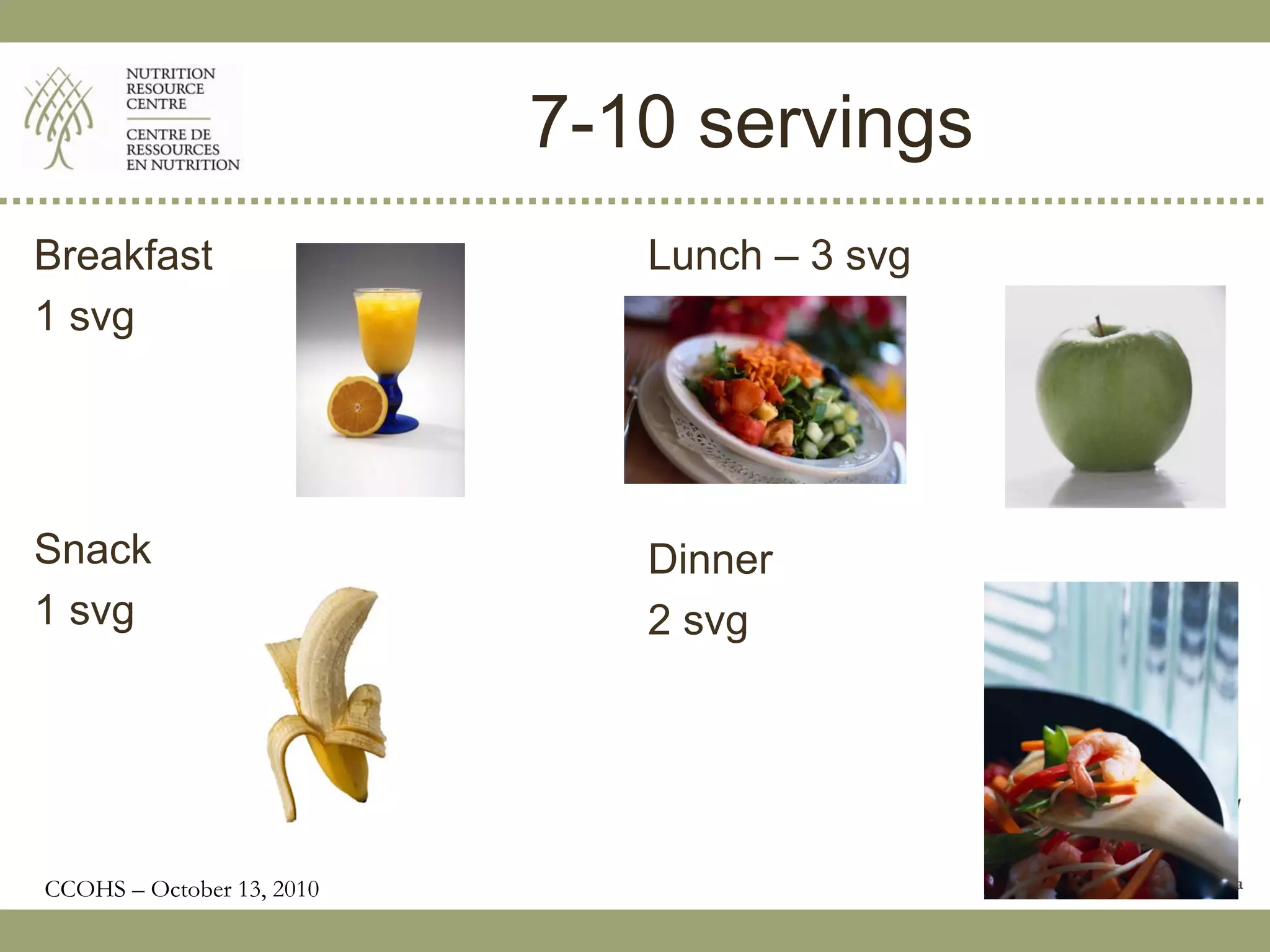
7-10 servings
Breakfast                     Lunch – 3 svg
1 svg


Snack                         Dinner
1 svg                         2 svg


CCOHS – October 13, 2010
Grain Products
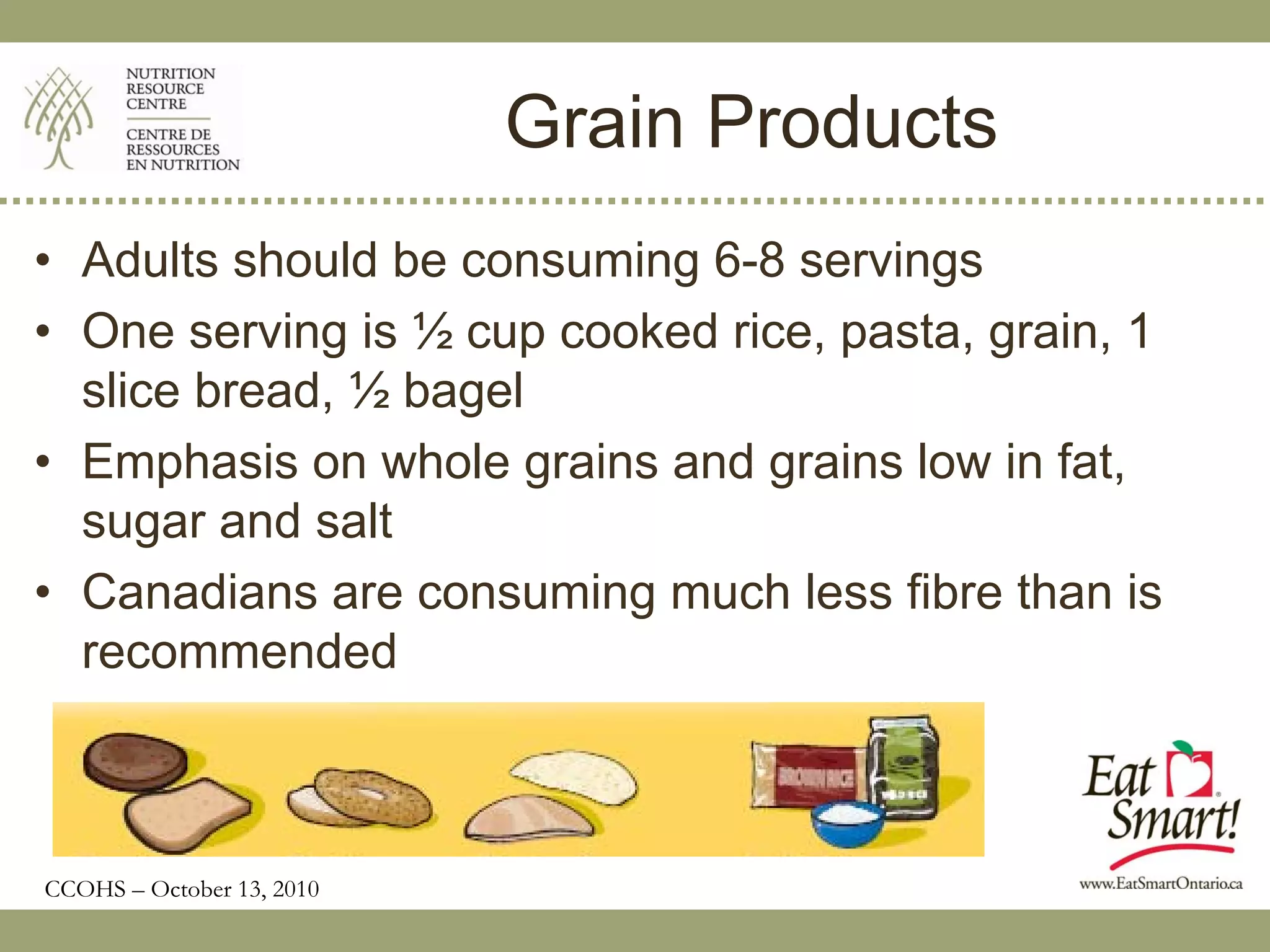
• Adults should be consuming 6-8 servings
• One serving is ½ cup cooked rice, pasta, grain, 1
  slice bread, ½ bagel
• Emphasis on whole grains and grains low in fat,
  sugar and salt
• Canadians are consuming much less fibre than is
  recommended


CCOHS – October 13, 2010
Milk and Alternatives
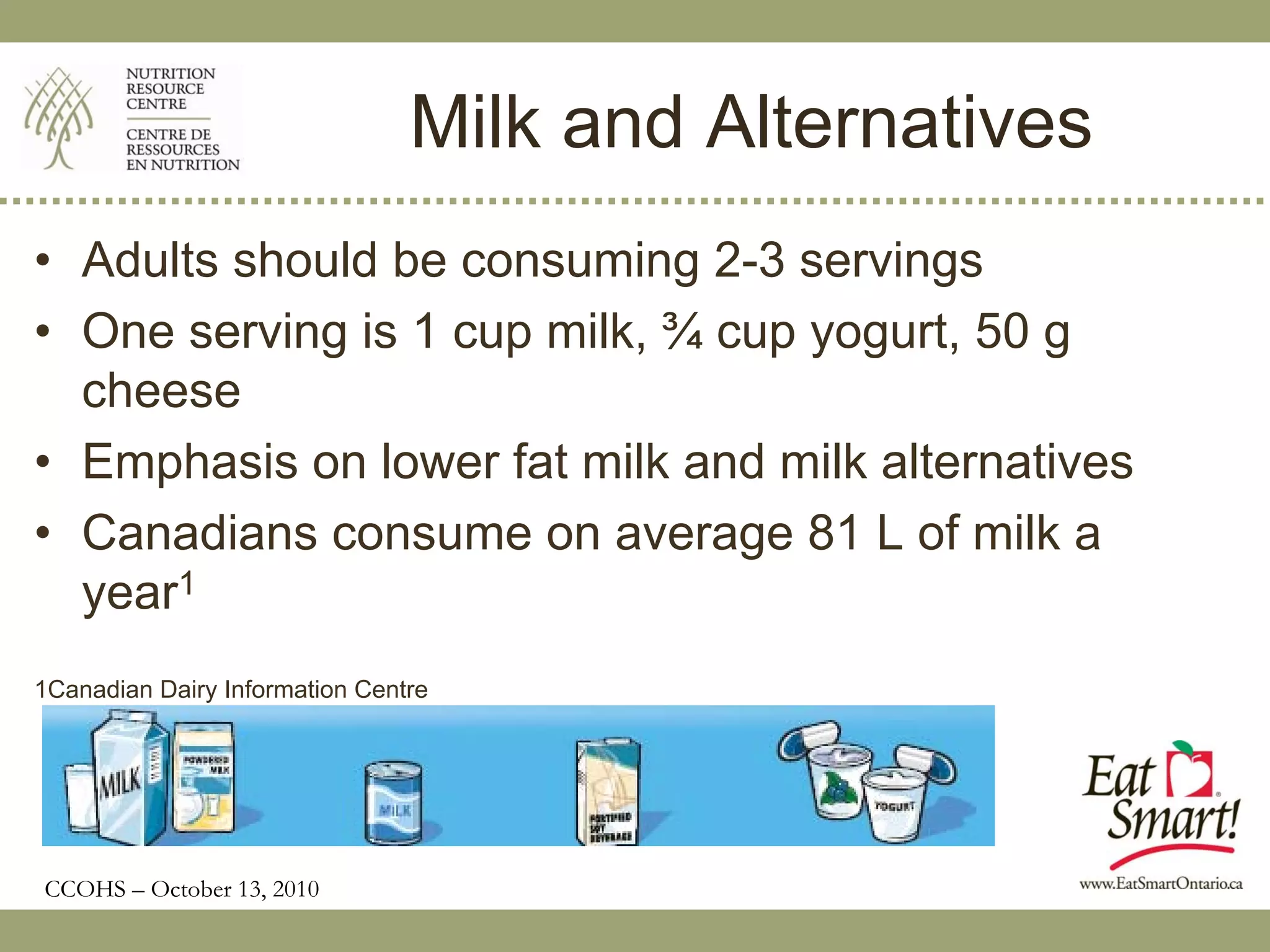
• Adults should be consuming 2-3 servings
• One serving is 1 cup milk, ¾ cup yogurt, 50 g
  cheese
• Emphasis on lower fat milk and milk alternatives
• Canadians consume on average 81 L of milk a
  year1
1Canadian Dairy Information Centre


CCOHS – October 13, 2010
Meat and Alternatives
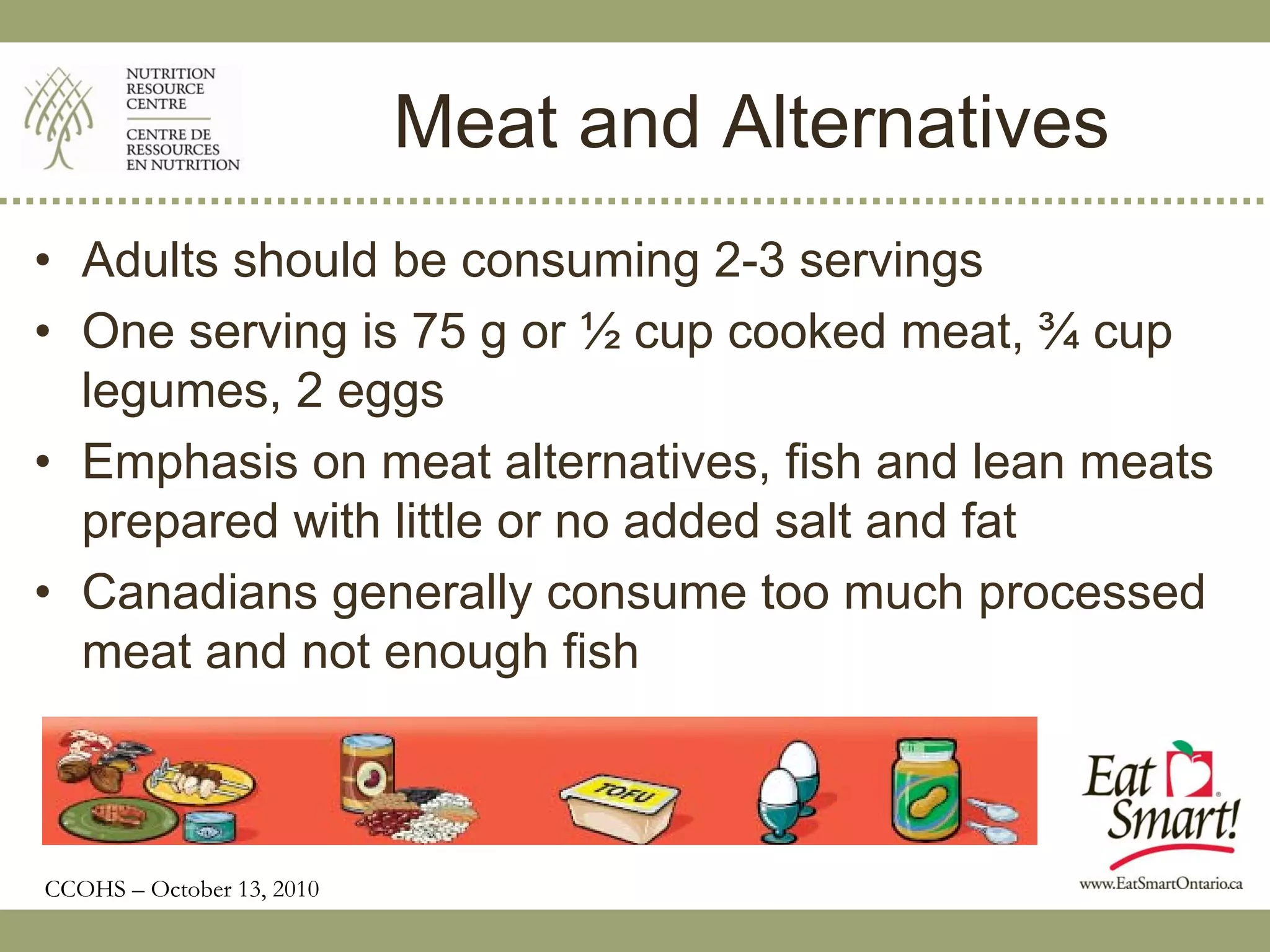
• Adults should be consuming 2-3 servings
• One serving is 75 g or ½ cup cooked meat, ¾ cup
  legumes, 2 eggs
• Emphasis on meat alternatives, fish and lean meats
  prepared with little or no added salt and fat
• Canadians generally consume too much processed
  meat and not enough fish


CCOHS – October 13, 2010
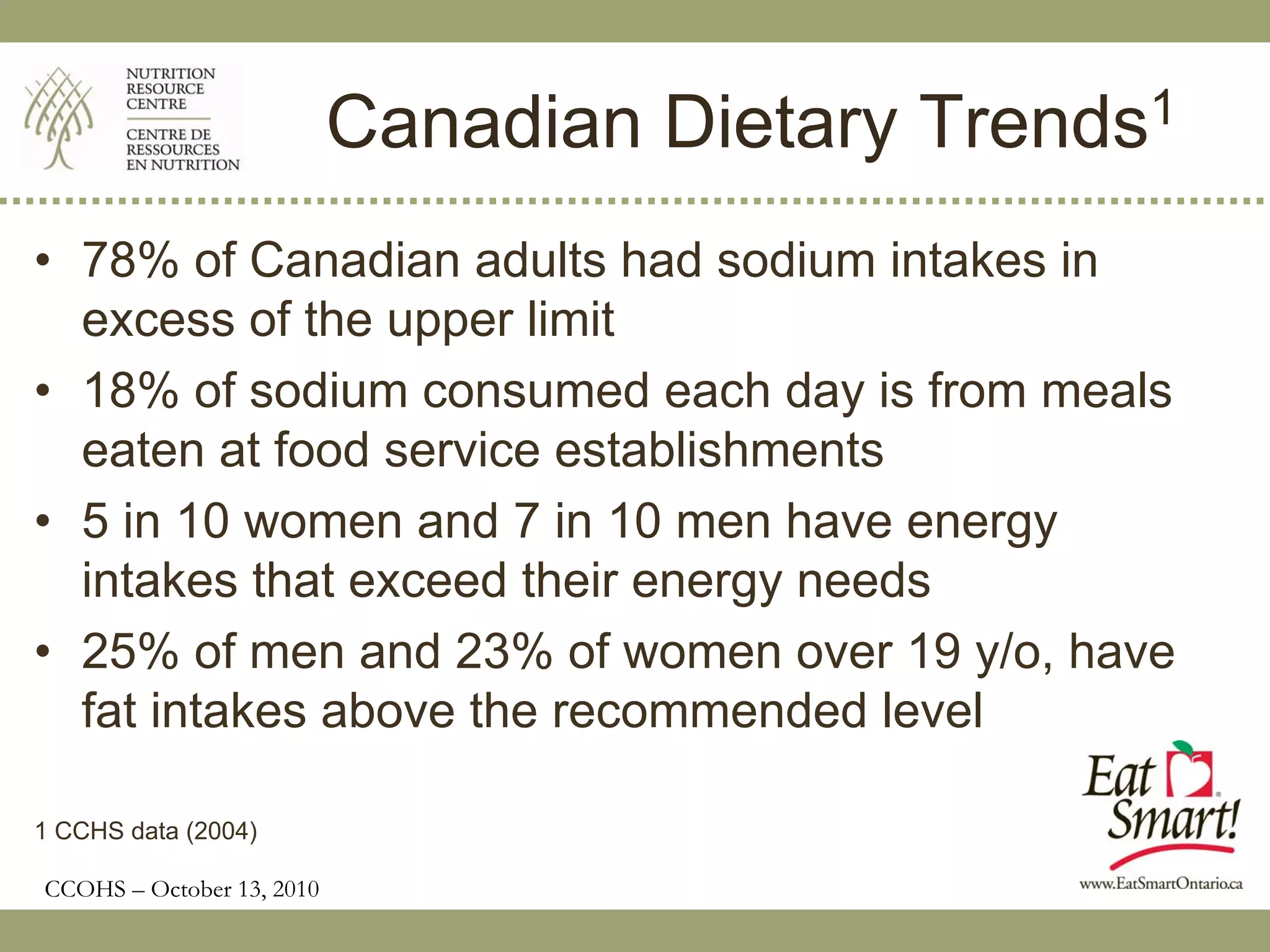
Canadian Dietary Trends1
• 78% of Canadian adults had sodium intakes in
  excess of the upper limit
• 18% of sodium consumed each day is from meals
  eaten at food service establishments
• 5 in 10 women and 7 in 10 men have energy
  intakes that exceed their energy needs
• 25% of men and 23% of women over 19 y/o, have
  fat intakes above the recommended level

1 CCHS data (2004)

CCOHS – October 13, 2010
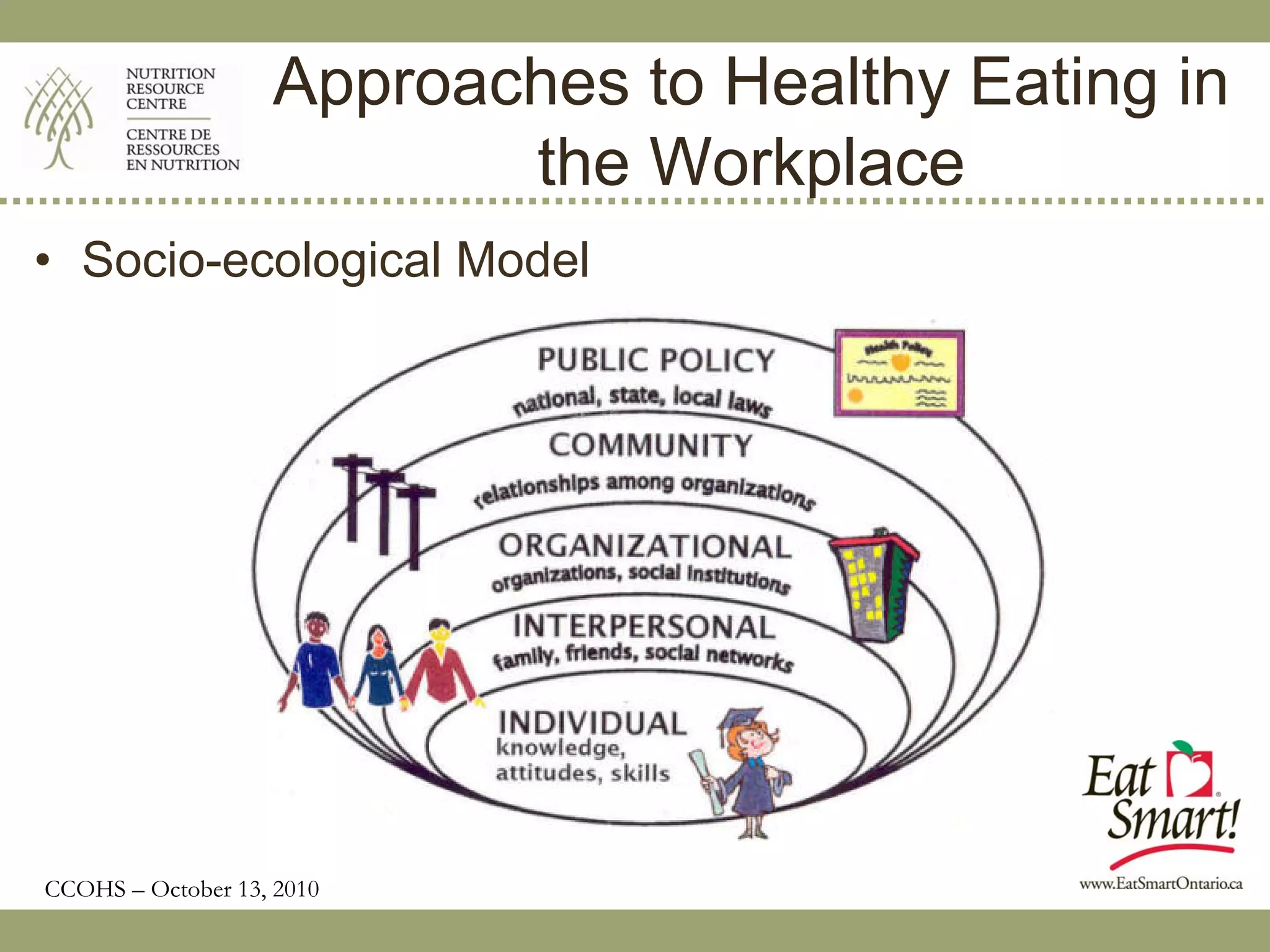
Approaches to Healthy Eating in
                          the Workplace
• Socio-ecological Model


CCOHS – October 13, 2010
Approaches to Healthy Eating in
                          the Workplace
• Comprehensive Workplace Health
    –   Awareness raising/education
    –   Skill building
    –   Supportive Environment
    –   Policy Development
• Goes beyond looking at just the individual
    – Changes to organizational culture and social norms
• Long-term commitment


CCOHS – October 13, 2010
Healthy Eating at Work –
                                   What Works…
• Not much data in this area
• Evaluation of programs is moderate at best
• Most studies focus on education and behavioural strategies,
  not the environment
• Comprehensive approach generally yields better results
• Informational and educational approaches alone were less
  effective
• Many programs are multifaceted and hard to determine
  which components yield the best results

* Taken from:
    Ni Mhurchu C (2010) BMC Public Health
    Anderson LM et al. (2009) American Journal of Preventive Medicine

CCOHS – October 13, 2010
Supportive Environment –
                                Food Choices
• Changing foods offered in cafeteria, cafés, vending
  can be effective in improving employee eating
  habits
• Keys:
    – Involve employees in determining food choices
          • Polls
          • Taste tests
    – Promote and label healthier options
    – More healthy options offered = employees will
      choose them more often
CCOHS – October 13, 2010
Supportive Environment -
                                      Pricing
• Vending study1
     – Reductions of 10%, 25% and 50% on low-fat snacks
     – Increased purchases by 9%, 39% and 93%
• Cafeteria study2
     – Increased cost of regular soft drinks by 35%
     – Purchases decreased by 26% and 36% when
       accompanied by educational campaign


1 French SA (2001) American Journal of Public Health
2 Block JP (2010) American Journal of Public Health

CCOHS – October 13, 2010
Supportive Environment-
                                 Placement
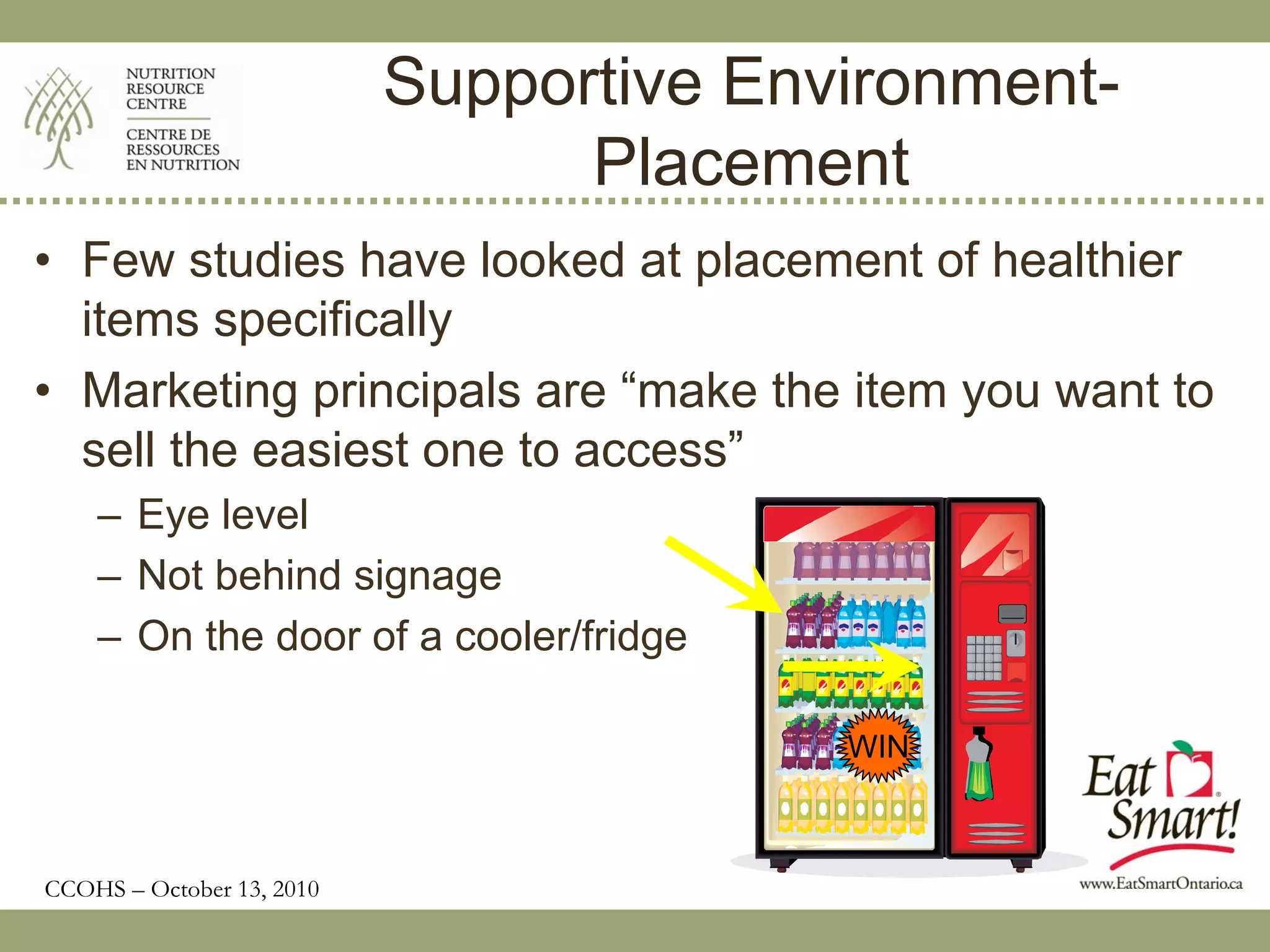
• Few studies have looked at placement of healthier
  items specifically
• Marketing principals are “make the item you want to
  sell the easiest one to access”
    – Eye level
    – Not behind signage
    – On the door of a cooler/fridge

                                         WIN


CCOHS – October 13, 2010
Point of Purchase Programs
• A few studies have focused exclusively on POP
  programs
    – Most show small effects on purchases of healthier foods
• POP work well with other supportive environment
  initiatives
• Focus on convenience, taste/sensory, energizing
  nature of healthier options
• Keep messages short and simple


CCOHS – October 13, 2010
Supportive Environment –
                                 More Ideas
• Serving healthier options at meetings and company
  sponsored events
• Limiting or removing treats from common areas
    – Ask people to keep these in their office
    – Encourage people to bring in healthier or fewer treats
• Find other ways to raise funds other than food
• Include access to registered dietitians as part of
  your health benefits


CCOHS – October 13, 2010
Eat Smart!® Workplace Program
• Eat Smart!® is an Award of Excellence program that
  recognizes and promotes Ontario food premises
  that meet standards of excellence in
   – nutrition
   – food safety
   – smoke-free environment
• Goals
   – Reduce the incidence of chronic diseases
     and food-borne illness in Ontario
CCOHS – October 13, 2010
Eat Smart!® Workplace Program
• Background
    – In Ontario since 2001
    – Coordinated by the Nutrition Resource Centre
    – Implemented by individual health units to help meet the
      Ontario Public Health Standards
    – Program Partners:

    – Supported by the Ministry of Health Promotion and Sport
    – Approximately 150 workplaces participate in 17
      different health units across Ontario
CCOHS – October 13, 2010
Eat Smart!® Workplace Program
• In order to achieve Eat Smart!® status, workplaces
  must meet consistent standards in
      • Nutrition
      • Food Safety
      • Smoke Free Environment
• You can view the standards online at
  www.EatSmartOntario.ca


CCOHS – October 13, 2010
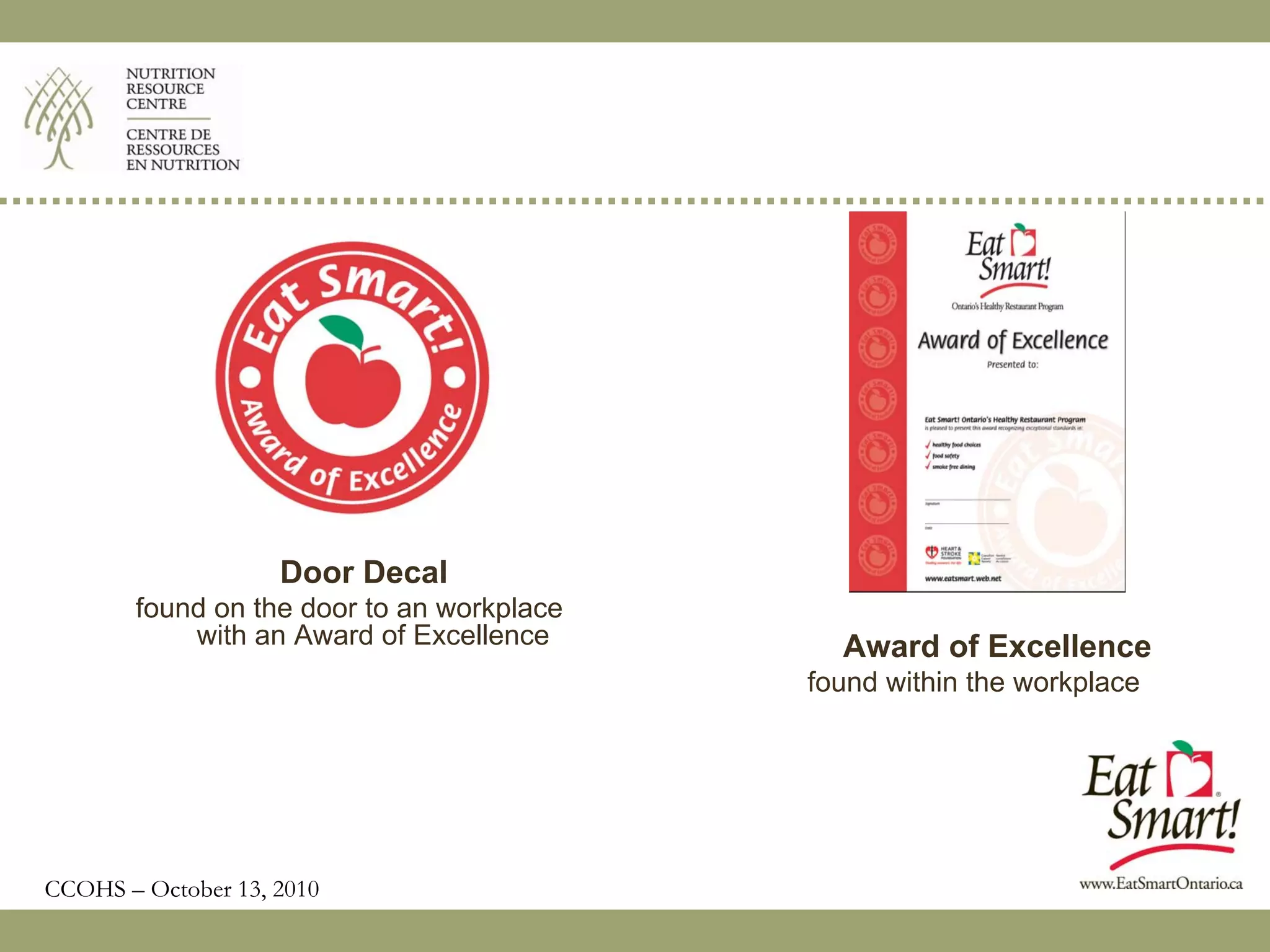
Door Decal
       found on the door to an workplace
           with an Award of Excellence       Award of Excellence
                                           found within the workplace


CCOHS – October 13, 2010
Eat Smart!® Workplace Program
• Creates supportive environments by increasing
  access to healthier foods in cafeterias
    – Café and vending component being pilot tested


• Raises awareness and educates employees
  through posters, table tents and POP messaging
    – Individual health units often do further


CCOHS – October 13, 2010
Eat Smart!® Workplace Program

• In the process of pilot-testing additional
  standards to strengthen the program
    – Action Committee involving employees, food
      service, public health, management
    – Standards for the pricing, placement and
      promotion of healthier options in cafeterias and
      vending


CCOHS – October 13, 2010
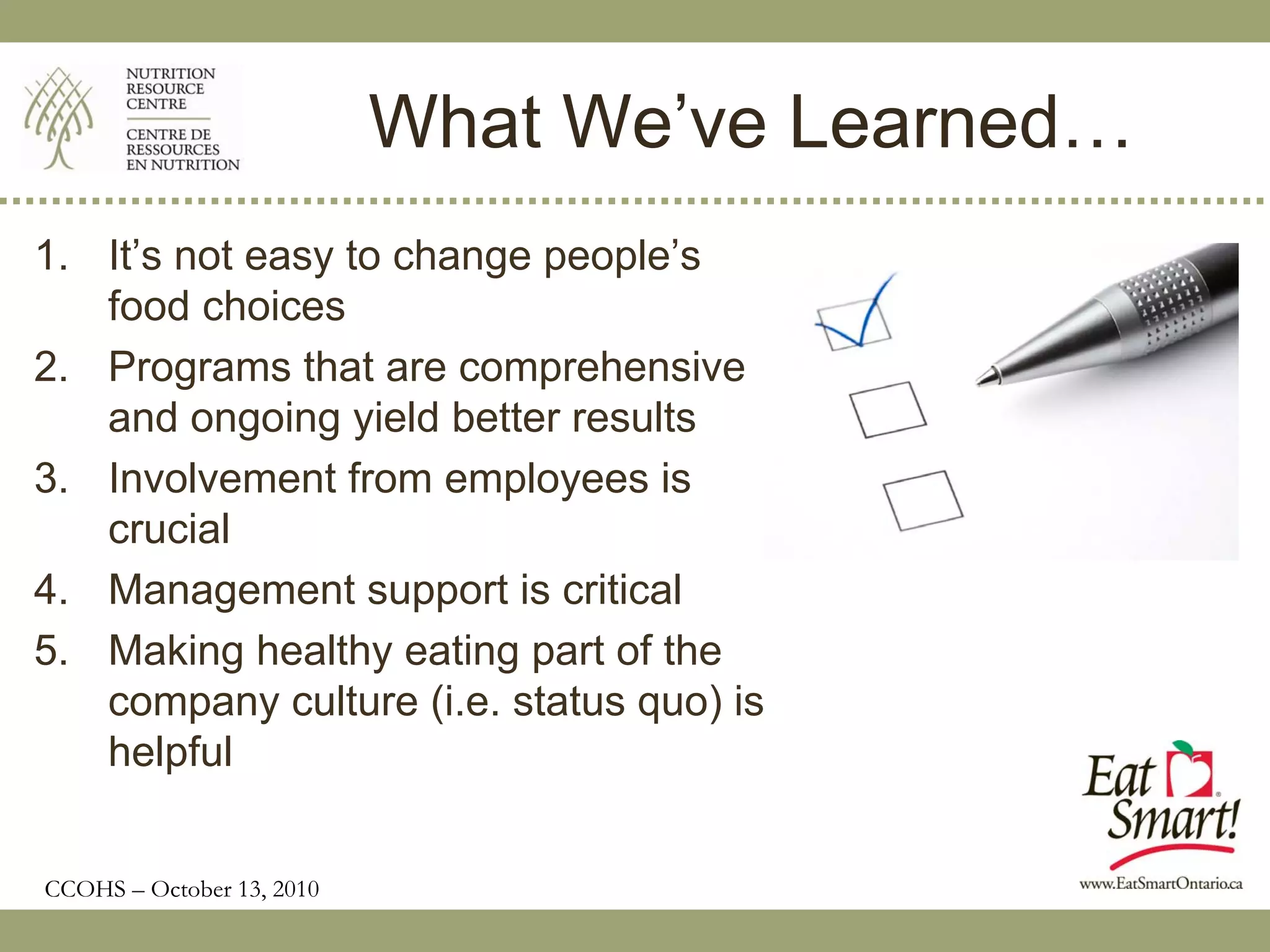
What We’ve Learned…
1. It’s not easy to change people’s
   food choices
2. Programs that are comprehensive
   and ongoing yield better results
3. Involvement from employees is
   crucial
4. Management support is critical
5. Making healthy eating part of the
   company culture (i.e. status quo) is
   helpful


CCOHS – October 13, 2010
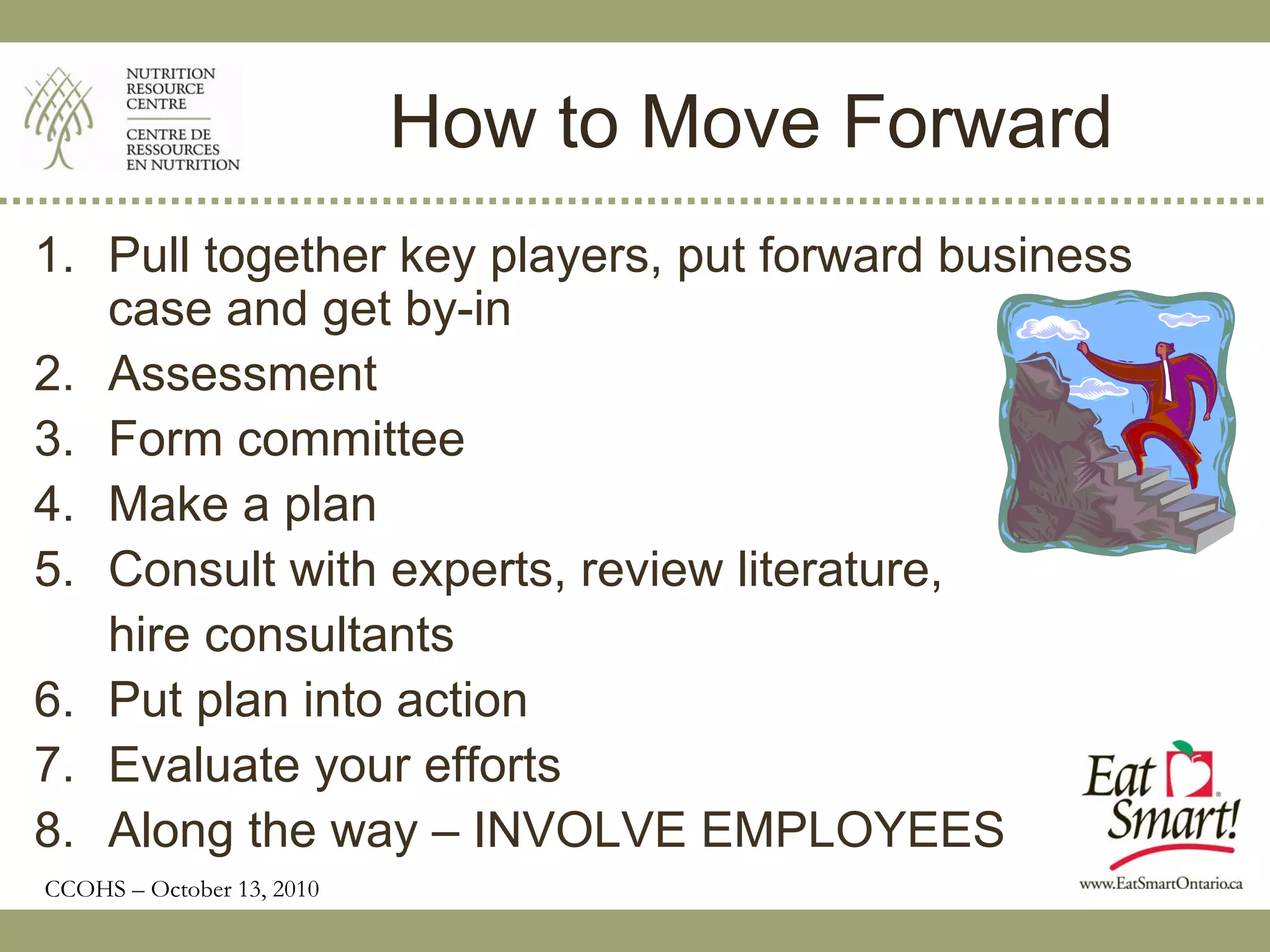
How to Move Forward
1. Pull together key players, put forward business
   case and get by-in
2. Assessment
3. Form committee
4. Make a plan
5. Consult with experts, review literature,
   hire consultants
6. Put plan into action
7. Evaluate your efforts
8. Along the way – INVOLVE EMPLOYEES
CCOHS – October 13, 2010
Maintaining Interest
• Focus on what employees are interested in
• Solicit employee feedback frequently
    – Polls
    – Taste tests
    – Focus Groups
• Ongoing, multifaceted initiatives
• Change the organizational culture


CCOHS – October 13, 2010
Healthy Eating Resources
• Canada’s Food Guide
  www.healthcanada.gc.ca/foodguide
• EatRight Ontario
  www.eatrightontario.ca
• HealthLink BC Dietitians
  http://www.healthlinkbc.ca/dietitian/
• Dietitians of Canada
  www.dietitians.ca
• Eat Well and Be Active Toolkit (Health Canada)
  www.health.gc.ca/eatwell-beactive
• Local Public Health Unit
CCOHS – October 13, 2010
Contact Information
• Eat Smart!® Program
  www.eatsmartontario.ca

• Heather Harvey, MHSc RD
  Program Coordinator
  Nutrition Resource Centre
  416-367-3313 x227
  hharvey@opha.on.ca

CCOHS – October 13, 2010
Questions?


CCOHS – October 13, 2010

Implementing Healthy Eating Programs in the Workplace

  • 1.
    Implementing Healthy Eating Programs in the Workplace October 13, 2010 Heather Harvey MHSc, RD Program Coordinator Nutrition Resource Centre, OPHA CCOHS – October 13, 2010
  • 2.
    Outline 1. Current nutritionissues and their affect on workplaces 2. Business case supporting health promotion and healthy eating in the workplace 3. Best practices for promoting healthy eating in the workplace 4. Case Study: Eat Smart!® Workplace Program 5. Making it happen at your workplace 6. Resources CCOHS – October 13, 2010
  • 3.
    • Think aboutyour day so far. How many eating decisions have you made? CCOHS – October 13, 2010
  • 4.
    • We makeapproximately 227 food related decisions per day1 – What we eat, how much, when, where, with who • Our decisions are impacted by: – Knowledge – Personal situation – Social environment – Physical environment – How food is presented Wansink B. (2007) Environment and Behaviour. CCOHS – October 13, 2010
  • 5.
    Food and Workplaces •If people spend 8 hours a day at work or 50% of their waking hours… – 113 food decisions are made at work – One meal – Two snacks • Employees can have access to many eating opportunities at work: – Cafeteria, café, vending machines – Treats in the lunch room – Food at meetings or events CCOHS – October 13, 2010
  • 6.
    Chronic Disease Obesity • 55%females and 79% of males, 40-59 y/o are either overweight or obese1 Heart Disease • 30% of all deaths in Canada are due to heart disease2 High Cholesterol • 10 million Canadian adults have high cholesterol2 Hypertension • 18% of 40-59 y/o and 53% of 60-79 y/o have high blood pressure3 Diabetes • 3 million Canadians have Diabetes4 • 90% are Type 24 1 Health Reports. Fitness of Canadian Adults (2010) 2 Heart and Stroke Foundation 3 Health Reports. Blood Pressure in Canadian Adults (2010) 4 Canadian Diabetes Association CCOHS – October 13, 2010
  • 7.
    Cost of ChronicDiseases • Costs to the Canadian economy: – Overweight/Obesity 4.3 billion in 2000/20011 – Heart Disease 2.2 billion annually2 – Diabetes by 2020, 6.9 billion a year3 • Cost of employee absenteeism 8.6 billion annually (2001)4 1 Katzmarzyk et al. (2004) Canadian Journal of Applied Physiology 2 Heart and Stroke Foundation 3 Canadian Diabetes Association 4Canadian Council on Integrated Healthcare- A Discussion Paper on Workplace Health (2002) CCOHS – October 13, 2010
  • 8.
    The Business Case CCOHS– October 13, 2010
  • 9.
    Return on Investment •Comprehensive Workplace Health Promotion – 3 review studies: • $3.14 per $1 invested1 • $4.30 per $1 invested2 • $2.05-$4.64 per $1 invested3 • Obesity Prevention Programs – Not much literature – Review of three studies – $1.44 - $4.16 per pound body weight lost4 1 Goetzel RZ (1999) AWHP’s Worksite Health 2 Aldana SG (2001) American Journal of Health Promotion 3 Chapman LS (2004) The Art of Health Promotion Newsletter 4 Anderson et al. (2009) American Journal of Preventive Medicine CCOHS – October 13, 2010
  • 10.
    Best Practices • Whatis Healthy Eating? CCOHS – October 13, 2010
  • 11.
    Canada’s Food Guide Emphasison: – Vegetables and fruit – Whole grains – Lean meats – Low fat milk products – Healthy fats – Moderate portion sizes CCOHS – October 13, 2010
  • 12.
    Vegetables and Fruit •Adults should be consuming 7-10 servings • One serving is ½ cup, one medium sized fruit/vegetable or 1 cup leafy greens • Emphasis on dark green and orange, limiting juice and no added fat, sugar or salt • 65% of Canadians consume less than 5 servings of vegetables and fruit a day Quadir T (2010) Canadian Journal of Dietetic Practice and Research CCOHS – October 13, 2010
  • 13.
    7-10 servings Breakfast Lunch – 3 svg 1 svg Snack Dinner 1 svg 2 svg CCOHS – October 13, 2010
  • 14.
    Grain Products • Adultsshould be consuming 6-8 servings • One serving is ½ cup cooked rice, pasta, grain, 1 slice bread, ½ bagel • Emphasis on whole grains and grains low in fat, sugar and salt • Canadians are consuming much less fibre than is recommended CCOHS – October 13, 2010
  • 15.
    Milk and Alternatives •Adults should be consuming 2-3 servings • One serving is 1 cup milk, ¾ cup yogurt, 50 g cheese • Emphasis on lower fat milk and milk alternatives • Canadians consume on average 81 L of milk a year1 1Canadian Dairy Information Centre CCOHS – October 13, 2010
  • 16.
    Meat and Alternatives •Adults should be consuming 2-3 servings • One serving is 75 g or ½ cup cooked meat, ¾ cup legumes, 2 eggs • Emphasis on meat alternatives, fish and lean meats prepared with little or no added salt and fat • Canadians generally consume too much processed meat and not enough fish CCOHS – October 13, 2010
  • 17.
    Canadian Dietary Trends1 •78% of Canadian adults had sodium intakes in excess of the upper limit • 18% of sodium consumed each day is from meals eaten at food service establishments • 5 in 10 women and 7 in 10 men have energy intakes that exceed their energy needs • 25% of men and 23% of women over 19 y/o, have fat intakes above the recommended level 1 CCHS data (2004) CCOHS – October 13, 2010
  • 18.
    Approaches to HealthyEating in the Workplace • Socio-ecological Model CCOHS – October 13, 2010
  • 19.
  • 20.
    Approaches to HealthyEating in the Workplace • Comprehensive Workplace Health – Awareness raising/education – Skill building – Supportive Environment – Policy Development • Goes beyond looking at just the individual – Changes to organizational culture and social norms • Long-term commitment CCOHS – October 13, 2010
  • 21.
    Healthy Eating atWork – What Works… • Not much data in this area • Evaluation of programs is moderate at best • Most studies focus on education and behavioural strategies, not the environment • Comprehensive approach generally yields better results • Informational and educational approaches alone were less effective • Many programs are multifaceted and hard to determine which components yield the best results * Taken from: Ni Mhurchu C (2010) BMC Public Health Anderson LM et al. (2009) American Journal of Preventive Medicine CCOHS – October 13, 2010
  • 22.
    Supportive Environment – Food Choices • Changing foods offered in cafeteria, cafés, vending can be effective in improving employee eating habits • Keys: – Involve employees in determining food choices • Polls • Taste tests – Promote and label healthier options – More healthy options offered = employees will choose them more often CCOHS – October 13, 2010
  • 23.
    Supportive Environment - Pricing • Vending study1 – Reductions of 10%, 25% and 50% on low-fat snacks – Increased purchases by 9%, 39% and 93% • Cafeteria study2 – Increased cost of regular soft drinks by 35% – Purchases decreased by 26% and 36% when accompanied by educational campaign 1 French SA (2001) American Journal of Public Health 2 Block JP (2010) American Journal of Public Health CCOHS – October 13, 2010
  • 24.
    Supportive Environment- Placement • Few studies have looked at placement of healthier items specifically • Marketing principals are “make the item you want to sell the easiest one to access” – Eye level – Not behind signage – On the door of a cooler/fridge WIN CCOHS – October 13, 2010
  • 25.
    Point of PurchasePrograms • A few studies have focused exclusively on POP programs – Most show small effects on purchases of healthier foods • POP work well with other supportive environment initiatives • Focus on convenience, taste/sensory, energizing nature of healthier options • Keep messages short and simple CCOHS – October 13, 2010
  • 26.
    Supportive Environment – More Ideas • Serving healthier options at meetings and company sponsored events • Limiting or removing treats from common areas – Ask people to keep these in their office – Encourage people to bring in healthier or fewer treats • Find other ways to raise funds other than food • Include access to registered dietitians as part of your health benefits CCOHS – October 13, 2010
  • 27.
    Eat Smart!® WorkplaceProgram • Eat Smart!® is an Award of Excellence program that recognizes and promotes Ontario food premises that meet standards of excellence in – nutrition – food safety – smoke-free environment • Goals – Reduce the incidence of chronic diseases and food-borne illness in Ontario CCOHS – October 13, 2010
  • 28.
    Eat Smart!® WorkplaceProgram • Background – In Ontario since 2001 – Coordinated by the Nutrition Resource Centre – Implemented by individual health units to help meet the Ontario Public Health Standards – Program Partners: – Supported by the Ministry of Health Promotion and Sport – Approximately 150 workplaces participate in 17 different health units across Ontario CCOHS – October 13, 2010
  • 29.
    Eat Smart!® WorkplaceProgram • In order to achieve Eat Smart!® status, workplaces must meet consistent standards in • Nutrition • Food Safety • Smoke Free Environment • You can view the standards online at www.EatSmartOntario.ca CCOHS – October 13, 2010
  • 30.
    Door Decal found on the door to an workplace with an Award of Excellence Award of Excellence found within the workplace CCOHS – October 13, 2010
  • 31.
    Eat Smart!® WorkplaceProgram • Creates supportive environments by increasing access to healthier foods in cafeterias – Café and vending component being pilot tested • Raises awareness and educates employees through posters, table tents and POP messaging – Individual health units often do further CCOHS – October 13, 2010
  • 32.
  • 33.
    Eat Smart!® WorkplaceProgram • In the process of pilot-testing additional standards to strengthen the program – Action Committee involving employees, food service, public health, management – Standards for the pricing, placement and promotion of healthier options in cafeterias and vending CCOHS – October 13, 2010
  • 34.
    What We’ve Learned… 1.It’s not easy to change people’s food choices 2. Programs that are comprehensive and ongoing yield better results 3. Involvement from employees is crucial 4. Management support is critical 5. Making healthy eating part of the company culture (i.e. status quo) is helpful CCOHS – October 13, 2010
  • 35.
    How to MoveForward 1. Pull together key players, put forward business case and get by-in 2. Assessment 3. Form committee 4. Make a plan 5. Consult with experts, review literature, hire consultants 6. Put plan into action 7. Evaluate your efforts 8. Along the way – INVOLVE EMPLOYEES CCOHS – October 13, 2010
  • 36.
    Maintaining Interest • Focuson what employees are interested in • Solicit employee feedback frequently – Polls – Taste tests – Focus Groups • Ongoing, multifaceted initiatives • Change the organizational culture CCOHS – October 13, 2010
  • 37.
    Healthy Eating Resources •Canada’s Food Guide www.healthcanada.gc.ca/foodguide • EatRight Ontario www.eatrightontario.ca • HealthLink BC Dietitians http://www.healthlinkbc.ca/dietitian/ • Dietitians of Canada www.dietitians.ca • Eat Well and Be Active Toolkit (Health Canada) www.health.gc.ca/eatwell-beactive • Local Public Health Unit CCOHS – October 13, 2010
  • 38.
    Contact Information • EatSmart!® Program www.eatsmartontario.ca • Heather Harvey, MHSc RD Program Coordinator Nutrition Resource Centre 416-367-3313 x227 hharvey@opha.on.ca CCOHS – October 13, 2010
  • 39.