AI in pharma &
biotech:
opportunities &
realities
Paul Agapow
London, March 2025
paul@agapow.net
sandserif
Introduction & disclaimer
● Have been a immunologist, molecular evolutionist,
bioinformatician, database manager, analyst, data
scientist, epi-informatician, “computer guy” ...
● More recently, using AIML, stats & computation in drug
development
● Nothing in this presentation implies the existence of any
project or policy at any company
Portrait via ChatGPT
To make a drug, we have to
know everything about
everything
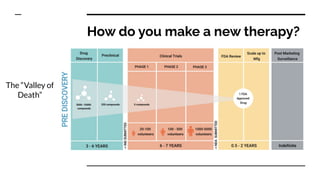
How do you make a new therapy?
The “Valley of
Death”
Why is drug development so
hard?
● Not just a scientific / biophysiological problem but also a
healthcare / logistics / manufacturing / marketing ...
● Biology and disease is complicated and ill-understood
● Many multi-modal problems
● It’s a casino economy
Areas for exploitation
There are many data-rich
processes in pharma
● Ripe for optimization
● Many uncertainties and unknowns
● Not every solution has to be perfect, just better
● The obvious, sexy problems are not always impactful
● AI best as a means, not an end in itself
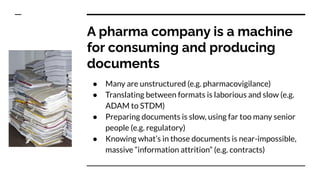
A pharma company is a machine
for consuming and producing
documents
● Many are unstructured (e.g. pharmacovigilance)
● Translating between formats is laborious and slow (e.g.
ADAM to STDM)
● Preparing documents is slow, using far too many senior
people (e.g. regulatory)
● Knowing what’s in those documents is near-impossible,
massive “information attrition” (e.g. contracts)
Large models change the game
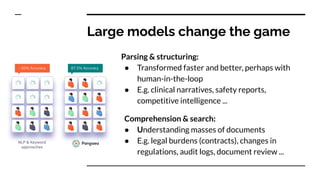
Parsing & structuring:
● Transformed faster and better, perhaps with
human-in-the-loop
● E.g. clinical narratives, safety reports,
competitive intelligence ...
Comprehension & search:
● Understanding masses of documents
● E.g. legal burdens (contracts), changes in
regulations, audit logs, document review ...
Large models change the game
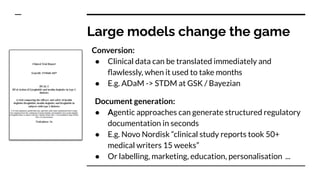
Conversion:
● Clinical data can be translated immediately and
flawlessly, when it used to take months
● E.g. ADaM -> STDM at GSK / Bayezian
Document generation:
● Agentic approaches can generate structured regulatory
documentation in seconds
● E.g. Novo Nordisk “clinical study reports took 50+
medical writers 15 weeks”
● Or labelling, marketing, education, personalisation ...
Clinical trials
● The bottleneck for all drugs
● But often unmodernised or left behind, with many soft
and unknown factors
● Fraught with (unnecessary) failure & problems
○ 90% failure rate overall
○ 40% can’t recruit enough patients
○ 50% of sites recruit 1 or fewer patients
○ 50% of trials fail to report on time
● Trials are getting more complex
○ Adaptive designs, platform trials, umbrella trials, digital endpoints,
seamless trials
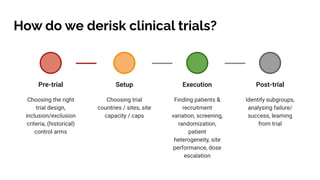
How do we derisk clinical trials?
Pre-trial
Choosing the right
trial design,
inclusion/exclusion
criteria, (historical)
control arms
Setup
Choosing trial
countries / sites, site
capacity / caps
Execution
Finding patients &
recruitment
variation, screening,
randomization,
patient
heterogeneity, site
performance, dose
escalation
Post-trial
Identify subgroups,
analysing failure/
success, learning
from trial
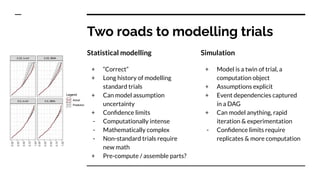
Two roads to modelling trials
Statistical modelling
+ “Correct”
+ Long history of modelling
standard trials
+ Can model assumption
uncertainty
+ Confidence limits
- Computationally intense
- Mathematically complex
- Non-standard trials require
new math
+ Pre-compute / assemble parts?
Simulation
+ Model is a twin of trial, a
computation object
+ Assumptions explicit
+ Event dependencies captured
in a DAG
+ Can model anything, rapid
iteration & experimentation
- Confidence limits require
replicates & more computation
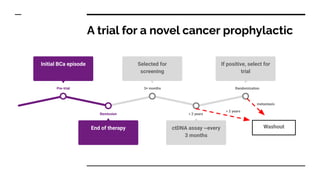
A trial for a novel cancer prophylactic
< 2 years
ctDNA assay ~every
3 months
3+ months
Selected for
screening
Remission
End of therapy
Pre-trial
Initial BCa episode
Randomization
If positive, select for
trial
Washout
> 2 years
metastasis
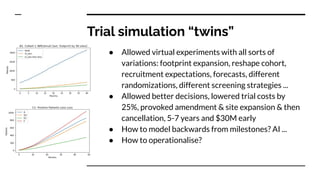
Trial simulation “twins”
● Allowed virtual experiments with all sorts of
variations: footprint expansion, reshape cohort,
recruitment expectations, forecasts, different
randomizations, different screening strategies ...
● Allowed better decisions, lowered trial costs by
25%, provoked amendment & site expansion & then
cancellation, 5-7 years and $30M early
● How to model backwards from milestones? AI ...
● How to operationalise?
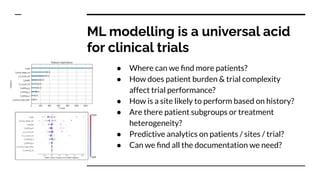
ML modelling is a universal acid
for clinical trials
● Where can we find more patients?
● How does patient burden & trial complexity
affect trial performance?
● How is a site likely to perform based on history?
● Are there patient subgroups or treatment
heterogeneity?
● Predictive analytics on patients / sites / trial?
● Can we find all the documentation we need?
Causality & reasoning
Why it matters
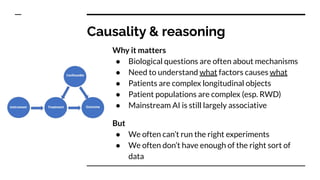
● Biological questions are often about mechanisms
● Need to understand what factors causes what
● Patients are complex longitudinal objects
● Patient populations are complex (esp. RWD)
● Mainstream AI is still largely associative
But
● We often can’t run the right experiments
● We often don’t have enough of the right sort of
data
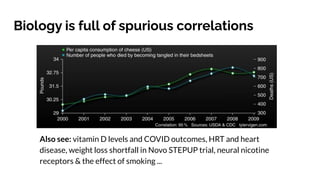
Biology is full of spurious correlations
Also see: vitamin D levels and COVID outcomes, HRT and heart
disease, weight loss shortfall in Novo STEPUP trial, neural nicotine
receptors & the effect of smoking ...
Causal inference
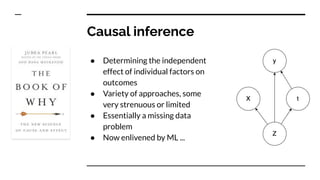
● Determining the independent
effect of individual factors on
outcomes
● Variety of approaches, some
very strenuous or limited
● Essentially a missing data
problem
● Now enlivened by ML ...
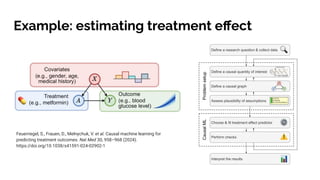
Example: estimating treatment effect
Feuerriegel, S., Frauen, D., Melnychuk, V. et al. Causal machine learning for
predicting treatment outcomes. Nat Med 30, 958–968 (2024).
https://doi.org/10.1038/s41591-024-02902-1
Causality is broadly useful
Discovery & mechanistic understanding sure but also ...
● Analysis of RWD to understand disease behaviour
● When you can’t do the experiment (e.g. children, severely
ill)
● Where there are two many combinations (e.g. dosing for
combo treatments)
● Very granular populations where you’ll never find enough
patients
● To get a individualized / conditional treatment effect
Multi-modality
Why
● Disease is a systemic, multi-level phenomena
● Many different weak signals can make a signal strong one
● Disease data is of many different types & modalities
But
● Difficult to integrate some sources (images, text)
● Many possible approaches, of unknown value
● Hughes / peaking phenomena
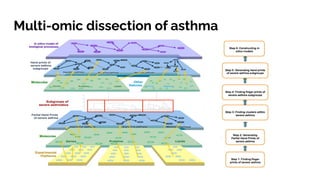
Multi-omic dissection of asthma
Multi-modal large molecule
design / selection
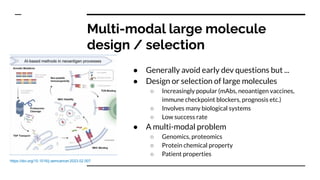
● Generally avoid early dev questions but ...
● Design or selection of large molecules
○ Increasingly popular (mAbs, neoantigen vaccines,
immune checkpoint blockers, prognosis etc.)
○ Involves many biological systems
○ Low success rate
● A multi-modal problem
○ Genomics, proteomics
○ Protein chemical property
○ Patient properties
https://doi.org/10.1016/j.semcancer.2023.02.007
A pharma company is a
manufacturer
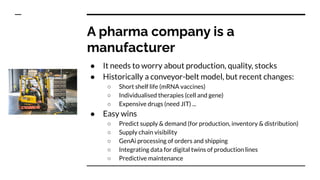
● It needs to worry about production, quality, stocks
● Historically a conveyor-belt model, but recent changes:
○ Short shelf life (mRNA vaccines)
○ Individualised therapies (cell and gene)
○ Expensive drugs (need JIT) ...
● Easy wins
○ Predict supply & demand (for production, inventory & distribution)
○ Supply chain visibility
○ GenAi processing of orders and shipping
○ Integrating data for digital twins of production lines
○ Predictive maintenance
Synthetic data
Why
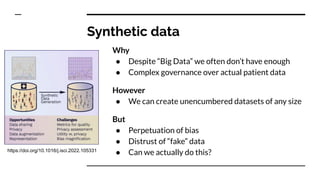
● Despite “Big Data” we often don’t have enough
● Complex governance over actual patient data
However
● We can create unencumbered datasets of any size
But
● Perpetuation of bias
● Distrust of “fake” data
● Can we actually do this?
https://doi.org/10.1016/j.isci.2022.105331
The psychology and
culture of pharma &
biotech
Behaviours
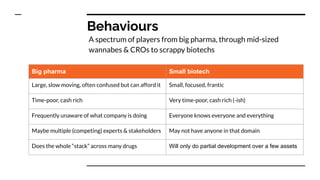
A spectrum of players from big pharma, through mid-sized
wannabes & CROs to scrappy biotechs
Big pharma Small biotech
Large, slow moving, often confused but can afford it Small, focused, frantic
Time-poor, cash rich Very time-poor, cash rich (-ish)
Frequently unaware of what company is doing Everyone knows everyone and everything
Maybe multiple (competing) experts & stakeholders May not have anyone in that domain
Does the whole “stack” across many drugs Will only do partial development over a few assets
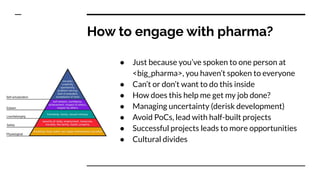
How to engage with pharma?
● Just because you’ve spoken to one person at
<big_pharma>, you haven’t spoken to everyone
● Can’t or don’t want to do this inside
● How does this help me get my job done?
● Managing uncertainty (derisk development)
● Avoid PoCs, lead with half-built projects
● Successful projects leads to more opportunities
● Cultural divides
Final thoughts
Summary
● Drug development is a complex process, rich with
multi-modal data
● AI seems like a good solution but the situation is
complicated by pharma & biological realities
● Strong opportunities abound, especially in neglected
pharma sectors
● Consider the mindset and culture of pharma to engage
with it
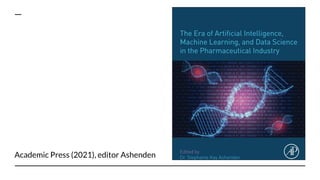
Academic Press (2021), editor Ashenden