HADOOP ENABLED
HEALTHCARE
Charles Boicey, MS, RN-BC, CPHIMS
Enterprise Analytics Architect
Stony Brook Medicine
Suffolk Care Collaborative
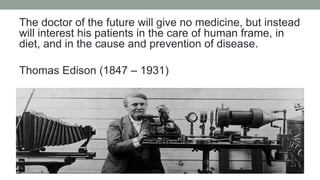
The doctor of the future will give no medicine, but instead
will interest his patients in the care of human frame, in
diet, and in the cause and prevention of disease.
Thomas Edison (1847 – 1931)
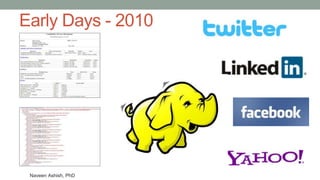
Early Days - 2010
Naveen Ashish, PhD
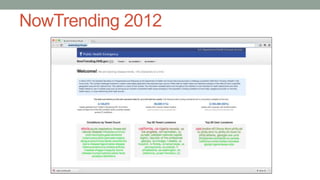
NowTrending 2012
Enterprise Data Warehouse
• Suffer from a latency factor of
up to 24 hours
• The EDW serves all of the
following retrospectively as
opposed to in real time
• Clinicians
• Operations
• Quality and research
Electronic Medical Record
• Not designed to process high
volume/velocity data
• Not intended to handle
complex operations
• Such as:
• Anomaly detection
• Machine learning
• Building complex algorithms
• Pattern set recognition
Current Environment
Big Data = Interoperability
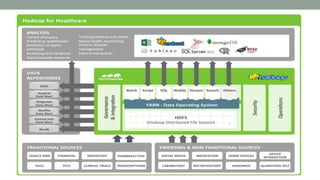
• Big Data Ecosystem that
Supports:
• Hadoop (HDFS)
• Hbase
• Hive
• Pig
• MapReduce
• Mahout
• MongoDB (NoSQL)
• Neo 4j (Graph Database)
• Relational Data Base
• R
• Spark
• Storm
• Weka
Big Data = Complete Data
• The Electronic Medical Record is primarily transactional taking
feeds from source systems via an interface engine
• The Enterprise Data Warehouse is a collection of data from
the EMR and various source systems in the enterprise
• In both cases decisions are made concerning data acquisition
• A Big Data system is capable of ingesting and storing
healthcare data in total and in real time
Modern Healthcare Data Platform
A healthcare information ecosystem built on “Big Data”
technologies should:
Be capable of serving the needs of clinicians, operations, quality and research
And should do so in real time and in one environment
Should be:
Able to ingest all healthcare generated data both internal and external in native
format
Should be:
A platform for advanced analytics such as early detection of sepsis & hospital
acquired conditions
Be enabled to predict potential readmissions
Leverage complex algorithms and be a machine learning platform
Architecture Guiding Principles
• Architecture to minimize encumbrance on IT staff
• Ability to store all healthcare date in native form and
complete
• Use of supported open source code
• Ensure architectural compatibility with commercial
applications
Infrastructure
• Low Cost of Entry & Scalable
• Open Source
• Commodity Hardware
• UCI Hadoop Ecosystem
• 10 nodes
• 5 terabytes
• Yahoo Hadoop Ecosystem
• 60K nodes
• 160 petabytes
• Cloud Ready
Data Sources
• Legacy Systems
• Print to Text or Delimited String
• All HL7 Feeds (EMR source
systems)
• All EMR Initiated Data (Stored
Procedures)
• Device Data (in one minute
intervals)
• Physiological Monitors (HL7)
• Ventilators (HL7)
• Smart Pumps
• Social Media (POC)
• Healthcare Organization
Sentiment Analysis
• Patient Engagement
• Home Monitoring (POC)
• Real Time Location System
(RFID)
• Hospital Sensors
Newer Data Sources
• External Streaming Device
Data
• Wearables
• Home Devices
• Social Media
• Geographic Information
System (GIS) Data
• Omic Data
• Open Data
• www.data.gov
• Adverse Drug Event
• www.researchae.com
• Internet of Things (IoT)
• Telematics
• 5G
Use Cases
• Legacy System Retirement
• Patient Condition Changes
• RRT
• Early Sepsis Detection
• Environmental Response
• Real Time Nursing Unit
Utilization
• Staffing and Resource Allocation
• Social Media Sentiment
Analysis
• Research
• Cohort Discovery
• Data Science
• Clinician Aware Applications
• Patient Monitoring External to
Traditional Healthcare Setting
• Event Driven Care & Real
Time Quality Monitoring
Future Use Cases
• Ventilator Management
• Vent dashboard in EMR
• Hospital Acquired Infections
(HAI)
• VTE Surveillance
• Sensium Vitals Digital Patch
• Patient-Generated Data
• Home Devices (Scale, Vital
Signs, Glucose)
• Exercise & Diet (Fit Bit,
Jawbone, Nike)
• Combining Phenotype Data
with Genotype Data
• Patient Threat Analysis
• Edge and Vertices Analysis
• Patient caregivers and
outcomes
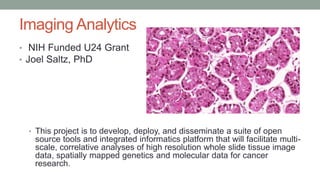
Imaging Analytics
• NIH Funded U24 Grant
• Joel Saltz, PhD
• This project is to develop, deploy, and disseminate a suite of open
source tools and integrated informatics platform that will facilitate multi-
scale, correlative analyses of high resolution whole slide tissue image
data, spatially mapped genetics and molecular data for cancer
research.
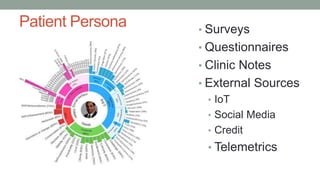
Patient Persona • Surveys
• Questionnaires
• Clinic Notes
• External Sources
• IoT
• Social Media
• Credit
• Telemetrics
FHIR – The “Public API” for Healthcare?
FHIR = Fast Health Interoperability Resource
• Emerging HL7 Standard (DSTU 2 soon)
• More powerful & less complex than HL7 V3
ReSTful API
• ReST = Representational State Transfer – basis for Internet Scale
• Resource-oriented rather than Remote Procedure Call (nouns > verbs)
• Easy for developers to understand and use
FHIR Resources
• Well-defined, simple snippets of data that capture core clinical entities
• Build on top of existing HL7 data types
• Resources are the “objects” in a network of URI reference links
Huff, S., McCallie, D HIMSS 2015
SMART Platform –Open Specification
for Apps
• “Substitutable Medical Apps”
• Kohane/Mandl – NEJM (2009)
• A SMART App is a Web App
• HTML5 + JavaScript
• Remote or embedded in EHR
• URL passes context & FHIR li nk
• EHR Data Access via FHIR
• OAuth2 / OIDC for security
Huff, S., McCallie, D HIMSS 2015
Some SMART Hotbeds
Huff, S., McCallie, D HIMSS 2015
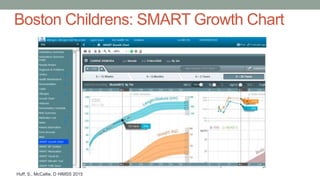
Boston Childrens: SMART Growth Chart
Huff, S., McCallie, D HIMSS 2015
DSRIP
• 8 billion dollar grant (Medicaid waiver) from CMS to NY
State
• 25% reduction over five years in avoidable hospitalizations
and ER visits in the Medicaid and uninsured population
• Collaborative effort to implement innovative projects
focused on
• System transformation
• Clinical improvement
• Population health improvement
5 Year Goals
• Create integrated Suffolk County care delivery system for
387K lives anchored by safety net providers
• Engage partners across the care delivery spectrum to
create a countywide network of care
• After five years, transition this network to an ACO which will
contract with insurance providers on an at risk basis
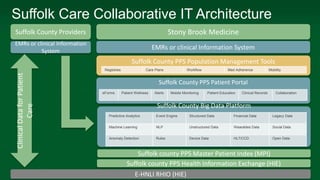
Suffolk Care Collaborative IT Architecture
Suffolk County Providers
Suffolk county PPS Master Patient Index (MPI)
Suffolk county PPS Health Information Exchange (HIE)
E-HNLI RHIO (HIE)
Suffolk County PPS Patient Portal
Stony Brook Medicine
Suffolk County Big Data Platform
Suffolk County PPS Population Management Tools
EMRs or clinical Information System
EMRs or clinical Information
System
eForms Patient Wellness Alerts Mobile Monitoring Patient Education Clinical Records Collaboration
Registries Care Plans Workflow Med Adherence Mobility
Predictive Analytics Event Engine Structured Data Financial Data Legacy Data
Machine Learning NLP Unstructured Data Wearables Data Social Data
Anomaly Detection Rules Device Data HL7/CCD Open Data
ClinicalDataforPatient
Care
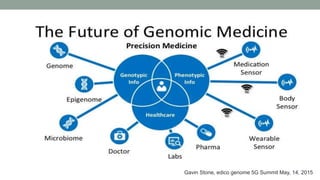
Gavin Stone, edico genome 5G Summit May, 14, 2015
New Team Members
• Data Scientist
• Developers
• Cognitive and Behavioral Psychology
• User Experience
• Human & Computer Interaction
• Devices
• Wearables
• Patients & Family
Trends: Big Data
• Definition: Evolving
• Creation & Management: Distributed and augmented
• Information Governance: Shared
• Meaningful Analysis: Beyond PnL, Reporting, Connections,
Correlations, Pattern Recognition, Machine Learning, Natural
Language Processing
• Business Requirements: Blank Page; We don’t know what
we want we will figure it out once we look at the data, the data
will lead the way, AKA, Data Science
Trends: Healthcare
• Content Analytics – Suggestive Analytics* – Prescriptive
Analytics
• Imaging Analytics
• Moving Analytics out of the EMR Environment
• Graph Data Mart
• Edge and Vertices Analysis
• Omic & Phenotype Combines
• Sentiment Analysis
Dale Sanders
Takeaways
• Underpinning platforms may change but concept is here to
stay, abstract where possible.
• Machine learning will lead to the evolution of Data Science and
eventual use of AI in Healthcare.
• Get used to source now, ask questions later: Healthcare
evolves with data and it is not a point in time construct any
longer.
• Get used to working with constant change, disruptive trends
and something new that will make your “frameworks” obsolete.
Real-Time Clinical Analytics
• Mercy Health
• Paul Boal
• Adam Doyle
• 4:35 – 5:15
• Right Here 230C
My Partners
Contact Me @
Charles Boicey
charles.boicey@stonybrookmedicine.edu
traumarn@cox.net
(631) 444-3971
@N2InformaticsRN

Hadoop Enabled Healthcare

  • 1.
    HADOOP ENABLED HEALTHCARE Charles Boicey,MS, RN-BC, CPHIMS Enterprise Analytics Architect Stony Brook Medicine Suffolk Care Collaborative
  • 2.
    The doctor ofthe future will give no medicine, but instead will interest his patients in the care of human frame, in diet, and in the cause and prevention of disease. Thomas Edison (1847 – 1931)
  • 3.
    Early Days -2010 Naveen Ashish, PhD
  • 4.
  • 5.
    Enterprise Data Warehouse •Suffer from a latency factor of up to 24 hours • The EDW serves all of the following retrospectively as opposed to in real time • Clinicians • Operations • Quality and research Electronic Medical Record • Not designed to process high volume/velocity data • Not intended to handle complex operations • Such as: • Anomaly detection • Machine learning • Building complex algorithms • Pattern set recognition Current Environment
  • 6.
    Big Data =Interoperability • Big Data Ecosystem that Supports: • Hadoop (HDFS) • Hbase • Hive • Pig • MapReduce • Mahout • MongoDB (NoSQL) • Neo 4j (Graph Database) • Relational Data Base • R • Spark • Storm • Weka
  • 7.
    Big Data =Complete Data • The Electronic Medical Record is primarily transactional taking feeds from source systems via an interface engine • The Enterprise Data Warehouse is a collection of data from the EMR and various source systems in the enterprise • In both cases decisions are made concerning data acquisition • A Big Data system is capable of ingesting and storing healthcare data in total and in real time
  • 8.
    Modern Healthcare DataPlatform A healthcare information ecosystem built on “Big Data” technologies should: Be capable of serving the needs of clinicians, operations, quality and research And should do so in real time and in one environment Should be: Able to ingest all healthcare generated data both internal and external in native format Should be: A platform for advanced analytics such as early detection of sepsis & hospital acquired conditions Be enabled to predict potential readmissions Leverage complex algorithms and be a machine learning platform
  • 9.
    Architecture Guiding Principles •Architecture to minimize encumbrance on IT staff • Ability to store all healthcare date in native form and complete • Use of supported open source code • Ensure architectural compatibility with commercial applications
  • 10.
    Infrastructure • Low Costof Entry & Scalable • Open Source • Commodity Hardware • UCI Hadoop Ecosystem • 10 nodes • 5 terabytes • Yahoo Hadoop Ecosystem • 60K nodes • 160 petabytes • Cloud Ready
  • 11.
    Data Sources • LegacySystems • Print to Text or Delimited String • All HL7 Feeds (EMR source systems) • All EMR Initiated Data (Stored Procedures) • Device Data (in one minute intervals) • Physiological Monitors (HL7) • Ventilators (HL7) • Smart Pumps • Social Media (POC) • Healthcare Organization Sentiment Analysis • Patient Engagement • Home Monitoring (POC) • Real Time Location System (RFID) • Hospital Sensors
  • 12.
    Newer Data Sources •External Streaming Device Data • Wearables • Home Devices • Social Media • Geographic Information System (GIS) Data • Omic Data • Open Data • www.data.gov • Adverse Drug Event • www.researchae.com • Internet of Things (IoT) • Telematics • 5G
  • 13.
    Use Cases • LegacySystem Retirement • Patient Condition Changes • RRT • Early Sepsis Detection • Environmental Response • Real Time Nursing Unit Utilization • Staffing and Resource Allocation • Social Media Sentiment Analysis • Research • Cohort Discovery • Data Science • Clinician Aware Applications • Patient Monitoring External to Traditional Healthcare Setting • Event Driven Care & Real Time Quality Monitoring
  • 14.
    Future Use Cases •Ventilator Management • Vent dashboard in EMR • Hospital Acquired Infections (HAI) • VTE Surveillance • Sensium Vitals Digital Patch • Patient-Generated Data • Home Devices (Scale, Vital Signs, Glucose) • Exercise & Diet (Fit Bit, Jawbone, Nike) • Combining Phenotype Data with Genotype Data • Patient Threat Analysis • Edge and Vertices Analysis • Patient caregivers and outcomes
  • 15.
    Imaging Analytics • NIHFunded U24 Grant • Joel Saltz, PhD • This project is to develop, deploy, and disseminate a suite of open source tools and integrated informatics platform that will facilitate multi- scale, correlative analyses of high resolution whole slide tissue image data, spatially mapped genetics and molecular data for cancer research.
  • 16.
    Patient Persona •Surveys • Questionnaires • Clinic Notes • External Sources • IoT • Social Media • Credit • Telemetrics
  • 18.
    FHIR – The“Public API” for Healthcare? FHIR = Fast Health Interoperability Resource • Emerging HL7 Standard (DSTU 2 soon) • More powerful & less complex than HL7 V3 ReSTful API • ReST = Representational State Transfer – basis for Internet Scale • Resource-oriented rather than Remote Procedure Call (nouns > verbs) • Easy for developers to understand and use FHIR Resources • Well-defined, simple snippets of data that capture core clinical entities • Build on top of existing HL7 data types • Resources are the “objects” in a network of URI reference links Huff, S., McCallie, D HIMSS 2015
  • 19.
    SMART Platform –OpenSpecification for Apps • “Substitutable Medical Apps” • Kohane/Mandl – NEJM (2009) • A SMART App is a Web App • HTML5 + JavaScript • Remote or embedded in EHR • URL passes context & FHIR li nk • EHR Data Access via FHIR • OAuth2 / OIDC for security Huff, S., McCallie, D HIMSS 2015
  • 20.
    Some SMART Hotbeds Huff,S., McCallie, D HIMSS 2015
  • 21.
    Boston Childrens: SMARTGrowth Chart Huff, S., McCallie, D HIMSS 2015
  • 22.
    DSRIP • 8 billiondollar grant (Medicaid waiver) from CMS to NY State • 25% reduction over five years in avoidable hospitalizations and ER visits in the Medicaid and uninsured population • Collaborative effort to implement innovative projects focused on • System transformation • Clinical improvement • Population health improvement
  • 23.
    5 Year Goals •Create integrated Suffolk County care delivery system for 387K lives anchored by safety net providers • Engage partners across the care delivery spectrum to create a countywide network of care • After five years, transition this network to an ACO which will contract with insurance providers on an at risk basis
  • 24.
    Suffolk Care CollaborativeIT Architecture Suffolk County Providers Suffolk county PPS Master Patient Index (MPI) Suffolk county PPS Health Information Exchange (HIE) E-HNLI RHIO (HIE) Suffolk County PPS Patient Portal Stony Brook Medicine Suffolk County Big Data Platform Suffolk County PPS Population Management Tools EMRs or clinical Information System EMRs or clinical Information System eForms Patient Wellness Alerts Mobile Monitoring Patient Education Clinical Records Collaboration Registries Care Plans Workflow Med Adherence Mobility Predictive Analytics Event Engine Structured Data Financial Data Legacy Data Machine Learning NLP Unstructured Data Wearables Data Social Data Anomaly Detection Rules Device Data HL7/CCD Open Data ClinicalDataforPatient Care
  • 25.
    Gavin Stone, edicogenome 5G Summit May, 14, 2015
  • 26.
    New Team Members •Data Scientist • Developers • Cognitive and Behavioral Psychology • User Experience • Human & Computer Interaction • Devices • Wearables • Patients & Family
  • 27.
    Trends: Big Data •Definition: Evolving • Creation & Management: Distributed and augmented • Information Governance: Shared • Meaningful Analysis: Beyond PnL, Reporting, Connections, Correlations, Pattern Recognition, Machine Learning, Natural Language Processing • Business Requirements: Blank Page; We don’t know what we want we will figure it out once we look at the data, the data will lead the way, AKA, Data Science
  • 28.
    Trends: Healthcare • ContentAnalytics – Suggestive Analytics* – Prescriptive Analytics • Imaging Analytics • Moving Analytics out of the EMR Environment • Graph Data Mart • Edge and Vertices Analysis • Omic & Phenotype Combines • Sentiment Analysis Dale Sanders
  • 29.
    Takeaways • Underpinning platformsmay change but concept is here to stay, abstract where possible. • Machine learning will lead to the evolution of Data Science and eventual use of AI in Healthcare. • Get used to source now, ask questions later: Healthcare evolves with data and it is not a point in time construct any longer. • Get used to working with constant change, disruptive trends and something new that will make your “frameworks” obsolete.
  • 30.
    Real-Time Clinical Analytics •Mercy Health • Paul Boal • Adam Doyle • 4:35 – 5:15 • Right Here 230C
  • 31.
  • 32.
    Contact Me @ CharlesBoicey charles.boicey@stonybrookmedicine.edu traumarn@cox.net (631) 444-3971 @N2InformaticsRN