HDLC Frame
Structure
(HIGH LEVEL DATA LINK CONTROL)
INTRODUCTION:
 HDLC is a bit oriented code transparent Synchronous data
link layer protocol.
 It is developed by International Standard Organization
(ISO).
 Current standard for HDLC is ISO 13239.
 It provides both connection-oriented and connectionless
service .
 In HDLC, data is organized into a unit (called a frame) and
sent across a network to a destination that verifies its
successful arrival.
contd.
 The HDLC protocol embeds information in a data frame that allows devices
to control data flow and correct errors.
 HDLC supports both half-duplex and full-duplex communication over
point to point & multipoint link.
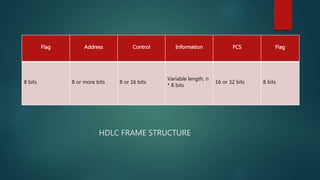
HDLC FRAME STRUCTURE
Flag Address Control Information FCS Flag
8 bits 8 or more bits 8 or 16 bits
Variable length, n
* 8 bits
16 or 32 bits 8 bits
Flag Address Control Information FCS Flag
8 bits 8 or more bits 8 or 16 bits
Variable length, n
* 8 bits
16 or 32 bits 8 bits
Flag Address Control Information FCS Flag
8 bits 8 or more bits 8 or 16 bits
Variable length, n
* 8 bits
16 or 32 bits 8 bits
HDLC FRAME FORMAT
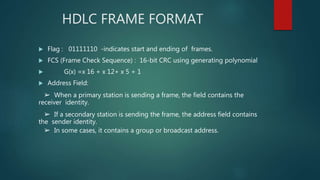
 Flag : 01111110 -indicates start and ending of frames.
 FCS (Frame Check Sequence) : 16-bit CRC using generating polynomial
 G(x) =x 16 + x 12+ x 5 + 1
 Address Field:
➢ When a primary station is sending a frame, the field contains the
receiver identity.
➢ If a secondary station is sending the frame, the address field contains
the sender identity.
➢ In some cases, it contains a group or broadcast address.
Frame Types
● There are three different classes of frames used in HDLC
➢ Unnumbered frames, used in link setup and
disconnection, and hence do not contain ACK.
➢ Information frames, which carry actual information.
Such frames can piggyback ACK in case of ABM.
➢ Supervisory frames, which are used for error and flow
control purposes and hence contain send and receive
sequence numbers.
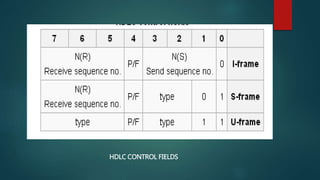
HDLC CONTROL FIELDS
CONTROL FIELDS
 In I-frames, N(s) is the sequence number of the frame being sent.
 N(r) is the sequence number of the frame being expected.
 The P/F bit, known as the poll/final bit, is used with
different meaning in different contexts.
➢ It is used to indicate polling, to indicate the final I- frame,
etc
3 DIFFERENT CLASSES OF
FRAMES
 Information frames, or I-frames, transport user data from the network
layer. In addition they can also include flow and error control
information piggybacked on data.
 Unnumbered frames, or U-frames, are used for various miscellaneous
purposes, including link management. Some U-frames contain an
information field, depending on the type.
 Supervisory Frames, or S-frames, are used for flow and error control
whenever piggybacking is impossible or inappropriate, such as when
a station does not have data to send. S-frames do not have
information fields.
contd.
 There are four different supervisory frames
➢ SS=00, Receiver Ready (RR), N(R),ACKs all frames received up to and including the one
with sequence number N(R) - 1.
➢ SS=10, Receiver Not Ready (RNR), and N(R) has the same meaning as above
➢ SS=01, Reject; all frames with sequence number N(R) or higher are rejected, which
in turns ACKs frames with sequence number N(R) -1 or lower.
➢ SS=11, Selective Reject; the receive rejects the frame with sequence number N(R)
contd.
 The unnumbered frames can be grouped into the following categories:
➢ Mode-setting commands and responses
➢ Recovery commands and responses
➢ Miscellaneous commands and responses
Hdlc

Hdlc

  • 1.
  • 2.
    INTRODUCTION:  HDLC isa bit oriented code transparent Synchronous data link layer protocol.  It is developed by International Standard Organization (ISO).  Current standard for HDLC is ISO 13239.  It provides both connection-oriented and connectionless service .  In HDLC, data is organized into a unit (called a frame) and sent across a network to a destination that verifies its successful arrival.
  • 3.
    contd.  The HDLCprotocol embeds information in a data frame that allows devices to control data flow and correct errors.  HDLC supports both half-duplex and full-duplex communication over point to point & multipoint link.
  • 4.
    HDLC FRAME STRUCTURE FlagAddress Control Information FCS Flag 8 bits 8 or more bits 8 or 16 bits Variable length, n * 8 bits 16 or 32 bits 8 bits Flag Address Control Information FCS Flag 8 bits 8 or more bits 8 or 16 bits Variable length, n * 8 bits 16 or 32 bits 8 bits Flag Address Control Information FCS Flag 8 bits 8 or more bits 8 or 16 bits Variable length, n * 8 bits 16 or 32 bits 8 bits
  • 5.
    HDLC FRAME FORMAT Flag : 01111110 -indicates start and ending of frames.  FCS (Frame Check Sequence) : 16-bit CRC using generating polynomial  G(x) =x 16 + x 12+ x 5 + 1  Address Field: ➢ When a primary station is sending a frame, the field contains the receiver identity. ➢ If a secondary station is sending the frame, the address field contains the sender identity. ➢ In some cases, it contains a group or broadcast address.
  • 6.
    Frame Types ● Thereare three different classes of frames used in HDLC ➢ Unnumbered frames, used in link setup and disconnection, and hence do not contain ACK. ➢ Information frames, which carry actual information. Such frames can piggyback ACK in case of ABM. ➢ Supervisory frames, which are used for error and flow control purposes and hence contain send and receive sequence numbers.
  • 7.
  • 8.
    CONTROL FIELDS  InI-frames, N(s) is the sequence number of the frame being sent.  N(r) is the sequence number of the frame being expected.  The P/F bit, known as the poll/final bit, is used with different meaning in different contexts. ➢ It is used to indicate polling, to indicate the final I- frame, etc
  • 9.
    3 DIFFERENT CLASSESOF FRAMES  Information frames, or I-frames, transport user data from the network layer. In addition they can also include flow and error control information piggybacked on data.  Unnumbered frames, or U-frames, are used for various miscellaneous purposes, including link management. Some U-frames contain an information field, depending on the type.  Supervisory Frames, or S-frames, are used for flow and error control whenever piggybacking is impossible or inappropriate, such as when a station does not have data to send. S-frames do not have information fields.
  • 10.
    contd.  There arefour different supervisory frames ➢ SS=00, Receiver Ready (RR), N(R),ACKs all frames received up to and including the one with sequence number N(R) - 1. ➢ SS=10, Receiver Not Ready (RNR), and N(R) has the same meaning as above ➢ SS=01, Reject; all frames with sequence number N(R) or higher are rejected, which in turns ACKs frames with sequence number N(R) -1 or lower. ➢ SS=11, Selective Reject; the receive rejects the frame with sequence number N(R)
  • 11.
    contd.  The unnumberedframes can be grouped into the following categories: ➢ Mode-setting commands and responses ➢ Recovery commands and responses ➢ Miscellaneous commands and responses