


.
Present By
Showkot Usman
High-Level Data Link Control (HDLC)
• A high-level data link control defines rules for transmitting data between
network points.
• Data in an HDLC is organized into units called frames and is sent across
networks to specified destinations. HDLC also manages the pace at which
data is transmitted. HDLC is commonly used in the open systems
interconnection (OSI) model's layer 2.
 Defines three types of stations
 Primary
 Secondary and
 Combined
Defines three types of data transfer mode : -
1. Normal Response mode
2 . Asynchronous Response mode
3. Asynchronous Balanced mode
HDLC
The three modes of data transfer operations are
1.Normal Response Mode (NRM)
- Secondary station can send ONLY when the primary station instruct it
to do so
2. Asynchronous Response Mode (ARM)
- More independent secondary station.
- Can send data or control information without explicit permission to do
so (note that it is still can not send commands)
3. Asynchronous Balanced Mode (ABM)
 Mainly used in point-to-point links, for communication between
combined stations.
 Either stations can send data, control information and commands
Three types of frames
Unnumbered
 information
 Supervisor
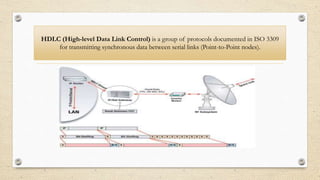
HDLC (High-level Data Link Control) is a group of protocols documented in ISO 3309
for transmitting synchronous data between serial links (Point-to-Point nodes).
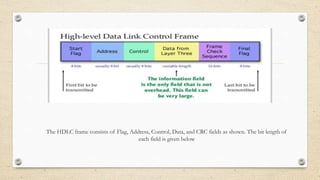
The HDLC frame consists of Flag, Address, Control, Data, and CRC fields as shown. The bit length of
each field is given below
Any Questions ……???
Thank You

HDLC

  • 1.
  • 2.
    High-Level Data LinkControl (HDLC) • A high-level data link control defines rules for transmitting data between network points. • Data in an HDLC is organized into units called frames and is sent across networks to specified destinations. HDLC also manages the pace at which data is transmitted. HDLC is commonly used in the open systems interconnection (OSI) model's layer 2.
  • 3.
     Defines threetypes of stations  Primary  Secondary and  Combined Defines three types of data transfer mode : - 1. Normal Response mode 2 . Asynchronous Response mode 3. Asynchronous Balanced mode
  • 4.
    HDLC The three modesof data transfer operations are 1.Normal Response Mode (NRM) - Secondary station can send ONLY when the primary station instruct it to do so 2. Asynchronous Response Mode (ARM) - More independent secondary station. - Can send data or control information without explicit permission to do so (note that it is still can not send commands)
  • 5.
    3. Asynchronous BalancedMode (ABM)  Mainly used in point-to-point links, for communication between combined stations.  Either stations can send data, control information and commands
  • 6.
    Three types offrames Unnumbered  information  Supervisor
  • 7.
    HDLC (High-level DataLink Control) is a group of protocols documented in ISO 3309 for transmitting synchronous data between serial links (Point-to-Point nodes).
  • 8.
    The HDLC frameconsists of Flag, Address, Control, Data, and CRC fields as shown. The bit length of each field is given below
  • 9.
  • 10.