Parallel HDF5
Introductory Tutorial

HDF and HDF-EOS Workshop IX
November 30, 2005

HDF
Outline
• Overview of Parallel HDF5 design
• Setting up parallel environment
• Programming model for
– Creating and accessing a File
– Creating and accessing a Dataset
– Writing and reading Hyperslabs

• Parallel tutorial available at

– http://hdf.ncsa.uiuc.edu/HDF5/doc/Tu
tor

HDF-EOS Workshop IX

-2-

HDF
Overview of Parallel HDF5

HDF
PHDF5 Initial Target
• Support for MPI programming
• Not for shared memory
programming
– Threads
– OpenMP

• Has some experiments with

– Thread-safe support for Pthreads
– OpenMP if called “correctly”

HDF-EOS Workshop IX

-4-

HDF
PHDF5 Requirements
• PHDF5 files compatible with serial HDF5
files

– Shareable between different serial or parallel
platforms

• Single file image to all processes

– One file per process design is undesirable
• Expensive post processing
• Not useable by different number of processes

• Standard parallel I/O interface

– Must be portable to different platforms

HDF-EOS Workshop IX

-5-

HDF
Implementation Requirements
• No use of Threads

– Not commonly supported (1998)

• No reserved process

– May interfere with parallel algorithms

• No spawn process

– Not commonly supported even now

HDF-EOS Workshop IX

-6-

HDF
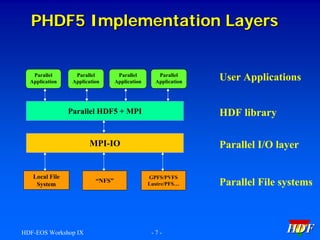
PHDF5 Implementation Layers

Parallel
Application

Parallel
Application

Parallel
Application

Parallel
Application

Parallel HDF5 + MPI

HDF library

MPI-IO

Local File
System

HDF-EOS Workshop IX

“NFS”

User Applications

Parallel I/O layer
GPFS/PVFS
Lustre/PFS…

-7-

Parallel File systems

HDF
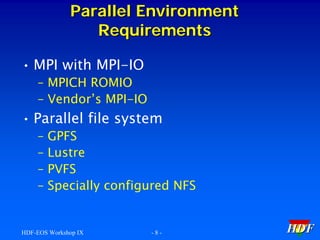
Parallel Environment
Requirements
• MPI with MPI-IO

– MPICH ROMIO
– Vendor’s MPI-IO

• Parallel file system
–
–
–
–

GPFS
Lustre
PVFS
Specially configured NFS

HDF-EOS Workshop IX

-8-

HDF
How to Compile PHDF5 Applications
• h5pcc – HDF5 C compiler command
– Similar to mpicc

• h5pfc – HDF5 F90 compiler command
– Similar to mpif90

• To compile:
% h5pcc h5prog.c
% h5pfc h5prog.f90
• Show the compiler commands without
executing them (i.e., dry run):
% h5pcc –show h5prog.c
% h5pfc –show h5prog.f90
HDF-EOS Workshop IX

-9-

HDF
Collective vs. Independent
Calls
• MPI definition of collective call

– All processes of the communicator must
participate in the right order

• Independent means not collective
• Collective is not necessarily
synchronous

HDF-EOS Workshop IX

- 10 -

HDF
Programming Restrictions
• Most PHDF5 APIs are collective
• PHDF5 opens a parallel file with a
communicator

– Returns a file-handle
– Future access to the file via the filehandle
– All processes must participate in
collective PHDF5 APIs
– Different files can be opened via
different communicators

HDF-EOS Workshop IX

- 11 -

HDF
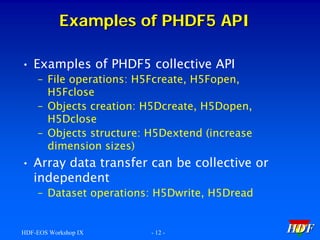
Examples of PHDF5 API
• Examples of PHDF5 collective API

– File operations: H5Fcreate, H5Fopen,
H5Fclose
– Objects creation: H5Dcreate, H5Dopen,
H5Dclose
– Objects structure: H5Dextend (increase
dimension sizes)

• Array data transfer can be collective or
independent
– Dataset operations: H5Dwrite, H5Dread

HDF-EOS Workshop IX

- 12 -

HDF
What Does PHDF5 Support ?
• After a file is opened by the processes of
a communicator

– All parts of file are accessible by all processes
– All objects in the file are accessible by all
processes
– Multiple processes write to the same data
array
– Each process writes to individual data array

HDF-EOS Workshop IX

- 13 -

HDF
PHDF5 API Languages
• C and F90 language interfaces
• Platforms supported:

– Most platforms with MPI-IO supported.
E.g.,
• IBM SP, Intel TFLOPS, SGI IRIX64/Altrix, HP
Alpha Clusters, Linux clusters

– Work in progress

• Red Storm, BlueGene/L, Cray xt3

HDF-EOS Workshop IX

- 14 -

HDF
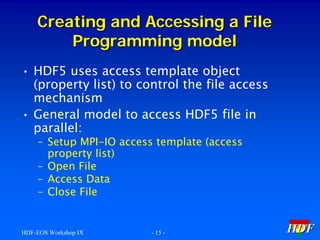
Creating and Accessing a File
Programming model
• HDF5 uses access template object
(property list) to control the file access
mechanism
• General model to access HDF5 file in
parallel:
– Setup MPI-IO access template (access
property list)
– Open File
– Access Data
– Close File

HDF-EOS Workshop IX

- 15 -

HDF
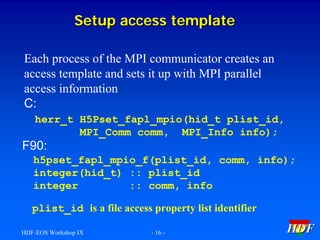
Setup access template
Each process of the MPI communicator creates an
access template and sets it up with MPI parallel
access information
C:
herr_t H5Pset_fapl_mpio(hid_t plist_id,
MPI_Comm comm, MPI_Info info);

F90:
h5pset_fapl_mpio_f(plist_id, comm, info);
integer(hid_t) :: plist_id
integer
:: comm, info
plist_id is a file access property list identifier
HDF-EOS Workshop IX

- 16 -

HDF
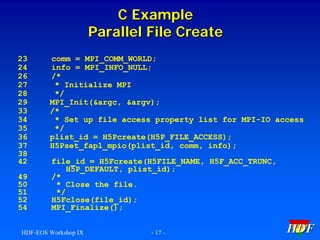
C Example
Parallel File Create
23
24
26
27
28
29
33
34
35
36
37
38
42
49
50
51
52
54

comm = MPI_COMM_WORLD;
info = MPI_INFO_NULL;
/*
* Initialize MPI
*/
MPI_Init(&argc, &argv);
/*
* Set up file access property list for MPI-IO access
*/
plist_id = H5Pcreate(H5P_FILE_ACCESS);
H5Pset_fapl_mpio(plist_id, comm, info);
file_id = H5Fcreate(H5FILE_NAME, H5F_ACC_TRUNC,
H5P_DEFAULT, plist_id);
/*
* Close the file.
*/
H5Fclose(file_id);
MPI_Finalize();

HDF-EOS Workshop IX

- 17 -

HDF
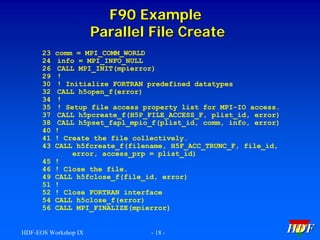
F90 Example
Parallel File Create
23
24
26
29
30
32
34
35
37
38
40
41
43
45
46
49
51
52
54
56

comm = MPI_COMM_WORLD
info = MPI_INFO_NULL
CALL MPI_INIT(mpierror)
!
! Initialize FORTRAN predefined datatypes
CALL h5open_f(error)
!
! Setup file access property list for MPI-IO access.
CALL h5pcreate_f(H5P_FILE_ACCESS_F, plist_id, error)
CALL h5pset_fapl_mpio_f(plist_id, comm, info, error)
!
! Create the file collectively.
CALL h5fcreate_f(filename, H5F_ACC_TRUNC_F, file_id,
error, access_prp = plist_id)
!
! Close the file.
CALL h5fclose_f(file_id, error)
!
! Close FORTRAN interface
CALL h5close_f(error)
CALL MPI_FINALIZE(mpierror)

HDF-EOS Workshop IX

- 18 -

HDF
Creating and Opening Dataset
• All processes of the communicator
open/close a dataset by a collective
call
– C: H5Dcreate or H5Dopen; H5Dclose
– F90: h5dcreate_f or h5dopen_f;
h5dclose_f

• All processes of the communicator
must extend an unlimited
dimension dataset before writing to
it
– C: H5Dextend
– F90: h5dextend_f

HDF-EOS Workshop IX

- 19 -

HDF
C Example
Parallel Dataset Create
56
57
58
59
60
61
62
63
64
65
66
67
68

file_id = H5Fcreate(…);
/*
* Create the dataspace for the dataset.
*/
dimsf[0] = NX;
dimsf[1] = NY;
filespace = H5Screate_simple(RANK, dimsf, NULL);

70
71
72
73
74

H5Dclose(dset_id);
/*
* Close the file.
*/
H5Fclose(file_id);

/*
* Create the dataset with default properties collective.
*/
dset_id = H5Dcreate(file_id, “dataset1”, H5T_NATIVE_INT,
filespace, H5P_DEFAULT);

HDF-EOS Workshop IX

- 20 -

HDF
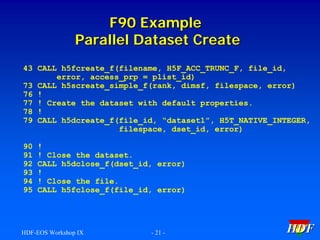
F90 Example
Parallel Dataset Create
43 CALL h5fcreate_f(filename, H5F_ACC_TRUNC_F, file_id,
error, access_prp = plist_id)
73 CALL h5screate_simple_f(rank, dimsf, filespace, error)
76 !
77 ! Create the dataset with default properties.
78 !
79 CALL h5dcreate_f(file_id, “dataset1”, H5T_NATIVE_INTEGER,
filespace, dset_id, error)
90
91
92
93
94
95

!
! Close the dataset.
CALL h5dclose_f(dset_id, error)
!
! Close the file.
CALL h5fclose_f(file_id, error)

HDF-EOS Workshop IX

- 21 -

HDF
Accessing a Dataset
• All processes that have opened
dataset may do collective I/O
• Each process may do independent
and arbitrary number of data I/O
access calls
– C: H5Dwrite and H5Dread
– F90: h5dwrite_f and h5dread_f

HDF-EOS Workshop IX

- 22 -

HDF
Accessing a Dataset
Programming model
• Create and set dataset transfer
property
– C: H5Pset_dxpl_mpio

– H5FD_MPIO_COLLECTIVE
– H5FD_MPIO_INDEPENDENT (default)

– F90: h5pset_dxpl_mpio_f

– H5FD_MPIO_COLLECTIVE_F
– H5FD_MPIO_INDEPENDENT_F (default)

• Access dataset with the defined
transfer property
HDF-EOS Workshop IX

- 23 -

HDF
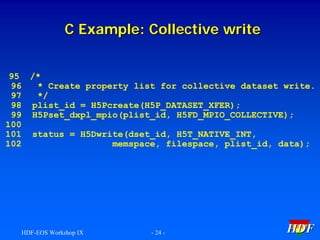
C Example: Collective write

95 /*
96
* Create property list for collective dataset write.
97
*/
98 plist_id = H5Pcreate(H5P_DATASET_XFER);
99 H5Pset_dxpl_mpio(plist_id, H5FD_MPIO_COLLECTIVE);
100
101 status = H5Dwrite(dset_id, H5T_NATIVE_INT,
102
memspace, filespace, plist_id, data);

HDF-EOS Workshop IX

- 24 -

HDF
F90 Example: Collective write

88
89
90
91
92
93
94
95
96

! Create property list for collective dataset write
!
CALL h5pcreate_f(H5P_DATASET_XFER_F, plist_id, error)
CALL h5pset_dxpl_mpio_f(plist_id, &
H5FD_MPIO_COLLECTIVE_F, error)
!
! Write the dataset collectively.
!
CALL h5dwrite_f(dset_id, H5T_NATIVE_INTEGER, data, &
error, &
file_space_id = filespace, &
mem_space_id = memspace, &
xfer_prp = plist_id)
HDF-EOS Workshop IX

- 25 -

HDF
Writing and Reading Hyperslabs
Programming model
• Distributed memory model: data is split
among processes
• PHDF5 uses hyperslab model
• Each process defines memory and file
hyperslabs
• Each process executes partial write/read
call
– Collective calls
– Independent calls

HDF-EOS Workshop IX

- 26 -

HDF
Hyperslab Example 1
Writing dataset by rows
P0
P1

File

P2
P3

HDF-EOS Workshop IX

- 27 -

HDF
Writing by rows
Output of h5dump utility
HDF5 "SDS_row.h5" {
GROUP "/" {
DATASET "IntArray" {
DATATYPE H5T_STD_I32BE
DATASPACE SIMPLE { ( 8, 5 ) / ( 8, 5 ) }
DATA {
10, 10, 10, 10, 10,
10, 10, 10, 10, 10,
11, 11, 11, 11, 11,
11, 11, 11, 11, 11,
12, 12, 12, 12, 12,
12, 12, 12, 12, 12,
13, 13, 13, 13, 13,
13, 13, 13, 13, 13
}
}
}
}
HDF-EOS Workshop IX

- 28 -

HDF
Example 1
Writing dataset by rows
File

P1 (memory space)

offset[1]
count[1]
count[0]

offset[0]

count[0] = dimsf[0]/mpi_size
count[1] = dimsf[1];
offset[0] = mpi_rank * count[0];
offset[1] = 0;
HDF-EOS Workshop IX

- 29 -

/* = 2 */

HDF
C Example 1
71 /*
72
* Each process defines dataset in memory and
* writes it to the hyperslab
73
* in the file.
74
*/
75
count[0] = dimsf[0]/mpi_size;
76
count[1] = dimsf[1];
77
offset[0] = mpi_rank * count[0];
78
offset[1] = 0;
79
memspace = H5Screate_simple(RANK,count,NULL);
80
81 /*
82
* Select hyperslab in the file.
83
*/
84
filespace = H5Dget_space(dset_id);
85
H5Sselect_hyperslab(filespace,
H5S_SELECT_SET,offset,NULL,count,NULL);

HDF-EOS Workshop IX

- 30 -

HDF
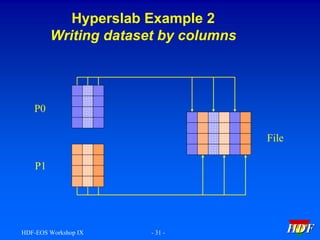
Hyperslab Example 2
Writing dataset by columns

P0
File
P1

HDF-EOS Workshop IX

- 31 -

HDF
Writing by columns
Output of h5dump utility
HDF5 "SDS_col.h5" {
GROUP "/" {
DATASET "IntArray" {
DATATYPE H5T_STD_I32BE
DATASPACE SIMPLE { ( 8, 6 ) / ( 8, 6 ) }
DATA {
1, 2, 10, 20, 100, 200,
1, 2, 10, 20, 100, 200,
1, 2, 10, 20, 100, 200,
1, 2, 10, 20, 100, 200,
1, 2, 10, 20, 100, 200,
1, 2, 10, 20, 100, 200,
1, 2, 10, 20, 100, 200,
1, 2, 10, 20, 100, 200
}
}
}
}
HDF-EOS Workshop IX

- 32 -

HDF
Example 2
Writing Dataset by Column
Memory

P0 offset[1]

block[0]

P0
dimsm[0]
dimsm[1]

File

P1 offset[1]

block[1]
stride[1]

P1

HDF-EOS Workshop IX

- 33 -

HDF
C Example 2
85
86
88
89
90
91
92
93
94
95
96
97
98
99
100
101
102

HDF-EOS Workshop IX

/*
* Each process defines hyperslab in
* the file
*/
count[0] = 1;
count[1] = dimsm[1];
offset[0] = 0;
offset[1] = mpi_rank;
stride[0] = 1;
stride[1] = 2;
block[0] = dimsf[0];
block[1] = 1;
/*
* Each process selects hyperslab.
*/
filespace = H5Dget_space(dset_id);
H5Sselect_hyperslab(filespace,
H5S_SELECT_SET, offset, stride,
count, block);

- 34 -

HDF
Hyperslab Example 3
Writing dataset by pattern

P0

File

P1
P2
P3

HDF-EOS Workshop IX

- 35 -

HDF
Writing by Pattern
Output of h5dump utility
HDF5 "SDS_pat.h5" {
GROUP "/" {
DATASET "IntArray" {
DATATYPE H5T_STD_I32BE
DATASPACE SIMPLE { ( 8, 4 ) / ( 8, 4 ) }
DATA {
1, 3, 1, 3,
2, 4, 2, 4,
1, 3, 1, 3,
2, 4, 2, 4,
1, 3, 1, 3,
2, 4, 2, 4,
1, 3, 1, 3,
2, 4, 2, 4
}
}
}
}
HDF-EOS Workshop IX

- 36 -

HDF
Example 3
Writing dataset by pattern
Memory

File
stride[1]

P2
stride[0]
count[1]
offset[0] = 0;
offset[1] = 1;
count[0] = 4;
count[1] = 2;
stride[0] = 2;
stride[1] = 2;
HDF-EOS Workshop IX

offset[1]
- 37 -

HDF
C Example 3: Writing by
pattern
90
91
92
93
94
95
96
97
98
99
100
101
102
103
104
105
106
107
108
109
110
111
112

/* Each process defines dataset in memory and
* writes it to the hyperslab
* in the file.
*/
count[0] = 4;
count[1] = 2;
stride[0] = 2;
stride[1] = 2;
if(mpi_rank == 0) {
offset[0] = 0;
offset[1] = 0;
}
if(mpi_rank == 1) {
offset[0] = 1;
offset[1] = 0;
}
if(mpi_rank == 2) {
offset[0] = 0;
offset[1] = 1;
}
if(mpi_rank == 3) {
offset[0] = 1;
offset[1] = 1;
}

HDF-EOS Workshop IX

- 38 -

HDF
Hyperslab Example 4
Writing dataset by chunks

P0

P1

HDF-EOS Workshop IX

P2

P3

- 39 -

File

HDF
Writing by Chunks
Output of h5dump utility
HDF5 "SDS_chnk.h5" {
GROUP "/" {
DATASET "IntArray" {
DATATYPE H5T_STD_I32BE
DATASPACE SIMPLE { ( 8, 4 ) / ( 8, 4 ) }
DATA {
1, 1, 2, 2,
1, 1, 2, 2,
1, 1, 2, 2,
1, 1, 2, 2,
3, 3, 4, 4,
3, 3, 4, 4,
3, 3, 4, 4,
3, 3, 4, 4
}
}
}
}
HDF-EOS Workshop IX

- 40 -

HDF
Example 4
Writing dataset by chunks
File

Memory
P2

offset[1]

chunk_dims[1]
offset[0]
chunk_dims[0]

block[0]
block[0] = chunk_dims[0];
block[1] = chunk_dims[1];
offset[0] = chunk_dims[0];
offset[1] = 0;
HDF-EOS Workshop IX

block[1]
- 41 -

HDF
C Example 4
Writing by chunks
97
98
99
100
101
102
103
104
105
106
107
108
109
110
111
112
113
114
115
116
117
118
HDF-EOS Workshop IX

count[0] = 1;
count[1] = 1 ;
stride[0] = 1;
stride[1] = 1;
block[0] = chunk_dims[0];
block[1] = chunk_dims[1];
if(mpi_rank == 0) {
offset[0] = 0;
offset[1] = 0;
}
if(mpi_rank == 1) {
offset[0] = 0;
offset[1] = chunk_dims[1];
}
if(mpi_rank == 2) {
offset[0] = chunk_dims[0];
offset[1] = 0;
}
if(mpi_rank == 3) {
offset[0] = chunk_dims[0];
offset[1] = chunk_dims[1];
}
- 42 -

HDF
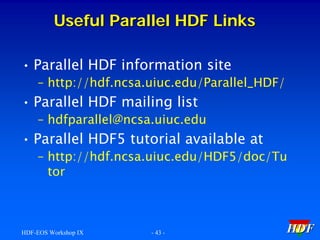
Useful Parallel HDF Links
• Parallel HDF information site

– http://hdf.ncsa.uiuc.edu/Parallel_HDF/

• Parallel HDF mailing list

– hdfparallel@ncsa.uiuc.edu

• Parallel HDF5 tutorial available at

– http://hdf.ncsa.uiuc.edu/HDF5/doc/Tu
tor

HDF-EOS Workshop IX

- 43 -

HDF
Thank you
This presentation is based upon work supported in part
by a Cooperative Agreement with the National
Aeronautics and Space Administration (NASA) under
NASA grant NNG05GC60A. Any opinions, findings, and
conclusions or recommendations expressed in this
material are those of the author(s) and do not
necessarily reflect the views of NASA. Other support
provided by NCSA and other sponsors and agencies
(http://hdf.ncsa.uiuc.edu/acknowledge.html).

Parallel HDF5 Introductory Tutorial

  • 1.
    Parallel HDF5 Introductory Tutorial HDFand HDF-EOS Workshop IX November 30, 2005 HDF
  • 2.
    Outline • Overview ofParallel HDF5 design • Setting up parallel environment • Programming model for – Creating and accessing a File – Creating and accessing a Dataset – Writing and reading Hyperslabs • Parallel tutorial available at – http://hdf.ncsa.uiuc.edu/HDF5/doc/Tu tor HDF-EOS Workshop IX -2- HDF
  • 3.
  • 4.
    PHDF5 Initial Target •Support for MPI programming • Not for shared memory programming – Threads – OpenMP • Has some experiments with – Thread-safe support for Pthreads – OpenMP if called “correctly” HDF-EOS Workshop IX -4- HDF
  • 5.
    PHDF5 Requirements • PHDF5files compatible with serial HDF5 files – Shareable between different serial or parallel platforms • Single file image to all processes – One file per process design is undesirable • Expensive post processing • Not useable by different number of processes • Standard parallel I/O interface – Must be portable to different platforms HDF-EOS Workshop IX -5- HDF
  • 6.
    Implementation Requirements • Nouse of Threads – Not commonly supported (1998) • No reserved process – May interfere with parallel algorithms • No spawn process – Not commonly supported even now HDF-EOS Workshop IX -6- HDF
  • 7.
    PHDF5 Implementation Layers Parallel Application Parallel Application Parallel Application Parallel Application ParallelHDF5 + MPI HDF library MPI-IO Local File System HDF-EOS Workshop IX “NFS” User Applications Parallel I/O layer GPFS/PVFS Lustre/PFS… -7- Parallel File systems HDF
  • 8.
    Parallel Environment Requirements • MPIwith MPI-IO – MPICH ROMIO – Vendor’s MPI-IO • Parallel file system – – – – GPFS Lustre PVFS Specially configured NFS HDF-EOS Workshop IX -8- HDF
  • 9.
    How to CompilePHDF5 Applications • h5pcc – HDF5 C compiler command – Similar to mpicc • h5pfc – HDF5 F90 compiler command – Similar to mpif90 • To compile: % h5pcc h5prog.c % h5pfc h5prog.f90 • Show the compiler commands without executing them (i.e., dry run): % h5pcc –show h5prog.c % h5pfc –show h5prog.f90 HDF-EOS Workshop IX -9- HDF
  • 10.
    Collective vs. Independent Calls •MPI definition of collective call – All processes of the communicator must participate in the right order • Independent means not collective • Collective is not necessarily synchronous HDF-EOS Workshop IX - 10 - HDF
  • 11.
    Programming Restrictions • MostPHDF5 APIs are collective • PHDF5 opens a parallel file with a communicator – Returns a file-handle – Future access to the file via the filehandle – All processes must participate in collective PHDF5 APIs – Different files can be opened via different communicators HDF-EOS Workshop IX - 11 - HDF
  • 12.
    Examples of PHDF5API • Examples of PHDF5 collective API – File operations: H5Fcreate, H5Fopen, H5Fclose – Objects creation: H5Dcreate, H5Dopen, H5Dclose – Objects structure: H5Dextend (increase dimension sizes) • Array data transfer can be collective or independent – Dataset operations: H5Dwrite, H5Dread HDF-EOS Workshop IX - 12 - HDF
  • 13.
    What Does PHDF5Support ? • After a file is opened by the processes of a communicator – All parts of file are accessible by all processes – All objects in the file are accessible by all processes – Multiple processes write to the same data array – Each process writes to individual data array HDF-EOS Workshop IX - 13 - HDF
  • 14.
    PHDF5 API Languages •C and F90 language interfaces • Platforms supported: – Most platforms with MPI-IO supported. E.g., • IBM SP, Intel TFLOPS, SGI IRIX64/Altrix, HP Alpha Clusters, Linux clusters – Work in progress • Red Storm, BlueGene/L, Cray xt3 HDF-EOS Workshop IX - 14 - HDF
  • 15.
    Creating and Accessinga File Programming model • HDF5 uses access template object (property list) to control the file access mechanism • General model to access HDF5 file in parallel: – Setup MPI-IO access template (access property list) – Open File – Access Data – Close File HDF-EOS Workshop IX - 15 - HDF
  • 16.
    Setup access template Eachprocess of the MPI communicator creates an access template and sets it up with MPI parallel access information C: herr_t H5Pset_fapl_mpio(hid_t plist_id, MPI_Comm comm, MPI_Info info); F90: h5pset_fapl_mpio_f(plist_id, comm, info); integer(hid_t) :: plist_id integer :: comm, info plist_id is a file access property list identifier HDF-EOS Workshop IX - 16 - HDF
  • 17.
    C Example Parallel FileCreate 23 24 26 27 28 29 33 34 35 36 37 38 42 49 50 51 52 54 comm = MPI_COMM_WORLD; info = MPI_INFO_NULL; /* * Initialize MPI */ MPI_Init(&argc, &argv); /* * Set up file access property list for MPI-IO access */ plist_id = H5Pcreate(H5P_FILE_ACCESS); H5Pset_fapl_mpio(plist_id, comm, info); file_id = H5Fcreate(H5FILE_NAME, H5F_ACC_TRUNC, H5P_DEFAULT, plist_id); /* * Close the file. */ H5Fclose(file_id); MPI_Finalize(); HDF-EOS Workshop IX - 17 - HDF
  • 18.
    F90 Example Parallel FileCreate 23 24 26 29 30 32 34 35 37 38 40 41 43 45 46 49 51 52 54 56 comm = MPI_COMM_WORLD info = MPI_INFO_NULL CALL MPI_INIT(mpierror) ! ! Initialize FORTRAN predefined datatypes CALL h5open_f(error) ! ! Setup file access property list for MPI-IO access. CALL h5pcreate_f(H5P_FILE_ACCESS_F, plist_id, error) CALL h5pset_fapl_mpio_f(plist_id, comm, info, error) ! ! Create the file collectively. CALL h5fcreate_f(filename, H5F_ACC_TRUNC_F, file_id, error, access_prp = plist_id) ! ! Close the file. CALL h5fclose_f(file_id, error) ! ! Close FORTRAN interface CALL h5close_f(error) CALL MPI_FINALIZE(mpierror) HDF-EOS Workshop IX - 18 - HDF
  • 19.
    Creating and OpeningDataset • All processes of the communicator open/close a dataset by a collective call – C: H5Dcreate or H5Dopen; H5Dclose – F90: h5dcreate_f or h5dopen_f; h5dclose_f • All processes of the communicator must extend an unlimited dimension dataset before writing to it – C: H5Dextend – F90: h5dextend_f HDF-EOS Workshop IX - 19 - HDF
  • 20.
    C Example Parallel DatasetCreate 56 57 58 59 60 61 62 63 64 65 66 67 68 file_id = H5Fcreate(…); /* * Create the dataspace for the dataset. */ dimsf[0] = NX; dimsf[1] = NY; filespace = H5Screate_simple(RANK, dimsf, NULL); 70 71 72 73 74 H5Dclose(dset_id); /* * Close the file. */ H5Fclose(file_id); /* * Create the dataset with default properties collective. */ dset_id = H5Dcreate(file_id, “dataset1”, H5T_NATIVE_INT, filespace, H5P_DEFAULT); HDF-EOS Workshop IX - 20 - HDF
  • 21.
    F90 Example Parallel DatasetCreate 43 CALL h5fcreate_f(filename, H5F_ACC_TRUNC_F, file_id, error, access_prp = plist_id) 73 CALL h5screate_simple_f(rank, dimsf, filespace, error) 76 ! 77 ! Create the dataset with default properties. 78 ! 79 CALL h5dcreate_f(file_id, “dataset1”, H5T_NATIVE_INTEGER, filespace, dset_id, error) 90 91 92 93 94 95 ! ! Close the dataset. CALL h5dclose_f(dset_id, error) ! ! Close the file. CALL h5fclose_f(file_id, error) HDF-EOS Workshop IX - 21 - HDF
  • 22.
    Accessing a Dataset •All processes that have opened dataset may do collective I/O • Each process may do independent and arbitrary number of data I/O access calls – C: H5Dwrite and H5Dread – F90: h5dwrite_f and h5dread_f HDF-EOS Workshop IX - 22 - HDF
  • 23.
    Accessing a Dataset Programmingmodel • Create and set dataset transfer property – C: H5Pset_dxpl_mpio – H5FD_MPIO_COLLECTIVE – H5FD_MPIO_INDEPENDENT (default) – F90: h5pset_dxpl_mpio_f – H5FD_MPIO_COLLECTIVE_F – H5FD_MPIO_INDEPENDENT_F (default) • Access dataset with the defined transfer property HDF-EOS Workshop IX - 23 - HDF
  • 24.
    C Example: Collectivewrite 95 /* 96 * Create property list for collective dataset write. 97 */ 98 plist_id = H5Pcreate(H5P_DATASET_XFER); 99 H5Pset_dxpl_mpio(plist_id, H5FD_MPIO_COLLECTIVE); 100 101 status = H5Dwrite(dset_id, H5T_NATIVE_INT, 102 memspace, filespace, plist_id, data); HDF-EOS Workshop IX - 24 - HDF
  • 25.
    F90 Example: Collectivewrite 88 89 90 91 92 93 94 95 96 ! Create property list for collective dataset write ! CALL h5pcreate_f(H5P_DATASET_XFER_F, plist_id, error) CALL h5pset_dxpl_mpio_f(plist_id, & H5FD_MPIO_COLLECTIVE_F, error) ! ! Write the dataset collectively. ! CALL h5dwrite_f(dset_id, H5T_NATIVE_INTEGER, data, & error, & file_space_id = filespace, & mem_space_id = memspace, & xfer_prp = plist_id) HDF-EOS Workshop IX - 25 - HDF
  • 26.
    Writing and ReadingHyperslabs Programming model • Distributed memory model: data is split among processes • PHDF5 uses hyperslab model • Each process defines memory and file hyperslabs • Each process executes partial write/read call – Collective calls – Independent calls HDF-EOS Workshop IX - 26 - HDF
  • 27.
    Hyperslab Example 1 Writingdataset by rows P0 P1 File P2 P3 HDF-EOS Workshop IX - 27 - HDF
  • 28.
    Writing by rows Outputof h5dump utility HDF5 "SDS_row.h5" { GROUP "/" { DATASET "IntArray" { DATATYPE H5T_STD_I32BE DATASPACE SIMPLE { ( 8, 5 ) / ( 8, 5 ) } DATA { 10, 10, 10, 10, 10, 10, 10, 10, 10, 10, 11, 11, 11, 11, 11, 11, 11, 11, 11, 11, 12, 12, 12, 12, 12, 12, 12, 12, 12, 12, 13, 13, 13, 13, 13, 13, 13, 13, 13, 13 } } } } HDF-EOS Workshop IX - 28 - HDF
  • 29.
    Example 1 Writing datasetby rows File P1 (memory space) offset[1] count[1] count[0] offset[0] count[0] = dimsf[0]/mpi_size count[1] = dimsf[1]; offset[0] = mpi_rank * count[0]; offset[1] = 0; HDF-EOS Workshop IX - 29 - /* = 2 */ HDF
  • 30.
    C Example 1 71/* 72 * Each process defines dataset in memory and * writes it to the hyperslab 73 * in the file. 74 */ 75 count[0] = dimsf[0]/mpi_size; 76 count[1] = dimsf[1]; 77 offset[0] = mpi_rank * count[0]; 78 offset[1] = 0; 79 memspace = H5Screate_simple(RANK,count,NULL); 80 81 /* 82 * Select hyperslab in the file. 83 */ 84 filespace = H5Dget_space(dset_id); 85 H5Sselect_hyperslab(filespace, H5S_SELECT_SET,offset,NULL,count,NULL); HDF-EOS Workshop IX - 30 - HDF
  • 31.
    Hyperslab Example 2 Writingdataset by columns P0 File P1 HDF-EOS Workshop IX - 31 - HDF
  • 32.
    Writing by columns Outputof h5dump utility HDF5 "SDS_col.h5" { GROUP "/" { DATASET "IntArray" { DATATYPE H5T_STD_I32BE DATASPACE SIMPLE { ( 8, 6 ) / ( 8, 6 ) } DATA { 1, 2, 10, 20, 100, 200, 1, 2, 10, 20, 100, 200, 1, 2, 10, 20, 100, 200, 1, 2, 10, 20, 100, 200, 1, 2, 10, 20, 100, 200, 1, 2, 10, 20, 100, 200, 1, 2, 10, 20, 100, 200, 1, 2, 10, 20, 100, 200 } } } } HDF-EOS Workshop IX - 32 - HDF
  • 33.
    Example 2 Writing Datasetby Column Memory P0 offset[1] block[0] P0 dimsm[0] dimsm[1] File P1 offset[1] block[1] stride[1] P1 HDF-EOS Workshop IX - 33 - HDF
  • 34.
    C Example 2 85 86 88 89 90 91 92 93 94 95 96 97 98 99 100 101 102 HDF-EOSWorkshop IX /* * Each process defines hyperslab in * the file */ count[0] = 1; count[1] = dimsm[1]; offset[0] = 0; offset[1] = mpi_rank; stride[0] = 1; stride[1] = 2; block[0] = dimsf[0]; block[1] = 1; /* * Each process selects hyperslab. */ filespace = H5Dget_space(dset_id); H5Sselect_hyperslab(filespace, H5S_SELECT_SET, offset, stride, count, block); - 34 - HDF
  • 35.
    Hyperslab Example 3 Writingdataset by pattern P0 File P1 P2 P3 HDF-EOS Workshop IX - 35 - HDF
  • 36.
    Writing by Pattern Outputof h5dump utility HDF5 "SDS_pat.h5" { GROUP "/" { DATASET "IntArray" { DATATYPE H5T_STD_I32BE DATASPACE SIMPLE { ( 8, 4 ) / ( 8, 4 ) } DATA { 1, 3, 1, 3, 2, 4, 2, 4, 1, 3, 1, 3, 2, 4, 2, 4, 1, 3, 1, 3, 2, 4, 2, 4, 1, 3, 1, 3, 2, 4, 2, 4 } } } } HDF-EOS Workshop IX - 36 - HDF
  • 37.
    Example 3 Writing datasetby pattern Memory File stride[1] P2 stride[0] count[1] offset[0] = 0; offset[1] = 1; count[0] = 4; count[1] = 2; stride[0] = 2; stride[1] = 2; HDF-EOS Workshop IX offset[1] - 37 - HDF
  • 38.
    C Example 3:Writing by pattern 90 91 92 93 94 95 96 97 98 99 100 101 102 103 104 105 106 107 108 109 110 111 112 /* Each process defines dataset in memory and * writes it to the hyperslab * in the file. */ count[0] = 4; count[1] = 2; stride[0] = 2; stride[1] = 2; if(mpi_rank == 0) { offset[0] = 0; offset[1] = 0; } if(mpi_rank == 1) { offset[0] = 1; offset[1] = 0; } if(mpi_rank == 2) { offset[0] = 0; offset[1] = 1; } if(mpi_rank == 3) { offset[0] = 1; offset[1] = 1; } HDF-EOS Workshop IX - 38 - HDF
  • 39.
    Hyperslab Example 4 Writingdataset by chunks P0 P1 HDF-EOS Workshop IX P2 P3 - 39 - File HDF
  • 40.
    Writing by Chunks Outputof h5dump utility HDF5 "SDS_chnk.h5" { GROUP "/" { DATASET "IntArray" { DATATYPE H5T_STD_I32BE DATASPACE SIMPLE { ( 8, 4 ) / ( 8, 4 ) } DATA { 1, 1, 2, 2, 1, 1, 2, 2, 1, 1, 2, 2, 1, 1, 2, 2, 3, 3, 4, 4, 3, 3, 4, 4, 3, 3, 4, 4, 3, 3, 4, 4 } } } } HDF-EOS Workshop IX - 40 - HDF
  • 41.
    Example 4 Writing datasetby chunks File Memory P2 offset[1] chunk_dims[1] offset[0] chunk_dims[0] block[0] block[0] = chunk_dims[0]; block[1] = chunk_dims[1]; offset[0] = chunk_dims[0]; offset[1] = 0; HDF-EOS Workshop IX block[1] - 41 - HDF
  • 42.
    C Example 4 Writingby chunks 97 98 99 100 101 102 103 104 105 106 107 108 109 110 111 112 113 114 115 116 117 118 HDF-EOS Workshop IX count[0] = 1; count[1] = 1 ; stride[0] = 1; stride[1] = 1; block[0] = chunk_dims[0]; block[1] = chunk_dims[1]; if(mpi_rank == 0) { offset[0] = 0; offset[1] = 0; } if(mpi_rank == 1) { offset[0] = 0; offset[1] = chunk_dims[1]; } if(mpi_rank == 2) { offset[0] = chunk_dims[0]; offset[1] = 0; } if(mpi_rank == 3) { offset[0] = chunk_dims[0]; offset[1] = chunk_dims[1]; } - 42 - HDF
  • 43.
    Useful Parallel HDFLinks • Parallel HDF information site – http://hdf.ncsa.uiuc.edu/Parallel_HDF/ • Parallel HDF mailing list – hdfparallel@ncsa.uiuc.edu • Parallel HDF5 tutorial available at – http://hdf.ncsa.uiuc.edu/HDF5/doc/Tu tor HDF-EOS Workshop IX - 43 - HDF
  • 44.
    Thank you This presentationis based upon work supported in part by a Cooperative Agreement with the National Aeronautics and Space Administration (NASA) under NASA grant NNG05GC60A. Any opinions, findings, and conclusions or recommendations expressed in this material are those of the author(s) and do not necessarily reflect the views of NASA. Other support provided by NCSA and other sponsors and agencies (http://hdf.ncsa.uiuc.edu/acknowledge.html).