Proprietary and Confidential. Copyright 2018, The HDF Group.
HDF for the Cloud -
Serverless HDF
ESIP Summer 2021
John Readey
2
• HDF as a Service – HSDS
• HSDS Storage Model
• HSDS Serverless with AWS Lambda
• HSDS Serverless with Direct Access
Overview
3
HSDS – Highly Scalable Data Service -- is a REST-based web service for HDF
data
Design criteria:
• Performant – good to great performance
• Scalable – Run across multiple cores and/or clusters
• Feature complete – Support (most) of the features provided by the HDF5 library
• Utilize POSIX or object storage (e.g. AWS S3, Azure Blob Storage)
HDF as a Service - HSDS
Note: HSDS was originally developed as a NASA ACCESS 2015
project: https://earthdata.nasa.gov/esds/competitive-
programs/access/hsds
4
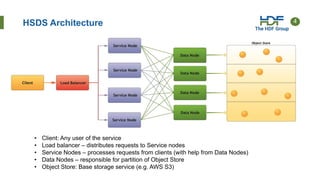
HSDS Architecture
Legend:
• Client: Any user of the service
• Load balancer – distributes requests to Service nodes
• Service Nodes – processes requests from clients (with help from Data Nodes)
• Data Nodes – responsible for partition of Object Store
• Object Store: Base storage service (e.g. AWS S3)
5
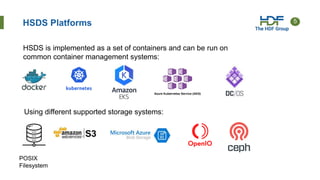
HSDS Platforms
POSIX
Filesystem
HSDS is implemented as a set of containers and can be run on
common container management systems:
Using different supported storage systems:
6
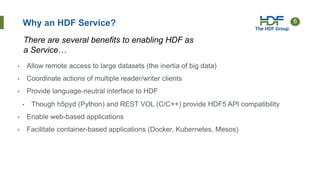
• Allow remote access to large datasets (the inertia of big data)
• Coordinate actions of multiple reader/writer clients
• Provide language-neutral interface to HDF
• Though h5pyd (Python) and REST VOL (C/C++) provide HDF5 API compatibility
• Enable web-based applications
• Facilitate container-based applications (Docker, Kubernetes, Mesos)
Why an HDF Service?
There are several benefits to enabling HDF as
a Service…
7
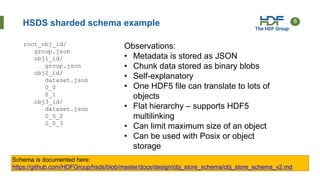
• Instead of managing HDF5 objects (datasets, groups, chunks) within a POSIX file, HSDS
stores each HDF object as a separate file (or object within an object storage system
such as S3)
• For meta data (datasets and groups), content is saved in a self-descriptive manner
using JSON
• For chunks, data is stored as a binary object for efficiency
• Storing larger datasets in this manner will lead to a large number of objects to store one
“file”, but HDF API and tools abstract user from needing to deal with the underlying
storage system
• The HSDS Storage model is ”cloud compatible” since it allows efficient updates when
object storage systems (e.g. S3, Azure Blob Storage, Ceph) are used
HSDS Storage Model
8
HSDS sharded schema example
root_obj_id/
group.json
obj1_id/
group.json
obj2_id/
dataset.json
0_0
0_1
obj3_id/
dataset.json
0_0_2
0_0_3
Observations:
• Metadata is stored as JSON
• Chunk data stored as binary blobs
• Self-explanatory
• One HDF5 file can translate to lots of
objects
• Flat hierarchy – supports HDF5
multilinking
• Can limit maximum size of an object
• Can be used with Posix or object
storage
Schema is documented here:
https://github.com/HDFGroup/hsds/blob/master/docs/design/obj_store_schema/obj_store_schema_v2.md
9
• The next HSDS release will provide two new (though related) capabilities:
• AWS Lambda support - HSDS implemented as a Lambda Function
• Direct Access Model – HSDS implemented entirely on the client
• Both of these enable developers to take advantage of HSDS capabilities without the
need to run a server
HSDS sans Service
10
Pros and cons of running a service
• Accessing a sharded data store via a service (HSDS) is great:
• Server mediates access to the storage system
• Server can speed things up by caching recently accessed data
• Minimizes data I/O between client & server (e.g. remote clients)
• HSDS serves as a synchronization point for multi-writer/multi-reader algorithms
• Unless it’s not:
• Don’t want to bother setting up, running service
• Challenge to scale capacity of service to clients
• Cloud charges for running server 24/7
11
AWS Lambda
• AWS Lambda is an AWS service that enables function to be executed on demand
without the need to provision any infrastructure
• Price (with 1GB memory) is: $0.0000000167/ms
• Beyond potential cost savings, Lambda enables “infinite elasticity”
• Can support widely varying workloads without need to spin up/down servers
• By default, 1000 instances of a function can be run simultaneously
• No infrastructure management required
• i.e. os patches, server backup, monitoring, etc.
• Invoked from AWS Management Console, Programmatically, or AWS API Gateway
12
AWS Lambda Challenges
• Adapting existing container-based server to run on Lambda is not trivial…
• Software needs to initialize as quickly as possible (to minimize latency)
• Unable to take advantage of caching
• Limited to max 6 VCPUs per function
• Lambda runtime environment is restricted:
• No equivalent to docker to manage multiple containers
• TCP not allowed (which is how HSDS containers talk to each other)
• Shared memory not allowed
13
HSDS Lambda Design
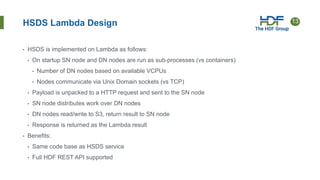
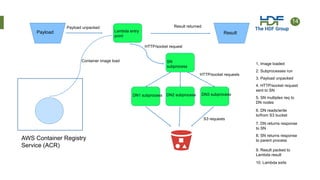
• HSDS is implemented on Lambda as follows:
• On startup SN node and DN nodes are run as sub-processes (vs containers)
• Number of DN nodes based on available VCPUs
• Nodes communicate via Unix Domain sockets (vs TCP)
• Payload is unpacked to a HTTP request and sent to the SN node
• SN node distributes work over DN nodes
• DN nodes read/write to S3, return result to SN node
• Response is returned as the Lambda result
• Benefits:
• Same code base as HSDS service
• Full HDF REST API supported
14
AWS Container Registry
Service (ACR)
Payload Lambda entry
point
SN
subprocess
DN1 subprocess DN2 subprocess DN3 subprocess
Result
1. Image loaded
2. Subprocesses run
3. Payload unpacked
4. HTTP/socket request
sent to SN
5. SN multiplex req to
DN nodes
6. DN reads/write
to/from S3 bucket
7. DN returns response
to SN
8. SN returns response
to parent process
9. Result packed to
Lambda result
10. Lambda exits
Container image load
Payload unpacked
HTTP/socket request
HTTP/socket requests
S3 requests
Result returned
15
HSDS Lambda Performance Constraints
• Compared with HSDS running on a dedicated server, the response time will be 2-100x slower
• Performance challenges:
• 2-4 seconds for a ”cold” function to startup
• ~0.5 seconds for HSDS code to initialize
• All data must be fetched from S3 (no cache to utilize)
• Limited number of cores (number of DN nodes) available
• But…
• Cost-effective ($0.0000000167/ms!)
• No setup needed
• Workload can be parallelized over as many as 1000 Lambda functions
16
HSDS Lambda Performance Results
• Simple performance test:
• (10000, 1602, 2976) dimension data, hyperslab selection of [:, x, y]
• 400 chunks access (~1GB data)
• 10,000 elements returned (~39KB)
• Results
• Server HSDS w/ 4 nodes: 5.04s, 204 MB/s
• Lambda HSDS w/ 1GB mem: 25.6s (cold), 40 MB/s
• Lambda HSDS w/ 1GB mem: 18.1s (warm), 56 MB/s
• Lambda HSDS w/ 10GB mem: 10.2s (warm), 102 MB/s
17
HSDS Direct Access
• HSDS Direct Access enables client code to incorporate HSDS functionality without the
need of a server
• As with HSDS Lambda, enables “serverless” operation
• Direct Access is best used for applications that run “close” to the storage and don’t
require close multi-client synchronization
• Supports POSIX, S3, or Azure Blob storage
18
HSDS Direct Access Architecture
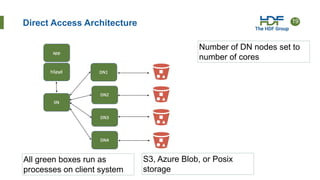
As with HSDS Lambda:
• SN code runs as a sub-process
• DN code runs in one or more sub-processes (e.g. based
on number of cores)
• Communication between parent processes and sub-
processes via Unix Domain sockets
• Sub-processes shutdown when last file is closed
All code executes on local system
The Python H5PYD package initiates direct access when
endpoint is specified as ‘local’.
Otherwise the application functions in the same manner as with
server
19
Direct Access Architecture
All green boxes run as
processes on client system
S3, Azure Blob, or Posix
storage
Number of DN nodes set to
number of cores
20
Direct Access Performance/Functional Constraints
• Limited to available network/CPU on host computer
• No clustering as with HSDS for Kubernetes
• Best if host is “close” to data
• E.g. running on EC2 instance in same region as S3 Bucket
• Client needs authorization to read/write from storage system
• No per-user access control as with HSDS service
• Multiple clients writing to same store may overwrite each other
• But no risk of storage becoming unreadable
21
Futures: Direct Access VOL plugin
• For C/C++ apps, the direct access model could be implemented as a VOL connector
• Other than launching the sub-processes the VOL would work in the same way as the
REST VOL, so it probably makes sense to include this functionality in the REST VOL
rather than create a new VOL
• With direct access HDF5 lib + REST VOL enables sharded data as an alternative to
the HDF5 file format
• Enables multi-threading (& parallelization support for even single threaded apps)
• Enables async API
• Cloud optimized storage (or Posix)
• Crash-proof
22
Release Target
• AWS Lambda support is available now in the HSDS 0.7.0 beta release
• Available on github
• Of course, requires AWS account and use of S3 storage
• Official release of HSDS 0.7.0 should be available this summer
• HSDS Direct access support will be available in h5pyd v0.8.0
• Available as beta now
• (also planned for summer 2021)
• Feedback (github issues, PRs, email) is encouraged
23
Try it out!
Get the software here:
• HSDS: https://github.com/HDFGroup/hsds
• H5pyd: https://github.com/HDFGroup/h5pyd
• REST VOL: https://github.com/HDFGroup/vol-rest
• REST API documentation:
https://github.com/HDFGroup/hdf-rest-api
• Example programs:
https://github.com/HDFGroup/hdflab_examples
• HSDS Lambda how to:
https://github.com/HDFGroup/hsds/blob/master/doc
s/aws_lambda_setup.md
24
Questions?

HDF for the Cloud - Serverless HDF

  • 1.
    Proprietary and Confidential.Copyright 2018, The HDF Group. HDF for the Cloud - Serverless HDF ESIP Summer 2021 John Readey
  • 2.
    2 • HDF asa Service – HSDS • HSDS Storage Model • HSDS Serverless with AWS Lambda • HSDS Serverless with Direct Access Overview
  • 3.
    3 HSDS – HighlyScalable Data Service -- is a REST-based web service for HDF data Design criteria: • Performant – good to great performance • Scalable – Run across multiple cores and/or clusters • Feature complete – Support (most) of the features provided by the HDF5 library • Utilize POSIX or object storage (e.g. AWS S3, Azure Blob Storage) HDF as a Service - HSDS Note: HSDS was originally developed as a NASA ACCESS 2015 project: https://earthdata.nasa.gov/esds/competitive- programs/access/hsds
  • 4.
    4 HSDS Architecture Legend: • Client:Any user of the service • Load balancer – distributes requests to Service nodes • Service Nodes – processes requests from clients (with help from Data Nodes) • Data Nodes – responsible for partition of Object Store • Object Store: Base storage service (e.g. AWS S3)
  • 5.
    5 HSDS Platforms POSIX Filesystem HSDS isimplemented as a set of containers and can be run on common container management systems: Using different supported storage systems:
  • 6.
    6 • Allow remoteaccess to large datasets (the inertia of big data) • Coordinate actions of multiple reader/writer clients • Provide language-neutral interface to HDF • Though h5pyd (Python) and REST VOL (C/C++) provide HDF5 API compatibility • Enable web-based applications • Facilitate container-based applications (Docker, Kubernetes, Mesos) Why an HDF Service? There are several benefits to enabling HDF as a Service…
  • 7.
    7 • Instead ofmanaging HDF5 objects (datasets, groups, chunks) within a POSIX file, HSDS stores each HDF object as a separate file (or object within an object storage system such as S3) • For meta data (datasets and groups), content is saved in a self-descriptive manner using JSON • For chunks, data is stored as a binary object for efficiency • Storing larger datasets in this manner will lead to a large number of objects to store one “file”, but HDF API and tools abstract user from needing to deal with the underlying storage system • The HSDS Storage model is ”cloud compatible” since it allows efficient updates when object storage systems (e.g. S3, Azure Blob Storage, Ceph) are used HSDS Storage Model
  • 8.
    8 HSDS sharded schemaexample root_obj_id/ group.json obj1_id/ group.json obj2_id/ dataset.json 0_0 0_1 obj3_id/ dataset.json 0_0_2 0_0_3 Observations: • Metadata is stored as JSON • Chunk data stored as binary blobs • Self-explanatory • One HDF5 file can translate to lots of objects • Flat hierarchy – supports HDF5 multilinking • Can limit maximum size of an object • Can be used with Posix or object storage Schema is documented here: https://github.com/HDFGroup/hsds/blob/master/docs/design/obj_store_schema/obj_store_schema_v2.md
  • 9.
    9 • The nextHSDS release will provide two new (though related) capabilities: • AWS Lambda support - HSDS implemented as a Lambda Function • Direct Access Model – HSDS implemented entirely on the client • Both of these enable developers to take advantage of HSDS capabilities without the need to run a server HSDS sans Service
  • 10.
    10 Pros and consof running a service • Accessing a sharded data store via a service (HSDS) is great: • Server mediates access to the storage system • Server can speed things up by caching recently accessed data • Minimizes data I/O between client & server (e.g. remote clients) • HSDS serves as a synchronization point for multi-writer/multi-reader algorithms • Unless it’s not: • Don’t want to bother setting up, running service • Challenge to scale capacity of service to clients • Cloud charges for running server 24/7
  • 11.
    11 AWS Lambda • AWSLambda is an AWS service that enables function to be executed on demand without the need to provision any infrastructure • Price (with 1GB memory) is: $0.0000000167/ms • Beyond potential cost savings, Lambda enables “infinite elasticity” • Can support widely varying workloads without need to spin up/down servers • By default, 1000 instances of a function can be run simultaneously • No infrastructure management required • i.e. os patches, server backup, monitoring, etc. • Invoked from AWS Management Console, Programmatically, or AWS API Gateway
  • 12.
    12 AWS Lambda Challenges •Adapting existing container-based server to run on Lambda is not trivial… • Software needs to initialize as quickly as possible (to minimize latency) • Unable to take advantage of caching • Limited to max 6 VCPUs per function • Lambda runtime environment is restricted: • No equivalent to docker to manage multiple containers • TCP not allowed (which is how HSDS containers talk to each other) • Shared memory not allowed
  • 13.
    13 HSDS Lambda Design •HSDS is implemented on Lambda as follows: • On startup SN node and DN nodes are run as sub-processes (vs containers) • Number of DN nodes based on available VCPUs • Nodes communicate via Unix Domain sockets (vs TCP) • Payload is unpacked to a HTTP request and sent to the SN node • SN node distributes work over DN nodes • DN nodes read/write to S3, return result to SN node • Response is returned as the Lambda result • Benefits: • Same code base as HSDS service • Full HDF REST API supported
  • 14.
    14 AWS Container Registry Service(ACR) Payload Lambda entry point SN subprocess DN1 subprocess DN2 subprocess DN3 subprocess Result 1. Image loaded 2. Subprocesses run 3. Payload unpacked 4. HTTP/socket request sent to SN 5. SN multiplex req to DN nodes 6. DN reads/write to/from S3 bucket 7. DN returns response to SN 8. SN returns response to parent process 9. Result packed to Lambda result 10. Lambda exits Container image load Payload unpacked HTTP/socket request HTTP/socket requests S3 requests Result returned
  • 15.
    15 HSDS Lambda PerformanceConstraints • Compared with HSDS running on a dedicated server, the response time will be 2-100x slower • Performance challenges: • 2-4 seconds for a ”cold” function to startup • ~0.5 seconds for HSDS code to initialize • All data must be fetched from S3 (no cache to utilize) • Limited number of cores (number of DN nodes) available • But… • Cost-effective ($0.0000000167/ms!) • No setup needed • Workload can be parallelized over as many as 1000 Lambda functions
  • 16.
    16 HSDS Lambda PerformanceResults • Simple performance test: • (10000, 1602, 2976) dimension data, hyperslab selection of [:, x, y] • 400 chunks access (~1GB data) • 10,000 elements returned (~39KB) • Results • Server HSDS w/ 4 nodes: 5.04s, 204 MB/s • Lambda HSDS w/ 1GB mem: 25.6s (cold), 40 MB/s • Lambda HSDS w/ 1GB mem: 18.1s (warm), 56 MB/s • Lambda HSDS w/ 10GB mem: 10.2s (warm), 102 MB/s
  • 17.
    17 HSDS Direct Access •HSDS Direct Access enables client code to incorporate HSDS functionality without the need of a server • As with HSDS Lambda, enables “serverless” operation • Direct Access is best used for applications that run “close” to the storage and don’t require close multi-client synchronization • Supports POSIX, S3, or Azure Blob storage
  • 18.
    18 HSDS Direct AccessArchitecture As with HSDS Lambda: • SN code runs as a sub-process • DN code runs in one or more sub-processes (e.g. based on number of cores) • Communication between parent processes and sub- processes via Unix Domain sockets • Sub-processes shutdown when last file is closed All code executes on local system The Python H5PYD package initiates direct access when endpoint is specified as ‘local’. Otherwise the application functions in the same manner as with server
  • 19.
    19 Direct Access Architecture Allgreen boxes run as processes on client system S3, Azure Blob, or Posix storage Number of DN nodes set to number of cores
  • 20.
    20 Direct Access Performance/FunctionalConstraints • Limited to available network/CPU on host computer • No clustering as with HSDS for Kubernetes • Best if host is “close” to data • E.g. running on EC2 instance in same region as S3 Bucket • Client needs authorization to read/write from storage system • No per-user access control as with HSDS service • Multiple clients writing to same store may overwrite each other • But no risk of storage becoming unreadable
  • 21.
    21 Futures: Direct AccessVOL plugin • For C/C++ apps, the direct access model could be implemented as a VOL connector • Other than launching the sub-processes the VOL would work in the same way as the REST VOL, so it probably makes sense to include this functionality in the REST VOL rather than create a new VOL • With direct access HDF5 lib + REST VOL enables sharded data as an alternative to the HDF5 file format • Enables multi-threading (& parallelization support for even single threaded apps) • Enables async API • Cloud optimized storage (or Posix) • Crash-proof
  • 22.
    22 Release Target • AWSLambda support is available now in the HSDS 0.7.0 beta release • Available on github • Of course, requires AWS account and use of S3 storage • Official release of HSDS 0.7.0 should be available this summer • HSDS Direct access support will be available in h5pyd v0.8.0 • Available as beta now • (also planned for summer 2021) • Feedback (github issues, PRs, email) is encouraged
  • 23.
    23 Try it out! Getthe software here: • HSDS: https://github.com/HDFGroup/hsds • H5pyd: https://github.com/HDFGroup/h5pyd • REST VOL: https://github.com/HDFGroup/vol-rest • REST API documentation: https://github.com/HDFGroup/hdf-rest-api • Example programs: https://github.com/HDFGroup/hdflab_examples • HSDS Lambda how to: https://github.com/HDFGroup/hsds/blob/master/doc s/aws_lambda_setup.md
  • 24.

Editor's Notes

  • #5 Each node is implemented as a docker container