Operations Management Higher/Int 2 Business Management 2009 - 2010
Operations A memory aid! Think of what happens in an operating theatre
Operating System An Operating System is a  configuration of resources  to provide a product or service Raw Materials Machinery Workers
Operating System What could we make? Paper, Scissors, People
Operating System We need to be organised We need to develop procedures
Operations Management Operations Management is a transforming process turning inputs (resources) into outputs (goods and services) The key here is  efficient management  of resources
Operations Management A Transformation Process  PROCESS INPUT OUTPUT Information Finance People Materials Machinery Goods Services Customer/Employee  Satisfaction
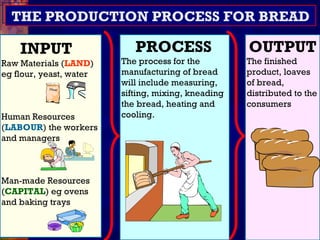
THE PRODUCTION PROCESS FOR BREAD INPUT   Raw Materials ( LAND )  eg flour, yeast, water Human Resources ( LABOUR ) the workers and managers Man-made Resources ( CAPITAL ) eg ovens and baking trays PROCESS   The process for the manufacturing of bread will include measuring, sifting, mixing, kneading the bread, heating and cooling. OUTPUT The finished product, loaves of bread, distributed to the consumers
Some Product Thoughts Deluxe Double Chocolate Chip Cookies Freddie’s Fish Collette’s Computer Manufacture Krazy Kazz’s Cars
Input Issues Best Price Reliability of Suppliers Delivery Times Quality Quantities Available Storage Space (Raw Materials)
Process Issues Average Demand per Week Production Capacity Available Working Procedures (eg H&S) Storage Space (Finished Product) Efficiency/Productivity Payment Systems Quality Stock Control
Output Issues Packaging Individual/Groups of Items Nature/Size of Containers Storage Space (Before Dispatch) Organising Customer Orders Transportation (Storage/Customers) Customer Requirements
A Complicated Function Operations Management is a complex area which can be further broken down into the following key areas: A) planning B) production C) purchasing D) storage and stock control E) distribution/logistics
Planning To be most efficient production should take place at a constant level
Planning In reality this is not possible: Consumer Demand Staff Shortages Machinery Breakdowns Maintenance
Production Systems How will the manufacturer produce goods? Start with the  factory layout  - where will each part of production take place? Who will complete? The splitting up of production into a number of different jobs is called the  division of labour A successful system will need a  flow of stocks  from one job to another to make sure that there are  no delays due to shortages or bottlenecks
What Production System? The Nature of the Product Washing Machines Bread House Atlas Farming New Bridge
What Production System? Market Size Where the firm is producing large numbers of standard products the production can be simplified eg Irn Bru Customised products for individual clients need a great deal of client input eg customised software or stained glass windows
What Production System? Resources Materials People Buildings Machinery/Tools Finance Time
What Production System? Business Development Small firms, small productions, production system limited eg Wallace & Gromit Cheese As firms grow they can increase their capacity and produce a greater variety of goods
What Production System? Labour Intensive Systems A labour intensive system is one which relies more heavily on its workforce than machinery ‘ Tattie Holidays’ Strawberry Picking Clothing Promotion
What Production System? Labour Intensive Systems Labour is cheaper than machinery Skill in craftsmanship required Can’t use machinery - working environment Ability required to think/reason/use initiative/make decisions Flexibility in production
What Production System? Capital Intensive Systems A Capital Intensive System is most common when: Supply of labour is limited Production benefits from machine efficiency and consistency Production is routine and repetitive
Automation CAM (Computer Aided Manufacture) CAD (Computer Aided Design) Robotics Allows firms to design, develop and produce products with high quality Ability to make a wider range of similar products to appeal to different segments of the market
Automation Advantages Complicated tasks completed quickly High accuracy Less waste Quality consistent Disadvantages Machinery is more likely to break down Narrow range of tasks
Sony Walkman At present, Sony has at least 12 different versions of the Sony Walkman on the market. Each has the same basic features, all of which are made on the same production line  Using technology in the design and production of the Walkman, Sony can add  different features to each model  to appeal to different consumers Prices vary as more advanced features are added
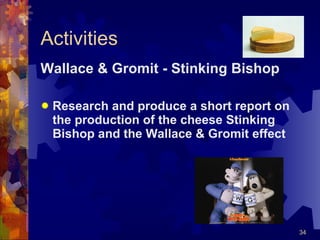
Activities Wallace & Gromit - Stinking Bishop Research and produce a short report on the production of the cheese Stinking Bishop and the Wallace & Gromit effect
Activities Sony Walkman Research The Sony Walkman has evolved over the years resulting in products unconceivable 20 years ago Create a short report detailing the current range of ‘Walkmans’, their features and what market they would appeal to
Purchasing This varies according to the size/nature of the organisation: Services  - very little purchasing, ‘production’ depends on staff skills Manufacturing  - may have a purchasing department
Purchasing Department Team of specialists with the aim to: Purchase the  best quality  materials At the  lowest cost With the  correct quantities At the  correct time Purchasing Mix
The Importance of Purchasing Objectives: Quantity and quality that the firm requires Purchase at the most competitive prices Ensure speedy delivery Arrange delivery to a suitable point eg site or gate Choose reliable suppliers and maintain good relations with them
Stages in Purchasing Process Requisition Negotiation Place Order Chase Delivery Clear Invoice
The Purchasing Mix Decisions on quantity to purchase: Stock of raw materials available Time between orders placed Amount of raw materials to meet output demand Availability and cost of storage space
The Purchasing Mix Choice of Supplier: Price : lowest? discounts? credit terms? Quantity : acceptable? continuity of supply? Availability : sources? delivery systems? confidence? Location : transport? insurance?
McDonalds Purchasing McDonalds  do not have contracts  with any of their suppliers They can  change suppliers without notice Size of McDonalds makes them  an attractive customer Must meet  very strict quality standards
Centralised Purchasing One department  carries out purchasing for the whole business Economies of Scale  (lower rates/market power) Quality  and  Standard materials  set Distribution  and  Warehousing  better planned
Decentralised Purchasing Reduces the cost  and burden of administration If  each store manager  (in retail) takes responsibility - needs of the store better catered for Managers get  additional responsibility  - increasing  motivation
Nature of Stocks (1) Raw materials  and components – saves delays in production (from stores) Work in Progress  – partially completed Finished Goods  – changes in demand (from stock holdings)
Nature of Stocks (2) A  stock take  will be performed at least annually to record the amount/value of stock. This is a physical count. Stock is listed as a  current asset  on the balance sheet.
Costs of Holding Stock Stock improves business performance but: too much means capital is unproductive too little means that there could be delays in production Opportunity cost Spoilage costs Administration/Finance costs Out-of-Stock costs
Stock Levels Decisions on how much stock to hold depend on: Demand  – cover growth in sales and unexpected demand Stockpile  – eg Christmas (toys) Costs of Stock holding  – if expensive less held eg furniture retailers Working capital  – if limited can’t purchase more stock Type of stock  – perishable eg bread/cakes, out-of-date eg new models Lead time  – time to place and receive new order External factors  – fear of future shortages
Stock Control Issuing stock Monitoring Stock levels Quantities of Stock held Economic Stock Level Minimum Stock Level Re-order level Re-order Quantity (see student notes)
Stock Control Diagram
Computerised Stock Control Most organisations use computer stock control systems Computer automatically orders more stock at the reorder level May use barcodes (30 yrs old in 2007) or RFID tags Physical checks to ensure discrepancies accounted for: Theft Natural wastage Deterioration Management make decisions with regard to popular products and adjust stock levels as necessary (local tastes) Information useful when dealing with large orders – judge delivery date possible
Just-in-Time (JIT) Limits stock holding to almost zero Close relationship between manufacturer and supplier  (need reliability) Stock brought to factory only when needed In a JIT system stock holding costs paid for by supplier: Capital tied up in stock Storage costs Stock loss/wastage Nothing produced unless there are customers ready to buy
Just-in-Time (JIT) - Example Just-in-Time was  first developed in Japan by Toyota , the car manufacturer.  In order to reduce the costs involved in holding stocks of materials and work-in-progress, Toyota devised a  card ordering system known as Kanban.  Toyota devised a policy that no components would be made, or supplies ordered, unless the instruction appeared on a  Kanban . For example, if a worker fitted six steering wheels, a Kanban card would be sent to the production team to order another six steering wheels.  These would arrive just-in-time before the worker ran out of steering wheels.
Just-in-Time (JIT) - Example In order for this to be successful.  Toyota had to ensure that its  suppliers understood the system  and were able to supply on demand.  When it opened its UK plant it  trained its suppliers in operations and quality procedures  to make sure that they delivered the exact product at the right time.  In some cases the  suppliers had their factories next door  to the Toyota plant to ensure that they could operate with the JIT production system.  To secure long term contracts with Toyota, suppliers had to deliver, at short notice, small quantities of high-quality goods.  The suppliers had to be  completely reliable  and would  have to pay the costs of lost production  if they could not deliver, or if they delivered faulty materials.
Storage of Stock (Centralised) Advantages Security Specialist Staff Supervise Agreed Procedures Cheaper Efficient Distribution Disadvantages Time Wasting Cost of Specialist Staff Cost of Dedicated Storage Area
Storage of Stock (Decentralised) Advantages Stock at Hand Order as Required (Depends on Production) Fast Turnover of Small Quantities of Stock Disadvantages Less Control Theft Loss Space in Production Area Required
Storage of Stock (Kanban) Advantages Exactly Meets Production Requirements Savings on Purchase/Storage Production Delays Prevented Close Links with Suppliers Disadvantages Dependency on Suppliers Suppliers must be Willing to Participate
Methods of Production You need to know: Job Production Batch Production Flow Production and advantages and disadvantages of each
Job Production Simple organisation ‘ One-offs’ Customer Needs Specifications  Changed Workers Motivated Production  Costs High Time-Consuming Production Versatile Equipment Each job is completed in full before another is started. INDIVIDUALITY
Job Production A  single product is custom-made  to a customer’s own specifications Examples: Boat Building Bridge Building Wedding Cakes/Dresses
Job Production Advantages “ One-off” orders  accommodated High price Specifications  can be changed Motivated  workforce Disadvantages High  labour costs Wide  variety of equipment  needed Each job will require  individual design  (time) Lead times  lengthy
Batch Production Flexibility Stock of Partly  Finished Goods Scope for  Specialisation Delays: Change/Clean  Equipment Small Batch = High Cost Co-ordination Required All stages in production completed at the same time – possibly different ingredients. EACH IN BATCH SAME VARY FROM BATCH TO BATCH
Batch Production The production of a  group of similar products .  No item in a group goes to the next stage until all are ready. Examples: Tinned Foods Bakery Houses in an Estate
Batch Production Advantages Flexible production Partly finished goods  can be stockpiled and completed later Reduced need  for highly skilled staff Machinery can be  standardised Disadvantages Higher costs per unit  (small batches) Needs  careful planning High stock levels Less motivated staff Delays  in changing/cleaning equipment
Flow Production Economies of  Scale Reduced  Stockholding  eg JIT Automation Start-up Costs High Standardised –  All Customers? Work is  Repetitive Use of a production line – component parts added at each stage. STANDARDISATION Quality Systems  Built In System Failure?
Flow Production Production items  move continuously from one operation to the next .  Products are produced to a  standard specification. Examples: Cars Computers White goods eg washing machines
Flow Production Advantages Economies of Scale Automated production lines  save time and money – 24/7 Large quantities  produced Reduced stockholding  eg JIT Quality systems  can be built in/standard products Disadvantages Large investement required Mass consumption  required If one part of the system fails  – shutdown Lack of worker motivation  - repetitive
Choice of Production Method Nature of the Product   - eg bridge, sewers (job); arable farming  (batch) Size of Market  - eg fast moving consumer goods such as soap/canned drinks have a large market  (flow) Stage of Business Development  - eg when starting up  (job or batch)  may then move to  flow  as sales increase Technology  - new materials/machinery eg computers and robotics in car manufacturing - also different models on same production line
Labour vs Capital Intensive Nature of the Product  - eg everyday high demand mass produced, large quantities of machinery (newspapers) Relative Prices  - if labour costs are rising might use more capital Size of Firm  - as firm grows scale of production increases employing more capital
Marginal Output Productivity rises as each additional worker is added to a production process The marginal output is the  increase in production by adding the extra worker As more workers are added eventually marginal output will fall as workers can no longer specialise this is called the  Law of Diminishing Returns
What is Quality? Physical appearance   (style) Reliability and Durability   (lifespan) Special features   (eg play MP3 CDs?) Suitability   (what the customer requires) Availability of spare parts Ease of repair   (service centres) After care service   (prompt delivery?) Image of manufacturer   (brand name?) Reputation of the product
Quality Control Historic concept  assuming a degree of waste - 25% Quality checks  take place at the end of the manufacturing process Often goods need  destroyed  or  re-work ed Psychological implications  - assumes failure by denying the assumption that things can be done right Friday Car Syndrome
Quality Assurance Assumes that  wastage  caused by Quality Control  can be prevented Quality  checked at every stage  of the process instead of just at the end Reduces waste  to levels as low as 5% In a highly  competitive market : Increased profits Reduced costs Increased customer satisfaction
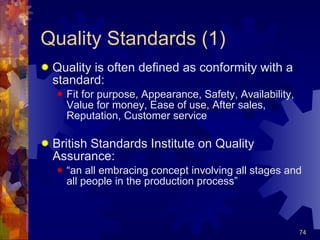
Quality Standards (1) Quality is often defined as conformity with a standard: Fit for purpose, Appearance, Safety, Availability, Value for money, Ease of use, After sales, Reputation, Customer service British Standards Institute on Quality Assurance: “ an all embracing concept involving all stages and all people in the production process”
Quality Standards (2) BSI Kitemark   - eg safety goggles, independently tested to a specific standard BS5750 / ISO9000 - mark of quality worldwide CE mark  an EU award - eg armbands, won’t deflate and need supervision warning ABTA Wool Mark  - pure new wool, Wool Marketing Board IIP  - Investors in People - provide training and development of staff Warranties  - manufacturer will undertake work arising out of a defect ‘free of charge’
UK - Toilet Test Operations folder on server …
Japanese - Toilet Test Operations folder on server …
ISO 9000 Can help business to: Examine and improve  systems, methods and procedures to lower costs Motivate staff  to gets things right first time Assure that orders are delivered on time Highlight product or design problems  - identifying improvements Record and investigate  all quality failure and customer complaints Give a clear signal to customer -  “we take quality seriously” Produce a  documented system  for recording and satisfying the training needs of staff in terms of quality
ISO 9001 a  set of procedures  that cover all key processes in the business;  monitoring processes  to ensure they are effective;  keeping  adequate records ;  checking output for defects , with appropriate and  corrective action  where necessary;  regularly reviewing individual processes  and the quality system itself for effectiveness; and  facilitating  continual improvement
Total Quality Management (1) Culture shift : ‘ we know what quality is’ ‘ You tell us what you want and that will be our definition of quality’ TQM assumes quality to  your client or customer , even if that is the next worker in the assembly line - your work should be of the highest standard and quality Costly to establish  TQM Wastage can be reduced  to around 3%
Total Quality Management (2) TQM requires: A  whole-company focus  on quality A  commitment from each individual  in the company Consultation  with every employee at every level of the organisation in setting standards A focus on  teamwork Viewing TQM as a  long term concept The  creation of a plan  for quality Training  for employees Constant  checking and review of performance Constant  checking for improvement
Total Quality Management (3) Four (4) key elements need managed: The definition of quality at each stage of production  -  lies with customer The commitment of all  -  mission statement, handbook, responsibilities, procedures, quality audits, quality circles, benchmarking etc System in which quality can be assured  -  checking, monitoring, documentation, appraisals, targets etc A measure of the ability to meet quality requirements  -  quantitatively or qualitatively  (see student notes for more detail)
Benchmarking A process of  Quality Assurance Compare your performance  with the market leaders (efficient producers) Customers Industrialists Business Analysts Journalists Could be  resistance to obtaining information May continue to benchmark  when you become the market leader
Quality Circles Groups of employees who meet regularly to  identify, discuss and resolve problems  in the production process Shop floor workers  know production problems best Workers will be motivated  by involvement in problem solving process Team will then  present ideas and solutions to management First  established in Japanese car industry
Payment Systems (1) Used to: Motivate Reward; and  Control Labour A variety of Payment Systems have been designed to achieve this.
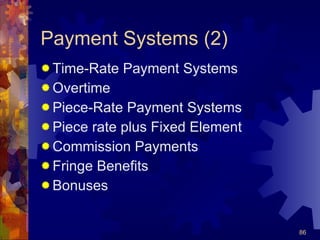
Payment Systems (2) Time-Rate Payment Systems Overtime Piece-Rate Payment Systems Piece rate plus Fixed Element Commission Payments Fringe Benefits Bonuses
Payment Systems (3) Incentives to Professionals Contract Employment Profit-Sharing Schemes
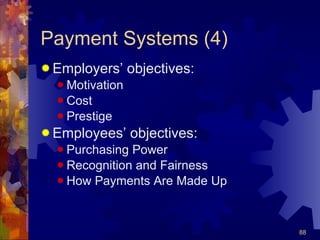
Payment Systems (4) Employers’ objectives: Motivation Cost Prestige Employees’ objectives: Purchasing Power Recognition and Fairness How Payments Are Made Up
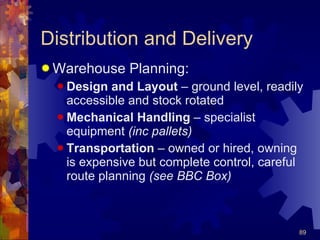
Distribution and Delivery Warehouse Planning: Design and Layout  – ground level, readily accessible and stock rotated Mechanical Handling  – specialist equipment  (inc pallets) Transportation  – owned or hired, owning is expensive but complete control, careful route planning  (see BBC Box)
Transportation Road  – 80% of goods transported, specialist vehicles, door-to-door delivery Rail  – shortage of lorry drivers, restrictions on driving time, road congestion, haulage to final destination Air  – Prestwick highest freight in Scotland, expensive, quick delivery Sea  – Forth Estuary, petrol/minerals/coal, lengthy delivery times
Distribution Mix Image  of Product The Product  itself Manufacturer’s  Distribution Capability Reliability of Other Organisations Legal  Restrictions Finance  Available
Scheduling Production Plans  will show where the  Factors of Production  are needed at any point in time. The aim being to eliminate  idle time May use a  Gantt Chart
Efficiency of Production A work study shows how tasks are currently done with a view to improvement: S elect the task to be analyses R ecord how it is currently done E xamine the information collected D evelop a better method of doing the task I nstall the new method M aintain the new method Method Study
Efficiency of Production A work study shows how tasks are currently done with a view to improvement: Establishing how long tasks should take so that standard times can be identified Actual times then judged on the standard Work  Measurement
Congratulations You have completed Operations in Higher/Int 2 Business Management

HBM Operations CMD

  • 1.
    Operations Management Higher/Int2 Business Management 2009 - 2010
  • 2.
    Operations A memoryaid! Think of what happens in an operating theatre
  • 3.
    Operating System AnOperating System is a configuration of resources to provide a product or service Raw Materials Machinery Workers
  • 4.
    Operating System Whatcould we make? Paper, Scissors, People
  • 5.
    Operating System Weneed to be organised We need to develop procedures
  • 6.
    Operations Management OperationsManagement is a transforming process turning inputs (resources) into outputs (goods and services) The key here is efficient management of resources
  • 7.
    Operations Management ATransformation Process PROCESS INPUT OUTPUT Information Finance People Materials Machinery Goods Services Customer/Employee Satisfaction
  • 8.
    THE PRODUCTION PROCESSFOR BREAD INPUT Raw Materials ( LAND ) eg flour, yeast, water Human Resources ( LABOUR ) the workers and managers Man-made Resources ( CAPITAL ) eg ovens and baking trays PROCESS The process for the manufacturing of bread will include measuring, sifting, mixing, kneading the bread, heating and cooling. OUTPUT The finished product, loaves of bread, distributed to the consumers
  • 16.
    Some Product ThoughtsDeluxe Double Chocolate Chip Cookies Freddie’s Fish Collette’s Computer Manufacture Krazy Kazz’s Cars
  • 17.
    Input Issues BestPrice Reliability of Suppliers Delivery Times Quality Quantities Available Storage Space (Raw Materials)
  • 18.
    Process Issues AverageDemand per Week Production Capacity Available Working Procedures (eg H&S) Storage Space (Finished Product) Efficiency/Productivity Payment Systems Quality Stock Control
  • 19.
    Output Issues PackagingIndividual/Groups of Items Nature/Size of Containers Storage Space (Before Dispatch) Organising Customer Orders Transportation (Storage/Customers) Customer Requirements
  • 20.
    A Complicated FunctionOperations Management is a complex area which can be further broken down into the following key areas: A) planning B) production C) purchasing D) storage and stock control E) distribution/logistics
  • 21.
    Planning To bemost efficient production should take place at a constant level
  • 22.
    Planning In realitythis is not possible: Consumer Demand Staff Shortages Machinery Breakdowns Maintenance
  • 23.
    Production Systems Howwill the manufacturer produce goods? Start with the factory layout - where will each part of production take place? Who will complete? The splitting up of production into a number of different jobs is called the division of labour A successful system will need a flow of stocks from one job to another to make sure that there are no delays due to shortages or bottlenecks
  • 24.
    What Production System?The Nature of the Product Washing Machines Bread House Atlas Farming New Bridge
  • 25.
    What Production System?Market Size Where the firm is producing large numbers of standard products the production can be simplified eg Irn Bru Customised products for individual clients need a great deal of client input eg customised software or stained glass windows
  • 26.
    What Production System?Resources Materials People Buildings Machinery/Tools Finance Time
  • 27.
    What Production System?Business Development Small firms, small productions, production system limited eg Wallace & Gromit Cheese As firms grow they can increase their capacity and produce a greater variety of goods
  • 28.
    What Production System?Labour Intensive Systems A labour intensive system is one which relies more heavily on its workforce than machinery ‘ Tattie Holidays’ Strawberry Picking Clothing Promotion
  • 29.
    What Production System?Labour Intensive Systems Labour is cheaper than machinery Skill in craftsmanship required Can’t use machinery - working environment Ability required to think/reason/use initiative/make decisions Flexibility in production
  • 30.
    What Production System?Capital Intensive Systems A Capital Intensive System is most common when: Supply of labour is limited Production benefits from machine efficiency and consistency Production is routine and repetitive
  • 31.
    Automation CAM (ComputerAided Manufacture) CAD (Computer Aided Design) Robotics Allows firms to design, develop and produce products with high quality Ability to make a wider range of similar products to appeal to different segments of the market
  • 32.
    Automation Advantages Complicatedtasks completed quickly High accuracy Less waste Quality consistent Disadvantages Machinery is more likely to break down Narrow range of tasks
  • 33.
    Sony Walkman Atpresent, Sony has at least 12 different versions of the Sony Walkman on the market. Each has the same basic features, all of which are made on the same production line Using technology in the design and production of the Walkman, Sony can add different features to each model to appeal to different consumers Prices vary as more advanced features are added
  • 34.
    Activities Wallace &Gromit - Stinking Bishop Research and produce a short report on the production of the cheese Stinking Bishop and the Wallace & Gromit effect
  • 35.
    Activities Sony WalkmanResearch The Sony Walkman has evolved over the years resulting in products unconceivable 20 years ago Create a short report detailing the current range of ‘Walkmans’, their features and what market they would appeal to
  • 36.
    Purchasing This variesaccording to the size/nature of the organisation: Services - very little purchasing, ‘production’ depends on staff skills Manufacturing - may have a purchasing department
  • 37.
    Purchasing Department Teamof specialists with the aim to: Purchase the best quality materials At the lowest cost With the correct quantities At the correct time Purchasing Mix
  • 38.
    The Importance ofPurchasing Objectives: Quantity and quality that the firm requires Purchase at the most competitive prices Ensure speedy delivery Arrange delivery to a suitable point eg site or gate Choose reliable suppliers and maintain good relations with them
  • 39.
    Stages in PurchasingProcess Requisition Negotiation Place Order Chase Delivery Clear Invoice
  • 40.
    The Purchasing MixDecisions on quantity to purchase: Stock of raw materials available Time between orders placed Amount of raw materials to meet output demand Availability and cost of storage space
  • 41.
    The Purchasing MixChoice of Supplier: Price : lowest? discounts? credit terms? Quantity : acceptable? continuity of supply? Availability : sources? delivery systems? confidence? Location : transport? insurance?
  • 42.
    McDonalds Purchasing McDonalds do not have contracts with any of their suppliers They can change suppliers without notice Size of McDonalds makes them an attractive customer Must meet very strict quality standards
  • 43.
    Centralised Purchasing Onedepartment carries out purchasing for the whole business Economies of Scale (lower rates/market power) Quality and Standard materials set Distribution and Warehousing better planned
  • 44.
    Decentralised Purchasing Reducesthe cost and burden of administration If each store manager (in retail) takes responsibility - needs of the store better catered for Managers get additional responsibility - increasing motivation
  • 45.
    Nature of Stocks(1) Raw materials and components – saves delays in production (from stores) Work in Progress – partially completed Finished Goods – changes in demand (from stock holdings)
  • 46.
    Nature of Stocks(2) A stock take will be performed at least annually to record the amount/value of stock. This is a physical count. Stock is listed as a current asset on the balance sheet.
  • 47.
    Costs of HoldingStock Stock improves business performance but: too much means capital is unproductive too little means that there could be delays in production Opportunity cost Spoilage costs Administration/Finance costs Out-of-Stock costs
  • 48.
    Stock Levels Decisionson how much stock to hold depend on: Demand – cover growth in sales and unexpected demand Stockpile – eg Christmas (toys) Costs of Stock holding – if expensive less held eg furniture retailers Working capital – if limited can’t purchase more stock Type of stock – perishable eg bread/cakes, out-of-date eg new models Lead time – time to place and receive new order External factors – fear of future shortages
  • 49.
    Stock Control Issuingstock Monitoring Stock levels Quantities of Stock held Economic Stock Level Minimum Stock Level Re-order level Re-order Quantity (see student notes)
  • 50.
  • 51.
    Computerised Stock ControlMost organisations use computer stock control systems Computer automatically orders more stock at the reorder level May use barcodes (30 yrs old in 2007) or RFID tags Physical checks to ensure discrepancies accounted for: Theft Natural wastage Deterioration Management make decisions with regard to popular products and adjust stock levels as necessary (local tastes) Information useful when dealing with large orders – judge delivery date possible
  • 52.
    Just-in-Time (JIT) Limitsstock holding to almost zero Close relationship between manufacturer and supplier (need reliability) Stock brought to factory only when needed In a JIT system stock holding costs paid for by supplier: Capital tied up in stock Storage costs Stock loss/wastage Nothing produced unless there are customers ready to buy
  • 53.
    Just-in-Time (JIT) -Example Just-in-Time was first developed in Japan by Toyota , the car manufacturer. In order to reduce the costs involved in holding stocks of materials and work-in-progress, Toyota devised a card ordering system known as Kanban. Toyota devised a policy that no components would be made, or supplies ordered, unless the instruction appeared on a Kanban . For example, if a worker fitted six steering wheels, a Kanban card would be sent to the production team to order another six steering wheels. These would arrive just-in-time before the worker ran out of steering wheels.
  • 54.
    Just-in-Time (JIT) -Example In order for this to be successful. Toyota had to ensure that its suppliers understood the system and were able to supply on demand. When it opened its UK plant it trained its suppliers in operations and quality procedures to make sure that they delivered the exact product at the right time. In some cases the suppliers had their factories next door to the Toyota plant to ensure that they could operate with the JIT production system. To secure long term contracts with Toyota, suppliers had to deliver, at short notice, small quantities of high-quality goods. The suppliers had to be completely reliable and would have to pay the costs of lost production if they could not deliver, or if they delivered faulty materials.
  • 55.
    Storage of Stock(Centralised) Advantages Security Specialist Staff Supervise Agreed Procedures Cheaper Efficient Distribution Disadvantages Time Wasting Cost of Specialist Staff Cost of Dedicated Storage Area
  • 56.
    Storage of Stock(Decentralised) Advantages Stock at Hand Order as Required (Depends on Production) Fast Turnover of Small Quantities of Stock Disadvantages Less Control Theft Loss Space in Production Area Required
  • 57.
    Storage of Stock(Kanban) Advantages Exactly Meets Production Requirements Savings on Purchase/Storage Production Delays Prevented Close Links with Suppliers Disadvantages Dependency on Suppliers Suppliers must be Willing to Participate
  • 58.
    Methods of ProductionYou need to know: Job Production Batch Production Flow Production and advantages and disadvantages of each
  • 59.
    Job Production Simpleorganisation ‘ One-offs’ Customer Needs Specifications Changed Workers Motivated Production Costs High Time-Consuming Production Versatile Equipment Each job is completed in full before another is started. INDIVIDUALITY
  • 60.
    Job Production A single product is custom-made to a customer’s own specifications Examples: Boat Building Bridge Building Wedding Cakes/Dresses
  • 61.
    Job Production Advantages“ One-off” orders accommodated High price Specifications can be changed Motivated workforce Disadvantages High labour costs Wide variety of equipment needed Each job will require individual design (time) Lead times lengthy
  • 62.
    Batch Production FlexibilityStock of Partly Finished Goods Scope for Specialisation Delays: Change/Clean Equipment Small Batch = High Cost Co-ordination Required All stages in production completed at the same time – possibly different ingredients. EACH IN BATCH SAME VARY FROM BATCH TO BATCH
  • 63.
    Batch Production Theproduction of a group of similar products . No item in a group goes to the next stage until all are ready. Examples: Tinned Foods Bakery Houses in an Estate
  • 64.
    Batch Production AdvantagesFlexible production Partly finished goods can be stockpiled and completed later Reduced need for highly skilled staff Machinery can be standardised Disadvantages Higher costs per unit (small batches) Needs careful planning High stock levels Less motivated staff Delays in changing/cleaning equipment
  • 65.
    Flow Production Economiesof Scale Reduced Stockholding eg JIT Automation Start-up Costs High Standardised – All Customers? Work is Repetitive Use of a production line – component parts added at each stage. STANDARDISATION Quality Systems Built In System Failure?
  • 66.
    Flow Production Productionitems move continuously from one operation to the next . Products are produced to a standard specification. Examples: Cars Computers White goods eg washing machines
  • 67.
    Flow Production AdvantagesEconomies of Scale Automated production lines save time and money – 24/7 Large quantities produced Reduced stockholding eg JIT Quality systems can be built in/standard products Disadvantages Large investement required Mass consumption required If one part of the system fails – shutdown Lack of worker motivation - repetitive
  • 68.
    Choice of ProductionMethod Nature of the Product - eg bridge, sewers (job); arable farming (batch) Size of Market - eg fast moving consumer goods such as soap/canned drinks have a large market (flow) Stage of Business Development - eg when starting up (job or batch) may then move to flow as sales increase Technology - new materials/machinery eg computers and robotics in car manufacturing - also different models on same production line
  • 69.
    Labour vs CapitalIntensive Nature of the Product - eg everyday high demand mass produced, large quantities of machinery (newspapers) Relative Prices - if labour costs are rising might use more capital Size of Firm - as firm grows scale of production increases employing more capital
  • 70.
    Marginal Output Productivityrises as each additional worker is added to a production process The marginal output is the increase in production by adding the extra worker As more workers are added eventually marginal output will fall as workers can no longer specialise this is called the Law of Diminishing Returns
  • 71.
    What is Quality?Physical appearance (style) Reliability and Durability (lifespan) Special features (eg play MP3 CDs?) Suitability (what the customer requires) Availability of spare parts Ease of repair (service centres) After care service (prompt delivery?) Image of manufacturer (brand name?) Reputation of the product
  • 72.
    Quality Control Historicconcept assuming a degree of waste - 25% Quality checks take place at the end of the manufacturing process Often goods need destroyed or re-work ed Psychological implications - assumes failure by denying the assumption that things can be done right Friday Car Syndrome
  • 73.
    Quality Assurance Assumesthat wastage caused by Quality Control can be prevented Quality checked at every stage of the process instead of just at the end Reduces waste to levels as low as 5% In a highly competitive market : Increased profits Reduced costs Increased customer satisfaction
  • 74.
    Quality Standards (1)Quality is often defined as conformity with a standard: Fit for purpose, Appearance, Safety, Availability, Value for money, Ease of use, After sales, Reputation, Customer service British Standards Institute on Quality Assurance: “ an all embracing concept involving all stages and all people in the production process”
  • 75.
    Quality Standards (2)BSI Kitemark - eg safety goggles, independently tested to a specific standard BS5750 / ISO9000 - mark of quality worldwide CE mark an EU award - eg armbands, won’t deflate and need supervision warning ABTA Wool Mark - pure new wool, Wool Marketing Board IIP - Investors in People - provide training and development of staff Warranties - manufacturer will undertake work arising out of a defect ‘free of charge’
  • 76.
    UK - ToiletTest Operations folder on server …
  • 77.
    Japanese - ToiletTest Operations folder on server …
  • 78.
    ISO 9000 Canhelp business to: Examine and improve systems, methods and procedures to lower costs Motivate staff to gets things right first time Assure that orders are delivered on time Highlight product or design problems - identifying improvements Record and investigate all quality failure and customer complaints Give a clear signal to customer - “we take quality seriously” Produce a documented system for recording and satisfying the training needs of staff in terms of quality
  • 79.
    ISO 9001 a set of procedures that cover all key processes in the business; monitoring processes to ensure they are effective; keeping adequate records ; checking output for defects , with appropriate and corrective action where necessary; regularly reviewing individual processes and the quality system itself for effectiveness; and facilitating continual improvement
  • 80.
    Total Quality Management(1) Culture shift : ‘ we know what quality is’ ‘ You tell us what you want and that will be our definition of quality’ TQM assumes quality to your client or customer , even if that is the next worker in the assembly line - your work should be of the highest standard and quality Costly to establish TQM Wastage can be reduced to around 3%
  • 81.
    Total Quality Management(2) TQM requires: A whole-company focus on quality A commitment from each individual in the company Consultation with every employee at every level of the organisation in setting standards A focus on teamwork Viewing TQM as a long term concept The creation of a plan for quality Training for employees Constant checking and review of performance Constant checking for improvement
  • 82.
    Total Quality Management(3) Four (4) key elements need managed: The definition of quality at each stage of production - lies with customer The commitment of all - mission statement, handbook, responsibilities, procedures, quality audits, quality circles, benchmarking etc System in which quality can be assured - checking, monitoring, documentation, appraisals, targets etc A measure of the ability to meet quality requirements - quantitatively or qualitatively (see student notes for more detail)
  • 83.
    Benchmarking A processof Quality Assurance Compare your performance with the market leaders (efficient producers) Customers Industrialists Business Analysts Journalists Could be resistance to obtaining information May continue to benchmark when you become the market leader
  • 84.
    Quality Circles Groupsof employees who meet regularly to identify, discuss and resolve problems in the production process Shop floor workers know production problems best Workers will be motivated by involvement in problem solving process Team will then present ideas and solutions to management First established in Japanese car industry
  • 85.
    Payment Systems (1)Used to: Motivate Reward; and Control Labour A variety of Payment Systems have been designed to achieve this.
  • 86.
    Payment Systems (2)Time-Rate Payment Systems Overtime Piece-Rate Payment Systems Piece rate plus Fixed Element Commission Payments Fringe Benefits Bonuses
  • 87.
    Payment Systems (3)Incentives to Professionals Contract Employment Profit-Sharing Schemes
  • 88.
    Payment Systems (4)Employers’ objectives: Motivation Cost Prestige Employees’ objectives: Purchasing Power Recognition and Fairness How Payments Are Made Up
  • 89.
    Distribution and DeliveryWarehouse Planning: Design and Layout – ground level, readily accessible and stock rotated Mechanical Handling – specialist equipment (inc pallets) Transportation – owned or hired, owning is expensive but complete control, careful route planning (see BBC Box)
  • 90.
    Transportation Road – 80% of goods transported, specialist vehicles, door-to-door delivery Rail – shortage of lorry drivers, restrictions on driving time, road congestion, haulage to final destination Air – Prestwick highest freight in Scotland, expensive, quick delivery Sea – Forth Estuary, petrol/minerals/coal, lengthy delivery times
  • 91.
    Distribution Mix Image of Product The Product itself Manufacturer’s Distribution Capability Reliability of Other Organisations Legal Restrictions Finance Available
  • 92.
    Scheduling Production Plans will show where the Factors of Production are needed at any point in time. The aim being to eliminate idle time May use a Gantt Chart
  • 93.
    Efficiency of ProductionA work study shows how tasks are currently done with a view to improvement: S elect the task to be analyses R ecord how it is currently done E xamine the information collected D evelop a better method of doing the task I nstall the new method M aintain the new method Method Study
  • 94.
    Efficiency of ProductionA work study shows how tasks are currently done with a view to improvement: Establishing how long tasks should take so that standard times can be identified Actual times then judged on the standard Work Measurement
  • 95.
    Congratulations You havecompleted Operations in Higher/Int 2 Business Management