Operation Management Introduction
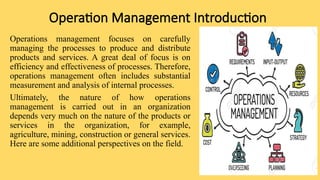
Operationsmanagement focuses on carefully
managing the processes to produce and distribute
products and services. A great deal of focus is on
efficiency and effectiveness of processes. Therefore,
operations management often includes substantial
measurement and analysis of internal processes.
Ultimately, the nature of how operations
management is carried out in an organization
depends very much on the nature of the products or
services in the organization, for example,
agriculture, mining, construction or general services.
Here are some additional perspectives on the field.
4.
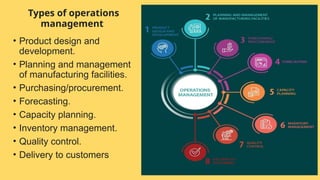
Types of operations
management
•Product design and
development.
• Planning and management
of manufacturing facilities.
• Purchasing/procurement.
• Forecasting.
• Capacity planning.
• Inventory management.
• Quality control.
• Delivery to customers
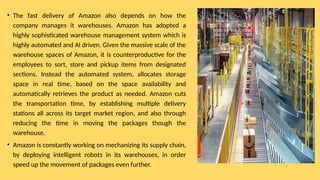
8.
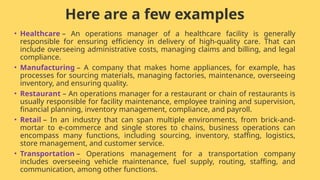
Here are afew examples
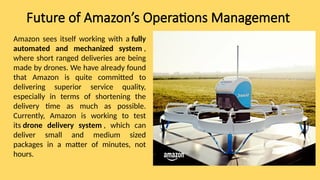
• Healthcare – An operations manager of a healthcare facility is generally
responsible for ensuring efficiency in delivery of high-quality care. That can
include overseeing administrative costs, managing claims and billing, and legal
compliance.
• Manufacturing – A company that makes home appliances, for example, has
processes for sourcing materials, managing factories, maintenance, overseeing
inventory, and ensuring quality.
• Restaurant – An operations manager for a restaurant or chain of restaurants is
usually responsible for facility maintenance, employee training and supervision,
financial planning, inventory management, compliance, and payroll.
• Retail – In an industry that can span multiple environments, from brick-and-
mortar to e-commerce and single stores to chains, business operations can
encompass many functions, including sourcing, inventory, staffing, logistics,
store management, and customer service.
• Transportation – Operations management for a transportation company
includes overseeing vehicle maintenance, fuel supply, routing, staffing, and
communication, among other functions.
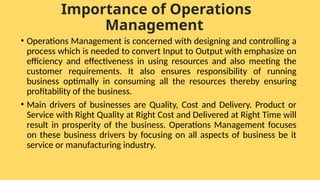
9.
Importance of Operations
Management
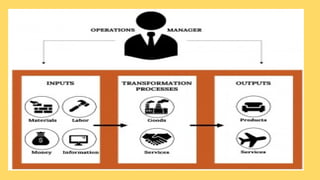
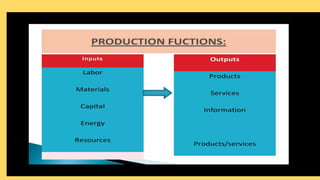
•Operations Management is concerned with designing and controlling a
process which is needed to convert Input to Output with emphasize on
efficiency and effectiveness in using resources and also meeting the
customer requirements. It also ensures responsibility of running
business optimally in consuming all the resources thereby ensuring
profitability of the business.
• Main drivers of businesses are Quality, Cost and Delivery. Product or
Service with Right Quality at Right Cost and Delivered at Right Time will
result in prosperity of the business. Operations Management focuses
on these business drivers by focusing on all aspects of business be it
service or manufacturing industry.
10.
Characteristics of operationprocess
Operations Processes Have Different Characteristics :
Operations processes differ in four distinctive ways:
•The volume of their output
•The variety of their output
•The variation in the demand for their output
•The degree of visibility which customers have of the production of the
product or service
11.
Understanding the fourVs of operations management – Volume,
variety, variation and visibility
The volume dimension
•High volume means high repeatability– people can specialize
•High volume leads to systemization of work
•High volume gives lower unit costs
e.g. McDonald low cost and Local Cafeteria high cost due to volume.
12.
The variety dimension
•Highvariety of products and services offered
•High variety increases cost of goods and services
•High variety operations must be flexible
•Standardization minimizes cost
e.g. Taxi and bus journey by using same route
13.
The Variation dimension
•Demandfor goods and services can change depending on the external
environment – seasonal factor
•Creates change in resources needed
•Activities must be planned effectively – forecasting
•Variation in demand can increase cost
e.g. Summer holiday resort hotel.
14.
Visibility
‘Visibility’ is thelast of the 4Vs. It refers to the visibility of the customer to the business
and its processes, and of the business to the customer. Some operations will be low-
visibility, e.g., a water treatment plant, or a supermarket, whose operations work
remotely from their customers. Other operations will be high-visibility, e.g., a coffee
shop or an estate agent.
Customers of high-visibility businesses will have a lower tolerance for waiting, and
customer satisfaction is more based upon perception of the quality and the attention to
detail. High-visibility businesses need to have a more client-oriented service or process,
resulting in a higher unit cost.
Organizations with “high visibility” operations, need to be much more apt at dealing
with customers, giving more attention to customer contact skills and presentation where
as those with low “visibility” others can focus more on their processes in privacy and are
judged on the end results of cost, quality, output, delivery etc.
Typically, more customer contact (high visibility) leads to higher costs – but – also you
can charge higher prices if you’re doing it well!
15.
Types of productionsystem
• There are three common types of basic production systems:
• Job Production
• Batch production
• Continuous production
16.
Job Production
Job shopis appropriate for manufactures of small batches of many different
products, each of which is custom designed and requires its own unique set of
processing steps or routing through production process.
• The production system in which different types of product follow different
sequences through different shops. Ex. Furniture manufacturing company,
restaurant, prototype industry.
• Much time is spent waiting for access to equipment. Some equipment
overloaded.
• A process technology suitable for a variety of custom designed products in some
volume.
• This production system adopts process layout as by this production system we
manufacture more variety of products at low product volume.
17.
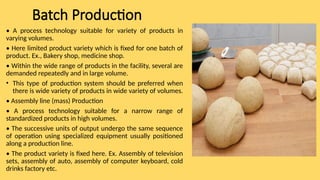
Batch Production
• Aprocess technology suitable for variety of products in
varying volumes.
• Here limited product variety which is fixed for one batch of
product. Ex., Bakery shop, medicine shop.
• Within the wide range of products in the facility, several are
demanded repeatedly and in large volume.
• This type of production system should be preferred when
there is wide variety of products in wide variety of volumes.
• Assembly line (mass) Production
• A process technology suitable for a narrow range of
standardized products in high volumes.
• The successive units of output undergo the same sequence
of operation using specialized equipment usually positioned
along a production line.
• The product variety is fixed here. Ex. Assembly of television
sets, assembly of auto, assembly of computer keyboard, cold
drinks factory etc.
18.
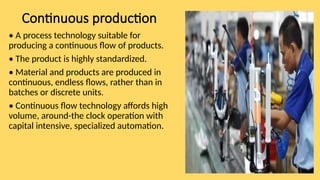
Continuous production
• Aprocess technology suitable for
producing a continuous flow of products.
• The product is highly standardized.
• Material and products are produced in
continuous, endless flows, rather than in
batches or discrete units.
• Continuous flow technology affords high
volume, around-the clock operation with
capital intensive, specialized automation.
19.
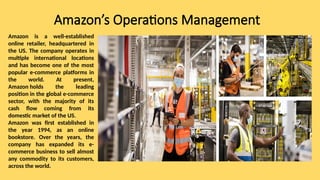
Amazon’s Operations Management
Amazonis a well-established
online retailer, headquartered in
the US. The company operates in
multiple international locations
and has become one of the most
popular e-commerce platforms in
the world. At present,
Amazon holds the leading
position in the global e-commerce
sector, with the majority of its
cash flow coming from its
domestic market of the US.
Amazon was first established in
the year 1994, as an online
bookstore. Over the years, the
company has expanded its e-
commerce business to sell almost
any commodity to its customers,
across the world.
20.
• Amazon isan online retail platform, which is used by the company to
sell different products to its customers and also allows third party
sellers to sell their own products as well. Thus, Amazon acts as an e-
commerce retailer as well as an online marketplace which brings third
party sellers close to a massive customer base .
• In order to offer the best possible service quality to its customers and
patterned sellers, Amazon has created a robust supply chain, which is
highly efficient and is capable of delivering its services to a
staggeringly high number of customers. In order to learn more about
the operations management of Amazon for your college essay, we
need to dig deeper into the supply chain of the company.
21.
Competitive Advantage andKey Purchasing
Criteria
Competitive advantage is the leverage a business has over its competitors.
This can be gained by offering clients better and greater value. Advertising
products or services with lower prices or higher quality piques the interest
of consumers. This is the reason behind brand loyalty, or why customers
prefer one particular product or service over another.
Each organization needs to have a deep understanding of their customers
and what drives their customers to make purchases. We refer to these
as key purchasing criteria. They are the factors which customers evaluate
and consider when making a product choice.
It is important to keep in mind that the customer is not always a consumer
purchasing a good at a store. The customer in many instances may be
another business. The city of Toronto may be purchasing heavy duty trucks
to use in the landscaping of city parks or Toyota may be searching for a
new supplier for automobile glass.
22.
Faster Delivery, HigherCustomer Satisfaction
• Amazon seeks to create a strong brand image by offering the best
possible service quality to its customers. In its pursuit, the company
has introduced a game changing product delivery service back in 2005
and named it Amazon Prime Service .
• This paid service allowed customers to have their product delivered at
their door-steps at an extremely short time of just two days. At the
time, it was something which was quite unheard of for any e-
commerce brand. Typically, customers had to wait much longer to
receive their products. The faster delivery of Amazon attracted a lot
of new customers and has eventually helped in creating a positive
brand image.
23.
Supply Chain ofAmazon
• Amazon delivers value through its supply chain to its stakeholders.
This can be really beneficial for you when you preparing your
college paper on Amazon.
• As mentioned earlier, apart from being an online retailer, Amazon also
acts as an online market place, which allows third party sellers to sell
their own products to a massive customer base using Amazon’s
platform. This business model has allowed the company to achieve
higher revenue by catering to a large number of customers and also
by leveraging the Long Tail approach.
24.
In order totake full advantage of the long tail strategy, Amazon has
introduced the Fulfillment by Amazon (FBA) program. The FBA allows
third party sellers, or SMEs to sell their products on the Amazon platform,
where they can instantly reach out to a massive customer base. Let us
now look at how FBA works to help you write essay on Amazon
operations management.
• A registered third-party seller sends their product to an Amazon
fulfillment center or schedules for a pick up.
• Amazon stores the product, from a single unit to the entire inventory, in
their warehouse.
• A customer buys the product from its listing on the Amazon platform.
• Amazon packs and ships the product to the customer.
• The seller makes revenue from the sale.
25.
Thus, the FBAallows Amazon to deliver the ordered products at the
shortest possible time. In this context, it should be highlighted that the
supply chain of Amazon is dependent on the high scalability of the
inventory capacity. As the company is storing the sellers’ products till
the time they are ordered, so it requires gargantuan warehouse spaces.
As of FY 2018, Amazon owned 288 million square feet of warehouse
space. Needless to say, that the company spends significant amount of
money to own and maintain these properties.
The fast and efficient delivery of products from the warehouses to the
door steps of the customers, is achieved through thoughtful
warehousing and logistics management system. Amazon has created a
highly intricate distribution network in its target market locations,
comprising of different types of facilities, that play a crucial role in its
supply chain. Let us look at each one of them now.
26.
• Crossdock Centers: Shipment from foreign vendors are stored here
until more inventories are required by the fulfillment center.
• Fulfilment Centers : The packages are stored here before being picked
up for delivery.
• Sortation Centers : In this facility the products are sorted by robots by
respective delivery addresses (zip codes) before they are sent out for
delivery.
• Delivery Stations : The delivery stations are meant to improve last
mile delivery , which is usually outsourced to third party logistics
companies like UPS or FedEx.
• Prime Now Hubs : These facilities enable time sensitive deliveries
such as groceries, which need to be delivered in a matter of hours.
27.
• The fastdelivery of Amazon also depends on how the
company manages it warehouses. Amazon has adopted a
highly sophisticated warehouse management system which is
highly automated and AI driven. Given the massive scale of the
warehouse spaces of Amazon, it is counterproductive for the
employees to sort, store and pickup items from designated
sections. Instead the automated system, allocates storage
space in real time, based on the space availability and
automatically retrieves the product as needed. Amazon cuts
the transportation time, by establishing multiple delivery
stations all across its target market region, and also through
reducing the time in moving the packages though the
warehouse.
• Amazon is constantly working on mechanizing its supply chain,
by deploying intelligent robots in its warehouses, in order
speed up the movement of packages even further.
28.
Future of Amazon’sOperations Management
Amazon sees itself working with a fully
automated and mechanized system ,
where short ranged deliveries are being
made by drones. We have already found
that Amazon is quite committed to
delivering superior service quality,
especially in terms of shortening the
delivery time as much as possible.
Currently, Amazon is working to test
its drone delivery system , which can
deliver small and medium sized
packages in a matter of minutes, not
hours.