BY:-
DEEP PARMAR
MATANG JAYANTILAL
HAZARD IDENTIFICATION
ASSESSMENT AND CONTROL
TECHNIQUES
Introduction
 Safety in any operation works best if the person
or people in charge take a leading role in
managing safety and health.
 Many business enterprises have proven that
good safety management leads to increased
productivity, and the same works for farms.
 By having a good safety management program,
you can avoid not only farm injuries, but also
other incidents that are costly, time consuming,
stressful and inconvenient. This makes good
economic sense.
HAZARD
 Any thing which has potential to cause harm to
the people and property is called hazard
Hazards may be identified in:
• Environments (light, noise, rain, heat, sun)
• Substances (pesticides, fuels, dusts)
• Workplace layout (parlor designs, cattle passes).
 Work organization (unnecessary manual
handling)
 Equipment (ladders, squeeze chutes, crowd
gates)
 Farm animals (that bite, kick, butt, crush, toss,
infect)
 Heights (roofs, vertical and horizontal silos,
manure pits)
 Electricity (switches, cables, leads, power tools,
Hazards may be identified by:
 Observation - use your senses of sight, hearing,
smell and touch - combined with knowledge and
experience.
 Material Safety Data Sheets (MSDSs) - obtain
them from manufacturers and suppliers. Read
them carefully to identify possible harm from
hazardous substances and precautions that need
to be taken.
 Hazard and risk surveys - conduct hazard
spotting surveys of main work areas. Talk to
others about their safety concerns.
 Record analysis - keep records of identified hazards,
near misses, injuries and workers' compensation
claims to help identify possible trends.
 Discussion groups - are useful for identifying
hazards and recommending solutions.
 Safety audits - consider creating a safety committee
to investigate safety and help prepare a
management plan.
 Information - keep informed of hazards in the
industry through the latest available information.
 Consumer information - carefully read and follow
consumer guidelines on equipment and substances.
 Regulations and best practices
How to assess the risks in your
workplace
 Identify the hazards
 Decide who might be harmed and how
 Evaluate the risks and decide on precautions
 Record your significant findings
 Review your assessment and update if necessary
Identify the hazards
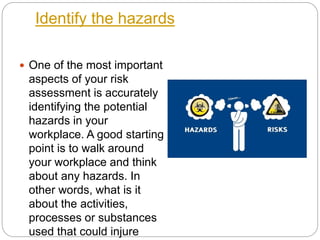
 One of the most important
aspects of your risk
assessment is accurately
identifying the potential
hazards in your
workplace. A good starting
point is to walk around
your workplace and think
about any hazards. In
other words, what is it
about the activities,
processes or substances
used that could injure
Decide who might be harmed and
how
 Think how employees
(or others who may be
present such as
contractors or visitors)
might be harmed. Ask
your employees what
they think the hazards
are, as they may notice
things that are not
obvious to you and may
have some good ideas
on how to control the
risks.
Evaluate the risks and decide on
precautions
 Having identified the
hazards, you then have to
decide how likely it is that
harm will occur; ie the level
of risk and what to do about
it. Risk is a part of everyday
life and you are not
expected to eliminate all
risks. What you must do is
make sure you know about
the main risks and the
things you need to do to
manage them responsibly.
Record your significant findings
 Make a record of your
significant findings - the
hazards, how people
might be harmed by
them and what you
have in place to control
the risks. Any record
produced should be
simple and focused on
controls
Review your assessment and
update if necessary
Few workplaces stay the same. Sooner or later,
you will bring in new equipment, substances and
procedures that could lead to new hazards. So it
makes sense to review what you are doing on an
ongoing basis, look at your risk assessment again
and ask yourself:
 Have there been any significant changes?
 Are there improvements you still need to make?
 Have your workers spotted a problem?
 Have you learnt anything from accidents or near
misses?
 Make sure your risk assessment stays up to date.
CONTROL TECHINQUE
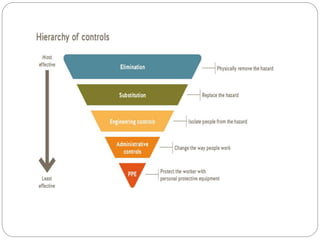
 The hierarchy of control is used to remove or
reduce hazards and risks and should be used
during a risk assessment. The idea is that you
start by choosing methods from the top of the list
and work your way down if required
Eliminate
Reduce
Isolate
Control
Personal Protective Equipment
Discipline
Elimination
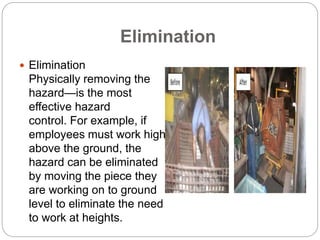
 Elimination
Physically removing the
hazard—is the most
effective hazard
control. For example, if
employees must work high
above the ground, the
hazard can be eliminated
by moving the piece they
are working on to ground
level to eliminate the need
to work at heights.
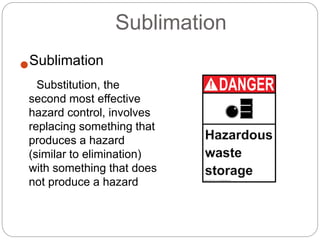
Sublimation
Sublimation
Substitution, the
second most effective
hazard control, involves
replacing something that
produces a hazard
(similar to elimination)
with something that does
not produce a hazard
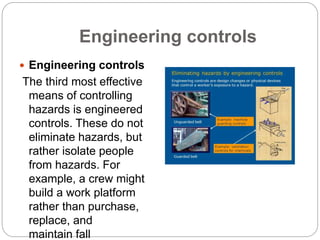
Engineering controls
 Engineering controls
The third most effective
means of controlling
hazards is engineered
controls. These do not
eliminate hazards, but
rather isolate people
from hazards. For
example, a crew might
build a work platform
rather than purchase,
replace, and
maintain fall
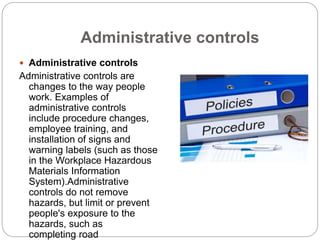
Administrative controls
 Administrative controls
Administrative controls are
changes to the way people
work. Examples of
administrative controls
include procedure changes,
employee training, and
installation of signs and
warning labels (such as those
in the Workplace Hazardous
Materials Information
System).Administrative
controls do not remove
hazards, but limit or prevent
people's exposure to the
hazards, such as
completing road
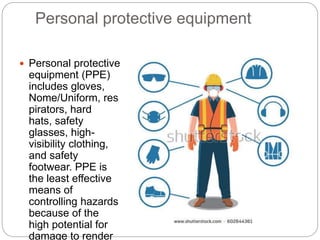
Personal protective equipment
 Personal protective
equipment (PPE)
includes gloves,
Nome/Uniform, res
pirators, hard
hats, safety
glasses, high-
visibility clothing,
and safety
footwear. PPE is
the least effective
means of
controlling hazards
because of the
high potential for
damage to render
Hazard identification assessment and control techniques

Hazard identification assessment and control techniques

  • 1.
    BY:- DEEP PARMAR MATANG JAYANTILAL HAZARDIDENTIFICATION ASSESSMENT AND CONTROL TECHNIQUES
  • 2.
    Introduction  Safety inany operation works best if the person or people in charge take a leading role in managing safety and health.  Many business enterprises have proven that good safety management leads to increased productivity, and the same works for farms.  By having a good safety management program, you can avoid not only farm injuries, but also other incidents that are costly, time consuming, stressful and inconvenient. This makes good economic sense.
  • 3.
    HAZARD  Any thingwhich has potential to cause harm to the people and property is called hazard
  • 4.
    Hazards may beidentified in: • Environments (light, noise, rain, heat, sun) • Substances (pesticides, fuels, dusts) • Workplace layout (parlor designs, cattle passes).  Work organization (unnecessary manual handling)  Equipment (ladders, squeeze chutes, crowd gates)  Farm animals (that bite, kick, butt, crush, toss, infect)  Heights (roofs, vertical and horizontal silos, manure pits)  Electricity (switches, cables, leads, power tools,
  • 5.
    Hazards may beidentified by:  Observation - use your senses of sight, hearing, smell and touch - combined with knowledge and experience.  Material Safety Data Sheets (MSDSs) - obtain them from manufacturers and suppliers. Read them carefully to identify possible harm from hazardous substances and precautions that need to be taken.  Hazard and risk surveys - conduct hazard spotting surveys of main work areas. Talk to others about their safety concerns.
  • 6.
     Record analysis- keep records of identified hazards, near misses, injuries and workers' compensation claims to help identify possible trends.  Discussion groups - are useful for identifying hazards and recommending solutions.  Safety audits - consider creating a safety committee to investigate safety and help prepare a management plan.  Information - keep informed of hazards in the industry through the latest available information.  Consumer information - carefully read and follow consumer guidelines on equipment and substances.  Regulations and best practices
  • 7.
    How to assessthe risks in your workplace  Identify the hazards  Decide who might be harmed and how  Evaluate the risks and decide on precautions  Record your significant findings  Review your assessment and update if necessary
  • 8.
    Identify the hazards One of the most important aspects of your risk assessment is accurately identifying the potential hazards in your workplace. A good starting point is to walk around your workplace and think about any hazards. In other words, what is it about the activities, processes or substances used that could injure
  • 9.
    Decide who mightbe harmed and how  Think how employees (or others who may be present such as contractors or visitors) might be harmed. Ask your employees what they think the hazards are, as they may notice things that are not obvious to you and may have some good ideas on how to control the risks.
  • 10.
    Evaluate the risksand decide on precautions  Having identified the hazards, you then have to decide how likely it is that harm will occur; ie the level of risk and what to do about it. Risk is a part of everyday life and you are not expected to eliminate all risks. What you must do is make sure you know about the main risks and the things you need to do to manage them responsibly.
  • 11.
    Record your significantfindings  Make a record of your significant findings - the hazards, how people might be harmed by them and what you have in place to control the risks. Any record produced should be simple and focused on controls
  • 12.
    Review your assessmentand update if necessary Few workplaces stay the same. Sooner or later, you will bring in new equipment, substances and procedures that could lead to new hazards. So it makes sense to review what you are doing on an ongoing basis, look at your risk assessment again and ask yourself:  Have there been any significant changes?  Are there improvements you still need to make?  Have your workers spotted a problem?  Have you learnt anything from accidents or near misses?  Make sure your risk assessment stays up to date.
  • 13.
    CONTROL TECHINQUE  Thehierarchy of control is used to remove or reduce hazards and risks and should be used during a risk assessment. The idea is that you start by choosing methods from the top of the list and work your way down if required Eliminate Reduce Isolate Control Personal Protective Equipment Discipline
  • 15.
    Elimination  Elimination Physically removingthe hazard—is the most effective hazard control. For example, if employees must work high above the ground, the hazard can be eliminated by moving the piece they are working on to ground level to eliminate the need to work at heights.
  • 16.
    Sublimation Sublimation Substitution, the second mosteffective hazard control, involves replacing something that produces a hazard (similar to elimination) with something that does not produce a hazard
  • 17.
    Engineering controls  Engineeringcontrols The third most effective means of controlling hazards is engineered controls. These do not eliminate hazards, but rather isolate people from hazards. For example, a crew might build a work platform rather than purchase, replace, and maintain fall
  • 18.
    Administrative controls  Administrativecontrols Administrative controls are changes to the way people work. Examples of administrative controls include procedure changes, employee training, and installation of signs and warning labels (such as those in the Workplace Hazardous Materials Information System).Administrative controls do not remove hazards, but limit or prevent people's exposure to the hazards, such as completing road
  • 19.
    Personal protective equipment Personal protective equipment (PPE) includes gloves, Nome/Uniform, res pirators, hard hats, safety glasses, high- visibility clothing, and safety footwear. PPE is the least effective means of controlling hazards because of the high potential for damage to render