Algorithms
Hash table
Abdelrahman M. Saleh
List of contents
● Introduction
○ Hashing
○ Linear probing
○ Basic operation
● Data structure
○ Data item
○ Hash method
List of contents
● implementation and Algorithm
○ Search operation
○ Insert operation
○ Delete operation
● Performance Runtime
○ Best, Average and worst cases.
● Execution
Introduction
Hashing :
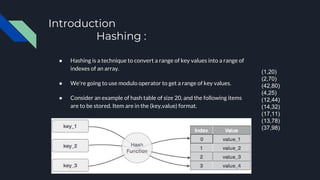
● Hashing is a technique to convert a range of key values into a range of
indexes of an array.
● We're going to use modulo operator to get a range of key values.
● Consider an example of hash table of size 20, and the following items
are to be stored. Item are in the (key,value) format.
(1,20)
(2,70)
(42,80)
(4,25)
(12,44)
(14,32)
(17,11)
(13,78)
(37,98)
Introduction
Linear probing :
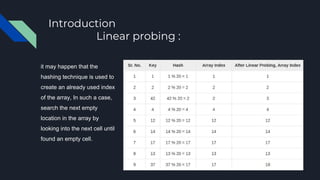
it may happen that the
hashing technique is used to
create an already used index
of the array, In such a case,
search the next empty
location in the array by
looking into the next cell until
found an empty cell.
Introduction
Basic operation :
Search Searches an element in a hash table.
Insert inserts an element in a hash table.
delete Deletes an element from a hash table.
Data structure :
Define a data item having some data and key,
based on which the search is to be conducted
in a hash table.
struct DataItem {
int data ;
int key ;
};
DataItem :
Hash method :
Define a hashing method to compute the
hash code of the key of the data item.
int hashCode(int key)
{
return key % SIZE;
}
Implementation and
Algorithms .
Search Operation
Whenever an element is to be
searched, compute the hash code of the
key passed and locate the element
using that hash code as index in the
array.
Use linear probing to get the element
ahead if the element is not found at the
computed hash code.
struct DataItem *search(int key) {
//get the hash
int hashIndex = hashCode(key);
//move in array until an empty
while(hashArray[hashIndex] != NULL) {
if(hashArray[hashIndex]->key == key)
return hashArray[hashIndex];
//go to next cell
++hashIndex;
//wrap around the table
hashIndex %= SIZE;
}
return NULL;
}
Insert Operation
Whenever an element is to be inserted,
compute the hash code of the key
passed and locate the index using that
hash code as an index in the array.
Use linear probing for empty location, if
an element is found at the computed
hash code.
void insert(int key,int data) {
struct DataItem *item = (struct DataItem*)
malloc(sizeof(struct DataItem));
item->data = data;
item->key = key;
//get the hash
int hashIndex = hashCode(key);
//move in array until an empty or deleted cell
while(hashArray[hashIndex] != NULL &&
hashArray[hashIndex]->key != -1) {
//go to next cell
++hashIndex;
//wrap around the table
hashIndex %= SIZE;
}
hashArray[hashIndex] = item;
}
Delete Operation
Whenever an element is to be deleted,
compute the hash code of the key
passed and locate the index using that
hash code as an index in the array.
Use linear probing to get the element
ahead if an element is not found at the
computed hash code.
When found, store a dummy item there
to keep the performance of the hash
table intact.
struct DataItem* delete(struct DataItem* item)
{
int key = item->key;
//get the hash
int hashIndex = hashCode(key);
//move in array until an empty
while(hashArray[hashIndex] !=NULL) {
if(hashArray[hashIndex]->key == key) {
struct DataItem* temp =
hashArray[hashIndex];
//assign a dummy item at deleted position
hashArray[hashIndex] = dummyItem;
return temp; }
//go to next cell
++hashIndex;
//wrap around the table
hashIndex %= SIZE; }
return NULL;
}
Performance Runtime
It's impossible to know in advance how many collisions you will get with your hash function, as
well as things like needing to resize.
This can add an element of unpredictability to the performance of a hash table, making it not
true O(1).
However, virtually all hash table implementations offer O(1) on the vast, vast, vast majority of
inserts. This is the same as array inserting - it's O(1) unless you need to resize, in which case it's
O(n), plus the collision uncertainty.

Hash table

  • 1.
  • 2.
    List of contents ●Introduction ○ Hashing ○ Linear probing ○ Basic operation ● Data structure ○ Data item ○ Hash method
  • 3.
    List of contents ●implementation and Algorithm ○ Search operation ○ Insert operation ○ Delete operation ● Performance Runtime ○ Best, Average and worst cases. ● Execution
  • 4.
    Introduction Hashing : ● Hashingis a technique to convert a range of key values into a range of indexes of an array. ● We're going to use modulo operator to get a range of key values. ● Consider an example of hash table of size 20, and the following items are to be stored. Item are in the (key,value) format. (1,20) (2,70) (42,80) (4,25) (12,44) (14,32) (17,11) (13,78) (37,98)
  • 5.
    Introduction Linear probing : itmay happen that the hashing technique is used to create an already used index of the array, In such a case, search the next empty location in the array by looking into the next cell until found an empty cell.
  • 6.
    Introduction Basic operation : SearchSearches an element in a hash table. Insert inserts an element in a hash table. delete Deletes an element from a hash table.
  • 7.
    Data structure : Definea data item having some data and key, based on which the search is to be conducted in a hash table. struct DataItem { int data ; int key ; }; DataItem : Hash method : Define a hashing method to compute the hash code of the key of the data item. int hashCode(int key) { return key % SIZE; }
  • 8.
  • 9.
    Search Operation Whenever anelement is to be searched, compute the hash code of the key passed and locate the element using that hash code as index in the array. Use linear probing to get the element ahead if the element is not found at the computed hash code. struct DataItem *search(int key) { //get the hash int hashIndex = hashCode(key); //move in array until an empty while(hashArray[hashIndex] != NULL) { if(hashArray[hashIndex]->key == key) return hashArray[hashIndex]; //go to next cell ++hashIndex; //wrap around the table hashIndex %= SIZE; } return NULL; }
  • 10.
    Insert Operation Whenever anelement is to be inserted, compute the hash code of the key passed and locate the index using that hash code as an index in the array. Use linear probing for empty location, if an element is found at the computed hash code. void insert(int key,int data) { struct DataItem *item = (struct DataItem*) malloc(sizeof(struct DataItem)); item->data = data; item->key = key; //get the hash int hashIndex = hashCode(key); //move in array until an empty or deleted cell while(hashArray[hashIndex] != NULL && hashArray[hashIndex]->key != -1) { //go to next cell ++hashIndex; //wrap around the table hashIndex %= SIZE; } hashArray[hashIndex] = item; }
  • 11.
    Delete Operation Whenever anelement is to be deleted, compute the hash code of the key passed and locate the index using that hash code as an index in the array. Use linear probing to get the element ahead if an element is not found at the computed hash code. When found, store a dummy item there to keep the performance of the hash table intact. struct DataItem* delete(struct DataItem* item) { int key = item->key; //get the hash int hashIndex = hashCode(key); //move in array until an empty while(hashArray[hashIndex] !=NULL) { if(hashArray[hashIndex]->key == key) { struct DataItem* temp = hashArray[hashIndex]; //assign a dummy item at deleted position hashArray[hashIndex] = dummyItem; return temp; } //go to next cell ++hashIndex; //wrap around the table hashIndex %= SIZE; } return NULL; }
  • 12.
    Performance Runtime It's impossibleto know in advance how many collisions you will get with your hash function, as well as things like needing to resize. This can add an element of unpredictability to the performance of a hash table, making it not true O(1). However, virtually all hash table implementations offer O(1) on the vast, vast, vast majority of inserts. This is the same as array inserting - it's O(1) unless you need to resize, in which case it's O(n), plus the collision uncertainty.