1
Presented By
UMAIR
KHAN
HASHING TABLES
2
Table of Content
 Introduction.
 Searching Methods.
 What is Hashing .
 Simple Hashing .
 Collision in Hashing.
 Techniques for Overcome Collisions.
 Advantages And Disadvantages.
 Summary .
 Q /A Session
3
Introduction
 Process of finding an element within the
list of elements in order or randomly.
 Searching Takes About 20% to 25% of computer
Execution Time.
 So That why we need to increase the efficiency of
our Searching function
4
LINEAR SEARCHING
BINARY SEARCH
HASH TABLES
5
Searching
Linear Searching
 Finding a value in a list of values.
 Searching is the process of locating given value
position in a list of values.
 Time complexity of Linear Search is O(n)
where n is total number of elements in the list.
6
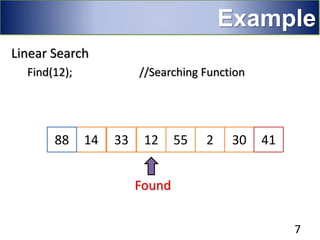
Linear Searching
Linear Search
Find(12); //Searching Function
7
Example
14 33 12 55 2 30 41
Found
88
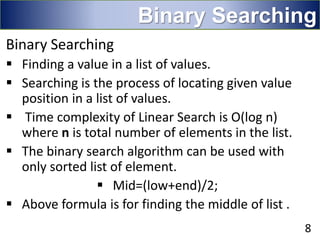
Binary Searching
 Finding a value in a list of values.
 Searching is the process of locating given value
position in a list of values.
 Time complexity of Linear Search is O(log n)
where n is total number of elements in the list.
 The binary search algorithm can be used with
only sorted list of element.
 Mid=(low+end)/2;
 Above formula is for finding the middle of list .
8
Binary Searching
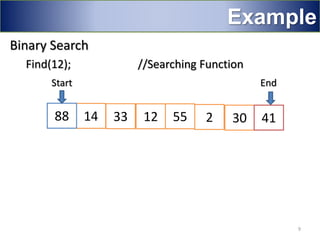
Binary Search
Find(12); //Searching Function
9
Example
14 33 12 55 2 30 4188
Start End
Function Find(int x)
{
While(start<=end)
{
Int mid=(start+end)/2;
If(x==A[mid]
{
cout<<X<<“ Value Successfully found In Given Array”<<endl;
Break;
}
Else if(x>A[mid])
{
Start=mid+1;
}
Else
End=mid-1;
}
If(x==-1)
{
Cout<<“Element not Found in Array”<<endl;
}
10
Example
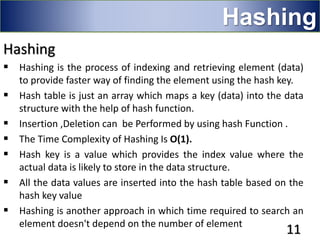
Hashing
 Hashing is the process of indexing and retrieving element (data)
to provide faster way of finding the element using the hash key.
 Hash table is just an array which maps a key (data) into the data
structure with the help of hash function.
 Insertion ,Deletion can be Performed by using hash Function .
 The Time Complexity of Hashing Is O(1).
 Hash key is a value which provides the index value where the
actual data is likely to store in the data structure.
 All the data values are inserted into the hash table based on the
hash key value
 Hashing is another approach in which time required to search an
element doesn't depend on the number of element
11
Hashing
Hashing Function
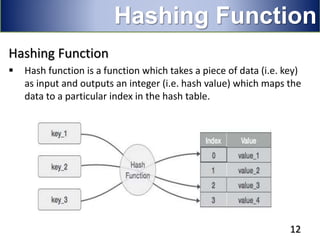
 Hash function is a function which takes a piece of data (i.e. key)
as input and outputs an integer (i.e. hash value) which maps the
data to a particular index in the hash table.
12
Hashing Function
Hashing Function
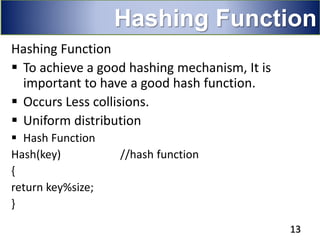
 To achieve a good hashing mechanism, It is
important to have a good hash function.
 Occurs Less collisions.
 Uniform distribution
 Hash Function
Hash(key) //hash function
{
return key%size;
}
13
Hashing Function
Insertion in Hash Tables
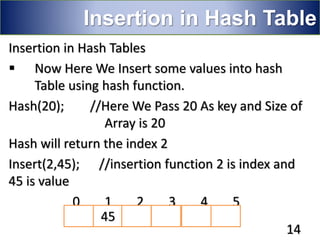
 Now Here We Insert some values into hash
Table using hash function.
Hash(20); //Here We Pass 20 As key and Size of
Array is 20
Hash will return the index 2
Insert(2,45); //insertion function 2 is index and
45 is value
0 1 2 3 4 5
14
Insertion in Hash Table
45
Searching in Hash Table
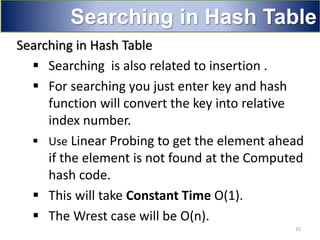
 Searching is also related to insertion .
 For searching you just enter key and hash
function will convert the key into relative
index number.
 Use Linear Probing to get the element ahead
if the element is not found at the Computed
hash code.
 This will take Constant Time O(1).
 The Wrest case will be O(n).
15
Searching in Hash Table
Hash(37); //will Return the key 17
Hash(17); //will Return the Key 17
 Now Here The Hash Function will return same
index for two different keys .
 This case is called in Hash Table called Collision.
 When two keys are mapped to the same
position called collision.
 To overcome Collision We apply some
techniques
16
Collision in Hashing
Linear Probing
 Linear search in the array from the
position where collision occurred.
Chaining
 Uses a Linked List at each position in the
Hash Table.
17
Collision Resolution
 Open addressing / probing is carried out for insertion
into fixed size hash tables.
 If the index given by the hash function is occupied, then
increment the table position by some number.
 It may be an empty location in Table.
 Start Search for Empty Slot in table than stop search
and insert into them.
 Quadratic Probing
 increment the position computed by the hash function.
 Double Hash:
 compute the index as a function of two different hash
functions.
18
Linear Probing
Insertion
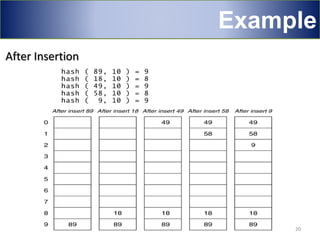
 Insert items with keys: 89, 18, 49, 58, 9 into an
empty hash table.
 Table size is 10.
 Hash function is hash(x) = x mod 10.
Linear Probing
20
Example
After Insertion
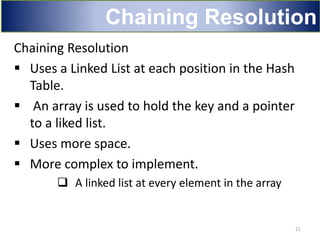
Chaining Resolution
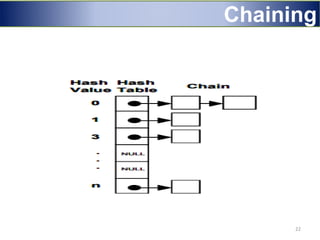
 Uses a Linked List at each position in the Hash
Table.
 An array is used to hold the key and a pointer
to a liked list.
 Uses more space.
 More complex to implement.
 A linked list at every element in the array
21
Chaining Resolution
22
Chaining
Hashing Applications
 Compilers use hash tables to implement the
symbol table (a data structure to keep track of
declared variables).
 Game programs use hash tables to keep track
of positions it has encountered .
 Online spelling checkers.
23
 Hash tables can be used to implement the
insert and find operations in constant average
time.
 it depends on the load factor not on the number of
items in the table
24
Summary
25
Any Question
“Learn The Rules Like Pro So
You Can Break them Like
Artist”
26
Thank You
27

Hashing data

  • 1.
  • 2.
  • 3.
    Table of Content Introduction.  Searching Methods.  What is Hashing .  Simple Hashing .  Collision in Hashing.  Techniques for Overcome Collisions.  Advantages And Disadvantages.  Summary .  Q /A Session 3
  • 4.
    Introduction  Process offinding an element within the list of elements in order or randomly.  Searching Takes About 20% to 25% of computer Execution Time.  So That why we need to increase the efficiency of our Searching function 4
  • 5.
  • 6.
    Linear Searching  Findinga value in a list of values.  Searching is the process of locating given value position in a list of values.  Time complexity of Linear Search is O(n) where n is total number of elements in the list. 6 Linear Searching
  • 7.
    Linear Search Find(12); //SearchingFunction 7 Example 14 33 12 55 2 30 41 Found 88
  • 8.
    Binary Searching  Findinga value in a list of values.  Searching is the process of locating given value position in a list of values.  Time complexity of Linear Search is O(log n) where n is total number of elements in the list.  The binary search algorithm can be used with only sorted list of element.  Mid=(low+end)/2;  Above formula is for finding the middle of list . 8 Binary Searching
  • 9.
    Binary Search Find(12); //SearchingFunction 9 Example 14 33 12 55 2 30 4188 Start End
  • 10.
    Function Find(int x) { While(start<=end) { Intmid=(start+end)/2; If(x==A[mid] { cout<<X<<“ Value Successfully found In Given Array”<<endl; Break; } Else if(x>A[mid]) { Start=mid+1; } Else End=mid-1; } If(x==-1) { Cout<<“Element not Found in Array”<<endl; } 10 Example
  • 11.
    Hashing  Hashing isthe process of indexing and retrieving element (data) to provide faster way of finding the element using the hash key.  Hash table is just an array which maps a key (data) into the data structure with the help of hash function.  Insertion ,Deletion can be Performed by using hash Function .  The Time Complexity of Hashing Is O(1).  Hash key is a value which provides the index value where the actual data is likely to store in the data structure.  All the data values are inserted into the hash table based on the hash key value  Hashing is another approach in which time required to search an element doesn't depend on the number of element 11 Hashing
  • 12.
    Hashing Function  Hashfunction is a function which takes a piece of data (i.e. key) as input and outputs an integer (i.e. hash value) which maps the data to a particular index in the hash table. 12 Hashing Function
  • 13.
    Hashing Function  Toachieve a good hashing mechanism, It is important to have a good hash function.  Occurs Less collisions.  Uniform distribution  Hash Function Hash(key) //hash function { return key%size; } 13 Hashing Function
  • 14.
    Insertion in HashTables  Now Here We Insert some values into hash Table using hash function. Hash(20); //Here We Pass 20 As key and Size of Array is 20 Hash will return the index 2 Insert(2,45); //insertion function 2 is index and 45 is value 0 1 2 3 4 5 14 Insertion in Hash Table 45
  • 15.
    Searching in HashTable  Searching is also related to insertion .  For searching you just enter key and hash function will convert the key into relative index number.  Use Linear Probing to get the element ahead if the element is not found at the Computed hash code.  This will take Constant Time O(1).  The Wrest case will be O(n). 15 Searching in Hash Table
  • 16.
    Hash(37); //will Returnthe key 17 Hash(17); //will Return the Key 17  Now Here The Hash Function will return same index for two different keys .  This case is called in Hash Table called Collision.  When two keys are mapped to the same position called collision.  To overcome Collision We apply some techniques 16 Collision in Hashing
  • 17.
    Linear Probing  Linearsearch in the array from the position where collision occurred. Chaining  Uses a Linked List at each position in the Hash Table. 17 Collision Resolution
  • 18.
     Open addressing/ probing is carried out for insertion into fixed size hash tables.  If the index given by the hash function is occupied, then increment the table position by some number.  It may be an empty location in Table.  Start Search for Empty Slot in table than stop search and insert into them.  Quadratic Probing  increment the position computed by the hash function.  Double Hash:  compute the index as a function of two different hash functions. 18 Linear Probing
  • 19.
    Insertion  Insert itemswith keys: 89, 18, 49, 58, 9 into an empty hash table.  Table size is 10.  Hash function is hash(x) = x mod 10. Linear Probing
  • 20.
  • 21.
    Chaining Resolution  Usesa Linked List at each position in the Hash Table.  An array is used to hold the key and a pointer to a liked list.  Uses more space.  More complex to implement.  A linked list at every element in the array 21 Chaining Resolution
  • 22.
  • 23.
    Hashing Applications  Compilersuse hash tables to implement the symbol table (a data structure to keep track of declared variables).  Game programs use hash tables to keep track of positions it has encountered .  Online spelling checkers. 23
  • 24.
     Hash tablescan be used to implement the insert and find operations in constant average time.  it depends on the load factor not on the number of items in the table 24 Summary
  • 25.
  • 26.
    “Learn The RulesLike Pro So You Can Break them Like Artist” 26
  • 27.