Algorithms
Quick Sort
Abdelrahman M. Saleh
List of contents
● Introduction
● Example w/ illustrating figures
● Algorithm
● implementation (Java, C++, Python)
● Performance Runtime
○ Best, Average and worst cases.
● Execution
● Other Notes
Introduction
● Like Merge sort it’s Divide and Conquer algorithm => picks an element as pivot and
partitions the given array around it
● There are many different versions of quickSort that pick pivot in different ways
○ Always pick first element as pivot.
○ Always pick last element as pivot (implemented below)
○ Pick a random element as pivot.
○ Pick median as pivot.
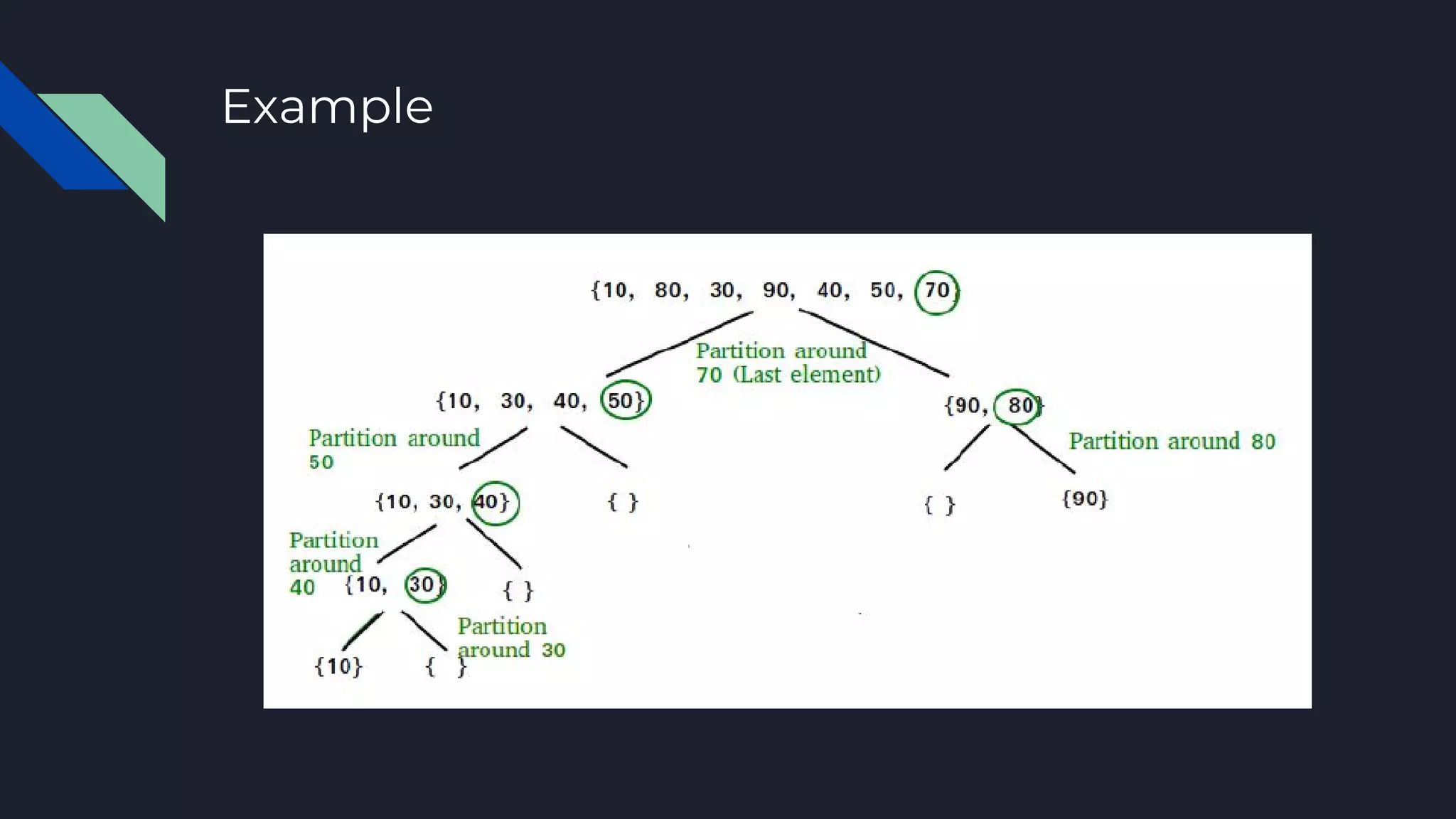
Example
Algorithm .
➔ Array name “arr” , starting index “low”, ending index “high”
● If low is smaller than high
○ pivot is partitioning index, arr[p] is now at right place :
■ pivot = partition(arr, low, high)
○ Recursively sort elements Aefore pivot :
■ Call quickSort(arr, low, pivot - 1)
○ Recursively sort elements After pivot :
■ Call quickSort(arr, pivot + 1, high)
Implementation .
C++
void quickSort(int arr[], int low, int high)
{
if (low < high)
{
int pivot = partition(arr, low, high);
quickSort(arr, low, pivot - 1);
quickSort(arr, pivot + 1, high);
}
}
C++
Continue ...
int partition (int arr[], int low, int high)
{
int pivot = arr[high], i = (low - 1);
for (int j = low; j <= high- 1; j++)
{
if (arr[j] <= pivot)
{
I++; swap(&arr[i], &arr[j]);
}
}
swap(&arr[i + 1], &arr[high]);
return (i + 1);
}
// partition the array around the pivot
JAVA
void sort(int arr[], int low, int high)
{
if (low < high)
{
int pi = partition(arr, low, high);
sort(arr, low, pi-1);
sort(arr, pi+1, high);
}
}
JAVA
Continue ...
int partition(int arr[], int low, int high) {
int pivot = arr[high], i = (low-1);
for (int j=low; j<high; j++)
{
if (arr[j] <= pivot)
{
i++;
int temp = arr[i]; arr[i] = arr[j]; arr[j] = temp; //swap of [i] & [j]
}
}
int temp = arr[i+1]; arr[i+1] = arr[high]; arr[high] = temp; //swap of [i+1] & [high]
return i+1;
}
// partition the array around the pivot
Python .
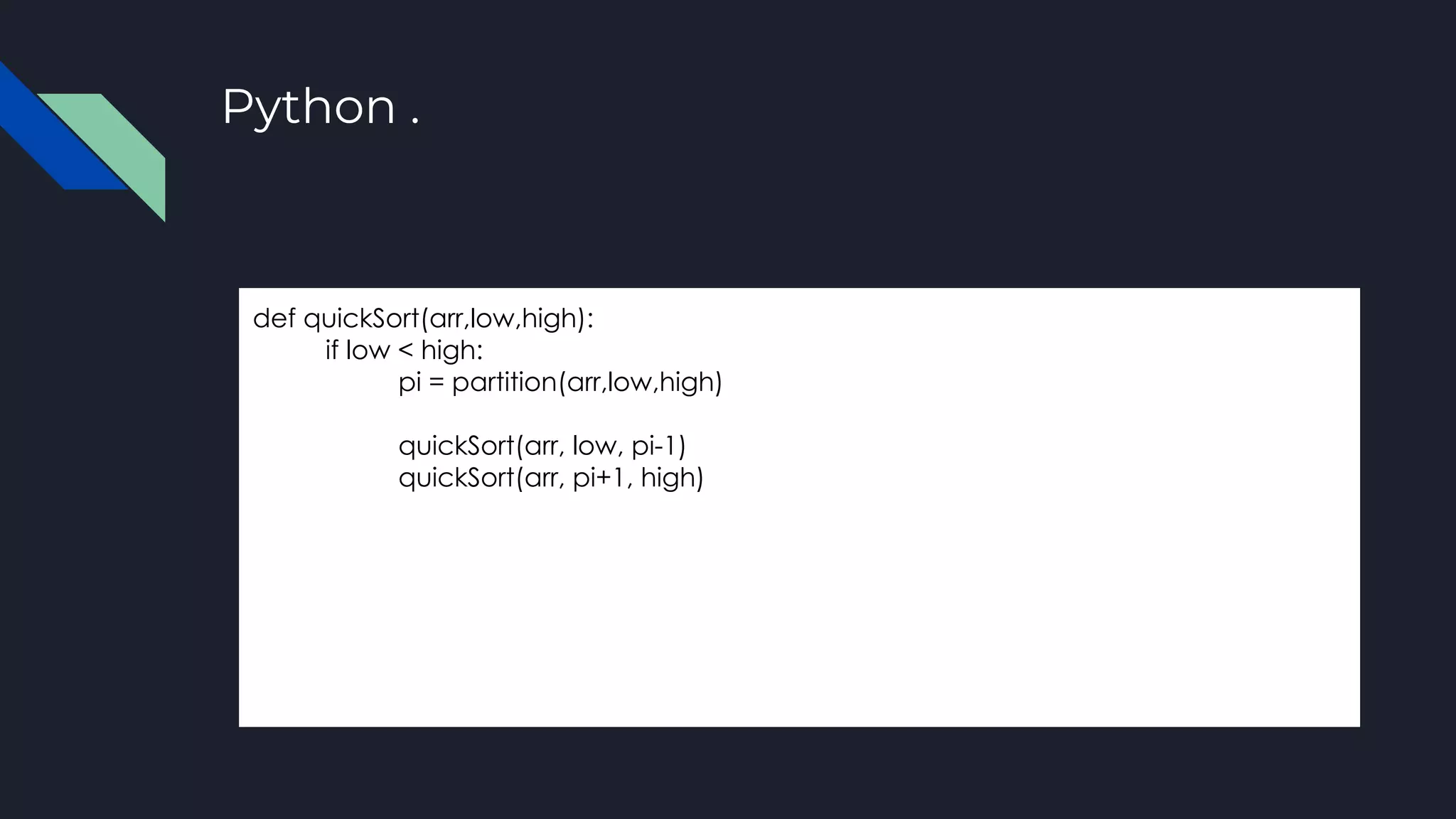
def quickSort(arr,low,high):
if low < high:
pi = partition(arr,low,high)
quickSort(arr, low, pi-1)
quickSort(arr, pi+1, high)
Python
Continue ...
def partition(arr,low,high):
i = ( low-1 )
pivot = arr[high]
for j in range(low , high):
if arr[j] <= pivot:
i = i+1
arr[i],arr[j] = arr[j],arr[i]
arr[i+1],arr[high] = arr[high],arr[i+1]
return ( i+1 )
// partition the array around the pivot
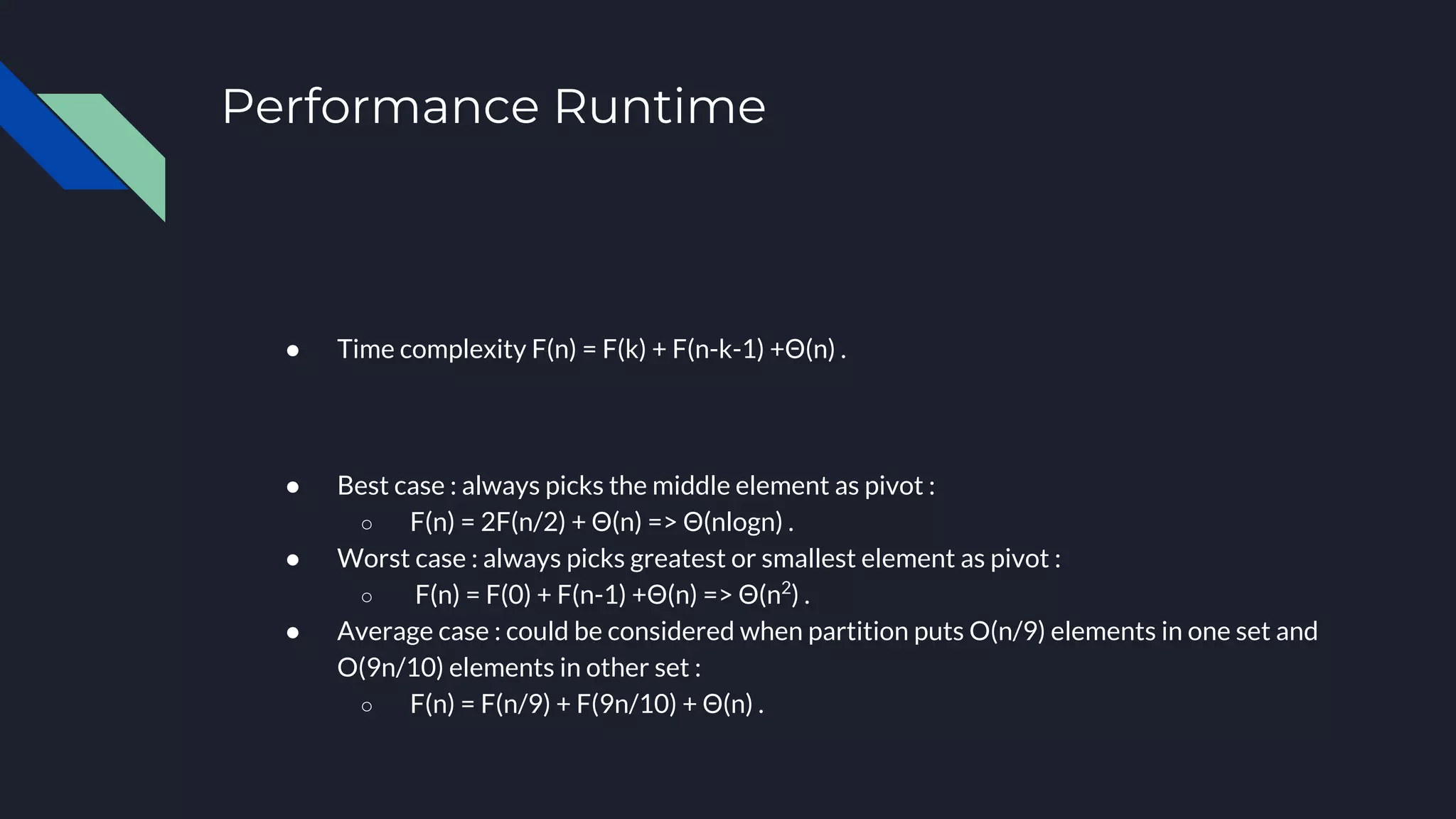
Performance Runtime
● Time complexity F(n) = F(k) + F(n-k-1) +Θ(n) .
● Best case : always picks the middle element as pivot :
○ F(n) = 2F(n/2) + Θ(n) => Θ(nlogn) .
● Worst case : always picks greatest or smallest element as pivot :
○ F(n) = F(0) + F(n-1) +Θ(n) => Θ(n2
) .
● Average case : could be considered when partition puts O(n/9) elements in one set and
O(9n/10) elements in other set :
○ F(n) = F(n/9) + F(9n/10) + Θ(n) .
Execution .
Input array : [4, 6, 3, 2, 1, 9, 7]
Swap Pivot “7” with “9”
=> left part [4, 6, 3, 2, 1] right part[9]
Swap Pivot “1”, 4
Swap 6, 2
=> left part [3, 2] right [4, 6]
Swap Pivot “2”, 3
=> left part [3] right [4, 6]
Output Array: [1, 2, 3, 4, 6, 7, 9]
Other Notes .
● Algorithmic Paradigm: Divide Approach
● Sorting In Place: Yes
● Stable: Yes
● Online: Yes

Quick sort

  • 1.
  • 2.
    List of contents ●Introduction ● Example w/ illustrating figures ● Algorithm ● implementation (Java, C++, Python) ● Performance Runtime ○ Best, Average and worst cases. ● Execution ● Other Notes
  • 3.
    Introduction ● Like Mergesort it’s Divide and Conquer algorithm => picks an element as pivot and partitions the given array around it ● There are many different versions of quickSort that pick pivot in different ways ○ Always pick first element as pivot. ○ Always pick last element as pivot (implemented below) ○ Pick a random element as pivot. ○ Pick median as pivot.
  • 4.
  • 5.
    Algorithm . ➔ Arrayname “arr” , starting index “low”, ending index “high” ● If low is smaller than high ○ pivot is partitioning index, arr[p] is now at right place : ■ pivot = partition(arr, low, high) ○ Recursively sort elements Aefore pivot : ■ Call quickSort(arr, low, pivot - 1) ○ Recursively sort elements After pivot : ■ Call quickSort(arr, pivot + 1, high)
  • 6.
  • 7.
    C++ void quickSort(int arr[],int low, int high) { if (low < high) { int pivot = partition(arr, low, high); quickSort(arr, low, pivot - 1); quickSort(arr, pivot + 1, high); } }
  • 8.
    C++ Continue ... int partition(int arr[], int low, int high) { int pivot = arr[high], i = (low - 1); for (int j = low; j <= high- 1; j++) { if (arr[j] <= pivot) { I++; swap(&arr[i], &arr[j]); } } swap(&arr[i + 1], &arr[high]); return (i + 1); } // partition the array around the pivot
  • 9.
    JAVA void sort(int arr[],int low, int high) { if (low < high) { int pi = partition(arr, low, high); sort(arr, low, pi-1); sort(arr, pi+1, high); } }
  • 10.
    JAVA Continue ... int partition(intarr[], int low, int high) { int pivot = arr[high], i = (low-1); for (int j=low; j<high; j++) { if (arr[j] <= pivot) { i++; int temp = arr[i]; arr[i] = arr[j]; arr[j] = temp; //swap of [i] & [j] } } int temp = arr[i+1]; arr[i+1] = arr[high]; arr[high] = temp; //swap of [i+1] & [high] return i+1; } // partition the array around the pivot
  • 11.
    Python . def quickSort(arr,low,high): iflow < high: pi = partition(arr,low,high) quickSort(arr, low, pi-1) quickSort(arr, pi+1, high)
  • 12.
    Python Continue ... def partition(arr,low,high): i= ( low-1 ) pivot = arr[high] for j in range(low , high): if arr[j] <= pivot: i = i+1 arr[i],arr[j] = arr[j],arr[i] arr[i+1],arr[high] = arr[high],arr[i+1] return ( i+1 ) // partition the array around the pivot
  • 13.
    Performance Runtime ● Timecomplexity F(n) = F(k) + F(n-k-1) +Θ(n) . ● Best case : always picks the middle element as pivot : ○ F(n) = 2F(n/2) + Θ(n) => Θ(nlogn) . ● Worst case : always picks greatest or smallest element as pivot : ○ F(n) = F(0) + F(n-1) +Θ(n) => Θ(n2 ) . ● Average case : could be considered when partition puts O(n/9) elements in one set and O(9n/10) elements in other set : ○ F(n) = F(n/9) + F(9n/10) + Θ(n) .
  • 14.
    Execution . Input array: [4, 6, 3, 2, 1, 9, 7] Swap Pivot “7” with “9” => left part [4, 6, 3, 2, 1] right part[9] Swap Pivot “1”, 4 Swap 6, 2 => left part [3, 2] right [4, 6] Swap Pivot “2”, 3 => left part [3] right [4, 6] Output Array: [1, 2, 3, 4, 6, 7, 9]
  • 15.
    Other Notes . ●Algorithmic Paradigm: Divide Approach ● Sorting In Place: Yes ● Stable: Yes ● Online: Yes