WELCOME TO OUR PRESENTATION
PRESENTED BY
MD PIAS KHAN
&
MAHDEE TAHMID
INSTRUCTED BY
TANVIR AHAMMED
LECTURER,
JAGANNATH UNIVERSITY
1
HASH FUNCTION
Presented by
Md. Pias Khan
ID:B-160305005
Instructed by
Md. Tanvir Alam
Lecturer, JnU
2
Contents
Introduction
History
Application
Problem Concept
Algorithm
Implementation
Complexity Analysis
Reference
3
Introduciton
A hash function is any function
is that can be used to map data
of arbitrary size to a data of
fixed size. The values returned
by them are called hash values.
4
History
◦ The idea of hashing arose independently in different places.
◦ In January 1953, Hans Peter Luhn wrote an internal IBM memorandum
that used hashing with chaining.
◦ Open addressing with linear probing (relatively prime stepping) is
credited to Gene Amdahl, but Ershov (in Russia) had the same idea.
5
Applications
• Hash table.
• In Database.
• Rabin-Karp Algorithm.
• Cryptography.
• Time efficient search.
6
First we shall look at hashing.
• Hashing is used to reduce the
search time for an element in an
array or group of data.
• For this purpose, we map the
elements into the indices of the
array as same as their hash key.
7
First we shall look at hashing.
In this way, we actually can find an element directly
i.e. at O(1) constant time. And this is done by
mapping, which is the credit of hash functions.
We call each element a key and denote the array
as hash table.
8
HASH FUNCTION
Must return a valid table location
Easy to implement.
Should be 1-to 1 mapping (avoid collision).
If key1!=key2 then hash (key1)!=hash(key2)
9
HASH FUNCTION
A collision occurs when two distinct keys hash to the
same location in the array.
Should distributed the keys evenly.
Any key value k is equally likely to hash to any of the
m array locations.
10
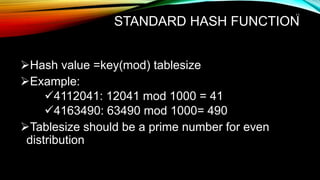
STANDARD HASH FUNCTION
Hash value =key(mod) tablesize
Example:
4112041: 12041 mod 1000 = 41
4163490: 63490 mod 1000= 490
Tablesize should be a prime number for even
distribution
11
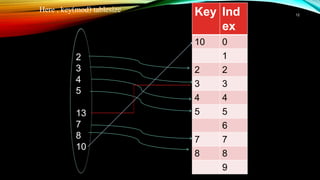
Here , key(mod) tablesize
2
3
4
5
13
7
8
10
Key Ind
ex
10 0
1
2 2
3 3
4 4
5 5
6
7 7
8 8
9
12
COLLISION
When an element is inserted, if it hashes to the
same value as an already inserted elements, then
we have a collision.
13
COLLISION RESOLVING
TECHNIQUES:
Separate Chaining
Open Addressing
Linear Probing
Quadratic Probing
Double Hashing
14
SEPARATE CHAINING
Usually implemented using linked lists.
To store an element in the hash table you
must insert it into a specific linked list. If there
is any collision (i.e. two different elements have
same hash value) then store both the elements
in the same linked list.
15
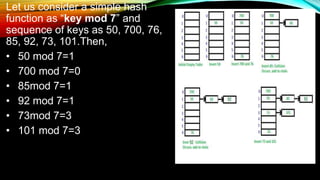
Let us consider a simple hash
function as “key mod 7” and
sequence of keys as 50, 700, 76,
85, 92, 73, 101.Then,
• 50 mod 7=1
• 700 mod 7=0
• 85mod 7=1
• 92 mod 7=1
• 73mod 7=3
• 101 mod 7=3
16
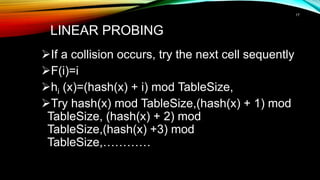
LINEAR PROBING
If a collision occurs, try the next cell sequently
F(i)=i
hi (x)=(hash(x) + i) mod TableSize,
Try hash(x) mod TableSize,(hash(x) + 1) mod
TableSize, (hash(x) + 2) mod
TableSize,(hash(x) +3) mod
TableSize,…………
17
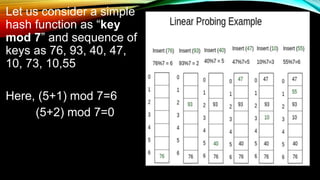
Let us consider a simple
hash function as “key
mod 7” and sequence of
keys as 76, 93, 40, 47,
10, 73, 10,55
Here, (5+1) mod 7=6
(5+2) mod 7=0
18
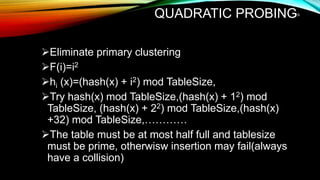
QUADRATIC PROBING
Eliminate primary clustering
F(i)=i2
hi (x)=(hash(x) + i2) mod TableSize,
Try hash(x) mod TableSize,(hash(x) + 12) mod
TableSize, (hash(x) + 22) mod TableSize,(hash(x)
+32) mod TableSize,…………
The table must be at most half full and tablesize
must be prime, otherwisw insertion may fail(always
have a collision)
19
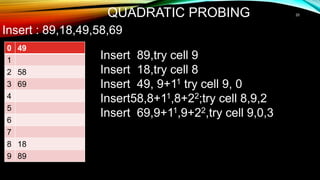
QUADRATIC PROBING
0 49
1
2 58
3 69
4
5
6
7
8 18
9 89
Insert : 89,18,49,58,69
Insert 89,try cell 9
Insert 18,try cell 8
Insert 49, 9+11 try cell 9, 0
Insert58,8+11,8+22;try cell 8,9,2
Insert 69,9+11,9+22,try cell 9,0,3
20
INSERT ALGORITHM
 Hash-insert(T,k) // T= array that represent hash table
 i = 0 to m // m = number of indices ,i=look counter
 Repeat
• j = h(k,i) //J=hash value
• if T[j] == NIL
• T[j] = k
• return j
• else i = i + 1
 until i == m
 error “hash table overflow”
21
SEARCH ALGORITHM
 Hash-Search(T,k)
 i = 0
 repeat
• j = h(k,i)
• If T[j] == k
• Return T[ j]
• i = i + 1
 until T[j]== NIL or i == m
 return NIL
22
IMPLEMENTATION
• #include<stdio.h>
• #include<limits.h>
•
•
• void insert(int ary[],int hFn, int size){
• int element,pos,n=0;
•
• printf("Enter key element to insertn");
• scanf("%d",&element);
•
• pos = element%hFn;
23
while(ary[pos=! size) { // INT_MAX indicates that cell is empty. So if cell is empty loop will
break and goto bottom of the loop to insert element
if(ary[pos]== INT_MAX)
break;
pos = (pos+1)%hFn;
n++;
if(n==size)
break;
}
if(n==size)
printf("Hash table was full of elementsnNo Place to insert this elementnn");
else
ary[pos] = element; //Inserting element
}
24
• void search(int ary[],int hFn,int size){
• int element,pos,n=0;
•
• printf("Enter element you want to searchn");
• scanf("%d",&element);
•
• pos = element%hFn;
•
• while(n++ != size){
• if(ary[pos]==element){
• printf("Element found at index %dn",pos);
• break;
• }
25
• else
• if(ary[pos]==INT_MAX ||ary[pos]!=INT_MIN)
• pos = (pos+1) %hFn;
• }
• if(--n==size) printf("Element not found in hash tablen");
• }
• void display(int ary[],int size){
• int i;
•
• printf("IndextValuen");
•
•
26
• for(i=0;i<size;i++)
• printf("%dt%dn",i,ary[i]);
• }
• int main(){
• int size,hFn,i,choice;
•
• printf("Enter size of hash tablen");
• scanf("%d",&size);
•
• int ary[size];
•
• printf("Enter hash function [if mod 10 enter 10]n");
• scanf("%d",&hFn);
27
• for(i=0;i<size;i++)
• ary[i]=INT_MIN; //Assigning INT_MIN indicates that
cell is empty
•
• do{
• printf("Enter your choicen");
• printf(" 1-> Insertn 2-> Deleten 3-> Displayn
4-> Searchingn 0-> Exitn");
• scanf("%d",&choice);
28
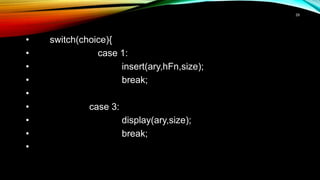
• switch(choice){
• case 1:
• insert(ary,hFn,size);
• break;
•
• case 3:
• display(ary,size);
• break;
•
29
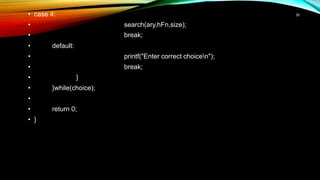
• case 4:
• search(ary,hFn,size);
• break;
• default:
• printf("Enter correct choicen");
• break;
• }
• }while(choice);
•
• return 0;
• }
30
COMPLEXITY ANALYSIS
Since we have to search for keys at
indexes not same as the key, the
search time is not O(1). But it is still
much better than O(logn).
31
REFERENCES
 https://en.wikipedia.org/wiki/Hash_table
 Introduction to Algorithms, Third Edition by By Thomas H. Cormen, Charles E. Leiserson, Ronald L.
Rivest and Clifford Stein
32
• Hoping that you have no question to us, we conclude our presentation. Yet if
someone wishes to embarrass us, other than our honorable teacher , I shall not
bother to answer my dear mates.

Hash function

  • 1.
    WELCOME TO OURPRESENTATION PRESENTED BY MD PIAS KHAN & MAHDEE TAHMID INSTRUCTED BY TANVIR AHAMMED LECTURER, JAGANNATH UNIVERSITY 1
  • 2.
    HASH FUNCTION Presented by Md.Pias Khan ID:B-160305005 Instructed by Md. Tanvir Alam Lecturer, JnU 2
  • 3.
  • 4.
    Introduciton A hash functionis any function is that can be used to map data of arbitrary size to a data of fixed size. The values returned by them are called hash values. 4
  • 5.
    History ◦ The ideaof hashing arose independently in different places. ◦ In January 1953, Hans Peter Luhn wrote an internal IBM memorandum that used hashing with chaining. ◦ Open addressing with linear probing (relatively prime stepping) is credited to Gene Amdahl, but Ershov (in Russia) had the same idea. 5
  • 6.
    Applications • Hash table. •In Database. • Rabin-Karp Algorithm. • Cryptography. • Time efficient search. 6
  • 7.
    First we shalllook at hashing. • Hashing is used to reduce the search time for an element in an array or group of data. • For this purpose, we map the elements into the indices of the array as same as their hash key. 7
  • 8.
    First we shalllook at hashing. In this way, we actually can find an element directly i.e. at O(1) constant time. And this is done by mapping, which is the credit of hash functions. We call each element a key and denote the array as hash table. 8
  • 9.
    HASH FUNCTION Must returna valid table location Easy to implement. Should be 1-to 1 mapping (avoid collision). If key1!=key2 then hash (key1)!=hash(key2) 9
  • 10.
    HASH FUNCTION A collisionoccurs when two distinct keys hash to the same location in the array. Should distributed the keys evenly. Any key value k is equally likely to hash to any of the m array locations. 10
  • 11.
    STANDARD HASH FUNCTION Hashvalue =key(mod) tablesize Example: 4112041: 12041 mod 1000 = 41 4163490: 63490 mod 1000= 490 Tablesize should be a prime number for even distribution 11
  • 12.
    Here , key(mod)tablesize 2 3 4 5 13 7 8 10 Key Ind ex 10 0 1 2 2 3 3 4 4 5 5 6 7 7 8 8 9 12
  • 13.
    COLLISION When an elementis inserted, if it hashes to the same value as an already inserted elements, then we have a collision. 13
  • 14.
    COLLISION RESOLVING TECHNIQUES: Separate Chaining OpenAddressing Linear Probing Quadratic Probing Double Hashing 14
  • 15.
    SEPARATE CHAINING Usually implementedusing linked lists. To store an element in the hash table you must insert it into a specific linked list. If there is any collision (i.e. two different elements have same hash value) then store both the elements in the same linked list. 15
  • 16.
    Let us considera simple hash function as “key mod 7” and sequence of keys as 50, 700, 76, 85, 92, 73, 101.Then, • 50 mod 7=1 • 700 mod 7=0 • 85mod 7=1 • 92 mod 7=1 • 73mod 7=3 • 101 mod 7=3 16
  • 17.
    LINEAR PROBING If acollision occurs, try the next cell sequently F(i)=i hi (x)=(hash(x) + i) mod TableSize, Try hash(x) mod TableSize,(hash(x) + 1) mod TableSize, (hash(x) + 2) mod TableSize,(hash(x) +3) mod TableSize,………… 17
  • 18.
    Let us considera simple hash function as “key mod 7” and sequence of keys as 76, 93, 40, 47, 10, 73, 10,55 Here, (5+1) mod 7=6 (5+2) mod 7=0 18
  • 19.
    QUADRATIC PROBING Eliminate primaryclustering F(i)=i2 hi (x)=(hash(x) + i2) mod TableSize, Try hash(x) mod TableSize,(hash(x) + 12) mod TableSize, (hash(x) + 22) mod TableSize,(hash(x) +32) mod TableSize,………… The table must be at most half full and tablesize must be prime, otherwisw insertion may fail(always have a collision) 19
  • 20.
    QUADRATIC PROBING 0 49 1 258 3 69 4 5 6 7 8 18 9 89 Insert : 89,18,49,58,69 Insert 89,try cell 9 Insert 18,try cell 8 Insert 49, 9+11 try cell 9, 0 Insert58,8+11,8+22;try cell 8,9,2 Insert 69,9+11,9+22,try cell 9,0,3 20
  • 21.
    INSERT ALGORITHM  Hash-insert(T,k)// T= array that represent hash table  i = 0 to m // m = number of indices ,i=look counter  Repeat • j = h(k,i) //J=hash value • if T[j] == NIL • T[j] = k • return j • else i = i + 1  until i == m  error “hash table overflow” 21
  • 22.
    SEARCH ALGORITHM  Hash-Search(T,k) i = 0  repeat • j = h(k,i) • If T[j] == k • Return T[ j] • i = i + 1  until T[j]== NIL or i == m  return NIL 22
  • 23.
    IMPLEMENTATION • #include<stdio.h> • #include<limits.h> • • •void insert(int ary[],int hFn, int size){ • int element,pos,n=0; • • printf("Enter key element to insertn"); • scanf("%d",&element); • • pos = element%hFn; 23
  • 24.
    while(ary[pos=! size) {// INT_MAX indicates that cell is empty. So if cell is empty loop will break and goto bottom of the loop to insert element if(ary[pos]== INT_MAX) break; pos = (pos+1)%hFn; n++; if(n==size) break; } if(n==size) printf("Hash table was full of elementsnNo Place to insert this elementnn"); else ary[pos] = element; //Inserting element } 24
  • 25.
    • void search(intary[],int hFn,int size){ • int element,pos,n=0; • • printf("Enter element you want to searchn"); • scanf("%d",&element); • • pos = element%hFn; • • while(n++ != size){ • if(ary[pos]==element){ • printf("Element found at index %dn",pos); • break; • } 25
  • 26.
    • else • if(ary[pos]==INT_MAX||ary[pos]!=INT_MIN) • pos = (pos+1) %hFn; • } • if(--n==size) printf("Element not found in hash tablen"); • } • void display(int ary[],int size){ • int i; • • printf("IndextValuen"); • • 26
  • 27.
    • for(i=0;i<size;i++) • printf("%dt%dn",i,ary[i]); •} • int main(){ • int size,hFn,i,choice; • • printf("Enter size of hash tablen"); • scanf("%d",&size); • • int ary[size]; • • printf("Enter hash function [if mod 10 enter 10]n"); • scanf("%d",&hFn); 27
  • 28.
    • for(i=0;i<size;i++) • ary[i]=INT_MIN;//Assigning INT_MIN indicates that cell is empty • • do{ • printf("Enter your choicen"); • printf(" 1-> Insertn 2-> Deleten 3-> Displayn 4-> Searchingn 0-> Exitn"); • scanf("%d",&choice); 28
  • 29.
    • switch(choice){ • case1: • insert(ary,hFn,size); • break; • • case 3: • display(ary,size); • break; • 29
  • 30.
    • case 4: •search(ary,hFn,size); • break; • default: • printf("Enter correct choicen"); • break; • } • }while(choice); • • return 0; • } 30
  • 31.
    COMPLEXITY ANALYSIS Since wehave to search for keys at indexes not same as the key, the search time is not O(1). But it is still much better than O(logn). 31
  • 32.
    REFERENCES  https://en.wikipedia.org/wiki/Hash_table  Introductionto Algorithms, Third Edition by By Thomas H. Cormen, Charles E. Leiserson, Ronald L. Rivest and Clifford Stein 32
  • 33.
    • Hoping thatyou have no question to us, we conclude our presentation. Yet if someone wishes to embarrass us, other than our honorable teacher , I shall not bother to answer my dear mates.