The Role of Imaging CoronaryThe Role of Imaging Coronary
CalciumCalcium
Harvey S. Hecht, MD, FACC
Director of Preventive Cardiology
Beth Israel Medical Center & Continuum Heart Institute
Professor of Clinical Medicine
Albert Einstein College of Medicine
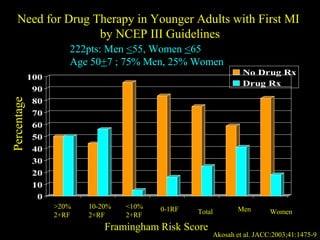
Need for Drug Therapy in Younger Adults with First MINeed for Drug Therapy in Younger Adults with First MI
by NCEP III Guidelinesby NCEP III Guidelines
0
10
20
30
40
50
60
70
80
90
100
No Drug Rx
Drug Rx
>20%>20%
2+RF2+RF
10-20%10-20%
2+RF2+RF
<10%<10%
2+RF2+RF
0-1RF0-1RF TotalTotal MenMen WomenWomen
PercentagePercentage
Framingham Risk ScoreFramingham Risk Score
222pts: Men222pts: Men <<55, Women55, Women <<6565
Age 50Age 50++7 ; 75% Men, 25% Women7 ; 75% Men, 25% Women
Akosah et al. JACC:2003;41:1475-9Akosah et al. JACC:2003;41:1475-9
0
5
10
15
20
25
30
35
<100
100-129
130-159
>160
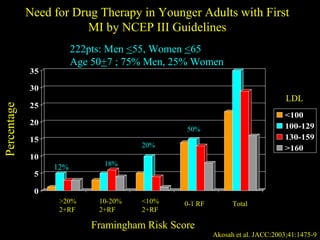
Need for Drug Therapy in Younger Adults with FirstNeed for Drug Therapy in Younger Adults with First
MI by NCEP III GuidelinesMI by NCEP III Guidelines
Framingham Risk ScoreFramingham Risk Score
PercentagePercentage
>20%>20%
2+RF2+RF
10-20%10-20%
2+RF2+RF
<10%<10%
2+RF2+RF
0-1 RF0-1 RF TotalTotal
222pts: Men222pts: Men <<55, Women55, Women <<6565
Age 50Age 50++7 ; 75% Men, 25% Women7 ; 75% Men, 25% Women
Akosah et al. JACC:2003;41:1475-9Akosah et al. JACC:2003;41:1475-9
LDLLDL
12%12% 18%18%
20%20%
50%50%
Importance of Primary Prevention of CADImportance of Primary Prevention of CAD
• Each year 1.1 million people have MI
– First symptomsymptom:
MI: 500,000
Sudden deathSudden death: 150,000 “: 150,000 “the last symptomthe last symptom””
– 63% of women and 50% of men with “sudden63% of women and 50% of men with “sudden
cardiac death” hadcardiac death” had nono prior known CADprior known CAD
• 68% of MI’s occur due to a lesion representing68% of MI’s occur due to a lesion representing <50%<50%
stenosisstenosis
• 35% of patients with CAD have a total cholesterol35% of patients with CAD have a total cholesterol <200<200
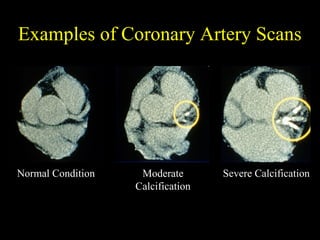
Examples of Coronary Artery ScansExamples of Coronary Artery Scans
Normal ConditionNormal Condition ModerateModerate
CalcificationCalcification
Severe CalcificationSevere Calcification
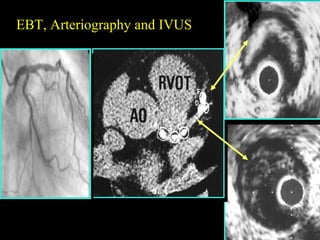
EBT, Arteriography and IVUSEBT, Arteriography and IVUS
0
2
4
6
8
10
12
14
16
0 1 2 3 4 5 6 7
Square Root Sum of Calcium Areas
SquareRootSumofPlaqueAreas
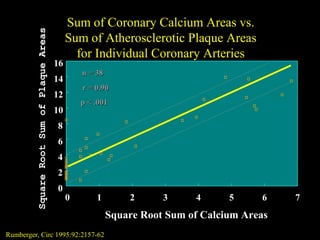
Sum of Coronary Calcium Areas vs.Sum of Coronary Calcium Areas vs.
Sum of Atherosclerotic Plaque AreasSum of Atherosclerotic Plaque Areas
for Individual Coronary Arteriesfor Individual Coronary Arteries
Rumberger, Circ 1995:92:2157-62Rumberger, Circ 1995:92:2157-62
n = 38n = 38
r = 0.90r = 0.90
p < .001p < .001
11
21
44
72
85
94
6
11
23
35
67
89
100 100
0
20
40
60
80
100
20-29 30-39 40-49 50-59 60-69 70-79 80-89
Age by Decade (years)
Percent(%)Incidence
Men (%) Women (%)
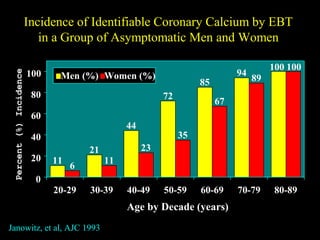
Incidence of Identifiable Coronary Calcium by EBTIncidence of Identifiable Coronary Calcium by EBT
in a Group of Asymptomatic Men and Womenin a Group of Asymptomatic Men and Women
Janowitz, et al, AJC 1993
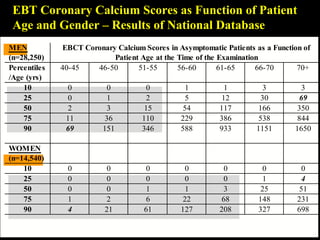
MEN
(n=28,250)
EBCT Coronary Calcium Scores in Asymptomatic Patients as a Function of
Patient Age at the Time of the Examination
Percentiles
/Age (yrs)
40-45 46-50 51-55 56-60 61-65 66-70 70+
10 0 0 0 1 1 3 3
25 0 1 2 5 12 30 69
50 2 3 15 54 117 166 350
75 11 36 110 229 386 538 844
90 69 151 346 588 933 1151 1650
WOMEN
(n=14,540)
10 0 0 0 0 0 0 0
25 0 0 0 0 0 1 4
50 0 0 1 1 3 25 51
75 1 2 6 22 68 148 231
90 4 21 61 127 208 327 698
EBT Coronary Calcium Scores as Function of PatientEBT Coronary Calcium Scores as Function of Patient
Age and Gender – Results of National DatabaseAge and Gender – Results of National Database
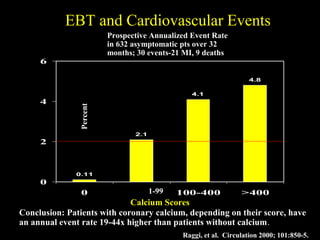
EBT and Cardiovascular EventsEBT and Cardiovascular Events
Conclusion: Patients with coronary calcium, depending on their score, haveConclusion: Patients with coronary calcium, depending on their score, have
an annual event rate 19-44x higher than patients without calciuman annual event rate 19-44x higher than patients without calcium..
Raggi, et al. Circulation 2000; 101:850-5.Raggi, et al. Circulation 2000; 101:850-5.
0.11
2.1
4.1
4.8
0
2
4
6
0 100-400 >400
Prospective Annualized Event RateProspective Annualized Event Rate
in 632 asymptomatic pts over 32in 632 asymptomatic pts over 32
months; 30 events-21 MI, 9 deathsmonths; 30 events-21 MI, 9 deaths
PercentPercent
1-991-99
Calcium ScoresCalcium Scores
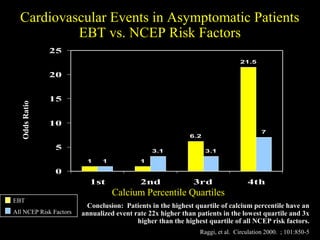
Cardiovascular Events in Asymptomatic PatientsCardiovascular Events in Asymptomatic Patients
EBT vs. NCEP Risk FactorsEBT vs. NCEP Risk Factors
Conclusion: Patients in the highest quartile of calcium percentile have anConclusion: Patients in the highest quartile of calcium percentile have an
annualized event rate 22x higher than patients in the lowest quartile and 3xannualized event rate 22x higher than patients in the lowest quartile and 3x
higher than the highest quartile of all NCEP risk factors.higher than the highest quartile of all NCEP risk factors.
Raggi, et al. Circulation 2000. ; 101:850-5Raggi, et al. Circulation 2000. ; 101:850-5
1 1
6.2
21.5
1
3.1 3.1
7
0
5
10
15
20
25
1st 2nd 3rd 4th
OddsRatioOddsRatio
Calcium Percentile QuartilesCalcium Percentile Quartiles
EBTEBT
All NCEP Risk FactorsAll NCEP Risk Factors
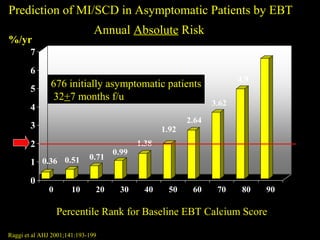
0.36 0.51 0.71
0.99
1.38
1.92
2.64
3.62
4.9
6.54
0
1
2
3
4
5
6
7
0 10 20 30 40 50 60 70 80 90
Percentile Rank for Baseline EBT Calcium ScorePercentile Rank for Baseline EBT Calcium Score

676 initially asymptomatic patients676 initially asymptomatic patients
3232++7 months f/u7 months f/u
Prediction of MI/SCD in Asymptomatic Patients by EBTPrediction of MI/SCD in Asymptomatic Patients by EBT
Raggi et al AHJ 2001;141:193-199Raggi et al AHJ 2001;141:193-199
%/yr%/yr
AnnualAnnual AbsoluteAbsolute RiskRisk
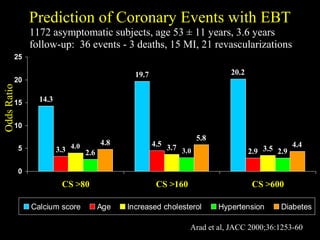
Prediction of Coronary Events with EBTPrediction of Coronary Events with EBT
14.3
19.7 20.2
3.3
4.5
2.93.7 3.5
2.6 2.9
4.8
5.8
4.44.0
3.0
0
5
10
15
20
25
CS >80 CS >160 CS >600
Calcium score Age Increased cholesterol Hypertension Diabetes
OddsRatioOddsRatio
Arad et al, JACC 2000;36:1253-60Arad et al, JACC 2000;36:1253-60
1172 asymptomatic subjects, age 53 ± 11 years, 3.6 years
follow-up: 36 events - 3 deaths, 15 MI, 21 revascularizations
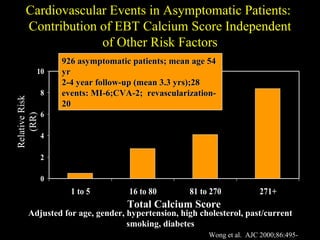
Cardiovascular Events in Asymptomatic Patients:Cardiovascular Events in Asymptomatic Patients:
Contribution of EBT Calcium Score IndependentContribution of EBT Calcium Score Independent
of Other Risk Factorsof Other Risk Factors
0
2
4
6
8
10
1 to 5 16 to 80 81 to 270 271+
RelativeRiskRelativeRisk
(RR)(RR)
Total Calcium ScoreTotal Calcium Score
926 asymptomatic patients; mean age 54926 asymptomatic patients; mean age 54
yryr
2-4 year follow-up (mean 3.3 yrs);282-4 year follow-up (mean 3.3 yrs);28
events: MI-6;CVA-2; revascularization-events: MI-6;CVA-2; revascularization-
2020
Adjusted for age, gender, hypertension, high cholesterol, past/currentAdjusted for age, gender, hypertension, high cholesterol, past/current
smoking, diabetessmoking, diabetes
Wong et al. AJC 2000;86:495-Wong et al. AJC 2000;86:495-
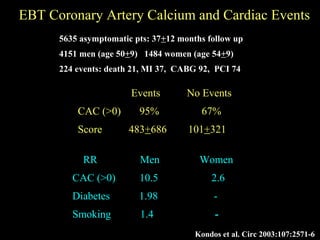
5635 asymptomatic pts: 37+12 months follow up
4151 men (age 50+9) 1484 women (age 54+9)
224 events: death 21, MI 37, CABG 92, PCI 74
Kondos et al. Circ 2003:107:2571-6
EBT Coronary Artery Calcium and Cardiac EventsEBT Coronary Artery Calcium and Cardiac Events
RR Men WomenRR Men Women
CAC (>0) 10.5 2.6CAC (>0) 10.5 2.6
Diabetes 1.98 -Diabetes 1.98 -
Smoking 1.4Smoking 1.4 --
Events No EventsEvents No Events
CAC (>0) 95% 67%CAC (>0) 95% 67%
Score 483Score 483++686 101686 101++321321
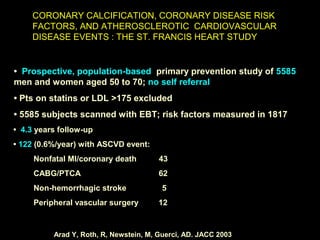
CORONARY CALCIFICATION, CORONARY DISEASE RISKCORONARY CALCIFICATION, CORONARY DISEASE RISK
FACTORS, AND ATHEROSCLEROTIC CARDIOVASCULARFACTORS, AND ATHEROSCLEROTIC CARDIOVASCULAR
DISEASE EVENTS : THE ST. FRANCIS HEART STUDYDISEASE EVENTS : THE ST. FRANCIS HEART STUDY
Arad Y, Roth, R, Newstein, M, Guerci, AD. JACC 2003
METHODS
• Prospective, population-based primary prevention study of 5585
men and women aged 50 to 70; no self referral
• Pts on statins or LDL >175 excluded
• 5585 subjects scanned with EBT; risk factors measured in 1817
• 4.3 years follow-up
• 122 (0.6%/year) with ASCVD event:
Nonfatal MI/coronary death 43
CABG/PTCA 62
Non-hemorrhagic stroke 5
Peripheral vascular surgery 12
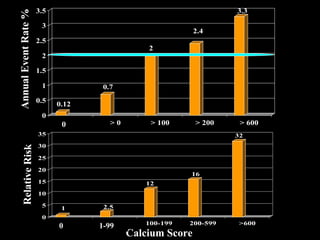
0.12
0.7
2
2.4
3.3
0
0.5
1
1.5
2
2.5
3
3.5
0 > 0 > 100 > 200 > 600
AnnualEventRate%
Calcium Score
1 2.5
12
16
32
0
5
10
15
20
25
30
35
0 Jan-99 100-199 200-599 >600
RelativeRisk
1-990
0
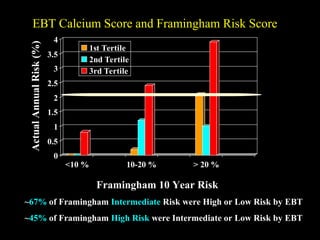
Framingham 10 Year Risk
0
0.5
1
1.5
2
2.5
3
3.5
4
<10 % 10-20 % > 20 %
1st Tertile
2nd Tertile
3rd Tertile
ActualAnnualRisk(%)
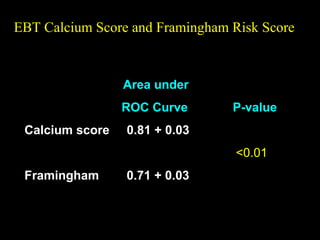
EBT Calcium Score and Framingham Risk ScoreEBT Calcium Score and Framingham Risk Score
~67% of Framingham Intermediate Risk were High or Low Risk by EBT
~45% of Framingham High Risk were Intermediate or Low Risk by EBT
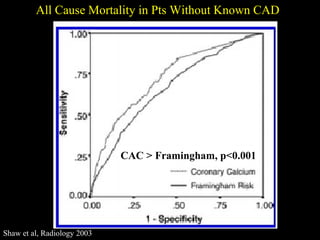
Area under
ROC Curve P-value
Calcium score 0.81 + 0.03
<0.01<0.01
Framingham 0.71 + 0.03
EBT Calcium Score and Framingham Risk ScoreEBT Calcium Score and Framingham Risk Score
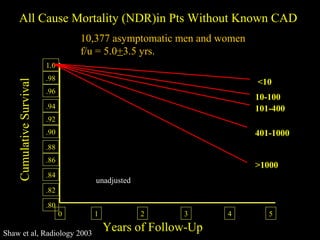
.80
.82
.84
.86
.88
.90
.92
.94
.96
.98
1.0
43210 5
CumulativeSurvivalCumulativeSurvival
Years of Follow-UpYears of Follow-Up
<10<10
10-10010-100
101-400101-400
401-1000401-1000
>1000>1000
10,377 asymptomatic men and women10,377 asymptomatic men and women
f/u = 5.0f/u = 5.0++3.5 yrs.3.5 yrs.
Shaw et al, Radiology 2003
All Cause Mortality (NDR)in Pts Without Known CADAll Cause Mortality (NDR)in Pts Without Known CAD
unadjusted
All Cause Mortality in Pts Without Known CADAll Cause Mortality in Pts Without Known CAD
Shaw et al, Radiology 2003
CAC > Framingham, p<0.001
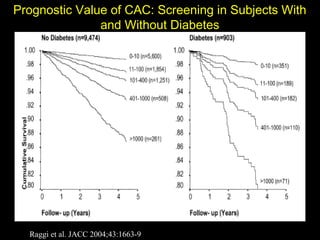
Prognostic Value of CAC: Screening in Subjects WithPrognostic Value of CAC: Screening in Subjects With
and Without Diabetesand Without Diabetes
Raggi et al. JACC 2004;43:1663-9
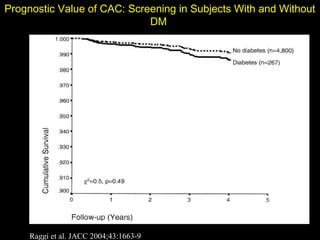
Prognostic Value of CAC: Screening in Subjects With and WithoutPrognostic Value of CAC: Screening in Subjects With and Without
DMDM
Raggi et al. JACC 2004;43:1663-9
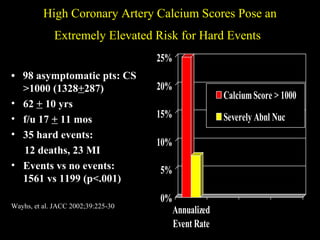
High Coronary Artery Calcium Scores Pose anHigh Coronary Artery Calcium Scores Pose an
Extremely Elevated Risk for Hard EventsExtremely Elevated Risk for Hard Events
• 98 asymptomatic pts: CS
>1000 (1328+287)
• 62 + 10 yrs
• f/u 17 + 11 mos
• 35 hard events:
12 deaths, 23 MI
• Events vs no events:
1561 vs 1199 (p<.001)
Wayhs, et al. JACC 2002;39:225-30
0%
5%
10%
15%
20%
25%
Annualized
Event Rate
CalciumScore > 1000
Severely Abnl Nuc
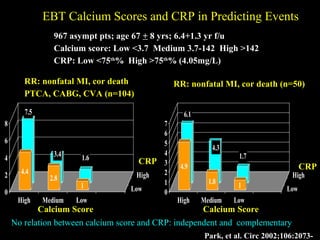
EBT Calcium Scores and CRP in Predicting EventsEBT Calcium Scores and CRP in Predicting Events
7.5
3.4 1.6
4.4
2.8
1
0
2
4
6
8
High Medium Low
Low
High
6.1
4.3
1.7
4.9
1.8
1
0
1
2
3
4
5
6
7
High Medium Low
Low
High
Calcium ScoreCalcium Score Calcium ScoreCalcium Score
CRPCRP
CRPCRP
RR: nonfatal MI, cor deathRR: nonfatal MI, cor death
PTCA, CABG, CVA (n=104)PTCA, CABG, CVA (n=104)
RR: nonfatal MI, cor death (n=50)RR: nonfatal MI, cor death (n=50)
Park, et al. Circ 2002;106:2073-Park, et al. Circ 2002;106:2073-
967 asympt pts; age 67967 asympt pts; age 67 ++ 8 yrs; 6.4+1.3 yr f/u8 yrs; 6.4+1.3 yr f/u
Calcium score: Low <3.7 Medium 3.7-142 High >142Calcium score: Low <3.7 Medium 3.7-142 High >142
CRP: Low <75CRP: Low <75thth
% High >75% High >75thth
% (4.05mg/L)% (4.05mg/L)
No relation between calcium score and CRP: independent and complementaryNo relation between calcium score and CRP: independent and complementary
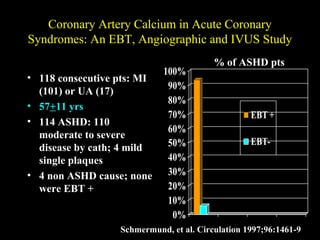
Coronary Artery Calcium in Acute CoronaryCoronary Artery Calcium in Acute Coronary
Syndromes: An EBT, Angiographic and IVUS StudySyndromes: An EBT, Angiographic and IVUS Study
• 118 consecutive pts: MI
(101) or UA (17)
• 57+11 yrs
• 114 ASHD: 110
moderate to severe
disease by cath; 4 mild
single plaques
• 4 non ASHD cause; none

were EBT +
0%
10%
20%
30%
40%
50%
60%
70%
80%
90%
100%
EBT +
EBT-
Schmermund, et al. Circulation 1997;96:1461-9
% of ASHD pts
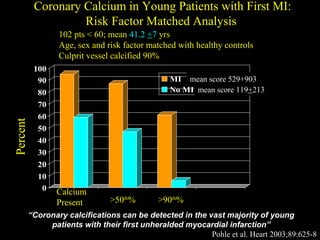
Coronary Calcium in Young Patients with First MI:Coronary Calcium in Young Patients with First MI:
Risk Factor Matched AnalysisRisk Factor Matched Analysis
0
10
20
30
40
50
60
70
80
90
100
MI
No MI
CalciumCalcium
PresentPresent >50>50thth
%% >90>90thth
%%
Pohle et al. Heart 2003;89:625-8
PercentPercent
102 pts < 60; mean102 pts < 60; mean 41.241.2 ++77 yrsyrs
Age, sex and risk factor matched with healthy controlsAge, sex and risk factor matched with healthy controls
Culprit vessel calcified 90%Culprit vessel calcified 90%
mean score 529+903
mean score 119+213
“Coronary calcifications can be detected in the vast majority of young
patients with their first unheralded myocardial infarction”
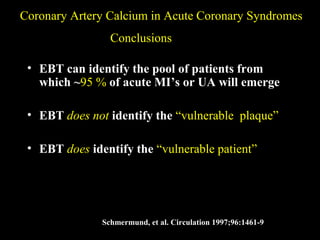
Coronary Artery Calcium in Acute Coronary SyndromesCoronary Artery Calcium in Acute Coronary Syndromes
ConclusionsConclusions
• EBT can identify the pool of patients from
which ~95 %95 % of acute MI’s or UA will emerge
• EBT does notdoes not identify the “vulnerable plaque”“vulnerable plaque”
• EBT doesdoes identify the “vulnerable patient”“vulnerable patient”
Schmermund, et al. Circulation 1997;96:1461-9
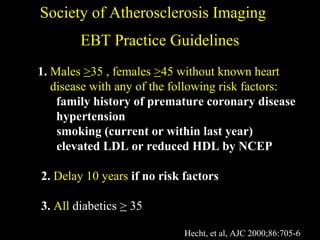
EBT Practice GuidelinesEBT Practice Guidelines
Society of Atherosclerosis ImagingSociety of Atherosclerosis Imaging
1. MalesMales >>35 , females35 , females >>45 without known heart45 without known heart
disease with any of the following risk factors:disease with any of the following risk factors:
family history of premature coronary disease
hypertension
smoking (current or within last year)
elevated LDL or reduced HDL by NCEP
2. Delay 10 yearsDelay 10 years if no risk factors
3. AllAll diabeticsdiabetics >> 3535
Hecht, et al, AJC 2000;86:705-6
1988 Soviet Secretary Gorbachev and U.S. President
Reagan sign the EBT Treaty, mandating EBT by SAI
guidelines for American and Russian citizens
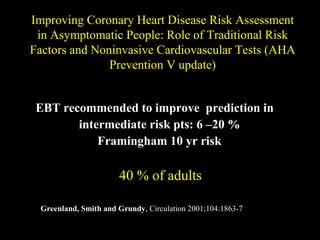
Improving Coronary Heart Disease Risk AssessmentImproving Coronary Heart Disease Risk Assessment
in Asymptomatic People: Role of Traditional Riskin Asymptomatic People: Role of Traditional Risk
Factors and Noninvasive Cardiovascular Tests (AHAFactors and Noninvasive Cardiovascular Tests (AHA
Prevention V update)Prevention V update)
EBT recommended to improve prediction in
intermediate risk pts: 6 –20 %
Framingham 10 yr risk
40 % of adults40 % of adults
Greenland, Smith and Grundy, Circulation 2001;104:1863-7
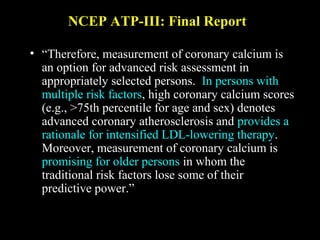
NCEP ATP-III: Final ReportNCEP ATP-III: Final Report
• “Therefore, measurement of coronary calcium is
an option for advanced risk assessment in
appropriately selected persons. In persons with
multiple risk factors, high coronary calcium scores
(e.g., >75th percentile for age and sex) denotes
advanced coronary atherosclerosis and provides a
rationale for intensified LDL-lowering therapy.
Moreover, measurement of coronary calcium is
promising for older persons in whom the
traditional risk factors lose some of their
predictive power.”
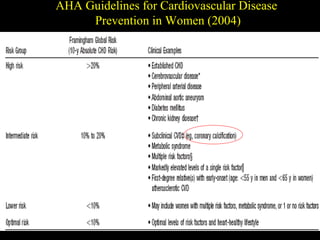
AHA Guidelines for Cardiovascular DiseaseAHA Guidelines for Cardiovascular Disease
Prevention in Women (2004)Prevention in Women (2004)
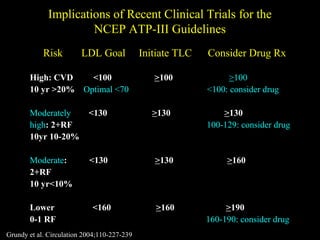
Implications of Recent Clinical Trials for theImplications of Recent Clinical Trials for the
NCEP ATP-III GuidelinesNCEP ATP-III Guidelines
Risk LDL Goal Initiate TLC Consider Drug RxRisk LDL Goal Initiate TLC Consider Drug Rx
High: CVD <100High: CVD <100 >>100100 >>100100
10 yr >20%10 yr >20% Optimal <70 <100: consider drugOptimal <70 <100: consider drug
ModeratelyModerately <130<130 >>130130 >>130130
highhigh: 2+RF: 2+RF 100-129: consider drug100-129: consider drug
10yr 10-20%10yr 10-20%
ModerateModerate: <130: <130 >>130130 >>160160
2+RF2+RF
10 yr<10%10 yr<10%
Lower <160Lower <160 >>160160 >>190190
0-1 RF0-1 RF 160-190: consider drug160-190: consider drug
Grundy et al. Circulation 2004;110-227-239
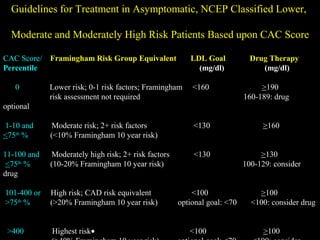
Guidelines for Treatment in Asymptomatic, NCEP Classified Lower,Guidelines for Treatment in Asymptomatic, NCEP Classified Lower,
Moderate and Moderately High Risk Patients Based upon CAC ScoreModerate and Moderately High Risk Patients Based upon CAC Score
CAC Score/CAC Score/ Framingham Risk Group Equivalent LDL Goal Drug TherapyFramingham Risk Group Equivalent LDL Goal Drug Therapy
PercentilePercentile (mg/dl) (mg/dl)
00 Lower risk; 0-1 risk factors; Framingham <160 >190
risk assessment not required 160-189: drug
optional
1-10 and1-10 and Moderate risk; 2+ risk factors <130 >160
<<7575thth
%% (<10% Framingham 10 year risk)
11-100 and11-100 and Moderately high risk; 2+ risk factors <130 >130
<<7575thth
%% (10-20% Framingham 10 year risk) 100-129: consider
drug
101-400 or101-400 or High risk; CAD risk equivalent <100 >100
>75>75thth
%% (>20% Framingham 10 year risk) optional goal: <70 <100: consider drug
>400>400 Highest risk• <100 >100
c. 400 BCE
Hippocrates published
regarding possible
cases of angina,
myocardial infarction,
and sudden death;
author of the
Hippocratic Oath;
Surgeon General of
Greece
Οατη, σηµοατη,
ϕυστ δο τηε Χαλχιυµ σχ
ορε! (Oath,shmoath, just do the
calcium score!)
Οατη, σηµοατη,
ϕυστ δο τηε Χαλχιυµ σχ
ορε! (Oath,shmoath, just do the
calcium score!)
Y O U R T I M E / H E A L T H / P A G I N G D R . G U P T A
Bill Clinton's Big Test
When he felt chest pains, he finally got an angiogram. Should you get one
too?
Monday, Sep. 20, 2004
"I really think it probably saved my life," Bill Clinton told Larry King, speaking not about the bypass operation he had last week but
about the test — an angiogram — that first showed that the arteries feeding blood to his heart were dangerously blocked. "If people have
a family history there, and high cholesterol and high blood pressure," Clinton said, "they ought to consider the angiogram."
Good advice? Yes and no. An angiogram is the gold standard of heart tests, and in Clinton's case it picked up a problem that all his previous stress
tests and electrocardiograms had missed. But an angiogram is not something to be taken lightly. It involves injecting a dye directly into the blood
vessels of your heart through a catheter that has been threaded into your chest from an artery in your groin. By taking X-ray images of the dye,
doctors can get a pretty clear picture of where blood is flowing freely and where there are constrictions. But angiograms are not risk free. In about
one case out of 1,000, according to Dr. Richard Stein, associate chairman of medicine at Beth Israel Medical Center in New York City, there are
complications — including, in rare cases, strokes. For patients who have never had any symptoms (such as the chest pains and shortness of breath
that Clinton experienced) and whose stress tests are normal, the risks outweigh the benefits, says Stein.
That's why there has been so much attention given lately to a noninvasive test called electronThat's why there has been so much attention given lately to a noninvasive test called electron
beam computed tomography (EBCT). It uses a burst of X rays to show how much calcium hasbeam computed tomography (EBCT). It uses a burst of X rays to show how much calcium has
been deposited in the coronary arteries — a good measure of how much plaque has accumulatedbeen deposited in the coronary arteries — a good measure of how much plaque has accumulated
there. In a study published in the Journal of the American College of Cardiology, more than halfthere. In a study published in the Journal of the American College of Cardiology, more than half
of 1,119 patients who passed their stress tests had high calcium scores in subsequent EBCTs,of 1,119 patients who passed their stress tests had high calcium scores in subsequent EBCTs,
suggesting significant hardening of the arteries.suggesting significant hardening of the arteries.
An EBCT is not the end of the story. If you get a high calcium count, you will still need anAn EBCT is not the end of the story. If you get a high calcium count, you will still need an
angiogram so your doctor can tell precisely where your arteries are blocked.angiogram so your doctor can tell precisely where your arteries are blocked. But EBCTs areBut EBCTs are
spotting a lot of hidden heart disease. Although some insurance companies are reluctant to payspotting a lot of hidden heart disease. Although some insurance companies are reluctant to pay
for this new test, its use is growing rapidly, and it may eventually become part of the standardfor this new test, its use is growing rapidly, and it may eventually become part of the standard
heart work-up.heart work-up.
Sanjay Gupta is a neurosurgeon and CNN medical correspondent
From the Sep. 20, 2004 issue of TIME magazine
Harvey hecht md aeha sat

Harvey hecht md aeha sat

  • 1.
    The Role ofImaging CoronaryThe Role of Imaging Coronary CalciumCalcium Harvey S. Hecht, MD, FACC Director of Preventive Cardiology Beth Israel Medical Center & Continuum Heart Institute Professor of Clinical Medicine Albert Einstein College of Medicine
  • 2.
    Need for DrugTherapy in Younger Adults with First MINeed for Drug Therapy in Younger Adults with First MI by NCEP III Guidelinesby NCEP III Guidelines 0 10 20 30 40 50 60 70 80 90 100 No Drug Rx Drug Rx >20%>20% 2+RF2+RF 10-20%10-20% 2+RF2+RF <10%<10% 2+RF2+RF 0-1RF0-1RF TotalTotal MenMen WomenWomen PercentagePercentage Framingham Risk ScoreFramingham Risk Score 222pts: Men222pts: Men <<55, Women55, Women <<6565 Age 50Age 50++7 ; 75% Men, 25% Women7 ; 75% Men, 25% Women Akosah et al. JACC:2003;41:1475-9Akosah et al. JACC:2003;41:1475-9
  • 3.
    0 5 10 15 20 25 30 35 <100 100-129 130-159 >160 Need for DrugTherapy in Younger Adults with FirstNeed for Drug Therapy in Younger Adults with First MI by NCEP III GuidelinesMI by NCEP III Guidelines Framingham Risk ScoreFramingham Risk Score PercentagePercentage >20%>20% 2+RF2+RF 10-20%10-20% 2+RF2+RF <10%<10% 2+RF2+RF 0-1 RF0-1 RF TotalTotal 222pts: Men222pts: Men <<55, Women55, Women <<6565 Age 50Age 50++7 ; 75% Men, 25% Women7 ; 75% Men, 25% Women Akosah et al. JACC:2003;41:1475-9Akosah et al. JACC:2003;41:1475-9 LDLLDL 12%12% 18%18% 20%20% 50%50%
  • 4.
    Importance of PrimaryPrevention of CADImportance of Primary Prevention of CAD • Each year 1.1 million people have MI – First symptomsymptom: MI: 500,000 Sudden deathSudden death: 150,000 “: 150,000 “the last symptomthe last symptom”” – 63% of women and 50% of men with “sudden63% of women and 50% of men with “sudden cardiac death” hadcardiac death” had nono prior known CADprior known CAD • 68% of MI’s occur due to a lesion representing68% of MI’s occur due to a lesion representing <50%<50% stenosisstenosis • 35% of patients with CAD have a total cholesterol35% of patients with CAD have a total cholesterol <200<200
  • 5.
    Examples of CoronaryArtery ScansExamples of Coronary Artery Scans Normal ConditionNormal Condition ModerateModerate CalcificationCalcification Severe CalcificationSevere Calcification
  • 6.
    EBT, Arteriography andIVUSEBT, Arteriography and IVUS
  • 7.
    0 2 4 6 8 10 12 14 16 0 1 23 4 5 6 7 Square Root Sum of Calcium Areas SquareRootSumofPlaqueAreas Sum of Coronary Calcium Areas vs.Sum of Coronary Calcium Areas vs. Sum of Atherosclerotic Plaque AreasSum of Atherosclerotic Plaque Areas for Individual Coronary Arteriesfor Individual Coronary Arteries Rumberger, Circ 1995:92:2157-62Rumberger, Circ 1995:92:2157-62 n = 38n = 38 r = 0.90r = 0.90 p < .001p < .001
  • 8.
    11 21 44 72 85 94 6 11 23 35 67 89 100 100 0 20 40 60 80 100 20-29 30-3940-49 50-59 60-69 70-79 80-89 Age by Decade (years) Percent(%)Incidence Men (%) Women (%) Incidence of Identifiable Coronary Calcium by EBTIncidence of Identifiable Coronary Calcium by EBT in a Group of Asymptomatic Men and Womenin a Group of Asymptomatic Men and Women Janowitz, et al, AJC 1993
  • 9.
    MEN (n=28,250) EBCT Coronary CalciumScores in Asymptomatic Patients as a Function of Patient Age at the Time of the Examination Percentiles /Age (yrs) 40-45 46-50 51-55 56-60 61-65 66-70 70+ 10 0 0 0 1 1 3 3 25 0 1 2 5 12 30 69 50 2 3 15 54 117 166 350 75 11 36 110 229 386 538 844 90 69 151 346 588 933 1151 1650 WOMEN (n=14,540) 10 0 0 0 0 0 0 0 25 0 0 0 0 0 1 4 50 0 0 1 1 3 25 51 75 1 2 6 22 68 148 231 90 4 21 61 127 208 327 698 EBT Coronary Calcium Scores as Function of PatientEBT Coronary Calcium Scores as Function of Patient Age and Gender – Results of National DatabaseAge and Gender – Results of National Database
  • 10.
    EBT and CardiovascularEventsEBT and Cardiovascular Events Conclusion: Patients with coronary calcium, depending on their score, haveConclusion: Patients with coronary calcium, depending on their score, have an annual event rate 19-44x higher than patients without calciuman annual event rate 19-44x higher than patients without calcium.. Raggi, et al. Circulation 2000; 101:850-5.Raggi, et al. Circulation 2000; 101:850-5. 0.11 2.1 4.1 4.8 0 2 4 6 0 100-400 >400 Prospective Annualized Event RateProspective Annualized Event Rate in 632 asymptomatic pts over 32in 632 asymptomatic pts over 32 months; 30 events-21 MI, 9 deathsmonths; 30 events-21 MI, 9 deaths PercentPercent 1-991-99 Calcium ScoresCalcium Scores
  • 11.
    Cardiovascular Events inAsymptomatic PatientsCardiovascular Events in Asymptomatic Patients EBT vs. NCEP Risk FactorsEBT vs. NCEP Risk Factors Conclusion: Patients in the highest quartile of calcium percentile have anConclusion: Patients in the highest quartile of calcium percentile have an annualized event rate 22x higher than patients in the lowest quartile and 3xannualized event rate 22x higher than patients in the lowest quartile and 3x higher than the highest quartile of all NCEP risk factors.higher than the highest quartile of all NCEP risk factors. Raggi, et al. Circulation 2000. ; 101:850-5Raggi, et al. Circulation 2000. ; 101:850-5 1 1 6.2 21.5 1 3.1 3.1 7 0 5 10 15 20 25 1st 2nd 3rd 4th OddsRatioOddsRatio Calcium Percentile QuartilesCalcium Percentile Quartiles EBTEBT All NCEP Risk FactorsAll NCEP Risk Factors
  • 12.
    0.36 0.51 0.71 0.99 1.38 1.92 2.64 3.62 4.9 6.54 0 1 2 3 4 5 6 7 010 20 30 40 50 60 70 80 90 Percentile Rank for Baseline EBT Calcium ScorePercentile Rank for Baseline EBT Calcium Score 676 initially asymptomatic patients676 initially asymptomatic patients 3232++7 months f/u7 months f/u Prediction of MI/SCD in Asymptomatic Patients by EBTPrediction of MI/SCD in Asymptomatic Patients by EBT Raggi et al AHJ 2001;141:193-199Raggi et al AHJ 2001;141:193-199 %/yr%/yr AnnualAnnual AbsoluteAbsolute RiskRisk
  • 13.
    Prediction of CoronaryEvents with EBTPrediction of Coronary Events with EBT 14.3 19.7 20.2 3.3 4.5 2.93.7 3.5 2.6 2.9 4.8 5.8 4.44.0 3.0 0 5 10 15 20 25 CS >80 CS >160 CS >600 Calcium score Age Increased cholesterol Hypertension Diabetes OddsRatioOddsRatio Arad et al, JACC 2000;36:1253-60Arad et al, JACC 2000;36:1253-60 1172 asymptomatic subjects, age 53 ± 11 years, 3.6 years follow-up: 36 events - 3 deaths, 15 MI, 21 revascularizations
  • 14.
    Cardiovascular Events inAsymptomatic Patients:Cardiovascular Events in Asymptomatic Patients: Contribution of EBT Calcium Score IndependentContribution of EBT Calcium Score Independent of Other Risk Factorsof Other Risk Factors 0 2 4 6 8 10 1 to 5 16 to 80 81 to 270 271+ RelativeRiskRelativeRisk (RR)(RR) Total Calcium ScoreTotal Calcium Score 926 asymptomatic patients; mean age 54926 asymptomatic patients; mean age 54 yryr 2-4 year follow-up (mean 3.3 yrs);282-4 year follow-up (mean 3.3 yrs);28 events: MI-6;CVA-2; revascularization-events: MI-6;CVA-2; revascularization- 2020 Adjusted for age, gender, hypertension, high cholesterol, past/currentAdjusted for age, gender, hypertension, high cholesterol, past/current smoking, diabetessmoking, diabetes Wong et al. AJC 2000;86:495-Wong et al. AJC 2000;86:495-
  • 15.
    5635 asymptomatic pts:37+12 months follow up 4151 men (age 50+9) 1484 women (age 54+9) 224 events: death 21, MI 37, CABG 92, PCI 74 Kondos et al. Circ 2003:107:2571-6 EBT Coronary Artery Calcium and Cardiac EventsEBT Coronary Artery Calcium and Cardiac Events RR Men WomenRR Men Women CAC (>0) 10.5 2.6CAC (>0) 10.5 2.6 Diabetes 1.98 -Diabetes 1.98 - Smoking 1.4Smoking 1.4 -- Events No EventsEvents No Events CAC (>0) 95% 67%CAC (>0) 95% 67% Score 483Score 483++686 101686 101++321321
  • 16.
    CORONARY CALCIFICATION, CORONARYDISEASE RISKCORONARY CALCIFICATION, CORONARY DISEASE RISK FACTORS, AND ATHEROSCLEROTIC CARDIOVASCULARFACTORS, AND ATHEROSCLEROTIC CARDIOVASCULAR DISEASE EVENTS : THE ST. FRANCIS HEART STUDYDISEASE EVENTS : THE ST. FRANCIS HEART STUDY Arad Y, Roth, R, Newstein, M, Guerci, AD. JACC 2003 METHODS • Prospective, population-based primary prevention study of 5585 men and women aged 50 to 70; no self referral • Pts on statins or LDL >175 excluded • 5585 subjects scanned with EBT; risk factors measured in 1817 • 4.3 years follow-up • 122 (0.6%/year) with ASCVD event: Nonfatal MI/coronary death 43 CABG/PTCA 62 Non-hemorrhagic stroke 5 Peripheral vascular surgery 12
  • 17.
    0.12 0.7 2 2.4 3.3 0 0.5 1 1.5 2 2.5 3 3.5 0 > 0> 100 > 200 > 600 AnnualEventRate% Calcium Score 1 2.5 12 16 32 0 5 10 15 20 25 30 35 0 Jan-99 100-199 200-599 >600 RelativeRisk 1-990 0
  • 18.
    Framingham 10 YearRisk 0 0.5 1 1.5 2 2.5 3 3.5 4 <10 % 10-20 % > 20 % 1st Tertile 2nd Tertile 3rd Tertile ActualAnnualRisk(%) EBT Calcium Score and Framingham Risk ScoreEBT Calcium Score and Framingham Risk Score ~67% of Framingham Intermediate Risk were High or Low Risk by EBT ~45% of Framingham High Risk were Intermediate or Low Risk by EBT
  • 19.
    Area under ROC CurveP-value Calcium score 0.81 + 0.03 <0.01<0.01 Framingham 0.71 + 0.03 EBT Calcium Score and Framingham Risk ScoreEBT Calcium Score and Framingham Risk Score
  • 20.
    .80 .82 .84 .86 .88 .90 .92 .94 .96 .98 1.0 43210 5 CumulativeSurvivalCumulativeSurvival Years ofFollow-UpYears of Follow-Up <10<10 10-10010-100 101-400101-400 401-1000401-1000 >1000>1000 10,377 asymptomatic men and women10,377 asymptomatic men and women f/u = 5.0f/u = 5.0++3.5 yrs.3.5 yrs. Shaw et al, Radiology 2003 All Cause Mortality (NDR)in Pts Without Known CADAll Cause Mortality (NDR)in Pts Without Known CAD unadjusted
  • 21.
    All Cause Mortalityin Pts Without Known CADAll Cause Mortality in Pts Without Known CAD Shaw et al, Radiology 2003 CAC > Framingham, p<0.001
  • 22.
    Prognostic Value ofCAC: Screening in Subjects WithPrognostic Value of CAC: Screening in Subjects With and Without Diabetesand Without Diabetes Raggi et al. JACC 2004;43:1663-9
  • 23.
    Prognostic Value ofCAC: Screening in Subjects With and WithoutPrognostic Value of CAC: Screening in Subjects With and Without DMDM Raggi et al. JACC 2004;43:1663-9
  • 24.
    High Coronary ArteryCalcium Scores Pose anHigh Coronary Artery Calcium Scores Pose an Extremely Elevated Risk for Hard EventsExtremely Elevated Risk for Hard Events • 98 asymptomatic pts: CS >1000 (1328+287) • 62 + 10 yrs • f/u 17 + 11 mos • 35 hard events: 12 deaths, 23 MI • Events vs no events: 1561 vs 1199 (p<.001) Wayhs, et al. JACC 2002;39:225-30 0% 5% 10% 15% 20% 25% Annualized Event Rate CalciumScore > 1000 Severely Abnl Nuc
  • 25.
    EBT Calcium Scoresand CRP in Predicting EventsEBT Calcium Scores and CRP in Predicting Events 7.5 3.4 1.6 4.4 2.8 1 0 2 4 6 8 High Medium Low Low High 6.1 4.3 1.7 4.9 1.8 1 0 1 2 3 4 5 6 7 High Medium Low Low High Calcium ScoreCalcium Score Calcium ScoreCalcium Score CRPCRP CRPCRP RR: nonfatal MI, cor deathRR: nonfatal MI, cor death PTCA, CABG, CVA (n=104)PTCA, CABG, CVA (n=104) RR: nonfatal MI, cor death (n=50)RR: nonfatal MI, cor death (n=50) Park, et al. Circ 2002;106:2073-Park, et al. Circ 2002;106:2073- 967 asympt pts; age 67967 asympt pts; age 67 ++ 8 yrs; 6.4+1.3 yr f/u8 yrs; 6.4+1.3 yr f/u Calcium score: Low <3.7 Medium 3.7-142 High >142Calcium score: Low <3.7 Medium 3.7-142 High >142 CRP: Low <75CRP: Low <75thth % High >75% High >75thth % (4.05mg/L)% (4.05mg/L) No relation between calcium score and CRP: independent and complementaryNo relation between calcium score and CRP: independent and complementary
  • 26.
    Coronary Artery Calciumin Acute CoronaryCoronary Artery Calcium in Acute Coronary Syndromes: An EBT, Angiographic and IVUS StudySyndromes: An EBT, Angiographic and IVUS Study • 118 consecutive pts: MI (101) or UA (17) • 57+11 yrs • 114 ASHD: 110 moderate to severe disease by cath; 4 mild single plaques • 4 non ASHD cause; none were EBT + 0% 10% 20% 30% 40% 50% 60% 70% 80% 90% 100% EBT + EBT- Schmermund, et al. Circulation 1997;96:1461-9 % of ASHD pts
  • 27.
    Coronary Calcium inYoung Patients with First MI:Coronary Calcium in Young Patients with First MI: Risk Factor Matched AnalysisRisk Factor Matched Analysis 0 10 20 30 40 50 60 70 80 90 100 MI No MI CalciumCalcium PresentPresent >50>50thth %% >90>90thth %% Pohle et al. Heart 2003;89:625-8 PercentPercent 102 pts < 60; mean102 pts < 60; mean 41.241.2 ++77 yrsyrs Age, sex and risk factor matched with healthy controlsAge, sex and risk factor matched with healthy controls Culprit vessel calcified 90%Culprit vessel calcified 90% mean score 529+903 mean score 119+213 “Coronary calcifications can be detected in the vast majority of young patients with their first unheralded myocardial infarction”
  • 28.
    Coronary Artery Calciumin Acute Coronary SyndromesCoronary Artery Calcium in Acute Coronary Syndromes ConclusionsConclusions • EBT can identify the pool of patients from which ~95 %95 % of acute MI’s or UA will emerge • EBT does notdoes not identify the “vulnerable plaque”“vulnerable plaque” • EBT doesdoes identify the “vulnerable patient”“vulnerable patient” Schmermund, et al. Circulation 1997;96:1461-9
  • 29.
    EBT Practice GuidelinesEBTPractice Guidelines Society of Atherosclerosis ImagingSociety of Atherosclerosis Imaging 1. MalesMales >>35 , females35 , females >>45 without known heart45 without known heart disease with any of the following risk factors:disease with any of the following risk factors: family history of premature coronary disease hypertension smoking (current or within last year) elevated LDL or reduced HDL by NCEP 2. Delay 10 yearsDelay 10 years if no risk factors 3. AllAll diabeticsdiabetics >> 3535 Hecht, et al, AJC 2000;86:705-6
  • 30.
    1988 Soviet SecretaryGorbachev and U.S. President Reagan sign the EBT Treaty, mandating EBT by SAI guidelines for American and Russian citizens
  • 31.
    Improving Coronary HeartDisease Risk AssessmentImproving Coronary Heart Disease Risk Assessment in Asymptomatic People: Role of Traditional Riskin Asymptomatic People: Role of Traditional Risk Factors and Noninvasive Cardiovascular Tests (AHAFactors and Noninvasive Cardiovascular Tests (AHA Prevention V update)Prevention V update) EBT recommended to improve prediction in intermediate risk pts: 6 –20 % Framingham 10 yr risk 40 % of adults40 % of adults Greenland, Smith and Grundy, Circulation 2001;104:1863-7
  • 32.
    NCEP ATP-III: FinalReportNCEP ATP-III: Final Report • “Therefore, measurement of coronary calcium is an option for advanced risk assessment in appropriately selected persons. In persons with multiple risk factors, high coronary calcium scores (e.g., >75th percentile for age and sex) denotes advanced coronary atherosclerosis and provides a rationale for intensified LDL-lowering therapy. Moreover, measurement of coronary calcium is promising for older persons in whom the traditional risk factors lose some of their predictive power.”
  • 33.
    AHA Guidelines forCardiovascular DiseaseAHA Guidelines for Cardiovascular Disease Prevention in Women (2004)Prevention in Women (2004)
  • 34.
    Implications of RecentClinical Trials for theImplications of Recent Clinical Trials for the NCEP ATP-III GuidelinesNCEP ATP-III Guidelines Risk LDL Goal Initiate TLC Consider Drug RxRisk LDL Goal Initiate TLC Consider Drug Rx High: CVD <100High: CVD <100 >>100100 >>100100 10 yr >20%10 yr >20% Optimal <70 <100: consider drugOptimal <70 <100: consider drug ModeratelyModerately <130<130 >>130130 >>130130 highhigh: 2+RF: 2+RF 100-129: consider drug100-129: consider drug 10yr 10-20%10yr 10-20% ModerateModerate: <130: <130 >>130130 >>160160 2+RF2+RF 10 yr<10%10 yr<10% Lower <160Lower <160 >>160160 >>190190 0-1 RF0-1 RF 160-190: consider drug160-190: consider drug Grundy et al. Circulation 2004;110-227-239
  • 35.
    Guidelines for Treatmentin Asymptomatic, NCEP Classified Lower,Guidelines for Treatment in Asymptomatic, NCEP Classified Lower, Moderate and Moderately High Risk Patients Based upon CAC ScoreModerate and Moderately High Risk Patients Based upon CAC Score CAC Score/CAC Score/ Framingham Risk Group Equivalent LDL Goal Drug TherapyFramingham Risk Group Equivalent LDL Goal Drug Therapy PercentilePercentile (mg/dl) (mg/dl) 00 Lower risk; 0-1 risk factors; Framingham <160 >190 risk assessment not required 160-189: drug optional 1-10 and1-10 and Moderate risk; 2+ risk factors <130 >160 <<7575thth %% (<10% Framingham 10 year risk) 11-100 and11-100 and Moderately high risk; 2+ risk factors <130 >130 <<7575thth %% (10-20% Framingham 10 year risk) 100-129: consider drug 101-400 or101-400 or High risk; CAD risk equivalent <100 >100 >75>75thth %% (>20% Framingham 10 year risk) optional goal: <70 <100: consider drug >400>400 Highest risk• <100 >100
  • 36.
    c. 400 BCE Hippocratespublished regarding possible cases of angina, myocardial infarction, and sudden death; author of the Hippocratic Oath; Surgeon General of Greece Οατη, σηµοατη, ϕυστ δο τηε Χαλχιυµ σχ ορε! (Oath,shmoath, just do the calcium score!) Οατη, σηµοατη, ϕυστ δο τηε Χαλχιυµ σχ ορε! (Oath,shmoath, just do the calcium score!)
  • 37.
    Y O UR T I M E / H E A L T H / P A G I N G D R . G U P T A Bill Clinton's Big Test When he felt chest pains, he finally got an angiogram. Should you get one too? Monday, Sep. 20, 2004 "I really think it probably saved my life," Bill Clinton told Larry King, speaking not about the bypass operation he had last week but about the test — an angiogram — that first showed that the arteries feeding blood to his heart were dangerously blocked. "If people have a family history there, and high cholesterol and high blood pressure," Clinton said, "they ought to consider the angiogram." Good advice? Yes and no. An angiogram is the gold standard of heart tests, and in Clinton's case it picked up a problem that all his previous stress tests and electrocardiograms had missed. But an angiogram is not something to be taken lightly. It involves injecting a dye directly into the blood vessels of your heart through a catheter that has been threaded into your chest from an artery in your groin. By taking X-ray images of the dye, doctors can get a pretty clear picture of where blood is flowing freely and where there are constrictions. But angiograms are not risk free. In about one case out of 1,000, according to Dr. Richard Stein, associate chairman of medicine at Beth Israel Medical Center in New York City, there are complications — including, in rare cases, strokes. For patients who have never had any symptoms (such as the chest pains and shortness of breath that Clinton experienced) and whose stress tests are normal, the risks outweigh the benefits, says Stein. That's why there has been so much attention given lately to a noninvasive test called electronThat's why there has been so much attention given lately to a noninvasive test called electron beam computed tomography (EBCT). It uses a burst of X rays to show how much calcium hasbeam computed tomography (EBCT). It uses a burst of X rays to show how much calcium has been deposited in the coronary arteries — a good measure of how much plaque has accumulatedbeen deposited in the coronary arteries — a good measure of how much plaque has accumulated there. In a study published in the Journal of the American College of Cardiology, more than halfthere. In a study published in the Journal of the American College of Cardiology, more than half of 1,119 patients who passed their stress tests had high calcium scores in subsequent EBCTs,of 1,119 patients who passed their stress tests had high calcium scores in subsequent EBCTs, suggesting significant hardening of the arteries.suggesting significant hardening of the arteries. An EBCT is not the end of the story. If you get a high calcium count, you will still need anAn EBCT is not the end of the story. If you get a high calcium count, you will still need an angiogram so your doctor can tell precisely where your arteries are blocked.angiogram so your doctor can tell precisely where your arteries are blocked. But EBCTs areBut EBCTs are spotting a lot of hidden heart disease. Although some insurance companies are reluctant to payspotting a lot of hidden heart disease. Although some insurance companies are reluctant to pay for this new test, its use is growing rapidly, and it may eventually become part of the standardfor this new test, its use is growing rapidly, and it may eventually become part of the standard heart work-up.heart work-up. Sanjay Gupta is a neurosurgeon and CNN medical correspondent From the Sep. 20, 2004 issue of TIME magazine

Editor's Notes

  • #12 Conclusions 1) Patients with coronary calcium, depending on their score, have an annual cardiac event rate from 19-44x higher than patients without coronary calcium. 2) Patients in the highest quartile of calcium percentile have an annualized cardiac event rate 22 x higher than patients in the lowest quartile and 3 x higher than the highest quartile of NCEP risk factors.