
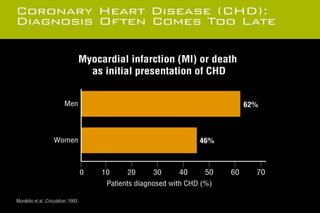

Scores >400 are are 10-foldScores >400 are are 10-fold
increased risk; Calciumincreased risk; Calcium
imaging should be routineimaging should be routine
Matthew J. Budoff, MD, FACCMatthew J. Budoff, MD, FACC
Assistant Professor of MedicineAssistant Professor of Medicine
Division of CardiologyDivision of Cardiology
Harbor-UCLA Medical Center
Torrance, CA
Presenter Disclosure Information
DISCLOSURE INFORMATION:
The following relationships exist related to this presentation:
Dr. Budoff is on the Speaker’s Bureau for Imatron, Inc.
Matthew Budoff, MD, FACC
High Speed CT
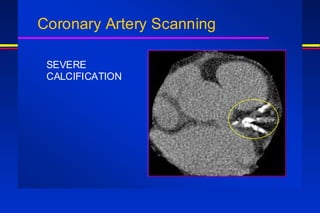
Coronary Artery Scanning
SEVERE
CALCIFICATION
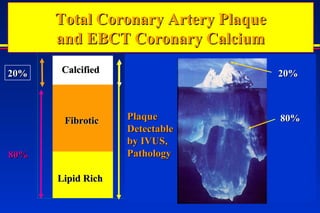
20%20%
80%80%
Total Coronary Artery PlaqueTotal Coronary Artery Plaque
and EBCT Coronary Calciumand EBCT Coronary Calcium
80%80%
PlaquePlaque
DetectableDetectable
by IVUS,by IVUS,
PathologyPathology
Lipid RichLipid Rich
FibroticFibrotic
CalcifiedCalcified 20%20%
80%80%
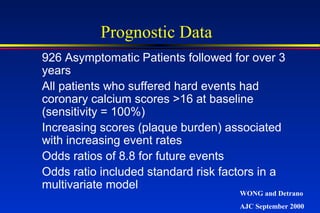
926 Asymptomatic Patients followed for over 3
years
All patients who suffered hard events had
coronary calcium scores >16 at baseline
(sensitivity = 100%)
Increasing scores (plaque burden) associated
with increasing event rates
Odds ratios of 8.8 for future events
Odds ratio included standard risk factors in a
multivariate model
Prognostic Data
WONG and Detrano
AJC September 2000
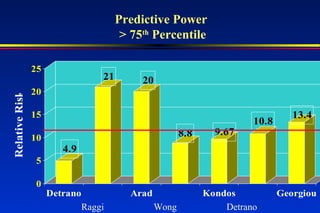
Predictive Power
> 75th
Percentile
4.9
21 20
8.8 9.67
10.8
13.4
0
5
10
15
20
25
RelativeRisk
Detrano Arad Kondos Georgiou
Raggi Wong Detrano
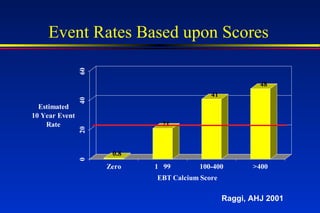
Event Rates Based upon Scores
0.8
21
41
480204060
Estimated
10 Year Event
Rate
Zero 1 99 100-400 >400
EBT Calcium Score
Raggi, AHJ 2001
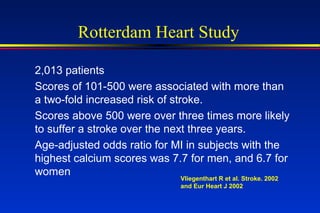
Rotterdam Heart Study
2,013 patients
Scores of 101-500 were associated with more than
a two-fold increased risk of stroke.
Scores above 500 were over three times more likely
to suffer a stroke over the next three years.
Age-adjusted odds ratio for MI in subjects with the
highest calcium scores was 7.7 for men, and 6.7 for
women
Vliegenthart R et al. Stroke. 2002
and Eur Heart J 2002
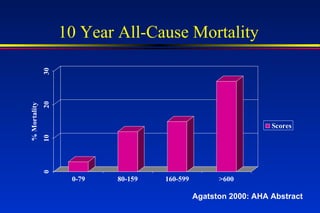
10 Year All-Cause Mortality
0102030
%Mortality
0-79 80-159 160-599 >600
Scores
Agatston 2000: AHA Abstract
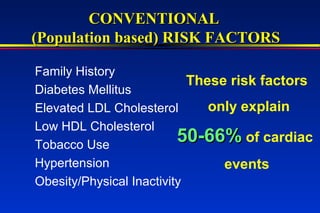
CONVENTIONALCONVENTIONAL
(Population based) RISK FACTORS(Population based) RISK FACTORS
Family History
Diabetes Mellitus
Elevated LDL Cholesterol
Low HDL Cholesterol
Tobacco Use
Hypertension
Obesity/Physical Inactivity
These risk factors
only explain
50-66%50-66% of cardiac
events
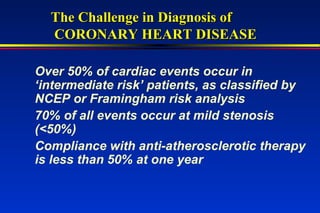
Over 50% of cardiac events occur in
‘intermediate risk’ patients, as classified by
NCEP or Framingham risk analysis
70% of all events occur at mild stenosis
(<50%)
Compliance with anti-atherosclerotic therapy
is less than 50% at one year
The Challenge in Diagnosis ofThe Challenge in Diagnosis of
CORONARY HEART DISEASECORONARY HEART DISEASE
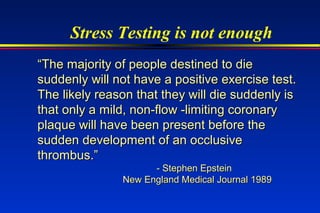
Stress Testing is not enough
““The majority of people destined to dieThe majority of people destined to die
suddenly will not have a positive exercise test.suddenly will not have a positive exercise test.
The likely reason that they will die suddenly isThe likely reason that they will die suddenly is
that only a mild, non-flow -limiting coronarythat only a mild, non-flow -limiting coronary
plaque will have been present before theplaque will have been present before the
sudden development of an occlusivesudden development of an occlusive
thrombus.”thrombus.”
- Stephen Epstein- Stephen Epstein
New England Medical Journal 1989New England Medical Journal 1989
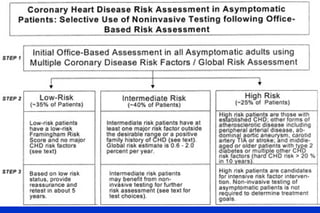
Asymptomatic Patient Algorithm forAsymptomatic Patient Algorithm for
Intermediate Risk PatientsIntermediate Risk Patients Greenland P, et al. Circulation Oct 9, 2001
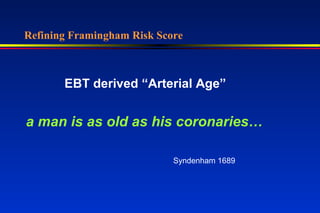
Refining Framingham Risk Score
EBT derived “Arterial Age”
a man is as old as his coronaries…
Syndenham 1689
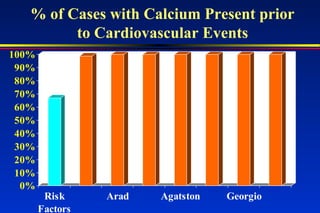
% of Cases with Calcium Present prior
to Cardiovascular Events
0%
10%
20%
30%
40%
50%
60%
70%
80%
90%
100%
Risk
Factors
Arad Agatston Georgio
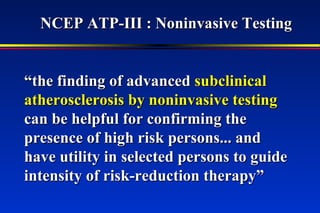
““the finding of advancedthe finding of advanced subclinicalsubclinical
atherosclerosis by noninvasive testingatherosclerosis by noninvasive testing
can be helpful for confirming thecan be helpful for confirming the
presence of high risk persons... andpresence of high risk persons... and
have utility in selected persons to guidehave utility in selected persons to guide
intensity of risk-reduction therapy”intensity of risk-reduction therapy”
NCEP ATP-III : Noninvasive TestingNCEP ATP-III : Noninvasive Testing
Subclinical Atherosclerosis

Budoff

  • 1.
    Scores >400 areare 10-foldScores >400 are are 10-fold increased risk; Calciumincreased risk; Calcium imaging should be routineimaging should be routine Matthew J. Budoff, MD, FACCMatthew J. Budoff, MD, FACC Assistant Professor of MedicineAssistant Professor of Medicine Division of CardiologyDivision of Cardiology Harbor-UCLA Medical Center Torrance, CA
  • 2.
    Presenter Disclosure Information DISCLOSUREINFORMATION: The following relationships exist related to this presentation: Dr. Budoff is on the Speaker’s Bureau for Imatron, Inc. Matthew Budoff, MD, FACC High Speed CT
  • 3.
  • 4.
    20%20% 80%80% Total Coronary ArteryPlaqueTotal Coronary Artery Plaque and EBCT Coronary Calciumand EBCT Coronary Calcium 80%80% PlaquePlaque DetectableDetectable by IVUS,by IVUS, PathologyPathology Lipid RichLipid Rich FibroticFibrotic CalcifiedCalcified 20%20% 80%80%
  • 5.
    926 Asymptomatic Patientsfollowed for over 3 years All patients who suffered hard events had coronary calcium scores >16 at baseline (sensitivity = 100%) Increasing scores (plaque burden) associated with increasing event rates Odds ratios of 8.8 for future events Odds ratio included standard risk factors in a multivariate model Prognostic Data WONG and Detrano AJC September 2000
  • 6.
    Predictive Power > 75th Percentile 4.9 2120 8.8 9.67 10.8 13.4 0 5 10 15 20 25 RelativeRisk Detrano Arad Kondos Georgiou Raggi Wong Detrano
  • 7.
    Event Rates Basedupon Scores 0.8 21 41 480204060 Estimated 10 Year Event Rate Zero 1 99 100-400 >400 EBT Calcium Score Raggi, AHJ 2001
  • 8.
    Rotterdam Heart Study 2,013patients Scores of 101-500 were associated with more than a two-fold increased risk of stroke. Scores above 500 were over three times more likely to suffer a stroke over the next three years. Age-adjusted odds ratio for MI in subjects with the highest calcium scores was 7.7 for men, and 6.7 for women Vliegenthart R et al. Stroke. 2002 and Eur Heart J 2002
  • 9.
    10 Year All-CauseMortality 0102030 %Mortality 0-79 80-159 160-599 >600 Scores Agatston 2000: AHA Abstract
  • 11.
    CONVENTIONALCONVENTIONAL (Population based) RISKFACTORS(Population based) RISK FACTORS Family History Diabetes Mellitus Elevated LDL Cholesterol Low HDL Cholesterol Tobacco Use Hypertension Obesity/Physical Inactivity These risk factors only explain 50-66%50-66% of cardiac events
  • 12.
    Over 50% ofcardiac events occur in ‘intermediate risk’ patients, as classified by NCEP or Framingham risk analysis 70% of all events occur at mild stenosis (<50%) Compliance with anti-atherosclerotic therapy is less than 50% at one year The Challenge in Diagnosis ofThe Challenge in Diagnosis of CORONARY HEART DISEASECORONARY HEART DISEASE
  • 13.
    Stress Testing isnot enough ““The majority of people destined to dieThe majority of people destined to die suddenly will not have a positive exercise test.suddenly will not have a positive exercise test. The likely reason that they will die suddenly isThe likely reason that they will die suddenly is that only a mild, non-flow -limiting coronarythat only a mild, non-flow -limiting coronary plaque will have been present before theplaque will have been present before the sudden development of an occlusivesudden development of an occlusive thrombus.”thrombus.” - Stephen Epstein- Stephen Epstein New England Medical Journal 1989New England Medical Journal 1989
  • 14.
    Asymptomatic Patient AlgorithmforAsymptomatic Patient Algorithm for Intermediate Risk PatientsIntermediate Risk Patients Greenland P, et al. Circulation Oct 9, 2001
  • 15.
    Refining Framingham RiskScore EBT derived “Arterial Age” a man is as old as his coronaries… Syndenham 1689
  • 16.
    % of Caseswith Calcium Present prior to Cardiovascular Events 0% 10% 20% 30% 40% 50% 60% 70% 80% 90% 100% Risk Factors Arad Agatston Georgio
  • 17.
    ““the finding ofadvancedthe finding of advanced subclinicalsubclinical atherosclerosis by noninvasive testingatherosclerosis by noninvasive testing can be helpful for confirming thecan be helpful for confirming the presence of high risk persons... andpresence of high risk persons... and have utility in selected persons to guidehave utility in selected persons to guide intensity of risk-reduction therapy”intensity of risk-reduction therapy” NCEP ATP-III : Noninvasive TestingNCEP ATP-III : Noninvasive Testing
  • 18.