Harvesting
Chief Editor : HH RP Bhakti Raghava Swami
E-mail : Bhakti.Raghava.Swami@pamho.net
Date Produced : February 05, 2017
Serial No : 6 of 54
Types of Harvesting
• Fruits plucking
• Vegetables
• Grains
Tips :When you harvest, look out for signs of trouble,
such as yellowing leaves or rotting fruit, and remove the
problem parts
Fruits
• Banana
• Mango
• Citrus fruits
• Grapefruit
• Lemon
• Mandarin orange
• Sweet orange
• Grape
• Guava
• Pear
• Sapota (chiku)
• Pomegranate
• Cashew
• Litchi
• Date-palm
• Apples
• Peach
• Cherry
• Papaya
• Pineapple
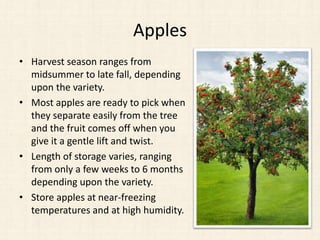
Apples
• Harvest season ranges from
midsummer to late fall, depending
upon the variety.
• Most apples are ready to pick when
they separate easily from the tree
and the fruit comes off when you
give it a gentle lift and twist.
• Length of storage varies, ranging
from only a few weeks to 6 months
depending upon the variety.
• Store apples at near-freezing
temperatures and at high humidity.
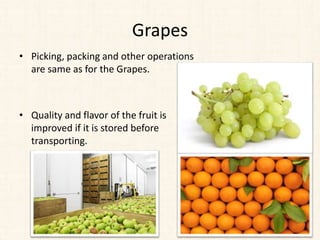
Grapes
• Picking, packing and other operations
are same as for the Grapes.
• Quality and flavor of the fruit is
improved if it is stored before
transporting.
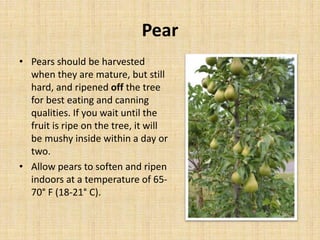
Pear
• Pears should be harvested
when they are mature, but still
hard, and ripened off the tree
for best eating and canning
qualities. If you wait until the
fruit is ripe on the tree, it will
be mushy inside within a day or
two.
• Allow pears to soften and ripen
indoors at a temperature of 65-
70° F (18-21° C).
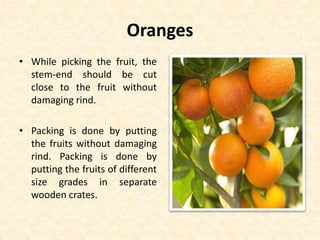
Oranges
• While picking the fruit, the
stem-end should be cut
close to the fruit without
damaging rind.
• Packing is done by putting
the fruits without damaging
rind. Packing is done by
putting the fruits of different
size grades in separate
wooden crates.
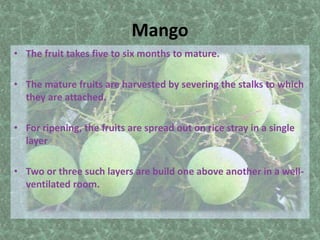
Mango
• The fruit takes five to six months to mature.
• The mature fruits are harvested by severing the stalks to which
they are attached.
• For ripening, the fruits are spread out on rice stray in a single
layer
• Two or three such layers are build one above another in a well-
ventilated room.
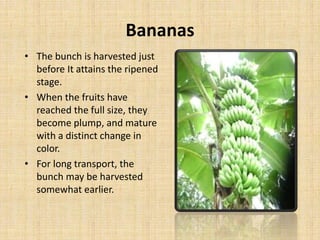
Bananas
• The bunch is harvested just
before It attains the ripened
stage.
• When the fruits have
reached the full size, they
become plump, and mature
with a distinct change in
color.
• For long transport, the
bunch may be harvested
somewhat earlier.
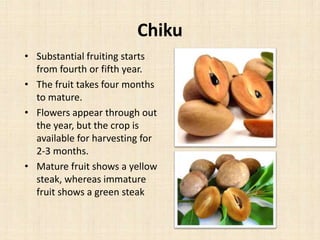
Chiku
• Substantial fruiting starts
from fourth or fifth year.
• The fruit takes four months
to mature.
• Flowers appear through out
the year, but the crop is
available for harvesting for
2-3 months.
• Mature fruit shows a yellow
steak, whereas immature
fruit shows a green steak
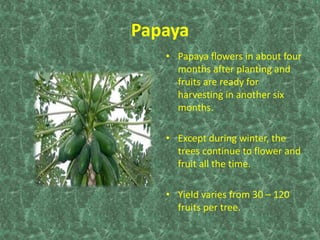
Papaya
• Papaya flowers in about four
months after planting and
fruits are ready for
harvesting in another six
months.
• Except during winter, the
trees continue to flower and
fruit all the time.
• Yield varies from 30 – 120
fruits per tree.
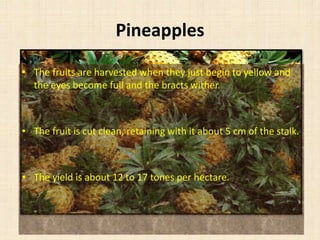
Pineapples
• The fruits are harvested when they just begin to yellow and
the eyes become full and the bracts wither.
• The fruit is cut clean, retaining with it about 5 cm of the stalk.
• The yield is about 12 to 17 tones per hectare.
Vegetables
• Solanaceous fruits : Brinjal , Tomato, Chilli
• Cole crops - Cauliflower, Cabbage, Knol-Khol, Broccoli, Brussels sprouts
• Root crops - Radish, Turnip, Carrot, Beet
• Bulb crops - Onion , Garlic
• Peas and beans (legumes) - Peas, French bean, Cowpea, Sem, Cluster
bean
• Cucurbits - Cucumber, Musk Melon, Water Melon, Bottle Gourd, Bitter
Groud, Songe Groud, Ridge Groud, Summer Squash, Tinda, Winter
Squash
• Sweet potato
• Okra or Bhindi
• Salad crops - Lettuce, Celery, Parsley
• Leafy vegetable, potherbs or greens - Palak, Spinach, Amaranth
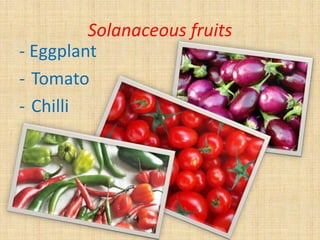
Solanaceous fruits
- Eggplant
- Tomato
- Chilli
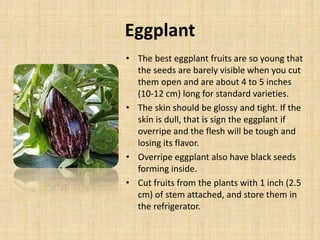
Eggplant
• The best eggplant fruits are so young that
the seeds are barely visible when you cut
them open and are about 4 to 5 inches
(10-12 cm) long for standard varieties.
• The skin should be glossy and tight. If the
skin is dull, that is sign the eggplant if
overripe and the flesh will be tough and
losing its flavor.
• Overripe eggplant also have black seeds
forming inside.
• Cut fruits from the plants with 1 inch (2.5
cm) of stem attached, and store them in
the refrigerator.
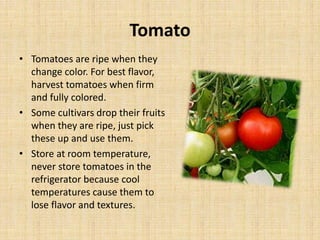
Tomato
• Tomatoes are ripe when they
change color. For best flavor,
harvest tomatoes when firm
and fully colored.
• Some cultivars drop their fruits
when they are ripe, just pick
these up and use them.
• Store at room temperature,
never store tomatoes in the
refrigerator because cool
temperatures cause them to
lose flavor and textures.
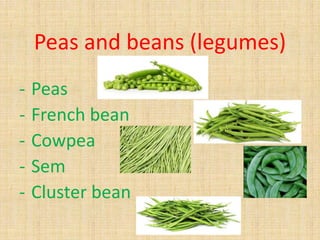
Peas and beans (legumes)
- Peas
- French bean
- Cowpea
- Sem
- Cluster bean
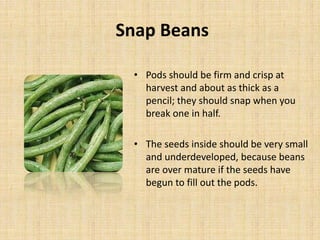
Snap Beans
• Pods should be firm and crisp at
harvest and about as thick as a
pencil; they should snap when you
break one in half.
• The seeds inside should be very small
and underdeveloped, because beans
are over mature if the seeds have
begun to fill out the pods.
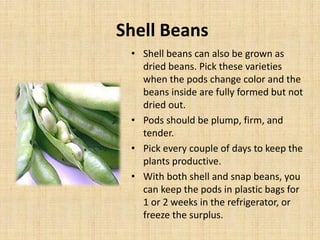
Shell Beans
• Shell beans can also be grown as
dried beans. Pick these varieties
when the pods change color and the
beans inside are fully formed but not
dried out.
• Pods should be plump, firm, and
tender.
• Pick every couple of days to keep the
plants productive.
• With both shell and snap beans, you
can keep the pods in plastic bags for
1 or 2 weeks in the refrigerator, or
freeze the surplus.
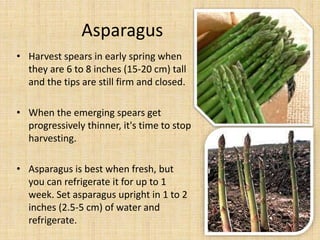
Asparagus
• Harvest spears in early spring when
they are 6 to 8 inches (15-20 cm) tall
and the tips are still firm and closed.
• When the emerging spears get
progressively thinner, it's time to stop
harvesting.
• Asparagus is best when fresh, but
you can refrigerate it for up to 1
week. Set asparagus upright in 1 to 2
inches (2.5-5 cm) of water and
refrigerate.
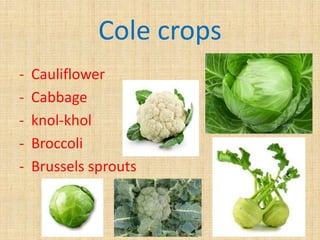
Cole crops
- Cauliflower
- Cabbage
- knol-khol
- Broccoli
- Brussels sprouts
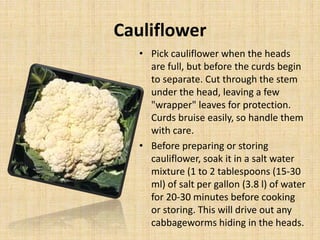
Cauliflower
• Pick cauliflower when the heads
are full, but before the curds begin
to separate. Cut through the stem
under the head, leaving a few
"wrapper" leaves for protection.
Curds bruise easily, so handle them
with care.
• Before preparing or storing
cauliflower, soak it in a salt water
mixture (1 to 2 tablespoons (15-30
ml) of salt per gallon (3.8 l) of water
for 20-30 minutes before cooking
or storing. This will drive out any
cabbageworms hiding in the heads.
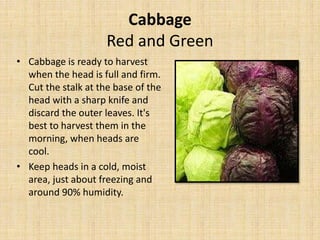
Cabbage
Red and Green
• Cabbage is ready to harvest
when the head is full and firm.
Cut the stalk at the base of the
head with a sharp knife and
discard the outer leaves. It's
best to harvest them in the
morning, when heads are
cool.
• Keep heads in a cold, moist
area, just about freezing and
around 90% humidity.
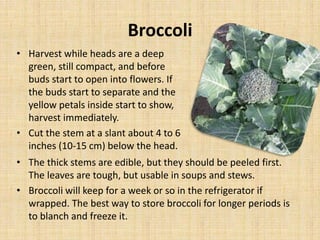
Broccoli
• Harvest while heads are a deep
green, still compact, and before
buds start to open into flowers. If
the buds start to separate and the
yellow petals inside start to show,
harvest immediately.
• Cut the stem at a slant about 4 to 6
inches (10-15 cm) below the head.
• The thick stems are edible, but they should be peeled first.
The leaves are tough, but usable in soups and stews.
• Broccoli will keep for a week or so in the refrigerator if
wrapped. The best way to store broccoli for longer periods is
to blanch and freeze it.
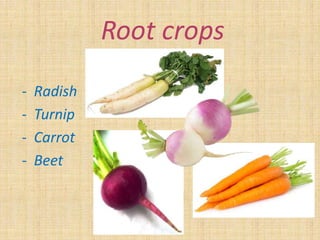
Root crops
- Radish
- Turnip
- Carrot
- Beet
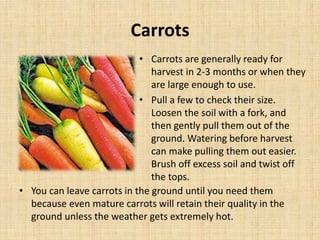
Carrots
• Carrots are generally ready for
harvest in 2-3 months or when they
are large enough to use.
• Pull a few to check their size.
Loosen the soil with a fork, and
then gently pull them out of the
ground. Watering before harvest
can make pulling them out easier.
Brush off excess soil and twist off
the tops.
• You can leave carrots in the ground until you need them
because even mature carrots will retain their quality in the
ground unless the weather gets extremely hot.
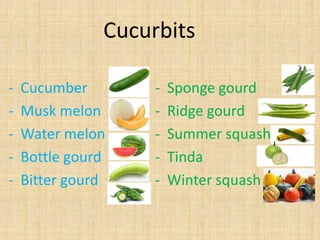
Cucurbits
- Cucumber
- Musk melon
- Water melon
- Bottle gourd
- Bitter gourd
- Sponge gourd
- Ridge gourd
- Summer squash
- Tinda
- Winter squash
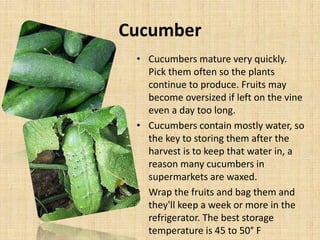
Cucumber
• Cucumbers mature very quickly.
Pick them often so the plants
continue to produce. Fruits may
become oversized if left on the vine
even a day too long.
• Cucumbers contain mostly water, so
the key to storing them after the
harvest is to keep that water in, a
reason many cucumbers in
supermarkets are waxed.
• Wrap the fruits and bag them and
they'll keep a week or more in the
refrigerator. The best storage
temperature is 45 to 50° F
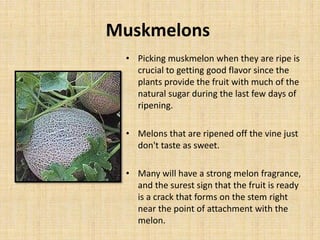
Muskmelons
• Picking muskmelon when they are ripe is
crucial to getting good flavor since the
plants provide the fruit with much of the
natural sugar during the last few days of
ripening.
• Melons that are ripened off the vine just
don't taste as sweet.
• Many will have a strong melon fragrance,
and the surest sign that the fruit is ready
is a crack that forms on the stem right
near the point of attachment with the
melon.
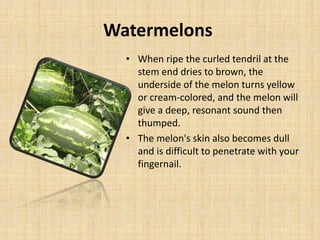
Watermelons
• When ripe the curled tendril at the
stem end dries to brown, the
underside of the melon turns yellow
or cream-colored, and the melon will
give a deep, resonant sound then
thumped.
• The melon's skin also becomes dull
and is difficult to penetrate with your
fingernail.
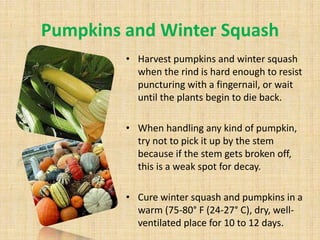
Pumpkins and Winter Squash
• Harvest pumpkins and winter squash
when the rind is hard enough to resist
puncturing with a fingernail, or wait
until the plants begin to die back.
• When handling any kind of pumpkin,
try not to pick it up by the stem
because if the stem gets broken off,
this is a weak spot for decay.
• Cure winter squash and pumpkins in a
warm (75-80° F (24-27° C), dry, well-
ventilated place for 10 to 12 days.
Honeydews
• The number 1 mistake home
gardeners make is picking honeydews
too early.
• Keep a record of your variety's
maturity date and keep the melons on
the vines at least until then, a bit
longer if you've had a cool spell during
the season.
• They will improve for a few days after
picking if kept at room temperature.
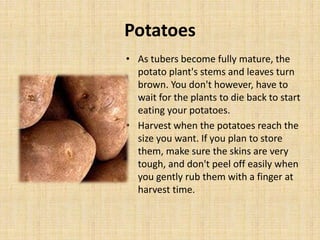
Potatoes
• As tubers become fully mature, the
potato plant's stems and leaves turn
brown. You don't however, have to
wait for the plants to die back to start
eating your potatoes.
• Harvest when the potatoes reach the
size you want. If you plan to store
them, make sure the skins are very
tough, and don't peel off easily when
you gently rub them with a finger at
harvest time.
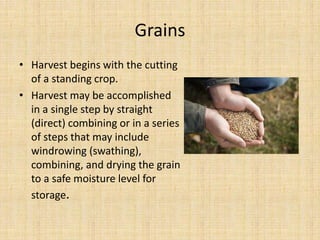
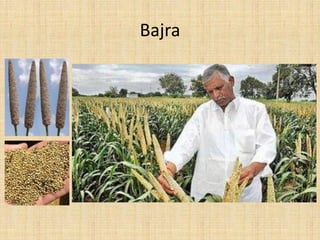
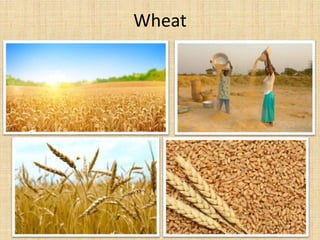
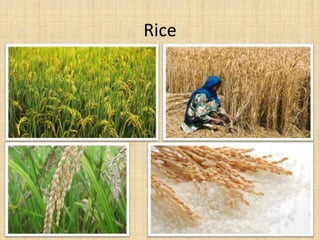
Grains
• Harvest begins with the cutting
of a standing crop.
• Harvest may be accomplished
in a single step by straight
(direct) combining or in a series
of steps that may include
windrowing (swathing),
combining, and drying the grain
to a safe moisture level for
storage.
Bajra
Wheat
Rice
Thank you !!!
Hare Krishna !!!
ISKCON Daiva Varnasrama
Ministry Promoting Rural
Development in India
www.iskconvarnasrama.com
OM Sri Surabhi Campaign
www.srisurabhi.org
ABOUT THE EDITOR
• Name HH RP Bhakti Raghava Swami
• Age and Gender 71, Male
• Country/Province of Origin Canada, Ontario
• Educational Degree and Year B.A, 1968, M.Ed., 2004
• Educational Institution State University of Yogyakarta
• Professional Work/Experience Social Worker/Counselor
• Affiliation with ISKCON Since 1974
• Present Service in ISKCON Minister, IDVM-India
Harvesting

Harvesting

  • 2.
    Harvesting Chief Editor :HH RP Bhakti Raghava Swami E-mail : Bhakti.Raghava.Swami@pamho.net Date Produced : February 05, 2017 Serial No : 6 of 54
  • 3.
    Types of Harvesting •Fruits plucking • Vegetables • Grains Tips :When you harvest, look out for signs of trouble, such as yellowing leaves or rotting fruit, and remove the problem parts
  • 4.
    Fruits • Banana • Mango •Citrus fruits • Grapefruit • Lemon • Mandarin orange • Sweet orange • Grape • Guava • Pear • Sapota (chiku) • Pomegranate • Cashew • Litchi • Date-palm • Apples • Peach • Cherry • Papaya • Pineapple
  • 5.
    Apples • Harvest seasonranges from midsummer to late fall, depending upon the variety. • Most apples are ready to pick when they separate easily from the tree and the fruit comes off when you give it a gentle lift and twist. • Length of storage varies, ranging from only a few weeks to 6 months depending upon the variety. • Store apples at near-freezing temperatures and at high humidity.
  • 6.
    Grapes • Picking, packingand other operations are same as for the Grapes. • Quality and flavor of the fruit is improved if it is stored before transporting.
  • 7.
    Pear • Pears shouldbe harvested when they are mature, but still hard, and ripened off the tree for best eating and canning qualities. If you wait until the fruit is ripe on the tree, it will be mushy inside within a day or two. • Allow pears to soften and ripen indoors at a temperature of 65- 70° F (18-21° C).
  • 8.
    Oranges • While pickingthe fruit, the stem-end should be cut close to the fruit without damaging rind. • Packing is done by putting the fruits without damaging rind. Packing is done by putting the fruits of different size grades in separate wooden crates.
  • 9.
    Mango • The fruittakes five to six months to mature. • The mature fruits are harvested by severing the stalks to which they are attached. • For ripening, the fruits are spread out on rice stray in a single layer • Two or three such layers are build one above another in a well- ventilated room.
  • 10.
    Bananas • The bunchis harvested just before It attains the ripened stage. • When the fruits have reached the full size, they become plump, and mature with a distinct change in color. • For long transport, the bunch may be harvested somewhat earlier.
  • 11.
    Chiku • Substantial fruitingstarts from fourth or fifth year. • The fruit takes four months to mature. • Flowers appear through out the year, but the crop is available for harvesting for 2-3 months. • Mature fruit shows a yellow steak, whereas immature fruit shows a green steak
  • 12.
    Papaya • Papaya flowersin about four months after planting and fruits are ready for harvesting in another six months. • Except during winter, the trees continue to flower and fruit all the time. • Yield varies from 30 – 120 fruits per tree.
  • 13.
    Pineapples • The fruitsare harvested when they just begin to yellow and the eyes become full and the bracts wither. • The fruit is cut clean, retaining with it about 5 cm of the stalk. • The yield is about 12 to 17 tones per hectare.
  • 14.
    Vegetables • Solanaceous fruits: Brinjal , Tomato, Chilli • Cole crops - Cauliflower, Cabbage, Knol-Khol, Broccoli, Brussels sprouts • Root crops - Radish, Turnip, Carrot, Beet • Bulb crops - Onion , Garlic • Peas and beans (legumes) - Peas, French bean, Cowpea, Sem, Cluster bean • Cucurbits - Cucumber, Musk Melon, Water Melon, Bottle Gourd, Bitter Groud, Songe Groud, Ridge Groud, Summer Squash, Tinda, Winter Squash • Sweet potato • Okra or Bhindi • Salad crops - Lettuce, Celery, Parsley • Leafy vegetable, potherbs or greens - Palak, Spinach, Amaranth
  • 15.
  • 16.
    Eggplant • The besteggplant fruits are so young that the seeds are barely visible when you cut them open and are about 4 to 5 inches (10-12 cm) long for standard varieties. • The skin should be glossy and tight. If the skin is dull, that is sign the eggplant if overripe and the flesh will be tough and losing its flavor. • Overripe eggplant also have black seeds forming inside. • Cut fruits from the plants with 1 inch (2.5 cm) of stem attached, and store them in the refrigerator.
  • 17.
    Tomato • Tomatoes areripe when they change color. For best flavor, harvest tomatoes when firm and fully colored. • Some cultivars drop their fruits when they are ripe, just pick these up and use them. • Store at room temperature, never store tomatoes in the refrigerator because cool temperatures cause them to lose flavor and textures.
  • 18.
    Peas and beans(legumes) - Peas - French bean - Cowpea - Sem - Cluster bean
  • 19.
    Snap Beans • Podsshould be firm and crisp at harvest and about as thick as a pencil; they should snap when you break one in half. • The seeds inside should be very small and underdeveloped, because beans are over mature if the seeds have begun to fill out the pods.
  • 20.
    Shell Beans • Shellbeans can also be grown as dried beans. Pick these varieties when the pods change color and the beans inside are fully formed but not dried out. • Pods should be plump, firm, and tender. • Pick every couple of days to keep the plants productive. • With both shell and snap beans, you can keep the pods in plastic bags for 1 or 2 weeks in the refrigerator, or freeze the surplus.
  • 21.
    Asparagus • Harvest spearsin early spring when they are 6 to 8 inches (15-20 cm) tall and the tips are still firm and closed. • When the emerging spears get progressively thinner, it's time to stop harvesting. • Asparagus is best when fresh, but you can refrigerate it for up to 1 week. Set asparagus upright in 1 to 2 inches (2.5-5 cm) of water and refrigerate.
  • 22.
    Cole crops - Cauliflower -Cabbage - knol-khol - Broccoli - Brussels sprouts
  • 23.
    Cauliflower • Pick cauliflowerwhen the heads are full, but before the curds begin to separate. Cut through the stem under the head, leaving a few "wrapper" leaves for protection. Curds bruise easily, so handle them with care. • Before preparing or storing cauliflower, soak it in a salt water mixture (1 to 2 tablespoons (15-30 ml) of salt per gallon (3.8 l) of water for 20-30 minutes before cooking or storing. This will drive out any cabbageworms hiding in the heads.
  • 24.
    Cabbage Red and Green •Cabbage is ready to harvest when the head is full and firm. Cut the stalk at the base of the head with a sharp knife and discard the outer leaves. It's best to harvest them in the morning, when heads are cool. • Keep heads in a cold, moist area, just about freezing and around 90% humidity.
  • 25.
    Broccoli • Harvest whileheads are a deep green, still compact, and before buds start to open into flowers. If the buds start to separate and the yellow petals inside start to show, harvest immediately. • Cut the stem at a slant about 4 to 6 inches (10-15 cm) below the head. • The thick stems are edible, but they should be peeled first. The leaves are tough, but usable in soups and stews. • Broccoli will keep for a week or so in the refrigerator if wrapped. The best way to store broccoli for longer periods is to blanch and freeze it.
  • 26.
    Root crops - Radish -Turnip - Carrot - Beet
  • 27.
    Carrots • Carrots aregenerally ready for harvest in 2-3 months or when they are large enough to use. • Pull a few to check their size. Loosen the soil with a fork, and then gently pull them out of the ground. Watering before harvest can make pulling them out easier. Brush off excess soil and twist off the tops. • You can leave carrots in the ground until you need them because even mature carrots will retain their quality in the ground unless the weather gets extremely hot.
  • 28.
    Cucurbits - Cucumber - Muskmelon - Water melon - Bottle gourd - Bitter gourd - Sponge gourd - Ridge gourd - Summer squash - Tinda - Winter squash
  • 29.
    Cucumber • Cucumbers maturevery quickly. Pick them often so the plants continue to produce. Fruits may become oversized if left on the vine even a day too long. • Cucumbers contain mostly water, so the key to storing them after the harvest is to keep that water in, a reason many cucumbers in supermarkets are waxed. • Wrap the fruits and bag them and they'll keep a week or more in the refrigerator. The best storage temperature is 45 to 50° F
  • 30.
    Muskmelons • Picking muskmelonwhen they are ripe is crucial to getting good flavor since the plants provide the fruit with much of the natural sugar during the last few days of ripening. • Melons that are ripened off the vine just don't taste as sweet. • Many will have a strong melon fragrance, and the surest sign that the fruit is ready is a crack that forms on the stem right near the point of attachment with the melon.
  • 31.
    Watermelons • When ripethe curled tendril at the stem end dries to brown, the underside of the melon turns yellow or cream-colored, and the melon will give a deep, resonant sound then thumped. • The melon's skin also becomes dull and is difficult to penetrate with your fingernail.
  • 32.
    Pumpkins and WinterSquash • Harvest pumpkins and winter squash when the rind is hard enough to resist puncturing with a fingernail, or wait until the plants begin to die back. • When handling any kind of pumpkin, try not to pick it up by the stem because if the stem gets broken off, this is a weak spot for decay. • Cure winter squash and pumpkins in a warm (75-80° F (24-27° C), dry, well- ventilated place for 10 to 12 days.
  • 33.
    Honeydews • The number1 mistake home gardeners make is picking honeydews too early. • Keep a record of your variety's maturity date and keep the melons on the vines at least until then, a bit longer if you've had a cool spell during the season. • They will improve for a few days after picking if kept at room temperature.
  • 34.
    Potatoes • As tubersbecome fully mature, the potato plant's stems and leaves turn brown. You don't however, have to wait for the plants to die back to start eating your potatoes. • Harvest when the potatoes reach the size you want. If you plan to store them, make sure the skins are very tough, and don't peel off easily when you gently rub them with a finger at harvest time.
  • 35.
    Grains • Harvest beginswith the cutting of a standing crop. • Harvest may be accomplished in a single step by straight (direct) combining or in a series of steps that may include windrowing (swathing), combining, and drying the grain to a safe moisture level for storage.
  • 36.
  • 37.
  • 38.
  • 39.
    Thank you !!! HareKrishna !!!
  • 40.
    ISKCON Daiva Varnasrama MinistryPromoting Rural Development in India www.iskconvarnasrama.com OM Sri Surabhi Campaign www.srisurabhi.org
  • 42.
    ABOUT THE EDITOR •Name HH RP Bhakti Raghava Swami • Age and Gender 71, Male • Country/Province of Origin Canada, Ontario • Educational Degree and Year B.A, 1968, M.Ed., 2004 • Educational Institution State University of Yogyakarta • Professional Work/Experience Social Worker/Counselor • Affiliation with ISKCON Since 1974 • Present Service in ISKCON Minister, IDVM-India