Submitted to: Dr Dharminder Pathak
Plant Breeder
Department of Plant Breeding and Genetics
Punjab Agricultural University
Ludhiana
Submitted by: Simranpreet kaur
L-2018-A-165-M
MSc Student
Environmental Control
Sex Determination
Sex Determination
 A sex-determination system is a biological system that
determines the development of sexual characteristics in
an organism
 Sex determination was discovered in the mealworm by
the American geneticist Nettie Stevens in 1903
 Mechanisms of sex determination
Environmental sex determination
Chromosomal sex determination
Genic sex determination
History
 Aristotle (335 B.C.): Sex is determined by “the heat of the male
partner during intercourse”. The more the passion greater the
probability of male offsprings.
 Bull and Eric Charnov in 1977, at the University of Utah, in Salt
Lake City, Utah, proposed a model for the evolution of
environmental sex determination (ESD) called the Charnov-Bull
model
 Bull and Richard Vogt in 1979 , researcher at Brazil university,
showed that TSD exists in some reptiles. In their article,
“Temperature-dependent Sex Determination in Turtles”,
investigated the effects of temperature on the sex of
hatchlings in five turtle species under controlled and natural
field conditions
Environmental sex determination
 In some animals, zygotes don’t differ
genetically for sex differentiation. In such
cases, sexual differentiation is determined
by environmental factors
 In larvae of the spoonworm Bonellia
viridis are sexually undifferentiated. Those
larvae that attach to the proboscis of
female worms develop into males and
those that don’t attach to female worm &
remain free living develop into females
 This is triggered by the presence of a
chemical produced by the female i.e
Bonellin
Temperature sex determination
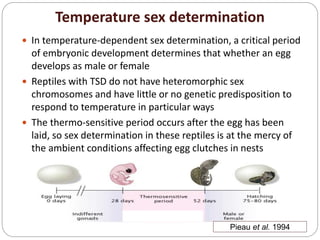
 In temperature-dependent sex determination, a critical period
of embryonic development determines that whether an egg
develops as male or female
 Reptiles with TSD do not have heteromorphic sex
chromosomes and have little or no genetic predisposition to
respond to temperature in particular ways
 The thermo-sensitive period occurs after the egg has been
laid, so sex determination in these reptiles is at the mercy of
the ambient conditions affecting egg clutches in nests
Pieau et al. 1994
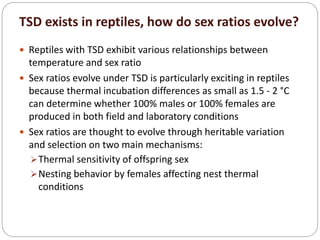
TSD exists in reptiles, how do sex ratios evolve?
 Reptiles with TSD exhibit various relationships between
temperature and sex ratio
 Sex ratios evolve under TSD is particularly exciting in reptiles
because thermal incubation differences as small as 1.5 - 2 °C
can determine whether 100% males or 100% females are
produced in both field and laboratory conditions
 Sex ratios are thought to evolve through heritable variation
and selection on two main mechanisms:
Thermal sensitivity of offspring sex
Nesting behavior by females affecting nest thermal
conditions
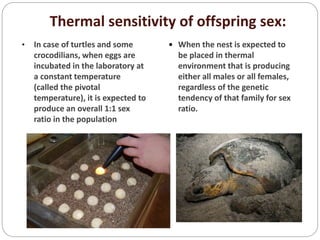
Thermal sensitivity of offspring sex:
• In case of turtles and some
crocodilians, when eggs are
incubated in the laboratory at
a constant temperature
(called the pivotal
temperature), it is expected to
produce an overall 1:1 sex
ratio in the population
 When the nest is expected to
be placed in thermal
environment that is producing
either all males or all females,
regardless of the genetic
tendency of that family for sex
ratio.
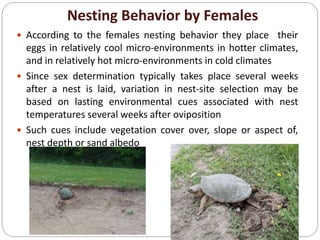
Nesting Behavior by Females
 According to the females nesting behavior they place their
eggs in relatively cool micro-environments in hotter climates,
and in relatively hot micro-environments in cold climates
 Since sex determination typically takes place several weeks
after a nest is laid, variation in nest-site selection may be
based on lasting environmental cues associated with nest
temperatures several weeks after oviposition
 Such cues include vegetation cover over, slope or aspect of,
nest depth or sand albedo
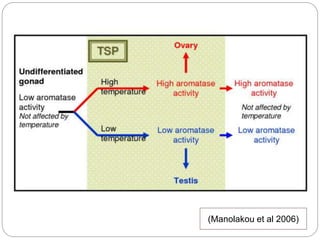
Aromatase activity levels during the
Thermosensitive period
 A group of hormones that influence sex development and
reproduction, from male (androgens) to female (estrogens)
sex hormones
 One cause of TSD is the enzyme aromatase which helps to
convert sex steroids
 Individuals with low levels of aromatase during the thermo
sensitive period will develop male characteristics and High
levels increase the production of female characteristics
 Incubation temperature modifies the activity of enzymes and
hormones.
(Manolakou et al 2006)
Reference
 Moeller, Karla T., "Temperature-Dependent Sex
Determination in Reptiles". Embryo Project
Encyclopedia (2013-02-01). ISSN: 1940-5030
 Morjan, Carrie L. 2003. “How Rapidly Can Maternal
Behavior Affecting Primary Sex Ratio Evolve in a Reptile
with Environmental Sex Determination ?”
 Shine, Richard. 1999. “Why Is Sex Determined by Nest
Temperature in Many Reptiles?” 14(5): 186–89.
 Wapstra, Erik et al. 2006. “Maternal Basking Behavior
Determines Offspring Sex in a Viviparous Reptile.” : 230–
32.

Environmental Control Sex Determination

  • 1.
    Submitted to: DrDharminder Pathak Plant Breeder Department of Plant Breeding and Genetics Punjab Agricultural University Ludhiana Submitted by: Simranpreet kaur L-2018-A-165-M MSc Student Environmental Control Sex Determination
  • 2.
    Sex Determination  Asex-determination system is a biological system that determines the development of sexual characteristics in an organism  Sex determination was discovered in the mealworm by the American geneticist Nettie Stevens in 1903  Mechanisms of sex determination Environmental sex determination Chromosomal sex determination Genic sex determination
  • 3.
    History  Aristotle (335B.C.): Sex is determined by “the heat of the male partner during intercourse”. The more the passion greater the probability of male offsprings.  Bull and Eric Charnov in 1977, at the University of Utah, in Salt Lake City, Utah, proposed a model for the evolution of environmental sex determination (ESD) called the Charnov-Bull model  Bull and Richard Vogt in 1979 , researcher at Brazil university, showed that TSD exists in some reptiles. In their article, “Temperature-dependent Sex Determination in Turtles”, investigated the effects of temperature on the sex of hatchlings in five turtle species under controlled and natural field conditions
  • 4.
    Environmental sex determination In some animals, zygotes don’t differ genetically for sex differentiation. In such cases, sexual differentiation is determined by environmental factors  In larvae of the spoonworm Bonellia viridis are sexually undifferentiated. Those larvae that attach to the proboscis of female worms develop into males and those that don’t attach to female worm & remain free living develop into females  This is triggered by the presence of a chemical produced by the female i.e Bonellin
  • 5.
    Temperature sex determination In temperature-dependent sex determination, a critical period of embryonic development determines that whether an egg develops as male or female  Reptiles with TSD do not have heteromorphic sex chromosomes and have little or no genetic predisposition to respond to temperature in particular ways  The thermo-sensitive period occurs after the egg has been laid, so sex determination in these reptiles is at the mercy of the ambient conditions affecting egg clutches in nests Pieau et al. 1994
  • 6.
    TSD exists inreptiles, how do sex ratios evolve?  Reptiles with TSD exhibit various relationships between temperature and sex ratio  Sex ratios evolve under TSD is particularly exciting in reptiles because thermal incubation differences as small as 1.5 - 2 °C can determine whether 100% males or 100% females are produced in both field and laboratory conditions  Sex ratios are thought to evolve through heritable variation and selection on two main mechanisms: Thermal sensitivity of offspring sex Nesting behavior by females affecting nest thermal conditions
  • 7.
    Thermal sensitivity ofoffspring sex: • In case of turtles and some crocodilians, when eggs are incubated in the laboratory at a constant temperature (called the pivotal temperature), it is expected to produce an overall 1:1 sex ratio in the population  When the nest is expected to be placed in thermal environment that is producing either all males or all females, regardless of the genetic tendency of that family for sex ratio.
  • 8.
    Nesting Behavior byFemales  According to the females nesting behavior they place their eggs in relatively cool micro-environments in hotter climates, and in relatively hot micro-environments in cold climates  Since sex determination typically takes place several weeks after a nest is laid, variation in nest-site selection may be based on lasting environmental cues associated with nest temperatures several weeks after oviposition  Such cues include vegetation cover over, slope or aspect of, nest depth or sand albedo
  • 9.
    Aromatase activity levelsduring the Thermosensitive period  A group of hormones that influence sex development and reproduction, from male (androgens) to female (estrogens) sex hormones  One cause of TSD is the enzyme aromatase which helps to convert sex steroids  Individuals with low levels of aromatase during the thermo sensitive period will develop male characteristics and High levels increase the production of female characteristics  Incubation temperature modifies the activity of enzymes and hormones.
  • 10.
  • 11.
    Reference  Moeller, KarlaT., "Temperature-Dependent Sex Determination in Reptiles". Embryo Project Encyclopedia (2013-02-01). ISSN: 1940-5030  Morjan, Carrie L. 2003. “How Rapidly Can Maternal Behavior Affecting Primary Sex Ratio Evolve in a Reptile with Environmental Sex Determination ?”  Shine, Richard. 1999. “Why Is Sex Determined by Nest Temperature in Many Reptiles?” 14(5): 186–89.  Wapstra, Erik et al. 2006. “Maternal Basking Behavior Determines Offspring Sex in a Viviparous Reptile.” : 230– 32.