



TCP / IP PROTOCOL PROTOCOL
TCP / IP The most popular networking protocols are  Transmission  Control Protocol/Internet Protocol  (TCP/IP).  TCP/IP was originally developed in the 1970s by the  Department of Defense (DOD) as a way of connecting  dissimilar networks that would be capable of withstanding  a nuclear attack.  It is important to note that although TCP and IP are the  cornerstone protocols, TCP/IP is actually a collection of  many protocols that are generically referred to as the  TCP/IP protocol suite.
The two main protocols that make up the TCP/IP suite of  protocols are TCP and IP.  These protocols fall into the Transport and Network layers of  the OSI model, respectively. IP functions at the Network layer of the OSI model.  The primary function of IP is to provide each attached device  with a unique address.  Each address indicates not only the individual device, but also  the network to which the device belongs.  The IP protocol is also responsible for routing packets over an  internet work. TCP / IP
The IP address is used to determine the exact location of the  destination network where the device exists.  TCP is a Transport layer protocol whose primary function is  to provide reliable delivery of data through a connection oriented service.  Sending data through TCP is a two-part process The sender and receiver exchange a ‘handshake’ to  establish communication, and then acknowledgements  are sent to verify that data was received.  Acknowledgements are being sent throughout the  transmission. TCP / IP
Benefits of TCP/IP: TCP/IP is commonly used as the Transport and Network  layer protocol for these reasons: 1. It support almost all network operating systems.    It is the required protocol for communicating over    the Internet. if you want to connect to the Internet    your computer has to use TCP/IP. 2. The protocol is designed to be fault tolerant and is    able to dynamically reroute packets if network links   become unavailable (assuming alternate paths exist). TCP / IP
Benefits of TCP/IP: 3. Protocol companions such as Dynamic Host    Configuration Protocol (DHCP) simplify IP    address management. 4. Domain Name System (DNS) is used with TCP/IP    to resolve a fully qualified domain name (FQDN),    such as sybex.com with its corresponding IP address. 5. TCP/IP is scalable to small and large networks. TCP / IP
Disadvantages of TCP/IP Although TCP/IP and the Internet have been wildly  successful, using this protocol has disadvantages.  1. Managing IP addresses is complicated and    cumbersome. IP address errors are usually    due to administrative error. 2. Troubleshooting TCP/IP problems on your    network requires an understanding of how    TCP/IP works and of the more than a dozen    protocols that are included in the suite. TCP / IP
Disadvantages of TCP/IP 3. Taking advantage of some of the best features    of the TCP/IP suite requires considerable skill    and knowledge.    Depending on your type of business, mastering    TCP/IP will require a significant amount of    education for you or necessitate the hiring of an    expert. TCP / IP
TCP / IP IP ADDRESSING Ipv4 only uses 32-bit (4-byte) addresses, which limits the  address space to 4,294,967,296 (232) possible unique  addresses.  Many IP address   are reserved for special purposes such as  private networks (~18 million addresses) and multicast  addresses (~270 million addresses).  This reduces the number of addresses that can be allocated  as public Internet addresses, and as the number of addresses  available is consumed, an IPv4 address shortage appears.  This limitation has helped stimulate the push towards IPv6.
TCP / IP I Pv4 addresses are usually represented in dotted-decimal  notation (four numbers, each ranging from 0 to 255, separat by dots, e.g. 147.132.42.18).  Each range from 0 to 255 can be represented by 8 bits, and is  therefore called an  octet . It is possible, although less common, to write IPv4 addresses in binary or hexadecimal.  When converting, each octet is treated as a separate number.  (So 255.255.0.0 in dot-decimal would be FF.FF.00.00 in hexa decimal.)
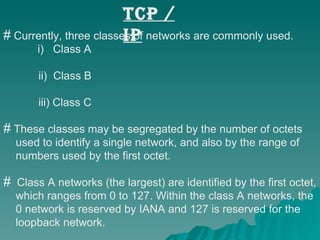
TCP / IP Currently, three classes of networks are commonly used.    i)  Class A    ii)  Class B    iii) Class C These classes may be segregated by the number of octets  used to identify a single network, and also by the range of  numbers used by the first octet. Class A networks (the largest) are identified by the first octet,  which ranges from 0 to 127. Within the class A networks, the  0 network is reserved by IANA and 127 is reserved for the  loopback network.
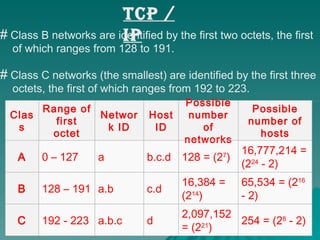
TCP / IP Class B networks are identified by the first two octets, the first  of which ranges from 128 to 191.  Class C networks (the smallest) are identified by the first three  octets, the first of which ranges from 192 to 223.  254 = (2 8  - 2) 2,097,152 = (2 21 ) d a.b.c 192 - 223 C 65,534 = (2 16  - 2) 16,384 = (2 14 ) c.d a.b 128 – 191 B 16,777,214 = (2 24  - 2) 128 = (2 7 ) b.c.d a 0 – 127 A Possible number of hosts Possible number of networks Host ID Network ID Range of first octet Class
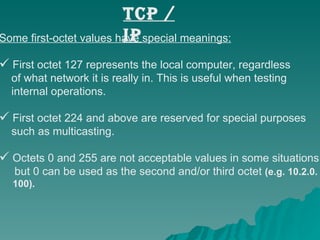
Some first-octet values have special meanings: First octet 127 represents the local computer, regardless  of what network it is really in. This is useful when testing  internal operations.  First octet 224 and above are reserved for special purposes  such as multicasting.  Octets 0 and 255 are not acceptable values in some situations, but 0 can be used as the second and/or third octet  (e.g. 10.2.0. 100). TCP / IP
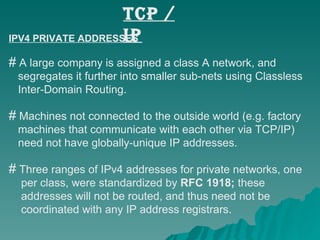
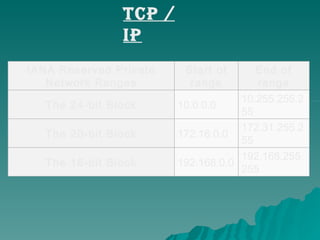
TCP / IP IPV4 PRIVATE ADDRESSES A large company is assigned a class A network, and  segregates it further into smaller sub-nets using Classless  Inter-Domain Routing.  Machines not connected to the outside world (e.g. factory  machines that communicate with each other via TCP/IP)  need not have globally-unique IP addresses. Three ranges of IPv4 addresses for private networks, one  per class, were standardized by  RFC 1918;  these  addresses will not be routed, and thus need not be  coordinated with any IP address registrars.
TCP / IP 192.168.255.255 192.168.0.0 The 16-bit Block 172.31.255.255 172.16.0.0 The 20-bit Block 10.255.255.255 10.0.0.0 The 24-bit Block End of range Start of range IANA Reserved Private Network Ranges
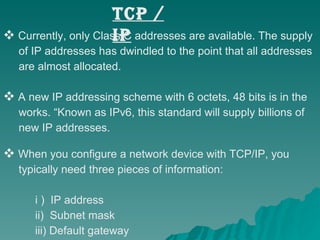
TCP / IP Currently, only Class C addresses are available. The supply  of IP addresses has dwindled to the point that all addresses  are almost allocated.  A new IP addressing scheme with 6 octets, 48 bits is in the  works. “Known as IPv6, this standard will supply billions of  new IP addresses.  When you configure a network device with TCP/IP, you  typically need three pieces of information: i )  IP address ii)  Subnet mask iii) Default gateway
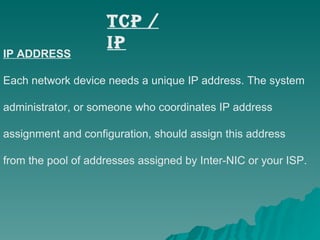
TCP / IP IP ADDRESS Each network device needs a unique IP address. The system  administrator, or someone who coordinates IP address  assignment and configuration, should assign this address  from the pool of addresses assigned by Inter-NIC or your ISP.
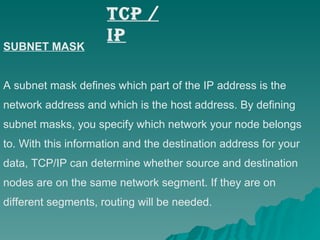
TCP / IP SUBNET MASK A subnet mask defines which part of the IP address is the  network address and which is the host address. By defining  subnet masks, you specify which network your node belongs to. With this information and the destination address for your  data, TCP/IP can determine whether source and destination nodes are on the same network segment. If they are on  different segments, routing will be needed.
TCP / IP DEFAULT ROUTER OR GATEWAY You need a default router, or gateway, configured on your  workstations if you want your packets routed over an  internet-work.  The default router is the IP address of the local router that  you use to connect your network to the internet.  The workstation needs to have this information if it wants to  send packets out to the Internet. Without it, the workstation is  clueless about where to send packets destined for external  networks.
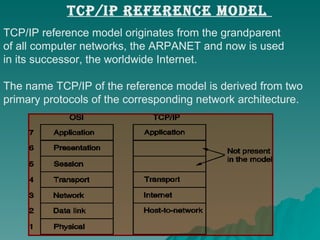
TCP/IP REFERENCE MODEL  TCP/IP reference model originates from the grandparent  of all computer networks, the ARPANET and now is used  in its successor, the worldwide Internet.  The name TCP/IP of the reference model is derived from two  primary protocols of the corresponding network architecture.
INTERNET LAYER The internet layer is the linchpin of the whole architecture. It is a connectionless internetwork layer forming a base for a packet-switching network.  Its job is to permit hosts to inject packets into any network  and have them travel independently to the destination. It  works in analogy with the (snail) mail system.  TCP/IP REFERENCE MODEL
THE INTERNET LAYER The internet layer defines an official packet format and  protocol called IP (Internet Protocol).  The job of the internet layer is to deliver IP packets where  they are supposed to go.  TCP/IP internet layer is very similar in functionality to the  OSI network layer.  TCP/IP REFERENCE MODEL
TRANSPORT LAYER The layer above the internet layer in the TCP/IP model is  now usually called transport layer.  It is designed to allow peer entities on the source and  destination hosts to carry on a conversation, the same  as in the OSI transport layer.  Two end-to-end protocols have been defined here:  TCP/IP REFERENCE MODEL
APPLICATION LAYER The application layer is on the top of the transport layer.  It contains all the higher level protocols. Some of them are:  Virtual terminal (TELNET) - allows a user on one    machine to log into a distant machine and work there.  File transfer protocol (FTP) - provides a way to move    data efficiently from one machine to another.  Electronic mail (SMTP) - specialized protocol for    electronic mail.  Domain name service (DNS) - for mapping host names    onto their network addresses.  TCP/IP REFERENCE MODEL
HOST-TO-NETWORK LAYER Bellow the internet layer there is a great void. The TCP/IP  reference model does not really say much about what  happens here, except to point out that the host has to connect  to the network using some protocol so it can send IP packet  over it. This protocol is not defined and varies from host to  host and network to network.  TCP/IP REFERENCE MODEL
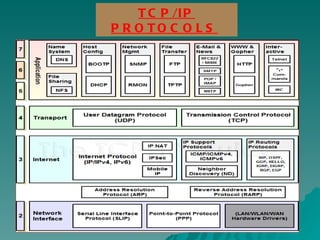
TCP/IP PROTOCOLS
 

Hardware9

  • 1.
    TCP / IPPROTOCOL PROTOCOL
  • 2.
    TCP / IPThe most popular networking protocols are Transmission Control Protocol/Internet Protocol (TCP/IP). TCP/IP was originally developed in the 1970s by the Department of Defense (DOD) as a way of connecting dissimilar networks that would be capable of withstanding a nuclear attack. It is important to note that although TCP and IP are the cornerstone protocols, TCP/IP is actually a collection of many protocols that are generically referred to as the TCP/IP protocol suite.
  • 3.
    The two mainprotocols that make up the TCP/IP suite of protocols are TCP and IP. These protocols fall into the Transport and Network layers of the OSI model, respectively. IP functions at the Network layer of the OSI model. The primary function of IP is to provide each attached device with a unique address. Each address indicates not only the individual device, but also the network to which the device belongs. The IP protocol is also responsible for routing packets over an internet work. TCP / IP
  • 4.
    The IP addressis used to determine the exact location of the destination network where the device exists. TCP is a Transport layer protocol whose primary function is to provide reliable delivery of data through a connection oriented service. Sending data through TCP is a two-part process The sender and receiver exchange a ‘handshake’ to establish communication, and then acknowledgements are sent to verify that data was received. Acknowledgements are being sent throughout the transmission. TCP / IP
  • 5.
    Benefits of TCP/IP:TCP/IP is commonly used as the Transport and Network layer protocol for these reasons: 1. It support almost all network operating systems. It is the required protocol for communicating over the Internet. if you want to connect to the Internet your computer has to use TCP/IP. 2. The protocol is designed to be fault tolerant and is able to dynamically reroute packets if network links become unavailable (assuming alternate paths exist). TCP / IP
  • 6.
    Benefits of TCP/IP:3. Protocol companions such as Dynamic Host Configuration Protocol (DHCP) simplify IP address management. 4. Domain Name System (DNS) is used with TCP/IP to resolve a fully qualified domain name (FQDN), such as sybex.com with its corresponding IP address. 5. TCP/IP is scalable to small and large networks. TCP / IP
  • 7.
    Disadvantages of TCP/IPAlthough TCP/IP and the Internet have been wildly successful, using this protocol has disadvantages. 1. Managing IP addresses is complicated and cumbersome. IP address errors are usually due to administrative error. 2. Troubleshooting TCP/IP problems on your network requires an understanding of how TCP/IP works and of the more than a dozen protocols that are included in the suite. TCP / IP
  • 8.
    Disadvantages of TCP/IP3. Taking advantage of some of the best features of the TCP/IP suite requires considerable skill and knowledge. Depending on your type of business, mastering TCP/IP will require a significant amount of education for you or necessitate the hiring of an expert. TCP / IP
  • 9.
    TCP / IPIP ADDRESSING Ipv4 only uses 32-bit (4-byte) addresses, which limits the address space to 4,294,967,296 (232) possible unique addresses. Many IP address are reserved for special purposes such as private networks (~18 million addresses) and multicast addresses (~270 million addresses). This reduces the number of addresses that can be allocated as public Internet addresses, and as the number of addresses available is consumed, an IPv4 address shortage appears. This limitation has helped stimulate the push towards IPv6.
  • 10.
    TCP / IPI Pv4 addresses are usually represented in dotted-decimal notation (four numbers, each ranging from 0 to 255, separat by dots, e.g. 147.132.42.18). Each range from 0 to 255 can be represented by 8 bits, and is therefore called an octet . It is possible, although less common, to write IPv4 addresses in binary or hexadecimal. When converting, each octet is treated as a separate number. (So 255.255.0.0 in dot-decimal would be FF.FF.00.00 in hexa decimal.)
  • 11.
    TCP / IPCurrently, three classes of networks are commonly used. i) Class A ii) Class B iii) Class C These classes may be segregated by the number of octets used to identify a single network, and also by the range of numbers used by the first octet. Class A networks (the largest) are identified by the first octet, which ranges from 0 to 127. Within the class A networks, the 0 network is reserved by IANA and 127 is reserved for the loopback network.
  • 12.
    TCP / IPClass B networks are identified by the first two octets, the first of which ranges from 128 to 191. Class C networks (the smallest) are identified by the first three octets, the first of which ranges from 192 to 223. 254 = (2 8 - 2) 2,097,152 = (2 21 ) d a.b.c 192 - 223 C 65,534 = (2 16 - 2) 16,384 = (2 14 ) c.d a.b 128 – 191 B 16,777,214 = (2 24 - 2) 128 = (2 7 ) b.c.d a 0 – 127 A Possible number of hosts Possible number of networks Host ID Network ID Range of first octet Class
  • 13.
    Some first-octet valueshave special meanings: First octet 127 represents the local computer, regardless of what network it is really in. This is useful when testing internal operations. First octet 224 and above are reserved for special purposes such as multicasting. Octets 0 and 255 are not acceptable values in some situations, but 0 can be used as the second and/or third octet (e.g. 10.2.0. 100). TCP / IP
  • 14.
    TCP / IPIPV4 PRIVATE ADDRESSES A large company is assigned a class A network, and segregates it further into smaller sub-nets using Classless Inter-Domain Routing. Machines not connected to the outside world (e.g. factory machines that communicate with each other via TCP/IP) need not have globally-unique IP addresses. Three ranges of IPv4 addresses for private networks, one per class, were standardized by RFC 1918; these addresses will not be routed, and thus need not be coordinated with any IP address registrars.
  • 15.
    TCP / IP192.168.255.255 192.168.0.0 The 16-bit Block 172.31.255.255 172.16.0.0 The 20-bit Block 10.255.255.255 10.0.0.0 The 24-bit Block End of range Start of range IANA Reserved Private Network Ranges
  • 16.
    TCP / IPCurrently, only Class C addresses are available. The supply of IP addresses has dwindled to the point that all addresses are almost allocated. A new IP addressing scheme with 6 octets, 48 bits is in the works. “Known as IPv6, this standard will supply billions of new IP addresses. When you configure a network device with TCP/IP, you typically need three pieces of information: i ) IP address ii) Subnet mask iii) Default gateway
  • 17.
    TCP / IPIP ADDRESS Each network device needs a unique IP address. The system administrator, or someone who coordinates IP address assignment and configuration, should assign this address from the pool of addresses assigned by Inter-NIC or your ISP.
  • 18.
    TCP / IPSUBNET MASK A subnet mask defines which part of the IP address is the network address and which is the host address. By defining subnet masks, you specify which network your node belongs to. With this information and the destination address for your data, TCP/IP can determine whether source and destination nodes are on the same network segment. If they are on different segments, routing will be needed.
  • 19.
    TCP / IPDEFAULT ROUTER OR GATEWAY You need a default router, or gateway, configured on your workstations if you want your packets routed over an internet-work. The default router is the IP address of the local router that you use to connect your network to the internet. The workstation needs to have this information if it wants to send packets out to the Internet. Without it, the workstation is clueless about where to send packets destined for external networks.
  • 20.
    TCP/IP REFERENCE MODEL TCP/IP reference model originates from the grandparent of all computer networks, the ARPANET and now is used in its successor, the worldwide Internet. The name TCP/IP of the reference model is derived from two primary protocols of the corresponding network architecture.
  • 21.
    INTERNET LAYER Theinternet layer is the linchpin of the whole architecture. It is a connectionless internetwork layer forming a base for a packet-switching network. Its job is to permit hosts to inject packets into any network and have them travel independently to the destination. It works in analogy with the (snail) mail system. TCP/IP REFERENCE MODEL
  • 22.
    THE INTERNET LAYERThe internet layer defines an official packet format and protocol called IP (Internet Protocol). The job of the internet layer is to deliver IP packets where they are supposed to go. TCP/IP internet layer is very similar in functionality to the OSI network layer. TCP/IP REFERENCE MODEL
  • 23.
    TRANSPORT LAYER Thelayer above the internet layer in the TCP/IP model is now usually called transport layer. It is designed to allow peer entities on the source and destination hosts to carry on a conversation, the same as in the OSI transport layer. Two end-to-end protocols have been defined here: TCP/IP REFERENCE MODEL
  • 24.
    APPLICATION LAYER Theapplication layer is on the top of the transport layer. It contains all the higher level protocols. Some of them are: Virtual terminal (TELNET) - allows a user on one machine to log into a distant machine and work there. File transfer protocol (FTP) - provides a way to move data efficiently from one machine to another. Electronic mail (SMTP) - specialized protocol for electronic mail. Domain name service (DNS) - for mapping host names onto their network addresses. TCP/IP REFERENCE MODEL
  • 25.
    HOST-TO-NETWORK LAYER Bellowthe internet layer there is a great void. The TCP/IP reference model does not really say much about what happens here, except to point out that the host has to connect to the network using some protocol so it can send IP packet over it. This protocol is not defined and varies from host to host and network to network. TCP/IP REFERENCE MODEL
  • 26.
  • 27.