Internetworking
              With TCP/IP

                      Douglas Comer

             Computer Science Department
                  Purdue University
               250 N. University Street
             West Lafayette, IN 47907-2066

       http://www.cs.purdue.edu/people/comer


 Š Copyright 2005. All rights reserved. This document may not
be reproduced by any means without written consent of the author.
PART I

                               COURSE OVERVIEW
                                     AND
                                INTRODUCTION


Internetworking With TCP/IP vol 1 -- Part 1     1      2005
Topic And Scope


Internetworking: an overview of concepts, terminology, and
technology underlying the TCP/IP Internet protocol suite and
the architecture of an internet.


Internetworking With TCP/IP vol 1 -- Part 1    2               2005
You Will Learn

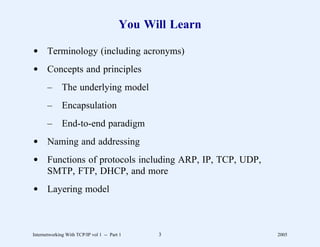
d Terminology (including acronyms)
d Concepts and principles
       –      The underlying model
       –      Encapsulation
       –      End-to-end paradigm
d Naming and addressing
d Functions of protocols including ARP, IP, TCP, UDP,
  SMTP, FTP, DHCP, and more
d Layering model


Internetworking With TCP/IP vol 1 -- Part 1    3          2005
You Will Learn
                                              (continued)

d Internet architecture and routing
d Applications


Internetworking With TCP/IP vol 1 -- Part 1        4        2005
What You Will NOT Learn

d A list of vendors, hardware products, software products,
  services, comparisons, or prices
d Alternative internetworking technologies (they have all
  disappeared!)


Internetworking With TCP/IP vol 1 -- Part 1   5              2005
Schedule Of Topics

d Introduction
d Review of
       –      Network hardware
       –      Physical addressing
d Internet model and concept
d Internet (IP) addresses
d Higher-level protocols and the layering principle
d Examples of internet architecture


Internetworking With TCP/IP vol 1 -- Part 1   6           2005
Schedule Of Topics
                                              (continued)

d Routing update protocols
d Application-layer protocols


Internetworking With TCP/IP vol 1 -- Part 1        7        2005
Why Study TCP/IP?

d The Internet is everywhere
d Most applications are distributed


Internetworking With TCP/IP vol 1 -- Part 1   8        2005
Remainder Of This Section

d History of Internet protocols (TCP/IP)
d Organizations
d Documents


Internetworking With TCP/IP vol 1 -- Part 1   9        2005
Vendor Independence

d Before TCP/IP and the Internet
       –      Only two sources of network protocols
              *      Specic vendors such as IBM or Digital Equipment
              *      Standards bodies such as the ITU (formerly known
                     as CCITT)
d TCP/IP
       –      Vendor independent


Internetworking With TCP/IP vol 1 -- Part 1   10                        2005
Who Built TCP/IP?

d Internet Architecture Board (IAB)
d Originally known as Internet Activities Board
d Evolved from Internet Research Group
d Forum for exchange among researchers
d About a dozen members
d Reorganized in 1989 and 1993
d Merged into the Internet Society in 1992


Internetworking With TCP/IP vol 1 -- Part 1   11        2005
Components Of The
                                     IAB Organization

d IAB (Internet Architecture Board)
       –      Board that oversees and arbitrates
       –      URL is
                                http://www.iab.org/iab

d IRTF (Internet Research Task Force)
       –      Coordinates research on TCP/IP and internetworking
       –      Virtually defunct, but may re-emerge


Internetworking With TCP/IP vol 1 -- Part 1   12                   2005
Components Of The
                                     IAB Organization
                                              (continued)
d IETF (Internet Engineering Task Force)
       –      Coordinates protocol and Internet engineering
       –      Headed by Internet Engineering Steering Group (IESG)
       –      Divided into N areas (N is 10 plus or minus a few)
       –      Each area has a manager
       –      Composed of working groups (volunteers)
       –      URL is
                                          http://www.ietf.org


Internetworking With TCP/IP vol 1 -- Part 1        13              2005
ICANN

d Internet Corporation for Assigned Names and Numbers
                                         http://www.icann.org

d Formed in 1998 to subsume IANA contract
d Not-for-prot managed by international board
d Now sets policies for addresses and domain names
d Support organizations
       –      Address allocation (ASO)
       –      Domain Names (DNSO)
       –      Protocol parameter assignments (PSO)


Internetworking With TCP/IP vol 1 -- Part 1       14            2005
ICANN

d Internet Corporation for Assigned Names and Numbers
                                         http://www.icann.org

d Formed in 1998 to subsume IANA contract
d Not-for-prot managed by international board
d Now sets policies for addresses and domain names
d Support organizations
       –      Address allocation (ASO)
       –      Domain Names (DNSO)
       –      Protocol parameter assignments (PSO)
d For fun see http://www.icannwatch.org
Internetworking With TCP/IP vol 1 -- Part 1       14            2005
World Wide Web Consortium

d Organization to develop common protocols for World Wide
  Web
d Open membership
d Funded by commercial members
d URL is

                                              http://w3c.org


Internetworking With TCP/IP vol 1 -- Part 1         15         2005
Internet Society

d Organization that promotes the use of the Internet
d Formed in 1992
d Not-for-prot
d Governed by a board of trustees
d Members worldwide
d URL is

                                         http://www.isoc.org


Internetworking With TCP/IP vol 1 -- Part 1      16            2005
Protocol Specications
                                    And Documents

d Protocols documented in series of reports
d Documents known as Request For Comments (RFCs)


Internetworking With TCP/IP vol 1 -- Part 1   17          2005
RFCs

d Series of reports that include
       –      TCP/IP protocols
       –      The Internet
       –      Related technologies
d Edited, but not peer-reviewed like scientic journals
d Contain:
       –      Proposals
       –      Surveys and measurements
       –      Protocol standards


Internetworking With TCP/IP vol 1 -- Part 1    18         2005
RFCs

d Series of reports that include
       –      TCP/IP protocols
       –      The Internet
       –      Related technologies
d Checked and edited by IESG
d Contain:
       –      Proposals
       –      Surveys and measurements
       –      Protocol Standards
       –      Jokes!


Internetworking With TCP/IP vol 1 -- Part 1    19    2005
RFCs
                                              (continued)

d Numbered in chronological order
d Revised document reissued under new number
d Numbers ending in 99 reserved for summary of previous
  100 RFCs
d Index and all RFCs available on-line


Internetworking With TCP/IP vol 1 -- Part 1       20        2005
Requirements RFCs

d Host Requirements Documents
       –      Major revision/clarification of most TCP/IP protocols
       –      RFC 1122 (Communication Layers)
       –      RFC 1123 (Application & Support)
       –      RFC 1127 (Perspective on 1122-3)
d Router Requirements
       –      Major specification of protocols used in IP gateways
              (routers)
       –      RFC 1812 (updated by RFC 2644)


Internetworking With TCP/IP vol 1 -- Part 1   21                     2005
Special Subsets Of RFCs

d For Your Information (FYI)
       –      Provide general information
       –      Intended for beginners
d Best Current Practices (BCP)
       –      Engineering hints
       –      Reviewed and approved by IESG


Internetworking With TCP/IP vol 1 -- Part 1   22        2005
A Note About RFCs

d RFCs span two extremes
       –      Protocol standards
       –      Jokes
d Question: how does one know which are standards?


Internetworking With TCP/IP vol 1 -- Part 1   23        2005
TCP/IP Standards (STD)

d Set by vote of IETF
d Documented in subset of RFCs
d Found in Internet Official Protocol Standards RFC and on
  IETF web site
       –      Issued periodically
       –      Current version is RFC 3600


Internetworking With TCP/IP vol 1 -- Part 1   24         2005
Internet Drafts

d Preliminary RFC documents
d Often used by IETF working groups
d Available on-line from several repositories
d Either become RFCs within six months or disappear


Internetworking With TCP/IP vol 1 -- Part 1     25          2005
Obtaining RFCs And
                                    Internet Drafts

d Available via
       –      Email
       –      FTP
       –      World Wide Web
                                              http://www.ietf.org/

d IETF report contains summary of weekly activity

                                http://www.isoc.org/ietfreport/


Internetworking With TCP/IP vol 1 -- Part 1            26            2005
Summary

d TCP/IP is vendor-independent
d Standards set by IETF
d Protocol standards found in document series known as
  Request For Comments (RFCs)
d Standards found in subset of RFCs labeled STD


Internetworking With TCP/IP vol 1 -- Part 1      27      2005
Questions?
PART II

                           REVIEW OF
                    NETWORK HARDWARE AND
                      PHYSICAL ADDRESSING


Internetworking With TCP/IP vol 1 -- Part 2      1      2005
The TCP/IP Concept

d Use existing network hardware
d Interconnect networks
d Add abstractions to hide heterogeneity


Internetworking With TCP/IP vol 1 -- Part 2   2         2005
The Challenge

d Accommodate all possible network hardware
d Question: what kinds of hardware exist?


Internetworking With TCP/IP vol 1 -- Part 2         3         2005
Network Hardware Review

d We will
       –      Review basic network concepts
       –      Examine example physical network technologies
       –      Introduce physical (hardware) addressing


Internetworking With TCP/IP vol 1 -- Part 2   4               2005
Two Basic Categories
                                Of Network Hardware

d Connection oriented
d Connectionless


Internetworking With TCP/IP vol 1 -- Part 2   5        2005
Connection Oriented
                       (Circuit Switched Technology)

d Paradigm
       –      Form a ‘‘connection’’ through the network
       –      Send / receive data over the connection
       –      Terminate the connection
d Can guarantee bandwidth
d Proponents argue that it works well with real-time
  applications
d Example: ATM network


Internetworking With TCP/IP vol 1 -- Part 2   6           2005
Connectionless
                       (Packet Switched Technology)

d Paradigm
       –      Form ‘‘packet’’ of data
       –      Pass to network
d Each packet travels independently
d Packet includes identication of the destination
d Each packet can be a different size
d The maximum packet size is xed (some technologies limit
  packet sizes to 1,500 octets or less)


Internetworking With TCP/IP vol 1 -- Part 2   7         2005
Broad Characterizations Of
                          Packet Switching Networks

d Local Area Network (LAN)
d Wide Area Network (WAN)
d Categories are informal and qualitative


Internetworking With TCP/IP vol 1 -- Part 2   8        2005
Local Area Networks

d Engineered for
       –      Low cost
       –      High capacity
d Direct connection among computers
d Limited distance


Internetworking With TCP/IP vol 1 -- Part 2   9         2005
Wide Area Networks
                                 (Long Haul Networks)

d Engineered for
       –      Long distances
       –      Indirect interconnection via special-purpose hardware
d Higher cost
d Lower capacity (usually)


Internetworking With TCP/IP vol 1 -- Part 2   10                      2005
Examples Of Packet
                                    Switched Networks

d Wide Area Nets
       –      ARPANET, NSFNET, ANSNET
       –      Common carrier services
d Leased line services
       –      Point-to-point connections
d Local Area Nets
       –      Ethernet
       –      Wi-Fi


Internetworking With TCP/IP vol 1 -- Part 2   11         2005
ARPANET (1969-1989)

d Original backbone of Internet
d Wide area network around which TCP/IP was developed
d Funding from Advanced Research Project Agency
d Initial speed 50 Kbps


Internetworking With TCP/IP vol 1 -- Part 2   12        2005
NSFNET (1987-1992)

d Funded by National Science Foundation
d Motivation: Internet backbone to connect all scientists and
  engineers
d Introduced Internet hierarchy
       –      Wide area backbone spanning geographic U.S.
       –      Many mid-level (regional) networks that attach to
              backbone
       –      Campus networks at lowest level
d Initial speed 1.544 Mbps


Internetworking With TCP/IP vol 1 -- Part 2   13                  2005
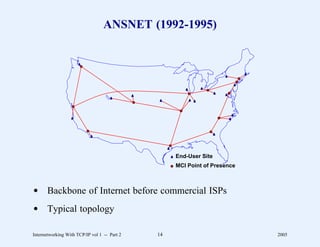
ANSNET (1992-1995)


                                                   End-User Site
                                                   MCI Point of Presence


d Backbone of Internet before commercial ISPs
d Typical topology

Internetworking With TCP/IP vol 1 -- Part 2   14                           2005
Wide Area Networks Available
                        From Common Carriers

d Point-to-point digital circuits
       –      T-series (e.g., T1 = 1.5 Mbps, T3 = 45 Mbps)
       –      OC-series (e.g., OC-3 = 155 Mbps, OC-48 = 2.4 Gbps)
d Packet switching services also available
       –      Examples: ISDN, SMDS, Frame Relay, ATM


Internetworking With TCP/IP vol 1 -- Part 2   15                2005
Example Local Area
                                    Network: Ethernet

d Extremely popular
d Can run over
       –      Copper (twisted pair)
       –      Optical fiber
d Three generations
       –      10Base-T operates at 10 Mbps
       –      100Base-T (fast Ethernet) operates at 100 Mbps
       –      1000Base-T (gigabit Ethernet) operates at 1 Gbps
d IEEE standard is 802.3

Internetworking With TCP/IP vol 1 -- Part 2   16                 2005
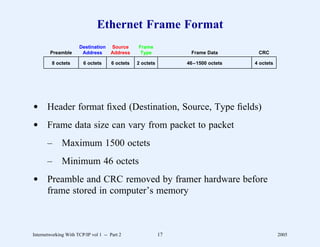
Ethernet Frame Format
                      Destination    Source      Frame
        Preamble       Address       Address      Type            Frame Data       CRC

         8 octets       6 octets      6 octets   2 octets        46–1500 octets   4 octets


d Header format xed (Destination, Source, Type elds)
d Frame data size can vary from packet to packet
       –      Maximum 1500 octets
       –      Minimum 46 octets
d Preamble and CRC removed by framer hardware before
  frame stored in computer’s memory


Internetworking With TCP/IP vol 1 -- Part 2                 17                               2005
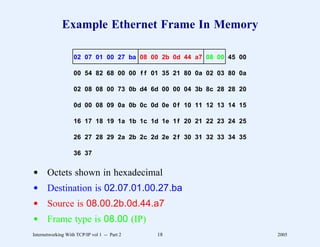
Example Ethernet Frame In Memory

                   02 07 01 00 27 ba 08 00 2b 0d 44 a7 08 00 45 00

                   00 54 82 68 00 00 f f 01 35 21 80 0a 02 03 80 0a

                   02 08 08 00 73 0b d4 6d 00 00 04 3b 8c 28 28 20

                   0d 00 08 09 0a 0b 0c 0d 0e 0 f 10 11 12 13 14 15

                   16 17 18 19 1a 1b 1c 1d 1e 1 f 20 21 22 23 24 25

                   26 27 28 29 2a 2b 2c 2d 2e 2 f 30 31 32 33 34 35

                   36 37


d Octets shown in hexadecimal
d Destination is 02.07.01.00.27.ba
d Source is 08.00.2b.0d.44.a7
d Frame type is 08.00 (IP)
Internetworking With TCP/IP vol 1 -- Part 2   18                      2005
Point-to-Point Network

d Any direct connection between two computers
       –      Leased line
       –      Connection between two routers
       –      Dialup connection
d Link-level protocol required for framing
d TCP/IP views as an independent network


Note: some pundits argue the terminology is incorrect because a
connection limited to two endpoints is not technically a
‘‘network’’


Internetworking With TCP/IP vol 1 -- Part 2   19            2005
Hardware Address

d Unique number assigned to each machine on a network
d Used to identify destination for a packet


Internetworking With TCP/IP vol 1 -- Part 2   20        2005
Hardware Address Terminology

d Known as
       –      MAC (Media Access Control) address
       –      Physical address
       –      Hardware unicast address
d Hardware engineers assign ne distinctions to the above
  terms
d We will treat all terms equally


Internetworking With TCP/IP vol 1 -- Part 2   21            2005
Use Of Hardware Address

d Sender supplies
       –      Destination’s address
       –      Source address (in most technologies)
d Network hardware
       –      Uses destination address to forward packet
       –      Delivers packet to proper machine.
d Important note: each technology denes its own addressing
  scheme


Internetworking With TCP/IP vol 1 -- Part 2   22           2005
Three Types Of Hardware
                             Addressing Schemes

d Static
       –      Address assigned by hardware vendor
d Congurable
       –      Address assigned by customer
d Dynamic
       –      Address assigned by software at startup


Internetworking With TCP/IP vol 1 -- Part 2   23        2005
Examples Of Hardware Address Types

d Congurable: proNET-10 (Proteon)
       –      8-bit address per interface card
       –      All 1s address reserved for broadcast
       –      Address assigned by customer when device installed
d Dynamic MAC addressing: LocalTalk (Apple)
       –      Randomized bidding
       –      Handled by protocols in software


Internetworking With TCP/IP vol 1 -- Part 2   24                   2005
Examples Of Hardware Address Types
                                              (continued)

d Static MAC addressing: Ethernet
       –      48-bit address
       –      Unicast address assigned when device manufactured
       –      All 1s address reserved for broadcast
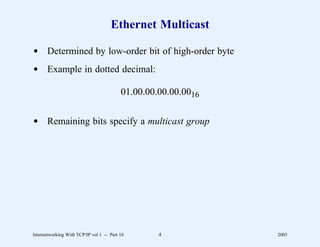
       –      One-half address space reserved for multicast (restricted
              form of broadcast)
d Ethernet’s static addressing is now most common form


Internetworking With TCP/IP vol 1 -- Part 2       25                 2005
Bridge

d Hardware device that connects multiple LANs and makes
  them appear to be a single LAN
d Repeats all packets from one LAN to the other and vice
  versa
d Introduces delay of 1 packet-time
d Does not forward collisions or noise
d Called Layer 2 Interconnect or Layer 2 forwarder
d Makes multiple LANs appear to be a single, large LAN
d Often embedded in other equipment (e.g., DSL modem)


Internetworking With TCP/IP vol 1 -- Part 2     26         2005
Bridge
                                              (continued)

d Watches packets to learn which computers are on which
  side of the bridge
d Uses hardware addresses to lter


Internetworking With TCP/IP vol 1 -- Part 2       27        2005
Layer 2 Switch

d Electronic device
d Computers connect directly
d Applies bridging algorithm
d Can separate computers onto virtual networks (VLAN
  switch)


Internetworking With TCP/IP vol 1 -- Part 2     28         2005
Physical Networks As
                                   Viewed By TCP/IP

d TCP/IP protocols accommodate
       –      Local Area Network
       –      Wide Area Network
       –      Point-to-point link
       –      Set of bridged LANs


Internetworking With TCP/IP vol 1 -- Part 2   29         2005
The Motivation For Heterogeneity

d Each network technology has advantages for some
  applications
d Consequence: an internet may contain combinations of
  technologies


Internetworking With TCP/IP vol 1 -- Part 2   30         2005
Heterogeneity And Addressing

d Recall: each technology can dene its own addressing
  scheme
d Heterogeneous networks imply potential for heterogeneous
  addressing
d Conclusion: cannot rely on hardware addressing


Internetworking With TCP/IP vol 1 -- Part 2   31         2005
Summary

d TCP/IP is designed to use all types of networks
       –      Connection-oriented
       –      Connectionless
       –      Local Area Network (LAN)
       –      Wide Area Network (WAN)
       –      Point-to-point link
       –      Set of bridged networks


Internetworking With TCP/IP vol 1 -- Part 2      32     2005
Summary
                                              (continued)

d Each technology denes an addressing scheme
d TCP/IP must accommodate heterogeneous addressing
  schemes


Internetworking With TCP/IP vol 1 -- Part 2       33        2005
Questions?
PART III

               INTERNETWORKING CONCEPT
               AND ARCHITECTURAL MODEL


Internetworking With TCP/IP vol 1 -- Part 3      1       2005
Accommodating Heterogeneity

d Approach 1
       –      Application gateways
       –      Gateway forwards data from one network to another
       –      Example: file transfer gateway
d Approach 2
       –      Network-level gateways
       –      Gateway forwards individual packets
d Discussion question: which is better?


Internetworking With TCP/IP vol 1 -- Part 3   2                   2005
Desired Properties

d Universal service
d End-to-end connectivity
d Transparency


Internetworking With TCP/IP vol 1 -- Part 3   3            2005
Agreement Needed To
                           Achieve Desired Properties

d Data formats
d Procedures for exchanging information
d Identication
       –      Services
       –      Computers
       –      Applications
d Broad concepts: naming and addressing


Internetworking With TCP/IP vol 1 -- Part 3   4         2005
The TCP/IP Internet Concept

d Use available networks
d Interconnect physical networks
       –      Network of networks
       –      Revolutionary when proposed
d Devise abstractions that hide
       –      Underlying architecture
       –      Hardware addresses
       –      Routes


Internetworking With TCP/IP vol 1 -- Part 3   5      2005
Network Interconnection

d Uses active system
d Each network sees an additional computer attached
d Device is IP router (originally called IP gateway)


Internetworking With TCP/IP vol 1 -- Part 3   6         2005
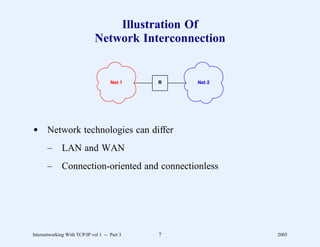
Illustration Of
                              Network Interconnection


                                     Net 1    R   Net 2


d Network technologies can differ
       –      LAN and WAN
       –      Connection-oriented and connectionless


Internetworking With TCP/IP vol 1 -- Part 3   7           2005
Building An Internet

d Use multiple IP routers
d Ensure that each network is reachable
d Do not need router between each pair of networks


Internetworking With TCP/IP vol 1 -- Part 3   8           2005
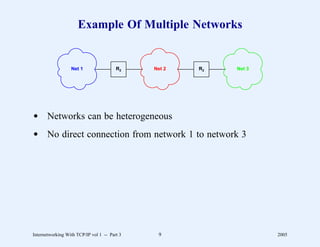
Example Of Multiple Networks


                  Net 1                 R2    Net 2   R2   Net 3


d Networks can be heterogeneous
d No direct connection from network 1 to network 3


Internetworking With TCP/IP vol 1 -- Part 3    9                   2005
Physical Connectivity


In a TCP/IP internet, special computers called IP routers or IP
gateways provide interconnections among physical networks.


Internetworking With TCP/IP vol 1 -- Part 3   10            2005
Packet Transmission Paradigm

d Source computer
       –      Generates a packet
       –      Sends across one network to a router
d Intermediate router
       –      Forwards packet to ‘‘next’’ router
d Final router
       –      Delivers packet to destination


Internetworking With TCP/IP vol 1 -- Part 3   11     2005
An Important Point
                                    About Forwarding


Routers use the destination network, not the destination
computer, when forwarding packets.


Internetworking With TCP/IP vol 1 -- Part 3   12         2005
Equal Treatment


The TCP/IP internet protocols treat all networks equally. A
Local Area Network such as an Ethernet, a Wide Area Network
used as a backbone, or a point-to-point link between two
computers each count as one network.


Internetworking With TCP/IP vol 1 -- Part 3    13         2005
User’s View Of Internet

d Single large (global) network
d User’s computers all attach directly
d No other structure visible


Internetworking With TCP/IP vol 1 -- Part 3   14         2005
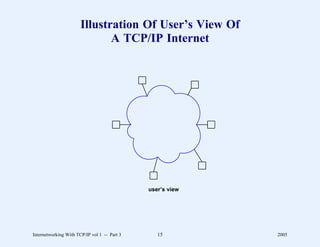
Illustration Of User’s View Of
                              A TCP/IP Internet


                                              user’s view


Internetworking With TCP/IP vol 1 -- Part 3      15         2005
Actual Internet Architecture

d Multiple physical networks interconnected
d Each host attaches to one network
d Single virtual network achieved through software that
  implements abstractions


Internetworking With TCP/IP vol 1 -- Part 3   16          2005
The Two Views Of
                                     A TCP/IP Internet


                        user’s view                  actual connections


Internetworking With TCP/IP vol 1 -- Part 3   17                          2005
Architectural Terminology

d End-user system is called host computer
       –      Connects to physical network
       –      Possibly many hosts per network
       –      Possibly more than one network connection per host
d Dedicated systems called IP gateways or IP routers
  interconnect networks
       –      Router connects two or more networks


Internetworking With TCP/IP vol 1 -- Part 3   18                   2005
Many Unanswered Questions

d Addressing model and relationship to hardware addresses
d Format of packet as it travels through Internet
d How a host handles concurrent communication with several
  other hosts


Internetworking With TCP/IP vol 1 -- Part 3   19            2005
Summary

d Internet is set of interconnected (possibly heterogeneous)
  networks
d Routers provide interconnection
d End-user systems are called host computers
d Internetworking introduces abstractions that hide details of
  underlying networks


Internetworking With TCP/IP vol 1 -- Part 3      20            2005
Questions?
PART IV

           CLASSFUL INTERNET ADDRESSES


Internetworking With TCP/IP vol 1 -- Part 4      1      2005
Denitions

d Name
       –      Identifies what an entity is
       –      Often textual (e.g., ASCII)
d Address
       –      Identifies where an entity is located
       –      Often binary and usually compact
       –      Sometimes called locator
d Route
       –      Identifies how to get to the object
       –      May be distributed
Internetworking With TCP/IP vol 1 -- Part 4       2        2005
Internet Protocol Address
                                  (IP Address)

d Analogous to hardware address
d Unique value assigned as unicast address to each host on
  Internet
d Used by Internet applications


Internetworking With TCP/IP vol 1 -- Part 4   3              2005
IP Address Details

d 32-bit binary value
d Unique value assigned to each host in Internet
d Values chosen to make routing efcient


Internetworking With TCP/IP vol 1 -- Part 4   4            2005
IP Address Division

d Address divided into two parts
       –      Prefix (network ID) identifies network to which host
              attaches
       –      Suffix (host ID) identifies host on that network


Internetworking With TCP/IP vol 1 -- Part 4   5                    2005
Classful Addressing

d Original IP scheme
d Explains many design decisions
d New schemes are backward compatible


Internetworking With TCP/IP vol 1 -- Part 4   6           2005
Desirable Properties Of An
                         Internet Addressing Scheme

d Compact (as small as possible)
d Universal (big enough)
d Works with all network hardware
d Supports efcient decision making
       –      Test whether a destination can be reached directly
       –      Decide which router to use for indirect delivery
       –      Choose next router along a path to the destination


Internetworking With TCP/IP vol 1 -- Part 4   7                    2005
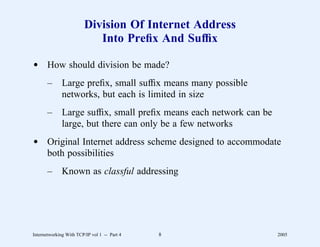
Division Of Internet Address
                           Into Prex And Sufx

d How should division be made?
       –      Large prefix, small suffix means many possible
              networks, but each is limited in size
       –      Large suffix, small prefix means each network can be
              large, but there can only be a few networks
d Original Internet address scheme designed to accommodate
  both possibilities
       –      Known as classful addressing


Internetworking With TCP/IP vol 1 -- Part 4   8                    2005
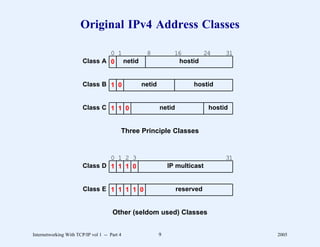
Original IPv4 Address Classes

                                0 1              8           16      24        31
                        Class A 0 netid                       hostid


                        Class B 1 0            netid                hostid


                        Class C 1 1 0                  netid              hostid


                                          Three Principle Classes


                                0 1 2 3                                        31
                        Class D 1 1 1 0                    IP multicast


                        Class E 1 1 1 1 0                      reserved


                                      Other (seldom used) Classes


Internetworking With TCP/IP vol 1 -- Part 4            9                            2005
Important Property

d Classful addresses are self-identifying
d Consequences
       –      Can determine boundary between prefix and suffix from
              the address itself
       –      No additional state needed to store boundary information
       –      Both hosts and routers benefit


Internetworking With TCP/IP vol 1 -- Part 4   10                   2005
Endpoint Identication


Because IP addresses encode both a network and a host on that
network, they do not specify an individual computer, but a
connection to a network.


Internetworking With TCP/IP vol 1 -- Part 4   11          2005
IP Address Conventions

d When used to refer to a network
       –      Host field contains all 0 bits
d Broadcast on the local wire
       –      Network and host fields both contain all 1 bits
d Directed broadcast: broadcast on specic (possibly remote)
  network
       –      Host field contains all 1 bits
       –      Nonstandard form: host field contains all 0 bits


Internetworking With TCP/IP vol 1 -- Part 4   12                2005
Assignment Of IP Addresses

d All hosts on same network assigned same address prex
       –      Prefixes assigned by central authority
       –      Obtained from ISP
d Each host on a network has a unique sufx
       –      Assigned locally
       –      Local administrator must ensure uniqueness


Internetworking With TCP/IP vol 1 -- Part 4   13           2005
Advantages Of Classful Addressing

d Computationally efcient
       –      First bits specify size of prefix / suffix
d Allows mixtures of large and small networks


Internetworking With TCP/IP vol 1 -- Part 4   14         2005
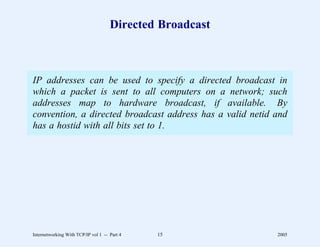
Directed Broadcast


IP addresses can be used to specify a directed broadcast in
which a packet is sent to all computers on a network; such
addresses map to hardware broadcast, if available. By
convention, a directed broadcast address has a valid netid and
has a hostid with all bits set to 1.


Internetworking With TCP/IP vol 1 -- Part 4   15           2005
Limited Broadcast

d All 1’s
d Broadcast limited to local network only (no forwarding)
d Useful for bootstrapping


Internetworking With TCP/IP vol 1 -- Part 4   16            2005
All Zeros IP Address

d Can only appear as source address
d Used during bootstrap before computer knows its address
d Means ‘‘this’’ computer


Internetworking With TCP/IP vol 1 -- Part 4   17            2005
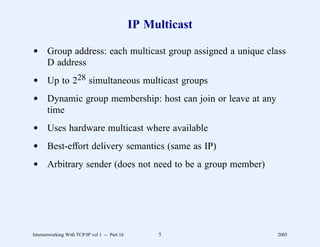
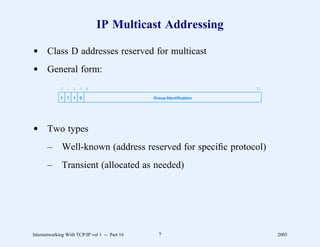
Internet Multicast

d IP allows Internet multicast, but no Internet-wide multicast
  delivery system currently in place
d Class D addresses reserved for multicast
d Each address corresponds to group of participating
  computers
d IP multicast uses hardware multicast when available
d More later in the course


Internetworking With TCP/IP vol 1 -- Part 4   18             2005
Consequences Of IP Addressing

d If a host computer moves from one network to another, its
  IP address must change
d For a multi-homed host (with two or more addresses), the
  path taken by packets depends on the address used


Internetworking With TCP/IP vol 1 -- Part 4   19             2005
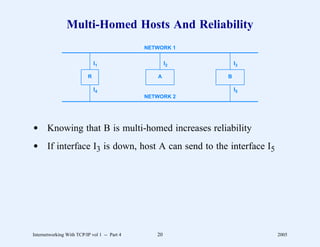
Multi-Homed Hosts And Reliability
                                              NETWORK 1


                              I1                      I2       I3

                          R                      A         B

                              I4                               I5
                                              NETWORK 2


d Knowing that B is multi-homed increases reliability
d If interface I3 is down, host A can send to the interface I5


Internetworking With TCP/IP vol 1 -- Part 4      20                 2005
Dotted Decimal Notation

d Syntactic form for expressing 32-bit address
d Used throughout the Internet and associated literature
d Represents each octet in decimal separated by periods (dots)


Internetworking With TCP/IP vol 1 -- Part 4   21            2005
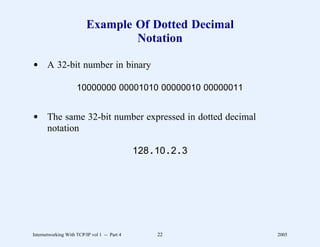
Example Of Dotted Decimal
                                  Notation

d A 32-bit number in binary

                     10000000 00001010 00000010 00000011


d The same 32-bit number expressed in dotted decimal
  notation

                                              128 . 10 . 2 . 3


Internetworking With TCP/IP vol 1 -- Part 4          22          2005
Loopback Address

d Used for testing
d Refers to local computer (never sent to Internet)
d Address is 127.0.0.1


Internetworking With TCP/IP vol 1 -- Part 4   23         2005
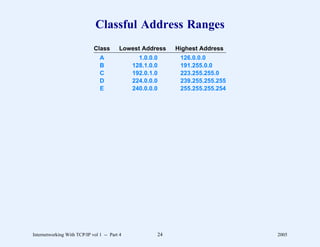
Classful Address Ranges
                             Class        Lowest Address   Highest Address
                                A               1.0.0.0     126.0.0.0
                                B             128.1.0.0     191.255.0.0
                                C             192.0.1.0     223.255.255.0
                                D             224.0.0.0     239.255.255.255
                                E             240.0.0.0     255.255.255.254


Internetworking With TCP/IP vol 1 -- Part 4           24                      2005
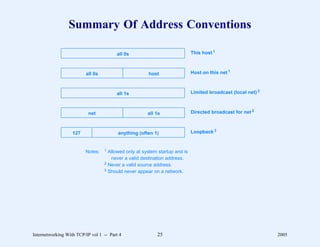
Summary Of Address Conventions

                                        all 0s                              This host 1


                         all 0s                       host                  Host on this net 1


                                        all 1s                              Limited broadcast (local net) 2


                           net                        all 1s                Directed broadcast for net 2


                   127                   anything (often 1)                 Loopback 3


                         Notes:   1 Allowed only at system startup and is
                                     never a valid destination address.
                                  2 Never a valid source address.
                                  3 Should never appear on a network.


Internetworking With TCP/IP vol 1 -- Part 4               25                                                  2005
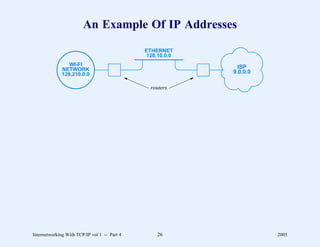
An Example Of IP Addresses
                                              ETHERNET
                                              128.10.0.0
                 WI-FI                                       ISP
              NETWORK                                      9.0.0.0
              128.210.0.0

                                                routers


Internetworking With TCP/IP vol 1 -- Part 4       26                 2005
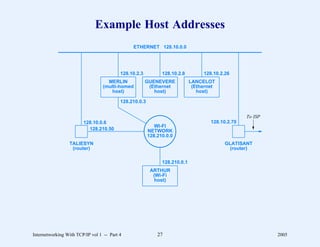
Example Host Addresses
                                               ETHERNET 128.10.0.0


                                          128.10.2.3          128.10.2.8         128.10.2.26
                                    MERLIN             GUENEVERE            LANCELOT
                                  (multi-homed          (Ethernet            (Ethernet
                                     host)                host)                host)

                                          128.210.0.3


                                                                                                  To ISP
                        128.10.0.6                                                  128.10.2.70
                                                           WI-FI
                          128.210.50                    NETWORK
                                                        128.210.0.0
                 TALIESYN                                                                 GLATISANT
                  (router)                                                                 (router)

                                                              128.210.0.1
                                                         ARTHUR
                                                          (Wi-Fi
                                                           host)


Internetworking With TCP/IP vol 1 -- Part 4                 27                                             2005
Another Addressing Example

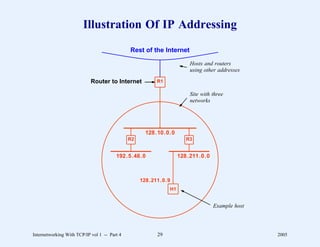
d Assume an organization has three networks
d Organization obtains three prexes, one per network
d Host address must begin with network prex


Internetworking With TCP/IP vol 1 -- Part 4   28        2005
Illustration Of IP Addressing
                                              Rest of the Internet

                                                                       Hosts and routers
                                                                       using other addresses

                            Router to Internet           R1

                                                                       Site with three
                                                                       networks


                                                    128.10.0.0
                                              R2                     R3


                                        192.5.48.0                 128.211.0.0


                                                   128.211.0.9
                                                              H1


                                                                                 Example host


Internetworking With TCP/IP vol 1 -- Part 4              29                                     2005
Summary

d IP address
       –      32 bits long
       –      Prefix identifies network
       –      Suffix identifies host
d Classful addressing uses rst few bits of address to
  determine boundary between prex and sufx


Internetworking With TCP/IP vol 1 -- Part 4      30      2005
Summary
                                              (continued)

d Special forms of addresses handle
       –      Limited broadcast
       –      Directed broadcast
       –      Network identification
       –      This host
       –      Loopback


Internetworking With TCP/IP vol 1 -- Part 4       31        2005
Questions?
PART V

             MAPPING INTERNET ADDRESSES
               TO PHYSICAL ADDRESSES
                        (ARP)


Internetworking With TCP/IP vol 1 -- Part 5     1      2005
Motivation

d Must use hardware (physical) addresses to communicate
  over network
d Applications only use Internet addresses


Internetworking With TCP/IP vol 1 -- Part 5       2        2005
Example

d Computers A and B on same network
d Application on A generates packet for application on B
d Protocol software on A must use B’s hardware address
  when sending a packet


Internetworking With TCP/IP vol 1 -- Part 5      3         2005
Consequence

d Protocol software needs a mechanism that maps an IP
  address to equivalent hardware address
d Known as address resolution problem


Internetworking With TCP/IP vol 1 -- Part 5        4        2005
Address Resolution

d Performed at each step along path through Internet
d Two basic algorithms
       –      Direct mapping
       –      Dynamic binding
d Choice depends on type of hardware


Internetworking With TCP/IP vol 1 -- Part 5   5           2005
Direct Mapping

d Easy to understand
d Efcient
d Only works when hardware address is small
d Technique: assign computer an IP address that encodes the
  hardware address


Internetworking With TCP/IP vol 1 -- Part 5    6          2005
Example Of Direct Mapping

d Hardware: proNet ring network
d Hardware address: 8 bits
d Assume IP address 192.5.48.0 (24-bit prex)
d Assign computer with hardware address K an IP address
  192.5.48.K
d Resolving an IP address means extracting the hardware
  address from low-order 8 bits


Internetworking With TCP/IP vol 1 -- Part 5   7           2005
Dynamic Binding

d Needed when hardware addresses are large (e.g., Ethernet)
d Allows computer A to find computer B’s hardware address
       –      A starts with B’s IP address
       –      A knows B is on the local network
d Technique: broadcast query and obtain response
d Note: dynamic binding only used across one network at a
  time


Internetworking With TCP/IP vol 1 -- Part 5   8             2005
Internet Address Resolution Protocol (ARP)

d Standard for dynamic address resolution in the Internet
d Requires hardware broadcast
d Intended for LAN
d Important idea: ARP only used to map addresses within a
  single physical network, never across multiple networks


Internetworking With TCP/IP vol 1 -- Part 5   9             2005
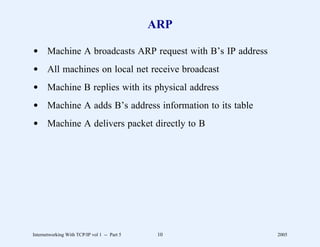
ARP

d Machine A broadcasts ARP request with B’s IP address
d All machines on local net receive broadcast
d Machine B replies with its physical address
d Machine A adds B’s address information to its table
d Machine A delivers packet directly to B


Internetworking With TCP/IP vol 1 -- Part 5    10        2005
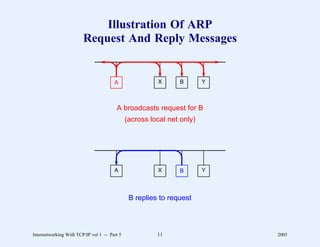
Illustration Of ARP
                        Request And Reply Messages


                                       A                X      B        Y


                                        A broadcasts request for B
                                              (across local net only)


                                       A                X      B        Y


                                               B replies to request


Internetworking With TCP/IP vol 1 -- Part 5             11                  2005
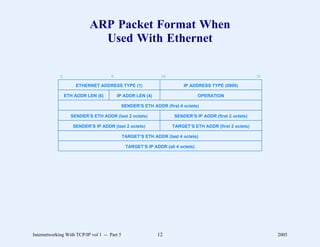
ARP Packet Format When
                             Used With Ethernet

             0                        8                       16                                        31

                     ETHERNET ADDRESS TYPE (1)                           IP ADDRESS TYPE (0800)

                 ETH ADDR LEN (6)         IP ADDR LEN (4)                        OPERATION

                                           SENDER’S ETH ADDR (first 4 octets)

                   SENDER’S ETH ADDR (last 2 octets)                SENDER’S IP ADDR (first 2 octets)

                    SENDER’S IP ADDR (last 2 octets)               TARGET’S ETH ADDR (first 2 octets)

                                              TARGET’S ETH ADDR (last 4 octets)

                                               TARGET’S IP ADDR (all 4 octets)


Internetworking With TCP/IP vol 1 -- Part 5                  12                                              2005
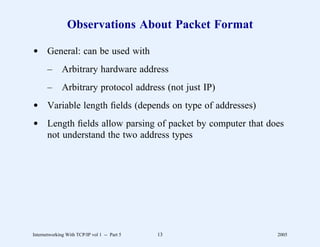
Observations About Packet Format

d General: can be used with
       –      Arbitrary hardware address
       –      Arbitrary protocol address (not just IP)
d Variable length elds (depends on type of addresses)
d Length elds allow parsing of packet by computer that does
  not understand the two address types


Internetworking With TCP/IP vol 1 -- Part 5   13          2005
Retention Of Bindings

d Cannot afford to send ARP request for each packet
d Solution
       –      Maintain a table of bindings
d Effect
       –      Use ARP one time, place results in table, and then send
              many packets


Internetworking With TCP/IP vol 1 -- Part 5   14                    2005
ARP Caching

d ARP table is a cache
d Entries time out and are removed
d Avoids stale bindings
d Typical timeout: 20 minutes


Internetworking With TCP/IP vol 1 -- Part 5        15       2005
Algorithm For Processing
                                  ARP Requests

d Extract sender’s pair, (IA, EA) and update local ARP table if
  it exists
d If this is a request and the target is ‘‘me’’
       –      Add sender’s pair to ARP table if not present
       –      Fill in target hardware address
       –      Exchange sender and target entries
       –      Set operation to reply
       –      Send reply back to requester


Internetworking With TCP/IP vol 1 -- Part 5   16              2005
Algorithm Features

d If A ARPs B, B keeps A’s information
       –      B will probably send a packet to A soon
d If A ARPs B, other machines do not keep A’s information
       –      Avoids clogging ARP caches needlessly


Internetworking With TCP/IP vol 1 -- Part 5   17         2005
Conceptual Purpose Of ARP

d Isolates hardware address at low level
d Allows application programs to use IP addresses


Internetworking With TCP/IP vol 1 -- Part 5   18     2005
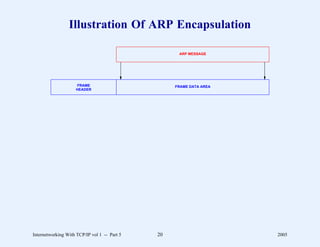
ARP Encapsulation

d ARP message travels in data portion of network frame
d We say ARP message is encapsulated


Internetworking With TCP/IP vol 1 -- Part 5   19         2005
Illustration Of ARP Encapsulation

                                                    ARP MESSAGE


                     FRAME                         FRAME DATA AREA
                     HEADER


Internetworking With TCP/IP vol 1 -- Part 5   20                     2005
Ethernet Encapsulation

d ARP message placed in frame data area
d Data area padded with zeroes if ARP message is shorter
  than minimum Ethernet frame
d Ethernet type 0x0806 used for ARP


Internetworking With TCP/IP vol 1 -- Part 5   21           2005
Reverse Address Resolution Protocol

d Maps Ethernet address to IP address
d Same packet format as ARP
d Intended for bootstrap
       –      Computer sends its Ethernet address
       –      RARP server responds by sending computer’s IP address
d Seldom used (replaced by DHCP)


Internetworking With TCP/IP vol 1 -- Part 5   22                2005
Summary

d Computer’s IP address independent of computer’s hardware
  address
d Applications use IP addresses
d Hardware only understands hardware addresses
d Must map from IP address to hardware address for
  transmission
d Two types
       –      Direct mapping
       –      Dynamic mapping


Internetworking With TCP/IP vol 1 -- Part 5      23     2005
Summary
                                              (continued)

d Address Resolution Protocol (ARP) used for dynamic
  address mapping
d Important for Ethernet
d Sender broadcasts ARP request, and target sends ARP reply
d ARP bindings are cached
d Reverse ARP was originally used for bootstrap


Internetworking With TCP/IP vol 1 -- Part 5       24        2005
Questions?
PART VI

                  INTERNET PROTOCOL:
               CONNECTIONLESS DATAGRAM
                       DELIVERY


Internetworking With TCP/IP vol 1 -- Part 6      1      2005
Internet Protocol

d One of two major protocols in TCP/IP suite
d Major goals
       –      Hide heterogeneity
       –      Provide the illusion of a single large network
       –      Virtualize access


Internetworking With TCP/IP vol 1 -- Part 6     2              2005
The Concept


IP allows a user to think of an internet as a single virtual
network that interconnects all hosts, and through which
communication is possible; its underlying architecture is both
hidden and irrelevant.


Internetworking With TCP/IP vol 1 -- Part 6        3        2005
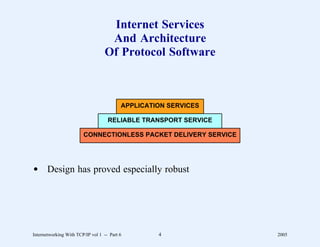
Internet Services
                                   And Architecture
                                  Of Protocol Software


                                          APPLICATION SERVICES

                                    RELIABLE TRANSPORT SERVICE

                        CONNECTIONLESS PACKET DELIVERY SERVICE


d Design has proved especially robust


Internetworking With TCP/IP vol 1 -- Part 6        4             2005
IP Characteristics

d Provides connectionless packet delivery service
d Denes three important items
       –      Internet addressing scheme
       –      Format of packets for the (virtual) Internet
       –      Packet forwarding


Internetworking With TCP/IP vol 1 -- Part 6   5              2005
Internet Packet

d Analogous to physical network packet
d Known as IP datagram


Internetworking With TCP/IP vol 1 -- Part 6      6          2005
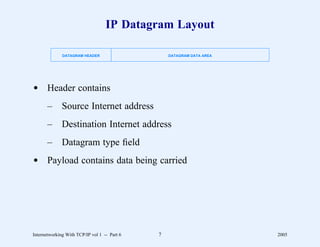
IP Datagram Layout

              DATAGRAM HEADER                     DATAGRAM DATA AREA


d Header contains
       –      Source Internet address
       –      Destination Internet address
       –      Datagram type field
d Payload contains data being carried


Internetworking With TCP/IP vol 1 -- Part 6   7                        2005
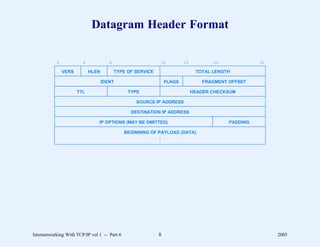
Datagram Header Format

           0            4             8                     16          19          24              31

               VERS         HLEN          TYPE OF SERVICE                     TOTAL LENGTH

                                   IDENT                        FLAGS            FRAGMENT OFFSET

                      TTL                      TYPE                          HEADER CHECKSUM

                                                  SOURCE IP ADDRESS

                                                DESTINATION IP ADDRESS

                                IP OPTIONS (MAY BE OMITTED)                               PADDING

                                              BEGINNING OF PAYLOAD (DATA)
                                                            .
                                                            .
                                                            .


Internetworking With TCP/IP vol 1 -- Part 6                 8                                            2005
Addresses In The Header

d SOURCE is the address of original source
d DESTINATION is the address of ultimate destination


Internetworking With TCP/IP vol 1 -- Part 6   9        2005
IP Versions

d Version eld in header denes version of datagram
d Internet currently uses version 4 of IP, IPv4
d Preceding gure is the IPv4 datagram format
d IPv6 discussed later in the course


Internetworking With TCP/IP vol 1 -- Part 6        10       2005
Datagram Encapsulation

d Datagram encapsulated in network frame
d Network hardware treats datagram as data
d Frame type eld identies contents as datagram
       –      Set by sending computer
       –      Tested by receiving computer


Internetworking With TCP/IP vol 1 -- Part 6   11       2005
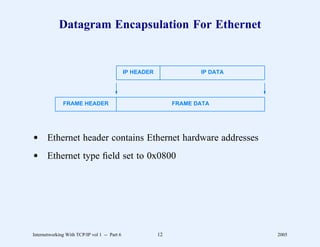
Datagram Encapsulation For Ethernet


                                              IP HEADER               IP DATA


              FRAME HEADER                                     FRAME DATA


d Ethernet header contains Ethernet hardware addresses
d Ethernet type eld set to 0x0800


Internetworking With TCP/IP vol 1 -- Part 6               12                    2005
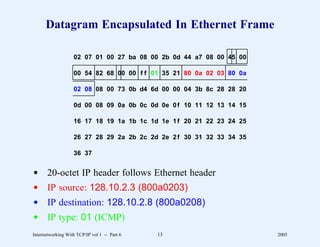
Datagram Encapsulated In Ethernet Frame

                   02 07 01 00 27 ba 08 00 2b 0d 44 a7 08 00 45 00

                   00 54 82 68 00 00 f f 01 35 21 80 0a 02 03 80 0a

                   02 08 08 00 73 0b d4 6d 00 00 04 3b 8c 28 28 20

                   0d 00 08 09 0a 0b 0c 0d 0e 0 f 10 11 12 13 14 15

                   16 17 18 19 1a 1b 1c 1d 1e 1 f 20 21 22 23 24 25

                   26 27 28 29 2a 2b 2c 2d 2e 2 f 30 31 32 33 34 35

                   36 37


d 20-octet IP header follows Ethernet header
d IP source: 128.10.2.3 (800a0203)
d IP destination: 128.10.2.8 (800a0208)
d IP type: 01 (ICMP)
Internetworking With TCP/IP vol 1 -- Part 6   13                      2005
Standards For Encapsulation

d TCP/IP protocols dene encapsulation for each possible type
  of network hardware
       –      Ethernet
       –      Frame Relay
       –      Others


Internetworking With TCP/IP vol 1 -- Part 6   14          2005
Encapsulation Over Serial Networks

d Serial hardware transfers stream of octets
       –      Leased serial data line
       –      Dialup telephone connection
d Encapsulation of IP on serial network
       –      Implemented by software
       –      Both ends must agree
d Most common standards: Point to Point Protocol (PPP)


Internetworking With TCP/IP vol 1 -- Part 6   15         2005
Encapsulation For Avian Carriers (RFC 1149)

d Characteristics of avian carrier
   –   Low throughput
   –   High delay
   –   Low altitude
   –   Point-to-point communication
   –   Intrinsic collision avoidance
d Encapsulation
   –   Write in hexadecimal on scroll of paper
   –   Attach to bird’s leg with duct tape
d For an implementation see

                 http://www.blug.linux.no/rfc1149
A Potential Problem

d A datagram can contain up to 65535 total octets (including
  header)
d Network hardware limits maximum size of frame (e.g.,
  Ethernet limited to 1500 octets)
       –      Known as the network Maximum Transmission Unit
              (MTU)
d Question: how is encapsulation handled if datagram exceeds
  network MTU?


Internetworking With TCP/IP vol 1 -- Part 6   16               2005
Possible Ways To Accommodate
                    Networks With Differing MTUs

d Force datagram to be less than smallest possible MTU
       –      Inefficient
       –      Cannot know minimum MTU
d Hide the network MTU and accommodate arbitrary
  datagram size


Internetworking With TCP/IP vol 1 -- Part 6   17         2005
Accommodating Large Datagrams

d Cannot send large datagram in single frame
d Solution
       –      Divide datagram into pieces
       –      Send each piece in a frame
       –      Called datagram fragmentation


Internetworking With TCP/IP vol 1 -- Part 6   18   2005
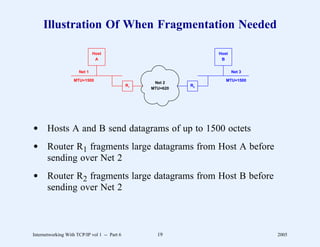
Illustration Of When Fragmentation Needed

                              Host                                Host
                               A                                   B


                      Net 1                                              Net 3

                   MTU=1500                                          MTU=1500
                                                    Net 2
                                              R1             R2
                                                   MTU=620


d Hosts A and B send datagrams of up to 1500 octets
d Router R1 fragments large datagrams from Host A before
  sending over Net 2
d Router R2 fragments large datagrams from Host B before
  sending over Net 2


Internetworking With TCP/IP vol 1 -- Part 6          19                          2005
Datagram Fragmentation

d Performed by routers
d Divides datagram into several, smaller datagrams called
  fragments
d Fragment uses same header format as datagram
d Each fragment forwarded independently


Internetworking With TCP/IP vol 1 -- Part 6   20            2005
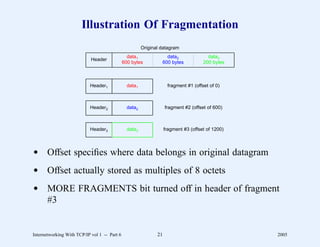
Illustration Of Fragmentation
                                                        Original datagram
                                                             .
                                                             .                     .
                                                                                   .
                                                             .                     .
                                                data1        .
                                                             .      data2          .
                                                                                   .      data3
                            Header                           .
                                                             .                     .
                                                                                   .
                                              600 bytes      .
                                                             .
                                                             .
                                                                  600 bytes        .
                                                                                   .
                                                                                   .
                                                                                        200 bytes
                                                             .                     .


                           Header1              data1                  fragment #1 (offset of 0)


                           Header2              data2                 fragment #2 (offset of 600)


                           Header3              data3                 fragment #3 (offset of 1200)


d Offset species where data belongs in original datagram
d Offset actually stored as multiples of 8 octets
d MORE FRAGMENTS bit turned off in header of fragment
  #3


Internetworking With TCP/IP vol 1 -- Part 6                      21                                  2005
Fragmenting A Fragment

d Fragment can be further fragmented
d Occurs when fragment reaches an even-smaller MTU
d Discussion: which elds of the datagram header are used,
  and what is the algorithm?


Internetworking With TCP/IP vol 1 -- Part 6   22             2005
Reassembly

d Ultimate destination puts fragments back together
       –      Key concept!
       –      Needed in a connectionless Internet
d Known as reassembly
d No need to reassemble subfragments rst
d Timer used to ensure all fragments arrive
       –      Timer started when first fragment arrives
       –      If timer expires, entire datagram discarded


Internetworking With TCP/IP vol 1 -- Part 6       23        2005
Time To Live

d TTL eld of datagram header decremented at each hop (i.e.,
  each router)
d If TTL reaches zero, datagram discarded
d Prevents datagrams from looping indenitely (in case
  forwarding error introduces loop)
d IETF recommends initial value of 255 (max)


Internetworking With TCP/IP vol 1 -- Part 6        24        2005
Checksum Field In Datagram Header

d 16-bit 1’s complement checksum
d Over IP header only!
d Recomputed at each hop


Internetworking With TCP/IP vol 1 -- Part 6   25   2005
IP Options

d Seldom used
d Primarily for debugging
d Only some options copied into fragments
d Are variable length
d Note: padding needed because header length measured in
  32-bit multiples
d Option starts with option code octet


Internetworking With TCP/IP vol 1 -- Part 6       26       2005
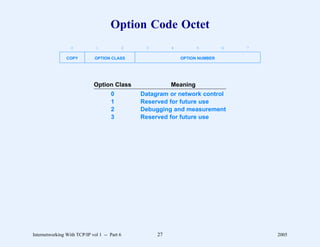
Option Code Octet
                  0           1           2    3        4         5         6   7

                COPY          OPTION CLASS                  OPTION NUMBER


                             Option Class               Meaning
                                     0        Datagram or network control
                                     1        Reserved for future use
                                     2        Debugging and measurement
                                     3        Reserved for future use


Internetworking With TCP/IP vol 1 -- Part 6        27                               2005
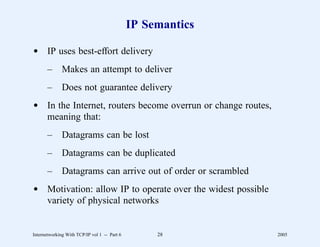
IP Semantics

d IP uses best-effort delivery
       –      Makes an attempt to deliver
       –      Does not guarantee delivery
d In the Internet, routers become overrun or change routes,
  meaning that:
       –      Datagrams can be lost
       –      Datagrams can be duplicated
       –      Datagrams can arrive out of order or scrambled
d Motivation: allow IP to operate over the widest possible
  variety of physical networks


Internetworking With TCP/IP vol 1 -- Part 6        28          2005
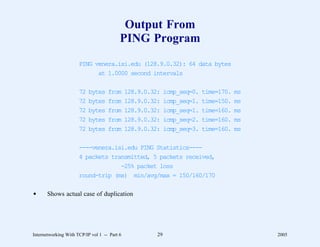
Output From
                                          PING Program
                      PING venera.isi.edu (128.9.0.32): 64 data bytes
                            at 1.0000 second intervals

                      72   bytes    from      128.9.0.32:    icmp_seq=0.   time=170.   ms
                      72   bytes    from      128.9.0.32:    icmp_seq=1.   time=150.   ms
                      72   bytes    from      128.9.0.32:    icmp_seq=1.   time=160.   ms
                      72   bytes    from      128.9.0.32:    icmp_seq=2.   time=160.   ms
                      72   bytes    from      128.9.0.32:    icmp_seq=3.   time=160.   ms

                      ----venera.isi.edu PING Statistics----
                      4 packets transmitted, 5 packets received,
                                   -25% packet loss
                      round-trip (ms) min/avg/max = 150/160/170

d      Shows actual case of duplication


Internetworking With TCP/IP vol 1 -- Part 6             29                                  2005
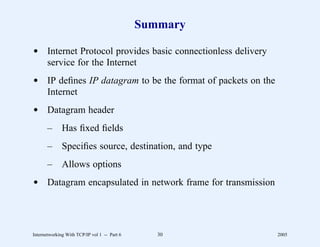
Summary

d Internet Protocol provides basic connectionless delivery
  service for the Internet
d IP denes IP datagram to be the format of packets on the
  Internet
d Datagram header
       –      Has fixed fields
       –      Specifies source, destination, and type
       –      Allows options
d Datagram encapsulated in network frame for transmission


Internetworking With TCP/IP vol 1 -- Part 6      30          2005
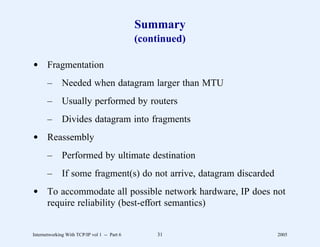
Summary
                                              (continued)

d Fragmentation
       –      Needed when datagram larger than MTU
       –      Usually performed by routers
       –      Divides datagram into fragments
d Reassembly
       –      Performed by ultimate destination
       –      If some fragment(s) do not arrive, datagram discarded
d To accommodate all possible network hardware, IP does not
  require reliability (best-effort semantics)


Internetworking With TCP/IP vol 1 -- Part 6       31                  2005
Questions?
PART VII

                   INTERNET PROTOCOL:
                FORWARDING IP DATAGRAMS


Internetworking With TCP/IP vol 1 -- Part 7      1       2005
Datagram Transmission

d Host delivers datagrams to directly connected machines
d Host sends datagrams that cannot be delivered directly to
  router
d Routers forward datagrams to other routers
d Final router delivers datagram directly


Internetworking With TCP/IP vol 1 -- Part 7   2               2005
Question


                 Does a host need to make forwarding choices?


Internetworking With TCP/IP vol 1 -- Part 7      3              2005
Question


                 Does a host need to make forwarding choices?

                                              Answer: YES!


Internetworking With TCP/IP vol 1 -- Part 7        3            2005
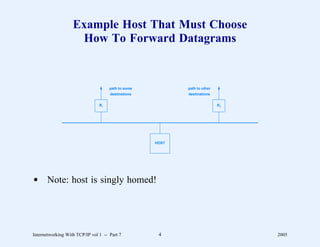
Example Host That Must Choose
                    How To Forward Datagrams


                                     path to some          path to other
                                     destinations          destinations


                                R1                                         R2


                                                    HOST


d Note: host is singly homed!


Internetworking With TCP/IP vol 1 -- Part 7          4                          2005
Two Broad Cases

d Direct delivery
       –      Ultimate destination can be reached over one network
       –      The ‘‘last hop’’ along a path
       –      Also occurs when two communicating hosts both attach
              to the same physical network
d Indirect delivery
       –      Requires intermediary (router)


Internetworking With TCP/IP vol 1 -- Part 7   5                      2005
Important Design Decision


Transmission of an IP datagram between two machines on a
single physical network does not involve routers. The sender
encapsulates the datagram in a physical frame, binds the
destination IP address to a physical hardware address, and
sends the resulting frame directly to the destination.


Internetworking With TCP/IP vol 1 -- Part 7   6          2005
Testing Whether A Destination
               Lies On The Same Physical Network
                          As The Sender


Because the Internet addresses of all machines on a single
network include a common network prefix and extracting that
prefix requires only a few machine instructions, testing whether
a machine can be reached directly is extremely efficient.


Internetworking With TCP/IP vol 1 -- Part 7   7              2005
Datagram Forwarding

d General paradigm
       –      Source host sends to first router
       –      Each router passes datagram to next router
       –      Last router along path delivers datagram to destination
              host
d Only works if routers cooperate


Internetworking With TCP/IP vol 1 -- Part 7   8                         2005
General Concept


Routers in a TCP/IP Internet form a cooperative,
interconnected structure. Datagrams pass from router to router
until they reach a router that can deliver the datagram directly.


Internetworking With TCP/IP vol 1 -- Part 7    9              2005
Efcient Forwarding

d Decisions based on table lookup
d Routing tables keep only network portion of addresses (size
  proportional to number of networks, not number of hosts)
d Extremely efcient
       –      Lookup
       –      Route update


Internetworking With TCP/IP vol 1 -- Part 7   10           2005
Important Idea

d Table used to decide how to send datagram known as
  routing table (also called a forwarding table)
d Routing table only stores address of next router along the
  path
d Scheme is known as next-hop forwarding or next-hop
  routing


Internetworking With TCP/IP vol 1 -- Part 7     11             2005
Terminology

d Originally
       –      Routing used to refer to passing datagram from router to
              router
d More recently
       –      Purists decided to use forwarding to refer to the process
              of looking up a route and sending a datagram
d But...
       –      Table is usually called a routing table


Internetworking With TCP/IP vol 1 -- Part 7        12                2005
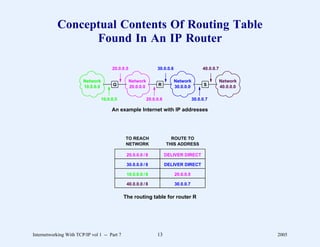
Conceptual Contents Of Routing Table
                 Found In An IP Router

                                        20.0.0.5                   30.0.0.6                   40.0.0.7

                        Network                    Network                    Network                    Network
                        10.0.0.0         Q         20.0.0.0         R         30.0.0.0         S         40.0.0.0

                                   10.0.0.5                   20.0.0.6                   30.0.0.7

                                        An example Internet with IP addresses


                                              TO REACH                     ROUTE TO
                                              NETWORK                    THIS ADDRESS

                                               20.0.0.0 / 8              DELIVER DIRECT

                                               30.0.0.0 / 8              DELIVER DIRECT

                                               10.0.0.0 / 8                   20.0.0.5

                                               40.0.0.0 / 8                   30.0.0.7

                                              The routing table for router R


Internetworking With TCP/IP vol 1 -- Part 7                        13                                               2005
Special Cases

d Default route
d Host-specic route


Internetworking With TCP/IP vol 1 -- Part 7         14        2005
Default Route

d Special entry in IP routing table
d Matches ‘‘any’’ destination address
d Only one default permitted
d Only selected if no other match in table


Internetworking With TCP/IP vol 1 -- Part 7         15        2005
Host-Specic Route

d Entry in routing table
d Matches entire 32-bit value
d Can be used to send trafc for a specic host along a
  specic path (i.e., can differ from the network route)
d More later in the course


Internetworking With TCP/IP vol 1 -- Part 7   16           2005
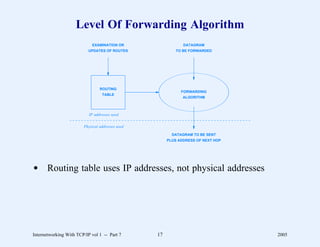
Level Of Forwarding Algorithm
                            EXAMINATION OR                    DATAGRAM
                           UPDATES OF ROUTES              TO BE FORWARDED


                                 ROUTING
                                                             FORWARDING
                                  TABLE
                                                              ALGORITHM


                           IP addresses used

                        Physical addresses used

                                                         DATAGRAM TO BE SENT
                                                       PLUS ADDRESS OF NEXT HOP


d Routing table uses IP addresses, not physical addresses


Internetworking With TCP/IP vol 1 -- Part 7       17                              2005
Summary

d IP uses routing table to forward datagrams
d Routing table
       –      Stores pairs of network prefix and next hop
       –      Can contain host-specific routes and a default route


Internetworking With TCP/IP vol 1 -- Part 7      18                 2005
Questions?
PART VIII

                            ERROR AND CONTROL
                                MESSAGES
                                  (ICMP)


Internetworking With TCP/IP vol 1 -- Part 8       1       2005
Errors In Packet Switching Networks

d Causes include
       –      Temporary or permanent disconnection
       –      Hardware failures
       –      Router overrun
       –      Routing loops
d Need mechanisms to detect and correct


Internetworking With TCP/IP vol 1 -- Part 8   2      2005
Error Detection And
                                Reporting Mechanisms

d IP header checksum to detect transmission errors
d Error reporting mechanism to distinguish between events
  such as lost datagrams and incorrect addresses
d Higher level protocols (i.e., TCP) must handle all other
  problems


Internetworking With TCP/IP vol 1 -- Part 8   3              2005
Error Reporting Mechanism

d Named Internet Control Message Protocol (ICMP)
d Required and integral part of IP
d Used primarily by routers to report delivery or routing
  problems to original source
d Also includes informational (nonerror) functionality
d Uses IP to carry control messages
d No error messages sent about error messages


Internetworking With TCP/IP vol 1 -- Part 8   4             2005
ICMP Purpose


The Internet Control Message Protocol allows a router to send
error or control messages to the source of a datagram, typically
a host. ICMP provides communication between the Internet
Protocol software on one machine and the Internet Protocol
software on another.


Internetworking With TCP/IP vol 1 -- Part 8    5             2005
Error Reporting Vs. Error Correction

d ICMP does not
       –      Provide interaction between a router and the source of
              trouble
       –      Maintain state information (each packet is handled
              independently)
d Consequence

When a datagram causes an error, ICMP can only report the
error condition back to the original source of the datagram; the
source must relate the error to an individual application
program or take other action to correct the problem.


Internetworking With TCP/IP vol 1 -- Part 8   6                        2005
Important Restriction

d ICMP only reports problems to original source
d Discussion question: what major problem in the Internet
  cannot be handled with ICMP?


Internetworking With TCP/IP vol 1 -- Part 8   7             2005
ICMP Encapsulation

d ICMP message travels in IP datagram
d Entire ICMP message treated as data in the datagram
d Two levels of encapsulation result


Internetworking With TCP/IP vol 1 -- Part 8   8         2005
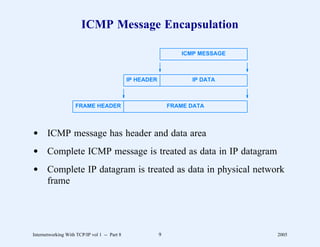
ICMP Message Encapsulation

                                                                 ICMP MESSAGE


                                              IP HEADER             IP DATA


                    FRAME HEADER                              FRAME DATA


d ICMP message has header and data area
d Complete ICMP message is treated as data in IP datagram
d Complete IP datagram is treated as data in physical network
  frame


Internetworking With TCP/IP vol 1 -- Part 8               9                     2005
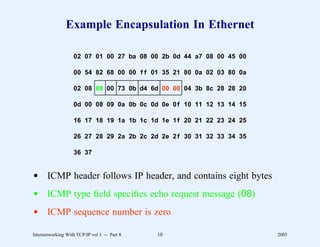
Example Encapsulation In Ethernet

                   02 07 01 00 27 ba 08 00 2b 0d 44 a7 08 00 45 00

                   00 54 82 68 00 00 f f 01 35 21 80 0a 02 03 80 0a

                   02 08 08 00 73 0b d4 6d 00 00 04 3b 8c 28 28 20

                   0d 00 08 09 0a 0b 0c 0d 0e 0 f 10 11 12 13 14 15

                   16 17 18 19 1a 1b 1c 1d 1e 1 f 20 21 22 23 24 25

                   26 27 28 29 2a 2b 2c 2d 2e 2 f 30 31 32 33 34 35

                   36 37


d ICMP header follows IP header, and contains eight bytes
d ICMP type eld species echo request message (08)
d ICMP sequence number is zero

Internetworking With TCP/IP vol 1 -- Part 8   10                      2005
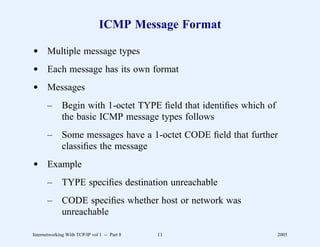
ICMP Message Format

d Multiple message types
d Each message has its own format
d Messages
       –      Begin with 1-octet TYPE field that identifies which of
              the basic ICMP message types follows
       –      Some messages have a 1-octet CODE field that further
              classies the message
d Example
       –      TYPE specifies destination unreachable
       –      CODE specifies whether host or network was
              unreachable

Internetworking With TCP/IP vol 1 -- Part 8   11                     2005
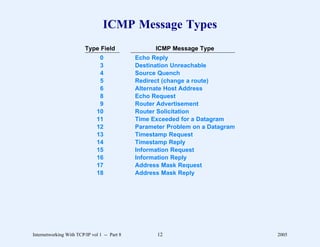
ICMP Message Types
                         Type Field                 ICMP Message Type
                                0             Echo Reply
                                3             Destination Unreachable
                                4             Source Quench
                                5             Redirect (change a route)
                                6             Alternate Host Address
                                8             Echo Request
                                9             Router Advertisement
                               10             Router Solicitation
                               11             Time Exceeded for a Datagram
                               12             Parameter Problem on a Datagram
                               13             Timestamp Request
                               14             Timestamp Reply
                               15             Information Request
                               16             Information Reply
                               17             Address Mask Request
                               18             Address Mask Reply


Internetworking With TCP/IP vol 1 -- Part 8         12                          2005
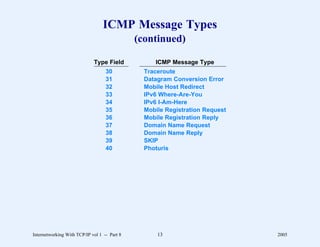
ICMP Message Types
                                              (continued)

                             Type Field            ICMP Message Type
                                   30           Traceroute
                                   31           Datagram Conversion Error
                                   32           Mobile Host Redirect
                                   33           IPv6 Where-Are-You
                                   34           IPv6 I-Am-Here
                                   35           Mobile Registration Request
                                   36           Mobile Registration Reply
                                   37           Domain Name Request
                                   38           Domain Name Reply
                                   39           SKIP
                                   40           Photuris


Internetworking With TCP/IP vol 1 -- Part 8         13                        2005
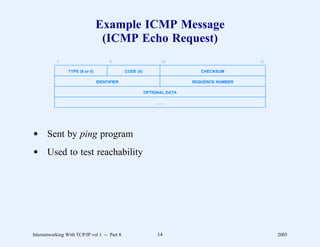
Example ICMP Message
                                  (ICMP Echo Request)
           0                          8                         16                         31

                 TYPE (8 or 0)                CODE (0)                      CHECKSUM

                                 IDENTIFIER                              SEQUENCE NUMBER

                                                         OPTIONAL DATA

                                                              ...


d Sent by ping program
d Used to test reachability


Internetworking With TCP/IP vol 1 -- Part 8                   14                                2005
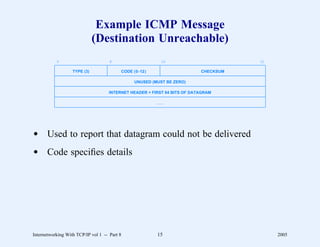
Example ICMP Message
                              (Destination Unreachable)
           0                         8                     16                         31

                   TYPE (3)               CODE (0-12)                      CHECKSUM

                                               UNUSED (MUST BE ZERO)

                                     INTERNET HEADER + FIRST 64 BITS OF DATAGRAM

                                                         ...


d Used to report that datagram could not be delivered
d Code species details


Internetworking With TCP/IP vol 1 -- Part 8              15                                2005
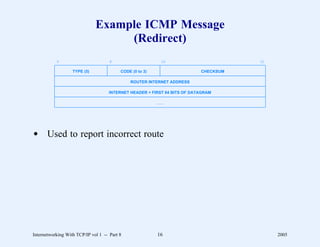
Example ICMP Message
                                   (Redirect)
           0                         8                      16                        31

                   TYPE (5)               CODE (0 to 3)                    CHECKSUM

                                              ROUTER INTERNET ADDRESS

                                     INTERNET HEADER + FIRST 64 BITS OF DATAGRAM

                                                          ...


d Used to report incorrect route


Internetworking With TCP/IP vol 1 -- Part 8               16                               2005
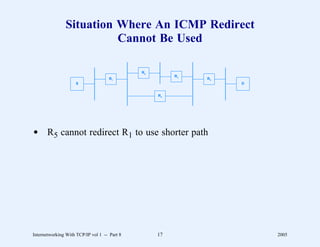
Situation Where An ICMP Redirect
                         Cannot Be Used

                                              R2
                                                        R3
                                     R1                      R5
                    S                                             D


                                                   R4


d R5 cannot redirect R1 to use shorter path


Internetworking With TCP/IP vol 1 -- Part 8        17                 2005
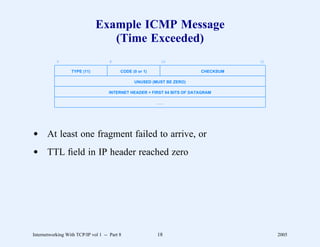
Example ICMP Message
                                 (Time Exceeded)
           0                         8                      16                        31

                  TYPE (11)               CODE (0 or 1)                    CHECKSUM

                                                UNUSED (MUST BE ZERO)

                                     INTERNET HEADER + FIRST 64 BITS OF DATAGRAM

                                                          ...


d At least one fragment failed to arrive, or
d TTL eld in IP header reached zero


Internetworking With TCP/IP vol 1 -- Part 8               18                               2005
ICMP Trick

d Include datagram that caused problem in the error message
       –      Efficient (sender must determine how to correct
              problem)
       –      Eliminates need to construct detailed message
d Problem: entire datagram may be too large
d Solution: send IP header plus 64 bits of data area (sufcient
  in most cases)


Internetworking With TCP/IP vol 1 -- Part 8       19           2005
Summary

d ICMP
       –      Required part of IP
       –      Used to report errors to original source
       –      Reporting only: no interaction or error correction
d Several ICMP message types, each with its own format
d ICMP message begins with 1-octet TYPE eld
d ICMP encapsulated in IP for delivery


Internetworking With TCP/IP vol 1 -- Part 8      20                2005
Questions?
PART IX

                          INTERNET PROTOCOL:
                         CLASSLESS AND SUBNET
                          ADDRESS EXTENSIONS
                                (CIDR)


Internetworking With TCP/IP vol 1 -- Part 9      1      2005
Recall


In the original IP addressing scheme, each physical network is
assigned a unique network address; each host on a network has
the network address as a prefix of the host’s individual address.


d Routers only examine prex (small routing tables)


Internetworking With TCP/IP vol 1 -- Part 9     2             2005
An Observation

d Division into prex and sufx means: site can assign and
  use IP addresses in unusual ways provided
       –      All hosts and routers at the site honor the site’s scheme
       –      Other sites on the Internet can treat addresses as a
              network prex and a host sufx


Internetworking With TCP/IP vol 1 -- Part 9    3                      2005
Classful Addressing

d Three possible classes for networks
d Class C network limited to 254 hosts (cannot use all-1s or
  all-0s)
d Personal computers result in networks with many hosts
d Class B network allows many hosts, but insufcient class B
  prexes


Internetworking With TCP/IP vol 1 -- Part 9   4                2005
Question

d How can we minimize the number of assigned network
  prexes (especially class B) without abandoning the 32-bit
  addressing scheme?


Internetworking With TCP/IP vol 1 -- Part 9      5         2005
Two Answers To The Minimization Question

d Proxy ARP
d Subnet addressing


Internetworking With TCP/IP vol 1 -- Part 9   6   2005
Proxy ARP

d Layer 2 solution
d Allow two physical networks to share a single IP prex
d Arrange special system to answer ARP requests and forward
  datagrams between networks


Internetworking With TCP/IP vol 1 -- Part 9       7        2005
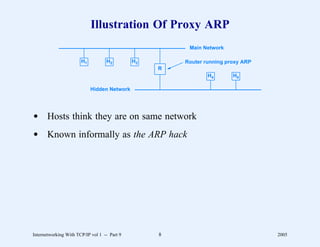
Illustration Of Proxy ARP
                                                        Main Network

                       H1          H2         H3       Router running proxy ARP
                                                   R
                                                               H4       H5

                            Hidden Network


d Hosts think they are on same network
d Known informally as the ARP hack


Internetworking With TCP/IP vol 1 -- Part 9        8                              2005
Assessment Of Proxy ARP

d Chief advantages
       –      Transparent to hosts
       –      No change in IP routing tables
d Chief disadvantages
       –      Does not generalize to complex topology
       –      Only works on networks that use ARP
       –      Most proxy ARP systems require manual configuration


Internetworking With TCP/IP vol 1 -- Part 9   9                2005
Subnet Addressing

d Not part of original TCP/IP address scheme
d Allows an organization to use a single network prex for
  multiple physical networks
d Subdivides the host sufx into a pair of elds for physical
  network and host
d Interpreted only by routers and hosts at the site; treated like
  normal address elsewhere


Internetworking With TCP/IP vol 1 -- Part 9   10                2005
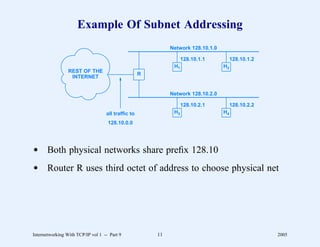
Example Of Subnet Addressing
                                                             Network 128.10.1.0

                                                                   128.10.1.1          128.10.1.2
                                                              H1                  H2
                 REST OF THE
                                                    R
                  INTERNET


                                                             Network 128.10.2.0

                                                                   128.10.2.1          128.10.2.2
                                   all traffic to             H3                  H4

                                    128.10.0.0


d Both physical networks share prex 128.10
d Router R uses third octet of address to choose physical net


Internetworking With TCP/IP vol 1 -- Part 9             11                                          2005
Interpretation Of Addresses

d Classful interpretation is two-level hierarchy
       –      Physical network identified by prefix
       –      Host on the net identified by suffix
d Subnetted interpretation is three-level hierarchy
       –      Site identified by network prefix
       –      Physical net at site identified by part of suffix
       –      Host on the net identified by remainder of suffix


Internetworking With TCP/IP vol 1 -- Part 9   12                2005
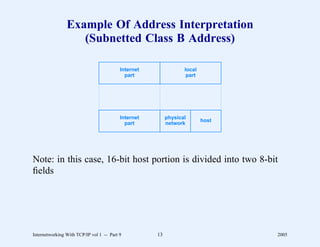
Example Of Address Interpretation
                   (Subnetted Class B Address)

                                          Internet               local
                                            part                  part
                               .
                               .                     .
                                                     .                          .
                                                                                .
                               .
                               .                     .
                                                     .                          .
                                                                                .
                               .
                               .                     .
                                                     .                          .
                                                                                .
                               .
                               .                     .
                                                     .                          .
                                                                                .
                               .
                               .                     .
                                                     .                          .
                                                                                .
                               .
                               .                     .
                                                     .                          .
                                                                                .
                               .
                               .                     .
                                                     .                          .
                                                                                .
                               .
                               .                     .
                                                     .                          .
                                                                                .
                               .
                               .                     .
                                                     .                          .
                                                                                .
                               .                     .                          .

                                          Internet        physical
                                                                         host
                                            part          network


Note: in this case, 16-bit host portion is divided into two 8-bit
elds


Internetworking With TCP/IP vol 1 -- Part 9          13                             2005
Choice Of Subnet Size

d How should host portion of address be divided?
d Answer depends on topology at site and number of hosts per
  network


Internetworking With TCP/IP vol 1 -- Part 9   14         2005
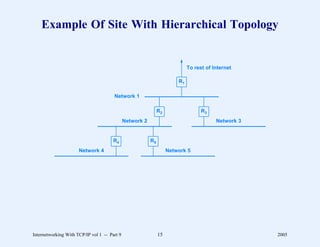
Example Of Site With Hierarchical Topology


                                                                             To rest of Internet

                                                                        R1

                                       Network 1

                                                               R2                  R3
                                              Network 2                                  Network 3


                                       R4                 R5
                      Network 4                                     Network 5


Internetworking With TCP/IP vol 1 -- Part 9                    15                                    2005
Illustration Of Subnet Addressing
                                              Rest of the Internet

                                                                        Subnet address treated as
                                                                        normal IP address

                                  Router at site         R1

                                                                        Subnet identified by using part of host
                                                                        portion to identify physical net


                                                      128.10.1.0
                                              R2                      R3


                                         128.10.2.0                128.10.3.0


                                           Site using third octet to
                                          subnet address 128.10.0.0


Internetworking With TCP/IP vol 1 -- Part 9              16                                                   2005
Address Mask

d Each physical network is assigned 32-bit address mask (also
  called subnet mask)
d One bits in mask cover network prex plus zero or more
  bits of sufx portion
d Logical and between mask and destination IP address
  extracts the prex and subnet portions


Internetworking With TCP/IP vol 1 -- Part 9        17        2005
Two Possible Mask Assignments

d Fixed-length subnet masks
d Variable-length subnet masks


Internetworking With TCP/IP vol 1 -- Part 9   18    2005
Fixed-length Subnet Masks

d Organization uses same mask on all networks
d Advantages
       –      Uniformity
       –      Ease of debugging / maintenance
d Disadvantages
       –      Number of nets fixed for entire organization
       –      Size of physical nets fixed for entire organization


Internetworking With TCP/IP vol 1 -- Part 9   19                   2005
Possible Fixed-Length Subnets
                      For Sixteen Bit Host Address
                       Bits in mask           # subnets   # hosts/subnet
                              16                   1          65534
                              18                   2          16382
                              19                   6           8190
                              20                  14           4094
                              21                  30           2046
                              22                  62           1022
                              23                 126            510
                              24                 254            254
                              25                 510            126
                              26                1022             62
                              27                2046             30
                              28                4094             14
                              29                8190              6
                              30               16382              2


d All-0s and all-1s values must be omitted
d Organization chooses one line in table
Internetworking With TCP/IP vol 1 -- Part 9       20                       2005
Variable-Length Subnet Masks (VLSM)

d Administrator chooses size for each physical network
d Mask assigned on per-network basis
d Advantages
       –      Flexibility to mix large and small nets
       –      More complete use of address space
d Disadvantages
       –      Difficult to assign / administer
       –      Potential address ambiguity
       –      More routes


Internetworking With TCP/IP vol 1 -- Part 9   21         2005
Use Of Address Space
                 (Start With 16 Bits Of Host Sufx)

d One possible VLSM assignment (92.9% of addresses used)
       –      11 networks of 2046 hosts each
       –      24 networks of 254 hosts each
       –      256 networks of 126 hosts each
d Another possible VLSM assignment (93.1% of addresses
  used)
       –      9 networks of 2046 hosts each
       –      2 networks of 1022 hosts each
       –      40 networks of 510 hosts each
       –      160 networks of 126 hosts each
Internetworking With TCP/IP vol 1 -- Part 9   22         2005
Subnet Details

d Two interesting facts
       –      Can assign all-0’s or all-1’s subnet
       –      Can assign noncontiguous subnet mask bits
d In practice
       –      Should avoid both
d Discussion question: why does the subnet standard allow the
  all-1’s and all-0’s subnet numbers?


Internetworking With TCP/IP vol 1 -- Part 9         23         2005
VLSM Example

d Use low-order sixteen bits of 128.10.0.0
d Create seven subnets
d Subnet 1
       –      Up to 254 hosts
       –      Subnet mask is 24 bits
d Subnets 2 through 7
       –      Up to 62 hosts each
       –      Subnet mask is 26 bits


Internetworking With TCP/IP vol 1 -- Part 9   24        2005
Example VLSM Prexes

d Subnet 1 (up to 254 hosts)
          mask:              11111111 11111111 11111111 00000000
          prefix: 10000000 00001010 00000001 00000000

d Subnet 2 (up to 62 hosts)
          mask:              11111111 11111111 11111111 11000000
          prefix: 10000000 00001010 00000000 10000000

d Subnet 3 (up to 62 hosts)
          mask:              11111111 11111111 11111111 11000000
          prefix: 10000000 00001010 00000000 11000000


Internetworking With TCP/IP vol 1 -- Part 9   25                   2005
Example VLSM Prexes
                                              (continued)

d Subnet 4 (up to 62 hosts)
          mask:              11111111 11111111 11111111 11000000
          prefix: 10000000 00001010 00000001 00000000

d Subnet 5 (up to 62 hosts)
          mask:              11111111 11111111 11111111 11000000
          prefix: 10000000 00001010 00000001 01000000

d Subnet 6 (up to 62 hosts)
          mask:              11111111 11111111 11111111 11000000
          prefix: 10000000 00001010 00000001 10000000
Internetworking With TCP/IP vol 1 -- Part 9       26               2005
Example VLSM Prexes
                                              (continued)

d Subnet 7 (up to 62 hosts)
          mask:              11111111 11111111 11111111 11000000
          prefix: 10000000 00001010 00000001 11000000


Internetworking With TCP/IP vol 1 -- Part 9       27               2005
Address Ambiguity

d Address of host 63 on subnet 1 is

          mask:              11111111 11111111 11111111 00000000
          prefix: 10000000 00001010 00000001 00000000
          host:              10000000 00001010 00000001 00111111

d Directed broadcast address on subnet 4 is

          mask:              11111111 11111111 11111111 11000000
          prefix: 10000000 00001010 00000001 00000000
          bcast: 10000000 00001010 00000001 00111111


Internetworking With TCP/IP vol 1 -- Part 9   28                   2005
Address Ambiguity

d Address of host 63 on subnet 1 is

          mask:              11111111 11111111 11111111 00000000
          prefix: 10000000 00001010 00000001 00000000
          host:              10000000 00001010 00000001 00111111

d Directed broadcast address on subnet 4 is

          mask:              11111111 11111111 11111111 11000000
          prefix: 10000000 00001010 00000001 00000000
          bcast: 10000000 00001010 00000001 00111111

d Same value!

Internetworking With TCP/IP vol 1 -- Part 9   28                   2005
More Address Ambiguity

d Directed broadcast address on subnet 1 is

       mask:                     11111111 11111111 11111111 00000000
       prefix:                   10000000 00001010 00000001 00000000
       broadcast: 10000000 00001010 00000001 11111111

d Directed broadcast address on subnet 7 is

        mask:                11111111 11111111 11111111 11000000
        prefix: 10000000 00001010 00000001 11000000
        broadcast:10000000 00001010 00000001 11111111


Internetworking With TCP/IP vol 1 -- Part 9   29                       2005
More Address Ambiguity

d Directed broadcast address on subnet 1 is

       mask:                     11111111 11111111 11111111 00000000
       prefix:                   10000000 00001010 00000001 00000000
       broadcast: 10000000 00001010 00000001 11111111

d Directed broadcast address on subnet 7 is

        mask:                11111111 11111111 11111111 11000000
        prefix: 10000000 00001010 00000001 11000000
        broadcast:10000000 00001010 00000001 11111111

d Same value!

Internetworking With TCP/IP vol 1 -- Part 9   29                       2005
Example Of Illegal Subnet Assignment

                                              Net 1 (not a subnet address)


                                                 R1        H        R2
           Net 2 (subnet of address N)                                   Net 3 (subnet of address N)


d Host cannot route among subnets
d Rule: subnets must be contiguous!


Internetworking With TCP/IP vol 1 -- Part 9               30                                           2005
Variety Of Routes

d Forwarding must accommodate
       –      Network-specific routes
       –      Subnet-specific routes
       –      Host-specific routes
       –      Default route
       –      Limited broadcast
       –      Directed broadcast to network
       –      Directed broadcast to specific subnet
d Single algorithm with address masks can accommodate all
  the above

Internetworking With TCP/IP vol 1 -- Part 9   31          2005
Use Of Address Masks

d Each entry in routing table also has address mask
d All-1s mask used for host-specic routes
d Network mask used for network-specic routes
d Subnet mask used for subnet-specic routes
d All-0s mask used for default route


Internetworking With TCP/IP vol 1 -- Part 9   32       2005
Unied Forwarding Algorithm

                                              Algorithm:

                            Forward_IP_Datagram (datagram, routing_table)

                      Extract destination IP address, ID, from datagram;
                      If prefix of ID matches address of any directly connected
                         network send datagram to destination over that network
                         (This involves resolving ID to a physical address,
                         encapsulating the datagram, and sending the frame.)
                      else
                         for each entry in routing table do
                            Let N be the bitwise-and of ID and the subnet mask
                            If N equals the network address field of the entry then
                               forward the datagram to the specified next hop address
                         endforloop
                      If no matches were found, declare a forwarding error;


Internetworking With TCP/IP vol 1 -- Part 9       33                                    2005
Special Case: Unnumbered Serial Network

d Only two endpoints
d Not necessary to assign (waste) network prex
d Trick: use remote IP address as next hop


Internetworking With TCP/IP vol 1 -- Part 9   34   2005
Example Unnumbered Serial Network


                128.10.0.0                                                  128.211.0.0

                                  R1          leased serial line      R2
                                 1   2


                        128.10.2.250                 (a)            128.211.0.100


                       TO REACH HOSTS           ROUTE TO           USING THIS
                         ON NETWORK           THIS ADDRESS         INTERFACE

                             128.10.0.0       DELIVER DIRECT           1

                              default          128.211.0.100           2


                                                     (b)


Internetworking With TCP/IP vol 1 -- Part 9          35                                   2005
Classless Inter-Domain
                                   Routing (CIDR)

d Problem
       –      Continued exponential Internet growth
       –      Subnetting insufficient
       –      Limited IP addresses (esp. Class B)
d Dire prediction made in 1993:

              We will exhaust the address space ‘‘in a few years’’.


       Note: address space is not near exhaustion


Internetworking With TCP/IP vol 1 -- Part 9   36                      2005
CIDR Addressing

d Solution to problem
       –      Temporary fix until next generation of IP
       –      Backward compatible with classful addressing
       –      Extend variable-length subnet technology to prefixes
d CIDR was predicted to work ‘‘for a few years’’
       –      Extremely successful!
       –      Will work for at least 25 years!


Internetworking With TCP/IP vol 1 -- Part 9   37                    2005
One Motivation For CIDR: Class C

d Fewer than seventeen thousand Class B numbers (total)
d More than two million Class C network numbers
d No one wants Class C (too small)
d CIDR allows
       –      Merging 256 Class C numbers into a single prefix that is
              equivalent to Class B
       –      Splitting a Class B along power of two boundaries


Internetworking With TCP/IP vol 1 -- Part 9   38                  2005
CIDR Notation

d Addresses written NUMBER / m
       –      NUMBER is IP prefix
       –      m is ‘‘address mask’’ length
d Example
                                              214.5.48.0/20

–      Prefix occupies 20 bits
–      Suffix occupies 12 bits
d Mask values must be converted to dotted decimal when
  conguring a router (and binary internally)


Internetworking With TCP/IP vol 1 -- Part 9        39         2005
Route Proliferation

d If classful forwarding used, CIDR addresses result in more
  routes
d Example:
       –      Single CIDR prefix spans 256 Class C network numbers
              (supernetting)
       –      Classful routing table requires 256 separate entries


Internetworking With TCP/IP vol 1 -- Part 9   40                     2005
Route Condensation

d Solution: change forwarding as well as addressing
d Store address mask with each route
d Send pair of (address, mask) whenever exchanging routing
  information
d Known as a CIDR block


Internetworking With TCP/IP vol 1 -- Part 9   41         2005
Example Of A CIDR Block


                            Dotted Decimal           32-bit Binary Equivalent
            lowest          128.211.168.0     10000000 11010011 10101000 00000000
           highest          128.211.175.255   10000000 11010011 10101111 11111111


Internetworking With TCP/IP vol 1 -- Part 9     42                                  2005
Dotted Decimal Equivalents
             CIDR Notation           Dotted Decimal        CIDR Notation   Dotted Decimal
                      /1             128.0.0.0                  /17        255.255.128.0
                      /2             192.0.0.0                  /18        255.255.192.0
                      /3             224.0.0.0                  /19        255.255.224.0
                      /4             240.0.0.0                  /20        255.255.240.0
                      /5             248.0.0.0                  /21        255.255.248.0
                      /6             252.0.0.0                  /22        255.255.252.0
                      /7             254.0.0.0                  /23        255.255.254.0
                      /8             255.0.0.0                  /24        255.255.255.0
                      /9             255.128.0.0                /25        255.255.255.128
                     /10             255.192.0.0                /26        255.255.255.192
                     /11             255.224.0.0                /27        255.255.255.224
                     /12             255.240.0.0                /28        255.255.255.240
                     /13             255.248.0.0                /29        255.255.255.248
                     /14             255.252.0.0                /30        255.255.255.252
                     /15             255.254.0.0                /31        255.255.255.254
                     /16             255.255.0.0                /32        255.255.255.255


Internetworking With TCP/IP vol 1 -- Part 9           43                                     2005
Example Of /30 CIDR Block

                            Dotted Decimal           32-bit Binary Equivalent
            lowest          128.211.176.212   10000000 11010011 10110000 11010100
           highest          128.211.176.215   10000000 11010011 10110000 11010111


d Useful when customer of ISP has very small network


Internetworking With TCP/IP vol 1 -- Part 9     44                                  2005
Implementation Of CIDR Route Lookup

d Each entry in routing table has address plus mask
d Search is organized from most-specic to least-specic (i.e.,
  entry with longest mask is tested rst)
d Known as longest-prefix lookup or longest-prefix search


Internetworking With TCP/IP vol 1 -- Part 9   45             2005
Implementing Longest-Prex Matching

d Cannot easily use hashing
d Data structure of choice is binary trie
d Identies unique prex needed to match route


Internetworking With TCP/IP vol 1 -- Part 9   46   2005
Example Of Unique Prexes


                                       32-Bit Address                   Unique Prefix
                      00110101      00000000   00000000      00000000     00
                      01000110      00000000   00000000      00000000     0100
                      01010110      00000000   00000000      00000000     0101
                      01100001      00000000   00000000      00000000     011
                      10101010      11110000   00000000      00000000     1010
                      10110000      00000010   00000000      00000000     10110
                      10111011      00001010   00000000      00000000     10111


Internetworking With TCP/IP vol 1 -- Part 9             47                              2005
Example Binary Trie For The Seven Prexes


                                              0                1


                                  0               1            0


                                              0           1        1


                                          0           1        0           1


                                                                       0       1


d Path for 0101 is shown in red


Internetworking With TCP/IP vol 1 -- Part 9               48                       2005
Modications And Extensions

d Several variations of trie data structures exist
       –      PATRICIA trees
       –      Level-Compressed tries (LC-tries)
d Motivation
       –      Handle longest-prefix match
       –      Skip levels that do not distinguish among routes


Internetworking With TCP/IP vol 1 -- Part 9   49                 2005
Nonroutable Addresses

d CIDR blocks reserved for use within a site
d Must never appear on the Internet
d ISPs do not maintain routes
d Also called private addresses

                              Prefix          Lowest Address   Highest Address
                          10 / 8               10.0.0.0        10.255.255.255
                          172.16 / 12          172.16.0.0      172.31.255.255
                          192.168 / 16         192.168.0.0     192.168.255.255
                          169.254 / 16         169.254.0.0     169.254.255.255


Internetworking With TCP/IP vol 1 -- Part 9            50                        2005
Summary

d Original IP addressing scheme was classful
d Two extensions added
       –      Subnet addressing
       –      CIDR addressing
d Subnetting used only within a site
d CIDR used throughout the Internet
d Both use 32-bit address mask
       –      CIDR mask identifies division between network prefix
              and host sufx
       –      Subnet mask identifies boundary between subnet and
              individual host
Internetworking With TCP/IP vol 1 -- Part 9      51                2005
Summary
                                              (continued)

d Single unied forwarding algorithm handles routes that are
       –      Network-specific
       –      Subnet-specific
       –      Host-specific
       –      Limited broadcast
       –      Directed broadcast to network
       –      Directed broadcast to subnet
       –      Default
d Longest-prex match required
       –      Typical implementation: binary trie
Internetworking With TCP/IP vol 1 -- Part 9       52        2005
Questions?
PART X

                            PROTOCOL LAYERING


Internetworking With TCP/IP vol 1 -- Part 10     1      2005
Motivation For Layering

d Communication is difcult to understand
d Many subproblems
       –      Hardware failure
       –      Network congestion
       –      Packet delay or loss
       –      Data corruption
       –      Data duplication or inverted arrivals


Internetworking With TCP/IP vol 1 -- Part 10   2        2005
Solving The Problem

d Divide the problem into pieces
d Solve subproblems separately
d Combine into integrated whole
d Result is layered protocols


Internetworking With TCP/IP vol 1 -- Part 10   3        2005
Protocol Layering

d Separates protocol functionality
d Each layer solves one part of the communication problem
d Intended primarily for protocol designers
d Set of layers is called a protocol stack


Internetworking With TCP/IP vol 1 -- Part 10   4            2005
Concept Of Layering


                             Sender                      Receiver


                             Layer n                     Layer n

                                ...                        ...

                             Layer 2                     Layer 2

                             Layer 1                     Layer 1


                                               Network


Internetworking With TCP/IP vol 1 -- Part 10      5                 2005
More Realistic Layering

              Conceptual Layers                              Software Organization

                   High-Level                  Protocol 1         Protocol 2         Protocol 3
                 Protocol Layer

                    Internet
                                                                  IP Module
                 Protocol Layer

                     Network
                 Interface Layer               Interface 1        Interface 2        Interface 3

                        (a)                                           (b)


Internetworking With TCP/IP vol 1 -- Part 10            6                                          2005
Layering In An Internet


                Sender                                                            Receiver


                other...                                                          other...

               IP Layer                   IP Layer            IP Layer            IP Layer

               Interface                  Interface           Interface           Interface


                               Net 1                  Net 2               Net 3


Internetworking With TCP/IP vol 1 -- Part 10           7                                      2005
Examples Of Layering

d Two models exist
d ISO 7-layer reference model for Open System
  Interconnection (OSI)
       –      Predates TCP/IP
       –      Does not include an Internet layer
       –      Prescriptive (designed before protocols)
d Internet 5-layer reference model
       –      Designed for TCP/IP
       –      Descriptive (designed along with actual protocols)


Internetworking With TCP/IP vol 1 -- Part 10   8                   2005
ISO 7-Layer Reference Model

                                    Layer         Functionality

                                      7            Application


                                      6           Presentation


                                      5              Session


                                      4             Transport


                                      3             Network

                                                    Data Link
                                      2        (Hardware Interface)

                                               Physical Hardware
                                      1           Connection


Internetworking With TCP/IP vol 1 -- Part 10         9                2005
TCP/IP 5-Layer Reference Model


                   Conceptual Layer                             Objects Passed
                                                                Between Layers

                        Application
                                                              Messages or Streams
                          Transport
                                                              Transport Protocol Packets
                            Internet
                                                              IP Datagrams
                   Network Interface
                 .....................................
                 .
                 .                                   .
                                                     .
                                                              Network-Specific Frames
                 .
                 .                                   .
                                                     .
                 .                                   .
                 .
                 .
                 .         Hardware                  .
                                                     .
                                                     .
                 .
                 .                                   .
                                                     .
                 .
                 .                                   .
                 .....................................
                                                     .


d Only four layers above hardware


Internetworking With TCP/IP vol 1 -- Part 10             10                                2005
TCP/IP Layer 1: Physical Hardware

d Denes electrical signals used in communication (e.g.,
  voltages on wires between two computers)
d Uninteresting except to electrical engineers


Internetworking With TCP/IP vol 1 -- Part 10   11          2005
TCP/IP Layer 2: Network Interface

d Denes communication between computer and network
  hardware
d Isolates details of hardware (MAC) addressing
d Example protocol: ARP
d Code is usually in the operating system


Internetworking With TCP/IP vol 1 -- Part 10   12     2005
TCP/IP Layer 3: Internet

d Protocol is IP
d Provides machine to machine communication
d Denes best-effort, connectionless datagram delivery service
  for the Internet
d Code is usually in the operating system


Internetworking With TCP/IP vol 1 -- Part 10   13          2005
TCP/IP Layer 4: Transport

d Provides end-to-end connection from application program to
  application program
d Often handles reliability, flow control
d Protocols are TCP and UDP
d Code is usually in the operating system


Internetworking With TCP/IP vol 1 -- Part 10   14         2005
TCP/IP Layer 5: Application

d Implemented by application programs
d Many application-specic protocols in the Internet
d Built on top of transport layer


Internetworking With TCP/IP vol 1 -- Part 10   15      2005
Two Differences Between TCP/IP
                    And Other Layered Protocols

d TCP/IP uses end-to-end reliability instead of link-level
  reliability
d TCP/IP places the locus of intelligence and decision making
  at the edge of the network instead of the core


Internetworking With TCP/IP vol 1 -- Part 10   16            2005
The Layering Principle


  Software implementing layer n at the destination receives
exactly the message sent by software implementing layer n at
the source.


Internetworking With TCP/IP vol 1 -- Part 10   17        2005
Illustration Of Layering Principle

                                Host A                          Host B

                             Application                      Application
                                                 identical
                                                 message
                              Transport                       Transport
                                                 identical
                                                  packet
                               Internet                        Internet
                                                 identical
                                                 datagram
                               Network                         Network
                               Interface         identical     Interface
                                                   frame

                                               Physical Net


Internetworking With TCP/IP vol 1 -- Part 10        18                      2005
When A Datagram Traverses The Internet

d All layers involved at
       –      Original source
       –      Ultimate destination
d Only up through IP layer involved at
       –      Intermediate routers


Internetworking With TCP/IP vol 1 -- Part 10   19   2005
Illustration Of Layering In An Internet

                       Host A                                                       Host B
                                                     identical
                     Application                                                  Application
                                                     message


                                                     identical
                      Transport                                                   Transport
                                                      packet

                                                     Router R

                       Internet                      Internet                      Internet
                                        identical                  identical
                                        datagram                   datagram

                      Network                        Network                       Network
                      Interface         identical    Interface      identical      Interface
                                          frame                       frame

                                    Physical Net 1               Physical Net 2


Internetworking With TCP/IP vol 1 -- Part 10            20                                      2005
A Key Denition

d A protocol is classied as end-to-end if the layering
  principle applies from one end of the Internet to the other
d Examples
       –      IP is machine-to-machine because layering principle
              only applies across one hop
       –      TCP is end-to-end because layering principle from
              original source to ultimate destination


Internetworking With TCP/IP vol 1 -- Part 10   21                   2005
Practical Aspect Of Layering

d Multiple protocols at each layer
d One protocol used at each layer for given datagram


Internetworking With TCP/IP vol 1 -- Part 10   22      2005
Example Of Two Protocols
                         At Network Interface Layer:
                               SLIP And PPP
d Both used to send IP across
       –      Serial data circuit
       –      Dialup connection
d Each denes standards for
       –      Framing (encapsulation)
       –      Addressing
d Incompatible


Internetworking With TCP/IP vol 1 -- Part 10   23      2005
Notion Of Multiple Interfaces And Layering

               Conceptual Layer                              Software Organization

                                               Protocol 1         Protocol 2         Protocol 3
                    Transport


                     Internet                                     IP Module

                    Network
                    Interface                  Interface 1        Interface 2        Interface 3

                                                                Point-To-Point
                     Intranet
                                                                  (Intranet)


                        (a)                                           (b)


Internetworking With TCP/IP vol 1 -- Part 10           24                                          2005
Boundaries In The TCP/IP Layering Model

d High-level protocol address boundary
       –      Division between software that uses hardware addresses
              and software that uses IP addresses
d Operating system boundary
       –      Division between application program running outside
              the operating system and protocol software running
              inside the operating system


Internetworking With TCP/IP vol 1 -- Part 10   25                    2005
The Consequence Of An Address Boundary


Application programs as well as all protocol software from the
Internet layer upward use only IP addresses; the network
interface layer handles physical addresses.


Internetworking With TCP/IP vol 1 -- Part 10   26          2005
Illustration Of The Two Boundaries

                            Conceptual Layer                                    Boundary

                                  Application
                                                                   Software outside the operating system
                                                                    Software inside the operating system
                                   Transport


                                     Internet
                                                                          Only IP addresses used
                                    Network                               Physical addresses used
                                    Interface
                        ........................................
                        .                                      .
                        .
                        .                                      .
                                                               .
                        .
                        .                                      .
                                                               .
                        .
                        .           Hardware                   .
                                                               .
                        .
                        .                                      .
                        ........................................
                        .                                      .
                                                               .


Internetworking With TCP/IP vol 1 -- Part 10                       27                                      2005
Handling Multiple Protocols Per Layer

d Sender places eld in header to say which protocol used at
  each layer
d Receiver uses eld to determine which protocol at next layer
  receives the packet
d Known as multiplexing and demultiplexing


Internetworking With TCP/IP vol 1 -- Part 10   28          2005
Example Of Demultiplexing An Incoming Frame


                          IP Module                ARP Module         RARP Module


                                               Demultiplexing Based
                                                 On Frame Type


                                                  Frame Arrives


Internetworking With TCP/IP vol 1 -- Part 10           29                           2005
Example Of Demultiplexing Performed By IP


                                     ICMP Module     UDP Module       TCP Module


                                                      IP Module


                                                   Datagram Arrives


Internetworking With TCP/IP vol 1 -- Part 10             30                        2005
Example Of Demultiplexing Performed By TCP

                            Application 1      Application 2         ...   Application n


                                                        TCP Module


                                                      Segment Arrives


d TCP is part of operating system
d Transfer to application program must cross operating system
  boundary


Internetworking With TCP/IP vol 1 -- Part 10                   31                          2005
Discussion

d What are the key advantages and disadvantages of
  multiplexing / demultiplexing?
d Can you think of an alternative?


Internetworking With TCP/IP vol 1 -- Part 10       32       2005
Summary

d Layering
       –      Intended for designers
       –      Helps control complexity in protocol design
d TCP/IP uses 5-layer reference model
d Conceptually, a router only needs layers 2 and 3, and a host
  needs all layers
d IP is machine-to-machine protocol
d TCP is end-to-end protocol
d Demultiplexing used to handle multiple protocols at each
  layer


Internetworking With TCP/IP vol 1 -- Part 10      33         2005
Questions?
PART XI

                 USER DATAGRAM PROTOCOL
                          (UDP)


Internetworking With TCP/IP vol 1 -- Part 11      1      2005
Identifying The Ultimate Destination

d IP address only species a computer
d Need a way to specify an application program (process) on a
  computer
d Unfortunately
       –      Application programs can be created and destroyed
              rapidly
       –      Each operating system uses its own identification


Internetworking With TCP/IP vol 1 -- Part 11   2                  2005
Specifying An Application Program

d TCP/IP introduces its own specication
d Abstract destination point known as protocol port number
  (positive integer)
d Each OS determines how to bind protocol port number to
  specic application program


Internetworking With TCP/IP vol 1 -- Part 11   3             2005
User Datagram Protocol

d Transport-layer protocol (Layer 4)
d Connectionless service: provides application programs with
  ability to send and receive messages
d Allows multiple, application programs on a single machine
  to communicate concurrently
d Same best-effort semantics as IP
       –      Message can be delayed, lost, or duplicated
       –      Messages can arrive out of order
d Application accepts full responsibility for errors


Internetworking With TCP/IP vol 1 -- Part 11   4            2005
The Added Benet Of UDP


The User Datagram Protocol (UDP) provides an unreliable
connectionless delivery service using IP to transport messages
between machines. It uses IP to carry messages, but adds the
ability to distinguish among multiple destinations within a given
host computer.


Internetworking With TCP/IP vol 1 -- Part 11   5              2005
UDP Message Format


             0                                   16                          31

                          UDP SOURCE PORT             UDP DESTINATION PORT

                        UDP MESSAGE LENGTH               UDP CHECKSUM

                                               DATA

                                               ...


d If UDP CHECKSUM eld contains zeroes, receiver does not
  verify the checksum


Internetworking With TCP/IP vol 1 -- Part 11    6                                 2005
Port Numbers In A UDP Message

d SOURCE PORT identies application on original source
  computer
d DESTINATION PORT identies application on ultimate
  destination computer
d Note: IP addresses of source and destination do not appear
  explicitly in header


Internetworking With TCP/IP vol 1 -- Part 11   7           2005
UDP Pseudo-Header

d Used when computing or verifying a checksum
d Temporarily prepended to UDP message
d Contains items from IP header
d Guarantees that message arrived at correct destination
d Note: pseudo header is not sent across Internet


Internetworking With TCP/IP vol 1 -- Part 11   8           2005
Contents Of UDP Pseudo-Header


         0                          8                       16                         31

                                                   SOURCE IP ADDRESS

                                                 DESTINATION IP ADDRESS

                   ZERO                        PROTO                      UDP LENGTH


d SOURCE ADDRESS and DESTINATION ADDRESS
  specify IP address of sending and receiving computers
d PROTO contains the Type from the IP datagram header


Internetworking With TCP/IP vol 1 -- Part 11               9                                2005
Position Of UDP In Protocol Stack

                                               Conceptual Layering


                                                     Application


                                                User Datagram (UDP)


                                                    Internet (IP)


                                                  Network Interface


d UDP lies between applications and IP


Internetworking With TCP/IP vol 1 -- Part 11             10           2005
Encapsulation


                                                 UDP
                                               HEADER                     UDP DATA AREA


                                IP
                              HEADER                             IP DATA AREA


             FRAME
             HEADER                                     FRAME DATA AREA


Internetworking With TCP/IP vol 1 -- Part 11            11                                2005
Division Of Duties Between
                                  IP and UDP


The IP layer is responsible for transferring data between a pair
of hosts on an internet, while the UDP layer is responsible for
differentiating among multiple sources or destinations within
one host.


d IP header only identies computer
d UDP header only identies application programs


Internetworking With TCP/IP vol 1 -- Part 11   12            2005
Demultiplexing Based On
                          UDP Protocol Port Number


                              Port 1                 Port 2                  Port 3


                                               UDP: Demultiplexing
                                                 Based On Port


                                                            UDP Datagram arrives


                                                   IP Module


Internetworking With TCP/IP vol 1 -- Part 11           13                             2005
Assignment Of UDP Port Numbers

d Small numbers reserved for specic services
       –      Called well-known ports
       –      Same interpretation throughout the Internet
       –      Used by server software
d Large numbers not reserved
       –      Available to arbitrary application program
       –      Used by client software
d More later in the course


Internetworking With TCP/IP vol 1 -- Part 11   14           2005
Examples Of Assigned UDP Port Numbers
  Decimal             Keyword              UNIX Keyword                Description
      0          -                        -               Reserved
      7          ECHO                     echo            Echo
      9          DISCARD                  discard         Discard
    11           USERS                    systat          Active Users
    13           DAYTIME                  daytime         Daytime
    15           -                        netstat         Network Status Program
    17           QUOTE                    qotd            Quote of the Day
    19           CHARGEN                  chargen         Character Generator
    37           TIME                     time            Time
    42           NAMESERVER               name            Host Name Server
    43           NICNAME                  whois           Who Is
    53           DOMAIN                   nameserver      Domain Name Server
    67           BOOTPS                   bootps          BOOTP or DHCP Server
    68           BOOTPC                   bootpc          BOOTP or DHCP Client
    69           TFTP                     tftp            Trivial File Transfer
    88           KERBEROS                 kerberos        Kerberos Security Service
   111           SUNRPC                   sunrpc          Sun Remote Procedure Call
   123           NTP                      ntp             Network Time Protocol
   161           -                        snmp            Simple Network Management Protocol
   162           -                        snmp-trap       SNMP traps
   512           -                        biff            UNIX comsat
   513           -                        who             UNIX rwho Daemon
   514           -                        syslog          System Log
   525           -                        timed           Time Daemon

Internetworking With TCP/IP vol 1 -- Part 11         15                                        2005
Summary

d User Datagram Protocol (UDP) provides connectionless,
  best-effort message service
d UDP message encapsulated in IP datagram for delivery
d IP identies destination computer; UDP identies
  application on the destination computer
d UDP uses abstraction known as protocol port numbers


Internetworking With TCP/IP vol 1 -- Part 11      16      2005
Questions?
PART XII

RELIABLE STREAM TRANSPORT SERVICE
              (TCP)


Internetworking With TCP/IP vol 1 -- Part 12      1       2005
Transmission Control Protocol
                                 (TCP)

d Major transport service in the TCP/IP suite
d Used for most Internet applications (esp. World Wide Web)


Internetworking With TCP/IP vol 1 -- Part 12   2         2005
TCP Characteristics

d Stream orientation
d Virtual circuit connection
d Buffered transfer
d Unstructured stream
d Full duplex connection
d Reliability


Internetworking With TCP/IP vol 1 -- Part 12   3         2005
Providing Reliability

d Traditional technique: Positive Acknowledgement with
  Retransmission (PAR)
       –      Receiver sends acknowledgement when data arrives
       –      Sender starts timer whenever transmitting
       –      Sender retransmits if timer expires before
              acknowledgement arrives


Internetworking With TCP/IP vol 1 -- Part 12   4                 2005
Illustration Of Acknowledgements

                 Events At Sender Site         Network Messages   Events At Receiver Site


                           Send Packet 1

                                                                  Receive Packet 1
                                                                  Send ACK 1

                           Receive ACK 1
                           Send Packet 2

                                                                  Receive Packet 2
                                                                  Send ACK 2

                           Receive ACK 2


d Time moves from top to bottom in the diagram


Internetworking With TCP/IP vol 1 -- Part 12          5                                     2005
Illustration Of Recovery After Packet Loss

                 Events At Sender Site         Network Messages      Events At Receiver Site

                                                       Packet lost
                           Send Packet 1
                             Start Timer
                                                                     Packet should arrive
                                                                     ACK should be sent
                    ACK would normally
                      arrive at this time

                            Timer Expires

                     Retransmit Packet 1
                             Start Timer
                                                                     Receive Packet 1
                                                                     Send ACK 1
                           Receive ACK 1
                            Cancel Timer


Internetworking With TCP/IP vol 1 -- Part 12          6                                        2005
The Problem With Simplistic PAR


A simple positive acknowledgement protocol wastes a
substantial amount of network bandwidth because it must delay
sending a new packet until it receives an acknowledgement for
the previous packet.


d Problem is especially severe if network has long latency


Internetworking With TCP/IP vol 1 -- Part 12   7             2005
Solving The Problem

d Allow multiple packets to be outstanding at any time
d Still require acknowledgements and retransmission
d Known as sliding window


Internetworking With TCP/IP vol 1 -- Part 12   8         2005
Illustration Of Sliding Window

                                               initial window


                                  1    2       3     4    5         6   7   8   9   10 . . .


                                                              (a)

                                                   window slides


                                  1    2       3     4    5         6   7   8   9   10 . . .


                                                              (b)


d Window size is xed
d As acknowledgement arrives, window moves forward


Internetworking With TCP/IP vol 1 -- Part 12                        9                          2005
Why Sliding Window Works


Because a well-tuned sliding window protocol keeps the
network completely saturated with packets, it obtains
substantially higher throughput than a simple positive
acknowledgement protocol.


Internetworking With TCP/IP vol 1 -- Part 12   10   2005
Illustration Of Sliding Window

                 Events At Sender Site         Network Messages   Events At Receiver Site


                           Send Packet 1

                                                                  Receive Packet 1
                           Send Packet 2                          Send ACK 1
                                                                  Receive Packet 2
                           Send Packet 3                          Send ACK 2

                           Receive ACK 1                          Receive Packet 3
                                                                  Send ACK 3

                           Receive ACK 2

                           Receive ACK 3


Internetworking With TCP/IP vol 1 -- Part 12          11                                    2005
Sliding Window Used By TCP

d Measured in byte positions
d Illustration
                                                   current window
                                                             .
                                                             .
                                                             .
                                                             .
                                                             .
                                                             .
                                                             .
                                                             .
                               1     2    3    4     5   6   .
                                                             .    7   8   9   10   11 . . .
                                                             .
                                                             .
                                                             .
                                                             .
                                                             .
                                                             .


d Bytes through 2 are acknowledged
d Bytes 3 through 6 not yet acknowledged
d Bytes 7 though 9 waiting to be sent
d Bytes above 9 lie outside the window and cannot be sent

Internetworking With TCP/IP vol 1 -- Part 12                 12                               2005
Layering Of The Three Major Protocols

                                               Conceptual Layering


                                                   Application


                               Reliable Stream (TCP)           User Datagram (UDP)


                                                   Internet (IP)


                                                Network Interface


Internetworking With TCP/IP vol 1 -- Part 12            13                           2005
TCP Ports, Connections, And Endpoints

d Endpoint of communication is application program
d TCP uses protocol port number to identify application
d TCP connection between two endpoints identied by four
  items
       –      Sender’s IP address
       –      Sender’s protocol port number
       –      Receiver’s IP address
       –      Receiver’s protocol port number


Internetworking With TCP/IP vol 1 -- Part 12   14          2005
An Important Idea About Port Numbers


Because TCP identifies a connection by a pair of endpoints, a
given TCP port number can be shared by multiple connections
on the same machine.


Internetworking With TCP/IP vol 1 -- Part 12   15         2005
Passive And Active Opens

d Two sides of a connection
d One side waits for contact
       –      A server program
       –      Uses TCP’s passive open
d One side initiates contact
       –      A client program
       –      Uses TCP’s active open


Internetworking With TCP/IP vol 1 -- Part 12   16      2005
TCP Segment Format

             0           4                 10                 16                  24                31

                             SOURCE PORT                               DESTINATION PORT

                                                   SEQUENCE NUMBER

                                               ACKNOWLEDGEMENT NUMBER

                 HLEN        RESERVED           CODE BITS                     WINDOW

                              CHECKSUM                                       URGENT PTR

                                  OPTIONS (MAY BE OMITTED)                                PADDING

                                               BEGINNING OF PAYLOAD (DATA)

                                                            . . .


d Offset species header size (offset of data) in 32-bit words


Internetworking With TCP/IP vol 1 -- Part 12                17                                           2005
Code Bits In The TCP Segment Header


                  Bit (left to right)                    Meaning if bit set to 1
                          URG                  Urgent pointer field is valid
                          ACK                  Acknowledgement field is valid
                          PSH                  This segment requests a push
                          RST                  Reset the connection
                          SYN                  Synchronize sequence numbers
                          FIN                  Sender has reached end of its byte stream


Internetworking With TCP/IP vol 1 -- Part 12             18                                2005
Flow Control And TCP Window

d Receiver controls flow by telling sender size of currently
  available buffer measured in bytes
d Called window advertisement
d Each segment, including data segments, species size of
  window beyond acknowledged byte
d Window size may be zero (receiver cannot accept additional
  data at present)
d Receiver can send additional acknowledgement later when
  buffer space becomes available


Internetworking With TCP/IP vol 1 -- Part 12   19             2005
TCP Checksum Computation

d Covers entire segment (header plus data)
d Required (unlike UDP)
d Pseudo header included in computation as with UDP


Internetworking With TCP/IP vol 1 -- Part 12   20     2005
TCP Pseudo Header


         0                          8                     16                         31

                                                 SOURCE IP ADDRESS

                                               DESTINATION IP ADDRESS

                   ZERO                   PROTOCOL                      TCP LENGTH


Internetworking With TCP/IP vol 1 -- Part 12            21                                2005
TCP Retransmission

d Designed for Internet environment
       –      Delays on one connection vary over time
       –      Delays vary widely between connections
d Fixed value for timeout will fail
       –      Waiting too long introduces unnecessary delay
       –      Not waiting long enough wastes network bandwidth
              with unnecessary retransmission
d Retransmission strategy must be adaptive


Internetworking With TCP/IP vol 1 -- Part 12   22                2005
Adaptive Retransmission

d TCP keeps estimate of round-trip time (RTT) on each
  connection
d Round-trip estimate derived from observed delay between
  sending segment and receiving acknowledgement
d Timeout for retransmission based on current round-trip
  estimate


Internetworking With TCP/IP vol 1 -- Part 12   23           2005
Difculties With Adaptive
                                 Retransmission

d The problem is knowing when to retransmit
d Segments or ACKs can be lost or delayed, making round-
  trip estimation difcult or inaccurate
d Round-trip times vary over several orders of magnitude
  between different connections
d Traffic is bursty, so round-trip times fluctuate wildly on a
  single connection


Internetworking With TCP/IP vol 1 -- Part 12   24              2005
Difculties With Adaptive
                                 Retransmission
                                               (continued)
d Load imposed by a single connection can congest routers or
  networks
d Retransmission can cause congestion
d Because an internet contains diverse network hardware
  technologies, there may be little or no control for intra-
  network congestion


Internetworking With TCP/IP vol 1 -- Part 12       25          2005
Solution: Smoothing

d Adaptive retransmission schemes keep a statistically
  smoothed round-trip estimate
d Smoothing keeps running average from fluctuating wildly,
  and keeps TCP from overreacting to change
d Difculty: choice of smoothing scheme


Internetworking With TCP/IP vol 1 -- Part 12   26           2005
Original Smoothing Scheme

d Let RTT be current (old) average round-trip time
d Let NRT be a new sample
d Compute
                                      RTT = ι * RTT + β * NRT
       where
                                               ι+β=1

d Example: ι = .8, β = .2
d Large Îą makes estimate less susceptible to a single long
  delay (more stable)
d Large β makes estimate track changes in round-trip time
  quickly

Internetworking With TCP/IP vol 1 -- Part 12    27              2005
Problems With Original
                                     Scheme

d Associating ACKs with transmissions
       –      TCP acknowledges receipt of data, not receipt of
              transmission
       –      Assuming ACK corresponds to most recent transmission
              can cause instability in round-trip estimate (Cypress
              syndrome)
       –      Assuming ACK corresponds to first transmission can
              cause unnecessarily long timeout
       –      Both assumptions lead to lower throughput


Internetworking With TCP/IP vol 1 -- Part 12   28                 2005
Partridge / Karn Scheme†

d Solves the problem of associating ACKs with correct
  transmission
d Species ignoring round-trip time samples that correspond
  to retransmissions
d Separates timeout from round-trip estimate for retransmitted
  packets


       †Also called Karn’s Algorithm


Internetworking With TCP/IP vol 1 -- Part 12   29           2005
Partridge / Karn Scheme
                                               (continued)

d Starts (as usual) with retransmission timer as a function of
  round-trip estimate
d Doubles retransmission timer value for each retransmission
  without changing round-trip estimate
d Resets retransmission timer to be function of round-trip
  estimate when ACK arrives for nonretransmitted segment


Internetworking With TCP/IP vol 1 -- Part 12       30            2005
Flow Control And Congestion

d Receiver advertises window that species how many
  additional bytes it can accept
d Window size of zero means sender must not send normal
  data (ACKs and urgent data allowed)
d Receiver can never decrease window beyond previously
  advertised point in sequence space
d Sender chooses effective window smaller than receiver’s
  advertised window if congestion detected


Internetworking With TCP/IP vol 1 -- Part 12   31           2005
Jacobson / Karels
                                    Congestion Control

d Assumes long delays (packet loss) due to congestion
d Uses successive retransmissions as measure of congestion
d Reduces effective window as retransmissions increase
d Effective window is minimum of receiver’s advertisement
  and computed quantity known as the congestion window


Internetworking With TCP/IP vol 1 -- Part 12   32            2005
Multiplicative Decrease

d In steady state (no congestion), the congestion window is
  equal to the receiver’s window
d When segment lost (retransmission timer expires), reduce
  congestion window by half
d Never reduce congestion window to less than one maximum
  sized segment


Internetworking With TCP/IP vol 1 -- Part 12   33             2005
Jacobson / Karels Slow Start

d Used when starting trafc or when recovering from
  congestion
d Self-clocking startup to increase transmission rate rapidly as
  long as no packets are lost
d When starting trafc, initialize the congestion window to the
  size of a single maximum sized segment
d Increase congestion window by size of one segment each
  time an ACK arrives without retransmission


Internetworking With TCP/IP vol 1 -- Part 12   34             2005
Jacobson / Karels Congestion Avoidance

d When congestion rst occurs, record one-half of last
  successful congestion window (flightsize) in a threshold
  variable
d During recovery, use slow start until congestion window
  reaches threshold
d Above threshold, slow down and increase congestion
  window by one segment per window (even if more than one
  segment was successfully transmitted in that interval)


Internetworking With TCP/IP vol 1 -- Part 12   35           2005
Jacobson / Karels Congestion Avoidance
                                               (continued)

d Increment window size on each ACK instead of waiting for
  complete window
      increase = segment / window
  Let N be segments per window, or

                         N = congestion_window / max segment size
       so
              increase = segment / N
                       = (MSS bytes / N)
                       = MSS / (congestion_window/MSS)
       or
              increase = (MSS*MSS)/congestion_window

Internetworking With TCP/IP vol 1 -- Part 12       36               2005
Changes In Delay

d Original smoothing scheme tracks the mean but not changes
d To track changes, compute
                    DIFF = SAMPLE - RTT
                    RTT = RTT + δ * DIFF
                    DEV = DEV + δ (| DIFF | - DEV)

d DEV estimates mean deviation
d δ is fraction between 0 and 1 that weights new sample
d Retransmission timer is weighted average of RTT and DEV:
                     RTO = µ * RTT + φ * DEV
d Typically, µ = 1 and φ = 4


Internetworking With TCP/IP vol 1 -- Part 12   37         2005
Computing Estimated Deviation

d Extremely efcient (optimized) implementation possible
                                               n
       –      Scale computation by 2
       –      Use integer arithmetic
       –      Choose δ to be 1/2n
       –      Implement multiplication or division by powers of 2
              with shifts
       –      Research shows n = 3 works well


Internetworking With TCP/IP vol 1 -- Part 12   38                   2005
TCP Round-Trip Estimation

         100

                                                                                                                          .. .... . .. .
                                                                                                                      .... .. . .... .....          .
                                                                                                              .     ..           ..        . ... ...
                                                                                                                                          .. . ... . .
                                                                                                             .... ..                        .. ... .
                                                                                                            . ... .                               .
                                                                                                    .... ... ..                                    . .
           80                                                                                      . .
                                                                                                         .       ..                                    .
                                                                                                 .. ..
                                                                                             .
                                                                                            .....
                                 ...                                            .         .. . .
                                                                               .... ...... .
           60                       . ..
                                .       ..                                 .... ...
                            .... .. .... ..
                          ..         .. .....                             ..
                        ..                                               .
                 .......                     .
                                              .. .. . . ...   .... . ..
           40                                                     . . ..
                                                . ....... . .        ..
                                                 ... .......


           20


                             20           40           60            80          100           120          140           160          180           200
                                                                     Datagram Number


Internetworking With TCP/IP vol 1 -- Part 12                                      39                                                                       2005
Measurement Of Internet Delays For 100
         Successive Packets At 1 Second Intervals

                    12 s


                    10 s


                                                                                                                                            x
                                                                                                                                            ..
                                                                                                                                             .                                                                                      xx   .
                                                                                                                                          .. .                                                                                        ..
                                                                                                                                        x ...
                                                                                                                                        .
                                                                                                                                          .                                                                                         ..
                                                                                                                                                                                                                                    .
                     8s                                                                                                            xx ..
                                                                                                                                     ..
                                                                                                                                     .
                                                                                                                                     .         .                                                                                 x..
                                                                                                                                                                                                                                  .
                                                                                                                                     .         .                                                                                  .
                                                                                                                                     .         .                                                                                  .
                                                                                                                                    .          .                                                                                  .
                                                                                                                                    .           .                                                                                 .
                                                                                                                                    .           .                                                                                 .
                                                                                                                                    .           .                                                                                 .
                                                                                                                                    .           .                                                                                 .
                                                                                                                                    .
                                                                                                                                    .          x..
                                                                                                                                                 .                                                                               .
                                                                                                                                                                                                                                 .
                                                                                                                                    .
                                                                                                                                    .
                                                                                                                                                   x.
                                                                                                                                                    .                                                                            .
                                                                                                                                                                                                                                 .
                                                                                                                                    .                ..                                                                          .
                     6s                                                                                                            .
                                                                                                                                   .                 x..                                                                         .
                                                                                                                                                                                                                                 .
                                                                                                                                   .                    .                                                                   x .
                                                                                                                                                                                                                             . . .
                                                                                                                                   .                    .                                                                   .
                                                                                                                                   .                                                                                        . .
                                                                                                                                   .
                                                                                                                                   .                    x.
                                                                                                                                                         .                                                                  . .
                                                                                                                                                                                                                            .. .
                                                                                                                                   .                     .                                                                  .. .
                                                                                                                                                          .                                                                 .. .
                 Time         xxxx
                                ....
                               . .                                       x .
                                                                                                                                  .
                                                                                                                                  .
                                                                                                                                  .
                                                                                                                                                          .
                                                                                                                                                          .                                                                 .. .
                                                                                                                                                                                                                            .. .
                                                                                                                                                                                                                              .
                               . ..
                               .                                        ..
                                                                      x ...                                                       .
                                                                                                                                  .
                                                                                                                                                          .
                                                                                                                                                          .                                                      xxx ... .. ..
                                                                                                                                                                                                                   ...
                                                                                                                                                                                                                  . .
                               .    .                                  .                                                          .                       .                                                       . ..      .. .
                                                                       . x. .
                                     .                                 . ..                                                   x ..                        .                                                       .
                               .     .                                 . x.x..
                                                                                                                               .                          .                                                       . .      .. .
                              .                                              xx                                               ..                                                                                  . .x . . .
                                                                                                                                                                                                                 . x... . . .
                                     .                                                                                      x ...                          .                                                               . .
                     4s       .       .                                .                                                    .. .. .                        .
                              .
                              .      x.
                                      ..                        x. .
                                                                .
                                                                .x .
                                                                               x x. xxx
                                                                               ..          .
                                                                                          .....
                                                                                                                         x ..
                                                                                                                          .
                                                                                                                          .                                .
                                                                                                                                                           .                           xx x.
                                                                                                                                                                                        ..
                                                                                                                                                                                       . . .                     .
                                                                                                                                                                                                                 .     x . ... .
                                                                                                                                                                                                                       .
                             .
                              .
                                        x..                 x ... ...
                                                              .                 .
                                                                                ..        . x ..                         . .                               .                           . . .x                    .     .. . .
                             .                               .                           .
                                                                                          .    .                         . x
                                                                                                                         .       .                         .
                                                                                                                                                           .                          . .... ..                 ..      . . .x
                                                                                                                                                                                                                        . . . ..
                             .            ..                . . .                . .           ..              x. .
                                                                                                                ..       .                                 .                          . x .. .                  .        .. x
                             .
                             .              ..            x . .
                                                          .
                                                           . . .                 . .
                                                                                  . .           .               .
                                                                                                                .x .                                        .
                                                                                                                                                            .
                                                                                                                                                                                    x
                                                                                                                                                                                    .
                                                                                                                                                                                     .
                                                                                                                                                                                               .                .
                                                                                                                                                                                                                .
                                                                                                                                                                                                                         .. .
                                                                                                                                                                                                                         .
                            .              xx .. .. ..
                                               ..                                 .. .           .
                                                                                                 .. .          . . .
                                                                                                               . .. .
                                                                                                                        .                                   .                   x
                                                                                                                                                                                   .            .              .        x .
                            .
                            .                   .. x.   .x
                                                        .         . ..             . .  .           x .x..
                                                                                                  .x.. x.x.x.. .. .
                                                                                                    .                                                       .
                                                                                                                                                            .                   ..
                                                                                                                                                                                  .           x .
                                                                                                                                                                                                 .             .
                                                                                                                                                                                                               .
                            .
                            .                    .. ..            . .              . .
                                                                                 x. x
                                                                                    .. .        x. . ..x x . .                                              .            x. ..
                                                                                                                                                                          ..                      .
                                                                                                                                                                                                   .        x...
                                                                                                                                                                                                            .
                                                                                                                                                                                                             .
                            x                                     ..
                                                                  .x                                               .. .x
                                                                                                                                                            .             . . x
                                                                                                                                                                        .. x.                     xx .. x
                            .                     .. ..                                               .. ..            .                                                                            ..         .
                                                                  x.
                                                                   .                 x.
                                                                                      .                .. ..       xx
                                                                                                                                                            .
                                                                                                                                                             . x
                                                                                                                                                             . ...
                                                                                                                                                                             ..
                                                                                                                                                                             x                       .. .
                     2s                          xx..
                                                                                                        .. x .                                               . .. . x.x
                                                                                                                                                                     .x..                              .. .
                                                                                                           .                                                 . . . ..                                   ..x
                                                                                                                                                                                                          .
                                                                                                                                                           x.x ...                                     x.
                                                                                                       x .                                                   . .
                                                                                                                                                             .
                                                                                                                                                                 x


                             1                10                  20                  30                  40                   50                  60                  70                   80                  90                100
                                                                                                Datagram Number

Internetworking With TCP/IP vol 1 -- Part 12                                                                           40                                                                                                                    2005
TCP Round-Trip Estimation For
                      Sampled Internet Delays

                    12 s


                    10 s


                                                                                                                                            x
                                                                                                                                            ..
                                                                                                                                             .                                                                                      xx   .
                                                                                                                                          .. .                                                                                        ..
                                                                                                                                        x ...
                                                                                                                                        .
                                                                                                                                          .                                                                                         ..
                                                                                                                                                                                                                                    .
                     8s                                                                                                            xx ..
                                                                                                                                     ..
                                                                                                                                     .
                                                                                                                                     .         .                                                                                 x..
                                                                                                                                                                                                                                  .
                                                                                                                                     .         .                                                                                  .
                                                                                                                                     .         .                                                                                  .
                                                                                                                                    .          .                                                                                  .
                                                                                                                                    .           .                                                                                 .
                                                                                                                                    .           .                                                                                 .
                                                                                                                                    .           .                                                                                 .
                                                                                                                                    .           .                                                                                 .
                                                                                                                                    .
                                                                                                                                    .          x..
                                                                                                                                                 .                                                                               .
                                                                                                                                                                                                                                 .
                                                                                                                                    .
                                                                                                                                    .
                                                                                                                                                   x.
                                                                                                                                                    .                                                                            .
                                                                                                                                                                                                                                 .
                                                                                                                                    .                ..                                                                          .
                     6s                                                                                                            .
                                                                                                                                   .                 x..                                                                         .
                                                                                                                                                                                                                                 .
                                                                                                                                   .                    .                                                                   x .
                                                                                                                                                                                                                             . . .
                                                                                                                                   .                    .                                                                   .
                                                                                                                                   .                                                                                        . .
                                                                                                                                   .
                                                                                                                                   .                    x.
                                                                                                                                                         .                                                                  . .
                                                                                                                                                                                                                            .. .
                                                                                                                                   .                     .                                                                  .. .
                                                                                                                                                          .                                                                 .. .
                 Time         xxxx
                                ....
                               . .                                       x .
                                                                                                                                  .
                                                                                                                                  .
                                                                                                                                  .
                                                                                                                                                          .
                                                                                                                                                          .                                                                 .. .
                                                                                                                                                                                                                            .. .
                                                                                                                                                                                                                              .
                               . ..
                               .                                        ..
                                                                      x ...                                                       .
                                                                                                                                  .
                                                                                                                                                          .
                                                                                                                                                          .                                                      xxx ... .. ..
                                                                                                                                                                                                                   ...
                                                                                                                                                                                                                  . .
                               .    .                                  .                                                          .                       .                                                       . ..      .. .
                                                                       . x. .
                                     .                                 . ..                                                   x ..                        .                                                       .
                               .     .                                 . x.x..
                                                                                                                               .                          .                                                       . .      .. .
                              .                                              xx                                               ..                                                                                  . .x . . .
                                                                                                                                                                                                                 . x... . . .
                                     .                                                                                      x ...                          .                                                               . .
                     4s       .       .                                .                                                    .. .. .                        .
                              .
                              .      x.
                                      ..                        x. .
                                                                .
                                                                .x .
                                                                               x x. xxx
                                                                               ..          .
                                                                                          .....
                                                                                                                         x ..
                                                                                                                          .
                                                                                                                          .                                .
                                                                                                                                                           .                           xx x.
                                                                                                                                                                                        ..
                                                                                                                                                                                       . . .                     .
                                                                                                                                                                                                                 .     x . ... .
                                                                                                                                                                                                                       .
                             .
                              .
                                        x..                 x ... ...
                                                              .                 .
                                                                                ..        . x ..                         . .                               .                           . . .x                    .     .. . .
                             .                               .                           .
                                                                                          .    .                         . x
                                                                                                                         .       .                         .
                                                                                                                                                           .                          . .... ..                 ..      . . .x
                                                                                                                                                                                                                        . . . ..
                             .            ..                . . .                . .           ..              x. .
                                                                                                                ..       .                                 .                          . x .. .                  .        .. x
                             .
                             .              ..            x . .
                                                          .
                                                           . . .                 . .
                                                                                  . .           .               .
                                                                                                                .x .                                        .
                                                                                                                                                            .
                                                                                                                                                                                    x
                                                                                                                                                                                    .
                                                                                                                                                                                     .
                                                                                                                                                                                               .                .
                                                                                                                                                                                                                .
                                                                                                                                                                                                                         .. .
                                                                                                                                                                                                                         .
                            .              xx .. .. ..
                                               ..                                 .. .           .
                                                                                                 .. .          . . .
                                                                                                               . .. .
                                                                                                                        .                                   .                   x
                                                                                                                                                                                   .            .              .        x .
                            .
                            .                   .. x.   .x
                                                        .         . ..             . .  .           x .x..
                                                                                                  .x.. x.x.x.. .. .
                                                                                                    .                                                       .
                                                                                                                                                            .                   ..
                                                                                                                                                                                  .           x .
                                                                                                                                                                                                 .             .
                                                                                                                                                                                                               .
                            .
                            .                    .. ..            . .              . .
                                                                                 x. x
                                                                                    .. .        x. . ..x x . .                                              .            x. ..
                                                                                                                                                                          ..                      .
                                                                                                                                                                                                   .        x...
                                                                                                                                                                                                            .
                                                                                                                                                                                                             .
                            x                                     ..
                                                                  .x                                               .. .x
                                                                                                                                                            .             . . x
                                                                                                                                                                        .. x.                     xx .. x
                            .                     .. ..                                               .. ..            .                                                                            ..         .
                                                                  x.
                                                                   .                 x.
                                                                                      .                .. ..       xx
                                                                                                                                                            .
                                                                                                                                                             . x
                                                                                                                                                             . ...
                                                                                                                                                                             ..
                                                                                                                                                                             x                       .. .
                     2s                          xx..
                                                                                                        .. x .                                               . .. . x.x
                                                                                                                                                                     .x..                              .. .
                                                                                                           .                                                 . . . ..                                   ..x
                                                                                                                                                                                                          .
                                                                                                                                                           x.x ...                                     x.
                                                                                                       x .                                                   . .
                                                                                                                                                             .
                                                                                                                                                                 x


                             1                10                  20                  30              40    50   60                                                    70                   80                  90                100
                                                                                                     Datagram Number


Internetworking With TCP/IP vol 1 -- Part 12                                                                           41                                                                                                                    2005
TCP Details

d Data flow may be shut down in one direction
d Connections started reliably, and terminated gracefully
d Connection established (and terminated) with a 3-way
  handshake


Internetworking With TCP/IP vol 1 -- Part 12        42       2005
3-Way Handshake
                               For Connection Startup


                               Events At Site 1 Network Messages Events At Site 2

                                Send SYN seq=x

                                                                  Receive SYN segment
                                                                  Send SYN seq=y, ACK x+1

                   Receive SYN + ACK segment
                                Send ACK y+1

                                                                  Receive ACK segment


Internetworking With TCP/IP vol 1 -- Part 12          43                                    2005
3-Way Handshake
                            For Connection Shutdown

                    Events At Site 1           Network Messages        Events At Site 2

          (application closes connection)
                          Send FIN seq=x


                                                                  Receive FIN segment
                                                                  Send ACK x+1
                                                                  (inform application)
                    Receive ACK segment

                                                                  (application closes connection)
                                                                  Send FIN seq=y, ACK x+1

              Receive FIN + ACK segment
                           Send ACK y+1

                                                                  Receive ACK segment


Internetworking With TCP/IP vol 1 -- Part 12          44                                            2005
TCP Finite State Machine
                                                                       anything / reset

                                       begin                CLOSED


                                                 passive open      close

                                                            LISTEN                         active open / syn
                    syn / syn + ack
                                                                            send / syn
                                                 reset
                 SYN                                     syn / syn + ack                                 SYN        close /
                RECVD                                                                                    SENT
                                                                                                                   timeout /
                                                                                                                     reset
                                            ack                                            syn + ack / ack

                                                            ESTAB-                  n / ack             CLOSE
                     close / n
                                                            LISHED                                        WAIT
                                  close / n
                                                                                                 close / n

                 FIN                  n / ack                                                           LAST        ack /
                                                           CLOSING
                WAIT-1                                                                                   ACK

                     ack /               n-ack / ack             ack /
                                                                                    timeout after 2 segment. lifetimes
                                                                                                               .
                                                                                                               .
                                                                                                               .
                                                                                                               .
                 FIN                  n / ack                  TIME                                           .
                WAIT-2                                          WAIT


Internetworking With TCP/IP vol 1 -- Part 12                           45                                                      2005
TCP Urgent Data

d Segment with urgent bit set contains pointer to last octet of
  urgent data
d Urgent data occupies part of normal sequence space
d Urgent data can be retransmitted
d Receiving TCP should deliver urgent data to application
  ‘‘immediately’’ upon receipt


Internetworking With TCP/IP vol 1 -- Part 12   46             2005
TCP Urgent Data
                                               (continued)

d Two interpretations of standard
       –      Out-of-band data interpretation
       –      Data mark interpretation


Internetworking With TCP/IP vol 1 -- Part 12       47        2005
Data-Mark Interpretation
                                 Of Urgent Data


d Has become widely accepted
d Single data stream
d Urgent pointer marks end of urgent data
d TCP informs application that urgent data arrived
d Application receives all data in sequence
d TCP informs application when end of urgent data reached


Internetworking With TCP/IP vol 1 -- Part 12   48           2005
Data-Mark Interpretation
                                 Of Urgent Data
                                               (continued)
d Application
       –      Reads all data from one stream
       –      Must recognize start of urgent data
       –      Must buffer normal data if needed later
d Urgent data marks read boundary


Internetworking With TCP/IP vol 1 -- Part 12       49        2005
Urgent Data
                                                Delivery

d Receiving application placed in urgent mode
d Receiving application leaves urgent mode after reading
  urgent data
d Receiving application acquires all available urgent data
  when in urgent mode


Internetworking With TCP/IP vol 1 -- Part 12        50       2005
Fast Retransmit

d Coarse-grained clock used to implement RTO
       –      Typically 300 to 500ms per tick
d Timer expires up to 1s after segment dropped
d Fast retransmission
       –      Sender uses three duplicate ACKs as trigger
       –      Sender retransmits ‘‘early’’
       –      Sender reduces congestion window to half


Internetworking With TCP/IP vol 1 -- Part 12    51          2005
Other TCP Details

d Silly Window Syndrome (SWS) avoidance
d Nagle algorithm
d Delayed ACKs
d For details, read the text


Internetworking With TCP/IP vol 1 -- Part 12   52        2005
Comparison Of UDP And TCP


                               Reliable Stream (TCP)          User Datagram (UDP)


                                                  Internet (IP)


                                                Network Interface


d TCP and UDP lie between applications and IP
d Otherwise, completely different


Internetworking With TCP/IP vol 1 -- Part 12           53                           2005
Comparison Of UDP and TCP
                           UDP                               TCP

     between apps. and IP                           between apps. and IP
     packets called datagrams                       packets called segments

     unreliable                                     reliable
     checksum optional                              checksum required
     connectionless                                 connection-oriented
     record boundaries                              stream interface
     intended for LAN                               useful over WAN or LAN
     no flow control                                flow control
     1-to-1, 1-many, many-1                         1-to-1
     allows unicast, multicast                      unicast only
          or broadcast


Internetworking With TCP/IP vol 1 -- Part 12   54                             2005
TCP Vs. UDP Trafc


  Around 95% of all bytes and around 85-95% of all packets on
the Internet are transmitted using TCP.

                        – Eggert, et. al. CCR
Summary Of TCP

d Major transport service in the Internet
d Connection oriented
d Provides end-to-end reliability
d Uses adaptive retransmission
d Includes facilities for flow control and congestion avoidance
d Uses 3-way handshake for connection startup and shutdown


Internetworking With TCP/IP vol 1 -- Part 12   55           2005
Questions?
PART XIII

                       ROUTING: CORES, PEERS,
                         AND ALGORITHMS


Internetworking With TCP/IP vol 1 -- Part 13       1       2005
Internet Routing
                                               (review)

d IP implements datagram forwarding
d Both hosts and routers
       –      Have an IP module
       –      Forward datagrams
d IP forwarding is table-driven
d Table known as routing table


Internetworking With TCP/IP vol 1 -- Part 13      2        2005
How / When Are IP Routing
                                 Tables Built?

d Depends on size / complexity of internet
d Static routing
       –      Fixes routes at boot time
       –      Useful only for simplest cases
d Dynamic routing
       –      Table initialized at boot time
       –      Values inserted / updated by protocols that propagate
              route information
       –      Necessary in large internets


Internetworking With TCP/IP vol 1 -- Part 13   3                      2005
Routing Tables

d Two sources of information
       –      Initialization (e.g., from disk)
       –      Update (e.g., from protocols)
d Hosts tend to freeze the routing table after initialization
d Routers use protocols to learn new information and update
  their routing table dynamically


Internetworking With TCP/IP vol 1 -- Part 13    4               2005
Routing With Partial Information


A host can forward datagrams successfully even if it only has
partial routing information because it can rely on a router.


Internetworking With TCP/IP vol 1 -- Part 13   5          2005
Routing With Partial Information
                                               (continued)


The routing table in a given router contains partial information
about possible destinations. Routing that uses partial
information allows sites autonomy in making local routing
changes, but introduces the possibility of inconsistencies that
may make some destinations unreachable from some sources.


Internetworking With TCP/IP vol 1 -- Part 13        6        2005
Original Internet


                                               ARPANET BACKBONE


                                                                                     Core
                                 R1                    R2        ...       Rn
                                                                                     Routers


                             Local Net 1           Local Net 2         Local Net n


d Backbone network plus routers each connecting a local
  network


Internetworking With TCP/IP vol 1 -- Part 13                7                                  2005
Worst Case If All Routers
                            Contain A Default Route


                                               BACKBONE
                                                             ...

                                   R1              R2        ...       Rn


                              Local Net 1      Local Net 2         Local Net n


d Datagram sent to nonexistent destination loops until TTL
  expires


Internetworking With TCP/IP vol 1 -- Part 13       8                             2005
Original Routing Architecture

d Small set of ‘‘core’’ routers with complete information
  about all destinations
d Other routers know local destinations and use the core as
  central router


Internetworking With TCP/IP vol 1 -- Part 13   9              2005
Illustration Of Default Routes
                       In The Original Internet Core


                                                            L1

                                                     Ln            L2

                                                 .
                                             .
                                         .
                                                           CORE
                                    L7                    SYSTEM
                                                                        L3


                                                     L6            L4

                                                            L5


Internetworking With TCP/IP vol 1 -- Part 13                10               2005
Disadvantage Of Original Core

d Central bottleneck for all trafc
d No shortcut routes possible
d Does not scale


Internetworking With TCP/IP vol 1 -- Part 13   11    2005
Beyond A Core Architecture

d Single core insufcient in world where multiple ISPs each
  have a wide-area backbone
d Two backbones rst appeared when NSF and ARPA funded
  separate backbone networks
d Known as peer backbones


Internetworking With TCP/IP vol 1 -- Part 13   12             2005
Illustration Of Peer Backbones


                HOST 1                         ARPANET BACKBONE        HOST 2


                                     R1               R2          R3


                HOST 3                         NSFNET BACKBONE         HOST 4


Internetworking With TCP/IP vol 1 -- Part 13          13                        2005
Partial Core

d Cannot have ‘‘partial core’’ scheme
d Proof:
                                                default route to sites
                    default routes                 beyond core 1              default routes
                      from sites                                                from sites
                    behind core 1                                             behind core 2
                                         PARTIAL                    PARTIAL
                                         CORE #1                    CORE #2


                                                default route to sites
                                                   beyond core 2


d Datagram destined for nonexistent destination loops until
  TTL expires


Internetworking With TCP/IP vol 1 -- Part 13             14                                    2005
When A Core Routing Architecture Works


A core routing architecture assumes a centralized set of routers
serves as the repository of information about all possible
destinations in an internet. Core systems work best for
internets that have a single, centrally managed backbone.
Expanding the topology to multiple backbones makes routing
complex; attempting to partition the core architecture so that
all routers use default routes introduces potential routing loops.


Internetworking With TCP/IP vol 1 -- Part 13   15              2005
General Idea

d Have a set of core routers know routes to all locations
d Devise a mechanism that allows other routers to contact the
  core to learn routes (spread necessary routing information
  automatically)
d Continually update routing information


Internetworking With TCP/IP vol 1 -- Part 13        16        2005
Automatic Route Propagation

d Two basic algorithms used by routing update protocols
       –      Distance-vector
       –      Link-state
d Many variations in implementation details


Internetworking With TCP/IP vol 1 -- Part 13   17         2005
Distance-Vector Algorithm

d Initialize routing table with one entry for each directly-
  connected network
d Periodically run a distance-vector update to exchange
  information with routers that are reachable over directly-
  connected networks


Internetworking With TCP/IP vol 1 -- Part 13   18              2005
Dynamic Update With Distance-Vector

d One router sends list of its routes to another
d List contains pairs of destination network and distance
d Receiver replaces entries in its table by routes to the sender
  if routing through the sender is less expensive than the
  current route
d Receiver propagates new routes next time it sends out an
  update
d Algorithm has well-known shortcomings (we will see an
  example later)


Internetworking With TCP/IP vol 1 -- Part 13   19             2005
Example Of Distance-Vector Update


              Destination        Distance       Route      Destination     Distance
                Net 1                0          direct       Net 1             2
                Net 2                0          direct       Net 4             3
                Net 4                8         Router L      Net 17            6
                Net 17               5         Router M      Net 21            4
                Net 24               6         Router J      Net 24            5
                Net 30               2         Router Q      Net 30           10
                Net 42               2         Router J      Net 42            3

                                     (a)                             (b)


d (a) is existing routing table
d (b) incoming update (marked items cause change)


Internetworking With TCP/IP vol 1 -- Part 13          20                              2005
Link-State Algorithm

d Alternative to distance-vector
d Distributed computation
       –      Broadcast information
       –      Allow each router to compute shortest paths
d Avoids problem where one router can damage the entire
  internet by passing incorrect information
d Also called Shortest Path First (SPF)


Internetworking With TCP/IP vol 1 -- Part 13   21           2005
Link-State Update

d Participating routers learn internet topology
d Think of routers as nodes in a graph, and networks
  connecting them as edges or links
d Pairs of directly-connected routers periodically
       –      Test link between them
       –      Propagate (broadcast) status of link
d All routers
       –      Receive link status messages
       –      Recompute routes from their local copy of information


Internetworking With TCP/IP vol 1 -- Part 13   22                 2005
Summary

d Routing tables can be
       –      Initialized at startup (host or router)
       –      Updated dynamically (router)
d Original Internet used core routing architecture
d Current Internet accommodates peer backbones
d Two important routing algorithms
       –      Distance-vector
       –      Link state


Internetworking With TCP/IP vol 1 -- Part 13      23     2005
Questions?
PART XIV

             ROUTING: EXTERIOR GATEWAY
             PROTOCOLS AND AUTONOMOUS
                   SYSTEMS (BGP)


Internetworking With TCP/IP vol 1 -- Part 14      1       2005
General Principle


Although it is desirable for routers to exchange routing
information, it is impractical for all routers in an arbitrarily
large internet to participate in a single routing update protocol.


d Consequence: routers must be divided into groups


Internetworking With TCP/IP vol 1 -- Part 14   2               2005
A Practical Limit On Group Size


It is safe to allow up to a dozen routers to participate in a
single routing information protocol across a wide area
network; approximately five times as many can safely
participate across a set of local area networks.


Internetworking With TCP/IP vol 1 -- Part 14   3          2005
Router Outside A Group

d Does not participate directly in group’s routing information
  propagation algorithm
d Will not choose optimal routes if it uses a member of the
  group for general delivery


Internetworking With TCP/IP vol 1 -- Part 14   4              2005
The Extra Hop
                                             Problem

                     Local Net 1     R1          BACKBONE                R2    Local Net 2

                                participating                       participating
                                   router              R3              router

                                                non-participating
                                                     router


d Non-participating router picks one participating router to use
  (e.g., R2)
d Non-participating router routes all packets to R2 across
  backbone
d Router R2 routes some packets back across backbone to R1


Internetworking With TCP/IP vol 1 -- Part 14           5                                     2005
Statement Of The Problem


Treating a group of routers that participate       in a routing update
protocol as a default delivery system can          introduce an extra
hop for datagram traffic; a mechanism is           needed that allows
nonparticipating routers to learn routes            from participating
routers so they can choose optimal routes.


Internetworking With TCP/IP vol 1 -- Part 14   6                   2005
Solving The Extra
                                        Hop Problem

d Not all routers can participate in a single routing exchange
  protocol (does not scale)
d Even nonparticipating routers should make routing decisions
d Need mechanism that allows nonparticipating routers to
  obtain correct routing information automatically (without the
  overhead of participating fully in a routing exchange
  protocol)


Internetworking With TCP/IP vol 1 -- Part 14   7             2005
Hidden Networks

d Each site has complex topology
d Nonparticipating router (from another site) cannot attach to
  all networks


Internetworking With TCP/IP vol 1 -- Part 14   8             2005
Illustration Of Hidden Networks


                                         INTERNET BACKBONE


                                                                   Participating
                                                     R1
                                                                   Router

                                               Local Net 1

                                               R2         R3

                                       Local Net 2        Local Net 3   R4    Local Net 4


d Propagation of route information is independent of datagram
  routing
d Group must learn routes from nonparticipating routers
d Example: owner of networks 1 and 3 must tell group that
  there is a route to network 4

Internetworking With TCP/IP vol 1 -- Part 14               9                                2005
A Requirement For Reverse Information Flow


Because an individual organization can have an arbitrarily
complex set of networks interconnected by routers, no router
from another organization can attach directly to all networks.
A mechanism is needed that allows nonparticipating routers to
inform the other group about hidden networks.


Internetworking With TCP/IP vol 1 -- Part 14   10          2005
Autonomous System Concept
                                  (AS)

d Group of networks under one administrative authority
d Free to choose internal routing update mechanism
d Connects to one or more other autonomous systems


Internetworking With TCP/IP vol 1 -- Part 14   11        2005
Modern Internet Architecture


A large TCP/IP internet has additional structure to
accommodate administrative boundaries: each collection of
networks and routers managed by one administrative authority
is considered to be a single autonomous system that is free to
choose an internal routing architecture and protocols.


Internetworking With TCP/IP vol 1 -- Part 14   12          2005
EGPs: Exterior Gateway
                                    Protocols

d Originally a single protocol for communicating routes
  between two autonomous systems
d Now refers to any exterior routing protocol
d Solves two problems
       –      Allows router outside a group to advertise networks
              hidden in another autonomous system
       –      Allows router outside a group to learn destinations in the
              group


Internetworking With TCP/IP vol 1 -- Part 14   13                    2005
Border Gateway Protocol

d The most popular (virtually the only) EGP in use in the
  Internet
d Current version is BGP-4
d Allows two autonomous systems to communicate routing
  information
d Supports CIDR (mask accompanies each route)
d Each AS designates a border router to speak on its behalf
d Two border routers become BGP peers


Internetworking With TCP/IP vol 1 -- Part 14   14             2005
Illustration Of An EGP
                                   (Typically BGP)


                                                             Common
                                          an EGP used        Network


                                                 R1          R2


Internetworking With TCP/IP vol 1 -- Part 14            15             2005
Key Characteristics Of BGP

d Provides inter-autonomous system communication
d Propagates reachability information
d Follows next-hop paradigm
d Provides support for policies
d Sends path information
d Permits incremental updates
d Allows route aggregation
d Allows authentication


Internetworking With TCP/IP vol 1 -- Part 14   16     2005
Additional BGP Facts

d Uses reliable transport (i.e., TCP)
       –      Unusual: most routing update protocols use
              connectionless transport (e.g., UDP)
d Sends keepalive messages so other end knows connection is
  valid (even if no new routing information is needed)


Internetworking With TCP/IP vol 1 -- Part 14   17          2005
Four BGP Message Types


              Type Code           Message Type             Description
                     1            OPEN           Initialize communication
                     2            UPDATE         Advertise or withdraw routes
                     3            NOTIFICATION   Response to an incorrect message
                     4            KEEPALIVE      Actively test peer connectivity


Internetworking With TCP/IP vol 1 -- Part 14     18                                 2005
BGP Message Header


         0                                        16           24   31


                                               MARKER


                               LENGTH                   TYPE


d Each BGP message starts with this header


Internetworking With TCP/IP vol 1 -- Part 14     19                      2005
BGP Open Message

         0                          8                         16                31

                 VERSION

                    AUTONOMOUS SYSTEMS NUM

                             HOLD TIME

                                                     BGP IDENTIFIER

                PARM. LEN


                                               Optional Parameters (variable)


d Used to start a connection
d HOLD TIME species max time that can elapse between
  BGP messages


Internetworking With TCP/IP vol 1 -- Part 14                20                       2005
BGP Update Message

         0                                                      16                 31

                          WITHDRAWN LEN


                                               Withdrawn Destinations (variable)


                              PATH LEN


                                                   Path Attributes (variable)


                                                Destination Networks (variable)


d Sender can advertise new routes or withdraw old routes


Internetworking With TCP/IP vol 1 -- Part 14                  21                        2005
Compressed Address Entries

d Each route entry consists of address and mask
d Entry can be compressed to eliminate zero bytes


Internetworking With TCP/IP vol 1 -- Part 14   22    2005
Format Of BGP Address Entry
                       That Permits Compression

         0                          8                                    31

                    LEN

                                               IP Address (1-4 octets)


d LEN eld species size of address that follows


Internetworking With TCP/IP vol 1 -- Part 14             23                   2005
Third-Party Routing Information

d Many routing protocols extract information from the local
  routing table
d BGP must send information ‘‘from the receiver’s
  perspective’’


Internetworking With TCP/IP vol 1 -- Part 14   24             2005
Example Of Architecture In Which
      BGP Must Consider Receiver’s Perspective


                   To peer in other Autonomous System


                                                        Net 5


                                               R1                     R2     Runs BGP

                                                            R3
                                     Net 1                                 Net 2


                                                    Net 3
                                                                 R4


                                                        Net 4


Internetworking With TCP/IP vol 1 -- Part 14                25                          2005
Metric Interpretation

d Each AS can use its own routing protocol
d Metrics differ
       –      Hop count
       –      Delay
       –      Policy-based values
d EGP communicates between two separate autonomous
  systems


Internetworking With TCP/IP vol 1 -- Part 14   26         2005
Key Restriction On An EGP


An exterior gateway protocol does not communicate or interpret
distance metrics, even if metrics are available.


d Interpretation: ‘‘my autonomous system provides a path to
  this network’’


Internetworking With TCP/IP vol 1 -- Part 14   27          2005
The Point About EGPs


Because an Exterior Gateway Protocol like BGP only
propagates reachability information, a receiver can implement
policy constraints, but cannot choose a least cost route. A
sender must only advertise paths that traffic should follow.


Internetworking With TCP/IP vol 1 -- Part 14   28         2005
Summary

d Internet is too large for all routers to participate in one
  routing update protocol
d Group of networks and routers under one administrative
  authority is called Autonomous System (AS)
d Each AS chooses its own interior routing update protocol
d Exterior Gateway Protocol (EGP) is used to communicate
  routing information between two autonomous systems
d Current exterior protocol is Border Gateway Protocol
  version 4, BGP-4
d An EGP provides reachability information, but does not
  associate metrics with each route


Internetworking With TCP/IP vol 1 -- Part 14      29            2005
Questions?
PART XV

                           ROUTING: INSIDE AN
                          AUTONOMOUS SYSTEM
                            (RIP, OSPF, HELLO)


Internetworking With TCP/IP vol 1 -- Part 15      1      2005
Static Vs. Dynamic Interior Routes

d Static routes
       –      Initialized at startup
       –      Never change
       –      Typical for host
       –      Sometimes used for router
d Dynamic router
       –      Initialized at startup
       –      Updated by route propagation protocols
       –      Typical for router
       –      Sometimes used in host
Internetworking With TCP/IP vol 1 -- Part 15   2       2005
Illustration Of Topology In Which
                      Static Routing Is Optimal

                                                               Net 1


                                                                R1
                                                       Net 2


                                     R2
                                                       Net 3


                                                R3                     R4


                                               Net 4                 Net 5


d Only one route exists for each destination


Internetworking With TCP/IP vol 1 -- Part 15            3                    2005
Illustration Of Topology In Which
                     Dynamic Routing Is Needed

                                                                    Net 1


                                                                     R1
                                                       Net 2


                                     R2                        R5
                                                       Net 3


                                                R3                          R4


                                               Net 4                      Net 5


d Additional router introduces multiple paths


Internetworking With TCP/IP vol 1 -- Part 15            4                         2005
Exchanging Routing Information
                   Within An Autonomous System

d Mechanisms called interior gateway protocols, IGPs
d Choice of IGP is made by autonomous system
d Note: if AS connects to rest of the world, a router in the AS
  must use an EGP to advertise network reachability to other
  autonomous systems.


Internetworking With TCP/IP vol 1 -- Part 15   5             2005
Example Of Two Autonomous Systems
               And the Routing Protocols Used


                                    IGP1                            IGP2
                                                    BGP used

                                               R1              R2
                                    IGP1                            IGP2


Internetworking With TCP/IP vol 1 -- Part 15           6                   2005
Example IGPs

d RIP
d HELLO
d OSPF


Internetworking With TCP/IP vol 1 -- Part 15    7         2005
Routing Information
                                     Protocol (RIP)

d Implemented by UNIX program routed
d Uses hop count metric
d Distance-vector protocol
d Relies on broadcast
d Assumes low-delay local area network
d Uses split horizon and poison reverse techniques to solve
  inconsistencies
d Current standard is RIP2


Internetworking With TCP/IP vol 1 -- Part 15   8              2005
Two Forms Of RIP

d Active
       –      Form used by routers
       –      Broadcasts routing updates periodically
       –      Uses incoming messages to update routes
d Passive
       –      Form used by hosts
       –      Uses incoming messages to update routes
       –      Does not send updates


Internetworking With TCP/IP vol 1 -- Part 15   9        2005
Illustration Of Hosts
                                     Using Passive RIP
                        To Some Parts                                     To Some Parts
                          Of Internet                                       Of Internet
                                        R1                           R2

                           128.10.0.200                               128.10.0.209
                                                  128.10.0.0


                                                               ...


d Host routing table initialized to:

                                    Destination               Route
                                    128.10.0.0                direct
                                      default              128.10.0.200

d Host listens for RIP broadcast and uses data to update table
d Eliminates ICMP redirects


Internetworking With TCP/IP vol 1 -- Part 15         10                                   2005
RIP Operation

d Each router sends update every 30 seconds
d Update contains pairs of
              (destination address, distance)
d Distance of 16 is infinity (i.e., no route)


Internetworking With TCP/IP vol 1 -- Part 15    11        2005
Slow Convergence Problem
                              (Count To Innity)


                                Network
                                                     R1            R2         R3
                                   N


                                           Routers with routes to network N


Internetworking With TCP/IP vol 1 -- Part 15              12                       2005
Slow Convergence Problem
                              (Count To Innity)


                                Network
                                                     R1             R2             R3
                                   N


                                           Routers with routes to network N


                                Network
                                                     R1             R2             R3
                                   N


                                       R1 erroneously routes to R2 after failure


Internetworking With TCP/IP vol 1 -- Part 15              12                            2005
RIP1 Update Format
             0                       8                       16                                 31

                  COMMAND                 VERSION (1)                         RESERVED

                           FAMILY OF NET 1                          NET 1 ADDR., OCTETS 1 - 2

                                               NET 1 ADDRESS, OCTETS 3 - 6

                                               NET 1 ADDRESS, OCTETS 7 - 10

                                           NET 1 ADDRESS, OCTETS 11 - 14

                                                 DISTANCE TO NETWORK 1

                           FAMILY OF NET 2                          NET 2 ADDR., OCTETS 1 - 2

                   NET 2 ADDRESS, OCTETS 3 - 6

                                               NET 2 ADDRESS, OCTETS 7 - 10

                                           NET 2 ADDRESS, OCTETS 11 - 14

                                                 DISTANCE TO NETWORK 2

                                                           ...


d Uses FAMILY eld to support multiple protocols
d IP address sent in octets 3 - 6 of address eld
d Message travels in UDP datagram

Internetworking With TCP/IP vol 1 -- Part 15               13                                        2005
Changes To RIP
                                         In Version 2

d Update includes subnet mask
d Authentication supported
d Explicit next-hop information
d Messages can be multicast (optional)
       –      IP multicast address is 224.0.0.9


Internetworking With TCP/IP vol 1 -- Part 15   14        2005
RIP2 Update Format
             0                       8                    16                               31

                  COMMAND                 VERSION (1)                      UNUSED

                           FAMILY OF NET 1                           ROUTE TAG FOR NET 1

                                                  NET 1 IP ADDRESS

                                                 NET 1 SUBNET MASK

                                               NET 1 NEXT HOP ADDRESS

                                               DISTANCE TO NETWORK 1

                           FAMILY OF NET 2                           ROUTE TAG FOR NET 2

                          NET 2 IP ADDRESS

                                                 NET 2 SUBNET MASK

                                               NET 2 NEXT HOP ADDRESS

                                               DISTANCE TO NETWORK 2

                                                        ...


d Packet format is backward compatible
d Innity still limited to 16
d RIP2 can be broadcast

Internetworking With TCP/IP vol 1 -- Part 15             15                                     2005
Measures Of Distance
                                 That Have Been Used

d Hops
       –      Zero-origin
       –      One-origin (e.g., RIP)
d Delay
d Throughput
d Jitter


Internetworking With TCP/IP vol 1 -- Part 15   16       2005
HELLO: A Protocol That
                                Used Delay

d Developed by Dave Mills
d Measured delay in milliseconds
d Used by NSFNET fuzzballs
d Now historic


Internetworking With TCP/IP vol 1 -- Part 15   17    2005
How HELLO Worked

d Participants kept track of delay between pairs of routers
d HELLO propagated delay information across net
d Route chosen to minimize total delay


Internetworking With TCP/IP vol 1 -- Part 15   18             2005
Route Oscillation

d Effective delay depends on trafc (delay increases as trafc
  increases)
d Using delay as metric means routing trafc where delay is
  low
d Increased trafc raises delay, which means route changes
d Routes tend to oscillate


Internetworking With TCP/IP vol 1 -- Part 15   19             2005
Why HELLO Worked

d HELLO used only on NSFNET backbone
d All paths had equal throughput
d Route changes damped to avoid oscillation


Internetworking With TCP/IP vol 1 -- Part 15   20   2005
Open Shortest Path First (OSPF)

d Developed by IETF in response to vendors’ proprietary
  protocols
d Uses SPF (link-state) algorithm
d More powerful than most predecessors
d Permits hierarchical topology
d More complex to install and manage


Internetworking With TCP/IP vol 1 -- Part 15   21         2005
OSPF Features

d Type of service routing
d Load balancing across multiple paths
d Networks partitioned into subsets called areas
d Message authentication
d Network-specic, subnet-specic, host-specic, and CIDR
  routes
d Designated router optimization for shared networks
d Virtual network topology abstracts away details
d Can import external routing information


Internetworking With TCP/IP vol 1 -- Part 15    22          2005
OSPF Message Header

             0                       8                      16                      24        31

                  VERSION (1)                  TYPE                          MESSAGE LENGTH

                                               SOURCE ROUTER IP ADDRESS

                                                        AREA ID

                                CHECKSUM                                AUTHENTICATION TYPE

                                               AUTHENTICATION (octets 0-3)

                                               AUTHENTICATION (octets 4-7)


d Each message starts with same header


Internetworking With TCP/IP vol 1 -- Part 15               23                                      2005
OSPF Message Types


                                 Type                      Meaning
                                    1          Hello (used to test reachability)
                                    2          Database description (topology)
                                    3          Link status request
                                    4          Link status update
                                    5          Link status acknowledgement


Internetworking With TCP/IP vol 1 -- Part 15              24                       2005
OSPF HELLO Message Format

             0                       8                     16                 24               31


                                               OSPF HEADER WITH TYPE = 1


                                                    NETWORK MASK

                              DEAD TIMER                        HELLO INTER        GWAY PRIO

                                                  DESIGNATED ROUTER

                                               BACKUP DESIGNATED ROUTER

                                                 NEIGHBOR1 IP ADDRESS

                                                 NEIGHBOR2 IP ADDRESS

                                                          ...

                                                 NEIGHBORn IP ADDRESS


d Used to test reachability


Internetworking With TCP/IP vol 1 -- Part 15              25                                        2005
OSPF Database Description Message Format

             0                       8                      16                  24     29    31


                                                OSPF HEADER WITH TYPE = 2


                                                 MUST BE ZERO                          I    M S

                                               DATABASE SEQUENCE NUMBER

                                                       LINK TYPE

                                                         LINK ID

                                                  ADVERTISING ROUTER

                                                 LINK SEQUENCE NUMBER

                            LINK CHECKSUM                                   LINK AGE

                                                           ...


d Fields starting at LINK TYPE are repeated


Internetworking With TCP/IP vol 1 -- Part 15               26                                     2005
Values In The LINK Field


                           Link Type                          Meaning
                                 1             Router link
                                 2             Network link
                                 3             Summary link (IP network)
                                 4             Summary link (link to border router)
                                 5             External link (link to another site)


Internetworking With TCP/IP vol 1 -- Part 15             27                           2005
OSPF Link Status Request Message Format

             0                                             16              31


                                               OSPF HEADER WITH TYPE = 3


                                                      LINK TYPE

                                                        LINK ID

                                                 ADVERTISING ROUTER

                                                          ...


Internetworking With TCP/IP vol 1 -- Part 15              28                    2005
OSPF Link Status Update Message Format

             0                                              16                31


                                                OSPF HEADER WITH TYPE = 4


                                       NUMBER OF LINK STATUS ADVERTISEMENTS


                                               LINK STATUS ADVERTISEMENT1


                                                           ...


                                               LINK STATUS ADVERTISEMENTn


Internetworking With TCP/IP vol 1 -- Part 15               29                      2005
Header Used In OSPF Link Status Advertisements

             0                                           16                       31

                                LINK AGE                              LINK TYPE

                                                      LINK ID

                                                ADVERTISING ROUTER

                                               LINK SEQUENCE NUMBER

                            LINK CHECKSUM                             LENGTH


d Four possible formats follow
       –      Links from a router to given area
       –      Links from a router to physical net
       –      Links from a router to physical nets of a subnetted IP
              network
       –      Links from a router to nets at other sites

Internetworking With TCP/IP vol 1 -- Part 15            30                             2005
Discussion Question

d What are the tradeoffs connected with the issue of routing in
  the presence of partial information?


Internetworking With TCP/IP vol 1 -- Part 15   31           2005
Summary

d Interior Gateway Protocols (IGPs) used within an AS
d Popular IGPs include
       –      RIP (distance vector algorithm)
       –      OSPF (link-state algorithm)


Internetworking With TCP/IP vol 1 -- Part 15      32     2005
Questions?
PART XVI

                      INTERNET MULTICASTING


Internetworking With TCP/IP vol 1 -- Part 16      1       2005
Hardware Multicast

d Form of broadcast
d Only one copy of a packet traverses the net
d NIC initially congured to accept packets destined to
       –      Computer’s unicast address
       –      Hardware broadcast address
d User can dynamically add (and later remove)
       –      One or more multicast addresses


Internetworking With TCP/IP vol 1 -- Part 16   2          2005
A Note About Hardware Multicast


Although it may help to think of multicast addressing as a
generalization that subsumes unicast and broadcast addresses,
the underlying forwarding and delivery mechanisms can make
multicast less efficient.


Internetworking With TCP/IP vol 1 -- Part 16   3          2005
Ethernet Multicast

d Determined by low-order bit of high-order byte
d Example in dotted decimal:

                                          01.00.00.00.00.0016


d Remaining bits specify a multicast group


Internetworking With TCP/IP vol 1 -- Part 16       4            2005
IP Multicast

d Group address: each multicast group assigned a unique class
  D address
d Up to 228 simultaneous multicast groups
d Dynamic group membership: host can join or leave at any
  time
d Uses hardware multicast where available
d Best-effort delivery semantics (same as IP)
d Arbitrary sender (does not need to be a group member)


Internetworking With TCP/IP vol 1 -- Part 16        5         2005
Facilities Needed For Internet Multicast

d Multicast addressing scheme
d Effective notication and delivery mechanism
d Efcient Internet forwarding facility


Internetworking With TCP/IP vol 1 -- Part 16   6     2005
IP Multicast Addressing

d Class D addresses reserved for multicast
d General form:
             0 1 2 3 4                                                31

             1   1   1   0                     Group Identification


d Two types
       –      Well-known (address reserved for specific protocol)
       –      Transient (allocated as needed)


Internetworking With TCP/IP vol 1 -- Part 16     7                         2005
Multicast Addresses

d Address range

                         224.0.0.0 through 239.255.255.255


d Notes
       –      224.0.0.0 is reserved (never used)
       –      224.0.0.1 is ‘‘all systems’’
       –      224.0.0.3 is ‘‘all routers’’
       –      Address up through 224.0.0.255 used for multicast
              routing protocols


Internetworking With TCP/IP vol 1 -- Part 16   8                  2005
Example Multicast Address Assignments

                                Address                  Meaning
                                224.0.0.0      Base Address (Reserved)
                                224.0.0.1      All Systems on this Subnet
                                224.0.0.2      All Routers on this Subnet
                                224.0.0.3      Unassigned
                                224.0.0.4      DVMRP Routers
                                224.0.0.5      OSPFIGP All Routers
                                224.0.0.6      OSPFIGP Designated Routers
                                224.0.0.7      ST Routers
                                224.0.0.8      ST Hosts
                                224.0.0.9      RIP2 Routers
                                224.0.0.10     IGRP Routers
                                224.0.0.11     Mobile-Agents
                                224.0.0.12     DHCP Server / Relay Agent
                                224.0.0.13     All PIM Routers
                                224.0.0.14     RSVP-Encapsulation
                                224.0.0.15     All-CBT-Routers
                                224.0.0.16     Designated-Sbm
                                224.0.0.17     All-Sbms
                                224.0.0.18     VRRP


Internetworking With TCP/IP vol 1 -- Part 16         9                      2005
Example Multicast Address Assignments
                                               (continued)


                           Address                          Meaning
                       224.0.0.19
                        through                Other Link Local Addresses
                       224.0.0.255
                       224.0.1.0
                        through                Globally Scoped Addresses
                       238.255.255.255
                       239.0.0.0
                         through               Scope restricted to one organization
                       239.255.255.255


Internetworking With TCP/IP vol 1 -- Part 16          10                              2005
Mapping An IP Multicast Address
                 To An Ethernet Multicast Address

d Place low-order 23 bits of IP multicast address in low-order
  23 bits of the special Ethernet address:

                                          01.00.5E.00.00.0016


d Example IP multicast address 224.0.0.2 becomes Ethernet
  multicast address

                                          01.00.5E.00.00.0216


Internetworking With TCP/IP vol 1 -- Part 16      11            2005
Transmission Of Multicast Datagrams

d Host does not install route to multicast router
d Host uses hardware multicast to transmit multicast
  datagrams
d If multicast router is present on net
       –      Multicast router receives datagram
       –      Multicast router uses destination address to determine
              routing


Internetworking With TCP/IP vol 1 -- Part 16   12                      2005
Multicast Scope

d Refers to range of members in a group
d Dened by set of networks over which multicast datagrams
  travel to reach group
d Two techniques control scope
       –      IP’s TTL field (TTL of 1 means local net only)
       –      Administrative scoping


Internetworking With TCP/IP vol 1 -- Part 16    13            2005
Host Participation In IP Multicast

d Host can participate in one of three ways:

                       Level                         Meaning
                          0        Host can neither send nor receive IP multicast
                          1        Host can send but not receive IP multicast
                          2        Host can both send and receive IP multicast


d Note: even level 2 requires additions to host software


Internetworking With TCP/IP vol 1 -- Part 16        14                              2005
Host Details For Level 2 Participation

d Host uses Internet Group Management Protocol (IGMP) to
  announce participation in multicast
d If multiple applications on a host join the same multicast
  group, each receives a copy of messages sent to the group
d Group membership is associated with a specic network:

A host joins a specific IP multicast group on a specific network.


Internetworking With TCP/IP vol 1 -- Part 16   15              2005
IGMP

d Allows host to register participation in a group
d Two conceptual phases
       –      When it joins a group, host sends message declaring
              membership
       –      Multicast router periodically polls a host to determine if
              any host on the network is still a member of a group


Internetworking With TCP/IP vol 1 -- Part 16    16                    2005
IGMP Implementation

d All communication between host and multicast router uses
  hardware multicast
d Single query message probes for membership in all active
  groups
d Default polling rate is every 125 seconds
d If multiple multicast routers attach to a shared network, one
  is elected to poll
d Host waits random time before responding to poll (to avoid
  simultaneous responses)
d Host listens to other responses, and suppresses unnecessary
  duplicate responses


Internetworking With TCP/IP vol 1 -- Part 16   17            2005
IGMP State Transitions

d Host uses FSM to determine actions:
                                                                    another host responds / cancel timer


                                join group / start timer                timer expires / send response

                 NON-                                      DELAYING                                     MEMBER
                MEMBER                                     MEMBER

                              leave group / cancel timer                  query arrives / start timer


                                            reference count becomes zero / leave group


d Separate state kept for each multicast group


Internetworking With TCP/IP vol 1 -- Part 16                18                                                   2005
IGMP Message Format

             0                       8                        16                             31

                      TYPE                     RESP TIME                       CHECKSUM

                                               GROUP ADDRESS (ZERO IN QUERY)


d Message TYPE eld is one of:


                   Type       Group Address                             Meaning
                   0x11        unused (zero)               General membership query
                   0x11            used                    Specific group membership query
                   0x16            used                    Membership report
                   0x17            used                    Leave group
                   0x12              used                  Membership report (version 1)


Internetworking With TCP/IP vol 1 -- Part 16                 19                                   2005
Multicast Forwarding Example


                                                        network 1


                                               R             B      C   D   E
                    network 3

                                                        network 2

                         A

                                                                    F   G


d Hosts marked with dot participate in one group
d Hosts marked with X participate in another group
d Forwarding depends on group membership


Internetworking With TCP/IP vol 1 -- Part 16       20                           2005
The Complexity Of Multicast Routing


Unlike unicast routing in which routes change only when the
topology changes or equipment fails, multicast routes can
change simply because an application program joins or leaves
a multicast group.


Internetworking With TCP/IP vol 1 -- Part 16   21        2005
Multicast Forwarding Complication


Multicast forwarding requires a router to examine more than
the destination address.


d In most cases, forwarding depends on the source address as
  well as the destination address


Internetworking With TCP/IP vol 1 -- Part 16   22         2005
Final Item That Complicates IP Multicast


A multicast datagram may originate on a computer that is not
part of the multicast group, and may be forwarded across
networks that do not have any group members attached.


Internetworking With TCP/IP vol 1 -- Part 16   23        2005
Multicast Routing Paradigms

d Two basic approaches
d Flood-and-prune
       –      Send a copy to all networks
       –      Only stop forwarding when it is known that no
              participant lies beyond a given point
d Multicast trees
       –      Routers interact to form a ‘‘tree’’ that reaches all
              networks of a given group
       –      Copy traverses branches of the tree


Internetworking With TCP/IP vol 1 -- Part 16   24                    2005
Reverse Path Forwarding

d Early flood-and-prune approach
d Actual algorithm is Truncated Reverse Path Forwarding
  (TRPF)


Internetworking With TCP/IP vol 1 -- Part 16   25         2005
Example Topology In Which
                     TRPF Delivers Multiple Copies


                                               network 1


                                       R1                  R2
                                                  A
                          network 2                             network 3


                               R3                                  R4
                                               network 4


                                                  B


Internetworking With TCP/IP vol 1 -- Part 16      26                        2005
Multicast Trees


A multicast forwarding tree is defined as a set of paths through
multicast routers from a source to all members of a multicast
group. For a given multicast group, each possible source of
datagrams can determine a different forwarding tree.


Internetworking With TCP/IP vol 1 -- Part 16    27           2005
Examples Of Multicast Routing Protocols

d Reverse Path Multicasting (RPM)
d Distance-Vector Multicast Routing Protocol (DVMRP)
d Core-Based Trees (CBT)
d Protocol Independent Multicast - Dense Mode (PIM-DM)
d Protocol Independent Multicast - Sparse Mode (PIM-SM)


Internetworking With TCP/IP vol 1 -- Part 16   28         2005
Reverse Path Multicasting (RPM)

d Early form
d Routers flood datagrams initially
d Flooding pruned as group membership information learned


Internetworking With TCP/IP vol 1 -- Part 16   29       2005
Distance-Vector Multicast Routing Protocol
                      (DVMRP)

d Early protocol
d Denes extension of IGMP that routers use to exchange
  multicast routing information
d Implemented by Unix mrouted program
       –      Configures tables in kernel
       –      Supports tunneling
       –      Used in Internet’s Multicast backBONE (MBONE)


Internetworking With TCP/IP vol 1 -- Part 16   30             2005
Topology In Which Tunneling Needed


                    net 1                                         net 2


                                                 INTERNET
                      R1                       (with no support    R2
                                                 for multicast)


Internetworking With TCP/IP vol 1 -- Part 16         31                   2005
Encapsulation Used With Tunneling


                                DATAGRAM
                                                       MULTICAST DATAGRAM DATA AREA
                                 HEADER


             DATAGRAM
                                               UNICAST DATAGRAM DATA AREA
              HEADER


d IP travels in IP


Internetworking With TCP/IP vol 1 -- Part 16      32                                  2005
Core-Based Trees (CBT)

d Proposed protocol
d Better for sparse network
d Does not forward to a net until host on the net joins a group
d Request to join a group sent to ‘‘core’’ of network
d Multiple cores used for large Internet


Internetworking With TCP/IP vol 1 -- Part 16   33            2005
Division Of Internet


Because CBT uses a demand-driven paradigm, it divides the
internet into regions and designates a core router for each
region; other routers in the region dynamically build a
forwarding tree by sending join requests to the core.


Internetworking With TCP/IP vol 1 -- Part 16   34          2005
Protocol Independent Multicast - Dense Mode
                   (PIM-DM)

d Allows router to build multicast forwarding table from
  information in conventional routing table
d Term ‘‘dense’’ refers to density of group members
d Best for high density areas
d Uses flood-and-prune approach


Internetworking With TCP/IP vol 1 -- Part 16   35          2005
Protocol Independent Multicast - Sparse Mode
                   (PIM-SM)

d Allows router to build multicast forwarding table from
  information in conventional routing table
d Term ‘‘sparse’’ refers to relative density of group members
d Best for situations with ‘‘islands’’ of participating hosts
  separated by networks with no participants
d Uses tree-based approach


Internetworking With TCP/IP vol 1 -- Part 16   36               2005
Question For Discussion

d How can we provide reliable multicast?


Internetworking With TCP/IP vol 1 -- Part 16   37       2005
Summary

d IP multicasting uses hardware multicast for delivery
d Host uses Internet Group Management Protocol (IGMP) to
  communicate group membership to local multicast router
d Two forms of multicast routing used
       –      Flood-and-prune
       –      Tree-based


Internetworking With TCP/IP vol 1 -- Part 16      38     2005
Summary
                                               (continued)

d Many multicast routing protocols have been proposed
       –      TRPF
       –      DVMRP
       –      CBT
       –      PIM-DM
       –      PIM-SM


Internetworking With TCP/IP vol 1 -- Part 16       39        2005
Questions?
PART XVII

                              IP Switching And MPLS


Internetworking With TCP/IP vol 1 -- Part 17       1       2005
Switching Technology

d Designed as a higher-speed alternative to packet forwarding
d Uses array lookup instead of destination address lookup
d Often associated with Asynchronous Transfer Mode (ATM)


Internetworking With TCP/IP vol 1 -- Part 17   2            2005
Switching Concept
                                                                          S2

                                                                           0
                                          S1
                                               0
                                               1                          S3

                                                                           0
                                                           (a)


                                         label           action
                                               0   send out interface 1
                                               1   send out interface 1
                                               2   send out interface 0
                                               3   send out interface 1
                                                             .
                                                             .
                                                             .

                                                           (b)


d Part (b) shows table for switch S1
d Identier in packet known as label
d All labels except 2 go out interface 1
Internetworking With TCP/IP vol 1 -- Part 17                3                  2005
Extending Switching To A Large Network
                                                                           S2

                                                                            0
                          S0                                S1
                                                                0
                            0
                                                                1          S3

        label           action             label          action            0

           0    label → 1; send out 0          0   label → 2; send out 1
           1    label → 0; send out 0          1   label → 4; send out 1
           2    label → 3; send out 0          2   label → 1; send out 0
           3    label → 2; send out 0          3   label → 3; send out 1


d Label replacement known as label swapping
d A path through the network corresponds to a sequence of
  labels


Internetworking With TCP/IP vol 1 -- Part 17                4                   2005
An Important Note

Switching uses a connection-oriented approach. To avoid the
need for global agreement on the use of labels, the technology
allows a manager to define a path of switches without requiring
that the same label be used across the entire path.


Internetworking With TCP/IP vol 1 -- Part 17   5            2005
Potential Advantages Of Switching
                         For IP Forwarding

d Faster forwarding
d Aggregated route information
d Ability to manage aggregate flows


Internetworking With TCP/IP vol 1 -- Part 17   6     2005
IP Switching

d Pioneered by Ipsilon Corporation
d Originally used ATM hardware
d Variants by others known as
       –      Layer 3 switching
       –      Tag switching
       –      Label switching
d Ideas eventually consolidated into Multi-Protocol Label
  Switching (MPLS)


Internetworking With TCP/IP vol 1 -- Part 17        7         2005
MPLS Operation

d Internet divided into
       –      Standard routers
       –      MPLS core
d Datagram encapsulated when entering the MPLS core and
  de-encapsulated when leaving
d Within the core, MPLS labels are used to forward packets


Internetworking With TCP/IP vol 1 -- Part 17   8             2005
Processing An Incoming Datagram

d Datagram classified
       –      Multiple headers examined
       –      Example: classification can depend on TCP port
              numbers as well as IP addresses
d Classication used to assign a label
d Note: each label corresponds to ‘‘flow’’ that may include
  may TCP sessions


Internetworking With TCP/IP vol 1 -- Part 17   9              2005
Hierarchical MPLS

d Multi-level hierarchy is possible
d Example: corporation with three campuses and multiple
  buildings on each campus
       –      Conventional forwarding within a building
       –      One level of MPLS for buildings within a campus
       –      Additional level of MPLS between campuses
d To accommodate hierarchy, MPLS uses stack of labels


Internetworking With TCP/IP vol 1 -- Part 17   10               2005
MPLS Label Processing

d Only top label is used to forward
d When entering new level of hierarchy, push addtional label
  on stack
d When leaving a level of the hierarchy, pop the top label
  from the stack


Internetworking With TCP/IP vol 1 -- Part 17   11            2005
MPLS Encapsulation
                                   MPLS header


                                 DATAGRAM
                                                        DATAGRAM DATA AREA
                                  HEADER


             FRAME
                                                 FRAME DATA AREA
             HEADER


d MPLS can run over conventional networks
d Shim header contains labels


Internetworking With TCP/IP vol 1 -- Part 17     12                          2005
Fields In An MPLS Shim Header
             0                                      20         22       24         31

                                       LABEL             EXP        S        TTL


d Shim header
       –      Prepended to IP datagram
       –      Only used while datagram in MPLS core
d MPLS switches use LABEL in shim when forwarding
  packet


Internetworking With TCP/IP vol 1 -- Part 17   13                                       2005
Label Switching Router (LSR)

d Device that connects between conventional Internet and
  MPLS core
d Handles classication
d Uses data structure known as Next Hop Label Forwarding
  Table (NHLFT) to choose an action


Internetworking With TCP/IP vol 1 -- Part 17   14          2005
Next Hop Label Forwarding Entry

d Found in NHLFT
d Species
       –      Next hop information (e.g., the outgoing interface)
       –      Operation to be performed
       –      Encapsulation to use (optional)
       –      How to encode the label (optional)
       –      Other information needed to handle the packet (optional)


Internetworking With TCP/IP vol 1 -- Part 17   15                   2005
Possible Operations

d Replace label at top of stack
d Pop label at top of stack
d Replace label at top of stack, and then push one or more
  new labels onto stack


Internetworking With TCP/IP vol 1 -- Part 17   16            2005
Control Processing And Label Distribution

d Needed to establish Label Switched Path (LSP)
       –      Coordinate labels along the path
       –      Configure next-hop forwarding in switches
d Performed by Label Distribution mechanism
d Series of labels selected automatically


Internetworking With TCP/IP vol 1 -- Part 17   17        2005
Protocols For MPLS Control

d Two primary protocols proposed
       –      Label Distribution Protocol (MPLS-LDP)
       –      Constraint-Based Routing LDP (CR-LDP)
d Other proposals to extend routing protocols
       –      OSPF
       –      BGP


Internetworking With TCP/IP vol 1 -- Part 17   18      2005
Notes About Fragmentation

d Outgoing
       –      MPLS prepends shim header to each datagram
       –      If datagram fills network MTU, fragmentation will be
              required
d Incoming
       –      Classification requires knowledge of headers (e.g., TCP
              port numbers)
       –      Only first fragment contains needed information
       –      LSR must collect fragments and reassemble before
              classication


Internetworking With TCP/IP vol 1 -- Part 17   19                   2005
Mesh Topology

d Used in many MPLS cores
d LSP established between each pair of LSRs
d Parallel LSPs can be used for levels of service
d Example
       –      One LSP reserved for VOIP traffic
       –      Another LSP used for all other traffic


Internetworking With TCP/IP vol 1 -- Part 17    20        2005
Service Differentiation


Because MPLS classification can use arbitrary fields in a
datagram, including the IP source address, the service a
datagram receives can depend on the customer sending the
datagram as well as the type of data being carried.


Internetworking With TCP/IP vol 1 -- Part 17   21          2005
Questions?
PART XVIII

                                               MOBILE IP


Internetworking With TCP/IP vol 1 -- Part 18       1        2005
Mobility And IP Addressing

d Recall: prex of IP address identies network to which host
  is attached
d Consequence: when moving to a new network either
       –      Host must change its IP address
       –      All routers install host-specific routes


Internetworking With TCP/IP vol 1 -- Part 18   2           2005
Mobile IP

d Technology to support mobility
       –      Allows host to retain original IP address
       –      Does not require routers to install host-specific routes


Internetworking With TCP/IP vol 1 -- Part 18       3                    2005
Characteristics Of Mobile IP

d Transparent to applications and transport protocols
d Interoperates with standard IPv4
d Scales to large Internet
d Secure
d Macro mobility (intended for working away from home
  rather than moving at high speed)


Internetworking With TCP/IP vol 1 -- Part 18   4        2005
General Approach

d Host visiting a foreign network obtains second IP address
  that is local to the site
d Host informs router on home network
d Router at home uses second address to forward datagrams
  for the host to the foreign network
       –      Datagrams sent in a tunnel
       –      Uses IP-in-IP encapsulation


Internetworking With TCP/IP vol 1 -- Part 18   5              2005
Two Broad Approaches

d Foreign network runs system known as foreign agent
       –      Visiting host registers with foreign agent
       –      Foreign agent assigns host a temporary address
       –      Foreign agent registers host with home agent
d Foreign network does not run a foreign agent
       –      Host uses DHCP to obtain temporary address
       –      Host registers directly with home agent


Internetworking With TCP/IP vol 1 -- Part 18   6               2005
Foreign Agent Advertisement Extension

d Sent by router that runs foreign agent
d Added to ICMP router advertisement
d Format:
             0                       8                     16                  24              31

                    TYPE (16)                  LENGTH                    SEQUENCE NUM

                                LIFETIME                          CODE              RESERVED

                                                   CARE-OF ADDRESSES


Internetworking With TCP/IP vol 1 -- Part 18               7                                        2005
CODE Field In Advertisement Message


                Bit                            Meaning
                 0      Registration with an agent is required; co-located
                         care-of addressing is not permitted
                 1      The agent is busy and is not accepting registrations
                 2      Agent functions as a home agent
                 3      Agent functions as a foreign agent
                 4      Agent uses minimal encapsulation
                 5      Agent uses GRE-style encapsulation
                 6      Agent supports header compression when communicating
                         with mobile
                 7      Unused (must be zero)


Internetworking With TCP/IP vol 1 -- Part 18   8                               2005
Host Registration Request


             0                       8                        16                    31

                  TYPE (1 or 3)                FLAGS                     LIFETIME

                                                       HOME ADDRESS

                                                        HOME AGENT

                                                   CARE-OF ADDRESS


                                                       IDENTIFICATION


                                                   EXTENSIONS .    . .


Internetworking With TCP/IP vol 1 -- Part 18                 9                           2005
FLAGS Field In Host Registration Request


                    Bit                          Meaning
                     0       This is a simultaneous (additional) address
                              rather than a replacement.
                     1       Mobile requests home agent to tunnel a copy of
                              each broadcast datagram
                     2       Mobile is using a co-located care-of address and
                              will decapsulate datagrams itself
                     3       Mobile requests agent to use minimal encapsulation
                     4       Mobile requests agent to use GRE encapsulation
                     5       Mobile requests header compression
                    6-7      Reserved (must be zero)


Internetworking With TCP/IP vol 1 -- Part 18      10                              2005
Consequence Of Mobile IP


Because a mobile uses its home address as a source address
when communicating with an arbitrary destination, each reply
is forwarded to the mobile’s home network, where an agent
intercepts the datagram, encapsulates it in another datagram,
and forwards it either directly to the mobile or to the foreign
agent the mobile is using.


Internetworking With TCP/IP vol 1 -- Part 18   11           2005
Illustration Of The Two-Crossing Problem


                Home Site                                                       Foreign Site

                                         R2             INTERNET   R3
                                                                                      D
           R1                                                       destination                R4
                      home agent
                                                                           foreign agent


                               mobile’s original home                              M       mobile


Internetworking With TCP/IP vol 1 -- Part 18               12                                       2005
A Severe Problem


Mobile IP introduces a routing inefficiency known as the two-
crossing problem that occurs when a mobile visits a foreign
network far from its home and then communicates with a
computer near the foreign site. Each datagram sent to the
mobile travels across the Internet to the mobile’s home agent
which then forwards the datagram back to the foreign site.
Eliminating the problem requires propagating host-specific
routes; the problem remains for any destination that does not
receive the host-specific route.


Internetworking With TCP/IP vol 1 -- Part 18   13         2005
Summary

d Mobile IP allows a host to visit a foreign site without
  changing its IP address
d A visiting host obtains a second, temporary address which is
  used for communication while at the site
d The chief advantage of mobile IP arises from transparency
  to applications
d The chief disadvantage of mobile IP arises from inefcient
  routing known as a two-crossing problem


Internetworking With TCP/IP vol 1 -- Part 18      14        2005
Questions?
PART XIX

 PRIVATE NETWORK INTERCONNECTION
           (NAT AND VPN)


Internetworking With TCP/IP vol 1 -- Part 19      1       2005
Denitions

d An internet is private to one group (sometimes called
  isolated) if none of the facilities or trafc is accessible to
  other groups
       –      Typical implementation involves using leased lines to
              interconnect routers at various sites of the group
d The global Internet is public because facilities are shared
  among all subscribers


Internetworking With TCP/IP vol 1 -- Part 19       2                  2005
Hybrid Architecture

d Permits some trafc to go over private connections
d Allows contact with global Internet


Internetworking With TCP/IP vol 1 -- Part 19   3         2005
Example Of Hybrid Architecture


                 Site 1                                              Site 2
                                                INTERNET

                           R1                                   R3
             128.10.1.0                                              192.5.48.0

                                               leased circuit
                            R2                                  R4
             128.10.2.0                                              128.210.0.0


Internetworking With TCP/IP vol 1 -- Part 19         4                             2005
The Cost Of Private And Public Networks

d Private network extremely expensive
d Public Internet access inexpensive
d Goal: combine safety of private network with low cost of
  global Internet


Internetworking With TCP/IP vol 1 -- Part 19   5             2005
Question


How can an organization that uses the global Internet to
connect its sites keep its data private?


d Answer: Virtual Private Network (VPN)


Internetworking With TCP/IP vol 1 -- Part 19      6       2005
Virtual Private Network

d Connect all sites to global Internet
d Protect data as it passes from one site to another
       –      Encryption
       –      IP-in-IP tunneling


Internetworking With TCP/IP vol 1 -- Part 19   7        2005
Illustration Of Encapsulation
                               Used With VPN


                                               ENCRYPTED INNER DATAGRAM


             DATAGRAM
                                               OUTER DATAGRAM DATA AREA
              HEADER


Internetworking With TCP/IP vol 1 -- Part 19      8                       2005
The Point


A Virtual Private Network sends data across the Internet, but
encrypts intersite transmissions to guarantee privacy.


Internetworking With TCP/IP vol 1 -- Part 19       9       2005
Example Of VPN Addressing And Routing


                 Site 1                                                               Site 2
                                                       INTERNET

                           R1                                                    R3
             128.10.1.0                                                               192.5.48.0
                                               destination         next hop
                            R2                                                   R4
                                               128.10.1.0            direct
             128.10.2.0                                                               128.210.0.0
                                               128.10.2.0             R2
                                               192.5.48.0         tunnel to R3
                                               128.210.0.0        tunnel to R3
                                                 default          ISP’s router

                                                   Routing table in R1


Internetworking With TCP/IP vol 1 -- Part 19                 10                                     2005
Example VPN With Private Addresses


                                   valid IP address              valid IP address
                  Site 1                                                                    Site 2
              using subnet            R1              INTERNET             R2           using subnet
                10.1.0.0                                                                  10.2.0.0
                              10.1 address                               10.2 address


d Advantage: only one globally valid IP address needed per
  site


Internetworking With TCP/IP vol 1 -- Part 19             11                                            2005
General Access With Private Addresses

d Question: how can a site provide multiple computers at the
  site access to Internet services without assigning each
  computer a globally-valid IP address?
d Two answers
       –      Application gateway (one needed for each service)
       –      Network Address Translation (NAT)


Internetworking With TCP/IP vol 1 -- Part 19   12                 2005
Network Address Translation (NAT)

d Extension to IP addressing
d IP-level access to the Internet through a single IP address
d Transparent to both ends
d Implementation
       –      Typically software
       –      Usually installed in IP router
       –      Special-purpose hardware for highest speed


Internetworking With TCP/IP vol 1 -- Part 19   13               2005
Network Address Translation (NAT)
                                               (continued)

d Pioneered in Unix program slirp
d Also known as
       –      Masquerade (Linux)
       –      Internet Connection Sharing (Microsoft)
d Inexpensive implementations available for home use


Internetworking With TCP/IP vol 1 -- Part 19       14        2005
NAT Details

d Organization
       –      Obtains one globally valid address per Internet
              connection
       –      Assigns nonroutable addresses internally (net 10)
       –      Runs NAT software in router connecting to Internet
d NAT
       –      Replaces source address in outgoing datagram
       –      Replaces destination address in incoming datagram
       –      Also handles higher layer protocols (e.g., pseudo header
              for TCP or UDP)


Internetworking With TCP/IP vol 1 -- Part 19        15              2005
NAT Translation Table

d NAT uses translation table
d Entry in table species local (private) endpoint and global
  destination.
d Typical paradigm
       –      Entry in table created as side-effect of datagram leaving
              site
       –      Entry in table used to reverse address mapping for
              incoming datagram


Internetworking With TCP/IP vol 1 -- Part 19   16                    2005
Example NAT Translation Table


             Private         Private             External        External   NAT     Protocol
             Address          Port               Address           Port     Port     Used
              10.0.0.5        21023             128.10.19.20       80       14003     tcp
              10.0.0.1          386             128.10.19.20       80       14010     tcp
              10.0.2.6        26600            207.200.75.200      21       14012     tcp
              10.0.0.3         1274              128.210.1.5       80       14007     tcp


d Variant of NAT that uses protocol port numbers is known as
  Network Address and Port Translation (NAPT)


Internetworking With TCP/IP vol 1 -- Part 19                17                                 2005
Use Of NAT By An ISP


                                               ISP using NAT

                                                               hosts using
                            INTERNET                           dialup access


Internetworking With TCP/IP vol 1 -- Part 19        18                         2005
Higher Layer Protocols And NAT

d NAT must
       –      Change IP headers
       –      Possibly change TCP or UDP source ports
       –      Recompute TCP or UDP checksums
       –      Translate ICMP messages
       –      Translate port numbers in an FTP session


Internetworking With TCP/IP vol 1 -- Part 19   19        2005
Applications And NAT


NAT affects ICMP, TCP, UDP, and other higher-layer
protocols; except for a few standard applications like FTP, an
application protocol that passes IP addresses or protocol port
numbers as data will not operate correctly across NAT.


Internetworking With TCP/IP vol 1 -- Part 19   20          2005
Summary

d Virtual Private Networks (VPNs) combine the advantages of
  low cost Internet connections with the safety of private
  networks
d VPNs use encryption and tunneling
d Network Address Translation allows a site to multiplex
  communication with multiple computers through a single,
  globally valid IP address.
d NAT uses a table to translate addresses in outgoing and
  incoming datagrams


Internetworking With TCP/IP vol 1 -- Part 19      21        2005
Questions?
PART XX

                         CLIENT-SERVER MODEL
                            OF INTERACTION


Internetworking With TCP/IP vol 1 -- Part 20      1      2005
Client-Server Paradigm

d Conceptual basis for virtually all distributed applications
d One program initiates interaction to which another program
  responds
d Note: ‘‘peer-to-peer’’ applications use client-server
  paradigm internally


Internetworking With TCP/IP vol 1 -- Part 20   2                2005
Denitions

d Client
       –      Any application program
       –      Contacts a server
       –      Forms and sends a request
       –      Awaits a response
d Server
       –      Usually a specialized program that offers a service
       –      Awaits a request
       –      Computes an answer
       –      Issues a response


Internetworking With TCP/IP vol 1 -- Part 20       3                2005
Server Persistence


A server starts execution before interaction begins and (usually)
continues to accept requests and send responses without ever
terminating. A client is any program that makes a request and
awaits a response; it (usually) terminates after using a server a
finite number of times.


Internetworking With TCP/IP vol 1 -- Part 20   4              2005
Illustration Of The
                               Client-Server Paradigm


                                      .                                 .
                                      .
                                      .             request sent to     .
                                                                        .
                                      .
                                      .                                 .
                                                                        .
                                      .             well-known port     .

                                    client                            server


                                               Client sends request


Internetworking With TCP/IP vol 1 -- Part 20            5                      2005
Illustration Of The
                               Client-Server Paradigm


                                      .                                   .
                                      .
                                      .               request sent to     .
                                                                          .
                                      .
                                      .                                   .
                                                                          .
                                      .               well-known port     .

                                    client                              server


                                                Client sends request


                                      .                                   .
                                      .
                                      .          response sent to         .
                                                                          .
                                      .
                                      .                                   .
                                                                          .
                                      .            client’s port          .

                                    client                              server


                                               Server sends response

Internetworking With TCP/IP vol 1 -- Part 20               5                     2005
Use Of Protocol Ports


A server waits for requests at a well-known port that has been
reserved for the service it offers. A client allocates an
arbitrary, unused, nonreserved port for its communication.


Internetworking With TCP/IP vol 1 -- Part 20   6           2005
Client Side

d Any application program can become a client
d Must know how to reach the server
       –      Server’s Internet address
       –      Server’s protocol port number
d Usually easy to build


Internetworking With TCP/IP vol 1 -- Part 20        7        2005
Server Side

d Finds client’s location from incoming request
d Can be implemented with application program or in
  operating system
d Starts execution before requests arrive
d Must ensure client is authorized
d Must uphold protection rules
d Must handle multiple, concurrent requests
d Usually complex to design and build


Internetworking With TCP/IP vol 1 -- Part 20        8        2005
Concurrent Server Algorithm

d Open well-known port
d Wait for next client request
d Create a new socket for the client
d Create thread / process to handle request
d Continue with wait step


Internetworking With TCP/IP vol 1 -- Part 20   9     2005
Complexity Of Servers


Servers are usually more difficult to build than clients because,
although they can be implemented with application programs,
servers must enforce all the access and protection policies of
the computer system on which they run and must protect
themselves against all possible errors.


Internetworking With TCP/IP vol 1 -- Part 20   10             2005
Summary

d Client-server model is basis for distributed applications
d Server is specialized, complex program (process) that offers
  a service
d Arbitrary application can become a client by contacting a
  server and sending a request
d Most servers are concurrent


Internetworking With TCP/IP vol 1 -- Part 20      11          2005
Questions?
PART XXI

                        THE SOCKET INTERFACE


Internetworking With TCP/IP vol 1 -- Part 21      1       2005
Using Protocols

d Protocol software usually embedded in OS
d Applications run outside OS
d Need an Application Program Interface (API) to allow
  application to access protocols


Internetworking With TCP/IP vol 1 -- Part 21    2          2005
API

d TCP/IP standards
       –      Describe general functionality needed
       –      Do not give details such as function names and
              arguments
d Each OS free to dene its own API
d In practice: socket interface has become de facto standard
  API


Internetworking With TCP/IP vol 1 -- Part 21    3              2005
Socket API

d Dened by U.C. Berkeley as part of BSD Unix
d Adopted (with minor changes) by Microsoft as Windows
  Sockets


Internetworking With TCP/IP vol 1 -- Part 21       4        2005
Characteristics Of Socket API

d Follows Unix’s open-read-write-close paradigm
d Uses Unix’s descriptor abstraction
       –      First, create a socket and receive an integer descriptor
       –      Second, call a set of functions that specify all the details
              for the socket (descriptor is argument to each function)
d Once socket has been established, use read and write or
  equivalent functions to transfer data
d When nished, close the socket


Internetworking With TCP/IP vol 1 -- Part 21   5                         2005
Creating A Socket


                             result = socket(pf, type, protocol)


d Argument species protocol family as TCP/IP


Internetworking With TCP/IP vol 1 -- Part 21   6                   2005
Terminating A Socket


                                               close(socket)


d Closing a socket permanently terminates the interaction


Internetworking With TCP/IP vol 1 -- Part 21         7         2005
Specifying A Local Address For The Socket


                               bind(socket, localaddr, addrlen)


Internetworking With TCP/IP vol 1 -- Part 21   8                  2005
Format Of A Sockaddr Structure
                             (Generic)

             0                                           16                                31

                            ADDRESS FAMILY                            ADDRESS OCTETS 0-1

                                               ADDRESS OCTETS 2-5

                                               ADDRESS OCTETS 6-9

                                               ADDRESS OCTETS 10-13


Internetworking With TCP/IP vol 1 -- Part 21            9                                       2005
Format Of A Sockaddr Structure
                      When Used With TCP/IP

             0                                      16                      31

                          ADDRESS FAMILY (2)                PROTOCOL PORT

                                               IP ADDRESS


Internetworking With TCP/IP vol 1 -- Part 21      10                             2005
Connecting A Socket To
                               A Destination Address


                             connect(socket, destaddr, addrlen)


d Can be used with UDP socket to specify remote endpoint
  address


Internetworking With TCP/IP vol 1 -- Part 21   11                 2005
Sending Data Through A Socket


                           send(socket, message, length, flags)


d Note
       –      Function write can also be used
       –      Alternatives exist for connectionless transport (UDP)


Internetworking With TCP/IP vol 1 -- Part 21   12                     2005
Receiving Data Through A Socket


                              recv(socket, buffer, length, flags)


d Note
       –      Function read can also be used
       –      Alternatives exist for connectionless transport (UDP)


Internetworking With TCP/IP vol 1 -- Part 21   13                     2005
Obtaining Remote And Local
                             Socket Addresses


                        getpeername(socket, destaddr, addrlen)
and
                       getsockname(socket, localaddr, addrlen)


Internetworking With TCP/IP vol 1 -- Part 21   14                2005
Set Maximum Queue Length (Server)


                                        listen(socket, qlength)


d Maximum queue length can be quite small


Internetworking With TCP/IP vol 1 -- Part 21      15              2005
Accepting New Connections (Server)


                       newsock = accept(socket, addr, addrlen)


d Note:
       –      Original socket remains available for accepting
              connections
       –      New socket corresponds to one connection
       –      Permits server to handle requests concurrently


Internetworking With TCP/IP vol 1 -- Part 21   16                2005
Handling Multiple Services With One Server

d Server
       –      Creates socket for each service
       –      Calls select function to wait for any request
       –      Select specifies which service was contacted
d Form of select

       nready = select(ndesc, indesc, outdesc, excdesc, timeout)


Internetworking With TCP/IP vol 1 -- Part 21   17                  2005
Socket Functions Used For DNS

d Mapping a host name to an IP address
                                   gethostname(name, length)

d Obtaining the local domain
                                getdomainname(name, length)


Internetworking With TCP/IP vol 1 -- Part 21   18              2005
Illustration Of A Socket Library


                                application program bound with library routines it calls

                           Application Program Code

                                                                          Library Routines Used


                                                System Calls In
                                           Computer’s Operating System


Internetworking With TCP/IP vol 1 -- Part 21              19                                      2005
Byte Order Conversion Routines

d Convert between network byte order and local host byte
  order
d If local host uses big-endian, routines have no effect

                                   localshort = ntohs(netshort)
                                   locallong = ntohl(netlong)
                                   netshort = htons(localshort)
                                   netlong = htonl(locallong)


Internetworking With TCP/IP vol 1 -- Part 21    20                2005
IP Address Manipulation
                                    Routines

d Convert from dotted decimal (ASCII string) to 32-bit binary
  value
d Example:

                                    address = inet_addr(string)


Internetworking With TCP/IP vol 1 -- Part 21    21                2005
Other Socket Routines

d Many other functions exist
d Examples: obtain information about
       –      Protocols
       –      Hosts
       –      Domain name


Internetworking With TCP/IP vol 1 -- Part 21   22       2005
Example Client Program
/* whoisclient.c - main */

#include      <stdio.h>
#include      <sys/types.h>
#include      <sys/socket.h>
#include      <netinet/in.h>
#include      <netdb.h>

/*----------------------------------------------------------------------
 * Program:     whoisclient
 *
 * Purpose:     UNIX application program that becomes a client for the
 *              Internet "whois" service.
 *
 * Use:         whois hostname username
 *
 * Author:      Barry Shein, Boston University
 *
 * Date:        Long ago in a universe far, far away
 *
 *----------------------------------------------------------------------
 */

Internetworking With TCP/IP vol 1 -- Part 21   23                      2005
Example Client Program (Part 2)
main(argc, argv)
int argc;                                      /* standard UNIX argument declarations */
char *argv[];
{
  int s;                                       /*   socket descriptor                  */
  int len;                                     /*   length of received data            */
  struct sockaddr_in sa;                       /*   Internet socket addr. structure    */
  struct hostent *hp;                          /*   result of host name lookup         */
  struct servent *sp;                          /*   result of service lookup           */
  char buf[BUFSIZ+1];                          /*   buffer to read whois information   */
  char *myname;                                /*   pointer to name of this program    */
  char *host;                                  /*   pointer to remote host name        */
  char *user;                                  /*   pointer to remote user name        */

   myname = argv[0];


Internetworking With TCP/IP vol 1 -- Part 21         24                                2005
Example Client (Part 3)
   /*
    * Check that there are two command line arguments
    */
   if(argc != 3) {
         fprintf(stderr, "Usage: %s host usernamen", myname);
         exit(1);
   }
   host = argv[1];
   user = argv[2];
   /*
    * Look up the specified hostname
    */
   if((hp = gethostbyname(host)) == NULL) {
         fprintf(stderr,"%s: %s: no such host?n", myname, host);
         exit(1);
   }
   /*
    * Put host’s address and address type into socket structure
    */
   bcopy((char *)hp->h_addr, (char *)&sa.sin_addr, hp->h_length);
   sa.sin_family = hp->h_addrtype;


Internetworking With TCP/IP vol 1 -- Part 21   25                   2005
Example Client (Part 4)
   /*
    * Look up the socket number for the WHOIS service
    */
   if((sp = getservbyname("whois","tcp")) == NULL) {
         fprintf(stderr,"%s: No whois service on this hostn", myname);
         exit(1);
   }
   /*
    * Put the whois socket number into the socket structure.
    */
   sa.sin_port = sp->s_port;
   /*
    * Allocate an open socket
    */
   if((s = socket(hp->h_addrtype, SOCK_STREAM, 0)) < 0) {
         perror("socket");
         exit(1);
   }


Internetworking With TCP/IP vol 1 -- Part 21   26                         2005
Example Client (Part 5)
    /*
     * Connect to the remote server
     */
    if(connect(s, &sa, sizeof sa) < 0) {
          perror("connect");
          exit(1);
    }
    /*
     * Send the request
     */
    if(write(s, user, strlen(user)) != strlen(user)) {
          fprintf(stderr, "%s: write errorn", myname);
          exit(1);
    }
    /*
     * Read the reply and put to user’s output
     */
    while( (len = read(s, buf, BUFSIZ)) > 0)
          write(1, buf, len);
    close(s);
    exit(0);
}

Internetworking With TCP/IP vol 1 -- Part 21   27         2005
Example Server Program
/* whoisserver.c - main */

#include      <stdio.h>
#include      <sys/types.h>
#include      <sys/socket.h>
#include      <netinet/in.h>
#include      <netdb.h>
#include      <pwd.h>

/*----------------------------------------------------------------------
 * Program:     whoisserver
 *
 * Purpose:     UNIX application program that acts as a server for
 *              the "whois" service on the local machine. It listens
 *              on well-known WHOIS port (43) and answers queries from
 *              clients. This program requires super-user privilege to
 *              run.
 *
 * Use:         whois hostname username
 *


Internetworking With TCP/IP vol 1 -- Part 21   28                      2005
Example Server (Part 2)
 * Author:      Barry Shein, Boston University
 *
 * Date:        Long ago in a universe far, far away
 *
 *----------------------------------------------------------------------
 */

#define BACKLOG                        5       /* # of requests we’re willing to queue */
#define MAXHOSTNAME                    32      /* maximum host name length we tolerate */

main(argc, argv)
int argc;                       /*               standard UNIX argument declarations */
char *argv[];
{
  int s, t;                     /*               socket descriptors                    */
  int i;                        /*               general purpose integer               */
  struct sockaddr_in sa, isa; /*                 Internet socket address structure     */
  struct hostent *hp;           /*               result of host name lookup            */
  char *myname;                 /*               pointer to name of this program       */
  struct servent *sp;           /*               result of service lookup              */
  char localhost[MAXHOSTNAME+1];/*               local host name as character string   */


Internetworking With TCP/IP vol 1 -- Part 21       29                                  2005
Example Server (Part 3)
   myname = argv[0];
   /*
    * Look up the WHOIS service entry
    */
   if((sp = getservbyname("whois","tcp")) == NULL) {
         fprintf(stderr, "%s: No whois service on this hostn", myname);
         exit(1);
   }
   /*
    * Get our own host information
    */
   gethostname(localhost, MAXHOSTNAME);
   if((hp = gethostbyname(localhost)) == NULL) {
         fprintf(stderr, "%s: cannot get local host info?n", myname);
         exit(1);
   }


Internetworking With TCP/IP vol 1 -- Part 21   30                          2005
Example Server (Part 4)
   /*
    * Put the WHOIS socket number and our address info
    * into the socket structure
    */
   sa.sin_port = sp->s_port;
   bcopy((char *)hp->h_addr, (char *)&sa.sin_addr, hp->h_length);
   sa.sin_family = hp->h_addrtype;
   /*
    * Allocate an open socket for incoming connections
    */
   if((s = socket(hp->h_addrtype, SOCK_STREAM, 0)) < 0) {
         perror("socket");
         exit(1);
   }
   /*
    * Bind the socket to the service port
    * so we hear incoming connections
    */
   if(bind(s, &sa, sizeof sa) < 0) {
         perror("bind");
         exit(1);
   }

Internetworking With TCP/IP vol 1 -- Part 21   31                   2005
Example Server (Part 5)
    /*
     * Set maximum connections we will fall behind
     */
    listen(s, BACKLOG);
    /*
     * Go into an infinite loop waiting for new connections
     */
    while(1) {
          i = sizeof isa;
          /*
           * We hang in accept() while waiting for new customers
           */
          if((t = accept(s, &isa, &i)) < 0) {
            perror("accept");
            exit(1);
          }
          whois(t);           /* perform the actual WHOIS service */
          close(t);
    }
}


Internetworking With TCP/IP vol 1 -- Part 21   32                      2005
Example Server (Part 6)
/*
 * Get the WHOIS request from remote host and format a reply.
 */
whois(sock)
int sock;
{
  struct passwd *p;
  char buf[BUFSIZ+1];
  int i;

   /*
    * Get one line request
    */
   if( (i = read(sock, buf, BUFSIZ)) <= 0)
         return;
   buf[i] = ’0’;        /* Null terminate */


Internetworking With TCP/IP vol 1 -- Part 21   33               2005
Example Server (Part 7)
    /*
     * Look up the requested user and format reply
     */
    if((p = getpwnam(buf)) == NULL)
          strcpy(buf,"User not foundn");
    else
          sprintf(buf, "%s: %sn", p->pw_name, p->pw_gecos);
    /*
     * Return reply
     */
    write(sock, buf, strlen(buf));
    return;
}


Internetworking With TCP/IP vol 1 -- Part 21   34              2005
Summary

d Socket API
       –      Invented for BSD Unix
       –      Not official part of TCP/IP
       –      De facto standard in the industry
       –      Used with TCP or UDP
       –      Large set of functions
d General paradigm: create socket and then use a set of
  functions to specify details


Internetworking With TCP/IP vol 1 -- Part 21      35      2005
Questions?
PART XXII

 BOOTSTRAP AND AUTOCONFIGURATION
              (DHCP)


Internetworking With TCP/IP vol 1 -- Part 22       1       2005
System Startup

d To keep protocol software general
       –      IP stack designed with many parameters
       –      Values filled in when system starts
d Two possible sources of information
       –      Local storage device (e.g., disk)
       –      Server on the network


Internetworking With TCP/IP vol 1 -- Part 22    2          2005
Bootstrapping

d BOOTstrap Protocol (BOOTP)
       –      Early alternative to RARP
       –      Provided more than just an IP address
       –      Obtained configuration parameters from a server
       –      Used UDP
d Dynamic Host Conguration Protocol (DHCP)
       –      Replaces and extends BOOTP
       –      Provides dynamic address assignment


Internetworking With TCP/IP vol 1 -- Part 22     3             2005
Apparent Contradiction

d DHCP used to obtain parameters for an IP stack
d DHCP uses IP and UDP to obtain the parameters
d Stack must be initialized before being initialized


Internetworking With TCP/IP vol 1 -- Part 22   4        2005
Solving The Apparent Contradiction

d DHCP runs as application
d Only needs basic facilities
d In particular:

An application program can use the limited broadcast IP
address to force IP to broadcast a datagram on the local
network before IP has discovered the IP address of the local
network or the machine’s IP address.


d Note: server cannot use ARP when replying to client
  because client does not know its own IP address


Internetworking With TCP/IP vol 1 -- Part 22   5         2005
DHCP Retransmission

d Client handles retransmission
d Initial timeout selected at random
d Timeout for successive retransmissions doubled


Internetworking With TCP/IP vol 1 -- Part 22   6       2005
Two-Step Bootstrap

d DHCP provides information, not data
d Client receives
       –      Name of file that contains boot image
       –      Address of server
d Client must use another means to obtain the image to run
  (typically TFTP)


Internetworking With TCP/IP vol 1 -- Part 22   7             2005
Dynamic Address Assignment

d Needed by ISPs
       –      Client obtains an IP address and uses temporarily
       –      When client finishes, address is available for another
              client
d Also used on many corporate networks


Internetworking With TCP/IP vol 1 -- Part 22   8                      2005
DHCP Address Assignment

d Backward compatible with BOOTP
d Can assign addresses in three ways
       –      Manual (manager specifies binding as in BOOTP)
       –      Automatic (address assigned by server, and machine
              retains same address)
       –      Dynamic (address assigned by server, but machine may
              obtain new address for successive request)
d Manager chooses type of assignment for each address


Internetworking With TCP/IP vol 1 -- Part 22   9                   2005
DHCP Support For Autoconguration


Because it allows a host to obtain all the parameters needed for
communication without manual intervention, DHCP permits
autoconfiguration. Autoconfiguration is, of course, subject to
administrative constraints.


Internetworking With TCP/IP vol 1 -- Part 22   10            2005
Dynamic Address Assignment

d Client is granted a lease on an address
d Server species length of lease
d At end of lease, client must renew lease or stop using
  address
d Actions controlled by nite state machine


Internetworking With TCP/IP vol 1 -- Part 22   11          2005
Server Contact


To use DHCP, a host becomes a client by broadcasting a
message to all servers on the local network. The host then
collects offers from servers, selects one of the offers, and
verifies acceptance with the server.


Internetworking With TCP/IP vol 1 -- Part 22    12         2005
DHCP Finite State Machine

                              Host Boots                INITIALIZE


                     / DHCPDISCOVER


              SELECT                            DHCPNACK                        DHCPNACK
                                                   or
                                               Lease Expires

                                                                       Lease Reaches
                       DHCPOFFER                                      87.5% Expiration /
                                                                      DHCPREQUEST
                                                         REBIND                            RENEW
                    Select Offer /
                    DHCPREQUEST

                                                                     DHCPACK

             REQUEST                              DHCPACK

                                                                                 Lease Reaches
                                                                                 50% Expiration /
                            DHCPACK                                              DHCPREQUEST


                                                         BOUND
                                                                      Cancel Lease / DHCPRELEASE


Internetworking With TCP/IP vol 1 -- Part 22                   13                                   2005
DHCP Message Format
                0                      8                     16                  24          31

                         OP                     HTYPE                  HLEN           HOPS

                                                      TRANSACTION ID

                                 SECONDS                                      FLAGS

                                                    CLIENT IP ADDRESS

                                                     YOUR IP ADDRESS

                                                    SERVER IP ADDRESS

                                                    ROUTER IP ADDRESS

                                           CLIENT HARDWARE ADDRESS (16 OCTETS)
                                                            .
                                                            .
                                                            .

                                               SERVER HOST NAME (64 OCTETS)
                                                            .
                                                            .
                                                            .

                                                BOOT FILE NAME (128 OCTETS)
                                                             .
                                                             .
                                                             .

                                                    OPTIONS (VARIABLE)
                                                             .
                                                             .
                                                             .


Internetworking With TCP/IP vol 1 -- Part 22                14                                    2005
Message Type Field


                         0                       8                16                  23

                                CODE (53)            LENGTH (1)        TYPE (1 - 7)


                         TYPE FIELD            Corresponding DHCP Message Type
                                 1                   DHCPDISCOVER
                                 2                   DHCPOFFER
                                 3                   DHCPREQUEST
                                 4                   DHCPDECLINE
                                 5                   DHCPACK
                                 6                   DHCPNACK
                                 7                   DHCPRELEASE
                                 8                   DHCPINFORM


Internetworking With TCP/IP vol 1 -- Part 22            15                                 2005
Questions For Discussion

d Explain the relationship between DHCP and DNS
d What basic facility is needed? Why?


Internetworking With TCP/IP vol 1 -- Part 22   16       2005
Summary

d Two protocols available for bootstrapping
       –      BOOTP (static binding of IP address to computer)
       –      DHCP (extension of BOOTP that adds dynamic binding
              of IP addresses)
d DHCP
       –      Server grants lease for an address
       –      Lease specifies length of time
       –      Host must renew lease or stop using address when lease
              expires
       –      Actions controlled by finite state machine


Internetworking With TCP/IP vol 1 -- Part 22      17              2005
Questions?
PART XXIII

                          DOMAIN NAME SYSTEM
                                 (DNS)


Internetworking With TCP/IP vol 1 -- Part 23       1        2005
Names For Computers

d Humans prefer pronounceable names rather than numeric
  addresses
d Two possibilities
       –      Flat namespace
       –      Hierarchical namespace


Internetworking With TCP/IP vol 1 -- Part 23   2          2005
Naming Hierarchy

d Two possibilities
       –      According to network topology
       –      By organizational structure (independent of physical
              networks)
d Internet uses the latter


Internetworking With TCP/IP vol 1 -- Part 23   3                     2005
Internet Hierarchy


In a TCP/IP internet, hierarchical machine names are assigned
according to the structure of organizations that obtain authority
for parts of the namespace, not necessarily according to the
structure of the physical network interconnections.


Internetworking With TCP/IP vol 1 -- Part 23   4              2005
Internet Domain Names

d Flexible hierarchy
       –      Universal naming scheme (same everywhere)
       –      Each organization determines internal naming structure
d Mechanism known as Domain Name System (DNS)
d Name assigned to a computer known as domain name


Internetworking With TCP/IP vol 1 -- Part 23   5                   2005
Domain Name Syntax

d Set of labels separated by delimiter character (period)
d Example

                                               cs . purdue . edu


d Three labels: cs, purdue, and edu
d String purdue . edu is also a domain
d Top-level domain is edu


Internetworking With TCP/IP vol 1 -- Part 23           6           2005
Original Top-Level Domains
                     Domain Name                            Assigned To
                         com                   Commercial organizations
                         edu                   Educational institutions (4-year)
                         gov                   Government institutions
                         mil                   Military groups
                         net                   Major network support centers
                         org                   Organizations other than those above
                         arpa                  Temporary ARPANET domain (obsolete)
                         int                   International organizations
                         country code          Each country (geographic scheme)


d Meaning assigned to each
d Three domains considered generic
                          .com
                          .net
                          .org


Internetworking With TCP/IP vol 1 -- Part 23            7                             2005
New Top-Level Domains


               Domain Name                                Assigned To
                   aero                Air-Transport Industry
                   biz                 Businesses
                   coop                Non-Profit Cooperatives
                   info                Unrestricted
                   museum              Museums
                   name                Individuals
                   pro                 Professionals (accountants, lawyers, physicians)


d Proponents argued (incorrectly) that DNS would collapse
  without additional TLDs
d New TLDs created legal nightmare


Internetworking With TCP/IP vol 1 -- Part 23          8                                   2005
Illustration Of Part Of The DNS Tree


                                                                  unnamed root


                   com                   edu          gov       . . .             us


                   dec                 purdue             nsf                     va


                               cc        cs     ecn                              reston


                                                                                  cnri


Internetworking With TCP/IP vol 1 -- Part 23          9                                   2005
Authority For Names

d Authority delegated down the tree
d Example
       –      Purdue University registers under top level domain .edu
              and receives authority for domain purdue . edu
       –      Computer Science Department at Purdue registers with
              the Purdue authority, and becomes the authority for
              cs . purdue . edu
       –      Owner of a lab in the CS Department registers with the
              departmental authority, and becomes the authority for
              xinu . cs . purdue . edu


Internetworking With TCP/IP vol 1 -- Part 23   10                  2005
DNS Database

d Record has (name, class)
d Class species type of object (e.g., computer, email
  exchanger)
d Consequence:

A given name may map to more than one item in the domain
system. The client specifies the type of object desired when
resolving a name, and the server returns objects of that type.


Internetworking With TCP/IP vol 1 -- Part 23    11         2005
Mapping Domain Names To Addresses

d DNS uses a set of on-line servers
d Servers arranged in tree
d Given server can handle entire subtree
       –      Example: ISP manages domain names for its clients
              (including corporations)


Internetworking With TCP/IP vol 1 -- Part 23   12                 2005
Terminology

d DNS server known as name server
d DNS client software known as resolver


Internetworking With TCP/IP vol 1 -- Part 23        13       2005
Illustration Of Topology Among
                               DNS Servers


                                                   Root
                                                  Server


            server for               server for      server for           server for
                                                                  . . .
              .com                      .edu            .gov                 .us


            server for               server for      server for           server for
             dec.com                purdue.edu        nsf.gov               va.us


Internetworking With TCP/IP vol 1 -- Part 23       14                                  2005
In Practice

d Single server can handle multiple levels of the naming tree
d Example: root server handles all top-level domains


Internetworking With TCP/IP vol 1 -- Part 23       15        2005
Domain Name Resolution

d Conceptually, must search from root of tree downward
d In practice
       –      Every name server knows location of a root server
       –      Only contacts root if no subdomain known
       –      Lookup always starts with local server first (host can
              learn address of DNS server from DHCP)


Internetworking With TCP/IP vol 1 -- Part 23   16                     2005
Efcient Translation

d Facts
       –      Most lookups refer to local names
       –      Name-to-address bindings change infrequently
       –      User is likely to repeat same lookup
d To increase efciency
       –      Initial contact begins with local name server
       –      Every server caches answers (owner specifies cache
              timeout)


Internetworking With TCP/IP vol 1 -- Part 23   17                 2005
Domain Server Message Format

         0                                                 16                                31

                           IDENTIFICATION                                    PARAMETER

                       NUMBER OF QUESTIONS                             NUMBER OF ANSWERS

                       NUMBER OF AUTHORITY                            NUMBER OF ADDITIONAL


                                                  QUESTION SECTION
                                                         ...


                                                   ANSWER SECTION
                                                        ...


                                                  AUTHORITY SECTION
                                                         ...


                                            ADDITIONAL INFORMATION SECTION
                                                          ...


Internetworking With TCP/IP vol 1 -- Part 23             18                                       2005
Parameter Bits
             Bit of PARAMETER field                            Meaning
                         0                     Operation:
                                                  0 Query
                                                  1 Response
                              1-4              Query Type:
                                                  0 Standard
                                                  1 Inverse
                                                  2 Server status request
                                                  3 Completion (now obsolete)
                                                  4 Notify
                                                  5 Update
                               5               Set if answer authoritative
                               6               Set if message truncated
                               7               Set if recursion desired
                               8               Set if recursion available
                               9               Set if data is authenticated
                              10               Set if checking is disabled
                              11               Reserved
                             12-15             Response Type:
                                                  0 No error
                                                  1 Format error in query
                                                  2 Server failure
                                                  3 Name does not exist
                                                  5 Refused
                                                  6 Name exists when it should not
                                                  7 RR set exists
                                                  8 RR set that should exist does not
                                                  9 Server not authoritative for the zone
                                                  10 Name not contained in zone


Internetworking With TCP/IP vol 1 -- Part 23         19                                     2005
Format Of Question Section


         0                                             16                        31


                                               QUERY DOMAIN NAME
                                                      ...

                            QUERY TYPE                             QUERY CLASS


Internetworking With TCP/IP vol 1 -- Part 23          20                              2005
Format Of Resource Records


         0                                                16                  31


                                               RESOURCE DOMAIN NAME
                                                        ...

                                TYPE                                  CLASS

                                                    TIME TO LIVE

                      RESOURCE DATA LENGTH


                                                  RESOURCE DATA
                                                       ...


Internetworking With TCP/IP vol 1 -- Part 23            21                         2005
Abbreviation Of Domain Names

d DNS only recognizes full domain names
d Client software allows abbreviation


Internetworking With TCP/IP vol 1 -- Part 23   22   2005
Example Of Domain Name Abbreviation

d Client congured with sufx list
       –       . cs . purdue . edu
       –       . cc . purdue . edu
       –       . purdue . edu
       –       null
d User enters abbreviation xinu
d Client tries the following in order
       – xinu. cs . purdue . edu
       – xinu. cc . purdue . edu
       – xinu. purdue . edu
       – xinu

Internetworking With TCP/IP vol 1 -- Part 23   23   2005
The Point About Abbreviation


The Domain Name System only maps full domain names into
addresses; abbreviations are not part of the Domain Name
System itself, but are introduced by client software to make
local names convenient for users.


Internetworking With TCP/IP vol 1 -- Part 23   24        2005
Inverse Query

d Map in reverse direction
d Excessive overhead
d May not have unique answer
d Not used in practice


Internetworking With TCP/IP vol 1 -- Part 23     25        2005
Pointer Query

d Special case of inverse mapping
d Convert IP address to domain name
d Trick: write IP address as a string and look up as a name


Internetworking With TCP/IP vol 1 -- Part 23     26           2005
Example Of Pointer Query

d Start with dotted decimal address such as

                                           aaa . bbb . ccc . ddd


d Rearrange dotted decimal representation as a string:

                                 ddd . ccc . bbb . aaa . in-addr . arpa


d Look up using a pointer query type


Internetworking With TCP/IP vol 1 -- Part 23        27                    2005
Object Types That DNS Supports


             Type               Meaning                       Contents
           A              Host Address         32-bit IP address
           CNAME          Canonical Name       Canonical domain name for an alias
           HINFO          CPU & OS             Name of CPU and operating system
           MINFO          Mailbox info         Information about a mailbox or mail list
           MX             Mail Exchanger       16-bit preference and name of host that
                                                  acts as mail exchanger for the domain
           NS             Name Server          Name of authoritative server for domain
           PTR            Pointer              Domain name (like a symbolic link)
           SOA            Start of Authority   Multiple fields that specify which
                                                  parts of the naming hierarchy
                                                  a server implements
           TXT            Arbitrary text       Uninterpreted string of ASCII text
           AAAA           Host Address         128-bit IPv6 address


Internetworking With TCP/IP vol 1 -- Part 23      28                                      2005
Summary

d Domain Name System provides mapping from
  pronounceable names to IP addresses
d Domain names are hierarchical; top-level domains are
  dictated by a central authority
d Organizations can choose how to structure their domain
  names
d DNS uses on-line servers to answer queries
d Lookup begins with local server, which caches entries


Internetworking With TCP/IP vol 1 -- Part 23      29       2005
Questions?
PART XXIV

                              APPLICATIONS:
                              REMOTE LOGIN
                           (TELNET AND RLOGIN)


Internetworking With TCP/IP vol 1 -- Part 24       1       2005
Remote Interaction

d Devised when computers used (ASCII) terminals
d Terminal abstraction extended to remote access over a
  network


Internetworking With TCP/IP vol 1 -- Part 24   2          2005
Client-Server Interaction

d Client
       –      Invoked by user
       –      Forms connection to remote server
       –      Passes keystrokes from user’s keyboard to server and
              displays output from server on user’s screen
d Server
       –      Accepts connection over the network
       –      Passes incoming characters to OS as if they were typed
              on a local keyboard
       –      Sends output over connection to client


Internetworking With TCP/IP vol 1 -- Part 24   3                     2005
TELNET

d Standard protocol for remote terminal access
d Three basic services
       –      Defines network virtual terminal that provides standard
              interface
       –      Mechanism that allows client and server to negotiate
              options (e.g., character set)
       –      Symmetric treatment that allows either end of the
              connection to be a program instead of a physical
              keyboard and display


Internetworking With TCP/IP vol 1 -- Part 24     4                   2005
Illustration Of TELNET


                                                                              server sends to
                                                                              pseudo terminal


                                     telnet                              telnet
                   client reads                client sends                         appl.
                 from keyboard       client      to server               server

                     user’s                            server receives
                    screen &       operating             from client        operating
                    keyboard        system                                   system


                                                    Internet                          the input
                                                                                     reaches an
                                                                                    application
                                                                                    through the
                                                                                  pseudo terminal


Internetworking With TCP/IP vol 1 -- Part 24            5                                           2005
Accommodating Heterogeneity

d Network Virtual Terminal (NVT) describes system-
  independent encoding
d TELNET client and server map NVT into local computer’s
  representation


Internetworking With TCP/IP vol 1 -- Part 24   6       2005
Illustration Of How NVT
                        Accommodates Heterogeneity


             user’s
            keyboard                           TCP connection across internet                       Server’s
            & display              Client                                       Server
                                                                                                    System


                Client System format used            NVT format used             Server System format used


Internetworking With TCP/IP vol 1 -- Part 24                 7                                                 2005
Denition Of TELNET NVT


   ASCII                         Decimal
Control Code                      Value                     Assigned Meaning
       NUL                             0       No operation (has no effect on output)
       BEL                             7       Sound audible/visible signal (no motion)
       BS                              8       Move left one character position
       HT                              9       Move right to the next horizontal tab stop
       LF                            10        Move down (vertically) to the next line
       VT                            11        Move down to the next vertical tab stop
       FF                            12        Move to the top of the next page
       CR                            13        Move to the left margin on the current line
  other control                       –        No operation (has no effect on output)


Internetworking With TCP/IP vol 1 -- Part 24   8                                         2005
TELNET NVT Control Functions


                     Signal                              Meaning
                     IP             Interrupt Process (terminate running program)
                     AO             Abort Output (discard any buffered output)
                     AYT            Are You There (test if server is responding)
                     EC             Erase Character (delete the previous character)
                     EL             Erase Line (delete the entire current line)
                     SYNCH          Synchronize (clear data path until TCP urgent
                                       data point, but do interpret commands)
                     BRK            Break (break key or attention signal)


Internetworking With TCP/IP vol 1 -- Part 24         9                                2005
TELNET Commands

                              Decimal
Command                      Encoding                             Meaning
IAC                              255           Interpret next octet as command (when the IAC
                                                  octet appears as data, the sender doubles it
                                                  and sends the 2-octet sequence IAC-IAC)
DON’T                            254           Denial of request to perform specified option
DO                               253           Approval to allow specified option
WON’T                            252           Refusal to perform specified option
WILL                             251           Agreement to perform specified option
SB                               250           Start of option subnegotiation
GA                               249           The ‘‘go ahead’’ signal
EL                               248           The ‘‘erase line’’ signal
EC                               247           The ‘‘erase character’’ signal
AYT                              246           The ‘‘are you there’’ signal
AO                               245           The ‘‘abort output’’ signal
IP                               244           The ‘‘interrupt process’’ signal
BRK                              243           The ‘‘break’’ signal
DMARK                            242           The data stream portion of a SYNCH (always
                                                  accompanied by TCP Urgent notification)
NOP                              241           No operation
SE                               240           End of option subnegotiation
EOR                              239           End of record

Internetworking With TCP/IP vol 1 -- Part 24     10                                       2005
TELNET Control Sequences And TCP


TELNET cannot rely on the conventional data stream alone to
carry control sequences between client and server because a
misbehaving application that needs to be controlled might
inadvertently block the data stream.


d Solution: use TCP’s urgent data to send control sequences


Internetworking With TCP/IP vol 1 -- Part 24   11         2005
TELNET Option Negotiation


TELNET uses a symmetric option negotiation mechanism to
allow clients and servers to reconfigure the parameters
controlling their interaction. Because all TELNET software
understands a basic NVT protocol, clients and servers can
interoperate even if one understands options another does not.


Internetworking With TCP/IP vol 1 -- Part 24   12          2005
Remote Login (rlogin)

d Invented for BSD Unix
d Includes facilities specically for Unix
d Allows manager to congure a set of computers so that if
  two or more computers have same login id, X, the logins are
  owned by the same individual
d Permits other forms of authentication


Internetworking With TCP/IP vol 1 -- Part 24   13         2005
Remote Shell (rsh)

d Similar to rlogin
d Also part of BSD Unix
d Allows remote execution of a single command


Internetworking With TCP/IP vol 1 -- Part 24   14          2005
Secure Remote Login (ssh)

d Alternative to TELNET/rlogin
d Transport layer protocol with service authentication
d User authentication protocol
d Connection protocol
       –      Multiplexes multiple transfers
       –      Uses encryption for privacy


Internetworking With TCP/IP vol 1 -- Part 24   15        2005
Port Forwarding

d Novel aspect of ssh
d Similar to NAT
d Permits incoming TCP connection to be forwarded across
  secure tunnel


Internetworking With TCP/IP vol 1 -- Part 24   16          2005
Remote Desktop

d Intended for systems that have a GUI interface
d Allows a remote user to see screen of remote system and
  use mouse as well as keyboard
d Examples include
       –      Virtual Network Computing (VNC)
       –      Remote Desktop Protocol (RDP)


Internetworking With TCP/IP vol 1 -- Part 24   17           2005
Summary

d Remote interaction allows client software to connect local
  keyboard and screen to remote system
d Standard protocol is TELNET
d Alternatives include rlogin, rsh, and ssh
d Remote desktop extends remote access to handle GUI
  inteface


Internetworking With TCP/IP vol 1 -- Part 24      18           2005
Questions?
PART XXV

                        APPLICATIONS:
                  FILE TRANSFER AND ACCESS
                        (FTP, TFTP, NFS)


Internetworking With TCP/IP vol 1 -- Part 25      1       2005
On-Line File Sharing

d Always a popular application
d Two basic paradigms
       –      Whole-file copying
       –      Piecewise file access
d Piecewise access mechanism
       –      Opaque: application uses special facilities to access
              remote le
       –      Transparent: application uses same facilities to access
              local and remote les


Internetworking With TCP/IP vol 1 -- Part 25   2                        2005
File Transfer

d Whole le copying
d Client
       –      Contacts server
       –      Specifies file
       –      Specifies transfer direction
–      Server
       –      Maintains set of files on local disk
       –      Waits for contact
       –      Honors request from client


Internetworking With TCP/IP vol 1 -- Part 25         3         2005
File Transfer Protocol (FTP)

d Major TCP/IP protocol for whole-le copying
d Uses TCP for transport
d Features
       –      Interactive access
       –      Format specification (ASCII or EBCDIC)
       –      Authentication control (login and password)


Internetworking With TCP/IP vol 1 -- Part 25   4            2005
FTP Process Model

                          client system                                    server system

                           data     control                               control     data
                         transfer   process    client control             process   transfer
                                               connection
           client data                                                                         server data
           connection                                                                          connection
                             operating                   server control       operating
                              system
                                                            connection         system


                                                       TCP/IP
                                                      internet


d Separate processes handle
       –      Interaction with user
       –      Individual transfer requests
Internetworking With TCP/IP vol 1 -- Part 25               5                                                 2005
FTP’s Use of TCP Connections


Data transfer connections and the data transfer processes that
use them can be created dynamically when needed, but the
control connection persists throughout a session. Once the
control connection disappears, the session is terminated and the
software at both ends terminates all data transfer processes.


Internetworking With TCP/IP vol 1 -- Part 25   6             2005
Control Connection Vs. Data Connection

d For data transfer, client side becomes server and server side
  becomes client
d Client
       –      Creates process to handle data transfer
       –      Allocates port and sends number to server over control
              connection
       –      Process waits for contact
d Server
       –      Receives request
       –      Creates process to handle data transfer
       –      Process contacts client-side
Internetworking With TCP/IP vol 1 -- Part 25   7                   2005
Question For Discussion

d What special relationship is required between FTP and
  NAT?


Internetworking With TCP/IP vol 1 -- Part 25   8          2005
Interactive Use Of FTP

d Initially a command-line interface
       –      User invokes client and specifies remote server
       –      User logs in and enters password
       –      User issues series of requests
       –      User closes connection
d Currently
       –      Most FTP initiated through browser
       –      User enters URL or clicks on link
       –      Browser uses FTP to contact remote server and obtain
              list of les
       –      User selects file for download


Internetworking With TCP/IP vol 1 -- Part 25   9                     2005
Anonymous FTP

d Login anonymous
d Password guest
d Used for ‘‘open’’ FTP site (where all files are publicly
  available
d Typically used by browsers


Internetworking With TCP/IP vol 1 -- Part 25   10           2005
Secure File Transfer Protocols

d Secure Sockets Layer FTP (SSL-FTP)
       –      Uses secure sockets layer technology
       –      All transfers are confidential
d Secure File Transfer Program (sftp)
       –      Almost nothing in common with FTP
       –      Uses ssh tunnel
d Secure Copy (scp)
       –      Derivative of Unix remote copy (rcp)
       –      Uses ssh tunnel


Internetworking With TCP/IP vol 1 -- Part 25   11       2005
Trivial File Transfer Protocol (TFTP)

d Alternative to FTP
d Whole-le copying
d Not as much functionality as FTP
d Code is much smaller
d Intended for use on Local Area Network
d Runs over UDP
d Diskless machine can use to obtain image at bootstrap


Internetworking With TCP/IP vol 1 -- Part 25   12         2005
TFTP Packet Types

           2-octet opcode                n octets    1 octet           n octets             1 octet
           READ REQ. (1)               FILENAME          0              MODE                  0


           2-octet opcode                n octets    1 octet           n octets             1 octet
          WRITE REQ. (2)               FILENAME          0              MODE                  0


           2-octet opcode           2 octets                   up to 512 octets
              DATA (3)             BLOCK #                     DATA OCTETS...


           2-octet opcode           2 octets
               ACK (4)             BLOCK #


           2-octet opcode           2 octets             n octets                 1 octet
             ERROR (5)          ERROR CODE          ERROR MESSAGE                   0


Internetworking With TCP/IP vol 1 -- Part 25        13                                                2005
TFTP Retransmission

d Symmetric (both sides implement timeout and
  retransmission)
d Data block is request for ACK
d ACK is request for next data block


Internetworking With TCP/IP vol 1 -- Part 25   14      2005
Sorcerer’s Apprentice Bug

d Consequence of symmetric retransmission
d Duplicate packet is perceived as second request, which
  generates another transmission
d Duplicate response triggers duplicate packets from the other
  end
d Cycle continues


Internetworking With TCP/IP vol 1 -- Part 25   15           2005
Network File System (NFS)

d Protocol for le access, not copying
d Developed by Sun Microsystems, now part of TCP/IP
  standards
d Transparent (application cannot tell that le is remote)


Internetworking With TCP/IP vol 1 -- Part 25   16            2005
NFS Implementation


                                                    application


                                                                          local / remote decision


                                                local
                                                               NFS
                                                 file
                                                              client
                                               system


                                                local                  network connection
                                                 disk                  to NFS server


Internetworking With TCP/IP vol 1 -- Part 25             17                                         2005
Remote Procedure Call (RPC)

d Also developed by Sun Microsystems, now part of TCP/IP
  standards
d Used in implementation of NFS
d Relies on eXternal Data Representation (XDR) standard for
  conversion of data items between heterogeneous computers


Internetworking With TCP/IP vol 1 -- Part 25   18        2005
Summary

d Two paradigms for remote le sharing
       –      Whole file copying
       –      Piecewise file access
d File Transfer Protocol (FTP)
       –      Standard protocol for file copying
       –      Separate TCP connection for each data transfer
       –      Client and server roles reversed for data connection
d Examples of secure alternatives to FTP
       –      SSL-FTP, sftp, and scp


Internetworking With TCP/IP vol 1 -- Part 25      19                 2005
Summary
                                               (continued)

d Trivial File Transfer Protocol (TFTP)
       –      Alternative to FTP that uses UDP
       –      Symmetric retransmission scheme
       –      Packet duplication can result in Sorcerer’s Apprentice
              problem
d Network File System (NFS)
       –      Standard protocol for piecewise file access
       –      Uses RPC and XDR


Internetworking With TCP/IP vol 1 -- Part 25       20                  2005
Questions?
PART XXVI

                            APPLICATIONS:
                           ELECTRONIC MAIL
                        (SMTP, POP, IMAP, MIME)


Internetworking With TCP/IP vol 1 -- Part 26       1       2005
Electronic Mail

d Among most widely used Internet services
d Two major components
       –      User interface
       –      Mail transfer software
d Paradigm: transfer is separate background activity


Internetworking With TCP/IP vol 1 -- Part 26     2          2005
Illustration Of Email System Components


          user sends mail                      outgoing             client     TCP connection
                            ............       mail spool       (background
                                                 area             transfer)   for outgoing mail


                              user
                             inter-
                              face


          user reads mail                      mailboxes           server
                                                  for                          TCP connection
                            ............
                                               incoming          (to accept
                                                                    mail)     for incoming mail
                                                  mail


Internetworking With TCP/IP vol 1 -- Part 26                3                                     2005
Mailbox Names And Aliases

d Email destination identied by pair

                                         ( mailbox, computer )


d Aliases permitted (user enters alias that is expanded)


Internetworking With TCP/IP vol 1 -- Part 26       4             2005
Forwarding

d Powerful idea
d Email arriving on a computer can be forwarded to an
  ultimate destination


Internetworking With TCP/IP vol 1 -- Part 26       5        2005
Illustration Of Aliases And Forwarding


                                           alias
                                         database


        user sends mail                     alias         outgoing         client
                          ............   expansion        mail spool   (background
                                            and             area         transfer)
                                         forwarding

                            user
                           inter-
                            face

        user reads mail                  mailboxes          server
                          ............      for           (to accept
                                         incoming            mail)
                                            mail


Internetworking With TCP/IP vol 1 -- Part 26          6                              2005
TCP/IP Standards For Email

d Syntax for email addresses
d Format of email message
d Protocols for email transfer and mailbox access


Internetworking With TCP/IP vol 1 -- Part 26   7     2005
Email Address Syntax

d Mailbox identied by string

                                          mailbox@computer


d String computer is domain name of computer on which a
  mailbox resides
d String mailbox is unique mailbox name on the destination
  computer


Internetworking With TCP/IP vol 1 -- Part 26     8           2005
Format Of Email Message

d Message consists of
       –      Header
       –      Blank line
       –      Body of message
d Headers have form

                                        keyword : information


d Standard given in RFC 2822


Internetworking With TCP/IP vol 1 -- Part 26      9             2005
Protocol For Email Transfer

d Species interaction between transfer components
       –      Transfer client
       –      Transfer server
d Standard protocol is Simple Mail Transfer Protocol (SMTP)


Internetworking With TCP/IP vol 1 -- Part 26   10        2005
SMTP

d Application-level protocol
d Uses TCP
d Commands and responses encoded in ASCII


Internetworking With TCP/IP vol 1 -- Part 26    11    2005
Example Of SMTP
               S: 220 Beta.GOV Simple Mail Transfer Service Ready
               C: HELO Alpha.EDU
               S: 250 Beta.GOV
               C: MAIL FROM:<Smith@Alpha.EDU>
               S: 250 OK
               C: RCPT TO:<Jones@Beta.GOV>
               S: 250 OK
               C: RCPT TO:<Green@Beta.GOV>
               S: 550 No such user here
               C: RCPT TO:<Brown@Beta.GOV>
               S: 250 OK
               C:    DATA
               S:    354 Start mail input; end with <CR><LF>.<CR><LF>
               C:    ...sends body of mail message...
               C:    ...continues for as many lines as message contains
               C:    <CR><LF>.<CR><LF>
               S:    250 OK
               C: QUIT
               S: 221 Beta.GOV Service closing transmission channel

Internetworking With TCP/IP vol 1 -- Part 26   12                         2005
Protocol For Mailbox Access

d Used when user’s mailbox resides on remote computer
d Especially helpful when user’s local computer is not always
  on-line
d Two protocols exist
       –      Post Office Protocol version 3 (POP3)
       –      Internet Message Access Protocol (IMAP)
d Each provides same basic functionality
       –      User authentication
       –      Mailbox access commands


Internetworking With TCP/IP vol 1 -- Part 26   13          2005
Multipurpose Internet Mail Extensions
                          (MIME)

d Permits nontextual data to be sent in email
       –      Graphics image
       –      Voice or video clip
d Sender
       –      Encodes binary item into printable characters
       –      Places in email message for transfer
d Receiver
       –      Receives email message containing encoded item
       –      Decodes message to extract original binary value

Internetworking With TCP/IP vol 1 -- Part 26   14                2005
MIME Header

d Header in email message describes encoding used
d Example

                  From: bill@acollege.edu
                  To: john@example.com
                  MIME-Version: 1.0
                  Content-Type: image/jpeg
                  Content-Transfer-Encoding: base64

                               ...data for the image...


Internetworking With TCP/IP vol 1 -- Part 26   15         2005
Seven Basic MIME Types


            Content Type                       Used When Data In the Message Is
              text                 Textual (e.g. a document).
              image                A still photograph or computer-generated image
              audio                A sound recording
              video                A video recording that includes motion
              application          Raw data for a program
              multipart            Multiple messages that each have a separate content
                                      type and encoding
              message              An entire e-mail message (e.g., a memo that has been
                                      forwarded) or an external reference to a
                                      message (e.g., an FTP server and file name)


Internetworking With TCP/IP vol 1 -- Part 26          16                                  2005
Example Of Mixed / Multipart Message
 From: bill@acollege.edu
 To: john@example.com
 MIME-Version: 1.0
 Content-Type: Multipart/Mixed; Boundary=StartOfNextPart
 --StartOfNextPart
 Content-Type: text/plain
 Content-Transfer-Encoding: 7bit
 John,
    Here is the photo of our research lab I promised
 to send you. You can see the equipment you donated.
 Thanks again, Bill
 --StartOfNextPart
 Content-Type: image/jpeg
 Content-Transfer-Encoding: base64
      ...data for the image...


Internetworking With TCP/IP vol 1 -- Part 26   17   2005
Summary

d Email operates at application layer
d Conceptual separation between
       –      User interface
       –      Mail transfer components
d Simple Mail Transfer Protocol (SMTP)
  – Standard for transfer
  – Uses ASCII encoding
d Post Ofce Protocol (POP) And Internet Mail Access
  Protocol (IMAP) allow access of remote mailbox.
d Multipurpose Internet Mail Extensions (MIME) permits
  transfer of nontextual information (e.g., images)


Internetworking With TCP/IP vol 1 -- Part 26      18     2005
Questions?
PART XXVII

                                  APPLICATIONS:
                                 WORLD WIDE WEB
                                     (HTTP)


Internetworking With TCP/IP vol 1 -- Part 27       1        2005
World Wide Web

d Distributed hypermedia paradigm
d Major service on the Internet
d Use surpassed le transfer in 1995


Internetworking With TCP/IP vol 1 -- Part 27   2        2005
Web Page Identier

d Known as Uniform Resource Locator (URL)
d Encodes
       –      Access protocol to use
       –      Domain name of server
       –      Protocol port number (optional)
       –      Path through server’s file system (optional)
       –      Parameters (optional)
       –      Query (optional)
d Format
     http: // hostname [: port] / path [; parameters] [? query]

Internetworking With TCP/IP vol 1 -- Part 27   3                  2005
Web Standards

d Separate standards for
       –      Representation
       –      Transfer


Internetworking With TCP/IP vol 1 -- Part 27   4         2005
Representation

d HyperText Markup Language (HTML)
d Document contains text plus embedded links
d HTML gives guidelines for display, not details
d Consequence: two browsers may choose to display same
  document differently


Internetworking With TCP/IP vol 1 -- Part 27    5          2005
Transfer

d Used between browser and web server
d Protocol is HyperText Transfer Protocol (HTTP)
d Runs over TCP


Internetworking With TCP/IP vol 1 -- Part 27      6       2005
HTTP Characteristics

d Application level
d Request / response paradigm
d Stateless
d Permits bi-directional transfer
d Offers capability negotiation
d Support for caching
d Support for intermediaries


Internetworking With TCP/IP vol 1 -- Part 27   7        2005
HTTP Operation

d Browser sends requests to which server replies
d Typical request: GET used to fetch document
d Example

     GET http://www.cs.purdue.edu/people/comer/ HTTP/1.1


d Relative URL also permitted

                             GET /people/comer/ HTTP/1.1


Internetworking With TCP/IP vol 1 -- Part 27   8           2005
Error Messages

d HTTP includes set of error responses
d Server can format error as HTML message for user or use
  internal form and allow browser to format message


Internetworking With TCP/IP vol 1 -- Part 27   9            2005
Persistent Connections

d HTTP version 1.0 uses one TCP connection per transfer
       –      Browser forms TCP connection to server
       –      Browser sends GET request
       –      Server returns header describing item
       –      Server returns item
       –      Server closes connection
d HTTP version 1.1 permits connection to persist across
  multiple requests


Internetworking With TCP/IP vol 1 -- Part 27   10         2005
HTTP Headers


HTTP uses MIME-like headers to carry meta information. Both
browsers and servers send headers that allow them to negotiate
agreement on the document representation and encoding to be
used.


Internetworking With TCP/IP vol 1 -- Part 27   11          2005
Handing Persistence


To allow a TCP connection to persist through multiple requests
and responses, HTTP sends a length before each response. If it
does not know the length, a server informs the client, sends the
response, and then closes the connection.


Internetworking With TCP/IP vol 1 -- Part 27   12            2005
Headers And Length Encoding

d HTTP headers use same syntax as email headers
       –      Lines of text followed by blank line
       –      Lines of text have form keyword:information
d For persistent connection header species length (in octets)
  of data item that follows


Internetworking With TCP/IP vol 1 -- Part 27   13            2005
Items That Can Appear In An HTTP Header


                                  Header              Meaning
                          Content-Length       Size of item in octets
                          Content-Type         Type of item
                          Content-Encoding     Encoding used for item
                          Content-Language     Language(s) used in item


Internetworking With TCP/IP vol 1 -- Part 27     14                       2005
Example Of Header


                      Content-Length: 34
                      Content-Language: english
                      Content-Encoding: ascii

                      <HTML> A trivial example. </HTML>


d Note: if length is not known in advance, server can inform
  browser that connection will close following transfer

                                               Connection: close


Internetworking With TCP/IP vol 1 -- Part 27          15           2005
Negotiation

d Either server or browser can initiate
d Items sent in headers
d Can specify representations that are acceptable with
  preference value assigned to each
d Example

          Accept: text/html, text/plain; q=0.5, text/x-dvi; q=0.8


Internetworking With TCP/IP vol 1 -- Part 27        16              2005
Items For Negotiation


                                          Accept-Encoding:
                                          Accept-Charset:
                                          Accept-Language:


Internetworking With TCP/IP vol 1 -- Part 27     17          2005
Conditional Request

d Allows browser to check cached copy for freshness
d Eliminates useless latency
d Sends If-Modified-Since in header of GET request
d Example

          If-Modied-Since: Wed, 31 Dec 2003 05:00:01 GMT


Internetworking With TCP/IP vol 1 -- Part 27   18           2005
Proxy Servers

d Browser can be congured to contact proxy
d Permits caching for entire organization
d Server can specify maximum number of proxies along path
  (including none)


Internetworking With TCP/IP vol 1 -- Part 27     19        2005
Caching Of Web Pages

d Caching essential to efciency
d Server species
       –      Whether page can be cached
       –      Maximum time page can be kept
d Intermediate caches and browser cache web pages
d Browser can specify maximum age of page (forces
  intermediate caches to revalidate)


Internetworking With TCP/IP vol 1 -- Part 27   20      2005
Summary

d Web is major application in the Internet
d Standard for representation is HTML
d Standard for transfer is HTTP
       –      Request-response protocol
       –      Header precedes item
       –      Version 1.1 permits persistent connections
       –      Server specifies length of time item can be cached
       –      Browser can issue conditional request to validate cached
              item


Internetworking With TCP/IP vol 1 -- Part 27      21                2005
Questions?
PART XXVIII

                          APPLICATIONS:
                     VOICE AND VIDEO OVER IP
                         (VOIP, RTP, RSVP)


Internetworking With TCP/IP vol 1 -- Part 28   1        2005
TCP/IP Protocols

d Designed for data
d Can also handle voice and video
d Industry excited about Voice Over IP (VOIP)


Internetworking With TCP/IP vol 1 -- Part 28   2          2005
Representation

d Voice and video must be converted between analog and
  digital forms
d Typical device is codec (coder / decoder)
d Example encoding used by phone system is Pulse Code
  Modulation (PCM)
       –      Note: 128 second audio clip encoded in PCM requires
              one megabyte of memory
d Codec for voice, known as vocodec, attempts to recognize
  speech rather than just waveforms


Internetworking With TCP/IP vol 1 -- Part 28    3                   2005
Playback

d Internet introduces burstiness
d Jitter buffer used to smooth bursts
d Protocol support needed


Internetworking With TCP/IP vol 1 -- Part 28      4       2005
Requirements For Real-Time

Because an IP Internet is not isochronous, additional protocol
support is required when sending digitized real-time data. In
addition to basic sequence information that allows detection of
duplicate or reordered packets, each packet must carry a
separate timestamp that tells the receiver the exact time at
which the data in the packet should be played.


Internetworking With TCP/IP vol 1 -- Part 28   5            2005
Illustration Of Jitter Buffer


            items inserted at                          items extracted
               a variable rate                         at a fixed rate

                                                   K


d Data arrives in bursts
d Data leaves at steady rate


Internetworking With TCP/IP vol 1 -- Part 28   6                         2005
Real-Time Transport Protocol (RTP)

d Internet standard
d Provides playback timestamp along with data
d Allows receiver to playback items in sequence


Internetworking With TCP/IP vol 1 -- Part 28   7   2005
RTP Message Format

d Each message begins with same header
         0   1       3              8                      16                           31

          VER    P   X     CC       M          PTYPE                     SEQUENCE NUM

                                                       TIMESTAMP

                                         SYNCHRONIZATION SOURCE IDENTIFIER

                                                CONTRIBUTING SOURCE ID
                                                          ...


Internetworking With TCP/IP vol 1 -- Part 28              8                                  2005
Terminology And Layering

d Name implies that RTP is a transport-layer protocol
d In fact
       –      RTP is an application protocol
       –      RTP runs over UDP


Internetworking With TCP/IP vol 1 -- Part 28   9        2005
Mixing

d RTP can coordinate multiple data streams
d Intended for combined audio and video
d Up to 15 sources
d Header species mixing


Internetworking With TCP/IP vol 1 -- Part 28     10     2005
RTP Control Protocol (RTCP)

d Required part of RTP
d Allows sender and receiver to exchange information about
  sessions that are in progress
d Separate data stream
d Uses protocol port number one greater than port number of
  data stream


Internetworking With TCP/IP vol 1 -- Part 28   11            2005
RTCP Message Types


                                   Type                 Meaning
                                    200        Sender report
                                    201        Receiver report
                                    202        Source description message
                                    203        Bye message
                                    204        Application specific message


Internetworking With TCP/IP vol 1 -- Part 28            12                    2005
RTCP Interaction

d Receivers generate receiver report messages
d Inform sender about reception and loss
d Senders generate sender report
d Provide absolute timestamp and relate real time to relative
  playback timestamp


Internetworking With TCP/IP vol 1 -- Part 28   13               2005
VOIP

d RTP used for encoding and transfer
d Also need signaling protocol for
       –      Dialing
       –      Answering a call
       –      Call forwarding
d Gateway used to connect IP telephone network to Public
  Switched Telephone Network (PSTN)
d PSTN uses SS7 for signaling


Internetworking With TCP/IP vol 1 -- Part 28    14         2005
Standards For IP Telephony

d H.323
d SIP


Internetworking With TCP/IP vol 1 -- Part 28   15     2005
H.323

d ITU standard
d Set of many protocols
d Major protocols specied by H.323 include
                     Protocol                            Purpose
                     H.225.0         Signaling used to establish a call
                     H.245           Control and feedback during the call
                     RTP             Real-time data transfer (sequence and timing)
                     T.120           Exchange of data associated with a call


Internetworking With TCP/IP vol 1 -- Part 28        16                               2005
How H.323 Protocols Fit Together


             audio / video applications                signaling and control                data
                                                                                         applications
              video              audio
              codec              codec                 H.225       H.225        H.245       T.120
                                               RTCP
                                                      Registr.   Signaling     Control      Data
                        RTP

                                   UDP                                            TCP

                                                        IP


Internetworking With TCP/IP vol 1 -- Part 28            17                                              2005
Session Initiation Protocol (SIP)

d IETF standard
d Alternative to H.323
       –      Less functionality
       –      Much smaller
d Permits SIP telephone to make call
d Does not require RTP for encoding


Internetworking With TCP/IP vol 1 -- Part 28   18       2005
Session Description Protocol (SDP)

d Companion to SIP
d Species details such as
       –      Media encoding
       –      Protocol port numbers
       –      Multicast addresses


Internetworking With TCP/IP vol 1 -- Part 28   19     2005
Quality Of Service (QoS)

d Statistical guarantee of performance
d Requires changes to underlying Internet infrastructure
d Proponents claim it is needed for telephony
d Others claim only larger bandwidth will solve the problem


Internetworking With TCP/IP vol 1 -- Part 28   20          2005
Resource ReSerVation Protocol (RSVP)

d IETF response to ATM
d End-to-end QoS guarantees
d Abstraction is unidirectional flow
d Initiated by endpoint


Internetworking With TCP/IP vol 1 -- Part 28   21   2005
RSVP Requests


An endpoint uses RSVP to request a simplex flow through an IP
internet with specified QoS bounds. If routers along the path
agree to honor the request, they approve it; otherwise, they
deny it. If an application needs QoS in two directions, each
endpoint must use RSVP to request a separate flow.


Internetworking With TCP/IP vol 1 -- Part 28   22         2005
Note About RSVP

d RSVP denes
       –      Messages endpoint sends to router to request QoS
       –      Messages routers send to other routers
       –      Replies
d RSVP does not specify how enforcement done
d Separate protocol needed


Internetworking With TCP/IP vol 1 -- Part 28   23                2005
Common Open Policy Services (COPS)

d Proposed enforcement protocol for RSVP
d Known as traffic policing
d Uses policy server
d Checks data sent on flow to ensure the flow does not exceed
  preestablished bounds


Internetworking With TCP/IP vol 1 -- Part 28   24        2005
Summary

d Codec translates between analog and digital forms
d RTP used to transfer real-time data
d RTP adds timestamp that sender uses to determine playback
  time
d RTCP is companion protocol for RTP that senders and
  receivers use to control and coordinate data transfer
d Voice Over IP uses
       –      RTP for digitized voice transfer
       –      SIP or H.323 for signaling
d RSVP and COPS provide quality of service guarantees


Internetworking With TCP/IP vol 1 -- Part 28      25      2005
Questions?
PART XXIX

                           APPLICATIONS:
                       INTERNET MANAGEMENT
                              (SNMP)


Internetworking With TCP/IP vol 1 -- Part 29       1       2005
Management Protocols

d Early network systems used two approaches
       –      Separate, parallel management network
       –      Link-level management commands
d TCP/IP pioneered running management protocols at the
  application layer
       –      Motivation: provide internet-wide capability instead of
              single network capability


Internetworking With TCP/IP vol 1 -- Part 29   2                        2005
The Point About Internet Management


In a TCP/IP internet, a manager needs to examine and control
routers and other network devices. Because such devices attach
to arbitrary networks, protocols for internet management
operate at the application level and communicate using TCP/IP
transport-level protocols.


Internetworking With TCP/IP vol 1 -- Part 29   3           2005
Architectural Model

                                          MA        Devices being managed
                                                                                 MA


                                                         MA


                                               MA        MA


                  MC


                                                    MA        MA
           Manager’s Host

                                                              Router being managed


                                                                            Other devices


Internetworking With TCP/IP vol 1 -- Part 29              4                                 2005
Terminology

d Agent
       –      Runs on arbitrary system (e.g., a router)
       –      Responds to manager’s requests
d Management software
       –      Runs on manager’s workstation
       –      Sends requests to agents as directed by the manager


Internetworking With TCP/IP vol 1 -- Part 29        5               2005
TCP/IP Network Management Protocols

d Management Information Base (MIB)
d Structure Of Management Information (SMI)
d Simple Network Management Protocol (SNMP)


Internetworking With TCP/IP vol 1 -- Part 29   6   2005
Management Information Base (MIB)

d All management commands are encoded as fetch or store
  operations on ‘‘variables’’
d Example: to reboot, store a zero in a variable that
  corresponds to the time until reboot.
d A MIB is a set of variables and the semantics of fetch and
  store on each


Internetworking With TCP/IP vol 1 -- Part 29   7               2005
MIB Categories


                   MIB category                  Includes Information About
                       system             The host or router operating system
                     interfaces           Individual network interfaces
                           at             Address translation (e.g., ARP mappings)
                           ip             Internet Protocol software
                        icmp              Internet Control Message Protocol software
                          tcp             Transmission Control Protocol software
                         udp              User Datagram Protocol software
                         ospf             Open Shortest Path First software
                         bgp              Border Gateway Protocol software
                        rmon              Remote network monitoring
                        rip-2             Routing Information Protocol software
                         dns              Domain Name System software


Internetworking With TCP/IP vol 1 -- Part 29          8                                2005
Examples of MIB Variables


            MIB Variable              Category               Meaning
        sysUpTime                      system     Time since last reboot
        ifNumber                     interfaces   Number of network interfaces
        ifMtu                        interfaces   MTU for a particular interface
        ipDefaultTTL                      ip      Value IP uses in time-to-live field
        ipInReceives                      ip      Number of datagrams received
        ipForwDatagrams                   ip      Number of datagrams forwarded
        ipOutNoRoutes                     ip      Number of routing failures
        ipReasmOKs                        ip      Number of datagrams reassembled
        ipFragOKs                         ip      Number of datagrams fragmented
        ipRoutingTable                    ip      IP Routing table
        icmpInEchos                     icmp      Number of ICMP Echo Requests received
        tcpRtoMin                        tcp      Minimum retransmission time TCP allows
        tcpMaxConn                       tcp      Maximum TCP connections allowed
        tcpInSegs                        tcp      Number of segments TCP has received
        udpInDatagrams                   udp      Number of UDP datagrams received


Internetworking With TCP/IP vol 1 -- Part 29         9                                     2005
Structure of Management Information (SMI)

d Set of rules for dening MIB variable names
d Includes basic denitions such as
       –      Address (4-octet value)
       –      Counter (integer from 0 to 232 - 1)
d Species using Abstract Syntax Notation 1 (ASN.1)


Internetworking With TCP/IP vol 1 -- Part 29   10     2005
ASN.1

d ISO standard
d Species
       –      Syntax for names (user-readable format)
       –      Binary encoding (format used in a message)
d Absolute, global, hierarchical namespace


Internetworking With TCP/IP vol 1 -- Part 29     11        2005
Position of MIB In The ASN.1 Hierarchy

                                                               unnamed


                                                                             joint-
                                                 iso             itu        iso-itu
                                                  1               2            3


                                                 org
                                                  3


                                                 dod
                                                  6


                                               internet
                                                   1


                                   directory    mgmt       experi-       private
                                                            mental
                                       1         2            3             4


                                                 mib
                                                  1


Internetworking With TCP/IP vol 1 -- Part 29              12                          2005
Syntactic Form

d Variable name written as sequence of labels with dot (period
  as delimiter)
d Numeric encoding used in messages
d Example: prex for mgmt node is

                                               1.3.6.1.2.1


Internetworking With TCP/IP vol 1 -- Part 29      13         2005
ASN.1 Hierarchy For TCP/IP
                                                           .
                                                           .
                                                           .
                                                                   label from the root to
                                                                   this point is 1 . 3 . 6

                                                        internet
                                                            1


                                      directory          mgmt            experi-             private
                                                                          mental
                                          1               2                 3                   4


                                                          mib
                                                           1


                                inter-         addr.
                  system        faces          trans.      ip        icmp          tcp          udp
                     1            2               3         4          5            6            7


Internetworking With TCP/IP vol 1 -- Part 29              14                                           2005
Example MIB Variables

d Prex for variable ipInReceives is

                iso . org . dod . internet . mgmt . mib . ip . ipInReceives


d Numeric value is

                                               1.3.6.1.2.1.4.3


Internetworking With TCP/IP vol 1 -- Part 29        15                        2005
MIB Tables

d Correspond to data structures programmers think of as
  arrays or structs
d ASN.1 denition uses keyword SEQUENCE
d Array index is appended to MIB variable name


Internetworking With TCP/IP vol 1 -- Part 29       16       2005
Example Of SEQUENCE Denition


                              IpAddrEntry ::= SEQUENCE {
                                 ipAdEntAddr
                                        IpAddress,
                                 ipAdEntIfIndex
                                        INTEGER,
                                 ipAdEntNetMask
                                        IpAddress,
                                 ipAdEntBcastAddr
                                        IpAddress,
                                 ipAdEntReasmMaxSize
                                        INTEGER (0..65535)
                              }


Internetworking With TCP/IP vol 1 -- Part 29   17            2005
Simple Network Management Protocol (SNMP)

d Specifies communication between manager’s workstation
  and managed entity
d Uses fetch-store paradigm


Internetworking With TCP/IP vol 1 -- Part 29   18        2005
Operations That SNMP Supports


                    Command                                 Meaning
               get-request                 Fetch a value from a specific variable
               get-next-request            Fetch a value without knowing its exact name
               get-bulk-request            Fetch a large volume of data (e.g., a table)
               response                    A response to any of the above requests
               set-request                 Store a value in a specific variable
               inform-request              Reference to third-part data (e.g., for a proxy)
               snmpv2-trap                 Reply triggered by an event
               report                      Undefined at present


Internetworking With TCP/IP vol 1 -- Part 29           19                                     2005
SNMP Message Format

d Dened using ASN.1 notation
d Similar to BNF grammar


Internetworking With TCP/IP vol 1 -- Part 29   20    2005
Example ASN.1 Denition


      SNMPv3Message ::=
         SEQUENCE {
            msgVersion INTEGER (0..2147483647),
             -- note: version number 3 is used for SNMPv3
            msgGlobalData HeaderData,
            msgSecurityParameters OCTET STRING,
            msgData ScopedPduData
         }


Internetworking With TCP/IP vol 1 -- Part 29   21           2005
Denition Of HeaderData Area In SNMP Message


   HeaderData ::= SEQUENCE {
     msgID INTEGER (0..2147483647),
       -- used to match responses with requests
     msgMaxSize INTEGER (484..2147483647),
       -- maximum size reply the sender can accept
     msgFlags OCTET STRING (SIZE(1)),
       -- Individual flag bits specify message characteristics
       -- bit 7 authorization used
       -- bit 6 privacy used
       -- bit 5 reportability (i.e., a response needed)
     msgSecurityModel INTEGER (1..2147483647)
       -- determines exact format of security parameters that follow
   }


Internetworking With TCP/IP vol 1 -- Part 29   22                  2005
Discriminated Union

d ASN.1 uses CHOICE keyword for a discriminated union
d Example

 ScopedPduData ::= CHOICE {
   plaintext ScopedPDU,
   encryptedPDU OCTET STRING -- encrypted ScopedPDU value
 }


Internetworking With TCP/IP vol 1 -- Part 29   23        2005
Summary

d TCP/IP management protocols reside at application layer
d Management Information Base (MIB) species set of
  variables that can be accessed
d Structure Of Management Information (SMI) species rules
  for naming MIB variables
d Simple Network Management Protocol (SNMP) species
  format of messages that pass between a manager’s
  workstation and managed entity
d Variables named using ASN.1 (absolute, global,
  hierarchical)
d Message format dened with ASN.1 (similar to BNF
  grammar)

Internetworking With TCP/IP vol 1 -- Part 29      24        2005
Questions?
PART XXX

                           INTERNET SECURITY
                          AND FIREWALL DESIGN
                                (IPsec, SSL)


Internetworking With TCP/IP vol 1 -- Part 30      1       2005
Network Security

d Refers in broad sense to condence that information and
  services available on a network cannot be accessed by
  unauthorized users
d Implies
       –      Safety
       –      Freedom from unauthorized access or use
       –      Freedom from snooping or wiretapping
       –      Freedom from disruption of service
       –      Assurance that outsiders cannot change data
d Also called information security


Internetworking With TCP/IP vol 1 -- Part 30   2            2005
A Crucial Point


Just as no physical property is absolutely secure against crime,
no network is completely secure.


Internetworking With TCP/IP vol 1 -- Part 30    3            2005
Aspects Of Protection

d Data integrity
d Data availability
d Privacy or condentiality
d Authorization
d Authentication
d Replay avoidance


Internetworking With TCP/IP vol 1 -- Part 30   4         2005
Information Policy

d Denes what is allowed
d Special note:


Humans are usually the most susceptible point in any security
scheme. A worker who is malicious, careless, or unaware of an
organization’s information policy can compromise the best
security.


Internetworking With TCP/IP vol 1 -- Part 30   5          2005
Internet Security

d Especially difcult
d Data travels across many networks owned by many groups
  from source to destination
d Computers in the middle can change data


Internetworking With TCP/IP vol 1 -- Part 30    6           2005
A Point About Authentication


An authorization scheme that uses a remote machine’s       IP
address to authenticate its identity does not suffice in   an
unsecure internet. An imposter who gains control of        an
intermediate router can obtain access by impersonating     an
authorized client.


Internetworking With TCP/IP vol 1 -- Part 30   7           2005
Two Basic Techniques For Internet Security


d Encryption
d Perimeter Security


Internetworking With TCP/IP vol 1 -- Part 30   8   2005
IP Security Protocol (IPsec)

d Devised by IETF
d Actually a set of protocols
d Name IPsec applies collectively
d Works with IPv4 or IPv6
d Gives framework, but does not specify exactly which
  encryption or authentication algorithms to use
d Choice between authentication and encryption


Internetworking With TCP/IP vol 1 -- Part 30   9         2005
IPsec Authentication Header (AH)

d Not an IP option
d Added after IP header
d Follows IPv6 format (more on IPv6 later in the course)


Internetworking With TCP/IP vol 1 -- Part 30   10          2005
Illustration of Authentication Header Insertion


                              IPv4   TCP              TCP
                            HEADER HEADER            DATA

                                               (a)


                   IPv4 AUTHENTICATION   TCP                 TCP
                 HEADER    HEADER      HEADER               DATA

                                               (b)


d (a) shows datagram and (b) shows same datagram after
  header has been inserted


Internetworking With TCP/IP vol 1 -- Part 30   11                  2005
Type Information

d IPv4 PROTOCOL eld is modied so the type is IPsec
d Authentication header contains NEXT HEADER eld that
  species original type


Internetworking With TCP/IP vol 1 -- Part 30   12         2005
Illustration Of Type Information
                          With Authentication


         0                          8                         16                           31

              NEXT HEADER                PAYLOAD LEN                            RESERVED

                                                SECURITY PARAMETERS INDEX

                                                     SEQUENCE NUMBER


                                               AUTHENTICATION DATA (VARIABLE)
                                                           . . .


Internetworking With TCP/IP vol 1 -- Part 30                13                                  2005
Security Association

d Not all information related to security can t in header
d Sender and receiver communicate, agree on security
  parameters, assign small index to each parameter, and then
  use index values in headers


Internetworking With TCP/IP vol 1 -- Part 30   14            2005
IPsec Encapsulating Security Payload (ESP)

d Used to encrypt packet contents
d More complex than authentication header


Internetworking With TCP/IP vol 1 -- Part 30   15   2005
Illustration Of ESP


                            IPv4   TCP                       TCP
                          HEADER HEADER                     DATA

                                                  (a)


                                               authenticated
                                                       encrypted

           IPv4   ESP    TCP                             TCP         ESP    ESP
         HEADER HEADER HEADER                           DATA       TRAILER AUTH

                                                  (b)


Internetworking With TCP/IP vol 1 -- Part 30       16                             2005
ESP Header


         0                                                 16              31


                                               SECURITY PARAMETERS INDEX


                                                   SEQUENCE NUMBER


d Eight octets
d Precedes payload


Internetworking With TCP/IP vol 1 -- Part 30              17                    2005
ESP Trailer


         0                                                16                  24                 31


                     0 - 255 OCTETS OF PADDING                 PAD LENGTH          NEXT HEADER


                                         ESP AUTHENTICATION DATA (VARIABLE)
                                                       . . .


d Authentication data variable size
d Padding optional


Internetworking With TCP/IP vol 1 -- Part 30            18                                            2005
Mutable Header Fields

d Some IP header elds change (e.g., TTL)
d IPsec designed to ensure end-to-end integrity
d One possibility: IPsec tunneling
       –      Place IPsec datagram inside normal datagram
       –      Often used in VPNs


Internetworking With TCP/IP vol 1 -- Part 30   19           2005
Illustration Of IPsec Tunneling


                       OUTER IP AUTHENTICATION                 INNER IP DATAGRAM
                       HEADER      HEADER                    (INCLUDING IP HEADER)

                                                       (a)


                                                    authenticated
                                                            encrypted

                 OUTER IP ESP                    INNER IP DATAGRAM            ESP    ESP
                 HEADER HEADER                 (INCLUDING IP HEADER)        TRAILER AUTH

                                                       (b)


d (a) when used with authentication
d (b) when used with encapsulated security payload

Internetworking With TCP/IP vol 1 -- Part 30           20                                  2005
Mandatory Security Algorithms For IPsec


                                               Authentication

                                       HMAC with MD5         RFC 2403
                                       HMAC with SHA-1       RFC 2404


                                       Encapsulating Security Payload

                                       DES in CBC mode       RFC 2405
                                       HMAC with MD5         RFC 2403
                                       HMAC with SHA-1       RFC 2404
                                       Null Authentication
                                       Null Encryption


Internetworking With TCP/IP vol 1 -- Part 30         21                 2005
Secure Sockets Layer (SS)

d Created by Netscape, Inc.
d Widely used
d Not formally adopted by IETF
d Same API as sockets
d Provides authentication and encryption
d De facto standard for web browsers


Internetworking With TCP/IP vol 1 -- Part 30   22       2005
Transport Layer Security (TLS)

d Created by IETF
d So closely related to SSL that the same protocol port is used
d Most implementations of SSL also support TLS


Internetworking With TCP/IP vol 1 -- Part 30   23           2005
Perimeter Security

d Form of access control
d Mechanism is Internet firewall
d Firewall placed at each connection between site and rest of
  Internet
d All rewalls use coordinated policy
d Blocks unwanted packets


Internetworking With TCP/IP vol 1 -- Part 30   24           2005
Firewall Implementation

d Basic technique is packet filter
d Typically runs in a router
d Manager species restrictions on incoming packets
d Filter drops packets that are not allowed


Internetworking With TCP/IP vol 1 -- Part 30   25       2005
Illustration Of Packet Filter


                                OUTSIDE              2   R    1         INSIDE


       ARRIVES ON                 IP            IP                          SOURCE   DEST.
       INTERFACE                SOURCE         DEST.          PROTOCOL       PORT    PORT
               2                     *           *                TCP            *    21
               2                     *           *                TCP            *    23
               1             128.5.0.0 / 16      *                TCP            *    25
               2                     *           *                UDP            *    43
               2                     *           *                UDP            *    69
               2                     *           *                TCP            *    79


Internetworking With TCP/IP vol 1 -- Part 30             26                                  2005
Effective Filtering


To be effective, a firewall that uses datagram filtering should
restrict access to all IP sources, IP destinations, protocols, and
protocol ports except those computers, networks, and services
the organization explicitly decides to make available externally.
A packet filter that allows a manager to specify which
datagrams to admit instead of which datagrams to block can
make such restrictions easy to specify.


Internetworking With TCP/IP vol 1 -- Part 30   27              2005
Consequences Of A Restrictive Filter


If an organization’s firewall restricts incoming datagrams
except for ports that correspond to services the organization
makes available externally, an arbitrary application inside the
organization cannot become a client of a server outside the
organization.


Internetworking With TCP/IP vol 1 -- Part 30   28           2005
Proxy Access

d Allows specic clients to access specic services
d Handles problems like virus detection on incoming les
d Uses bastion host


Internetworking With TCP/IP vol 1 -- Part 30        29        2005
Illustration Of Proxy Access


                                                      bastion host


               GLOBAL
                                                                     INTRANET
              INTERNET
                                                                      (INSIDE)
              (OUTSIDE)


                                               manually enabled
                                                   bypass


d Two rewall lters restrict
       –      Incoming packets from Internet to proxy
       –      Outgoing packets from site to proxy


Internetworking With TCP/IP vol 1 -- Part 30            30                       2005
Stateful Firewalls

d Allow clients inside an organization to contact servers in the
  Internet
d Firewall
       –      Watches outgoing packets
       –      Records source and destination information
       –      Uses recorded information when admitting packets
d Communication still subject to policies


Internetworking With TCP/IP vol 1 -- Part 30   31                2005
Managing Firewall State

d Connection tracking
       –      Uses FIN to remove state for TCP connection
       –      Does not work well with UDP
d Soft state
       –      Timer set when entry created
       –      Idle entry removed after timeout


Internetworking With TCP/IP vol 1 -- Part 30   32           2005
Content Protection With Proxies

d Firewall only operates at packet level
d Mechanism known as application proxy protects against
  incoming
       –      Viruses
       –      Other illicit content
d Proxy can examine entire content (e.g., mail message)


Internetworking With TCP/IP vol 1 -- Part 30   33         2005
Summary

d Two basic techniques used for Internet security
       –      Encryption
       –      Perimeter security
d IETF has dened IPsec as a framework for security
d IPsec offers choice of
       –      Authentication header (AH)
       –      Encapsulated Security Payload (ESP)


Internetworking With TCP/IP vol 1 -- Part 30      34     2005
Summary
                                               (continued)

d Firewall is mechanism used for perimeter security
d Packet lter specied by manager
d Firewall rejects packets except those explicitly allowed
d Stateful rewall allows clients in organization to initiate
  communication
d Application proxy can be used to check content


Internetworking With TCP/IP vol 1 -- Part 30       35           2005
Questions?
PART XXXI

                          THE FUTURE OF TCP/IP
                                 (IPv6)


Internetworking With TCP/IP vol 1 -- Part 31       1       2005
Current Version

d TCP/IP has worked well for over 25 years
d Design is flexible and powerful
d Has adapted to
       –      New computer and communication technologies
       –      New applications
       –      Increases in size and load


Internetworking With TCP/IP vol 1 -- Part 31   2            2005
Most Signicant Technical Problem

d Address space limitation
d IPv4 address space may be exhausted by the year 2020


Internetworking With TCP/IP vol 1 -- Part 31   3         2005
History Of The New Version

d Developed by IETF
d Started in early 1990s
d Input from many groups, including: computer
  manufacturers, hardware and software vendors, users,
  managers, programmers, telephone companies, and the cable
  television industry


Internetworking With TCP/IP vol 1 -- Part 31   4         2005
History Of The New Version
                                               (continued)

d Three main proposals
d Eventually new version emerged
d Assigned version number 6, and known as IPv6
d RFC in 1994
d Dened over 10 years ago!


Internetworking With TCP/IP vol 1 -- Part 31        5        2005
Major Changes From IPv4

d Larger addresses
d Extended address hierarchy
d Variable header format
d Facilities for many options
d Provision for protocol extension
d Support for autoconguration and renumbering
d Support for resource allocation


Internetworking With TCP/IP vol 1 -- Part 31   6     2005
IPv6 Address Size

d 128 bits per address
d Absurd increase in capacity
d IPv6 has 1024 addresses per square meter of the Earth’s
  surface!


Internetworking With TCP/IP vol 1 -- Part 31   7            2005
General Form Of IPv6 Datagram


                                           optional


               Base            Extension              Extension
                                               ...                DATA . . .
              Header           Header 1               Header N


d Base header required
d Extension headers optional


Internetworking With TCP/IP vol 1 -- Part 31                8                  2005
IPv6 Base Header Format
         0             4                       12               16                      24               31

             VERS           TRAFFIC CLASS                                  FLOW LABEL


                           PAYLOAD LENGTH                            NEXT HEADER             HOP LIMIT


                                                     SOURCE ADDRESS


                                                    DESTINATION ADDRESS


d Alignment is on 64-bit multiples
d Fragmentation in extension header
d Flow label intended for resource reservation
Internetworking With TCP/IP vol 1 -- Part 31                9                                                 2005
Size Of Base Header


Each IPv6 datagram begins with a 40-octet base header that
includes fields for the source and destination addresses, the
maximum hop limit, the traffic class, the flow label, and the
type of the next header. Thus, an IPv6 datagram must contain
at least 40 octets in addition to the data.


Internetworking With TCP/IP vol 1 -- Part 31   10         2005
IPv6 Extension Headers

d Sender chooses zero or more extension headers
d Only those facilities that are needed should be included


Internetworking With TCP/IP vol 1 -- Part 31   11            2005
Parsing An IPv6 Datagram

                                  Base Header
                                                                    TCP Segment
                                   NEXT=TCP


                                                              (a)


                       Base Header             Route Header
                                                                             TCP Segment
                       NEXT=ROUTE               NEXT=TCP


                                                              (b)


            Base Header           Route Header           Auth Header
                                                                                      TCP Segment
            NEXT=ROUTE            NEXT=AUTH              NEXT=TCP


                                                              (c)


d Each header includes NEXT HEADER eld
d NEXT HEADER operates like type eld

Internetworking With TCP/IP vol 1 -- Part 31                  12                                    2005
IPv6 Fragmentation And Reassembly

d Like IPv4
       –      Ultimate destination reassembles
d Unlike IPv4
       –      Routers avoid fragmentation
       –      Original source must fragment


Internetworking With TCP/IP vol 1 -- Part 31   13   2005
How Can Original Source Fragment?

d Option 1: choose minimum guaranteed MTU of 1280
d Option 2: use path MTU discovery


Internetworking With TCP/IP vol 1 -- Part 31   14   2005
Path MTU Discovery

d Guessing game
d Source sends datagram without fragmenting
d If router cannot forward, router sends back ICMP error
  message
d Source tries smaller MTU


Internetworking With TCP/IP vol 1 -- Part 31   15          2005
Fragmentation Details


         0                          8                     16                            29    31

              NEXT HEADER                  RESERVED                      FRAG. OFFSET    RS   M

                                               DATAGRAM IDENTIFICATION


d Fragmentation information carried in extension header


Internetworking With TCP/IP vol 1 -- Part 31             16                                        2005
Discussion Questions

d Is fragmentation desirable?
d What are the consequences of the IPv6 design?


Internetworking With TCP/IP vol 1 -- Part 31   17         2005
IPv6 Colon Hexadecimal Notation

d Replaces dotted decimal
d Example: dotted decimal value

   104.230.140.100.255.255.255.255.0.0.17.128.150.10.255.255


d Becomes

                     68E6:8C64:FFFF:FFFF:0:1180:96A:FFFF


Internetworking With TCP/IP vol 1 -- Part 31   18          2005
Zero Compression

d Successive zeroes are indicated by a pair of colons
d Example


                                          FF05:0:0:0:0:0:0:B3


d Becomes

                                               FF05::B3


Internetworking With TCP/IP vol 1 -- Part 31      19            2005
IPv6 Destination Addresses

d Three types
       –      Unicast (single host receives copy)
       –      Multicast (set of hosts each receive a copy)
       –      Anycast (set of hosts, one of which receives a copy)
d Note: no broadcast (but special multicast addresses (e.g.,
  ‘‘all hosts on local wire’’)


Internetworking With TCP/IP vol 1 -- Part 31   20                    2005
Proposed IPv6 Address Space
Binary Prefix                             Type Of Address        Part Of Address Space
0000 0000                        Reserved (IPv4 compatibility)          1/256
0000 0001                        Unassigned                             1/256
0000 001                         NSAP Addresses                         1/128
0000 01                          Unassigned                              1/64
0000 1                           Unassigned                              1/32
0001                             Unassigned                              1/16
001                              Global Unicast                           1/8
010                              Unassigned                               1/8
011                              Unassigned                               1/8
100                              Unassigned                               1/8
101                              Unassigned                               1/8
110                              Unassigned                               1/8
1110                             Unassigned                             1/16
1111 0                           Unassigned                             1/32
1111 10                          Unassigned                             1/64
1111 110                         Unassigned                             1/128
1111 1110 0                      Unassigned                             1/512
1111 1110 10                     Link-Local Unicast Addresses           1/1024
1111 1110 11                     IANA - Reserved                        1/1024
1111 1111                        Multicast Addresses                    1/256


Internetworking With TCP/IP vol 1 -- Part 31         21                           2005
Backward Compatibility

d Subset of IPv6 addresses encode IPv4 addresses
d Dotted hex notation can end with 4 octets in dotted decimal


                                       80 zero bits                    16 bits      32 bits


                      0000 . . . . . . . . . . . . . . . . . . 0000    0000      IPv4 Address

                      0000 . . . . . . . . . . . . . . . . . . 0000    FFFF      IPv4 Address


Internetworking With TCP/IP vol 1 -- Part 31                      22                            2005
Myths About IPv6
                          According To Geoff Huston

d IPv6 is
       –      More secure
       –      Required for mobility
       –      Better for wireless networks
d IPv6 offers better QoS
d Only IPv6 supports auto-conguration
d IPv6 solves route scaling


Internetworking With TCP/IP vol 1 -- Part 31   23     2005
Myths About IPv6
                          According To Geoff Huston
                                               (continued)

d IPv6 provides better support for
       –      Rapid prefix renumbering
       –      Multihomed sites
d IPv4 has run out of addresses


Source: G. Huston, ‘‘The Mythology Of IP Version 6,’’ The Internet
Protocol Journal vol. 6:2 (June, 2003)


Internetworking With TCP/IP vol 1 -- Part 31       23           2005
Summary

d IETF has dened next version of IP to be IPv6
d Addresses are 128 bits long
d Datagram starts with base header followed by zero or more
  extension headers
d Sender performs fragmentation
d Many myths abound about the advantages of IPv6
d No strong technical motivation for change


Internetworking With TCP/IP vol 1 -- Part 31      23      2005
Questions?
STOP

InternetWorking With TCP\IP

  • 1.
    Internetworking With TCP/IP Douglas Comer Computer Science Department Purdue University 250 N. University Street West Lafayette, IN 47907-2066 http://www.cs.purdue.edu/people/comer Š Copyright 2005. All rights reserved. This document may not be reproduced by any means without written consent of the author.
  • 2.
    PART I COURSE OVERVIEW AND INTRODUCTION Internetworking With TCP/IP vol 1 -- Part 1 1 2005
  • 3.
    Topic And Scope Internetworking:an overview of concepts, terminology, and technology underlying the TCP/IP Internet protocol suite and the architecture of an internet. Internetworking With TCP/IP vol 1 -- Part 1 2 2005
  • 4.
    You Will Learn dTerminology (including acronyms) d Concepts and principles – The underlying model – Encapsulation – End-to-end paradigm d Naming and addressing d Functions of protocols including ARP, IP, TCP, UDP, SMTP, FTP, DHCP, and more d Layering model Internetworking With TCP/IP vol 1 -- Part 1 3 2005
  • 5.
    You Will Learn (continued) d Internet architecture and routing d Applications Internetworking With TCP/IP vol 1 -- Part 1 4 2005
  • 6.
    What You WillNOT Learn d A list of vendors, hardware products, software products, services, comparisons, or prices d Alternative internetworking technologies (they have all disappeared!) Internetworking With TCP/IP vol 1 -- Part 1 5 2005
  • 7.
    Schedule Of Topics dIntroduction d Review of – Network hardware – Physical addressing d Internet model and concept d Internet (IP) addresses d Higher-level protocols and the layering principle d Examples of internet architecture Internetworking With TCP/IP vol 1 -- Part 1 6 2005
  • 8.
    Schedule Of Topics (continued) d Routing update protocols d Application-layer protocols Internetworking With TCP/IP vol 1 -- Part 1 7 2005
  • 9.
    Why Study TCP/IP? dThe Internet is everywhere d Most applications are distributed Internetworking With TCP/IP vol 1 -- Part 1 8 2005
  • 10.
    Remainder Of ThisSection d History of Internet protocols (TCP/IP) d Organizations d Documents Internetworking With TCP/IP vol 1 -- Part 1 9 2005
  • 11.
    Vendor Independence d BeforeTCP/IP and the Internet – Only two sources of network protocols * Specific vendors such as IBM or Digital Equipment * Standards bodies such as the ITU (formerly known as CCITT) d TCP/IP – Vendor independent Internetworking With TCP/IP vol 1 -- Part 1 10 2005
  • 12.
    Who Built TCP/IP? dInternet Architecture Board (IAB) d Originally known as Internet Activities Board d Evolved from Internet Research Group d Forum for exchange among researchers d About a dozen members d Reorganized in 1989 and 1993 d Merged into the Internet Society in 1992 Internetworking With TCP/IP vol 1 -- Part 1 11 2005
  • 13.
    Components Of The IAB Organization d IAB (Internet Architecture Board) – Board that oversees and arbitrates – URL is http://www.iab.org/iab d IRTF (Internet Research Task Force) – Coordinates research on TCP/IP and internetworking – Virtually defunct, but may re-emerge Internetworking With TCP/IP vol 1 -- Part 1 12 2005
  • 14.
    Components Of The IAB Organization (continued) d IETF (Internet Engineering Task Force) – Coordinates protocol and Internet engineering – Headed by Internet Engineering Steering Group (IESG) – Divided into N areas (N is 10 plus or minus a few) – Each area has a manager – Composed of working groups (volunteers) – URL is http://www.ietf.org Internetworking With TCP/IP vol 1 -- Part 1 13 2005
  • 15.
    ICANN d Internet Corporationfor Assigned Names and Numbers http://www.icann.org d Formed in 1998 to subsume IANA contract d Not-for-profit managed by international board d Now sets policies for addresses and domain names d Support organizations – Address allocation (ASO) – Domain Names (DNSO) – Protocol parameter assignments (PSO) Internetworking With TCP/IP vol 1 -- Part 1 14 2005
  • 16.
    ICANN d Internet Corporationfor Assigned Names and Numbers http://www.icann.org d Formed in 1998 to subsume IANA contract d Not-for-profit managed by international board d Now sets policies for addresses and domain names d Support organizations – Address allocation (ASO) – Domain Names (DNSO) – Protocol parameter assignments (PSO) d For fun see http://www.icannwatch.org Internetworking With TCP/IP vol 1 -- Part 1 14 2005
  • 17.
    World Wide WebConsortium d Organization to develop common protocols for World Wide Web d Open membership d Funded by commercial members d URL is http://w3c.org Internetworking With TCP/IP vol 1 -- Part 1 15 2005
  • 18.
    Internet Society d Organizationthat promotes the use of the Internet d Formed in 1992 d Not-for-prot d Governed by a board of trustees d Members worldwide d URL is http://www.isoc.org Internetworking With TCP/IP vol 1 -- Part 1 16 2005
  • 19.
    Protocol Specications And Documents d Protocols documented in series of reports d Documents known as Request For Comments (RFCs) Internetworking With TCP/IP vol 1 -- Part 1 17 2005
  • 20.
    RFCs d Series ofreports that include – TCP/IP protocols – The Internet – Related technologies d Edited, but not peer-reviewed like scientific journals d Contain: – Proposals – Surveys and measurements – Protocol standards Internetworking With TCP/IP vol 1 -- Part 1 18 2005
  • 21.
    RFCs d Series ofreports that include – TCP/IP protocols – The Internet – Related technologies d Checked and edited by IESG d Contain: – Proposals – Surveys and measurements – Protocol Standards – Jokes! Internetworking With TCP/IP vol 1 -- Part 1 19 2005
  • 22.
    RFCs (continued) d Numbered in chronological order d Revised document reissued under new number d Numbers ending in 99 reserved for summary of previous 100 RFCs d Index and all RFCs available on-line Internetworking With TCP/IP vol 1 -- Part 1 20 2005
  • 23.
    Requirements RFCs d HostRequirements Documents – Major revision/clarification of most TCP/IP protocols – RFC 1122 (Communication Layers) – RFC 1123 (Application & Support) – RFC 1127 (Perspective on 1122-3) d Router Requirements – Major specification of protocols used in IP gateways (routers) – RFC 1812 (updated by RFC 2644) Internetworking With TCP/IP vol 1 -- Part 1 21 2005
  • 24.
    Special Subsets OfRFCs d For Your Information (FYI) – Provide general information – Intended for beginners d Best Current Practices (BCP) – Engineering hints – Reviewed and approved by IESG Internetworking With TCP/IP vol 1 -- Part 1 22 2005
  • 25.
    A Note AboutRFCs d RFCs span two extremes – Protocol standards – Jokes d Question: how does one know which are standards? Internetworking With TCP/IP vol 1 -- Part 1 23 2005
  • 26.
    TCP/IP Standards (STD) dSet by vote of IETF d Documented in subset of RFCs d Found in Internet Official Protocol Standards RFC and on IETF web site – Issued periodically – Current version is RFC 3600 Internetworking With TCP/IP vol 1 -- Part 1 24 2005
  • 27.
    Internet Drafts d PreliminaryRFC documents d Often used by IETF working groups d Available on-line from several repositories d Either become RFCs within six months or disappear Internetworking With TCP/IP vol 1 -- Part 1 25 2005
  • 28.
    Obtaining RFCs And Internet Drafts d Available via – Email – FTP – World Wide Web http://www.ietf.org/ d IETF report contains summary of weekly activity http://www.isoc.org/ietfreport/ Internetworking With TCP/IP vol 1 -- Part 1 26 2005
  • 29.
    Summary d TCP/IP isvendor-independent d Standards set by IETF d Protocol standards found in document series known as Request For Comments (RFCs) d Standards found in subset of RFCs labeled STD Internetworking With TCP/IP vol 1 -- Part 1 27 2005
  • 30.
  • 31.
    PART II REVIEW OF NETWORK HARDWARE AND PHYSICAL ADDRESSING Internetworking With TCP/IP vol 1 -- Part 2 1 2005
  • 32.
    The TCP/IP Concept dUse existing network hardware d Interconnect networks d Add abstractions to hide heterogeneity Internetworking With TCP/IP vol 1 -- Part 2 2 2005
  • 33.
    The Challenge d Accommodateall possible network hardware d Question: what kinds of hardware exist? Internetworking With TCP/IP vol 1 -- Part 2 3 2005
  • 34.
    Network Hardware Review dWe will – Review basic network concepts – Examine example physical network technologies – Introduce physical (hardware) addressing Internetworking With TCP/IP vol 1 -- Part 2 4 2005
  • 35.
    Two Basic Categories Of Network Hardware d Connection oriented d Connectionless Internetworking With TCP/IP vol 1 -- Part 2 5 2005
  • 36.
    Connection Oriented (Circuit Switched Technology) d Paradigm – Form a ‘‘connection’’ through the network – Send / receive data over the connection – Terminate the connection d Can guarantee bandwidth d Proponents argue that it works well with real-time applications d Example: ATM network Internetworking With TCP/IP vol 1 -- Part 2 6 2005
  • 37.
    Connectionless (Packet Switched Technology) d Paradigm – Form ‘‘packet’’ of data – Pass to network d Each packet travels independently d Packet includes identification of the destination d Each packet can be a different size d The maximum packet size is fixed (some technologies limit packet sizes to 1,500 octets or less) Internetworking With TCP/IP vol 1 -- Part 2 7 2005
  • 38.
    Broad Characterizations Of Packet Switching Networks d Local Area Network (LAN) d Wide Area Network (WAN) d Categories are informal and qualitative Internetworking With TCP/IP vol 1 -- Part 2 8 2005
  • 39.
    Local Area Networks dEngineered for – Low cost – High capacity d Direct connection among computers d Limited distance Internetworking With TCP/IP vol 1 -- Part 2 9 2005
  • 40.
    Wide Area Networks (Long Haul Networks) d Engineered for – Long distances – Indirect interconnection via special-purpose hardware d Higher cost d Lower capacity (usually) Internetworking With TCP/IP vol 1 -- Part 2 10 2005
  • 41.
    Examples Of Packet Switched Networks d Wide Area Nets – ARPANET, NSFNET, ANSNET – Common carrier services d Leased line services – Point-to-point connections d Local Area Nets – Ethernet – Wi-Fi Internetworking With TCP/IP vol 1 -- Part 2 11 2005
  • 42.
    ARPANET (1969-1989) d Originalbackbone of Internet d Wide area network around which TCP/IP was developed d Funding from Advanced Research Project Agency d Initial speed 50 Kbps Internetworking With TCP/IP vol 1 -- Part 2 12 2005
  • 43.
    NSFNET (1987-1992) d Fundedby National Science Foundation d Motivation: Internet backbone to connect all scientists and engineers d Introduced Internet hierarchy – Wide area backbone spanning geographic U.S. – Many mid-level (regional) networks that attach to backbone – Campus networks at lowest level d Initial speed 1.544 Mbps Internetworking With TCP/IP vol 1 -- Part 2 13 2005
  • 44.
    ANSNET (1992-1995) End-User Site MCI Point of Presence d Backbone of Internet before commercial ISPs d Typical topology Internetworking With TCP/IP vol 1 -- Part 2 14 2005
  • 45.
    Wide Area NetworksAvailable From Common Carriers d Point-to-point digital circuits – T-series (e.g., T1 = 1.5 Mbps, T3 = 45 Mbps) – OC-series (e.g., OC-3 = 155 Mbps, OC-48 = 2.4 Gbps) d Packet switching services also available – Examples: ISDN, SMDS, Frame Relay, ATM Internetworking With TCP/IP vol 1 -- Part 2 15 2005
  • 46.
    Example Local Area Network: Ethernet d Extremely popular d Can run over – Copper (twisted pair) – Optical fiber d Three generations – 10Base-T operates at 10 Mbps – 100Base-T (fast Ethernet) operates at 100 Mbps – 1000Base-T (gigabit Ethernet) operates at 1 Gbps d IEEE standard is 802.3 Internetworking With TCP/IP vol 1 -- Part 2 16 2005
  • 47.
    Ethernet Frame Format Destination Source Frame Preamble Address Address Type Frame Data CRC 8 octets 6 octets 6 octets 2 octets 46–1500 octets 4 octets d Header format fixed (Destination, Source, Type fields) d Frame data size can vary from packet to packet – Maximum 1500 octets – Minimum 46 octets d Preamble and CRC removed by framer hardware before frame stored in computer’s memory Internetworking With TCP/IP vol 1 -- Part 2 17 2005
  • 48.
    Example Ethernet FrameIn Memory 02 07 01 00 27 ba 08 00 2b 0d 44 a7 08 00 45 00 00 54 82 68 00 00 f f 01 35 21 80 0a 02 03 80 0a 02 08 08 00 73 0b d4 6d 00 00 04 3b 8c 28 28 20 0d 00 08 09 0a 0b 0c 0d 0e 0 f 10 11 12 13 14 15 16 17 18 19 1a 1b 1c 1d 1e 1 f 20 21 22 23 24 25 26 27 28 29 2a 2b 2c 2d 2e 2 f 30 31 32 33 34 35 36 37 d Octets shown in hexadecimal d Destination is 02.07.01.00.27.ba d Source is 08.00.2b.0d.44.a7 d Frame type is 08.00 (IP) Internetworking With TCP/IP vol 1 -- Part 2 18 2005
  • 49.
    Point-to-Point Network d Anydirect connection between two computers – Leased line – Connection between two routers – Dialup connection d Link-level protocol required for framing d TCP/IP views as an independent network Note: some pundits argue the terminology is incorrect because a connection limited to two endpoints is not technically a ‘‘network’’ Internetworking With TCP/IP vol 1 -- Part 2 19 2005
  • 50.
    Hardware Address d Uniquenumber assigned to each machine on a network d Used to identify destination for a packet Internetworking With TCP/IP vol 1 -- Part 2 20 2005
  • 51.
    Hardware Address Terminology dKnown as – MAC (Media Access Control) address – Physical address – Hardware unicast address d Hardware engineers assign fine distinctions to the above terms d We will treat all terms equally Internetworking With TCP/IP vol 1 -- Part 2 21 2005
  • 52.
    Use Of HardwareAddress d Sender supplies – Destination’s address – Source address (in most technologies) d Network hardware – Uses destination address to forward packet – Delivers packet to proper machine. d Important note: each technology defines its own addressing scheme Internetworking With TCP/IP vol 1 -- Part 2 22 2005
  • 53.
    Three Types OfHardware Addressing Schemes d Static – Address assigned by hardware vendor d Configurable – Address assigned by customer d Dynamic – Address assigned by software at startup Internetworking With TCP/IP vol 1 -- Part 2 23 2005
  • 54.
    Examples Of HardwareAddress Types d Configurable: proNET-10 (Proteon) – 8-bit address per interface card – All 1s address reserved for broadcast – Address assigned by customer when device installed d Dynamic MAC addressing: LocalTalk (Apple) – Randomized bidding – Handled by protocols in software Internetworking With TCP/IP vol 1 -- Part 2 24 2005
  • 55.
    Examples Of HardwareAddress Types (continued) d Static MAC addressing: Ethernet – 48-bit address – Unicast address assigned when device manufactured – All 1s address reserved for broadcast – One-half address space reserved for multicast (restricted form of broadcast) d Ethernet’s static addressing is now most common form Internetworking With TCP/IP vol 1 -- Part 2 25 2005
  • 56.
    Bridge d Hardware devicethat connects multiple LANs and makes them appear to be a single LAN d Repeats all packets from one LAN to the other and vice versa d Introduces delay of 1 packet-time d Does not forward collisions or noise d Called Layer 2 Interconnect or Layer 2 forwarder d Makes multiple LANs appear to be a single, large LAN d Often embedded in other equipment (e.g., DSL modem) Internetworking With TCP/IP vol 1 -- Part 2 26 2005
  • 57.
    Bridge (continued) d Watches packets to learn which computers are on which side of the bridge d Uses hardware addresses to lter Internetworking With TCP/IP vol 1 -- Part 2 27 2005
  • 58.
    Layer 2 Switch dElectronic device d Computers connect directly d Applies bridging algorithm d Can separate computers onto virtual networks (VLAN switch) Internetworking With TCP/IP vol 1 -- Part 2 28 2005
  • 59.
    Physical Networks As Viewed By TCP/IP d TCP/IP protocols accommodate – Local Area Network – Wide Area Network – Point-to-point link – Set of bridged LANs Internetworking With TCP/IP vol 1 -- Part 2 29 2005
  • 60.
    The Motivation ForHeterogeneity d Each network technology has advantages for some applications d Consequence: an internet may contain combinations of technologies Internetworking With TCP/IP vol 1 -- Part 2 30 2005
  • 61.
    Heterogeneity And Addressing dRecall: each technology can dene its own addressing scheme d Heterogeneous networks imply potential for heterogeneous addressing d Conclusion: cannot rely on hardware addressing Internetworking With TCP/IP vol 1 -- Part 2 31 2005
  • 62.
    Summary d TCP/IP isdesigned to use all types of networks – Connection-oriented – Connectionless – Local Area Network (LAN) – Wide Area Network (WAN) – Point-to-point link – Set of bridged networks Internetworking With TCP/IP vol 1 -- Part 2 32 2005
  • 63.
    Summary (continued) d Each technology denes an addressing scheme d TCP/IP must accommodate heterogeneous addressing schemes Internetworking With TCP/IP vol 1 -- Part 2 33 2005
  • 64.
  • 65.
    PART III INTERNETWORKING CONCEPT AND ARCHITECTURAL MODEL Internetworking With TCP/IP vol 1 -- Part 3 1 2005
  • 66.
    Accommodating Heterogeneity d Approach1 – Application gateways – Gateway forwards data from one network to another – Example: file transfer gateway d Approach 2 – Network-level gateways – Gateway forwards individual packets d Discussion question: which is better? Internetworking With TCP/IP vol 1 -- Part 3 2 2005
  • 67.
    Desired Properties d Universalservice d End-to-end connectivity d Transparency Internetworking With TCP/IP vol 1 -- Part 3 3 2005
  • 68.
    Agreement Needed To Achieve Desired Properties d Data formats d Procedures for exchanging information d Identification – Services – Computers – Applications d Broad concepts: naming and addressing Internetworking With TCP/IP vol 1 -- Part 3 4 2005
  • 69.
    The TCP/IP InternetConcept d Use available networks d Interconnect physical networks – Network of networks – Revolutionary when proposed d Devise abstractions that hide – Underlying architecture – Hardware addresses – Routes Internetworking With TCP/IP vol 1 -- Part 3 5 2005
  • 70.
    Network Interconnection d Usesactive system d Each network sees an additional computer attached d Device is IP router (originally called IP gateway) Internetworking With TCP/IP vol 1 -- Part 3 6 2005
  • 71.
    Illustration Of Network Interconnection Net 1 R Net 2 d Network technologies can differ – LAN and WAN – Connection-oriented and connectionless Internetworking With TCP/IP vol 1 -- Part 3 7 2005
  • 72.
    Building An Internet dUse multiple IP routers d Ensure that each network is reachable d Do not need router between each pair of networks Internetworking With TCP/IP vol 1 -- Part 3 8 2005
  • 73.
    Example Of MultipleNetworks Net 1 R2 Net 2 R2 Net 3 d Networks can be heterogeneous d No direct connection from network 1 to network 3 Internetworking With TCP/IP vol 1 -- Part 3 9 2005
  • 74.
    Physical Connectivity In aTCP/IP internet, special computers called IP routers or IP gateways provide interconnections among physical networks. Internetworking With TCP/IP vol 1 -- Part 3 10 2005
  • 75.
    Packet Transmission Paradigm dSource computer – Generates a packet – Sends across one network to a router d Intermediate router – Forwards packet to ‘‘next’’ router d Final router – Delivers packet to destination Internetworking With TCP/IP vol 1 -- Part 3 11 2005
  • 76.
    An Important Point About Forwarding Routers use the destination network, not the destination computer, when forwarding packets. Internetworking With TCP/IP vol 1 -- Part 3 12 2005
  • 77.
    Equal Treatment The TCP/IPinternet protocols treat all networks equally. A Local Area Network such as an Ethernet, a Wide Area Network used as a backbone, or a point-to-point link between two computers each count as one network. Internetworking With TCP/IP vol 1 -- Part 3 13 2005
  • 78.
    User’s View OfInternet d Single large (global) network d User’s computers all attach directly d No other structure visible Internetworking With TCP/IP vol 1 -- Part 3 14 2005
  • 79.
    Illustration Of User’sView Of A TCP/IP Internet user’s view Internetworking With TCP/IP vol 1 -- Part 3 15 2005
  • 80.
    Actual Internet Architecture dMultiple physical networks interconnected d Each host attaches to one network d Single virtual network achieved through software that implements abstractions Internetworking With TCP/IP vol 1 -- Part 3 16 2005
  • 81.
    The Two ViewsOf A TCP/IP Internet user’s view actual connections Internetworking With TCP/IP vol 1 -- Part 3 17 2005
  • 82.
    Architectural Terminology d End-usersystem is called host computer – Connects to physical network – Possibly many hosts per network – Possibly more than one network connection per host d Dedicated systems called IP gateways or IP routers interconnect networks – Router connects two or more networks Internetworking With TCP/IP vol 1 -- Part 3 18 2005
  • 83.
    Many Unanswered Questions dAddressing model and relationship to hardware addresses d Format of packet as it travels through Internet d How a host handles concurrent communication with several other hosts Internetworking With TCP/IP vol 1 -- Part 3 19 2005
  • 84.
    Summary d Internet isset of interconnected (possibly heterogeneous) networks d Routers provide interconnection d End-user systems are called host computers d Internetworking introduces abstractions that hide details of underlying networks Internetworking With TCP/IP vol 1 -- Part 3 20 2005
  • 85.
  • 86.
    PART IV CLASSFUL INTERNET ADDRESSES Internetworking With TCP/IP vol 1 -- Part 4 1 2005
  • 87.
    Definitions d Name – Identifies what an entity is – Often textual (e.g., ASCII) d Address – Identifies where an entity is located – Often binary and usually compact – Sometimes called locator d Route – Identifies how to get to the object – May be distributed Internetworking With TCP/IP vol 1 -- Part 4 2 2005
  • 88.
    Internet Protocol Address (IP Address) d Analogous to hardware address d Unique value assigned as unicast address to each host on Internet d Used by Internet applications Internetworking With TCP/IP vol 1 -- Part 4 3 2005
  • 89.
    IP Address Details d32-bit binary value d Unique value assigned to each host in Internet d Values chosen to make routing efcient Internetworking With TCP/IP vol 1 -- Part 4 4 2005
  • 90.
    IP Address Division dAddress divided into two parts – Prefix (network ID) identifies network to which host attaches – Suffix (host ID) identifies host on that network Internetworking With TCP/IP vol 1 -- Part 4 5 2005
  • 91.
    Classful Addressing d OriginalIP scheme d Explains many design decisions d New schemes are backward compatible Internetworking With TCP/IP vol 1 -- Part 4 6 2005
  • 92.
    Desirable Properties OfAn Internet Addressing Scheme d Compact (as small as possible) d Universal (big enough) d Works with all network hardware d Supports efficient decision making – Test whether a destination can be reached directly – Decide which router to use for indirect delivery – Choose next router along a path to the destination Internetworking With TCP/IP vol 1 -- Part 4 7 2005
  • 93.
    Division Of InternetAddress Into Prefix And Suffix d How should division be made? – Large prefix, small suffix means many possible networks, but each is limited in size – Large suffix, small prefix means each network can be large, but there can only be a few networks d Original Internet address scheme designed to accommodate both possibilities – Known as classful addressing Internetworking With TCP/IP vol 1 -- Part 4 8 2005
  • 94.
    Original IPv4 AddressClasses 0 1 8 16 24 31 Class A 0 netid hostid Class B 1 0 netid hostid Class C 1 1 0 netid hostid Three Principle Classes 0 1 2 3 31 Class D 1 1 1 0 IP multicast Class E 1 1 1 1 0 reserved Other (seldom used) Classes Internetworking With TCP/IP vol 1 -- Part 4 9 2005
  • 95.
    Important Property d Classfuladdresses are self-identifying d Consequences – Can determine boundary between prefix and suffix from the address itself – No additional state needed to store boundary information – Both hosts and routers benefit Internetworking With TCP/IP vol 1 -- Part 4 10 2005
  • 96.
    Endpoint Identication Because IPaddresses encode both a network and a host on that network, they do not specify an individual computer, but a connection to a network. Internetworking With TCP/IP vol 1 -- Part 4 11 2005
  • 97.
    IP Address Conventions dWhen used to refer to a network – Host field contains all 0 bits d Broadcast on the local wire – Network and host fields both contain all 1 bits d Directed broadcast: broadcast on specific (possibly remote) network – Host field contains all 1 bits – Nonstandard form: host field contains all 0 bits Internetworking With TCP/IP vol 1 -- Part 4 12 2005
  • 98.
    Assignment Of IPAddresses d All hosts on same network assigned same address prefix – Prefixes assigned by central authority – Obtained from ISP d Each host on a network has a unique suffix – Assigned locally – Local administrator must ensure uniqueness Internetworking With TCP/IP vol 1 -- Part 4 13 2005
  • 99.
    Advantages Of ClassfulAddressing d Computationally efficient – First bits specify size of prefix / suffix d Allows mixtures of large and small networks Internetworking With TCP/IP vol 1 -- Part 4 14 2005
  • 100.
    Directed Broadcast IP addressescan be used to specify a directed broadcast in which a packet is sent to all computers on a network; such addresses map to hardware broadcast, if available. By convention, a directed broadcast address has a valid netid and has a hostid with all bits set to 1. Internetworking With TCP/IP vol 1 -- Part 4 15 2005
  • 101.
    Limited Broadcast d All1’s d Broadcast limited to local network only (no forwarding) d Useful for bootstrapping Internetworking With TCP/IP vol 1 -- Part 4 16 2005
  • 102.
    All Zeros IPAddress d Can only appear as source address d Used during bootstrap before computer knows its address d Means ‘‘this’’ computer Internetworking With TCP/IP vol 1 -- Part 4 17 2005
  • 103.
    Internet Multicast d IPallows Internet multicast, but no Internet-wide multicast delivery system currently in place d Class D addresses reserved for multicast d Each address corresponds to group of participating computers d IP multicast uses hardware multicast when available d More later in the course Internetworking With TCP/IP vol 1 -- Part 4 18 2005
  • 104.
    Consequences Of IPAddressing d If a host computer moves from one network to another, its IP address must change d For a multi-homed host (with two or more addresses), the path taken by packets depends on the address used Internetworking With TCP/IP vol 1 -- Part 4 19 2005
  • 105.
    Multi-Homed Hosts AndReliability NETWORK 1 I1 I2 I3 R A B I4 I5 NETWORK 2 d Knowing that B is multi-homed increases reliability d If interface I3 is down, host A can send to the interface I5 Internetworking With TCP/IP vol 1 -- Part 4 20 2005
  • 106.
    Dotted Decimal Notation dSyntactic form for expressing 32-bit address d Used throughout the Internet and associated literature d Represents each octet in decimal separated by periods (dots) Internetworking With TCP/IP vol 1 -- Part 4 21 2005
  • 107.
    Example Of DottedDecimal Notation d A 32-bit number in binary 10000000 00001010 00000010 00000011 d The same 32-bit number expressed in dotted decimal notation 128 . 10 . 2 . 3 Internetworking With TCP/IP vol 1 -- Part 4 22 2005
  • 108.
    Loopback Address d Usedfor testing d Refers to local computer (never sent to Internet) d Address is 127.0.0.1 Internetworking With TCP/IP vol 1 -- Part 4 23 2005
  • 109.
    Classful Address Ranges Class Lowest Address Highest Address A 1.0.0.0 126.0.0.0 B 128.1.0.0 191.255.0.0 C 192.0.1.0 223.255.255.0 D 224.0.0.0 239.255.255.255 E 240.0.0.0 255.255.255.254 Internetworking With TCP/IP vol 1 -- Part 4 24 2005
  • 110.
    Summary Of AddressConventions all 0s This host 1 all 0s host Host on this net 1 all 1s Limited broadcast (local net) 2 net all 1s Directed broadcast for net 2 127 anything (often 1) Loopback 3 Notes: 1 Allowed only at system startup and is never a valid destination address. 2 Never a valid source address. 3 Should never appear on a network. Internetworking With TCP/IP vol 1 -- Part 4 25 2005
  • 111.
    An Example OfIP Addresses ETHERNET 128.10.0.0 WI-FI ISP NETWORK 9.0.0.0 128.210.0.0 routers Internetworking With TCP/IP vol 1 -- Part 4 26 2005
  • 112.
    Example Host Addresses ETHERNET 128.10.0.0 128.10.2.3 128.10.2.8 128.10.2.26 MERLIN GUENEVERE LANCELOT (multi-homed (Ethernet (Ethernet host) host) host) 128.210.0.3 To ISP 128.10.0.6 128.10.2.70 WI-FI 128.210.50 NETWORK 128.210.0.0 TALIESYN GLATISANT (router) (router) 128.210.0.1 ARTHUR (Wi-Fi host) Internetworking With TCP/IP vol 1 -- Part 4 27 2005
  • 113.
    Another Addressing Example dAssume an organization has three networks d Organization obtains three prexes, one per network d Host address must begin with network prex Internetworking With TCP/IP vol 1 -- Part 4 28 2005
  • 114.
    Illustration Of IPAddressing Rest of the Internet Hosts and routers using other addresses Router to Internet R1 Site with three networks 128.10.0.0 R2 R3 192.5.48.0 128.211.0.0 128.211.0.9 H1 Example host Internetworking With TCP/IP vol 1 -- Part 4 29 2005
  • 115.
    Summary d IP address – 32 bits long – Prefix identifies network – Suffix identifies host d Classful addressing uses first few bits of address to determine boundary between prefix and suffix Internetworking With TCP/IP vol 1 -- Part 4 30 2005
  • 116.
    Summary (continued) d Special forms of addresses handle – Limited broadcast – Directed broadcast – Network identification – This host – Loopback Internetworking With TCP/IP vol 1 -- Part 4 31 2005
  • 117.
  • 118.
    PART V MAPPING INTERNET ADDRESSES TO PHYSICAL ADDRESSES (ARP) Internetworking With TCP/IP vol 1 -- Part 5 1 2005
  • 119.
    Motivation d Must usehardware (physical) addresses to communicate over network d Applications only use Internet addresses Internetworking With TCP/IP vol 1 -- Part 5 2 2005
  • 120.
    Example d Computers Aand B on same network d Application on A generates packet for application on B d Protocol software on A must use B’s hardware address when sending a packet Internetworking With TCP/IP vol 1 -- Part 5 3 2005
  • 121.
    Consequence d Protocol softwareneeds a mechanism that maps an IP address to equivalent hardware address d Known as address resolution problem Internetworking With TCP/IP vol 1 -- Part 5 4 2005
  • 122.
    Address Resolution d Performedat each step along path through Internet d Two basic algorithms – Direct mapping – Dynamic binding d Choice depends on type of hardware Internetworking With TCP/IP vol 1 -- Part 5 5 2005
  • 123.
    Direct Mapping d Easyto understand d Efcient d Only works when hardware address is small d Technique: assign computer an IP address that encodes the hardware address Internetworking With TCP/IP vol 1 -- Part 5 6 2005
  • 124.
    Example Of DirectMapping d Hardware: proNet ring network d Hardware address: 8 bits d Assume IP address 192.5.48.0 (24-bit prex) d Assign computer with hardware address K an IP address 192.5.48.K d Resolving an IP address means extracting the hardware address from low-order 8 bits Internetworking With TCP/IP vol 1 -- Part 5 7 2005
  • 125.
    Dynamic Binding d Neededwhen hardware addresses are large (e.g., Ethernet) d Allows computer A to find computer B’s hardware address – A starts with B’s IP address – A knows B is on the local network d Technique: broadcast query and obtain response d Note: dynamic binding only used across one network at a time Internetworking With TCP/IP vol 1 -- Part 5 8 2005
  • 126.
    Internet Address ResolutionProtocol (ARP) d Standard for dynamic address resolution in the Internet d Requires hardware broadcast d Intended for LAN d Important idea: ARP only used to map addresses within a single physical network, never across multiple networks Internetworking With TCP/IP vol 1 -- Part 5 9 2005
  • 127.
    ARP d Machine Abroadcasts ARP request with B’s IP address d All machines on local net receive broadcast d Machine B replies with its physical address d Machine A adds B’s address information to its table d Machine A delivers packet directly to B Internetworking With TCP/IP vol 1 -- Part 5 10 2005
  • 128.
    Illustration Of ARP Request And Reply Messages A X B Y A broadcasts request for B (across local net only) A X B Y B replies to request Internetworking With TCP/IP vol 1 -- Part 5 11 2005
  • 129.
    ARP Packet FormatWhen Used With Ethernet 0 8 16 31 ETHERNET ADDRESS TYPE (1) IP ADDRESS TYPE (0800) ETH ADDR LEN (6) IP ADDR LEN (4) OPERATION SENDER’S ETH ADDR (first 4 octets) SENDER’S ETH ADDR (last 2 octets) SENDER’S IP ADDR (first 2 octets) SENDER’S IP ADDR (last 2 octets) TARGET’S ETH ADDR (first 2 octets) TARGET’S ETH ADDR (last 4 octets) TARGET’S IP ADDR (all 4 octets) Internetworking With TCP/IP vol 1 -- Part 5 12 2005
  • 130.
    Observations About PacketFormat d General: can be used with – Arbitrary hardware address – Arbitrary protocol address (not just IP) d Variable length fields (depends on type of addresses) d Length fields allow parsing of packet by computer that does not understand the two address types Internetworking With TCP/IP vol 1 -- Part 5 13 2005
  • 131.
    Retention Of Bindings dCannot afford to send ARP request for each packet d Solution – Maintain a table of bindings d Effect – Use ARP one time, place results in table, and then send many packets Internetworking With TCP/IP vol 1 -- Part 5 14 2005
  • 132.
    ARP Caching d ARPtable is a cache d Entries time out and are removed d Avoids stale bindings d Typical timeout: 20 minutes Internetworking With TCP/IP vol 1 -- Part 5 15 2005
  • 133.
    Algorithm For Processing ARP Requests d Extract sender’s pair, (IA, EA) and update local ARP table if it exists d If this is a request and the target is ‘‘me’’ – Add sender’s pair to ARP table if not present – Fill in target hardware address – Exchange sender and target entries – Set operation to reply – Send reply back to requester Internetworking With TCP/IP vol 1 -- Part 5 16 2005
  • 134.
    Algorithm Features d IfA ARPs B, B keeps A’s information – B will probably send a packet to A soon d If A ARPs B, other machines do not keep A’s information – Avoids clogging ARP caches needlessly Internetworking With TCP/IP vol 1 -- Part 5 17 2005
  • 135.
    Conceptual Purpose OfARP d Isolates hardware address at low level d Allows application programs to use IP addresses Internetworking With TCP/IP vol 1 -- Part 5 18 2005
  • 136.
    ARP Encapsulation d ARPmessage travels in data portion of network frame d We say ARP message is encapsulated Internetworking With TCP/IP vol 1 -- Part 5 19 2005
  • 137.
    Illustration Of ARPEncapsulation ARP MESSAGE FRAME FRAME DATA AREA HEADER Internetworking With TCP/IP vol 1 -- Part 5 20 2005
  • 138.
    Ethernet Encapsulation d ARPmessage placed in frame data area d Data area padded with zeroes if ARP message is shorter than minimum Ethernet frame d Ethernet type 0x0806 used for ARP Internetworking With TCP/IP vol 1 -- Part 5 21 2005
  • 139.
    Reverse Address ResolutionProtocol d Maps Ethernet address to IP address d Same packet format as ARP d Intended for bootstrap – Computer sends its Ethernet address – RARP server responds by sending computer’s IP address d Seldom used (replaced by DHCP) Internetworking With TCP/IP vol 1 -- Part 5 22 2005
  • 140.
    Summary d Computer’s IPaddress independent of computer’s hardware address d Applications use IP addresses d Hardware only understands hardware addresses d Must map from IP address to hardware address for transmission d Two types – Direct mapping – Dynamic mapping Internetworking With TCP/IP vol 1 -- Part 5 23 2005
  • 141.
    Summary (continued) d Address Resolution Protocol (ARP) used for dynamic address mapping d Important for Ethernet d Sender broadcasts ARP request, and target sends ARP reply d ARP bindings are cached d Reverse ARP was originally used for bootstrap Internetworking With TCP/IP vol 1 -- Part 5 24 2005
  • 142.
  • 143.
    PART VI INTERNET PROTOCOL: CONNECTIONLESS DATAGRAM DELIVERY Internetworking With TCP/IP vol 1 -- Part 6 1 2005
  • 144.
    Internet Protocol d Oneof two major protocols in TCP/IP suite d Major goals – Hide heterogeneity – Provide the illusion of a single large network – Virtualize access Internetworking With TCP/IP vol 1 -- Part 6 2 2005
  • 145.
    The Concept IP allowsa user to think of an internet as a single virtual network that interconnects all hosts, and through which communication is possible; its underlying architecture is both hidden and irrelevant. Internetworking With TCP/IP vol 1 -- Part 6 3 2005
  • 146.
    Internet Services And Architecture Of Protocol Software APPLICATION SERVICES RELIABLE TRANSPORT SERVICE CONNECTIONLESS PACKET DELIVERY SERVICE d Design has proved especially robust Internetworking With TCP/IP vol 1 -- Part 6 4 2005
  • 147.
    IP Characteristics d Providesconnectionless packet delivery service d Defines three important items – Internet addressing scheme – Format of packets for the (virtual) Internet – Packet forwarding Internetworking With TCP/IP vol 1 -- Part 6 5 2005
  • 148.
    Internet Packet d Analogousto physical network packet d Known as IP datagram Internetworking With TCP/IP vol 1 -- Part 6 6 2005
  • 149.
    IP Datagram Layout DATAGRAM HEADER DATAGRAM DATA AREA d Header contains – Source Internet address – Destination Internet address – Datagram type field d Payload contains data being carried Internetworking With TCP/IP vol 1 -- Part 6 7 2005
  • 150.
    Datagram Header Format 0 4 8 16 19 24 31 VERS HLEN TYPE OF SERVICE TOTAL LENGTH IDENT FLAGS FRAGMENT OFFSET TTL TYPE HEADER CHECKSUM SOURCE IP ADDRESS DESTINATION IP ADDRESS IP OPTIONS (MAY BE OMITTED) PADDING BEGINNING OF PAYLOAD (DATA) . . . Internetworking With TCP/IP vol 1 -- Part 6 8 2005
  • 151.
    Addresses In TheHeader d SOURCE is the address of original source d DESTINATION is the address of ultimate destination Internetworking With TCP/IP vol 1 -- Part 6 9 2005
  • 152.
    IP Versions d Versioneld in header denes version of datagram d Internet currently uses version 4 of IP, IPv4 d Preceding gure is the IPv4 datagram format d IPv6 discussed later in the course Internetworking With TCP/IP vol 1 -- Part 6 10 2005
  • 153.
    Datagram Encapsulation d Datagramencapsulated in network frame d Network hardware treats datagram as data d Frame type field identifies contents as datagram – Set by sending computer – Tested by receiving computer Internetworking With TCP/IP vol 1 -- Part 6 11 2005
  • 154.
    Datagram Encapsulation ForEthernet IP HEADER IP DATA FRAME HEADER FRAME DATA d Ethernet header contains Ethernet hardware addresses d Ethernet type eld set to 0x0800 Internetworking With TCP/IP vol 1 -- Part 6 12 2005
  • 155.
    Datagram Encapsulated InEthernet Frame 02 07 01 00 27 ba 08 00 2b 0d 44 a7 08 00 45 00 00 54 82 68 00 00 f f 01 35 21 80 0a 02 03 80 0a 02 08 08 00 73 0b d4 6d 00 00 04 3b 8c 28 28 20 0d 00 08 09 0a 0b 0c 0d 0e 0 f 10 11 12 13 14 15 16 17 18 19 1a 1b 1c 1d 1e 1 f 20 21 22 23 24 25 26 27 28 29 2a 2b 2c 2d 2e 2 f 30 31 32 33 34 35 36 37 d 20-octet IP header follows Ethernet header d IP source: 128.10.2.3 (800a0203) d IP destination: 128.10.2.8 (800a0208) d IP type: 01 (ICMP) Internetworking With TCP/IP vol 1 -- Part 6 13 2005
  • 156.
    Standards For Encapsulation dTCP/IP protocols define encapsulation for each possible type of network hardware – Ethernet – Frame Relay – Others Internetworking With TCP/IP vol 1 -- Part 6 14 2005
  • 157.
    Encapsulation Over SerialNetworks d Serial hardware transfers stream of octets – Leased serial data line – Dialup telephone connection d Encapsulation of IP on serial network – Implemented by software – Both ends must agree d Most common standards: Point to Point Protocol (PPP) Internetworking With TCP/IP vol 1 -- Part 6 15 2005
  • 158.
    Encapsulation For AvianCarriers (RFC 1149) d Characteristics of avian carrier – Low throughput – High delay – Low altitude – Point-to-point communication – Intrinsic collision avoidance d Encapsulation – Write in hexadecimal on scroll of paper – Attach to bird’s leg with duct tape d For an implementation see http://www.blug.linux.no/rfc1149
  • 159.
    A Potential Problem dA datagram can contain up to 65535 total octets (including header) d Network hardware limits maximum size of frame (e.g., Ethernet limited to 1500 octets) – Known as the network Maximum Transmission Unit (MTU) d Question: how is encapsulation handled if datagram exceeds network MTU? Internetworking With TCP/IP vol 1 -- Part 6 16 2005
  • 160.
    Possible Ways ToAccommodate Networks With Differing MTUs d Force datagram to be less than smallest possible MTU – Inefficient – Cannot know minimum MTU d Hide the network MTU and accommodate arbitrary datagram size Internetworking With TCP/IP vol 1 -- Part 6 17 2005
  • 161.
    Accommodating Large Datagrams dCannot send large datagram in single frame d Solution – Divide datagram into pieces – Send each piece in a frame – Called datagram fragmentation Internetworking With TCP/IP vol 1 -- Part 6 18 2005
  • 162.
    Illustration Of WhenFragmentation Needed Host Host A B Net 1 Net 3 MTU=1500 MTU=1500 Net 2 R1 R2 MTU=620 d Hosts A and B send datagrams of up to 1500 octets d Router R1 fragments large datagrams from Host A before sending over Net 2 d Router R2 fragments large datagrams from Host B before sending over Net 2 Internetworking With TCP/IP vol 1 -- Part 6 19 2005
  • 163.
    Datagram Fragmentation d Performedby routers d Divides datagram into several, smaller datagrams called fragments d Fragment uses same header format as datagram d Each fragment forwarded independently Internetworking With TCP/IP vol 1 -- Part 6 20 2005
  • 164.
    Illustration Of Fragmentation Original datagram . . . . . . data1 . . data2 . . data3 Header . . . . 600 bytes . . . 600 bytes . . . 200 bytes . . Header1 data1 fragment #1 (offset of 0) Header2 data2 fragment #2 (offset of 600) Header3 data3 fragment #3 (offset of 1200) d Offset species where data belongs in original datagram d Offset actually stored as multiples of 8 octets d MORE FRAGMENTS bit turned off in header of fragment #3 Internetworking With TCP/IP vol 1 -- Part 6 21 2005
  • 165.
    Fragmenting A Fragment dFragment can be further fragmented d Occurs when fragment reaches an even-smaller MTU d Discussion: which elds of the datagram header are used, and what is the algorithm? Internetworking With TCP/IP vol 1 -- Part 6 22 2005
  • 166.
    Reassembly d Ultimate destinationputs fragments back together – Key concept! – Needed in a connectionless Internet d Known as reassembly d No need to reassemble subfragments first d Timer used to ensure all fragments arrive – Timer started when first fragment arrives – If timer expires, entire datagram discarded Internetworking With TCP/IP vol 1 -- Part 6 23 2005
  • 167.
    Time To Live dTTL eld of datagram header decremented at each hop (i.e., each router) d If TTL reaches zero, datagram discarded d Prevents datagrams from looping indenitely (in case forwarding error introduces loop) d IETF recommends initial value of 255 (max) Internetworking With TCP/IP vol 1 -- Part 6 24 2005
  • 168.
    Checksum Field InDatagram Header d 16-bit 1’s complement checksum d Over IP header only! d Recomputed at each hop Internetworking With TCP/IP vol 1 -- Part 6 25 2005
  • 169.
    IP Options d Seldomused d Primarily for debugging d Only some options copied into fragments d Are variable length d Note: padding needed because header length measured in 32-bit multiples d Option starts with option code octet Internetworking With TCP/IP vol 1 -- Part 6 26 2005
  • 170.
    Option Code Octet 0 1 2 3 4 5 6 7 COPY OPTION CLASS OPTION NUMBER Option Class Meaning 0 Datagram or network control 1 Reserved for future use 2 Debugging and measurement 3 Reserved for future use Internetworking With TCP/IP vol 1 -- Part 6 27 2005
  • 171.
    IP Semantics d IPuses best-effort delivery – Makes an attempt to deliver – Does not guarantee delivery d In the Internet, routers become overrun or change routes, meaning that: – Datagrams can be lost – Datagrams can be duplicated – Datagrams can arrive out of order or scrambled d Motivation: allow IP to operate over the widest possible variety of physical networks Internetworking With TCP/IP vol 1 -- Part 6 28 2005
  • 172.
    Output From PING Program PING venera.isi.edu (128.9.0.32): 64 data bytes at 1.0000 second intervals 72 bytes from 128.9.0.32: icmp_seq=0. time=170. ms 72 bytes from 128.9.0.32: icmp_seq=1. time=150. ms 72 bytes from 128.9.0.32: icmp_seq=1. time=160. ms 72 bytes from 128.9.0.32: icmp_seq=2. time=160. ms 72 bytes from 128.9.0.32: icmp_seq=3. time=160. ms ----venera.isi.edu PING Statistics---- 4 packets transmitted, 5 packets received, -25% packet loss round-trip (ms) min/avg/max = 150/160/170 d Shows actual case of duplication Internetworking With TCP/IP vol 1 -- Part 6 29 2005
  • 173.
    Summary d Internet Protocolprovides basic connectionless delivery service for the Internet d IP defines IP datagram to be the format of packets on the Internet d Datagram header – Has fixed fields – Specifies source, destination, and type – Allows options d Datagram encapsulated in network frame for transmission Internetworking With TCP/IP vol 1 -- Part 6 30 2005
  • 174.
    Summary (continued) d Fragmentation – Needed when datagram larger than MTU – Usually performed by routers – Divides datagram into fragments d Reassembly – Performed by ultimate destination – If some fragment(s) do not arrive, datagram discarded d To accommodate all possible network hardware, IP does not require reliability (best-effort semantics) Internetworking With TCP/IP vol 1 -- Part 6 31 2005
  • 175.
  • 176.
    PART VII INTERNET PROTOCOL: FORWARDING IP DATAGRAMS Internetworking With TCP/IP vol 1 -- Part 7 1 2005
  • 177.
    Datagram Transmission d Hostdelivers datagrams to directly connected machines d Host sends datagrams that cannot be delivered directly to router d Routers forward datagrams to other routers d Final router delivers datagram directly Internetworking With TCP/IP vol 1 -- Part 7 2 2005
  • 178.
    Question Does a host need to make forwarding choices? Internetworking With TCP/IP vol 1 -- Part 7 3 2005
  • 179.
    Question Does a host need to make forwarding choices? Answer: YES! Internetworking With TCP/IP vol 1 -- Part 7 3 2005
  • 180.
    Example Host ThatMust Choose How To Forward Datagrams path to some path to other destinations destinations R1 R2 HOST d Note: host is singly homed! Internetworking With TCP/IP vol 1 -- Part 7 4 2005
  • 181.
    Two Broad Cases dDirect delivery – Ultimate destination can be reached over one network – The ‘‘last hop’’ along a path – Also occurs when two communicating hosts both attach to the same physical network d Indirect delivery – Requires intermediary (router) Internetworking With TCP/IP vol 1 -- Part 7 5 2005
  • 182.
    Important Design Decision Transmissionof an IP datagram between two machines on a single physical network does not involve routers. The sender encapsulates the datagram in a physical frame, binds the destination IP address to a physical hardware address, and sends the resulting frame directly to the destination. Internetworking With TCP/IP vol 1 -- Part 7 6 2005
  • 183.
    Testing Whether ADestination Lies On The Same Physical Network As The Sender Because the Internet addresses of all machines on a single network include a common network prefix and extracting that prefix requires only a few machine instructions, testing whether a machine can be reached directly is extremely efficient. Internetworking With TCP/IP vol 1 -- Part 7 7 2005
  • 184.
    Datagram Forwarding d Generalparadigm – Source host sends to first router – Each router passes datagram to next router – Last router along path delivers datagram to destination host d Only works if routers cooperate Internetworking With TCP/IP vol 1 -- Part 7 8 2005
  • 185.
    General Concept Routers ina TCP/IP Internet form a cooperative, interconnected structure. Datagrams pass from router to router until they reach a router that can deliver the datagram directly. Internetworking With TCP/IP vol 1 -- Part 7 9 2005
  • 186.
    Efficient Forwarding d Decisionsbased on table lookup d Routing tables keep only network portion of addresses (size proportional to number of networks, not number of hosts) d Extremely efficient – Lookup – Route update Internetworking With TCP/IP vol 1 -- Part 7 10 2005
  • 187.
    Important Idea d Tableused to decide how to send datagram known as routing table (also called a forwarding table) d Routing table only stores address of next router along the path d Scheme is known as next-hop forwarding or next-hop routing Internetworking With TCP/IP vol 1 -- Part 7 11 2005
  • 188.
    Terminology d Originally – Routing used to refer to passing datagram from router to router d More recently – Purists decided to use forwarding to refer to the process of looking up a route and sending a datagram d But... – Table is usually called a routing table Internetworking With TCP/IP vol 1 -- Part 7 12 2005
  • 189.
    Conceptual Contents OfRouting Table Found In An IP Router 20.0.0.5 30.0.0.6 40.0.0.7 Network Network Network Network 10.0.0.0 Q 20.0.0.0 R 30.0.0.0 S 40.0.0.0 10.0.0.5 20.0.0.6 30.0.0.7 An example Internet with IP addresses TO REACH ROUTE TO NETWORK THIS ADDRESS 20.0.0.0 / 8 DELIVER DIRECT 30.0.0.0 / 8 DELIVER DIRECT 10.0.0.0 / 8 20.0.0.5 40.0.0.0 / 8 30.0.0.7 The routing table for router R Internetworking With TCP/IP vol 1 -- Part 7 13 2005
  • 190.
    Special Cases d Defaultroute d Host-specic route Internetworking With TCP/IP vol 1 -- Part 7 14 2005
  • 191.
    Default Route d Specialentry in IP routing table d Matches ‘‘any’’ destination address d Only one default permitted d Only selected if no other match in table Internetworking With TCP/IP vol 1 -- Part 7 15 2005
  • 192.
    Host-Specic Route d Entryin routing table d Matches entire 32-bit value d Can be used to send trafc for a specic host along a specic path (i.e., can differ from the network route) d More later in the course Internetworking With TCP/IP vol 1 -- Part 7 16 2005
  • 193.
    Level Of ForwardingAlgorithm EXAMINATION OR DATAGRAM UPDATES OF ROUTES TO BE FORWARDED ROUTING FORWARDING TABLE ALGORITHM IP addresses used Physical addresses used DATAGRAM TO BE SENT PLUS ADDRESS OF NEXT HOP d Routing table uses IP addresses, not physical addresses Internetworking With TCP/IP vol 1 -- Part 7 17 2005
  • 194.
    Summary d IP usesrouting table to forward datagrams d Routing table – Stores pairs of network prefix and next hop – Can contain host-specific routes and a default route Internetworking With TCP/IP vol 1 -- Part 7 18 2005
  • 195.
  • 196.
    PART VIII ERROR AND CONTROL MESSAGES (ICMP) Internetworking With TCP/IP vol 1 -- Part 8 1 2005
  • 197.
    Errors In PacketSwitching Networks d Causes include – Temporary or permanent disconnection – Hardware failures – Router overrun – Routing loops d Need mechanisms to detect and correct Internetworking With TCP/IP vol 1 -- Part 8 2 2005
  • 198.
    Error Detection And Reporting Mechanisms d IP header checksum to detect transmission errors d Error reporting mechanism to distinguish between events such as lost datagrams and incorrect addresses d Higher level protocols (i.e., TCP) must handle all other problems Internetworking With TCP/IP vol 1 -- Part 8 3 2005
  • 199.
    Error Reporting Mechanism dNamed Internet Control Message Protocol (ICMP) d Required and integral part of IP d Used primarily by routers to report delivery or routing problems to original source d Also includes informational (nonerror) functionality d Uses IP to carry control messages d No error messages sent about error messages Internetworking With TCP/IP vol 1 -- Part 8 4 2005
  • 200.
    ICMP Purpose The InternetControl Message Protocol allows a router to send error or control messages to the source of a datagram, typically a host. ICMP provides communication between the Internet Protocol software on one machine and the Internet Protocol software on another. Internetworking With TCP/IP vol 1 -- Part 8 5 2005
  • 201.
    Error Reporting Vs.Error Correction d ICMP does not – Provide interaction between a router and the source of trouble – Maintain state information (each packet is handled independently) d Consequence When a datagram causes an error, ICMP can only report the error condition back to the original source of the datagram; the source must relate the error to an individual application program or take other action to correct the problem. Internetworking With TCP/IP vol 1 -- Part 8 6 2005
  • 202.
    Important Restriction d ICMPonly reports problems to original source d Discussion question: what major problem in the Internet cannot be handled with ICMP? Internetworking With TCP/IP vol 1 -- Part 8 7 2005
  • 203.
    ICMP Encapsulation d ICMPmessage travels in IP datagram d Entire ICMP message treated as data in the datagram d Two levels of encapsulation result Internetworking With TCP/IP vol 1 -- Part 8 8 2005
  • 204.
    ICMP Message Encapsulation ICMP MESSAGE IP HEADER IP DATA FRAME HEADER FRAME DATA d ICMP message has header and data area d Complete ICMP message is treated as data in IP datagram d Complete IP datagram is treated as data in physical network frame Internetworking With TCP/IP vol 1 -- Part 8 9 2005
  • 205.
    Example Encapsulation InEthernet 02 07 01 00 27 ba 08 00 2b 0d 44 a7 08 00 45 00 00 54 82 68 00 00 f f 01 35 21 80 0a 02 03 80 0a 02 08 08 00 73 0b d4 6d 00 00 04 3b 8c 28 28 20 0d 00 08 09 0a 0b 0c 0d 0e 0 f 10 11 12 13 14 15 16 17 18 19 1a 1b 1c 1d 1e 1 f 20 21 22 23 24 25 26 27 28 29 2a 2b 2c 2d 2e 2 f 30 31 32 33 34 35 36 37 d ICMP header follows IP header, and contains eight bytes d ICMP type eld species echo request message (08) d ICMP sequence number is zero Internetworking With TCP/IP vol 1 -- Part 8 10 2005
  • 206.
    ICMP Message Format dMultiple message types d Each message has its own format d Messages – Begin with 1-octet TYPE field that identifies which of the basic ICMP message types follows – Some messages have a 1-octet CODE field that further classifies the message d Example – TYPE specifies destination unreachable – CODE specifies whether host or network was unreachable Internetworking With TCP/IP vol 1 -- Part 8 11 2005
  • 207.
    ICMP Message Types Type Field ICMP Message Type 0 Echo Reply 3 Destination Unreachable 4 Source Quench 5 Redirect (change a route) 6 Alternate Host Address 8 Echo Request 9 Router Advertisement 10 Router Solicitation 11 Time Exceeded for a Datagram 12 Parameter Problem on a Datagram 13 Timestamp Request 14 Timestamp Reply 15 Information Request 16 Information Reply 17 Address Mask Request 18 Address Mask Reply Internetworking With TCP/IP vol 1 -- Part 8 12 2005
  • 208.
    ICMP Message Types (continued) Type Field ICMP Message Type 30 Traceroute 31 Datagram Conversion Error 32 Mobile Host Redirect 33 IPv6 Where-Are-You 34 IPv6 I-Am-Here 35 Mobile Registration Request 36 Mobile Registration Reply 37 Domain Name Request 38 Domain Name Reply 39 SKIP 40 Photuris Internetworking With TCP/IP vol 1 -- Part 8 13 2005
  • 209.
    Example ICMP Message (ICMP Echo Request) 0 8 16 31 TYPE (8 or 0) CODE (0) CHECKSUM IDENTIFIER SEQUENCE NUMBER OPTIONAL DATA ... d Sent by ping program d Used to test reachability Internetworking With TCP/IP vol 1 -- Part 8 14 2005
  • 210.
    Example ICMP Message (Destination Unreachable) 0 8 16 31 TYPE (3) CODE (0-12) CHECKSUM UNUSED (MUST BE ZERO) INTERNET HEADER + FIRST 64 BITS OF DATAGRAM ... d Used to report that datagram could not be delivered d Code species details Internetworking With TCP/IP vol 1 -- Part 8 15 2005
  • 211.
    Example ICMP Message (Redirect) 0 8 16 31 TYPE (5) CODE (0 to 3) CHECKSUM ROUTER INTERNET ADDRESS INTERNET HEADER + FIRST 64 BITS OF DATAGRAM ... d Used to report incorrect route Internetworking With TCP/IP vol 1 -- Part 8 16 2005
  • 212.
    Situation Where AnICMP Redirect Cannot Be Used R2 R3 R1 R5 S D R4 d R5 cannot redirect R1 to use shorter path Internetworking With TCP/IP vol 1 -- Part 8 17 2005
  • 213.
    Example ICMP Message (Time Exceeded) 0 8 16 31 TYPE (11) CODE (0 or 1) CHECKSUM UNUSED (MUST BE ZERO) INTERNET HEADER + FIRST 64 BITS OF DATAGRAM ... d At least one fragment failed to arrive, or d TTL eld in IP header reached zero Internetworking With TCP/IP vol 1 -- Part 8 18 2005
  • 214.
    ICMP Trick d Includedatagram that caused problem in the error message – Efficient (sender must determine how to correct problem) – Eliminates need to construct detailed message d Problem: entire datagram may be too large d Solution: send IP header plus 64 bits of data area (sufficient in most cases) Internetworking With TCP/IP vol 1 -- Part 8 19 2005
  • 215.
    Summary d ICMP – Required part of IP – Used to report errors to original source – Reporting only: no interaction or error correction d Several ICMP message types, each with its own format d ICMP message begins with 1-octet TYPE field d ICMP encapsulated in IP for delivery Internetworking With TCP/IP vol 1 -- Part 8 20 2005
  • 216.
  • 217.
    PART IX INTERNET PROTOCOL: CLASSLESS AND SUBNET ADDRESS EXTENSIONS (CIDR) Internetworking With TCP/IP vol 1 -- Part 9 1 2005
  • 218.
    Recall In the originalIP addressing scheme, each physical network is assigned a unique network address; each host on a network has the network address as a prefix of the host’s individual address. d Routers only examine prefix (small routing tables) Internetworking With TCP/IP vol 1 -- Part 9 2 2005
  • 219.
    An Observation d Divisioninto prefix and suffix means: site can assign and use IP addresses in unusual ways provided – All hosts and routers at the site honor the site’s scheme – Other sites on the Internet can treat addresses as a network prefix and a host suffix Internetworking With TCP/IP vol 1 -- Part 9 3 2005
  • 220.
    Classful Addressing d Threepossible classes for networks d Class C network limited to 254 hosts (cannot use all-1s or all-0s) d Personal computers result in networks with many hosts d Class B network allows many hosts, but insufcient class B prexes Internetworking With TCP/IP vol 1 -- Part 9 4 2005
  • 221.
    Question d How canwe minimize the number of assigned network prexes (especially class B) without abandoning the 32-bit addressing scheme? Internetworking With TCP/IP vol 1 -- Part 9 5 2005
  • 222.
    Two Answers ToThe Minimization Question d Proxy ARP d Subnet addressing Internetworking With TCP/IP vol 1 -- Part 9 6 2005
  • 223.
    Proxy ARP d Layer2 solution d Allow two physical networks to share a single IP prex d Arrange special system to answer ARP requests and forward datagrams between networks Internetworking With TCP/IP vol 1 -- Part 9 7 2005
  • 224.
    Illustration Of ProxyARP Main Network H1 H2 H3 Router running proxy ARP R H4 H5 Hidden Network d Hosts think they are on same network d Known informally as the ARP hack Internetworking With TCP/IP vol 1 -- Part 9 8 2005
  • 225.
    Assessment Of ProxyARP d Chief advantages – Transparent to hosts – No change in IP routing tables d Chief disadvantages – Does not generalize to complex topology – Only works on networks that use ARP – Most proxy ARP systems require manual configuration Internetworking With TCP/IP vol 1 -- Part 9 9 2005
  • 226.
    Subnet Addressing d Notpart of original TCP/IP address scheme d Allows an organization to use a single network prex for multiple physical networks d Subdivides the host sufx into a pair of elds for physical network and host d Interpreted only by routers and hosts at the site; treated like normal address elsewhere Internetworking With TCP/IP vol 1 -- Part 9 10 2005
  • 227.
    Example Of SubnetAddressing Network 128.10.1.0 128.10.1.1 128.10.1.2 H1 H2 REST OF THE R INTERNET Network 128.10.2.0 128.10.2.1 128.10.2.2 all traffic to H3 H4 128.10.0.0 d Both physical networks share prex 128.10 d Router R uses third octet of address to choose physical net Internetworking With TCP/IP vol 1 -- Part 9 11 2005
  • 228.
    Interpretation Of Addresses dClassful interpretation is two-level hierarchy – Physical network identified by prefix – Host on the net identified by suffix d Subnetted interpretation is three-level hierarchy – Site identified by network prefix – Physical net at site identified by part of suffix – Host on the net identified by remainder of suffix Internetworking With TCP/IP vol 1 -- Part 9 12 2005
  • 229.
    Example Of AddressInterpretation (Subnetted Class B Address) Internet local part part . . . . . . . . . . . . . . . . . . . . . . . . . . . . . . . . . . . . . . . . . . . . . . . . . . . . . . . . . Internet physical host part network Note: in this case, 16-bit host portion is divided into two 8-bit elds Internetworking With TCP/IP vol 1 -- Part 9 13 2005
  • 230.
    Choice Of SubnetSize d How should host portion of address be divided? d Answer depends on topology at site and number of hosts per network Internetworking With TCP/IP vol 1 -- Part 9 14 2005
  • 231.
    Example Of SiteWith Hierarchical Topology To rest of Internet R1 Network 1 R2 R3 Network 2 Network 3 R4 R5 Network 4 Network 5 Internetworking With TCP/IP vol 1 -- Part 9 15 2005
  • 232.
    Illustration Of SubnetAddressing Rest of the Internet Subnet address treated as normal IP address Router at site R1 Subnet identified by using part of host portion to identify physical net 128.10.1.0 R2 R3 128.10.2.0 128.10.3.0 Site using third octet to subnet address 128.10.0.0 Internetworking With TCP/IP vol 1 -- Part 9 16 2005
  • 233.
    Address Mask d Eachphysical network is assigned 32-bit address mask (also called subnet mask) d One bits in mask cover network prex plus zero or more bits of sufx portion d Logical and between mask and destination IP address extracts the prex and subnet portions Internetworking With TCP/IP vol 1 -- Part 9 17 2005
  • 234.
    Two Possible MaskAssignments d Fixed-length subnet masks d Variable-length subnet masks Internetworking With TCP/IP vol 1 -- Part 9 18 2005
  • 235.
    Fixed-length Subnet Masks dOrganization uses same mask on all networks d Advantages – Uniformity – Ease of debugging / maintenance d Disadvantages – Number of nets fixed for entire organization – Size of physical nets fixed for entire organization Internetworking With TCP/IP vol 1 -- Part 9 19 2005
  • 236.
    Possible Fixed-Length Subnets For Sixteen Bit Host Address Bits in mask # subnets # hosts/subnet 16 1 65534 18 2 16382 19 6 8190 20 14 4094 21 30 2046 22 62 1022 23 126 510 24 254 254 25 510 126 26 1022 62 27 2046 30 28 4094 14 29 8190 6 30 16382 2 d All-0s and all-1s values must be omitted d Organization chooses one line in table Internetworking With TCP/IP vol 1 -- Part 9 20 2005
  • 237.
    Variable-Length Subnet Masks(VLSM) d Administrator chooses size for each physical network d Mask assigned on per-network basis d Advantages – Flexibility to mix large and small nets – More complete use of address space d Disadvantages – Difficult to assign / administer – Potential address ambiguity – More routes Internetworking With TCP/IP vol 1 -- Part 9 21 2005
  • 238.
    Use Of AddressSpace (Start With 16 Bits Of Host Suffix) d One possible VLSM assignment (92.9% of addresses used) – 11 networks of 2046 hosts each – 24 networks of 254 hosts each – 256 networks of 126 hosts each d Another possible VLSM assignment (93.1% of addresses used) – 9 networks of 2046 hosts each – 2 networks of 1022 hosts each – 40 networks of 510 hosts each – 160 networks of 126 hosts each Internetworking With TCP/IP vol 1 -- Part 9 22 2005
  • 239.
    Subnet Details d Twointeresting facts – Can assign all-0’s or all-1’s subnet – Can assign noncontiguous subnet mask bits d In practice – Should avoid both d Discussion question: why does the subnet standard allow the all-1’s and all-0’s subnet numbers? Internetworking With TCP/IP vol 1 -- Part 9 23 2005
  • 240.
    VLSM Example d Uselow-order sixteen bits of 128.10.0.0 d Create seven subnets d Subnet 1 – Up to 254 hosts – Subnet mask is 24 bits d Subnets 2 through 7 – Up to 62 hosts each – Subnet mask is 26 bits Internetworking With TCP/IP vol 1 -- Part 9 24 2005
  • 241.
    Example VLSM Prexes dSubnet 1 (up to 254 hosts) mask: 11111111 11111111 11111111 00000000 prefix: 10000000 00001010 00000001 00000000 d Subnet 2 (up to 62 hosts) mask: 11111111 11111111 11111111 11000000 prefix: 10000000 00001010 00000000 10000000 d Subnet 3 (up to 62 hosts) mask: 11111111 11111111 11111111 11000000 prefix: 10000000 00001010 00000000 11000000 Internetworking With TCP/IP vol 1 -- Part 9 25 2005
  • 242.
    Example VLSM Prexes (continued) d Subnet 4 (up to 62 hosts) mask: 11111111 11111111 11111111 11000000 prefix: 10000000 00001010 00000001 00000000 d Subnet 5 (up to 62 hosts) mask: 11111111 11111111 11111111 11000000 prefix: 10000000 00001010 00000001 01000000 d Subnet 6 (up to 62 hosts) mask: 11111111 11111111 11111111 11000000 prefix: 10000000 00001010 00000001 10000000 Internetworking With TCP/IP vol 1 -- Part 9 26 2005
  • 243.
    Example VLSM Prexes (continued) d Subnet 7 (up to 62 hosts) mask: 11111111 11111111 11111111 11000000 prefix: 10000000 00001010 00000001 11000000 Internetworking With TCP/IP vol 1 -- Part 9 27 2005
  • 244.
    Address Ambiguity d Addressof host 63 on subnet 1 is mask: 11111111 11111111 11111111 00000000 prefix: 10000000 00001010 00000001 00000000 host: 10000000 00001010 00000001 00111111 d Directed broadcast address on subnet 4 is mask: 11111111 11111111 11111111 11000000 prefix: 10000000 00001010 00000001 00000000 bcast: 10000000 00001010 00000001 00111111 Internetworking With TCP/IP vol 1 -- Part 9 28 2005
  • 245.
    Address Ambiguity d Addressof host 63 on subnet 1 is mask: 11111111 11111111 11111111 00000000 prefix: 10000000 00001010 00000001 00000000 host: 10000000 00001010 00000001 00111111 d Directed broadcast address on subnet 4 is mask: 11111111 11111111 11111111 11000000 prefix: 10000000 00001010 00000001 00000000 bcast: 10000000 00001010 00000001 00111111 d Same value! Internetworking With TCP/IP vol 1 -- Part 9 28 2005
  • 246.
    More Address Ambiguity dDirected broadcast address on subnet 1 is mask: 11111111 11111111 11111111 00000000 prefix: 10000000 00001010 00000001 00000000 broadcast: 10000000 00001010 00000001 11111111 d Directed broadcast address on subnet 7 is mask: 11111111 11111111 11111111 11000000 prefix: 10000000 00001010 00000001 11000000 broadcast:10000000 00001010 00000001 11111111 Internetworking With TCP/IP vol 1 -- Part 9 29 2005
  • 247.
    More Address Ambiguity dDirected broadcast address on subnet 1 is mask: 11111111 11111111 11111111 00000000 prefix: 10000000 00001010 00000001 00000000 broadcast: 10000000 00001010 00000001 11111111 d Directed broadcast address on subnet 7 is mask: 11111111 11111111 11111111 11000000 prefix: 10000000 00001010 00000001 11000000 broadcast:10000000 00001010 00000001 11111111 d Same value! Internetworking With TCP/IP vol 1 -- Part 9 29 2005
  • 248.
    Example Of IllegalSubnet Assignment Net 1 (not a subnet address) R1 H R2 Net 2 (subnet of address N) Net 3 (subnet of address N) d Host cannot route among subnets d Rule: subnets must be contiguous! Internetworking With TCP/IP vol 1 -- Part 9 30 2005
  • 249.
    Variety Of Routes dForwarding must accommodate – Network-specific routes – Subnet-specific routes – Host-specific routes – Default route – Limited broadcast – Directed broadcast to network – Directed broadcast to specific subnet d Single algorithm with address masks can accommodate all the above Internetworking With TCP/IP vol 1 -- Part 9 31 2005
  • 250.
    Use Of AddressMasks d Each entry in routing table also has address mask d All-1s mask used for host-specic routes d Network mask used for network-specic routes d Subnet mask used for subnet-specic routes d All-0s mask used for default route Internetworking With TCP/IP vol 1 -- Part 9 32 2005
  • 251.
    Unied Forwarding Algorithm Algorithm: Forward_IP_Datagram (datagram, routing_table) Extract destination IP address, ID, from datagram; If prefix of ID matches address of any directly connected network send datagram to destination over that network (This involves resolving ID to a physical address, encapsulating the datagram, and sending the frame.) else for each entry in routing table do Let N be the bitwise-and of ID and the subnet mask If N equals the network address field of the entry then forward the datagram to the specified next hop address endforloop If no matches were found, declare a forwarding error; Internetworking With TCP/IP vol 1 -- Part 9 33 2005
  • 252.
    Special Case: UnnumberedSerial Network d Only two endpoints d Not necessary to assign (waste) network prex d Trick: use remote IP address as next hop Internetworking With TCP/IP vol 1 -- Part 9 34 2005
  • 253.
    Example Unnumbered SerialNetwork 128.10.0.0 128.211.0.0 R1 leased serial line R2 1 2 128.10.2.250 (a) 128.211.0.100 TO REACH HOSTS ROUTE TO USING THIS ON NETWORK THIS ADDRESS INTERFACE 128.10.0.0 DELIVER DIRECT 1 default 128.211.0.100 2 (b) Internetworking With TCP/IP vol 1 -- Part 9 35 2005
  • 254.
    Classless Inter-Domain Routing (CIDR) d Problem – Continued exponential Internet growth – Subnetting insufficient – Limited IP addresses (esp. Class B) d Dire prediction made in 1993: We will exhaust the address space ‘‘in a few years’’. Note: address space is not near exhaustion Internetworking With TCP/IP vol 1 -- Part 9 36 2005
  • 255.
    CIDR Addressing d Solutionto problem – Temporary fix until next generation of IP – Backward compatible with classful addressing – Extend variable-length subnet technology to prefixes d CIDR was predicted to work ‘‘for a few years’’ – Extremely successful! – Will work for at least 25 years! Internetworking With TCP/IP vol 1 -- Part 9 37 2005
  • 256.
    One Motivation ForCIDR: Class C d Fewer than seventeen thousand Class B numbers (total) d More than two million Class C network numbers d No one wants Class C (too small) d CIDR allows – Merging 256 Class C numbers into a single prefix that is equivalent to Class B – Splitting a Class B along power of two boundaries Internetworking With TCP/IP vol 1 -- Part 9 38 2005
  • 257.
    CIDR Notation d Addresseswritten NUMBER / m – NUMBER is IP prefix – m is ‘‘address mask’’ length d Example 214.5.48.0/20 – Prefix occupies 20 bits – Suffix occupies 12 bits d Mask values must be converted to dotted decimal when configuring a router (and binary internally) Internetworking With TCP/IP vol 1 -- Part 9 39 2005
  • 258.
    Route Proliferation d Ifclassful forwarding used, CIDR addresses result in more routes d Example: – Single CIDR prefix spans 256 Class C network numbers (supernetting) – Classful routing table requires 256 separate entries Internetworking With TCP/IP vol 1 -- Part 9 40 2005
  • 259.
    Route Condensation d Solution:change forwarding as well as addressing d Store address mask with each route d Send pair of (address, mask) whenever exchanging routing information d Known as a CIDR block Internetworking With TCP/IP vol 1 -- Part 9 41 2005
  • 260.
    Example Of ACIDR Block Dotted Decimal 32-bit Binary Equivalent lowest 128.211.168.0 10000000 11010011 10101000 00000000 highest 128.211.175.255 10000000 11010011 10101111 11111111 Internetworking With TCP/IP vol 1 -- Part 9 42 2005
  • 261.
    Dotted Decimal Equivalents CIDR Notation Dotted Decimal CIDR Notation Dotted Decimal /1 128.0.0.0 /17 255.255.128.0 /2 192.0.0.0 /18 255.255.192.0 /3 224.0.0.0 /19 255.255.224.0 /4 240.0.0.0 /20 255.255.240.0 /5 248.0.0.0 /21 255.255.248.0 /6 252.0.0.0 /22 255.255.252.0 /7 254.0.0.0 /23 255.255.254.0 /8 255.0.0.0 /24 255.255.255.0 /9 255.128.0.0 /25 255.255.255.128 /10 255.192.0.0 /26 255.255.255.192 /11 255.224.0.0 /27 255.255.255.224 /12 255.240.0.0 /28 255.255.255.240 /13 255.248.0.0 /29 255.255.255.248 /14 255.252.0.0 /30 255.255.255.252 /15 255.254.0.0 /31 255.255.255.254 /16 255.255.0.0 /32 255.255.255.255 Internetworking With TCP/IP vol 1 -- Part 9 43 2005
  • 262.
    Example Of /30CIDR Block Dotted Decimal 32-bit Binary Equivalent lowest 128.211.176.212 10000000 11010011 10110000 11010100 highest 128.211.176.215 10000000 11010011 10110000 11010111 d Useful when customer of ISP has very small network Internetworking With TCP/IP vol 1 -- Part 9 44 2005
  • 263.
    Implementation Of CIDRRoute Lookup d Each entry in routing table has address plus mask d Search is organized from most-specic to least-specic (i.e., entry with longest mask is tested rst) d Known as longest-prefix lookup or longest-prefix search Internetworking With TCP/IP vol 1 -- Part 9 45 2005
  • 264.
    Implementing Longest-Prex Matching dCannot easily use hashing d Data structure of choice is binary trie d Identies unique prex needed to match route Internetworking With TCP/IP vol 1 -- Part 9 46 2005
  • 265.
    Example Of UniquePrexes 32-Bit Address Unique Prefix 00110101 00000000 00000000 00000000 00 01000110 00000000 00000000 00000000 0100 01010110 00000000 00000000 00000000 0101 01100001 00000000 00000000 00000000 011 10101010 11110000 00000000 00000000 1010 10110000 00000010 00000000 00000000 10110 10111011 00001010 00000000 00000000 10111 Internetworking With TCP/IP vol 1 -- Part 9 47 2005
  • 266.
    Example Binary TrieFor The Seven Prexes 0 1 0 1 0 0 1 1 0 1 0 1 0 1 d Path for 0101 is shown in red Internetworking With TCP/IP vol 1 -- Part 9 48 2005
  • 267.
    Modifications And Extensions dSeveral variations of trie data structures exist – PATRICIA trees – Level-Compressed tries (LC-tries) d Motivation – Handle longest-prefix match – Skip levels that do not distinguish among routes Internetworking With TCP/IP vol 1 -- Part 9 49 2005
  • 268.
    Nonroutable Addresses d CIDRblocks reserved for use within a site d Must never appear on the Internet d ISPs do not maintain routes d Also called private addresses Prefix Lowest Address Highest Address 10 / 8 10.0.0.0 10.255.255.255 172.16 / 12 172.16.0.0 172.31.255.255 192.168 / 16 192.168.0.0 192.168.255.255 169.254 / 16 169.254.0.0 169.254.255.255 Internetworking With TCP/IP vol 1 -- Part 9 50 2005
  • 269.
    Summary d Original IPaddressing scheme was classful d Two extensions added – Subnet addressing – CIDR addressing d Subnetting used only within a site d CIDR used throughout the Internet d Both use 32-bit address mask – CIDR mask identifies division between network prefix and host suffix – Subnet mask identifies boundary between subnet and individual host Internetworking With TCP/IP vol 1 -- Part 9 51 2005
  • 270.
    Summary (continued) d Single unified forwarding algorithm handles routes that are – Network-specific – Subnet-specific – Host-specific – Limited broadcast – Directed broadcast to network – Directed broadcast to subnet – Default d Longest-prefix match required – Typical implementation: binary trie Internetworking With TCP/IP vol 1 -- Part 9 52 2005
  • 271.
  • 272.
    PART X PROTOCOL LAYERING Internetworking With TCP/IP vol 1 -- Part 10 1 2005
  • 273.
    Motivation For Layering dCommunication is difficult to understand d Many subproblems – Hardware failure – Network congestion – Packet delay or loss – Data corruption – Data duplication or inverted arrivals Internetworking With TCP/IP vol 1 -- Part 10 2 2005
  • 274.
    Solving The Problem dDivide the problem into pieces d Solve subproblems separately d Combine into integrated whole d Result is layered protocols Internetworking With TCP/IP vol 1 -- Part 10 3 2005
  • 275.
    Protocol Layering d Separatesprotocol functionality d Each layer solves one part of the communication problem d Intended primarily for protocol designers d Set of layers is called a protocol stack Internetworking With TCP/IP vol 1 -- Part 10 4 2005
  • 276.
    Concept Of Layering Sender Receiver Layer n Layer n ... ... Layer 2 Layer 2 Layer 1 Layer 1 Network Internetworking With TCP/IP vol 1 -- Part 10 5 2005
  • 277.
    More Realistic Layering Conceptual Layers Software Organization High-Level Protocol 1 Protocol 2 Protocol 3 Protocol Layer Internet IP Module Protocol Layer Network Interface Layer Interface 1 Interface 2 Interface 3 (a) (b) Internetworking With TCP/IP vol 1 -- Part 10 6 2005
  • 278.
    Layering In AnInternet Sender Receiver other... other... IP Layer IP Layer IP Layer IP Layer Interface Interface Interface Interface Net 1 Net 2 Net 3 Internetworking With TCP/IP vol 1 -- Part 10 7 2005
  • 279.
    Examples Of Layering dTwo models exist d ISO 7-layer reference model for Open System Interconnection (OSI) – Predates TCP/IP – Does not include an Internet layer – Prescriptive (designed before protocols) d Internet 5-layer reference model – Designed for TCP/IP – Descriptive (designed along with actual protocols) Internetworking With TCP/IP vol 1 -- Part 10 8 2005
  • 280.
    ISO 7-Layer ReferenceModel Layer Functionality 7 Application 6 Presentation 5 Session 4 Transport 3 Network Data Link 2 (Hardware Interface) Physical Hardware 1 Connection Internetworking With TCP/IP vol 1 -- Part 10 9 2005
  • 281.
    TCP/IP 5-Layer ReferenceModel Conceptual Layer Objects Passed Between Layers Application Messages or Streams Transport Transport Protocol Packets Internet IP Datagrams Network Interface ..................................... . . . . Network-Specific Frames . . . . . . . . . Hardware . . . . . . . . . . ..................................... . d Only four layers above hardware Internetworking With TCP/IP vol 1 -- Part 10 10 2005
  • 282.
    TCP/IP Layer 1:Physical Hardware d Denes electrical signals used in communication (e.g., voltages on wires between two computers) d Uninteresting except to electrical engineers Internetworking With TCP/IP vol 1 -- Part 10 11 2005
  • 283.
    TCP/IP Layer 2:Network Interface d Denes communication between computer and network hardware d Isolates details of hardware (MAC) addressing d Example protocol: ARP d Code is usually in the operating system Internetworking With TCP/IP vol 1 -- Part 10 12 2005
  • 284.
    TCP/IP Layer 3:Internet d Protocol is IP d Provides machine to machine communication d Denes best-effort, connectionless datagram delivery service for the Internet d Code is usually in the operating system Internetworking With TCP/IP vol 1 -- Part 10 13 2005
  • 285.
    TCP/IP Layer 4:Transport d Provides end-to-end connection from application program to application program d Often handles reliability, flow control d Protocols are TCP and UDP d Code is usually in the operating system Internetworking With TCP/IP vol 1 -- Part 10 14 2005
  • 286.
    TCP/IP Layer 5:Application d Implemented by application programs d Many application-specic protocols in the Internet d Built on top of transport layer Internetworking With TCP/IP vol 1 -- Part 10 15 2005
  • 287.
    Two Differences BetweenTCP/IP And Other Layered Protocols d TCP/IP uses end-to-end reliability instead of link-level reliability d TCP/IP places the locus of intelligence and decision making at the edge of the network instead of the core Internetworking With TCP/IP vol 1 -- Part 10 16 2005
  • 288.
    The Layering Principle Software implementing layer n at the destination receives exactly the message sent by software implementing layer n at the source. Internetworking With TCP/IP vol 1 -- Part 10 17 2005
  • 289.
    Illustration Of LayeringPrinciple Host A Host B Application Application identical message Transport Transport identical packet Internet Internet identical datagram Network Network Interface identical Interface frame Physical Net Internetworking With TCP/IP vol 1 -- Part 10 18 2005
  • 290.
    When A DatagramTraverses The Internet d All layers involved at – Original source – Ultimate destination d Only up through IP layer involved at – Intermediate routers Internetworking With TCP/IP vol 1 -- Part 10 19 2005
  • 291.
    Illustration Of LayeringIn An Internet Host A Host B identical Application Application message identical Transport Transport packet Router R Internet Internet Internet identical identical datagram datagram Network Network Network Interface identical Interface identical Interface frame frame Physical Net 1 Physical Net 2 Internetworking With TCP/IP vol 1 -- Part 10 20 2005
  • 292.
    A Key Definition dA protocol is classified as end-to-end if the layering principle applies from one end of the Internet to the other d Examples – IP is machine-to-machine because layering principle only applies across one hop – TCP is end-to-end because layering principle from original source to ultimate destination Internetworking With TCP/IP vol 1 -- Part 10 21 2005
  • 293.
    Practical Aspect OfLayering d Multiple protocols at each layer d One protocol used at each layer for given datagram Internetworking With TCP/IP vol 1 -- Part 10 22 2005
  • 294.
    Example Of TwoProtocols At Network Interface Layer: SLIP And PPP d Both used to send IP across – Serial data circuit – Dialup connection d Each defines standards for – Framing (encapsulation) – Addressing d Incompatible Internetworking With TCP/IP vol 1 -- Part 10 23 2005
  • 295.
    Notion Of MultipleInterfaces And Layering Conceptual Layer Software Organization Protocol 1 Protocol 2 Protocol 3 Transport Internet IP Module Network Interface Interface 1 Interface 2 Interface 3 Point-To-Point Intranet (Intranet) (a) (b) Internetworking With TCP/IP vol 1 -- Part 10 24 2005
  • 296.
    Boundaries In TheTCP/IP Layering Model d High-level protocol address boundary – Division between software that uses hardware addresses and software that uses IP addresses d Operating system boundary – Division between application program running outside the operating system and protocol software running inside the operating system Internetworking With TCP/IP vol 1 -- Part 10 25 2005
  • 297.
    The Consequence OfAn Address Boundary Application programs as well as all protocol software from the Internet layer upward use only IP addresses; the network interface layer handles physical addresses. Internetworking With TCP/IP vol 1 -- Part 10 26 2005
  • 298.
    Illustration Of TheTwo Boundaries Conceptual Layer Boundary Application Software outside the operating system Software inside the operating system Transport Internet Only IP addresses used Network Physical addresses used Interface ........................................ . . . . . . . . . . . . Hardware . . . . . ........................................ . . . Internetworking With TCP/IP vol 1 -- Part 10 27 2005
  • 299.
    Handling Multiple ProtocolsPer Layer d Sender places eld in header to say which protocol used at each layer d Receiver uses eld to determine which protocol at next layer receives the packet d Known as multiplexing and demultiplexing Internetworking With TCP/IP vol 1 -- Part 10 28 2005
  • 300.
    Example Of DemultiplexingAn Incoming Frame IP Module ARP Module RARP Module Demultiplexing Based On Frame Type Frame Arrives Internetworking With TCP/IP vol 1 -- Part 10 29 2005
  • 301.
    Example Of DemultiplexingPerformed By IP ICMP Module UDP Module TCP Module IP Module Datagram Arrives Internetworking With TCP/IP vol 1 -- Part 10 30 2005
  • 302.
    Example Of DemultiplexingPerformed By TCP Application 1 Application 2 ... Application n TCP Module Segment Arrives d TCP is part of operating system d Transfer to application program must cross operating system boundary Internetworking With TCP/IP vol 1 -- Part 10 31 2005
  • 303.
    Discussion d What arethe key advantages and disadvantages of multiplexing / demultiplexing? d Can you think of an alternative? Internetworking With TCP/IP vol 1 -- Part 10 32 2005
  • 304.
    Summary d Layering – Intended for designers – Helps control complexity in protocol design d TCP/IP uses 5-layer reference model d Conceptually, a router only needs layers 2 and 3, and a host needs all layers d IP is machine-to-machine protocol d TCP is end-to-end protocol d Demultiplexing used to handle multiple protocols at each layer Internetworking With TCP/IP vol 1 -- Part 10 33 2005
  • 305.
  • 306.
    PART XI USER DATAGRAM PROTOCOL (UDP) Internetworking With TCP/IP vol 1 -- Part 11 1 2005
  • 307.
    Identifying The UltimateDestination d IP address only specifies a computer d Need a way to specify an application program (process) on a computer d Unfortunately – Application programs can be created and destroyed rapidly – Each operating system uses its own identification Internetworking With TCP/IP vol 1 -- Part 11 2 2005
  • 308.
    Specifying An ApplicationProgram d TCP/IP introduces its own specication d Abstract destination point known as protocol port number (positive integer) d Each OS determines how to bind protocol port number to specic application program Internetworking With TCP/IP vol 1 -- Part 11 3 2005
  • 309.
    User Datagram Protocol dTransport-layer protocol (Layer 4) d Connectionless service: provides application programs with ability to send and receive messages d Allows multiple, application programs on a single machine to communicate concurrently d Same best-effort semantics as IP – Message can be delayed, lost, or duplicated – Messages can arrive out of order d Application accepts full responsibility for errors Internetworking With TCP/IP vol 1 -- Part 11 4 2005
  • 310.
    The Added BenetOf UDP The User Datagram Protocol (UDP) provides an unreliable connectionless delivery service using IP to transport messages between machines. It uses IP to carry messages, but adds the ability to distinguish among multiple destinations within a given host computer. Internetworking With TCP/IP vol 1 -- Part 11 5 2005
  • 311.
    UDP Message Format 0 16 31 UDP SOURCE PORT UDP DESTINATION PORT UDP MESSAGE LENGTH UDP CHECKSUM DATA ... d If UDP CHECKSUM eld contains zeroes, receiver does not verify the checksum Internetworking With TCP/IP vol 1 -- Part 11 6 2005
  • 312.
    Port Numbers InA UDP Message d SOURCE PORT identies application on original source computer d DESTINATION PORT identies application on ultimate destination computer d Note: IP addresses of source and destination do not appear explicitly in header Internetworking With TCP/IP vol 1 -- Part 11 7 2005
  • 313.
    UDP Pseudo-Header d Usedwhen computing or verifying a checksum d Temporarily prepended to UDP message d Contains items from IP header d Guarantees that message arrived at correct destination d Note: pseudo header is not sent across Internet Internetworking With TCP/IP vol 1 -- Part 11 8 2005
  • 314.
    Contents Of UDPPseudo-Header 0 8 16 31 SOURCE IP ADDRESS DESTINATION IP ADDRESS ZERO PROTO UDP LENGTH d SOURCE ADDRESS and DESTINATION ADDRESS specify IP address of sending and receiving computers d PROTO contains the Type from the IP datagram header Internetworking With TCP/IP vol 1 -- Part 11 9 2005
  • 315.
    Position Of UDPIn Protocol Stack Conceptual Layering Application User Datagram (UDP) Internet (IP) Network Interface d UDP lies between applications and IP Internetworking With TCP/IP vol 1 -- Part 11 10 2005
  • 316.
    Encapsulation UDP HEADER UDP DATA AREA IP HEADER IP DATA AREA FRAME HEADER FRAME DATA AREA Internetworking With TCP/IP vol 1 -- Part 11 11 2005
  • 317.
    Division Of DutiesBetween IP and UDP The IP layer is responsible for transferring data between a pair of hosts on an internet, while the UDP layer is responsible for differentiating among multiple sources or destinations within one host. d IP header only identies computer d UDP header only identies application programs Internetworking With TCP/IP vol 1 -- Part 11 12 2005
  • 318.
    Demultiplexing Based On UDP Protocol Port Number Port 1 Port 2 Port 3 UDP: Demultiplexing Based On Port UDP Datagram arrives IP Module Internetworking With TCP/IP vol 1 -- Part 11 13 2005
  • 319.
    Assignment Of UDPPort Numbers d Small numbers reserved for specific services – Called well-known ports – Same interpretation throughout the Internet – Used by server software d Large numbers not reserved – Available to arbitrary application program – Used by client software d More later in the course Internetworking With TCP/IP vol 1 -- Part 11 14 2005
  • 320.
    Examples Of AssignedUDP Port Numbers Decimal Keyword UNIX Keyword Description 0 - - Reserved 7 ECHO echo Echo 9 DISCARD discard Discard 11 USERS systat Active Users 13 DAYTIME daytime Daytime 15 - netstat Network Status Program 17 QUOTE qotd Quote of the Day 19 CHARGEN chargen Character Generator 37 TIME time Time 42 NAMESERVER name Host Name Server 43 NICNAME whois Who Is 53 DOMAIN nameserver Domain Name Server 67 BOOTPS bootps BOOTP or DHCP Server 68 BOOTPC bootpc BOOTP or DHCP Client 69 TFTP tftp Trivial File Transfer 88 KERBEROS kerberos Kerberos Security Service 111 SUNRPC sunrpc Sun Remote Procedure Call 123 NTP ntp Network Time Protocol 161 - snmp Simple Network Management Protocol 162 - snmp-trap SNMP traps 512 - biff UNIX comsat 513 - who UNIX rwho Daemon 514 - syslog System Log 525 - timed Time Daemon Internetworking With TCP/IP vol 1 -- Part 11 15 2005
  • 321.
    Summary d User DatagramProtocol (UDP) provides connectionless, best-effort message service d UDP message encapsulated in IP datagram for delivery d IP identies destination computer; UDP identies application on the destination computer d UDP uses abstraction known as protocol port numbers Internetworking With TCP/IP vol 1 -- Part 11 16 2005
  • 322.
  • 323.
    PART XII RELIABLE STREAMTRANSPORT SERVICE (TCP) Internetworking With TCP/IP vol 1 -- Part 12 1 2005
  • 324.
    Transmission Control Protocol (TCP) d Major transport service in the TCP/IP suite d Used for most Internet applications (esp. World Wide Web) Internetworking With TCP/IP vol 1 -- Part 12 2 2005
  • 325.
    TCP Characteristics d Streamorientation d Virtual circuit connection d Buffered transfer d Unstructured stream d Full duplex connection d Reliability Internetworking With TCP/IP vol 1 -- Part 12 3 2005
  • 326.
    Providing Reliability d Traditionaltechnique: Positive Acknowledgement with Retransmission (PAR) – Receiver sends acknowledgement when data arrives – Sender starts timer whenever transmitting – Sender retransmits if timer expires before acknowledgement arrives Internetworking With TCP/IP vol 1 -- Part 12 4 2005
  • 327.
    Illustration Of Acknowledgements Events At Sender Site Network Messages Events At Receiver Site Send Packet 1 Receive Packet 1 Send ACK 1 Receive ACK 1 Send Packet 2 Receive Packet 2 Send ACK 2 Receive ACK 2 d Time moves from top to bottom in the diagram Internetworking With TCP/IP vol 1 -- Part 12 5 2005
  • 328.
    Illustration Of RecoveryAfter Packet Loss Events At Sender Site Network Messages Events At Receiver Site Packet lost Send Packet 1 Start Timer Packet should arrive ACK should be sent ACK would normally arrive at this time Timer Expires Retransmit Packet 1 Start Timer Receive Packet 1 Send ACK 1 Receive ACK 1 Cancel Timer Internetworking With TCP/IP vol 1 -- Part 12 6 2005
  • 329.
    The Problem WithSimplistic PAR A simple positive acknowledgement protocol wastes a substantial amount of network bandwidth because it must delay sending a new packet until it receives an acknowledgement for the previous packet. d Problem is especially severe if network has long latency Internetworking With TCP/IP vol 1 -- Part 12 7 2005
  • 330.
    Solving The Problem dAllow multiple packets to be outstanding at any time d Still require acknowledgements and retransmission d Known as sliding window Internetworking With TCP/IP vol 1 -- Part 12 8 2005
  • 331.
    Illustration Of SlidingWindow initial window 1 2 3 4 5 6 7 8 9 10 . . . (a) window slides 1 2 3 4 5 6 7 8 9 10 . . . (b) d Window size is xed d As acknowledgement arrives, window moves forward Internetworking With TCP/IP vol 1 -- Part 12 9 2005
  • 332.
    Why Sliding WindowWorks Because a well-tuned sliding window protocol keeps the network completely saturated with packets, it obtains substantially higher throughput than a simple positive acknowledgement protocol. Internetworking With TCP/IP vol 1 -- Part 12 10 2005
  • 333.
    Illustration Of SlidingWindow Events At Sender Site Network Messages Events At Receiver Site Send Packet 1 Receive Packet 1 Send Packet 2 Send ACK 1 Receive Packet 2 Send Packet 3 Send ACK 2 Receive ACK 1 Receive Packet 3 Send ACK 3 Receive ACK 2 Receive ACK 3 Internetworking With TCP/IP vol 1 -- Part 12 11 2005
  • 334.
    Sliding Window UsedBy TCP d Measured in byte positions d Illustration current window . . . . . . . . 1 2 3 4 5 6 . . 7 8 9 10 11 . . . . . . . . . d Bytes through 2 are acknowledged d Bytes 3 through 6 not yet acknowledged d Bytes 7 though 9 waiting to be sent d Bytes above 9 lie outside the window and cannot be sent Internetworking With TCP/IP vol 1 -- Part 12 12 2005
  • 335.
    Layering Of TheThree Major Protocols Conceptual Layering Application Reliable Stream (TCP) User Datagram (UDP) Internet (IP) Network Interface Internetworking With TCP/IP vol 1 -- Part 12 13 2005
  • 336.
    TCP Ports, Connections,And Endpoints d Endpoint of communication is application program d TCP uses protocol port number to identify application d TCP connection between two endpoints identified by four items – Sender’s IP address – Sender’s protocol port number – Receiver’s IP address – Receiver’s protocol port number Internetworking With TCP/IP vol 1 -- Part 12 14 2005
  • 337.
    An Important IdeaAbout Port Numbers Because TCP identifies a connection by a pair of endpoints, a given TCP port number can be shared by multiple connections on the same machine. Internetworking With TCP/IP vol 1 -- Part 12 15 2005
  • 338.
    Passive And ActiveOpens d Two sides of a connection d One side waits for contact – A server program – Uses TCP’s passive open d One side initiates contact – A client program – Uses TCP’s active open Internetworking With TCP/IP vol 1 -- Part 12 16 2005
  • 339.
    TCP Segment Format 0 4 10 16 24 31 SOURCE PORT DESTINATION PORT SEQUENCE NUMBER ACKNOWLEDGEMENT NUMBER HLEN RESERVED CODE BITS WINDOW CHECKSUM URGENT PTR OPTIONS (MAY BE OMITTED) PADDING BEGINNING OF PAYLOAD (DATA) . . . d Offset species header size (offset of data) in 32-bit words Internetworking With TCP/IP vol 1 -- Part 12 17 2005
  • 340.
    Code Bits InThe TCP Segment Header Bit (left to right) Meaning if bit set to 1 URG Urgent pointer field is valid ACK Acknowledgement field is valid PSH This segment requests a push RST Reset the connection SYN Synchronize sequence numbers FIN Sender has reached end of its byte stream Internetworking With TCP/IP vol 1 -- Part 12 18 2005
  • 341.
    Flow Control AndTCP Window d Receiver controls flow by telling sender size of currently available buffer measured in bytes d Called window advertisement d Each segment, including data segments, specifies size of window beyond acknowledged byte d Window size may be zero (receiver cannot accept additional data at present) d Receiver can send additional acknowledgement later when buffer space becomes available Internetworking With TCP/IP vol 1 -- Part 12 19 2005
  • 342.
    TCP Checksum Computation dCovers entire segment (header plus data) d Required (unlike UDP) d Pseudo header included in computation as with UDP Internetworking With TCP/IP vol 1 -- Part 12 20 2005
  • 343.
    TCP Pseudo Header 0 8 16 31 SOURCE IP ADDRESS DESTINATION IP ADDRESS ZERO PROTOCOL TCP LENGTH Internetworking With TCP/IP vol 1 -- Part 12 21 2005
  • 344.
    TCP Retransmission d Designedfor Internet environment – Delays on one connection vary over time – Delays vary widely between connections d Fixed value for timeout will fail – Waiting too long introduces unnecessary delay – Not waiting long enough wastes network bandwidth with unnecessary retransmission d Retransmission strategy must be adaptive Internetworking With TCP/IP vol 1 -- Part 12 22 2005
  • 345.
    Adaptive Retransmission d TCPkeeps estimate of round-trip time (RTT) on each connection d Round-trip estimate derived from observed delay between sending segment and receiving acknowledgement d Timeout for retransmission based on current round-trip estimate Internetworking With TCP/IP vol 1 -- Part 12 23 2005
  • 346.
    Difficulties With Adaptive Retransmission d The problem is knowing when to retransmit d Segments or ACKs can be lost or delayed, making round- trip estimation difficult or inaccurate d Round-trip times vary over several orders of magnitude between different connections d Traffic is bursty, so round-trip times fluctuate wildly on a single connection Internetworking With TCP/IP vol 1 -- Part 12 24 2005
  • 347.
    Difculties With Adaptive Retransmission (continued) d Load imposed by a single connection can congest routers or networks d Retransmission can cause congestion d Because an internet contains diverse network hardware technologies, there may be little or no control for intra- network congestion Internetworking With TCP/IP vol 1 -- Part 12 25 2005
  • 348.
    Solution: Smoothing d Adaptiveretransmission schemes keep a statistically smoothed round-trip estimate d Smoothing keeps running average from fluctuating wildly, and keeps TCP from overreacting to change d Difficulty: choice of smoothing scheme Internetworking With TCP/IP vol 1 -- Part 12 26 2005
  • 349.
    Original Smoothing Scheme dLet RTT be current (old) average round-trip time d Let NRT be a new sample d Compute RTT = ι * RTT + β * NRT where ι+β=1 d Example: ι = .8, β = .2 d Large ι makes estimate less susceptible to a single long delay (more stable) d Large β makes estimate track changes in round-trip time quickly Internetworking With TCP/IP vol 1 -- Part 12 27 2005
  • 350.
    Problems With Original Scheme d Associating ACKs with transmissions – TCP acknowledges receipt of data, not receipt of transmission – Assuming ACK corresponds to most recent transmission can cause instability in round-trip estimate (Cypress syndrome) – Assuming ACK corresponds to first transmission can cause unnecessarily long timeout – Both assumptions lead to lower throughput Internetworking With TCP/IP vol 1 -- Part 12 28 2005
  • 351.
    Partridge / KarnScheme† d Solves the problem of associating ACKs with correct transmission d Specifies ignoring round-trip time samples that correspond to retransmissions d Separates timeout from round-trip estimate for retransmitted packets †Also called Karn’s Algorithm Internetworking With TCP/IP vol 1 -- Part 12 29 2005
  • 352.
    Partridge / KarnScheme (continued) d Starts (as usual) with retransmission timer as a function of round-trip estimate d Doubles retransmission timer value for each retransmission without changing round-trip estimate d Resets retransmission timer to be function of round-trip estimate when ACK arrives for nonretransmitted segment Internetworking With TCP/IP vol 1 -- Part 12 30 2005
  • 353.
    Flow Control AndCongestion d Receiver advertises window that specifies how many additional bytes it can accept d Window size of zero means sender must not send normal data (ACKs and urgent data allowed) d Receiver can never decrease window beyond previously advertised point in sequence space d Sender chooses effective window smaller than receiver’s advertised window if congestion detected Internetworking With TCP/IP vol 1 -- Part 12 31 2005
  • 354.
    Jacobson / Karels Congestion Control d Assumes long delays (packet loss) due to congestion d Uses successive retransmissions as measure of congestion d Reduces effective window as retransmissions increase d Effective window is minimum of receiver’s advertisement and computed quantity known as the congestion window Internetworking With TCP/IP vol 1 -- Part 12 32 2005
  • 355.
    Multiplicative Decrease d Insteady state (no congestion), the congestion window is equal to the receiver’s window d When segment lost (retransmission timer expires), reduce congestion window by half d Never reduce congestion window to less than one maximum sized segment Internetworking With TCP/IP vol 1 -- Part 12 33 2005
  • 356.
    Jacobson / KarelsSlow Start d Used when starting trafc or when recovering from congestion d Self-clocking startup to increase transmission rate rapidly as long as no packets are lost d When starting trafc, initialize the congestion window to the size of a single maximum sized segment d Increase congestion window by size of one segment each time an ACK arrives without retransmission Internetworking With TCP/IP vol 1 -- Part 12 34 2005
  • 357.
    Jacobson / KarelsCongestion Avoidance d When congestion first occurs, record one-half of last successful congestion window (flightsize) in a threshold variable d During recovery, use slow start until congestion window reaches threshold d Above threshold, slow down and increase congestion window by one segment per window (even if more than one segment was successfully transmitted in that interval) Internetworking With TCP/IP vol 1 -- Part 12 35 2005
  • 358.
    Jacobson / KarelsCongestion Avoidance (continued) d Increment window size on each ACK instead of waiting for complete window increase = segment / window Let N be segments per window, or N = congestion_window / max segment size so increase = segment / N = (MSS bytes / N) = MSS / (congestion_window/MSS) or increase = (MSS*MSS)/congestion_window Internetworking With TCP/IP vol 1 -- Part 12 36 2005
  • 359.
    Changes In Delay dOriginal smoothing scheme tracks the mean but not changes d To track changes, compute DIFF = SAMPLE - RTT RTT = RTT + δ * DIFF DEV = DEV + δ (| DIFF | - DEV) d DEV estimates mean deviation d δ is fraction between 0 and 1 that weights new sample d Retransmission timer is weighted average of RTT and DEV: RTO = µ * RTT + φ * DEV d Typically, µ = 1 and φ = 4 Internetworking With TCP/IP vol 1 -- Part 12 37 2005
  • 360.
    Computing Estimated Deviation dExtremely efficient (optimized) implementation possible n – Scale computation by 2 – Use integer arithmetic – Choose δ to be 1/2n – Implement multiplication or division by powers of 2 with shifts – Research shows n = 3 works well Internetworking With TCP/IP vol 1 -- Part 12 38 2005
  • 361.
    TCP Round-Trip Estimation 100 .. .... . .. . .... .. . .... ..... . . .. .. . ... ... .. . ... . . .... .. .. ... . . ... . . .... ... .. . . 80 . . . .. . .. .. . ..... ... . .. . . .... ...... . 60 . .. . .. .... ... .... .. .... .. .. .. ..... .. .. . ....... . .. .. . . ... .... . .. 40 . . .. . ....... . . .. ... ....... 20 20 40 60 80 100 120 140 160 180 200 Datagram Number Internetworking With TCP/IP vol 1 -- Part 12 39 2005
  • 362.
    Measurement Of InternetDelays For 100 Successive Packets At 1 Second Intervals 12 s 10 s x .. . xx . .. . .. x ... . . .. . 8s xx .. .. . . . x.. . . . . . . . . . . . . . . . . . . . . . . . . x.. . . . . . x. . . . . .. . 6s . . x.. . . . . x . . . . . . . . . . . . x. . . . .. . . . .. . . .. . Time xxxx .... . . x . . . . . . .. . .. . . . .. . .. x ... . . . . xxx ... .. .. ... . . . . . . . . .. .. . . x. . . . .. x .. . . . . . x.x.. . . . . .. . . xx .. . .x . . . . x... . . . . x ... . . . 4s . . . .. .. . . . . x. .. x. . . .x . x x. xxx .. . ..... x .. . . . . xx x. .. . . . . . x . ... . . . . x.. x ... ... . . .. . x .. . . . . . .x . .. . . . . . . . . x . . . . . .... .. .. . . .x . . . .. . .. . . . . . .. x. . .. . . . x .. . . .. x . . .. x . . . . . . . . . . . . .x . . . x . . . . . .. . . . xx .. .. .. .. .. . . .. . . . . . .. . . . x . . . x . . . .. x. .x . . .. . . . x .x.. .x.. x.x.x.. .. . . . . .. . x . . . . . . .. .. . . . . x. x .. . x. . ..x x . . . x. .. .. . . x... . . x .. .x .. .x . . . x .. x. xx .. x . .. .. .. .. . .. . x. . x. . .. .. xx . . x . ... .. x .. . 2s xx.. .. x . . .. . x.x .x.. .. . . . . . .. ..x . x.x ... x. x . . . . x 1 10 20 30 40 50 60 70 80 90 100 Datagram Number Internetworking With TCP/IP vol 1 -- Part 12 40 2005
  • 363.
    TCP Round-Trip EstimationFor Sampled Internet Delays 12 s 10 s x .. . xx . .. . .. x ... . . .. . 8s xx .. .. . . . x.. . . . . . . . . . . . . . . . . . . . . . . . . x.. . . . . . x. . . . . .. . 6s . . x.. . . . . x . . . . . . . . . . . . x. . . . .. . . . .. . . .. . Time xxxx .... . . x . . . . . . .. . .. . . . .. . .. x ... . . . . xxx ... .. .. ... . . . . . . . . .. .. . . x. . . . .. x .. . . . . . x.x.. . . . . .. . . xx .. . .x . . . . x... . . . . x ... . . . 4s . . . .. .. . . . . x. .. x. . . .x . x x. xxx .. . ..... x .. . . . . xx x. .. . . . . . x . ... . . . . x.. x ... ... . . .. . x .. . . . . . .x . .. . . . . . . . . x . . . . . .... .. .. . . .x . . . .. . .. . . . . . .. x. . .. . . . x .. . . .. x . . .. x . . . . . . . . . . . . .x . . . x . . . . . .. . . . xx .. .. .. .. .. . . .. . . . . . .. . . . x . . . x . . . .. x. .x . . .. . . . x .x.. .x.. x.x.x.. .. . . . . .. . x . . . . . . .. .. . . . . x. x .. . x. . ..x x . . . x. .. .. . . x... . . x .. .x .. .x . . . x .. x. xx .. x . .. .. .. .. . .. . x. . x. . .. .. xx . . x . ... .. x .. . 2s xx.. .. x . . .. . x.x .x.. .. . . . . . .. ..x . x.x ... x. x . . . . x 1 10 20 30 40 50 60 70 80 90 100 Datagram Number Internetworking With TCP/IP vol 1 -- Part 12 41 2005
  • 364.
    TCP Details d Dataflow may be shut down in one direction d Connections started reliably, and terminated gracefully d Connection established (and terminated) with a 3-way handshake Internetworking With TCP/IP vol 1 -- Part 12 42 2005
  • 365.
    3-Way Handshake For Connection Startup Events At Site 1 Network Messages Events At Site 2 Send SYN seq=x Receive SYN segment Send SYN seq=y, ACK x+1 Receive SYN + ACK segment Send ACK y+1 Receive ACK segment Internetworking With TCP/IP vol 1 -- Part 12 43 2005
  • 366.
    3-Way Handshake For Connection Shutdown Events At Site 1 Network Messages Events At Site 2 (application closes connection) Send FIN seq=x Receive FIN segment Send ACK x+1 (inform application) Receive ACK segment (application closes connection) Send FIN seq=y, ACK x+1 Receive FIN + ACK segment Send ACK y+1 Receive ACK segment Internetworking With TCP/IP vol 1 -- Part 12 44 2005
  • 367.
    TCP Finite StateMachine anything / reset begin CLOSED passive open close LISTEN active open / syn syn / syn + ack send / syn reset SYN syn / syn + ack SYN close / RECVD SENT timeout / reset ack syn + ack / ack ESTAB- n / ack CLOSE close / n LISHED WAIT close / n close / n FIN n / ack LAST ack / CLOSING WAIT-1 ACK ack / n-ack / ack ack / timeout after 2 segment. lifetimes . . . . FIN n / ack TIME . WAIT-2 WAIT Internetworking With TCP/IP vol 1 -- Part 12 45 2005
  • 368.
    TCP Urgent Data dSegment with urgent bit set contains pointer to last octet of urgent data d Urgent data occupies part of normal sequence space d Urgent data can be retransmitted d Receiving TCP should deliver urgent data to application ‘‘immediately’’ upon receipt Internetworking With TCP/IP vol 1 -- Part 12 46 2005
  • 369.
    TCP Urgent Data (continued) d Two interpretations of standard – Out-of-band data interpretation – Data mark interpretation Internetworking With TCP/IP vol 1 -- Part 12 47 2005
  • 370.
    Data-Mark Interpretation Of Urgent Data d Has become widely accepted d Single data stream d Urgent pointer marks end of urgent data d TCP informs application that urgent data arrived d Application receives all data in sequence d TCP informs application when end of urgent data reached Internetworking With TCP/IP vol 1 -- Part 12 48 2005
  • 371.
    Data-Mark Interpretation Of Urgent Data (continued) d Application – Reads all data from one stream – Must recognize start of urgent data – Must buffer normal data if needed later d Urgent data marks read boundary Internetworking With TCP/IP vol 1 -- Part 12 49 2005
  • 372.
    Urgent Data Delivery d Receiving application placed in urgent mode d Receiving application leaves urgent mode after reading urgent data d Receiving application acquires all available urgent data when in urgent mode Internetworking With TCP/IP vol 1 -- Part 12 50 2005
  • 373.
    Fast Retransmit d Coarse-grainedclock used to implement RTO – Typically 300 to 500ms per tick d Timer expires up to 1s after segment dropped d Fast retransmission – Sender uses three duplicate ACKs as trigger – Sender retransmits ‘‘early’’ – Sender reduces congestion window to half Internetworking With TCP/IP vol 1 -- Part 12 51 2005
  • 374.
    Other TCP Details dSilly Window Syndrome (SWS) avoidance d Nagle algorithm d Delayed ACKs d For details, read the text Internetworking With TCP/IP vol 1 -- Part 12 52 2005
  • 375.
    Comparison Of UDPAnd TCP Reliable Stream (TCP) User Datagram (UDP) Internet (IP) Network Interface d TCP and UDP lie between applications and IP d Otherwise, completely different Internetworking With TCP/IP vol 1 -- Part 12 53 2005
  • 376.
    Comparison Of UDPand TCP UDP TCP between apps. and IP between apps. and IP packets called datagrams packets called segments unreliable reliable checksum optional checksum required connectionless connection-oriented record boundaries stream interface intended for LAN useful over WAN or LAN no flow control flow control 1-to-1, 1-many, many-1 1-to-1 allows unicast, multicast unicast only or broadcast Internetworking With TCP/IP vol 1 -- Part 12 54 2005
  • 377.
    TCP Vs. UDPTraffic Around 95% of all bytes and around 85-95% of all packets on the Internet are transmitted using TCP. – Eggert, et. al. CCR
  • 378.
    Summary Of TCP dMajor transport service in the Internet d Connection oriented d Provides end-to-end reliability d Uses adaptive retransmission d Includes facilities for flow control and congestion avoidance d Uses 3-way handshake for connection startup and shutdown Internetworking With TCP/IP vol 1 -- Part 12 55 2005
  • 379.
  • 380.
    PART XIII ROUTING: CORES, PEERS, AND ALGORITHMS Internetworking With TCP/IP vol 1 -- Part 13 1 2005
  • 381.
    Internet Routing (review) d IP implements datagram forwarding d Both hosts and routers – Have an IP module – Forward datagrams d IP forwarding is table-driven d Table known as routing table Internetworking With TCP/IP vol 1 -- Part 13 2 2005
  • 382.
    How / WhenAre IP Routing Tables Built? d Depends on size / complexity of internet d Static routing – Fixes routes at boot time – Useful only for simplest cases d Dynamic routing – Table initialized at boot time – Values inserted / updated by protocols that propagate route information – Necessary in large internets Internetworking With TCP/IP vol 1 -- Part 13 3 2005
  • 383.
    Routing Tables d Twosources of information – Initialization (e.g., from disk) – Update (e.g., from protocols) d Hosts tend to freeze the routing table after initialization d Routers use protocols to learn new information and update their routing table dynamically Internetworking With TCP/IP vol 1 -- Part 13 4 2005
  • 384.
    Routing With PartialInformation A host can forward datagrams successfully even if it only has partial routing information because it can rely on a router. Internetworking With TCP/IP vol 1 -- Part 13 5 2005
  • 385.
    Routing With PartialInformation (continued) The routing table in a given router contains partial information about possible destinations. Routing that uses partial information allows sites autonomy in making local routing changes, but introduces the possibility of inconsistencies that may make some destinations unreachable from some sources. Internetworking With TCP/IP vol 1 -- Part 13 6 2005
  • 386.
    Original Internet ARPANET BACKBONE Core R1 R2 ... Rn Routers Local Net 1 Local Net 2 Local Net n d Backbone network plus routers each connecting a local network Internetworking With TCP/IP vol 1 -- Part 13 7 2005
  • 387.
    Worst Case IfAll Routers Contain A Default Route BACKBONE ... R1 R2 ... Rn Local Net 1 Local Net 2 Local Net n d Datagram sent to nonexistent destination loops until TTL expires Internetworking With TCP/IP vol 1 -- Part 13 8 2005
  • 388.
    Original Routing Architecture dSmall set of ‘‘core’’ routers with complete information about all destinations d Other routers know local destinations and use the core as central router Internetworking With TCP/IP vol 1 -- Part 13 9 2005
  • 389.
    Illustration Of DefaultRoutes In The Original Internet Core L1 Ln L2 . . . CORE L7 SYSTEM L3 L6 L4 L5 Internetworking With TCP/IP vol 1 -- Part 13 10 2005
  • 390.
    Disadvantage Of OriginalCore d Central bottleneck for all trafc d No shortcut routes possible d Does not scale Internetworking With TCP/IP vol 1 -- Part 13 11 2005
  • 391.
    Beyond A CoreArchitecture d Single core insufcient in world where multiple ISPs each have a wide-area backbone d Two backbones rst appeared when NSF and ARPA funded separate backbone networks d Known as peer backbones Internetworking With TCP/IP vol 1 -- Part 13 12 2005
  • 392.
    Illustration Of PeerBackbones HOST 1 ARPANET BACKBONE HOST 2 R1 R2 R3 HOST 3 NSFNET BACKBONE HOST 4 Internetworking With TCP/IP vol 1 -- Part 13 13 2005
  • 393.
    Partial Core d Cannothave ‘‘partial core’’ scheme d Proof: default route to sites default routes beyond core 1 default routes from sites from sites behind core 1 behind core 2 PARTIAL PARTIAL CORE #1 CORE #2 default route to sites beyond core 2 d Datagram destined for nonexistent destination loops until TTL expires Internetworking With TCP/IP vol 1 -- Part 13 14 2005
  • 394.
    When A CoreRouting Architecture Works A core routing architecture assumes a centralized set of routers serves as the repository of information about all possible destinations in an internet. Core systems work best for internets that have a single, centrally managed backbone. Expanding the topology to multiple backbones makes routing complex; attempting to partition the core architecture so that all routers use default routes introduces potential routing loops. Internetworking With TCP/IP vol 1 -- Part 13 15 2005
  • 395.
    General Idea d Havea set of core routers know routes to all locations d Devise a mechanism that allows other routers to contact the core to learn routes (spread necessary routing information automatically) d Continually update routing information Internetworking With TCP/IP vol 1 -- Part 13 16 2005
  • 396.
    Automatic Route Propagation dTwo basic algorithms used by routing update protocols – Distance-vector – Link-state d Many variations in implementation details Internetworking With TCP/IP vol 1 -- Part 13 17 2005
  • 397.
    Distance-Vector Algorithm d Initializerouting table with one entry for each directly- connected network d Periodically run a distance-vector update to exchange information with routers that are reachable over directly- connected networks Internetworking With TCP/IP vol 1 -- Part 13 18 2005
  • 398.
    Dynamic Update WithDistance-Vector d One router sends list of its routes to another d List contains pairs of destination network and distance d Receiver replaces entries in its table by routes to the sender if routing through the sender is less expensive than the current route d Receiver propagates new routes next time it sends out an update d Algorithm has well-known shortcomings (we will see an example later) Internetworking With TCP/IP vol 1 -- Part 13 19 2005
  • 399.
    Example Of Distance-VectorUpdate Destination Distance Route Destination Distance Net 1 0 direct Net 1 2 Net 2 0 direct Net 4 3 Net 4 8 Router L Net 17 6 Net 17 5 Router M Net 21 4 Net 24 6 Router J Net 24 5 Net 30 2 Router Q Net 30 10 Net 42 2 Router J Net 42 3 (a) (b) d (a) is existing routing table d (b) incoming update (marked items cause change) Internetworking With TCP/IP vol 1 -- Part 13 20 2005
  • 400.
    Link-State Algorithm d Alternativeto distance-vector d Distributed computation – Broadcast information – Allow each router to compute shortest paths d Avoids problem where one router can damage the entire internet by passing incorrect information d Also called Shortest Path First (SPF) Internetworking With TCP/IP vol 1 -- Part 13 21 2005
  • 401.
    Link-State Update d Participatingrouters learn internet topology d Think of routers as nodes in a graph, and networks connecting them as edges or links d Pairs of directly-connected routers periodically – Test link between them – Propagate (broadcast) status of link d All routers – Receive link status messages – Recompute routes from their local copy of information Internetworking With TCP/IP vol 1 -- Part 13 22 2005
  • 402.
    Summary d Routing tablescan be – Initialized at startup (host or router) – Updated dynamically (router) d Original Internet used core routing architecture d Current Internet accommodates peer backbones d Two important routing algorithms – Distance-vector – Link state Internetworking With TCP/IP vol 1 -- Part 13 23 2005
  • 403.
  • 404.
    PART XIV ROUTING: EXTERIOR GATEWAY PROTOCOLS AND AUTONOMOUS SYSTEMS (BGP) Internetworking With TCP/IP vol 1 -- Part 14 1 2005
  • 405.
    General Principle Although itis desirable for routers to exchange routing information, it is impractical for all routers in an arbitrarily large internet to participate in a single routing update protocol. d Consequence: routers must be divided into groups Internetworking With TCP/IP vol 1 -- Part 14 2 2005
  • 406.
    A Practical LimitOn Group Size It is safe to allow up to a dozen routers to participate in a single routing information protocol across a wide area network; approximately five times as many can safely participate across a set of local area networks. Internetworking With TCP/IP vol 1 -- Part 14 3 2005
  • 407.
    Router Outside AGroup d Does not participate directly in group’s routing information propagation algorithm d Will not choose optimal routes if it uses a member of the group for general delivery Internetworking With TCP/IP vol 1 -- Part 14 4 2005
  • 408.
    The Extra Hop Problem Local Net 1 R1 BACKBONE R2 Local Net 2 participating participating router R3 router non-participating router d Non-participating router picks one participating router to use (e.g., R2) d Non-participating router routes all packets to R2 across backbone d Router R2 routes some packets back across backbone to R1 Internetworking With TCP/IP vol 1 -- Part 14 5 2005
  • 409.
    Statement Of TheProblem Treating a group of routers that participate in a routing update protocol as a default delivery system can introduce an extra hop for datagram traffic; a mechanism is needed that allows nonparticipating routers to learn routes from participating routers so they can choose optimal routes. Internetworking With TCP/IP vol 1 -- Part 14 6 2005
  • 410.
    Solving The Extra Hop Problem d Not all routers can participate in a single routing exchange protocol (does not scale) d Even nonparticipating routers should make routing decisions d Need mechanism that allows nonparticipating routers to obtain correct routing information automatically (without the overhead of participating fully in a routing exchange protocol) Internetworking With TCP/IP vol 1 -- Part 14 7 2005
  • 411.
    Hidden Networks d Eachsite has complex topology d Nonparticipating router (from another site) cannot attach to all networks Internetworking With TCP/IP vol 1 -- Part 14 8 2005
  • 412.
    Illustration Of HiddenNetworks INTERNET BACKBONE Participating R1 Router Local Net 1 R2 R3 Local Net 2 Local Net 3 R4 Local Net 4 d Propagation of route information is independent of datagram routing d Group must learn routes from nonparticipating routers d Example: owner of networks 1 and 3 must tell group that there is a route to network 4 Internetworking With TCP/IP vol 1 -- Part 14 9 2005
  • 413.
    A Requirement ForReverse Information Flow Because an individual organization can have an arbitrarily complex set of networks interconnected by routers, no router from another organization can attach directly to all networks. A mechanism is needed that allows nonparticipating routers to inform the other group about hidden networks. Internetworking With TCP/IP vol 1 -- Part 14 10 2005
  • 414.
    Autonomous System Concept (AS) d Group of networks under one administrative authority d Free to choose internal routing update mechanism d Connects to one or more other autonomous systems Internetworking With TCP/IP vol 1 -- Part 14 11 2005
  • 415.
    Modern Internet Architecture Alarge TCP/IP internet has additional structure to accommodate administrative boundaries: each collection of networks and routers managed by one administrative authority is considered to be a single autonomous system that is free to choose an internal routing architecture and protocols. Internetworking With TCP/IP vol 1 -- Part 14 12 2005
  • 416.
    EGPs: Exterior Gateway Protocols d Originally a single protocol for communicating routes between two autonomous systems d Now refers to any exterior routing protocol d Solves two problems – Allows router outside a group to advertise networks hidden in another autonomous system – Allows router outside a group to learn destinations in the group Internetworking With TCP/IP vol 1 -- Part 14 13 2005
  • 417.
    Border Gateway Protocol dThe most popular (virtually the only) EGP in use in the Internet d Current version is BGP-4 d Allows two autonomous systems to communicate routing information d Supports CIDR (mask accompanies each route) d Each AS designates a border router to speak on its behalf d Two border routers become BGP peers Internetworking With TCP/IP vol 1 -- Part 14 14 2005
  • 418.
    Illustration Of AnEGP (Typically BGP) Common an EGP used Network R1 R2 Internetworking With TCP/IP vol 1 -- Part 14 15 2005
  • 419.
    Key Characteristics OfBGP d Provides inter-autonomous system communication d Propagates reachability information d Follows next-hop paradigm d Provides support for policies d Sends path information d Permits incremental updates d Allows route aggregation d Allows authentication Internetworking With TCP/IP vol 1 -- Part 14 16 2005
  • 420.
    Additional BGP Facts dUses reliable transport (i.e., TCP) – Unusual: most routing update protocols use connectionless transport (e.g., UDP) d Sends keepalive messages so other end knows connection is valid (even if no new routing information is needed) Internetworking With TCP/IP vol 1 -- Part 14 17 2005
  • 421.
    Four BGP MessageTypes Type Code Message Type Description 1 OPEN Initialize communication 2 UPDATE Advertise or withdraw routes 3 NOTIFICATION Response to an incorrect message 4 KEEPALIVE Actively test peer connectivity Internetworking With TCP/IP vol 1 -- Part 14 18 2005
  • 422.
    BGP Message Header 0 16 24 31 MARKER LENGTH TYPE d Each BGP message starts with this header Internetworking With TCP/IP vol 1 -- Part 14 19 2005
  • 423.
    BGP Open Message 0 8 16 31 VERSION AUTONOMOUS SYSTEMS NUM HOLD TIME BGP IDENTIFIER PARM. LEN Optional Parameters (variable) d Used to start a connection d HOLD TIME species max time that can elapse between BGP messages Internetworking With TCP/IP vol 1 -- Part 14 20 2005
  • 424.
    BGP Update Message 0 16 31 WITHDRAWN LEN Withdrawn Destinations (variable) PATH LEN Path Attributes (variable) Destination Networks (variable) d Sender can advertise new routes or withdraw old routes Internetworking With TCP/IP vol 1 -- Part 14 21 2005
  • 425.
    Compressed Address Entries dEach route entry consists of address and mask d Entry can be compressed to eliminate zero bytes Internetworking With TCP/IP vol 1 -- Part 14 22 2005
  • 426.
    Format Of BGPAddress Entry That Permits Compression 0 8 31 LEN IP Address (1-4 octets) d LEN eld species size of address that follows Internetworking With TCP/IP vol 1 -- Part 14 23 2005
  • 427.
    Third-Party Routing Information dMany routing protocols extract information from the local routing table d BGP must send information ‘‘from the receiver’s perspective’’ Internetworking With TCP/IP vol 1 -- Part 14 24 2005
  • 428.
    Example Of ArchitectureIn Which BGP Must Consider Receiver’s Perspective To peer in other Autonomous System Net 5 R1 R2 Runs BGP R3 Net 1 Net 2 Net 3 R4 Net 4 Internetworking With TCP/IP vol 1 -- Part 14 25 2005
  • 429.
    Metric Interpretation d EachAS can use its own routing protocol d Metrics differ – Hop count – Delay – Policy-based values d EGP communicates between two separate autonomous systems Internetworking With TCP/IP vol 1 -- Part 14 26 2005
  • 430.
    Key Restriction OnAn EGP An exterior gateway protocol does not communicate or interpret distance metrics, even if metrics are available. d Interpretation: ‘‘my autonomous system provides a path to this network’’ Internetworking With TCP/IP vol 1 -- Part 14 27 2005
  • 431.
    The Point AboutEGPs Because an Exterior Gateway Protocol like BGP only propagates reachability information, a receiver can implement policy constraints, but cannot choose a least cost route. A sender must only advertise paths that traffic should follow. Internetworking With TCP/IP vol 1 -- Part 14 28 2005
  • 432.
    Summary d Internet istoo large for all routers to participate in one routing update protocol d Group of networks and routers under one administrative authority is called Autonomous System (AS) d Each AS chooses its own interior routing update protocol d Exterior Gateway Protocol (EGP) is used to communicate routing information between two autonomous systems d Current exterior protocol is Border Gateway Protocol version 4, BGP-4 d An EGP provides reachability information, but does not associate metrics with each route Internetworking With TCP/IP vol 1 -- Part 14 29 2005
  • 433.
  • 434.
    PART XV ROUTING: INSIDE AN AUTONOMOUS SYSTEM (RIP, OSPF, HELLO) Internetworking With TCP/IP vol 1 -- Part 15 1 2005
  • 435.
    Static Vs. DynamicInterior Routes d Static routes – Initialized at startup – Never change – Typical for host – Sometimes used for router d Dynamic router – Initialized at startup – Updated by route propagation protocols – Typical for router – Sometimes used in host Internetworking With TCP/IP vol 1 -- Part 15 2 2005
  • 436.
    Illustration Of TopologyIn Which Static Routing Is Optimal Net 1 R1 Net 2 R2 Net 3 R3 R4 Net 4 Net 5 d Only one route exists for each destination Internetworking With TCP/IP vol 1 -- Part 15 3 2005
  • 437.
    Illustration Of TopologyIn Which Dynamic Routing Is Needed Net 1 R1 Net 2 R2 R5 Net 3 R3 R4 Net 4 Net 5 d Additional router introduces multiple paths Internetworking With TCP/IP vol 1 -- Part 15 4 2005
  • 438.
    Exchanging Routing Information Within An Autonomous System d Mechanisms called interior gateway protocols, IGPs d Choice of IGP is made by autonomous system d Note: if AS connects to rest of the world, a router in the AS must use an EGP to advertise network reachability to other autonomous systems. Internetworking With TCP/IP vol 1 -- Part 15 5 2005
  • 439.
    Example Of TwoAutonomous Systems And the Routing Protocols Used IGP1 IGP2 BGP used R1 R2 IGP1 IGP2 Internetworking With TCP/IP vol 1 -- Part 15 6 2005
  • 440.
    Example IGPs d RIP dHELLO d OSPF Internetworking With TCP/IP vol 1 -- Part 15 7 2005
  • 441.
    Routing Information Protocol (RIP) d Implemented by UNIX program routed d Uses hop count metric d Distance-vector protocol d Relies on broadcast d Assumes low-delay local area network d Uses split horizon and poison reverse techniques to solve inconsistencies d Current standard is RIP2 Internetworking With TCP/IP vol 1 -- Part 15 8 2005
  • 442.
    Two Forms OfRIP d Active – Form used by routers – Broadcasts routing updates periodically – Uses incoming messages to update routes d Passive – Form used by hosts – Uses incoming messages to update routes – Does not send updates Internetworking With TCP/IP vol 1 -- Part 15 9 2005
  • 443.
    Illustration Of Hosts Using Passive RIP To Some Parts To Some Parts Of Internet Of Internet R1 R2 128.10.0.200 128.10.0.209 128.10.0.0 ... d Host routing table initialized to: Destination Route 128.10.0.0 direct default 128.10.0.200 d Host listens for RIP broadcast and uses data to update table d Eliminates ICMP redirects Internetworking With TCP/IP vol 1 -- Part 15 10 2005
  • 444.
    RIP Operation d Eachrouter sends update every 30 seconds d Update contains pairs of (destination address, distance) d Distance of 16 is infinity (i.e., no route) Internetworking With TCP/IP vol 1 -- Part 15 11 2005
  • 445.
    Slow Convergence Problem (Count To Innity) Network R1 R2 R3 N Routers with routes to network N Internetworking With TCP/IP vol 1 -- Part 15 12 2005
  • 446.
    Slow Convergence Problem (Count To Innity) Network R1 R2 R3 N Routers with routes to network N Network R1 R2 R3 N R1 erroneously routes to R2 after failure Internetworking With TCP/IP vol 1 -- Part 15 12 2005
  • 447.
    RIP1 Update Format 0 8 16 31 COMMAND VERSION (1) RESERVED FAMILY OF NET 1 NET 1 ADDR., OCTETS 1 - 2 NET 1 ADDRESS, OCTETS 3 - 6 NET 1 ADDRESS, OCTETS 7 - 10 NET 1 ADDRESS, OCTETS 11 - 14 DISTANCE TO NETWORK 1 FAMILY OF NET 2 NET 2 ADDR., OCTETS 1 - 2 NET 2 ADDRESS, OCTETS 3 - 6 NET 2 ADDRESS, OCTETS 7 - 10 NET 2 ADDRESS, OCTETS 11 - 14 DISTANCE TO NETWORK 2 ... d Uses FAMILY eld to support multiple protocols d IP address sent in octets 3 - 6 of address eld d Message travels in UDP datagram Internetworking With TCP/IP vol 1 -- Part 15 13 2005
  • 448.
    Changes To RIP In Version 2 d Update includes subnet mask d Authentication supported d Explicit next-hop information d Messages can be multicast (optional) – IP multicast address is 224.0.0.9 Internetworking With TCP/IP vol 1 -- Part 15 14 2005
  • 449.
    RIP2 Update Format 0 8 16 31 COMMAND VERSION (1) UNUSED FAMILY OF NET 1 ROUTE TAG FOR NET 1 NET 1 IP ADDRESS NET 1 SUBNET MASK NET 1 NEXT HOP ADDRESS DISTANCE TO NETWORK 1 FAMILY OF NET 2 ROUTE TAG FOR NET 2 NET 2 IP ADDRESS NET 2 SUBNET MASK NET 2 NEXT HOP ADDRESS DISTANCE TO NETWORK 2 ... d Packet format is backward compatible d Innity still limited to 16 d RIP2 can be broadcast Internetworking With TCP/IP vol 1 -- Part 15 15 2005
  • 450.
    Measures Of Distance That Have Been Used d Hops – Zero-origin – One-origin (e.g., RIP) d Delay d Throughput d Jitter Internetworking With TCP/IP vol 1 -- Part 15 16 2005
  • 451.
    HELLO: A ProtocolThat Used Delay d Developed by Dave Mills d Measured delay in milliseconds d Used by NSFNET fuzzballs d Now historic Internetworking With TCP/IP vol 1 -- Part 15 17 2005
  • 452.
    How HELLO Worked dParticipants kept track of delay between pairs of routers d HELLO propagated delay information across net d Route chosen to minimize total delay Internetworking With TCP/IP vol 1 -- Part 15 18 2005
  • 453.
    Route Oscillation d Effectivedelay depends on trafc (delay increases as trafc increases) d Using delay as metric means routing trafc where delay is low d Increased trafc raises delay, which means route changes d Routes tend to oscillate Internetworking With TCP/IP vol 1 -- Part 15 19 2005
  • 454.
    Why HELLO Worked dHELLO used only on NSFNET backbone d All paths had equal throughput d Route changes damped to avoid oscillation Internetworking With TCP/IP vol 1 -- Part 15 20 2005
  • 455.
    Open Shortest PathFirst (OSPF) d Developed by IETF in response to vendors’ proprietary protocols d Uses SPF (link-state) algorithm d More powerful than most predecessors d Permits hierarchical topology d More complex to install and manage Internetworking With TCP/IP vol 1 -- Part 15 21 2005
  • 456.
    OSPF Features d Typeof service routing d Load balancing across multiple paths d Networks partitioned into subsets called areas d Message authentication d Network-specic, subnet-specic, host-specic, and CIDR routes d Designated router optimization for shared networks d Virtual network topology abstracts away details d Can import external routing information Internetworking With TCP/IP vol 1 -- Part 15 22 2005
  • 457.
    OSPF Message Header 0 8 16 24 31 VERSION (1) TYPE MESSAGE LENGTH SOURCE ROUTER IP ADDRESS AREA ID CHECKSUM AUTHENTICATION TYPE AUTHENTICATION (octets 0-3) AUTHENTICATION (octets 4-7) d Each message starts with same header Internetworking With TCP/IP vol 1 -- Part 15 23 2005
  • 458.
    OSPF Message Types Type Meaning 1 Hello (used to test reachability) 2 Database description (topology) 3 Link status request 4 Link status update 5 Link status acknowledgement Internetworking With TCP/IP vol 1 -- Part 15 24 2005
  • 459.
    OSPF HELLO MessageFormat 0 8 16 24 31 OSPF HEADER WITH TYPE = 1 NETWORK MASK DEAD TIMER HELLO INTER GWAY PRIO DESIGNATED ROUTER BACKUP DESIGNATED ROUTER NEIGHBOR1 IP ADDRESS NEIGHBOR2 IP ADDRESS ... NEIGHBORn IP ADDRESS d Used to test reachability Internetworking With TCP/IP vol 1 -- Part 15 25 2005
  • 460.
    OSPF Database DescriptionMessage Format 0 8 16 24 29 31 OSPF HEADER WITH TYPE = 2 MUST BE ZERO I M S DATABASE SEQUENCE NUMBER LINK TYPE LINK ID ADVERTISING ROUTER LINK SEQUENCE NUMBER LINK CHECKSUM LINK AGE ... d Fields starting at LINK TYPE are repeated Internetworking With TCP/IP vol 1 -- Part 15 26 2005
  • 461.
    Values In TheLINK Field Link Type Meaning 1 Router link 2 Network link 3 Summary link (IP network) 4 Summary link (link to border router) 5 External link (link to another site) Internetworking With TCP/IP vol 1 -- Part 15 27 2005
  • 462.
    OSPF Link StatusRequest Message Format 0 16 31 OSPF HEADER WITH TYPE = 3 LINK TYPE LINK ID ADVERTISING ROUTER ... Internetworking With TCP/IP vol 1 -- Part 15 28 2005
  • 463.
    OSPF Link StatusUpdate Message Format 0 16 31 OSPF HEADER WITH TYPE = 4 NUMBER OF LINK STATUS ADVERTISEMENTS LINK STATUS ADVERTISEMENT1 ... LINK STATUS ADVERTISEMENTn Internetworking With TCP/IP vol 1 -- Part 15 29 2005
  • 464.
    Header Used InOSPF Link Status Advertisements 0 16 31 LINK AGE LINK TYPE LINK ID ADVERTISING ROUTER LINK SEQUENCE NUMBER LINK CHECKSUM LENGTH d Four possible formats follow – Links from a router to given area – Links from a router to physical net – Links from a router to physical nets of a subnetted IP network – Links from a router to nets at other sites Internetworking With TCP/IP vol 1 -- Part 15 30 2005
  • 465.
    Discussion Question d Whatare the tradeoffs connected with the issue of routing in the presence of partial information? Internetworking With TCP/IP vol 1 -- Part 15 31 2005
  • 466.
    Summary d Interior GatewayProtocols (IGPs) used within an AS d Popular IGPs include – RIP (distance vector algorithm) – OSPF (link-state algorithm) Internetworking With TCP/IP vol 1 -- Part 15 32 2005
  • 467.
  • 468.
    PART XVI INTERNET MULTICASTING Internetworking With TCP/IP vol 1 -- Part 16 1 2005
  • 469.
    Hardware Multicast d Formof broadcast d Only one copy of a packet traverses the net d NIC initially configured to accept packets destined to – Computer’s unicast address – Hardware broadcast address d User can dynamically add (and later remove) – One or more multicast addresses Internetworking With TCP/IP vol 1 -- Part 16 2 2005
  • 470.
    A Note AboutHardware Multicast Although it may help to think of multicast addressing as a generalization that subsumes unicast and broadcast addresses, the underlying forwarding and delivery mechanisms can make multicast less efficient. Internetworking With TCP/IP vol 1 -- Part 16 3 2005
  • 471.
    Ethernet Multicast d Determinedby low-order bit of high-order byte d Example in dotted decimal: 01.00.00.00.00.0016 d Remaining bits specify a multicast group Internetworking With TCP/IP vol 1 -- Part 16 4 2005
  • 472.
    IP Multicast d Groupaddress: each multicast group assigned a unique class D address d Up to 228 simultaneous multicast groups d Dynamic group membership: host can join or leave at any time d Uses hardware multicast where available d Best-effort delivery semantics (same as IP) d Arbitrary sender (does not need to be a group member) Internetworking With TCP/IP vol 1 -- Part 16 5 2005
  • 473.
    Facilities Needed ForInternet Multicast d Multicast addressing scheme d Effective notication and delivery mechanism d Efcient Internet forwarding facility Internetworking With TCP/IP vol 1 -- Part 16 6 2005
  • 474.
    IP Multicast Addressing dClass D addresses reserved for multicast d General form: 0 1 2 3 4 31 1 1 1 0 Group Identification d Two types – Well-known (address reserved for specific protocol) – Transient (allocated as needed) Internetworking With TCP/IP vol 1 -- Part 16 7 2005
  • 475.
    Multicast Addresses d Addressrange 224.0.0.0 through 239.255.255.255 d Notes – 224.0.0.0 is reserved (never used) – 224.0.0.1 is ‘‘all systems’’ – 224.0.0.3 is ‘‘all routers’’ – Address up through 224.0.0.255 used for multicast routing protocols Internetworking With TCP/IP vol 1 -- Part 16 8 2005
  • 476.
    Example Multicast AddressAssignments Address Meaning 224.0.0.0 Base Address (Reserved) 224.0.0.1 All Systems on this Subnet 224.0.0.2 All Routers on this Subnet 224.0.0.3 Unassigned 224.0.0.4 DVMRP Routers 224.0.0.5 OSPFIGP All Routers 224.0.0.6 OSPFIGP Designated Routers 224.0.0.7 ST Routers 224.0.0.8 ST Hosts 224.0.0.9 RIP2 Routers 224.0.0.10 IGRP Routers 224.0.0.11 Mobile-Agents 224.0.0.12 DHCP Server / Relay Agent 224.0.0.13 All PIM Routers 224.0.0.14 RSVP-Encapsulation 224.0.0.15 All-CBT-Routers 224.0.0.16 Designated-Sbm 224.0.0.17 All-Sbms 224.0.0.18 VRRP Internetworking With TCP/IP vol 1 -- Part 16 9 2005
  • 477.
    Example Multicast AddressAssignments (continued) Address Meaning 224.0.0.19 through Other Link Local Addresses 224.0.0.255 224.0.1.0 through Globally Scoped Addresses 238.255.255.255 239.0.0.0 through Scope restricted to one organization 239.255.255.255 Internetworking With TCP/IP vol 1 -- Part 16 10 2005
  • 478.
    Mapping An IPMulticast Address To An Ethernet Multicast Address d Place low-order 23 bits of IP multicast address in low-order 23 bits of the special Ethernet address: 01.00.5E.00.00.0016 d Example IP multicast address 224.0.0.2 becomes Ethernet multicast address 01.00.5E.00.00.0216 Internetworking With TCP/IP vol 1 -- Part 16 11 2005
  • 479.
    Transmission Of MulticastDatagrams d Host does not install route to multicast router d Host uses hardware multicast to transmit multicast datagrams d If multicast router is present on net – Multicast router receives datagram – Multicast router uses destination address to determine routing Internetworking With TCP/IP vol 1 -- Part 16 12 2005
  • 480.
    Multicast Scope d Refersto range of members in a group d Defined by set of networks over which multicast datagrams travel to reach group d Two techniques control scope – IP’s TTL field (TTL of 1 means local net only) – Administrative scoping Internetworking With TCP/IP vol 1 -- Part 16 13 2005
  • 481.
    Host Participation InIP Multicast d Host can participate in one of three ways: Level Meaning 0 Host can neither send nor receive IP multicast 1 Host can send but not receive IP multicast 2 Host can both send and receive IP multicast d Note: even level 2 requires additions to host software Internetworking With TCP/IP vol 1 -- Part 16 14 2005
  • 482.
    Host Details ForLevel 2 Participation d Host uses Internet Group Management Protocol (IGMP) to announce participation in multicast d If multiple applications on a host join the same multicast group, each receives a copy of messages sent to the group d Group membership is associated with a specic network: A host joins a specific IP multicast group on a specific network. Internetworking With TCP/IP vol 1 -- Part 16 15 2005
  • 483.
    IGMP d Allows hostto register participation in a group d Two conceptual phases – When it joins a group, host sends message declaring membership – Multicast router periodically polls a host to determine if any host on the network is still a member of a group Internetworking With TCP/IP vol 1 -- Part 16 16 2005
  • 484.
    IGMP Implementation d Allcommunication between host and multicast router uses hardware multicast d Single query message probes for membership in all active groups d Default polling rate is every 125 seconds d If multiple multicast routers attach to a shared network, one is elected to poll d Host waits random time before responding to poll (to avoid simultaneous responses) d Host listens to other responses, and suppresses unnecessary duplicate responses Internetworking With TCP/IP vol 1 -- Part 16 17 2005
  • 485.
    IGMP State Transitions dHost uses FSM to determine actions: another host responds / cancel timer join group / start timer timer expires / send response NON- DELAYING MEMBER MEMBER MEMBER leave group / cancel timer query arrives / start timer reference count becomes zero / leave group d Separate state kept for each multicast group Internetworking With TCP/IP vol 1 -- Part 16 18 2005
  • 486.
    IGMP Message Format 0 8 16 31 TYPE RESP TIME CHECKSUM GROUP ADDRESS (ZERO IN QUERY) d Message TYPE eld is one of: Type Group Address Meaning 0x11 unused (zero) General membership query 0x11 used Specific group membership query 0x16 used Membership report 0x17 used Leave group 0x12 used Membership report (version 1) Internetworking With TCP/IP vol 1 -- Part 16 19 2005
  • 487.
    Multicast Forwarding Example network 1 R B C D E network 3 network 2 A F G d Hosts marked with dot participate in one group d Hosts marked with X participate in another group d Forwarding depends on group membership Internetworking With TCP/IP vol 1 -- Part 16 20 2005
  • 488.
    The Complexity OfMulticast Routing Unlike unicast routing in which routes change only when the topology changes or equipment fails, multicast routes can change simply because an application program joins or leaves a multicast group. Internetworking With TCP/IP vol 1 -- Part 16 21 2005
  • 489.
    Multicast Forwarding Complication Multicastforwarding requires a router to examine more than the destination address. d In most cases, forwarding depends on the source address as well as the destination address Internetworking With TCP/IP vol 1 -- Part 16 22 2005
  • 490.
    Final Item ThatComplicates IP Multicast A multicast datagram may originate on a computer that is not part of the multicast group, and may be forwarded across networks that do not have any group members attached. Internetworking With TCP/IP vol 1 -- Part 16 23 2005
  • 491.
    Multicast Routing Paradigms dTwo basic approaches d Flood-and-prune – Send a copy to all networks – Only stop forwarding when it is known that no participant lies beyond a given point d Multicast trees – Routers interact to form a ‘‘tree’’ that reaches all networks of a given group – Copy traverses branches of the tree Internetworking With TCP/IP vol 1 -- Part 16 24 2005
  • 492.
    Reverse Path Forwarding dEarly flood-and-prune approach d Actual algorithm is Truncated Reverse Path Forwarding (TRPF) Internetworking With TCP/IP vol 1 -- Part 16 25 2005
  • 493.
    Example Topology InWhich TRPF Delivers Multiple Copies network 1 R1 R2 A network 2 network 3 R3 R4 network 4 B Internetworking With TCP/IP vol 1 -- Part 16 26 2005
  • 494.
    Multicast Trees A multicastforwarding tree is defined as a set of paths through multicast routers from a source to all members of a multicast group. For a given multicast group, each possible source of datagrams can determine a different forwarding tree. Internetworking With TCP/IP vol 1 -- Part 16 27 2005
  • 495.
    Examples Of MulticastRouting Protocols d Reverse Path Multicasting (RPM) d Distance-Vector Multicast Routing Protocol (DVMRP) d Core-Based Trees (CBT) d Protocol Independent Multicast - Dense Mode (PIM-DM) d Protocol Independent Multicast - Sparse Mode (PIM-SM) Internetworking With TCP/IP vol 1 -- Part 16 28 2005
  • 496.
    Reverse Path Multicasting(RPM) d Early form d Routers flood datagrams initially d Flooding pruned as group membership information learned Internetworking With TCP/IP vol 1 -- Part 16 29 2005
  • 497.
    Distance-Vector Multicast RoutingProtocol (DVMRP) d Early protocol d Defines extension of IGMP that routers use to exchange multicast routing information d Implemented by Unix mrouted program – Configures tables in kernel – Supports tunneling – Used in Internet’s Multicast backBONE (MBONE) Internetworking With TCP/IP vol 1 -- Part 16 30 2005
  • 498.
    Topology In WhichTunneling Needed net 1 net 2 INTERNET R1 (with no support R2 for multicast) Internetworking With TCP/IP vol 1 -- Part 16 31 2005
  • 499.
    Encapsulation Used WithTunneling DATAGRAM MULTICAST DATAGRAM DATA AREA HEADER DATAGRAM UNICAST DATAGRAM DATA AREA HEADER d IP travels in IP Internetworking With TCP/IP vol 1 -- Part 16 32 2005
  • 500.
    Core-Based Trees (CBT) dProposed protocol d Better for sparse network d Does not forward to a net until host on the net joins a group d Request to join a group sent to ‘‘core’’ of network d Multiple cores used for large Internet Internetworking With TCP/IP vol 1 -- Part 16 33 2005
  • 501.
    Division Of Internet BecauseCBT uses a demand-driven paradigm, it divides the internet into regions and designates a core router for each region; other routers in the region dynamically build a forwarding tree by sending join requests to the core. Internetworking With TCP/IP vol 1 -- Part 16 34 2005
  • 502.
    Protocol Independent Multicast- Dense Mode (PIM-DM) d Allows router to build multicast forwarding table from information in conventional routing table d Term ‘‘dense’’ refers to density of group members d Best for high density areas d Uses flood-and-prune approach Internetworking With TCP/IP vol 1 -- Part 16 35 2005
  • 503.
    Protocol Independent Multicast- Sparse Mode (PIM-SM) d Allows router to build multicast forwarding table from information in conventional routing table d Term ‘‘sparse’’ refers to relative density of group members d Best for situations with ‘‘islands’’ of participating hosts separated by networks with no participants d Uses tree-based approach Internetworking With TCP/IP vol 1 -- Part 16 36 2005
  • 504.
    Question For Discussion dHow can we provide reliable multicast? Internetworking With TCP/IP vol 1 -- Part 16 37 2005
  • 505.
    Summary d IP multicastinguses hardware multicast for delivery d Host uses Internet Group Management Protocol (IGMP) to communicate group membership to local multicast router d Two forms of multicast routing used – Flood-and-prune – Tree-based Internetworking With TCP/IP vol 1 -- Part 16 38 2005
  • 506.
    Summary (continued) d Many multicast routing protocols have been proposed – TRPF – DVMRP – CBT – PIM-DM – PIM-SM Internetworking With TCP/IP vol 1 -- Part 16 39 2005
  • 507.
  • 508.
    PART XVII IP Switching And MPLS Internetworking With TCP/IP vol 1 -- Part 17 1 2005
  • 509.
    Switching Technology d Designedas a higher-speed alternative to packet forwarding d Uses array lookup instead of destination address lookup d Often associated with Asynchronous Transfer Mode (ATM) Internetworking With TCP/IP vol 1 -- Part 17 2 2005
  • 510.
    Switching Concept S2 0 S1 0 1 S3 0 (a) label action 0 send out interface 1 1 send out interface 1 2 send out interface 0 3 send out interface 1 . . . (b) d Part (b) shows table for switch S1 d Identier in packet known as label d All labels except 2 go out interface 1 Internetworking With TCP/IP vol 1 -- Part 17 3 2005
  • 511.
    Extending Switching ToA Large Network S2 0 S0 S1 0 0 1 S3 label action label action 0 0 label → 1; send out 0 0 label → 2; send out 1 1 label → 0; send out 0 1 label → 4; send out 1 2 label → 3; send out 0 2 label → 1; send out 0 3 label → 2; send out 0 3 label → 3; send out 1 d Label replacement known as label swapping d A path through the network corresponds to a sequence of labels Internetworking With TCP/IP vol 1 -- Part 17 4 2005
  • 512.
    An Important Note Switchinguses a connection-oriented approach. To avoid the need for global agreement on the use of labels, the technology allows a manager to define a path of switches without requiring that the same label be used across the entire path. Internetworking With TCP/IP vol 1 -- Part 17 5 2005
  • 513.
    Potential Advantages OfSwitching For IP Forwarding d Faster forwarding d Aggregated route information d Ability to manage aggregate flows Internetworking With TCP/IP vol 1 -- Part 17 6 2005
  • 514.
    IP Switching d Pioneeredby Ipsilon Corporation d Originally used ATM hardware d Variants by others known as – Layer 3 switching – Tag switching – Label switching d Ideas eventually consolidated into Multi-Protocol Label Switching (MPLS) Internetworking With TCP/IP vol 1 -- Part 17 7 2005
  • 515.
    MPLS Operation d Internetdivided into – Standard routers – MPLS core d Datagram encapsulated when entering the MPLS core and de-encapsulated when leaving d Within the core, MPLS labels are used to forward packets Internetworking With TCP/IP vol 1 -- Part 17 8 2005
  • 516.
    Processing An IncomingDatagram d Datagram classified – Multiple headers examined – Example: classification can depend on TCP port numbers as well as IP addresses d Classification used to assign a label d Note: each label corresponds to ‘‘flow’’ that may include may TCP sessions Internetworking With TCP/IP vol 1 -- Part 17 9 2005
  • 517.
    Hierarchical MPLS d Multi-levelhierarchy is possible d Example: corporation with three campuses and multiple buildings on each campus – Conventional forwarding within a building – One level of MPLS for buildings within a campus – Additional level of MPLS between campuses d To accommodate hierarchy, MPLS uses stack of labels Internetworking With TCP/IP vol 1 -- Part 17 10 2005
  • 518.
    MPLS Label Processing dOnly top label is used to forward d When entering new level of hierarchy, push addtional label on stack d When leaving a level of the hierarchy, pop the top label from the stack Internetworking With TCP/IP vol 1 -- Part 17 11 2005
  • 519.
    MPLS Encapsulation MPLS header DATAGRAM DATAGRAM DATA AREA HEADER FRAME FRAME DATA AREA HEADER d MPLS can run over conventional networks d Shim header contains labels Internetworking With TCP/IP vol 1 -- Part 17 12 2005
  • 520.
    Fields In AnMPLS Shim Header 0 20 22 24 31 LABEL EXP S TTL d Shim header – Prepended to IP datagram – Only used while datagram in MPLS core d MPLS switches use LABEL in shim when forwarding packet Internetworking With TCP/IP vol 1 -- Part 17 13 2005
  • 521.
    Label Switching Router(LSR) d Device that connects between conventional Internet and MPLS core d Handles classication d Uses data structure known as Next Hop Label Forwarding Table (NHLFT) to choose an action Internetworking With TCP/IP vol 1 -- Part 17 14 2005
  • 522.
    Next Hop LabelForwarding Entry d Found in NHLFT d Specifies – Next hop information (e.g., the outgoing interface) – Operation to be performed – Encapsulation to use (optional) – How to encode the label (optional) – Other information needed to handle the packet (optional) Internetworking With TCP/IP vol 1 -- Part 17 15 2005
  • 523.
    Possible Operations d Replacelabel at top of stack d Pop label at top of stack d Replace label at top of stack, and then push one or more new labels onto stack Internetworking With TCP/IP vol 1 -- Part 17 16 2005
  • 524.
    Control Processing AndLabel Distribution d Needed to establish Label Switched Path (LSP) – Coordinate labels along the path – Configure next-hop forwarding in switches d Performed by Label Distribution mechanism d Series of labels selected automatically Internetworking With TCP/IP vol 1 -- Part 17 17 2005
  • 525.
    Protocols For MPLSControl d Two primary protocols proposed – Label Distribution Protocol (MPLS-LDP) – Constraint-Based Routing LDP (CR-LDP) d Other proposals to extend routing protocols – OSPF – BGP Internetworking With TCP/IP vol 1 -- Part 17 18 2005
  • 526.
    Notes About Fragmentation dOutgoing – MPLS prepends shim header to each datagram – If datagram fills network MTU, fragmentation will be required d Incoming – Classification requires knowledge of headers (e.g., TCP port numbers) – Only first fragment contains needed information – LSR must collect fragments and reassemble before classification Internetworking With TCP/IP vol 1 -- Part 17 19 2005
  • 527.
    Mesh Topology d Usedin many MPLS cores d LSP established between each pair of LSRs d Parallel LSPs can be used for levels of service d Example – One LSP reserved for VOIP traffic – Another LSP used for all other traffic Internetworking With TCP/IP vol 1 -- Part 17 20 2005
  • 528.
    Service Differentiation Because MPLSclassification can use arbitrary fields in a datagram, including the IP source address, the service a datagram receives can depend on the customer sending the datagram as well as the type of data being carried. Internetworking With TCP/IP vol 1 -- Part 17 21 2005
  • 529.
  • 530.
    PART XVIII MOBILE IP Internetworking With TCP/IP vol 1 -- Part 18 1 2005
  • 531.
    Mobility And IPAddressing d Recall: prefix of IP address identifies network to which host is attached d Consequence: when moving to a new network either – Host must change its IP address – All routers install host-specific routes Internetworking With TCP/IP vol 1 -- Part 18 2 2005
  • 532.
    Mobile IP d Technologyto support mobility – Allows host to retain original IP address – Does not require routers to install host-specific routes Internetworking With TCP/IP vol 1 -- Part 18 3 2005
  • 533.
    Characteristics Of MobileIP d Transparent to applications and transport protocols d Interoperates with standard IPv4 d Scales to large Internet d Secure d Macro mobility (intended for working away from home rather than moving at high speed) Internetworking With TCP/IP vol 1 -- Part 18 4 2005
  • 534.
    General Approach d Hostvisiting a foreign network obtains second IP address that is local to the site d Host informs router on home network d Router at home uses second address to forward datagrams for the host to the foreign network – Datagrams sent in a tunnel – Uses IP-in-IP encapsulation Internetworking With TCP/IP vol 1 -- Part 18 5 2005
  • 535.
    Two Broad Approaches dForeign network runs system known as foreign agent – Visiting host registers with foreign agent – Foreign agent assigns host a temporary address – Foreign agent registers host with home agent d Foreign network does not run a foreign agent – Host uses DHCP to obtain temporary address – Host registers directly with home agent Internetworking With TCP/IP vol 1 -- Part 18 6 2005
  • 536.
    Foreign Agent AdvertisementExtension d Sent by router that runs foreign agent d Added to ICMP router advertisement d Format: 0 8 16 24 31 TYPE (16) LENGTH SEQUENCE NUM LIFETIME CODE RESERVED CARE-OF ADDRESSES Internetworking With TCP/IP vol 1 -- Part 18 7 2005
  • 537.
    CODE Field InAdvertisement Message Bit Meaning 0 Registration with an agent is required; co-located care-of addressing is not permitted 1 The agent is busy and is not accepting registrations 2 Agent functions as a home agent 3 Agent functions as a foreign agent 4 Agent uses minimal encapsulation 5 Agent uses GRE-style encapsulation 6 Agent supports header compression when communicating with mobile 7 Unused (must be zero) Internetworking With TCP/IP vol 1 -- Part 18 8 2005
  • 538.
    Host Registration Request 0 8 16 31 TYPE (1 or 3) FLAGS LIFETIME HOME ADDRESS HOME AGENT CARE-OF ADDRESS IDENTIFICATION EXTENSIONS . . . Internetworking With TCP/IP vol 1 -- Part 18 9 2005
  • 539.
    FLAGS Field InHost Registration Request Bit Meaning 0 This is a simultaneous (additional) address rather than a replacement. 1 Mobile requests home agent to tunnel a copy of each broadcast datagram 2 Mobile is using a co-located care-of address and will decapsulate datagrams itself 3 Mobile requests agent to use minimal encapsulation 4 Mobile requests agent to use GRE encapsulation 5 Mobile requests header compression 6-7 Reserved (must be zero) Internetworking With TCP/IP vol 1 -- Part 18 10 2005
  • 540.
    Consequence Of MobileIP Because a mobile uses its home address as a source address when communicating with an arbitrary destination, each reply is forwarded to the mobile’s home network, where an agent intercepts the datagram, encapsulates it in another datagram, and forwards it either directly to the mobile or to the foreign agent the mobile is using. Internetworking With TCP/IP vol 1 -- Part 18 11 2005
  • 541.
    Illustration Of TheTwo-Crossing Problem Home Site Foreign Site R2 INTERNET R3 D R1 destination R4 home agent foreign agent mobile’s original home M mobile Internetworking With TCP/IP vol 1 -- Part 18 12 2005
  • 542.
    A Severe Problem MobileIP introduces a routing inefficiency known as the two- crossing problem that occurs when a mobile visits a foreign network far from its home and then communicates with a computer near the foreign site. Each datagram sent to the mobile travels across the Internet to the mobile’s home agent which then forwards the datagram back to the foreign site. Eliminating the problem requires propagating host-specific routes; the problem remains for any destination that does not receive the host-specific route. Internetworking With TCP/IP vol 1 -- Part 18 13 2005
  • 543.
    Summary d Mobile IPallows a host to visit a foreign site without changing its IP address d A visiting host obtains a second, temporary address which is used for communication while at the site d The chief advantage of mobile IP arises from transparency to applications d The chief disadvantage of mobile IP arises from inefcient routing known as a two-crossing problem Internetworking With TCP/IP vol 1 -- Part 18 14 2005
  • 544.
  • 545.
    PART XIX PRIVATENETWORK INTERCONNECTION (NAT AND VPN) Internetworking With TCP/IP vol 1 -- Part 19 1 2005
  • 546.
    Definitions d An internetis private to one group (sometimes called isolated) if none of the facilities or traffic is accessible to other groups – Typical implementation involves using leased lines to interconnect routers at various sites of the group d The global Internet is public because facilities are shared among all subscribers Internetworking With TCP/IP vol 1 -- Part 19 2 2005
  • 547.
    Hybrid Architecture d Permitssome trafc to go over private connections d Allows contact with global Internet Internetworking With TCP/IP vol 1 -- Part 19 3 2005
  • 548.
    Example Of HybridArchitecture Site 1 Site 2 INTERNET R1 R3 128.10.1.0 192.5.48.0 leased circuit R2 R4 128.10.2.0 128.210.0.0 Internetworking With TCP/IP vol 1 -- Part 19 4 2005
  • 549.
    The Cost OfPrivate And Public Networks d Private network extremely expensive d Public Internet access inexpensive d Goal: combine safety of private network with low cost of global Internet Internetworking With TCP/IP vol 1 -- Part 19 5 2005
  • 550.
    Question How can anorganization that uses the global Internet to connect its sites keep its data private? d Answer: Virtual Private Network (VPN) Internetworking With TCP/IP vol 1 -- Part 19 6 2005
  • 551.
    Virtual Private Network dConnect all sites to global Internet d Protect data as it passes from one site to another – Encryption – IP-in-IP tunneling Internetworking With TCP/IP vol 1 -- Part 19 7 2005
  • 552.
    Illustration Of Encapsulation Used With VPN ENCRYPTED INNER DATAGRAM DATAGRAM OUTER DATAGRAM DATA AREA HEADER Internetworking With TCP/IP vol 1 -- Part 19 8 2005
  • 553.
    The Point A VirtualPrivate Network sends data across the Internet, but encrypts intersite transmissions to guarantee privacy. Internetworking With TCP/IP vol 1 -- Part 19 9 2005
  • 554.
    Example Of VPNAddressing And Routing Site 1 Site 2 INTERNET R1 R3 128.10.1.0 192.5.48.0 destination next hop R2 R4 128.10.1.0 direct 128.10.2.0 128.210.0.0 128.10.2.0 R2 192.5.48.0 tunnel to R3 128.210.0.0 tunnel to R3 default ISP’s router Routing table in R1 Internetworking With TCP/IP vol 1 -- Part 19 10 2005
  • 555.
    Example VPN WithPrivate Addresses valid IP address valid IP address Site 1 Site 2 using subnet R1 INTERNET R2 using subnet 10.1.0.0 10.2.0.0 10.1 address 10.2 address d Advantage: only one globally valid IP address needed per site Internetworking With TCP/IP vol 1 -- Part 19 11 2005
  • 556.
    General Access WithPrivate Addresses d Question: how can a site provide multiple computers at the site access to Internet services without assigning each computer a globally-valid IP address? d Two answers – Application gateway (one needed for each service) – Network Address Translation (NAT) Internetworking With TCP/IP vol 1 -- Part 19 12 2005
  • 557.
    Network Address Translation(NAT) d Extension to IP addressing d IP-level access to the Internet through a single IP address d Transparent to both ends d Implementation – Typically software – Usually installed in IP router – Special-purpose hardware for highest speed Internetworking With TCP/IP vol 1 -- Part 19 13 2005
  • 558.
    Network Address Translation(NAT) (continued) d Pioneered in Unix program slirp d Also known as – Masquerade (Linux) – Internet Connection Sharing (Microsoft) d Inexpensive implementations available for home use Internetworking With TCP/IP vol 1 -- Part 19 14 2005
  • 559.
    NAT Details d Organization – Obtains one globally valid address per Internet connection – Assigns nonroutable addresses internally (net 10) – Runs NAT software in router connecting to Internet d NAT – Replaces source address in outgoing datagram – Replaces destination address in incoming datagram – Also handles higher layer protocols (e.g., pseudo header for TCP or UDP) Internetworking With TCP/IP vol 1 -- Part 19 15 2005
  • 560.
    NAT Translation Table dNAT uses translation table d Entry in table specifies local (private) endpoint and global destination. d Typical paradigm – Entry in table created as side-effect of datagram leaving site – Entry in table used to reverse address mapping for incoming datagram Internetworking With TCP/IP vol 1 -- Part 19 16 2005
  • 561.
    Example NAT TranslationTable Private Private External External NAT Protocol Address Port Address Port Port Used 10.0.0.5 21023 128.10.19.20 80 14003 tcp 10.0.0.1 386 128.10.19.20 80 14010 tcp 10.0.2.6 26600 207.200.75.200 21 14012 tcp 10.0.0.3 1274 128.210.1.5 80 14007 tcp d Variant of NAT that uses protocol port numbers is known as Network Address and Port Translation (NAPT) Internetworking With TCP/IP vol 1 -- Part 19 17 2005
  • 562.
    Use Of NATBy An ISP ISP using NAT hosts using INTERNET dialup access Internetworking With TCP/IP vol 1 -- Part 19 18 2005
  • 563.
    Higher Layer ProtocolsAnd NAT d NAT must – Change IP headers – Possibly change TCP or UDP source ports – Recompute TCP or UDP checksums – Translate ICMP messages – Translate port numbers in an FTP session Internetworking With TCP/IP vol 1 -- Part 19 19 2005
  • 564.
    Applications And NAT NATaffects ICMP, TCP, UDP, and other higher-layer protocols; except for a few standard applications like FTP, an application protocol that passes IP addresses or protocol port numbers as data will not operate correctly across NAT. Internetworking With TCP/IP vol 1 -- Part 19 20 2005
  • 565.
    Summary d Virtual PrivateNetworks (VPNs) combine the advantages of low cost Internet connections with the safety of private networks d VPNs use encryption and tunneling d Network Address Translation allows a site to multiplex communication with multiple computers through a single, globally valid IP address. d NAT uses a table to translate addresses in outgoing and incoming datagrams Internetworking With TCP/IP vol 1 -- Part 19 21 2005
  • 566.
  • 567.
    PART XX CLIENT-SERVER MODEL OF INTERACTION Internetworking With TCP/IP vol 1 -- Part 20 1 2005
  • 568.
    Client-Server Paradigm d Conceptualbasis for virtually all distributed applications d One program initiates interaction to which another program responds d Note: ‘‘peer-to-peer’’ applications use client-server paradigm internally Internetworking With TCP/IP vol 1 -- Part 20 2 2005
  • 569.
    Definitions d Client – Any application program – Contacts a server – Forms and sends a request – Awaits a response d Server – Usually a specialized program that offers a service – Awaits a request – Computes an answer – Issues a response Internetworking With TCP/IP vol 1 -- Part 20 3 2005
  • 570.
    Server Persistence A serverstarts execution before interaction begins and (usually) continues to accept requests and send responses without ever terminating. A client is any program that makes a request and awaits a response; it (usually) terminates after using a server a finite number of times. Internetworking With TCP/IP vol 1 -- Part 20 4 2005
  • 571.
    Illustration Of The Client-Server Paradigm . . . . request sent to . . . . . . . well-known port . client server Client sends request Internetworking With TCP/IP vol 1 -- Part 20 5 2005
  • 572.
    Illustration Of The Client-Server Paradigm . . . . request sent to . . . . . . . well-known port . client server Client sends request . . . . response sent to . . . . . . . client’s port . client server Server sends response Internetworking With TCP/IP vol 1 -- Part 20 5 2005
  • 573.
    Use Of ProtocolPorts A server waits for requests at a well-known port that has been reserved for the service it offers. A client allocates an arbitrary, unused, nonreserved port for its communication. Internetworking With TCP/IP vol 1 -- Part 20 6 2005
  • 574.
    Client Side d Anyapplication program can become a client d Must know how to reach the server – Server’s Internet address – Server’s protocol port number d Usually easy to build Internetworking With TCP/IP vol 1 -- Part 20 7 2005
  • 575.
    Server Side d Findsclient’s location from incoming request d Can be implemented with application program or in operating system d Starts execution before requests arrive d Must ensure client is authorized d Must uphold protection rules d Must handle multiple, concurrent requests d Usually complex to design and build Internetworking With TCP/IP vol 1 -- Part 20 8 2005
  • 576.
    Concurrent Server Algorithm dOpen well-known port d Wait for next client request d Create a new socket for the client d Create thread / process to handle request d Continue with wait step Internetworking With TCP/IP vol 1 -- Part 20 9 2005
  • 577.
    Complexity Of Servers Serversare usually more difficult to build than clients because, although they can be implemented with application programs, servers must enforce all the access and protection policies of the computer system on which they run and must protect themselves against all possible errors. Internetworking With TCP/IP vol 1 -- Part 20 10 2005
  • 578.
    Summary d Client-server modelis basis for distributed applications d Server is specialized, complex program (process) that offers a service d Arbitrary application can become a client by contacting a server and sending a request d Most servers are concurrent Internetworking With TCP/IP vol 1 -- Part 20 11 2005
  • 579.
  • 580.
    PART XXI THE SOCKET INTERFACE Internetworking With TCP/IP vol 1 -- Part 21 1 2005
  • 581.
    Using Protocols d Protocolsoftware usually embedded in OS d Applications run outside OS d Need an Application Program Interface (API) to allow application to access protocols Internetworking With TCP/IP vol 1 -- Part 21 2 2005
  • 582.
    API d TCP/IP standards – Describe general functionality needed – Do not give details such as function names and arguments d Each OS free to define its own API d In practice: socket interface has become de facto standard API Internetworking With TCP/IP vol 1 -- Part 21 3 2005
  • 583.
    Socket API d Denedby U.C. Berkeley as part of BSD Unix d Adopted (with minor changes) by Microsoft as Windows Sockets Internetworking With TCP/IP vol 1 -- Part 21 4 2005
  • 584.
    Characteristics Of SocketAPI d Follows Unix’s open-read-write-close paradigm d Uses Unix’s descriptor abstraction – First, create a socket and receive an integer descriptor – Second, call a set of functions that specify all the details for the socket (descriptor is argument to each function) d Once socket has been established, use read and write or equivalent functions to transfer data d When finished, close the socket Internetworking With TCP/IP vol 1 -- Part 21 5 2005
  • 585.
    Creating A Socket result = socket(pf, type, protocol) d Argument species protocol family as TCP/IP Internetworking With TCP/IP vol 1 -- Part 21 6 2005
  • 586.
    Terminating A Socket close(socket) d Closing a socket permanently terminates the interaction Internetworking With TCP/IP vol 1 -- Part 21 7 2005
  • 587.
    Specifying A LocalAddress For The Socket bind(socket, localaddr, addrlen) Internetworking With TCP/IP vol 1 -- Part 21 8 2005
  • 588.
    Format Of ASockaddr Structure (Generic) 0 16 31 ADDRESS FAMILY ADDRESS OCTETS 0-1 ADDRESS OCTETS 2-5 ADDRESS OCTETS 6-9 ADDRESS OCTETS 10-13 Internetworking With TCP/IP vol 1 -- Part 21 9 2005
  • 589.
    Format Of ASockaddr Structure When Used With TCP/IP 0 16 31 ADDRESS FAMILY (2) PROTOCOL PORT IP ADDRESS Internetworking With TCP/IP vol 1 -- Part 21 10 2005
  • 590.
    Connecting A SocketTo A Destination Address connect(socket, destaddr, addrlen) d Can be used with UDP socket to specify remote endpoint address Internetworking With TCP/IP vol 1 -- Part 21 11 2005
  • 591.
    Sending Data ThroughA Socket send(socket, message, length, flags) d Note – Function write can also be used – Alternatives exist for connectionless transport (UDP) Internetworking With TCP/IP vol 1 -- Part 21 12 2005
  • 592.
    Receiving Data ThroughA Socket recv(socket, buffer, length, flags) d Note – Function read can also be used – Alternatives exist for connectionless transport (UDP) Internetworking With TCP/IP vol 1 -- Part 21 13 2005
  • 593.
    Obtaining Remote AndLocal Socket Addresses getpeername(socket, destaddr, addrlen) and getsockname(socket, localaddr, addrlen) Internetworking With TCP/IP vol 1 -- Part 21 14 2005
  • 594.
    Set Maximum QueueLength (Server) listen(socket, qlength) d Maximum queue length can be quite small Internetworking With TCP/IP vol 1 -- Part 21 15 2005
  • 595.
    Accepting New Connections(Server) newsock = accept(socket, addr, addrlen) d Note: – Original socket remains available for accepting connections – New socket corresponds to one connection – Permits server to handle requests concurrently Internetworking With TCP/IP vol 1 -- Part 21 16 2005
  • 596.
    Handling Multiple ServicesWith One Server d Server – Creates socket for each service – Calls select function to wait for any request – Select specifies which service was contacted d Form of select nready = select(ndesc, indesc, outdesc, excdesc, timeout) Internetworking With TCP/IP vol 1 -- Part 21 17 2005
  • 597.
    Socket Functions UsedFor DNS d Mapping a host name to an IP address gethostname(name, length) d Obtaining the local domain getdomainname(name, length) Internetworking With TCP/IP vol 1 -- Part 21 18 2005
  • 598.
    Illustration Of ASocket Library application program bound with library routines it calls Application Program Code Library Routines Used System Calls In Computer’s Operating System Internetworking With TCP/IP vol 1 -- Part 21 19 2005
  • 599.
    Byte Order ConversionRoutines d Convert between network byte order and local host byte order d If local host uses big-endian, routines have no effect localshort = ntohs(netshort) locallong = ntohl(netlong) netshort = htons(localshort) netlong = htonl(locallong) Internetworking With TCP/IP vol 1 -- Part 21 20 2005
  • 600.
    IP Address Manipulation Routines d Convert from dotted decimal (ASCII string) to 32-bit binary value d Example: address = inet_addr(string) Internetworking With TCP/IP vol 1 -- Part 21 21 2005
  • 601.
    Other Socket Routines dMany other functions exist d Examples: obtain information about – Protocols – Hosts – Domain name Internetworking With TCP/IP vol 1 -- Part 21 22 2005
  • 602.
    Example Client Program /*whoisclient.c - main */ #include <stdio.h> #include <sys/types.h> #include <sys/socket.h> #include <netinet/in.h> #include <netdb.h> /*---------------------------------------------------------------------- * Program: whoisclient * * Purpose: UNIX application program that becomes a client for the * Internet "whois" service. * * Use: whois hostname username * * Author: Barry Shein, Boston University * * Date: Long ago in a universe far, far away * *---------------------------------------------------------------------- */ Internetworking With TCP/IP vol 1 -- Part 21 23 2005
  • 603.
    Example Client Program(Part 2) main(argc, argv) int argc; /* standard UNIX argument declarations */ char *argv[]; { int s; /* socket descriptor */ int len; /* length of received data */ struct sockaddr_in sa; /* Internet socket addr. structure */ struct hostent *hp; /* result of host name lookup */ struct servent *sp; /* result of service lookup */ char buf[BUFSIZ+1]; /* buffer to read whois information */ char *myname; /* pointer to name of this program */ char *host; /* pointer to remote host name */ char *user; /* pointer to remote user name */ myname = argv[0]; Internetworking With TCP/IP vol 1 -- Part 21 24 2005
  • 604.
    Example Client (Part3) /* * Check that there are two command line arguments */ if(argc != 3) { fprintf(stderr, "Usage: %s host usernamen", myname); exit(1); } host = argv[1]; user = argv[2]; /* * Look up the specified hostname */ if((hp = gethostbyname(host)) == NULL) { fprintf(stderr,"%s: %s: no such host?n", myname, host); exit(1); } /* * Put host’s address and address type into socket structure */ bcopy((char *)hp->h_addr, (char *)&sa.sin_addr, hp->h_length); sa.sin_family = hp->h_addrtype; Internetworking With TCP/IP vol 1 -- Part 21 25 2005
  • 605.
    Example Client (Part4) /* * Look up the socket number for the WHOIS service */ if((sp = getservbyname("whois","tcp")) == NULL) { fprintf(stderr,"%s: No whois service on this hostn", myname); exit(1); } /* * Put the whois socket number into the socket structure. */ sa.sin_port = sp->s_port; /* * Allocate an open socket */ if((s = socket(hp->h_addrtype, SOCK_STREAM, 0)) < 0) { perror("socket"); exit(1); } Internetworking With TCP/IP vol 1 -- Part 21 26 2005
  • 606.
    Example Client (Part5) /* * Connect to the remote server */ if(connect(s, &sa, sizeof sa) < 0) { perror("connect"); exit(1); } /* * Send the request */ if(write(s, user, strlen(user)) != strlen(user)) { fprintf(stderr, "%s: write errorn", myname); exit(1); } /* * Read the reply and put to user’s output */ while( (len = read(s, buf, BUFSIZ)) > 0) write(1, buf, len); close(s); exit(0); } Internetworking With TCP/IP vol 1 -- Part 21 27 2005
  • 607.
    Example Server Program /*whoisserver.c - main */ #include <stdio.h> #include <sys/types.h> #include <sys/socket.h> #include <netinet/in.h> #include <netdb.h> #include <pwd.h> /*---------------------------------------------------------------------- * Program: whoisserver * * Purpose: UNIX application program that acts as a server for * the "whois" service on the local machine. It listens * on well-known WHOIS port (43) and answers queries from * clients. This program requires super-user privilege to * run. * * Use: whois hostname username * Internetworking With TCP/IP vol 1 -- Part 21 28 2005
  • 608.
    Example Server (Part2) * Author: Barry Shein, Boston University * * Date: Long ago in a universe far, far away * *---------------------------------------------------------------------- */ #define BACKLOG 5 /* # of requests we’re willing to queue */ #define MAXHOSTNAME 32 /* maximum host name length we tolerate */ main(argc, argv) int argc; /* standard UNIX argument declarations */ char *argv[]; { int s, t; /* socket descriptors */ int i; /* general purpose integer */ struct sockaddr_in sa, isa; /* Internet socket address structure */ struct hostent *hp; /* result of host name lookup */ char *myname; /* pointer to name of this program */ struct servent *sp; /* result of service lookup */ char localhost[MAXHOSTNAME+1];/* local host name as character string */ Internetworking With TCP/IP vol 1 -- Part 21 29 2005
  • 609.
    Example Server (Part3) myname = argv[0]; /* * Look up the WHOIS service entry */ if((sp = getservbyname("whois","tcp")) == NULL) { fprintf(stderr, "%s: No whois service on this hostn", myname); exit(1); } /* * Get our own host information */ gethostname(localhost, MAXHOSTNAME); if((hp = gethostbyname(localhost)) == NULL) { fprintf(stderr, "%s: cannot get local host info?n", myname); exit(1); } Internetworking With TCP/IP vol 1 -- Part 21 30 2005
  • 610.
    Example Server (Part4) /* * Put the WHOIS socket number and our address info * into the socket structure */ sa.sin_port = sp->s_port; bcopy((char *)hp->h_addr, (char *)&sa.sin_addr, hp->h_length); sa.sin_family = hp->h_addrtype; /* * Allocate an open socket for incoming connections */ if((s = socket(hp->h_addrtype, SOCK_STREAM, 0)) < 0) { perror("socket"); exit(1); } /* * Bind the socket to the service port * so we hear incoming connections */ if(bind(s, &sa, sizeof sa) < 0) { perror("bind"); exit(1); } Internetworking With TCP/IP vol 1 -- Part 21 31 2005
  • 611.
    Example Server (Part5) /* * Set maximum connections we will fall behind */ listen(s, BACKLOG); /* * Go into an infinite loop waiting for new connections */ while(1) { i = sizeof isa; /* * We hang in accept() while waiting for new customers */ if((t = accept(s, &isa, &i)) < 0) { perror("accept"); exit(1); } whois(t); /* perform the actual WHOIS service */ close(t); } } Internetworking With TCP/IP vol 1 -- Part 21 32 2005
  • 612.
    Example Server (Part6) /* * Get the WHOIS request from remote host and format a reply. */ whois(sock) int sock; { struct passwd *p; char buf[BUFSIZ+1]; int i; /* * Get one line request */ if( (i = read(sock, buf, BUFSIZ)) <= 0) return; buf[i] = ’0’; /* Null terminate */ Internetworking With TCP/IP vol 1 -- Part 21 33 2005
  • 613.
    Example Server (Part7) /* * Look up the requested user and format reply */ if((p = getpwnam(buf)) == NULL) strcpy(buf,"User not foundn"); else sprintf(buf, "%s: %sn", p->pw_name, p->pw_gecos); /* * Return reply */ write(sock, buf, strlen(buf)); return; } Internetworking With TCP/IP vol 1 -- Part 21 34 2005
  • 614.
    Summary d Socket API – Invented for BSD Unix – Not official part of TCP/IP – De facto standard in the industry – Used with TCP or UDP – Large set of functions d General paradigm: create socket and then use a set of functions to specify details Internetworking With TCP/IP vol 1 -- Part 21 35 2005
  • 615.
  • 616.
    PART XXII BOOTSTRAPAND AUTOCONFIGURATION (DHCP) Internetworking With TCP/IP vol 1 -- Part 22 1 2005
  • 617.
    System Startup d Tokeep protocol software general – IP stack designed with many parameters – Values filled in when system starts d Two possible sources of information – Local storage device (e.g., disk) – Server on the network Internetworking With TCP/IP vol 1 -- Part 22 2 2005
  • 618.
    Bootstrapping d BOOTstrap Protocol(BOOTP) – Early alternative to RARP – Provided more than just an IP address – Obtained configuration parameters from a server – Used UDP d Dynamic Host Configuration Protocol (DHCP) – Replaces and extends BOOTP – Provides dynamic address assignment Internetworking With TCP/IP vol 1 -- Part 22 3 2005
  • 619.
    Apparent Contradiction d DHCPused to obtain parameters for an IP stack d DHCP uses IP and UDP to obtain the parameters d Stack must be initialized before being initialized Internetworking With TCP/IP vol 1 -- Part 22 4 2005
  • 620.
    Solving The ApparentContradiction d DHCP runs as application d Only needs basic facilities d In particular: An application program can use the limited broadcast IP address to force IP to broadcast a datagram on the local network before IP has discovered the IP address of the local network or the machine’s IP address. d Note: server cannot use ARP when replying to client because client does not know its own IP address Internetworking With TCP/IP vol 1 -- Part 22 5 2005
  • 621.
    DHCP Retransmission d Clienthandles retransmission d Initial timeout selected at random d Timeout for successive retransmissions doubled Internetworking With TCP/IP vol 1 -- Part 22 6 2005
  • 622.
    Two-Step Bootstrap d DHCPprovides information, not data d Client receives – Name of file that contains boot image – Address of server d Client must use another means to obtain the image to run (typically TFTP) Internetworking With TCP/IP vol 1 -- Part 22 7 2005
  • 623.
    Dynamic Address Assignment dNeeded by ISPs – Client obtains an IP address and uses temporarily – When client finishes, address is available for another client d Also used on many corporate networks Internetworking With TCP/IP vol 1 -- Part 22 8 2005
  • 624.
    DHCP Address Assignment dBackward compatible with BOOTP d Can assign addresses in three ways – Manual (manager specifies binding as in BOOTP) – Automatic (address assigned by server, and machine retains same address) – Dynamic (address assigned by server, but machine may obtain new address for successive request) d Manager chooses type of assignment for each address Internetworking With TCP/IP vol 1 -- Part 22 9 2005
  • 625.
    DHCP Support ForAutoconguration Because it allows a host to obtain all the parameters needed for communication without manual intervention, DHCP permits autoconfiguration. Autoconfiguration is, of course, subject to administrative constraints. Internetworking With TCP/IP vol 1 -- Part 22 10 2005
  • 626.
    Dynamic Address Assignment dClient is granted a lease on an address d Server species length of lease d At end of lease, client must renew lease or stop using address d Actions controlled by nite state machine Internetworking With TCP/IP vol 1 -- Part 22 11 2005
  • 627.
    Server Contact To useDHCP, a host becomes a client by broadcasting a message to all servers on the local network. The host then collects offers from servers, selects one of the offers, and verifies acceptance with the server. Internetworking With TCP/IP vol 1 -- Part 22 12 2005
  • 628.
    DHCP Finite StateMachine Host Boots INITIALIZE / DHCPDISCOVER SELECT DHCPNACK DHCPNACK or Lease Expires Lease Reaches DHCPOFFER 87.5% Expiration / DHCPREQUEST REBIND RENEW Select Offer / DHCPREQUEST DHCPACK REQUEST DHCPACK Lease Reaches 50% Expiration / DHCPACK DHCPREQUEST BOUND Cancel Lease / DHCPRELEASE Internetworking With TCP/IP vol 1 -- Part 22 13 2005
  • 629.
    DHCP Message Format 0 8 16 24 31 OP HTYPE HLEN HOPS TRANSACTION ID SECONDS FLAGS CLIENT IP ADDRESS YOUR IP ADDRESS SERVER IP ADDRESS ROUTER IP ADDRESS CLIENT HARDWARE ADDRESS (16 OCTETS) . . . SERVER HOST NAME (64 OCTETS) . . . BOOT FILE NAME (128 OCTETS) . . . OPTIONS (VARIABLE) . . . Internetworking With TCP/IP vol 1 -- Part 22 14 2005
  • 630.
    Message Type Field 0 8 16 23 CODE (53) LENGTH (1) TYPE (1 - 7) TYPE FIELD Corresponding DHCP Message Type 1 DHCPDISCOVER 2 DHCPOFFER 3 DHCPREQUEST 4 DHCPDECLINE 5 DHCPACK 6 DHCPNACK 7 DHCPRELEASE 8 DHCPINFORM Internetworking With TCP/IP vol 1 -- Part 22 15 2005
  • 631.
    Questions For Discussion dExplain the relationship between DHCP and DNS d What basic facility is needed? Why? Internetworking With TCP/IP vol 1 -- Part 22 16 2005
  • 632.
    Summary d Two protocolsavailable for bootstrapping – BOOTP (static binding of IP address to computer) – DHCP (extension of BOOTP that adds dynamic binding of IP addresses) d DHCP – Server grants lease for an address – Lease specifies length of time – Host must renew lease or stop using address when lease expires – Actions controlled by finite state machine Internetworking With TCP/IP vol 1 -- Part 22 17 2005
  • 633.
  • 634.
    PART XXIII DOMAIN NAME SYSTEM (DNS) Internetworking With TCP/IP vol 1 -- Part 23 1 2005
  • 635.
    Names For Computers dHumans prefer pronounceable names rather than numeric addresses d Two possibilities – Flat namespace – Hierarchical namespace Internetworking With TCP/IP vol 1 -- Part 23 2 2005
  • 636.
    Naming Hierarchy d Twopossibilities – According to network topology – By organizational structure (independent of physical networks) d Internet uses the latter Internetworking With TCP/IP vol 1 -- Part 23 3 2005
  • 637.
    Internet Hierarchy In aTCP/IP internet, hierarchical machine names are assigned according to the structure of organizations that obtain authority for parts of the namespace, not necessarily according to the structure of the physical network interconnections. Internetworking With TCP/IP vol 1 -- Part 23 4 2005
  • 638.
    Internet Domain Names dFlexible hierarchy – Universal naming scheme (same everywhere) – Each organization determines internal naming structure d Mechanism known as Domain Name System (DNS) d Name assigned to a computer known as domain name Internetworking With TCP/IP vol 1 -- Part 23 5 2005
  • 639.
    Domain Name Syntax dSet of labels separated by delimiter character (period) d Example cs . purdue . edu d Three labels: cs, purdue, and edu d String purdue . edu is also a domain d Top-level domain is edu Internetworking With TCP/IP vol 1 -- Part 23 6 2005
  • 640.
    Original Top-Level Domains Domain Name Assigned To com Commercial organizations edu Educational institutions (4-year) gov Government institutions mil Military groups net Major network support centers org Organizations other than those above arpa Temporary ARPANET domain (obsolete) int International organizations country code Each country (geographic scheme) d Meaning assigned to each d Three domains considered generic .com .net .org Internetworking With TCP/IP vol 1 -- Part 23 7 2005
  • 641.
    New Top-Level Domains Domain Name Assigned To aero Air-Transport Industry biz Businesses coop Non-Profit Cooperatives info Unrestricted museum Museums name Individuals pro Professionals (accountants, lawyers, physicians) d Proponents argued (incorrectly) that DNS would collapse without additional TLDs d New TLDs created legal nightmare Internetworking With TCP/IP vol 1 -- Part 23 8 2005
  • 642.
    Illustration Of PartOf The DNS Tree unnamed root com edu gov . . . us dec purdue nsf va cc cs ecn reston cnri Internetworking With TCP/IP vol 1 -- Part 23 9 2005
  • 643.
    Authority For Names dAuthority delegated down the tree d Example – Purdue University registers under top level domain .edu and receives authority for domain purdue . edu – Computer Science Department at Purdue registers with the Purdue authority, and becomes the authority for cs . purdue . edu – Owner of a lab in the CS Department registers with the departmental authority, and becomes the authority for xinu . cs . purdue . edu Internetworking With TCP/IP vol 1 -- Part 23 10 2005
  • 644.
    DNS Database d Recordhas (name, class) d Class species type of object (e.g., computer, email exchanger) d Consequence: A given name may map to more than one item in the domain system. The client specifies the type of object desired when resolving a name, and the server returns objects of that type. Internetworking With TCP/IP vol 1 -- Part 23 11 2005
  • 645.
    Mapping Domain NamesTo Addresses d DNS uses a set of on-line servers d Servers arranged in tree d Given server can handle entire subtree – Example: ISP manages domain names for its clients (including corporations) Internetworking With TCP/IP vol 1 -- Part 23 12 2005
  • 646.
    Terminology d DNS serverknown as name server d DNS client software known as resolver Internetworking With TCP/IP vol 1 -- Part 23 13 2005
  • 647.
    Illustration Of TopologyAmong DNS Servers Root Server server for server for server for server for . . . .com .edu .gov .us server for server for server for server for dec.com purdue.edu nsf.gov va.us Internetworking With TCP/IP vol 1 -- Part 23 14 2005
  • 648.
    In Practice d Singleserver can handle multiple levels of the naming tree d Example: root server handles all top-level domains Internetworking With TCP/IP vol 1 -- Part 23 15 2005
  • 649.
    Domain Name Resolution dConceptually, must search from root of tree downward d In practice – Every name server knows location of a root server – Only contacts root if no subdomain known – Lookup always starts with local server first (host can learn address of DNS server from DHCP) Internetworking With TCP/IP vol 1 -- Part 23 16 2005
  • 650.
    Efficient Translation d Facts – Most lookups refer to local names – Name-to-address bindings change infrequently – User is likely to repeat same lookup d To increase efficiency – Initial contact begins with local name server – Every server caches answers (owner specifies cache timeout) Internetworking With TCP/IP vol 1 -- Part 23 17 2005
  • 651.
    Domain Server MessageFormat 0 16 31 IDENTIFICATION PARAMETER NUMBER OF QUESTIONS NUMBER OF ANSWERS NUMBER OF AUTHORITY NUMBER OF ADDITIONAL QUESTION SECTION ... ANSWER SECTION ... AUTHORITY SECTION ... ADDITIONAL INFORMATION SECTION ... Internetworking With TCP/IP vol 1 -- Part 23 18 2005
  • 652.
    Parameter Bits Bit of PARAMETER field Meaning 0 Operation: 0 Query 1 Response 1-4 Query Type: 0 Standard 1 Inverse 2 Server status request 3 Completion (now obsolete) 4 Notify 5 Update 5 Set if answer authoritative 6 Set if message truncated 7 Set if recursion desired 8 Set if recursion available 9 Set if data is authenticated 10 Set if checking is disabled 11 Reserved 12-15 Response Type: 0 No error 1 Format error in query 2 Server failure 3 Name does not exist 5 Refused 6 Name exists when it should not 7 RR set exists 8 RR set that should exist does not 9 Server not authoritative for the zone 10 Name not contained in zone Internetworking With TCP/IP vol 1 -- Part 23 19 2005
  • 653.
    Format Of QuestionSection 0 16 31 QUERY DOMAIN NAME ... QUERY TYPE QUERY CLASS Internetworking With TCP/IP vol 1 -- Part 23 20 2005
  • 654.
    Format Of ResourceRecords 0 16 31 RESOURCE DOMAIN NAME ... TYPE CLASS TIME TO LIVE RESOURCE DATA LENGTH RESOURCE DATA ... Internetworking With TCP/IP vol 1 -- Part 23 21 2005
  • 655.
    Abbreviation Of DomainNames d DNS only recognizes full domain names d Client software allows abbreviation Internetworking With TCP/IP vol 1 -- Part 23 22 2005
  • 656.
    Example Of DomainName Abbreviation d Client configured with suffix list – . cs . purdue . edu – . cc . purdue . edu – . purdue . edu – null d User enters abbreviation xinu d Client tries the following in order – xinu. cs . purdue . edu – xinu. cc . purdue . edu – xinu. purdue . edu – xinu Internetworking With TCP/IP vol 1 -- Part 23 23 2005
  • 657.
    The Point AboutAbbreviation The Domain Name System only maps full domain names into addresses; abbreviations are not part of the Domain Name System itself, but are introduced by client software to make local names convenient for users. Internetworking With TCP/IP vol 1 -- Part 23 24 2005
  • 658.
    Inverse Query d Mapin reverse direction d Excessive overhead d May not have unique answer d Not used in practice Internetworking With TCP/IP vol 1 -- Part 23 25 2005
  • 659.
    Pointer Query d Specialcase of inverse mapping d Convert IP address to domain name d Trick: write IP address as a string and look up as a name Internetworking With TCP/IP vol 1 -- Part 23 26 2005
  • 660.
    Example Of PointerQuery d Start with dotted decimal address such as aaa . bbb . ccc . ddd d Rearrange dotted decimal representation as a string: ddd . ccc . bbb . aaa . in-addr . arpa d Look up using a pointer query type Internetworking With TCP/IP vol 1 -- Part 23 27 2005
  • 661.
    Object Types ThatDNS Supports Type Meaning Contents A Host Address 32-bit IP address CNAME Canonical Name Canonical domain name for an alias HINFO CPU & OS Name of CPU and operating system MINFO Mailbox info Information about a mailbox or mail list MX Mail Exchanger 16-bit preference and name of host that acts as mail exchanger for the domain NS Name Server Name of authoritative server for domain PTR Pointer Domain name (like a symbolic link) SOA Start of Authority Multiple fields that specify which parts of the naming hierarchy a server implements TXT Arbitrary text Uninterpreted string of ASCII text AAAA Host Address 128-bit IPv6 address Internetworking With TCP/IP vol 1 -- Part 23 28 2005
  • 662.
    Summary d Domain NameSystem provides mapping from pronounceable names to IP addresses d Domain names are hierarchical; top-level domains are dictated by a central authority d Organizations can choose how to structure their domain names d DNS uses on-line servers to answer queries d Lookup begins with local server, which caches entries Internetworking With TCP/IP vol 1 -- Part 23 29 2005
  • 663.
  • 664.
    PART XXIV APPLICATIONS: REMOTE LOGIN (TELNET AND RLOGIN) Internetworking With TCP/IP vol 1 -- Part 24 1 2005
  • 665.
    Remote Interaction d Devisedwhen computers used (ASCII) terminals d Terminal abstraction extended to remote access over a network Internetworking With TCP/IP vol 1 -- Part 24 2 2005
  • 666.
    Client-Server Interaction d Client – Invoked by user – Forms connection to remote server – Passes keystrokes from user’s keyboard to server and displays output from server on user’s screen d Server – Accepts connection over the network – Passes incoming characters to OS as if they were typed on a local keyboard – Sends output over connection to client Internetworking With TCP/IP vol 1 -- Part 24 3 2005
  • 667.
    TELNET d Standard protocolfor remote terminal access d Three basic services – Defines network virtual terminal that provides standard interface – Mechanism that allows client and server to negotiate options (e.g., character set) – Symmetric treatment that allows either end of the connection to be a program instead of a physical keyboard and display Internetworking With TCP/IP vol 1 -- Part 24 4 2005
  • 668.
    Illustration Of TELNET server sends to pseudo terminal telnet telnet client reads client sends appl. from keyboard client to server server user’s server receives screen & operating from client operating keyboard system system Internet the input reaches an application through the pseudo terminal Internetworking With TCP/IP vol 1 -- Part 24 5 2005
  • 669.
    Accommodating Heterogeneity d NetworkVirtual Terminal (NVT) describes system- independent encoding d TELNET client and server map NVT into local computer’s representation Internetworking With TCP/IP vol 1 -- Part 24 6 2005
  • 670.
    Illustration Of HowNVT Accommodates Heterogeneity user’s keyboard TCP connection across internet Server’s & display Client Server System Client System format used NVT format used Server System format used Internetworking With TCP/IP vol 1 -- Part 24 7 2005
  • 671.
    Definition Of TELNETNVT ASCII Decimal Control Code Value Assigned Meaning NUL 0 No operation (has no effect on output) BEL 7 Sound audible/visible signal (no motion) BS 8 Move left one character position HT 9 Move right to the next horizontal tab stop LF 10 Move down (vertically) to the next line VT 11 Move down to the next vertical tab stop FF 12 Move to the top of the next page CR 13 Move to the left margin on the current line other control – No operation (has no effect on output) Internetworking With TCP/IP vol 1 -- Part 24 8 2005
  • 672.
    TELNET NVT ControlFunctions Signal Meaning IP Interrupt Process (terminate running program) AO Abort Output (discard any buffered output) AYT Are You There (test if server is responding) EC Erase Character (delete the previous character) EL Erase Line (delete the entire current line) SYNCH Synchronize (clear data path until TCP urgent data point, but do interpret commands) BRK Break (break key or attention signal) Internetworking With TCP/IP vol 1 -- Part 24 9 2005
  • 673.
    TELNET Commands Decimal Command Encoding Meaning IAC 255 Interpret next octet as command (when the IAC octet appears as data, the sender doubles it and sends the 2-octet sequence IAC-IAC) DON’T 254 Denial of request to perform specified option DO 253 Approval to allow specified option WON’T 252 Refusal to perform specified option WILL 251 Agreement to perform specified option SB 250 Start of option subnegotiation GA 249 The ‘‘go ahead’’ signal EL 248 The ‘‘erase line’’ signal EC 247 The ‘‘erase character’’ signal AYT 246 The ‘‘are you there’’ signal AO 245 The ‘‘abort output’’ signal IP 244 The ‘‘interrupt process’’ signal BRK 243 The ‘‘break’’ signal DMARK 242 The data stream portion of a SYNCH (always accompanied by TCP Urgent notification) NOP 241 No operation SE 240 End of option subnegotiation EOR 239 End of record Internetworking With TCP/IP vol 1 -- Part 24 10 2005
  • 674.
    TELNET Control SequencesAnd TCP TELNET cannot rely on the conventional data stream alone to carry control sequences between client and server because a misbehaving application that needs to be controlled might inadvertently block the data stream. d Solution: use TCP’s urgent data to send control sequences Internetworking With TCP/IP vol 1 -- Part 24 11 2005
  • 675.
    TELNET Option Negotiation TELNETuses a symmetric option negotiation mechanism to allow clients and servers to reconfigure the parameters controlling their interaction. Because all TELNET software understands a basic NVT protocol, clients and servers can interoperate even if one understands options another does not. Internetworking With TCP/IP vol 1 -- Part 24 12 2005
  • 676.
    Remote Login (rlogin) dInvented for BSD Unix d Includes facilities specically for Unix d Allows manager to congure a set of computers so that if two or more computers have same login id, X, the logins are owned by the same individual d Permits other forms of authentication Internetworking With TCP/IP vol 1 -- Part 24 13 2005
  • 677.
    Remote Shell (rsh) dSimilar to rlogin d Also part of BSD Unix d Allows remote execution of a single command Internetworking With TCP/IP vol 1 -- Part 24 14 2005
  • 678.
    Secure Remote Login(ssh) d Alternative to TELNET/rlogin d Transport layer protocol with service authentication d User authentication protocol d Connection protocol – Multiplexes multiple transfers – Uses encryption for privacy Internetworking With TCP/IP vol 1 -- Part 24 15 2005
  • 679.
    Port Forwarding d Novelaspect of ssh d Similar to NAT d Permits incoming TCP connection to be forwarded across secure tunnel Internetworking With TCP/IP vol 1 -- Part 24 16 2005
  • 680.
    Remote Desktop d Intendedfor systems that have a GUI interface d Allows a remote user to see screen of remote system and use mouse as well as keyboard d Examples include – Virtual Network Computing (VNC) – Remote Desktop Protocol (RDP) Internetworking With TCP/IP vol 1 -- Part 24 17 2005
  • 681.
    Summary d Remote interactionallows client software to connect local keyboard and screen to remote system d Standard protocol is TELNET d Alternatives include rlogin, rsh, and ssh d Remote desktop extends remote access to handle GUI inteface Internetworking With TCP/IP vol 1 -- Part 24 18 2005
  • 682.
  • 683.
    PART XXV APPLICATIONS: FILE TRANSFER AND ACCESS (FTP, TFTP, NFS) Internetworking With TCP/IP vol 1 -- Part 25 1 2005
  • 684.
    On-Line File Sharing dAlways a popular application d Two basic paradigms – Whole-file copying – Piecewise file access d Piecewise access mechanism – Opaque: application uses special facilities to access remote file – Transparent: application uses same facilities to access local and remote files Internetworking With TCP/IP vol 1 -- Part 25 2 2005
  • 685.
    File Transfer d Wholefile copying d Client – Contacts server – Specifies file – Specifies transfer direction – Server – Maintains set of files on local disk – Waits for contact – Honors request from client Internetworking With TCP/IP vol 1 -- Part 25 3 2005
  • 686.
    File Transfer Protocol(FTP) d Major TCP/IP protocol for whole-file copying d Uses TCP for transport d Features – Interactive access – Format specification (ASCII or EBCDIC) – Authentication control (login and password) Internetworking With TCP/IP vol 1 -- Part 25 4 2005
  • 687.
    FTP Process Model client system server system data control control data transfer process client control process transfer connection client data server data connection connection operating server control operating system connection system TCP/IP internet d Separate processes handle – Interaction with user – Individual transfer requests Internetworking With TCP/IP vol 1 -- Part 25 5 2005
  • 688.
    FTP’s Use ofTCP Connections Data transfer connections and the data transfer processes that use them can be created dynamically when needed, but the control connection persists throughout a session. Once the control connection disappears, the session is terminated and the software at both ends terminates all data transfer processes. Internetworking With TCP/IP vol 1 -- Part 25 6 2005
  • 689.
    Control Connection Vs.Data Connection d For data transfer, client side becomes server and server side becomes client d Client – Creates process to handle data transfer – Allocates port and sends number to server over control connection – Process waits for contact d Server – Receives request – Creates process to handle data transfer – Process contacts client-side Internetworking With TCP/IP vol 1 -- Part 25 7 2005
  • 690.
    Question For Discussion dWhat special relationship is required between FTP and NAT? Internetworking With TCP/IP vol 1 -- Part 25 8 2005
  • 691.
    Interactive Use OfFTP d Initially a command-line interface – User invokes client and specifies remote server – User logs in and enters password – User issues series of requests – User closes connection d Currently – Most FTP initiated through browser – User enters URL or clicks on link – Browser uses FTP to contact remote server and obtain list of files – User selects file for download Internetworking With TCP/IP vol 1 -- Part 25 9 2005
  • 692.
    Anonymous FTP d Loginanonymous d Password guest d Used for ‘‘open’’ FTP site (where all files are publicly available d Typically used by browsers Internetworking With TCP/IP vol 1 -- Part 25 10 2005
  • 693.
    Secure File TransferProtocols d Secure Sockets Layer FTP (SSL-FTP) – Uses secure sockets layer technology – All transfers are confidential d Secure File Transfer Program (sftp) – Almost nothing in common with FTP – Uses ssh tunnel d Secure Copy (scp) – Derivative of Unix remote copy (rcp) – Uses ssh tunnel Internetworking With TCP/IP vol 1 -- Part 25 11 2005
  • 694.
    Trivial File TransferProtocol (TFTP) d Alternative to FTP d Whole-le copying d Not as much functionality as FTP d Code is much smaller d Intended for use on Local Area Network d Runs over UDP d Diskless machine can use to obtain image at bootstrap Internetworking With TCP/IP vol 1 -- Part 25 12 2005
  • 695.
    TFTP Packet Types 2-octet opcode n octets 1 octet n octets 1 octet READ REQ. (1) FILENAME 0 MODE 0 2-octet opcode n octets 1 octet n octets 1 octet WRITE REQ. (2) FILENAME 0 MODE 0 2-octet opcode 2 octets up to 512 octets DATA (3) BLOCK # DATA OCTETS... 2-octet opcode 2 octets ACK (4) BLOCK # 2-octet opcode 2 octets n octets 1 octet ERROR (5) ERROR CODE ERROR MESSAGE 0 Internetworking With TCP/IP vol 1 -- Part 25 13 2005
  • 696.
    TFTP Retransmission d Symmetric(both sides implement timeout and retransmission) d Data block is request for ACK d ACK is request for next data block Internetworking With TCP/IP vol 1 -- Part 25 14 2005
  • 697.
    Sorcerer’s Apprentice Bug dConsequence of symmetric retransmission d Duplicate packet is perceived as second request, which generates another transmission d Duplicate response triggers duplicate packets from the other end d Cycle continues Internetworking With TCP/IP vol 1 -- Part 25 15 2005
  • 698.
    Network File System(NFS) d Protocol for le access, not copying d Developed by Sun Microsystems, now part of TCP/IP standards d Transparent (application cannot tell that le is remote) Internetworking With TCP/IP vol 1 -- Part 25 16 2005
  • 699.
    NFS Implementation application local / remote decision local NFS file client system local network connection disk to NFS server Internetworking With TCP/IP vol 1 -- Part 25 17 2005
  • 700.
    Remote Procedure Call(RPC) d Also developed by Sun Microsystems, now part of TCP/IP standards d Used in implementation of NFS d Relies on eXternal Data Representation (XDR) standard for conversion of data items between heterogeneous computers Internetworking With TCP/IP vol 1 -- Part 25 18 2005
  • 701.
    Summary d Two paradigmsfor remote file sharing – Whole file copying – Piecewise file access d File Transfer Protocol (FTP) – Standard protocol for file copying – Separate TCP connection for each data transfer – Client and server roles reversed for data connection d Examples of secure alternatives to FTP – SSL-FTP, sftp, and scp Internetworking With TCP/IP vol 1 -- Part 25 19 2005
  • 702.
    Summary (continued) d Trivial File Transfer Protocol (TFTP) – Alternative to FTP that uses UDP – Symmetric retransmission scheme – Packet duplication can result in Sorcerer’s Apprentice problem d Network File System (NFS) – Standard protocol for piecewise file access – Uses RPC and XDR Internetworking With TCP/IP vol 1 -- Part 25 20 2005
  • 703.
  • 704.
    PART XXVI APPLICATIONS: ELECTRONIC MAIL (SMTP, POP, IMAP, MIME) Internetworking With TCP/IP vol 1 -- Part 26 1 2005
  • 705.
    Electronic Mail d Amongmost widely used Internet services d Two major components – User interface – Mail transfer software d Paradigm: transfer is separate background activity Internetworking With TCP/IP vol 1 -- Part 26 2 2005
  • 706.
    Illustration Of EmailSystem Components user sends mail outgoing client TCP connection ............ mail spool (background area transfer) for outgoing mail user inter- face user reads mail mailboxes server for TCP connection ............ incoming (to accept mail) for incoming mail mail Internetworking With TCP/IP vol 1 -- Part 26 3 2005
  • 707.
    Mailbox Names AndAliases d Email destination identied by pair ( mailbox, computer ) d Aliases permitted (user enters alias that is expanded) Internetworking With TCP/IP vol 1 -- Part 26 4 2005
  • 708.
    Forwarding d Powerful idea dEmail arriving on a computer can be forwarded to an ultimate destination Internetworking With TCP/IP vol 1 -- Part 26 5 2005
  • 709.
    Illustration Of AliasesAnd Forwarding alias database user sends mail alias outgoing client ............ expansion mail spool (background and area transfer) forwarding user inter- face user reads mail mailboxes server ............ for (to accept incoming mail) mail Internetworking With TCP/IP vol 1 -- Part 26 6 2005
  • 710.
    TCP/IP Standards ForEmail d Syntax for email addresses d Format of email message d Protocols for email transfer and mailbox access Internetworking With TCP/IP vol 1 -- Part 26 7 2005
  • 711.
    Email Address Syntax dMailbox identied by string mailbox@computer d String computer is domain name of computer on which a mailbox resides d String mailbox is unique mailbox name on the destination computer Internetworking With TCP/IP vol 1 -- Part 26 8 2005
  • 712.
    Format Of EmailMessage d Message consists of – Header – Blank line – Body of message d Headers have form keyword : information d Standard given in RFC 2822 Internetworking With TCP/IP vol 1 -- Part 26 9 2005
  • 713.
    Protocol For EmailTransfer d Specifies interaction between transfer components – Transfer client – Transfer server d Standard protocol is Simple Mail Transfer Protocol (SMTP) Internetworking With TCP/IP vol 1 -- Part 26 10 2005
  • 714.
    SMTP d Application-level protocol dUses TCP d Commands and responses encoded in ASCII Internetworking With TCP/IP vol 1 -- Part 26 11 2005
  • 715.
    Example Of SMTP S: 220 Beta.GOV Simple Mail Transfer Service Ready C: HELO Alpha.EDU S: 250 Beta.GOV C: MAIL FROM:<Smith@Alpha.EDU> S: 250 OK C: RCPT TO:<Jones@Beta.GOV> S: 250 OK C: RCPT TO:<Green@Beta.GOV> S: 550 No such user here C: RCPT TO:<Brown@Beta.GOV> S: 250 OK C: DATA S: 354 Start mail input; end with <CR><LF>.<CR><LF> C: ...sends body of mail message... C: ...continues for as many lines as message contains C: <CR><LF>.<CR><LF> S: 250 OK C: QUIT S: 221 Beta.GOV Service closing transmission channel Internetworking With TCP/IP vol 1 -- Part 26 12 2005
  • 716.
    Protocol For MailboxAccess d Used when user’s mailbox resides on remote computer d Especially helpful when user’s local computer is not always on-line d Two protocols exist – Post Office Protocol version 3 (POP3) – Internet Message Access Protocol (IMAP) d Each provides same basic functionality – User authentication – Mailbox access commands Internetworking With TCP/IP vol 1 -- Part 26 13 2005
  • 717.
    Multipurpose Internet MailExtensions (MIME) d Permits nontextual data to be sent in email – Graphics image – Voice or video clip d Sender – Encodes binary item into printable characters – Places in email message for transfer d Receiver – Receives email message containing encoded item – Decodes message to extract original binary value Internetworking With TCP/IP vol 1 -- Part 26 14 2005
  • 718.
    MIME Header d Headerin email message describes encoding used d Example From: bill@acollege.edu To: john@example.com MIME-Version: 1.0 Content-Type: image/jpeg Content-Transfer-Encoding: base64 ...data for the image... Internetworking With TCP/IP vol 1 -- Part 26 15 2005
  • 719.
    Seven Basic MIMETypes Content Type Used When Data In the Message Is text Textual (e.g. a document). image A still photograph or computer-generated image audio A sound recording video A video recording that includes motion application Raw data for a program multipart Multiple messages that each have a separate content type and encoding message An entire e-mail message (e.g., a memo that has been forwarded) or an external reference to a message (e.g., an FTP server and file name) Internetworking With TCP/IP vol 1 -- Part 26 16 2005
  • 720.
    Example Of Mixed/ Multipart Message From: bill@acollege.edu To: john@example.com MIME-Version: 1.0 Content-Type: Multipart/Mixed; Boundary=StartOfNextPart --StartOfNextPart Content-Type: text/plain Content-Transfer-Encoding: 7bit John, Here is the photo of our research lab I promised to send you. You can see the equipment you donated. Thanks again, Bill --StartOfNextPart Content-Type: image/jpeg Content-Transfer-Encoding: base64 ...data for the image... Internetworking With TCP/IP vol 1 -- Part 26 17 2005
  • 721.
    Summary d Email operatesat application layer d Conceptual separation between – User interface – Mail transfer components d Simple Mail Transfer Protocol (SMTP) – Standard for transfer – Uses ASCII encoding d Post Office Protocol (POP) And Internet Mail Access Protocol (IMAP) allow access of remote mailbox. d Multipurpose Internet Mail Extensions (MIME) permits transfer of nontextual information (e.g., images) Internetworking With TCP/IP vol 1 -- Part 26 18 2005
  • 722.
  • 723.
    PART XXVII APPLICATIONS: WORLD WIDE WEB (HTTP) Internetworking With TCP/IP vol 1 -- Part 27 1 2005
  • 724.
    World Wide Web dDistributed hypermedia paradigm d Major service on the Internet d Use surpassed le transfer in 1995 Internetworking With TCP/IP vol 1 -- Part 27 2 2005
  • 725.
    Web Page Identifier dKnown as Uniform Resource Locator (URL) d Encodes – Access protocol to use – Domain name of server – Protocol port number (optional) – Path through server’s file system (optional) – Parameters (optional) – Query (optional) d Format http: // hostname [: port] / path [; parameters] [? query] Internetworking With TCP/IP vol 1 -- Part 27 3 2005
  • 726.
    Web Standards d Separatestandards for – Representation – Transfer Internetworking With TCP/IP vol 1 -- Part 27 4 2005
  • 727.
    Representation d HyperText MarkupLanguage (HTML) d Document contains text plus embedded links d HTML gives guidelines for display, not details d Consequence: two browsers may choose to display same document differently Internetworking With TCP/IP vol 1 -- Part 27 5 2005
  • 728.
    Transfer d Used betweenbrowser and web server d Protocol is HyperText Transfer Protocol (HTTP) d Runs over TCP Internetworking With TCP/IP vol 1 -- Part 27 6 2005
  • 729.
    HTTP Characteristics d Applicationlevel d Request / response paradigm d Stateless d Permits bi-directional transfer d Offers capability negotiation d Support for caching d Support for intermediaries Internetworking With TCP/IP vol 1 -- Part 27 7 2005
  • 730.
    HTTP Operation d Browsersends requests to which server replies d Typical request: GET used to fetch document d Example GET http://www.cs.purdue.edu/people/comer/ HTTP/1.1 d Relative URL also permitted GET /people/comer/ HTTP/1.1 Internetworking With TCP/IP vol 1 -- Part 27 8 2005
  • 731.
    Error Messages d HTTPincludes set of error responses d Server can format error as HTML message for user or use internal form and allow browser to format message Internetworking With TCP/IP vol 1 -- Part 27 9 2005
  • 732.
    Persistent Connections d HTTPversion 1.0 uses one TCP connection per transfer – Browser forms TCP connection to server – Browser sends GET request – Server returns header describing item – Server returns item – Server closes connection d HTTP version 1.1 permits connection to persist across multiple requests Internetworking With TCP/IP vol 1 -- Part 27 10 2005
  • 733.
    HTTP Headers HTTP usesMIME-like headers to carry meta information. Both browsers and servers send headers that allow them to negotiate agreement on the document representation and encoding to be used. Internetworking With TCP/IP vol 1 -- Part 27 11 2005
  • 734.
    Handing Persistence To allowa TCP connection to persist through multiple requests and responses, HTTP sends a length before each response. If it does not know the length, a server informs the client, sends the response, and then closes the connection. Internetworking With TCP/IP vol 1 -- Part 27 12 2005
  • 735.
    Headers And LengthEncoding d HTTP headers use same syntax as email headers – Lines of text followed by blank line – Lines of text have form keyword:information d For persistent connection header specifies length (in octets) of data item that follows Internetworking With TCP/IP vol 1 -- Part 27 13 2005
  • 736.
    Items That CanAppear In An HTTP Header Header Meaning Content-Length Size of item in octets Content-Type Type of item Content-Encoding Encoding used for item Content-Language Language(s) used in item Internetworking With TCP/IP vol 1 -- Part 27 14 2005
  • 737.
    Example Of Header Content-Length: 34 Content-Language: english Content-Encoding: ascii <HTML> A trivial example. </HTML> d Note: if length is not known in advance, server can inform browser that connection will close following transfer Connection: close Internetworking With TCP/IP vol 1 -- Part 27 15 2005
  • 738.
    Negotiation d Either serveror browser can initiate d Items sent in headers d Can specify representations that are acceptable with preference value assigned to each d Example Accept: text/html, text/plain; q=0.5, text/x-dvi; q=0.8 Internetworking With TCP/IP vol 1 -- Part 27 16 2005
  • 739.
    Items For Negotiation Accept-Encoding: Accept-Charset: Accept-Language: Internetworking With TCP/IP vol 1 -- Part 27 17 2005
  • 740.
    Conditional Request d Allowsbrowser to check cached copy for freshness d Eliminates useless latency d Sends If-Modified-Since in header of GET request d Example If-Modied-Since: Wed, 31 Dec 2003 05:00:01 GMT Internetworking With TCP/IP vol 1 -- Part 27 18 2005
  • 741.
    Proxy Servers d Browsercan be congured to contact proxy d Permits caching for entire organization d Server can specify maximum number of proxies along path (including none) Internetworking With TCP/IP vol 1 -- Part 27 19 2005
  • 742.
    Caching Of WebPages d Caching essential to efficiency d Server specifies – Whether page can be cached – Maximum time page can be kept d Intermediate caches and browser cache web pages d Browser can specify maximum age of page (forces intermediate caches to revalidate) Internetworking With TCP/IP vol 1 -- Part 27 20 2005
  • 743.
    Summary d Web ismajor application in the Internet d Standard for representation is HTML d Standard for transfer is HTTP – Request-response protocol – Header precedes item – Version 1.1 permits persistent connections – Server specifies length of time item can be cached – Browser can issue conditional request to validate cached item Internetworking With TCP/IP vol 1 -- Part 27 21 2005
  • 744.
  • 745.
    PART XXVIII APPLICATIONS: VOICE AND VIDEO OVER IP (VOIP, RTP, RSVP) Internetworking With TCP/IP vol 1 -- Part 28 1 2005
  • 746.
    TCP/IP Protocols d Designedfor data d Can also handle voice and video d Industry excited about Voice Over IP (VOIP) Internetworking With TCP/IP vol 1 -- Part 28 2 2005
  • 747.
    Representation d Voice andvideo must be converted between analog and digital forms d Typical device is codec (coder / decoder) d Example encoding used by phone system is Pulse Code Modulation (PCM) – Note: 128 second audio clip encoded in PCM requires one megabyte of memory d Codec for voice, known as vocodec, attempts to recognize speech rather than just waveforms Internetworking With TCP/IP vol 1 -- Part 28 3 2005
  • 748.
    Playback d Internet introducesburstiness d Jitter buffer used to smooth bursts d Protocol support needed Internetworking With TCP/IP vol 1 -- Part 28 4 2005
  • 749.
    Requirements For Real-Time Becausean IP Internet is not isochronous, additional protocol support is required when sending digitized real-time data. In addition to basic sequence information that allows detection of duplicate or reordered packets, each packet must carry a separate timestamp that tells the receiver the exact time at which the data in the packet should be played. Internetworking With TCP/IP vol 1 -- Part 28 5 2005
  • 750.
    Illustration Of JitterBuffer items inserted at items extracted a variable rate at a fixed rate K d Data arrives in bursts d Data leaves at steady rate Internetworking With TCP/IP vol 1 -- Part 28 6 2005
  • 751.
    Real-Time Transport Protocol(RTP) d Internet standard d Provides playback timestamp along with data d Allows receiver to playback items in sequence Internetworking With TCP/IP vol 1 -- Part 28 7 2005
  • 752.
    RTP Message Format dEach message begins with same header 0 1 3 8 16 31 VER P X CC M PTYPE SEQUENCE NUM TIMESTAMP SYNCHRONIZATION SOURCE IDENTIFIER CONTRIBUTING SOURCE ID ... Internetworking With TCP/IP vol 1 -- Part 28 8 2005
  • 753.
    Terminology And Layering dName implies that RTP is a transport-layer protocol d In fact – RTP is an application protocol – RTP runs over UDP Internetworking With TCP/IP vol 1 -- Part 28 9 2005
  • 754.
    Mixing d RTP cancoordinate multiple data streams d Intended for combined audio and video d Up to 15 sources d Header species mixing Internetworking With TCP/IP vol 1 -- Part 28 10 2005
  • 755.
    RTP Control Protocol(RTCP) d Required part of RTP d Allows sender and receiver to exchange information about sessions that are in progress d Separate data stream d Uses protocol port number one greater than port number of data stream Internetworking With TCP/IP vol 1 -- Part 28 11 2005
  • 756.
    RTCP Message Types Type Meaning 200 Sender report 201 Receiver report 202 Source description message 203 Bye message 204 Application specific message Internetworking With TCP/IP vol 1 -- Part 28 12 2005
  • 757.
    RTCP Interaction d Receiversgenerate receiver report messages d Inform sender about reception and loss d Senders generate sender report d Provide absolute timestamp and relate real time to relative playback timestamp Internetworking With TCP/IP vol 1 -- Part 28 13 2005
  • 758.
    VOIP d RTP usedfor encoding and transfer d Also need signaling protocol for – Dialing – Answering a call – Call forwarding d Gateway used to connect IP telephone network to Public Switched Telephone Network (PSTN) d PSTN uses SS7 for signaling Internetworking With TCP/IP vol 1 -- Part 28 14 2005
  • 759.
    Standards For IPTelephony d H.323 d SIP Internetworking With TCP/IP vol 1 -- Part 28 15 2005
  • 760.
    H.323 d ITU standard dSet of many protocols d Major protocols specied by H.323 include Protocol Purpose H.225.0 Signaling used to establish a call H.245 Control and feedback during the call RTP Real-time data transfer (sequence and timing) T.120 Exchange of data associated with a call Internetworking With TCP/IP vol 1 -- Part 28 16 2005
  • 761.
    How H.323 ProtocolsFit Together audio / video applications signaling and control data applications video audio codec codec H.225 H.225 H.245 T.120 RTCP Registr. Signaling Control Data RTP UDP TCP IP Internetworking With TCP/IP vol 1 -- Part 28 17 2005
  • 762.
    Session Initiation Protocol(SIP) d IETF standard d Alternative to H.323 – Less functionality – Much smaller d Permits SIP telephone to make call d Does not require RTP for encoding Internetworking With TCP/IP vol 1 -- Part 28 18 2005
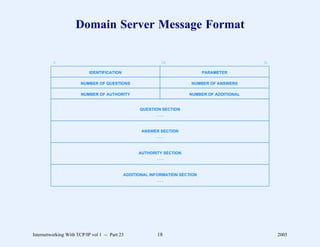
  • 763.
    Session Description Protocol(SDP) d Companion to SIP d Specifies details such as – Media encoding – Protocol port numbers – Multicast addresses Internetworking With TCP/IP vol 1 -- Part 28 19 2005
  • 764.
    Quality Of Service(QoS) d Statistical guarantee of performance d Requires changes to underlying Internet infrastructure d Proponents claim it is needed for telephony d Others claim only larger bandwidth will solve the problem Internetworking With TCP/IP vol 1 -- Part 28 20 2005
  • 765.
    Resource ReSerVation Protocol(RSVP) d IETF response to ATM d End-to-end QoS guarantees d Abstraction is unidirectional flow d Initiated by endpoint Internetworking With TCP/IP vol 1 -- Part 28 21 2005
  • 766.
    RSVP Requests An endpointuses RSVP to request a simplex flow through an IP internet with specified QoS bounds. If routers along the path agree to honor the request, they approve it; otherwise, they deny it. If an application needs QoS in two directions, each endpoint must use RSVP to request a separate flow. Internetworking With TCP/IP vol 1 -- Part 28 22 2005
  • 767.
    Note About RSVP dRSVP defines – Messages endpoint sends to router to request QoS – Messages routers send to other routers – Replies d RSVP does not specify how enforcement done d Separate protocol needed Internetworking With TCP/IP vol 1 -- Part 28 23 2005
  • 768.
    Common Open PolicyServices (COPS) d Proposed enforcement protocol for RSVP d Known as traffic policing d Uses policy server d Checks data sent on flow to ensure the flow does not exceed preestablished bounds Internetworking With TCP/IP vol 1 -- Part 28 24 2005
  • 769.
    Summary d Codec translatesbetween analog and digital forms d RTP used to transfer real-time data d RTP adds timestamp that sender uses to determine playback time d RTCP is companion protocol for RTP that senders and receivers use to control and coordinate data transfer d Voice Over IP uses – RTP for digitized voice transfer – SIP or H.323 for signaling d RSVP and COPS provide quality of service guarantees Internetworking With TCP/IP vol 1 -- Part 28 25 2005
  • 770.
  • 771.
    PART XXIX APPLICATIONS: INTERNET MANAGEMENT (SNMP) Internetworking With TCP/IP vol 1 -- Part 29 1 2005
  • 772.
    Management Protocols d Earlynetwork systems used two approaches – Separate, parallel management network – Link-level management commands d TCP/IP pioneered running management protocols at the application layer – Motivation: provide internet-wide capability instead of single network capability Internetworking With TCP/IP vol 1 -- Part 29 2 2005
  • 773.
    The Point AboutInternet Management In a TCP/IP internet, a manager needs to examine and control routers and other network devices. Because such devices attach to arbitrary networks, protocols for internet management operate at the application level and communicate using TCP/IP transport-level protocols. Internetworking With TCP/IP vol 1 -- Part 29 3 2005
  • 774.
    Architectural Model MA Devices being managed MA MA MA MA MC MA MA Manager’s Host Router being managed Other devices Internetworking With TCP/IP vol 1 -- Part 29 4 2005
  • 775.
    Terminology d Agent – Runs on arbitrary system (e.g., a router) – Responds to manager’s requests d Management software – Runs on manager’s workstation – Sends requests to agents as directed by the manager Internetworking With TCP/IP vol 1 -- Part 29 5 2005
  • 776.
    TCP/IP Network ManagementProtocols d Management Information Base (MIB) d Structure Of Management Information (SMI) d Simple Network Management Protocol (SNMP) Internetworking With TCP/IP vol 1 -- Part 29 6 2005
  • 777.
    Management Information Base(MIB) d All management commands are encoded as fetch or store operations on ‘‘variables’’ d Example: to reboot, store a zero in a variable that corresponds to the time until reboot. d A MIB is a set of variables and the semantics of fetch and store on each Internetworking With TCP/IP vol 1 -- Part 29 7 2005
  • 778.
    MIB Categories MIB category Includes Information About system The host or router operating system interfaces Individual network interfaces at Address translation (e.g., ARP mappings) ip Internet Protocol software icmp Internet Control Message Protocol software tcp Transmission Control Protocol software udp User Datagram Protocol software ospf Open Shortest Path First software bgp Border Gateway Protocol software rmon Remote network monitoring rip-2 Routing Information Protocol software dns Domain Name System software Internetworking With TCP/IP vol 1 -- Part 29 8 2005
  • 779.
    Examples of MIBVariables MIB Variable Category Meaning sysUpTime system Time since last reboot ifNumber interfaces Number of network interfaces ifMtu interfaces MTU for a particular interface ipDefaultTTL ip Value IP uses in time-to-live field ipInReceives ip Number of datagrams received ipForwDatagrams ip Number of datagrams forwarded ipOutNoRoutes ip Number of routing failures ipReasmOKs ip Number of datagrams reassembled ipFragOKs ip Number of datagrams fragmented ipRoutingTable ip IP Routing table icmpInEchos icmp Number of ICMP Echo Requests received tcpRtoMin tcp Minimum retransmission time TCP allows tcpMaxConn tcp Maximum TCP connections allowed tcpInSegs tcp Number of segments TCP has received udpInDatagrams udp Number of UDP datagrams received Internetworking With TCP/IP vol 1 -- Part 29 9 2005
  • 780.
    Structure of ManagementInformation (SMI) d Set of rules for defining MIB variable names d Includes basic definitions such as – Address (4-octet value) – Counter (integer from 0 to 232 - 1) d Specifies using Abstract Syntax Notation 1 (ASN.1) Internetworking With TCP/IP vol 1 -- Part 29 10 2005
  • 781.
    ASN.1 d ISO standard dSpecifies – Syntax for names (user-readable format) – Binary encoding (format used in a message) d Absolute, global, hierarchical namespace Internetworking With TCP/IP vol 1 -- Part 29 11 2005
  • 782.
    Position of MIBIn The ASN.1 Hierarchy unnamed joint- iso itu iso-itu 1 2 3 org 3 dod 6 internet 1 directory mgmt experi- private mental 1 2 3 4 mib 1 Internetworking With TCP/IP vol 1 -- Part 29 12 2005
  • 783.
    Syntactic Form d Variablename written as sequence of labels with dot (period as delimiter) d Numeric encoding used in messages d Example: prex for mgmt node is 1.3.6.1.2.1 Internetworking With TCP/IP vol 1 -- Part 29 13 2005
  • 784.
    ASN.1 Hierarchy ForTCP/IP . . . label from the root to this point is 1 . 3 . 6 internet 1 directory mgmt experi- private mental 1 2 3 4 mib 1 inter- addr. system faces trans. ip icmp tcp udp 1 2 3 4 5 6 7 Internetworking With TCP/IP vol 1 -- Part 29 14 2005
  • 785.
    Example MIB Variables dPrex for variable ipInReceives is iso . org . dod . internet . mgmt . mib . ip . ipInReceives d Numeric value is 1.3.6.1.2.1.4.3 Internetworking With TCP/IP vol 1 -- Part 29 15 2005
  • 786.
    MIB Tables d Correspondto data structures programmers think of as arrays or structs d ASN.1 denition uses keyword SEQUENCE d Array index is appended to MIB variable name Internetworking With TCP/IP vol 1 -- Part 29 16 2005
  • 787.
    Example Of SEQUENCEDenition IpAddrEntry ::= SEQUENCE { ipAdEntAddr IpAddress, ipAdEntIfIndex INTEGER, ipAdEntNetMask IpAddress, ipAdEntBcastAddr IpAddress, ipAdEntReasmMaxSize INTEGER (0..65535) } Internetworking With TCP/IP vol 1 -- Part 29 17 2005
  • 788.
    Simple Network ManagementProtocol (SNMP) d Specifies communication between manager’s workstation and managed entity d Uses fetch-store paradigm Internetworking With TCP/IP vol 1 -- Part 29 18 2005
  • 789.
    Operations That SNMPSupports Command Meaning get-request Fetch a value from a specific variable get-next-request Fetch a value without knowing its exact name get-bulk-request Fetch a large volume of data (e.g., a table) response A response to any of the above requests set-request Store a value in a specific variable inform-request Reference to third-part data (e.g., for a proxy) snmpv2-trap Reply triggered by an event report Undefined at present Internetworking With TCP/IP vol 1 -- Part 29 19 2005
  • 790.
    SNMP Message Format dDened using ASN.1 notation d Similar to BNF grammar Internetworking With TCP/IP vol 1 -- Part 29 20 2005
  • 791.
    Example ASN.1 Denition SNMPv3Message ::= SEQUENCE { msgVersion INTEGER (0..2147483647), -- note: version number 3 is used for SNMPv3 msgGlobalData HeaderData, msgSecurityParameters OCTET STRING, msgData ScopedPduData } Internetworking With TCP/IP vol 1 -- Part 29 21 2005
  • 792.
    Definition Of HeaderDataArea In SNMP Message HeaderData ::= SEQUENCE { msgID INTEGER (0..2147483647), -- used to match responses with requests msgMaxSize INTEGER (484..2147483647), -- maximum size reply the sender can accept msgFlags OCTET STRING (SIZE(1)), -- Individual flag bits specify message characteristics -- bit 7 authorization used -- bit 6 privacy used -- bit 5 reportability (i.e., a response needed) msgSecurityModel INTEGER (1..2147483647) -- determines exact format of security parameters that follow } Internetworking With TCP/IP vol 1 -- Part 29 22 2005
  • 793.
    Discriminated Union d ASN.1uses CHOICE keyword for a discriminated union d Example ScopedPduData ::= CHOICE { plaintext ScopedPDU, encryptedPDU OCTET STRING -- encrypted ScopedPDU value } Internetworking With TCP/IP vol 1 -- Part 29 23 2005
  • 794.
    Summary d TCP/IP managementprotocols reside at application layer d Management Information Base (MIB) specifies set of variables that can be accessed d Structure Of Management Information (SMI) specifies rules for naming MIB variables d Simple Network Management Protocol (SNMP) specifies format of messages that pass between a manager’s workstation and managed entity d Variables named using ASN.1 (absolute, global, hierarchical) d Message format defined with ASN.1 (similar to BNF grammar) Internetworking With TCP/IP vol 1 -- Part 29 24 2005
  • 795.
  • 796.
    PART XXX INTERNET SECURITY AND FIREWALL DESIGN (IPsec, SSL) Internetworking With TCP/IP vol 1 -- Part 30 1 2005
  • 797.
    Network Security d Refersin broad sense to confidence that information and services available on a network cannot be accessed by unauthorized users d Implies – Safety – Freedom from unauthorized access or use – Freedom from snooping or wiretapping – Freedom from disruption of service – Assurance that outsiders cannot change data d Also called information security Internetworking With TCP/IP vol 1 -- Part 30 2 2005
  • 798.
    A Crucial Point Justas no physical property is absolutely secure against crime, no network is completely secure. Internetworking With TCP/IP vol 1 -- Part 30 3 2005
  • 799.
    Aspects Of Protection dData integrity d Data availability d Privacy or condentiality d Authorization d Authentication d Replay avoidance Internetworking With TCP/IP vol 1 -- Part 30 4 2005
  • 800.
    Information Policy d Defineswhat is allowed d Special note: Humans are usually the most susceptible point in any security scheme. A worker who is malicious, careless, or unaware of an organization’s information policy can compromise the best security. Internetworking With TCP/IP vol 1 -- Part 30 5 2005
  • 801.
    Internet Security d Especiallydifcult d Data travels across many networks owned by many groups from source to destination d Computers in the middle can change data Internetworking With TCP/IP vol 1 -- Part 30 6 2005
  • 802.
    A Point AboutAuthentication An authorization scheme that uses a remote machine’s IP address to authenticate its identity does not suffice in an unsecure internet. An imposter who gains control of an intermediate router can obtain access by impersonating an authorized client. Internetworking With TCP/IP vol 1 -- Part 30 7 2005
  • 803.
    Two Basic TechniquesFor Internet Security d Encryption d Perimeter Security Internetworking With TCP/IP vol 1 -- Part 30 8 2005
  • 804.
    IP Security Protocol(IPsec) d Devised by IETF d Actually a set of protocols d Name IPsec applies collectively d Works with IPv4 or IPv6 d Gives framework, but does not specify exactly which encryption or authentication algorithms to use d Choice between authentication and encryption Internetworking With TCP/IP vol 1 -- Part 30 9 2005
  • 805.
    IPsec Authentication Header(AH) d Not an IP option d Added after IP header d Follows IPv6 format (more on IPv6 later in the course) Internetworking With TCP/IP vol 1 -- Part 30 10 2005
  • 806.
    Illustration of AuthenticationHeader Insertion IPv4 TCP TCP HEADER HEADER DATA (a) IPv4 AUTHENTICATION TCP TCP HEADER HEADER HEADER DATA (b) d (a) shows datagram and (b) shows same datagram after header has been inserted Internetworking With TCP/IP vol 1 -- Part 30 11 2005
  • 807.
    Type Information d IPv4PROTOCOL eld is modied so the type is IPsec d Authentication header contains NEXT HEADER eld that species original type Internetworking With TCP/IP vol 1 -- Part 30 12 2005
  • 808.
    Illustration Of TypeInformation With Authentication 0 8 16 31 NEXT HEADER PAYLOAD LEN RESERVED SECURITY PARAMETERS INDEX SEQUENCE NUMBER AUTHENTICATION DATA (VARIABLE) . . . Internetworking With TCP/IP vol 1 -- Part 30 13 2005
  • 809.
    Security Association d Notall information related to security can t in header d Sender and receiver communicate, agree on security parameters, assign small index to each parameter, and then use index values in headers Internetworking With TCP/IP vol 1 -- Part 30 14 2005
  • 810.
    IPsec Encapsulating SecurityPayload (ESP) d Used to encrypt packet contents d More complex than authentication header Internetworking With TCP/IP vol 1 -- Part 30 15 2005
  • 811.
    Illustration Of ESP IPv4 TCP TCP HEADER HEADER DATA (a) authenticated encrypted IPv4 ESP TCP TCP ESP ESP HEADER HEADER HEADER DATA TRAILER AUTH (b) Internetworking With TCP/IP vol 1 -- Part 30 16 2005
  • 812.
    ESP Header 0 16 31 SECURITY PARAMETERS INDEX SEQUENCE NUMBER d Eight octets d Precedes payload Internetworking With TCP/IP vol 1 -- Part 30 17 2005
  • 813.
    ESP Trailer 0 16 24 31 0 - 255 OCTETS OF PADDING PAD LENGTH NEXT HEADER ESP AUTHENTICATION DATA (VARIABLE) . . . d Authentication data variable size d Padding optional Internetworking With TCP/IP vol 1 -- Part 30 18 2005
  • 814.
    Mutable Header Fields dSome IP header fields change (e.g., TTL) d IPsec designed to ensure end-to-end integrity d One possibility: IPsec tunneling – Place IPsec datagram inside normal datagram – Often used in VPNs Internetworking With TCP/IP vol 1 -- Part 30 19 2005
  • 815.
    Illustration Of IPsecTunneling OUTER IP AUTHENTICATION INNER IP DATAGRAM HEADER HEADER (INCLUDING IP HEADER) (a) authenticated encrypted OUTER IP ESP INNER IP DATAGRAM ESP ESP HEADER HEADER (INCLUDING IP HEADER) TRAILER AUTH (b) d (a) when used with authentication d (b) when used with encapsulated security payload Internetworking With TCP/IP vol 1 -- Part 30 20 2005
  • 816.
    Mandatory Security AlgorithmsFor IPsec Authentication HMAC with MD5 RFC 2403 HMAC with SHA-1 RFC 2404 Encapsulating Security Payload DES in CBC mode RFC 2405 HMAC with MD5 RFC 2403 HMAC with SHA-1 RFC 2404 Null Authentication Null Encryption Internetworking With TCP/IP vol 1 -- Part 30 21 2005
  • 817.
    Secure Sockets Layer(SS) d Created by Netscape, Inc. d Widely used d Not formally adopted by IETF d Same API as sockets d Provides authentication and encryption d De facto standard for web browsers Internetworking With TCP/IP vol 1 -- Part 30 22 2005
  • 818.
    Transport Layer Security(TLS) d Created by IETF d So closely related to SSL that the same protocol port is used d Most implementations of SSL also support TLS Internetworking With TCP/IP vol 1 -- Part 30 23 2005
  • 819.
    Perimeter Security d Formof access control d Mechanism is Internet firewall d Firewall placed at each connection between site and rest of Internet d All rewalls use coordinated policy d Blocks unwanted packets Internetworking With TCP/IP vol 1 -- Part 30 24 2005
  • 820.
    Firewall Implementation d Basictechnique is packet filter d Typically runs in a router d Manager species restrictions on incoming packets d Filter drops packets that are not allowed Internetworking With TCP/IP vol 1 -- Part 30 25 2005
  • 821.
    Illustration Of PacketFilter OUTSIDE 2 R 1 INSIDE ARRIVES ON IP IP SOURCE DEST. INTERFACE SOURCE DEST. PROTOCOL PORT PORT 2 * * TCP * 21 2 * * TCP * 23 1 128.5.0.0 / 16 * TCP * 25 2 * * UDP * 43 2 * * UDP * 69 2 * * TCP * 79 Internetworking With TCP/IP vol 1 -- Part 30 26 2005
  • 822.
    Effective Filtering To beeffective, a firewall that uses datagram filtering should restrict access to all IP sources, IP destinations, protocols, and protocol ports except those computers, networks, and services the organization explicitly decides to make available externally. A packet filter that allows a manager to specify which datagrams to admit instead of which datagrams to block can make such restrictions easy to specify. Internetworking With TCP/IP vol 1 -- Part 30 27 2005
  • 823.
    Consequences Of ARestrictive Filter If an organization’s firewall restricts incoming datagrams except for ports that correspond to services the organization makes available externally, an arbitrary application inside the organization cannot become a client of a server outside the organization. Internetworking With TCP/IP vol 1 -- Part 30 28 2005
  • 824.
    Proxy Access d Allowsspecic clients to access specic services d Handles problems like virus detection on incoming les d Uses bastion host Internetworking With TCP/IP vol 1 -- Part 30 29 2005
  • 825.
    Illustration Of ProxyAccess bastion host GLOBAL INTRANET INTERNET (INSIDE) (OUTSIDE) manually enabled bypass d Two firewall filters restrict – Incoming packets from Internet to proxy – Outgoing packets from site to proxy Internetworking With TCP/IP vol 1 -- Part 30 30 2005
  • 826.
    Stateful Firewalls d Allowclients inside an organization to contact servers in the Internet d Firewall – Watches outgoing packets – Records source and destination information – Uses recorded information when admitting packets d Communication still subject to policies Internetworking With TCP/IP vol 1 -- Part 30 31 2005
  • 827.
    Managing Firewall State dConnection tracking – Uses FIN to remove state for TCP connection – Does not work well with UDP d Soft state – Timer set when entry created – Idle entry removed after timeout Internetworking With TCP/IP vol 1 -- Part 30 32 2005
  • 828.
    Content Protection WithProxies d Firewall only operates at packet level d Mechanism known as application proxy protects against incoming – Viruses – Other illicit content d Proxy can examine entire content (e.g., mail message) Internetworking With TCP/IP vol 1 -- Part 30 33 2005
  • 829.
    Summary d Two basictechniques used for Internet security – Encryption – Perimeter security d IETF has defined IPsec as a framework for security d IPsec offers choice of – Authentication header (AH) – Encapsulated Security Payload (ESP) Internetworking With TCP/IP vol 1 -- Part 30 34 2005
  • 830.
    Summary (continued) d Firewall is mechanism used for perimeter security d Packet lter specied by manager d Firewall rejects packets except those explicitly allowed d Stateful rewall allows clients in organization to initiate communication d Application proxy can be used to check content Internetworking With TCP/IP vol 1 -- Part 30 35 2005
  • 831.
  • 832.
    PART XXXI THE FUTURE OF TCP/IP (IPv6) Internetworking With TCP/IP vol 1 -- Part 31 1 2005
  • 833.
    Current Version d TCP/IPhas worked well for over 25 years d Design is flexible and powerful d Has adapted to – New computer and communication technologies – New applications – Increases in size and load Internetworking With TCP/IP vol 1 -- Part 31 2 2005
  • 834.
    Most Signicant TechnicalProblem d Address space limitation d IPv4 address space may be exhausted by the year 2020 Internetworking With TCP/IP vol 1 -- Part 31 3 2005
  • 835.
    History Of TheNew Version d Developed by IETF d Started in early 1990s d Input from many groups, including: computer manufacturers, hardware and software vendors, users, managers, programmers, telephone companies, and the cable television industry Internetworking With TCP/IP vol 1 -- Part 31 4 2005
  • 836.
    History Of TheNew Version (continued) d Three main proposals d Eventually new version emerged d Assigned version number 6, and known as IPv6 d RFC in 1994 d Dened over 10 years ago! Internetworking With TCP/IP vol 1 -- Part 31 5 2005
  • 837.
    Major Changes FromIPv4 d Larger addresses d Extended address hierarchy d Variable header format d Facilities for many options d Provision for protocol extension d Support for autoconguration and renumbering d Support for resource allocation Internetworking With TCP/IP vol 1 -- Part 31 6 2005
  • 838.
    IPv6 Address Size d128 bits per address d Absurd increase in capacity d IPv6 has 1024 addresses per square meter of the Earth’s surface! Internetworking With TCP/IP vol 1 -- Part 31 7 2005
  • 839.
    General Form OfIPv6 Datagram optional Base Extension Extension ... DATA . . . Header Header 1 Header N d Base header required d Extension headers optional Internetworking With TCP/IP vol 1 -- Part 31 8 2005
  • 840.
    IPv6 Base HeaderFormat 0 4 12 16 24 31 VERS TRAFFIC CLASS FLOW LABEL PAYLOAD LENGTH NEXT HEADER HOP LIMIT SOURCE ADDRESS DESTINATION ADDRESS d Alignment is on 64-bit multiples d Fragmentation in extension header d Flow label intended for resource reservation Internetworking With TCP/IP vol 1 -- Part 31 9 2005
  • 841.
    Size Of BaseHeader Each IPv6 datagram begins with a 40-octet base header that includes fields for the source and destination addresses, the maximum hop limit, the traffic class, the flow label, and the type of the next header. Thus, an IPv6 datagram must contain at least 40 octets in addition to the data. Internetworking With TCP/IP vol 1 -- Part 31 10 2005
  • 842.
    IPv6 Extension Headers dSender chooses zero or more extension headers d Only those facilities that are needed should be included Internetworking With TCP/IP vol 1 -- Part 31 11 2005
  • 843.
    Parsing An IPv6Datagram Base Header TCP Segment NEXT=TCP (a) Base Header Route Header TCP Segment NEXT=ROUTE NEXT=TCP (b) Base Header Route Header Auth Header TCP Segment NEXT=ROUTE NEXT=AUTH NEXT=TCP (c) d Each header includes NEXT HEADER eld d NEXT HEADER operates like type eld Internetworking With TCP/IP vol 1 -- Part 31 12 2005
  • 844.
    IPv6 Fragmentation AndReassembly d Like IPv4 – Ultimate destination reassembles d Unlike IPv4 – Routers avoid fragmentation – Original source must fragment Internetworking With TCP/IP vol 1 -- Part 31 13 2005
  • 845.
    How Can OriginalSource Fragment? d Option 1: choose minimum guaranteed MTU of 1280 d Option 2: use path MTU discovery Internetworking With TCP/IP vol 1 -- Part 31 14 2005
  • 846.
    Path MTU Discovery dGuessing game d Source sends datagram without fragmenting d If router cannot forward, router sends back ICMP error message d Source tries smaller MTU Internetworking With TCP/IP vol 1 -- Part 31 15 2005
  • 847.
    Fragmentation Details 0 8 16 29 31 NEXT HEADER RESERVED FRAG. OFFSET RS M DATAGRAM IDENTIFICATION d Fragmentation information carried in extension header Internetworking With TCP/IP vol 1 -- Part 31 16 2005
  • 848.
    Discussion Questions d Isfragmentation desirable? d What are the consequences of the IPv6 design? Internetworking With TCP/IP vol 1 -- Part 31 17 2005
  • 849.
    IPv6 Colon HexadecimalNotation d Replaces dotted decimal d Example: dotted decimal value 104.230.140.100.255.255.255.255.0.0.17.128.150.10.255.255 d Becomes 68E6:8C64:FFFF:FFFF:0:1180:96A:FFFF Internetworking With TCP/IP vol 1 -- Part 31 18 2005
  • 850.
    Zero Compression d Successivezeroes are indicated by a pair of colons d Example FF05:0:0:0:0:0:0:B3 d Becomes FF05::B3 Internetworking With TCP/IP vol 1 -- Part 31 19 2005
  • 851.
    IPv6 Destination Addresses dThree types – Unicast (single host receives copy) – Multicast (set of hosts each receive a copy) – Anycast (set of hosts, one of which receives a copy) d Note: no broadcast (but special multicast addresses (e.g., ‘‘all hosts on local wire’’) Internetworking With TCP/IP vol 1 -- Part 31 20 2005
  • 852.
    Proposed IPv6 AddressSpace Binary Prefix Type Of Address Part Of Address Space 0000 0000 Reserved (IPv4 compatibility) 1/256 0000 0001 Unassigned 1/256 0000 001 NSAP Addresses 1/128 0000 01 Unassigned 1/64 0000 1 Unassigned 1/32 0001 Unassigned 1/16 001 Global Unicast 1/8 010 Unassigned 1/8 011 Unassigned 1/8 100 Unassigned 1/8 101 Unassigned 1/8 110 Unassigned 1/8 1110 Unassigned 1/16 1111 0 Unassigned 1/32 1111 10 Unassigned 1/64 1111 110 Unassigned 1/128 1111 1110 0 Unassigned 1/512 1111 1110 10 Link-Local Unicast Addresses 1/1024 1111 1110 11 IANA - Reserved 1/1024 1111 1111 Multicast Addresses 1/256 Internetworking With TCP/IP vol 1 -- Part 31 21 2005
  • 853.
    Backward Compatibility d Subsetof IPv6 addresses encode IPv4 addresses d Dotted hex notation can end with 4 octets in dotted decimal 80 zero bits 16 bits 32 bits 0000 . . . . . . . . . . . . . . . . . . 0000 0000 IPv4 Address 0000 . . . . . . . . . . . . . . . . . . 0000 FFFF IPv4 Address Internetworking With TCP/IP vol 1 -- Part 31 22 2005
  • 854.
    Myths About IPv6 According To Geoff Huston d IPv6 is – More secure – Required for mobility – Better for wireless networks d IPv6 offers better QoS d Only IPv6 supports auto-configuration d IPv6 solves route scaling Internetworking With TCP/IP vol 1 -- Part 31 23 2005
  • 855.
    Myths About IPv6 According To Geoff Huston (continued) d IPv6 provides better support for – Rapid prefix renumbering – Multihomed sites d IPv4 has run out of addresses Source: G. Huston, ‘‘The Mythology Of IP Version 6,’’ The Internet Protocol Journal vol. 6:2 (June, 2003) Internetworking With TCP/IP vol 1 -- Part 31 23 2005
  • 856.
    Summary d IETF hasdened next version of IP to be IPv6 d Addresses are 128 bits long d Datagram starts with base header followed by zero or more extension headers d Sender performs fragmentation d Many myths abound about the advantages of IPv6 d No strong technical motivation for change Internetworking With TCP/IP vol 1 -- Part 31 23 2005
  • 857.
  • 858.