HARAPPAN CIVILIZATION
(TOWN PLANNING)
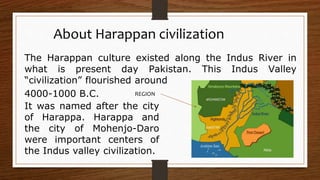
The Harappan culture existed along the Indus River in
what is present day Pakistan. This Indus Valley
“civilization” flourished around
4000-1000 B.C.
About Harappan civilization
It was named after the city
of Harappa. Harappa and
the city of Mohenjo-Daro
were important centers of
the Indus valley civilization.
REGION
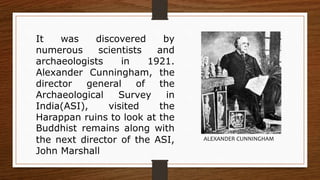
It was discovered by
numerous scientists and
archaeologists in 1921.
Alexander Cunningham, the
director general of the
Archaeological Survey in
India(ASI), visited the
Harappan ruins to look at the
Buddhist remains along with
the next director of the ASI,
John Marshall
ALEXANDER CUNNINGHAM
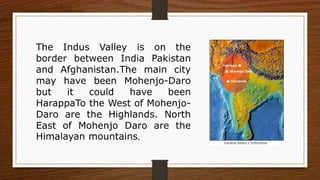
The Indus Valley is on the
border between India Pakistan
and Afghanistan.The main city
may have been Mohenjo-Daro
but it could have been
HarappaTo the West of Mohenjo-
Daro are the Highlands. North
East of Mohenjo Daro are the
Himalayan mountains.
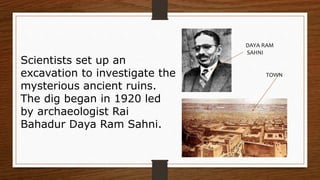
Scientists set up an
excavation to investigate the
mysterious ancient ruins.
The dig began in 1920 led
by archaeologist Rai
Bahadur Daya Ram Sahni.
DAYA RAM
SAHNI
TOWN
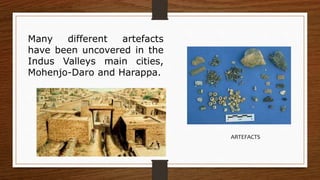
Many different artefacts
have been uncovered in the
Indus Valleys main cities,
Mohenjo-Daro and Harappa.
ARTEFACTS
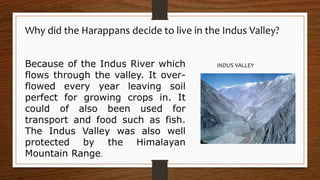
Because of the Indus River which
flows through the valley. It over-
flowed every year leaving soil
perfect for growing crops in. It
could of also been used for
transport and food such as fish.
The Indus Valley was also well
protected by the Himalayan
Mountain Range.
Why did the Harappans decide to live in the Indus Valley?
INDUS VALLEY
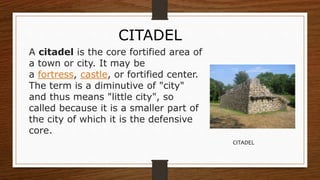
A citadel is the core fortified area of
a town or city. It may be
a fortress, castle, or fortified center.
The term is a diminutive of "city"
and thus means "little city", so
called because it is a smaller part of
the city of which it is the defensive
core.
CITADEL
CITADEL
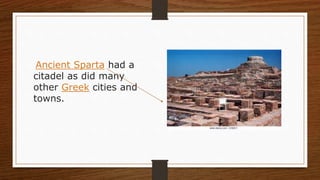
Ancient Sparta had a
citadel as did many
other Greek cities and
towns.
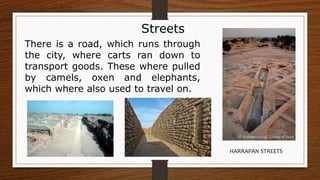
Streets
There is a road, which runs through
the city, where carts ran down to
transport goods. These where pulled
by camels, oxen and elephants,
which where also used to travel on.
HARRAPAN STREETS
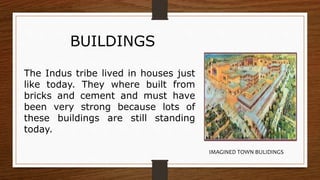
BUILDINGS
The Indus tribe lived in houses just
like today. They where built from
bricks and cement and must have
been very strong because lots of
these buildings are still standing
today.
IMAGINED TOWN BULIDINGS
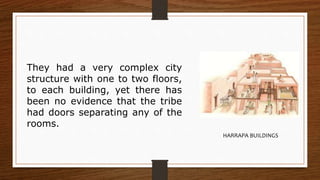
They had a very complex city
structure with one to two floors,
to each building, yet there has
been no evidence that the tribe
had doors separating any of the
rooms.
HARRAPA BUILDINGS
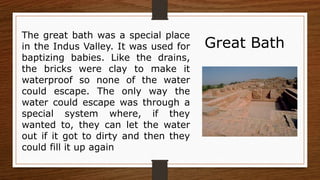
The great bath was a special place
in the Indus Valley. It was used for
baptizing babies. Like the drains,
the bricks were clay to make it
waterproof so none of the water
could escape. The only way the
water could escape was through a
special system where, if they
wanted to, they can let the water
out if it got to dirty and then they
could fill it up again
Great Bath
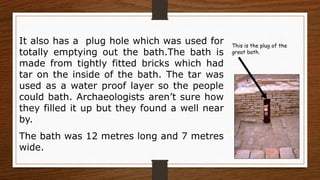
This is the plug of the
great bath.
It also has a plug hole which was used for
totally emptying out the bath.The bath is
made from tightly fitted bricks which had
tar on the inside of the bath. The tar was
used as a water proof layer so the people
could bath. Archaeologists aren’t sure how
they filled it up but they found a well near
by.
The bath was 12 metres long and 7 metres
wide.
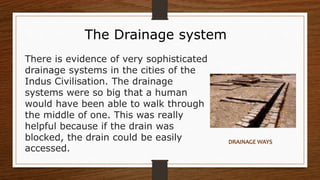
There is evidence of very sophisticated
drainage systems in the cities of the
Indus Civilisation. The drainage
systems were so big that a human
would have been able to walk through
the middle of one. This was really
helpful because if the drain was
blocked, the drain could be easily
accessed.
The Drainage system
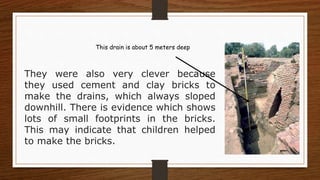
They were also very clever because
they used cement and clay bricks to
make the drains, which always sloped
downhill. There is evidence which shows
lots of small footprints in the bricks.
This may indicate that children helped
to make the bricks.
This drain is about 5 meters deep
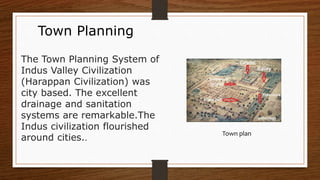
Town Planning
The Town Planning System of
Indus Valley Civilization
(Harappan Civilization) was
city based. The excellent
drainage and sanitation
systems are remarkable.The
Indus civilization flourished
around cities..
Town plan
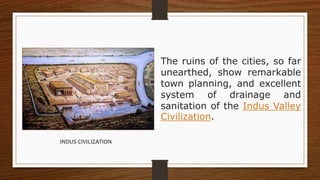
The ruins of the cities, so far
unearthed, show remarkable
town planning, and excellent
system of drainage and
sanitation of the Indus Valley
Civilization.
INDUS CIVILIZATION
The city was the heart of the civilization. The life in
the Indus cities gives the impression of “a democratic
bourgeois economy” like that of ancient Crete
PLANNING
[house]
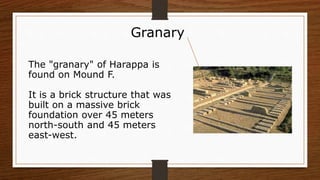
The "granary" of Harappa is
found on Mound F.
It is a brick structure that was
built on a massive brick
foundation over 45 meters
north-south and 45 meters
east-west.
Granary
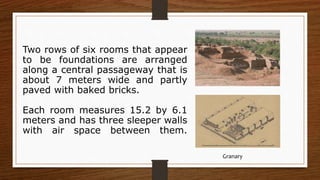
Two rows of six rooms that appear
to be foundations are arranged
along a central passageway that is
about 7 meters wide and partly
paved with baked bricks.
Each room measures 15.2 by 6.1
meters and has three sleeper walls
with air space between them.
Granary
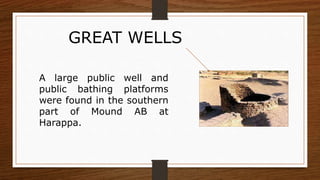
A large public well and
public bathing platforms
were found in the southern
part of Mound AB at
Harappa.
GREAT WELLS
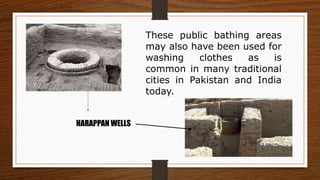
These public bathing areas
may also have been used for
washing clothes as is
common in many traditional
cities in Pakistan and India
today.
HARAPPAN WELLS
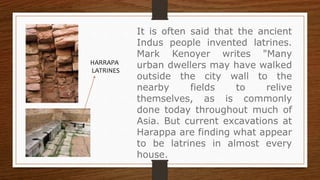
It is often said that the ancient
Indus people invented latrines.
Mark Kenoyer writes "Many
urban dwellers may have walked
outside the city wall to the
nearby fields to relive
themselves, as is commonly
done today throughout much of
Asia. But current excavations at
Harappa are finding what appear
to be latrines in almost every
house.
HARRAPA
LATRINES
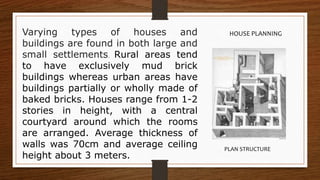
HOUSE PLANNINGVarying types of houses and
buildings are found in both large and
small settlements. Rural areas tend
to have exclusively mud brick
buildings whereas urban areas have
buildings partially or wholly made of
baked bricks. Houses range from 1-2
stories in height, with a central
courtyard around which the rooms
are arranged. Average thickness of
walls was 70cm and average ceiling
height about 3 meters.
PLAN STRUCTURE
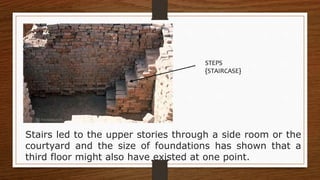
Stairs led to the upper stories through a side room or the
courtyard and the size of foundations has shown that a
third floor might also have existed at one point.
STEPS
{STAIRCASE}
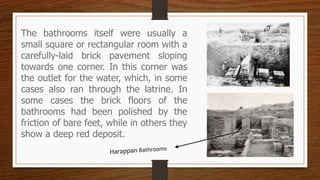
The bathrooms itself were usually a
small square or rectangular room with a
carefully-laid brick pavement sloping
towards one corner. In this corner was
the outlet for the water, which, in some
cases also ran through the latrine. In
some cases the brick floors of the
bathrooms had been polished by the
friction of bare feet, while in others they
show a deep red deposit.
Indus valley civilization is the dream of today but shown
yesterday. It is that civilization which laid the foundation of
our culture. Town planning was marvelous. Drainage system
was covered so that there is no pollution. There was food
storage system from which all the people were benefited. They
worship nature which is the need of today….women were
educated. Administration was proper. So, we can say that it is
dream of todays -
• ------------------------------------------------------ Conclusion
Harappan civilization

Harappan civilization

  • 1.
  • 2.
    The Harappan cultureexisted along the Indus River in what is present day Pakistan. This Indus Valley “civilization” flourished around 4000-1000 B.C. About Harappan civilization It was named after the city of Harappa. Harappa and the city of Mohenjo-Daro were important centers of the Indus valley civilization. REGION
  • 3.
    It was discoveredby numerous scientists and archaeologists in 1921. Alexander Cunningham, the director general of the Archaeological Survey in India(ASI), visited the Harappan ruins to look at the Buddhist remains along with the next director of the ASI, John Marshall ALEXANDER CUNNINGHAM
  • 4.
    The Indus Valleyis on the border between India Pakistan and Afghanistan.The main city may have been Mohenjo-Daro but it could have been HarappaTo the West of Mohenjo- Daro are the Highlands. North East of Mohenjo Daro are the Himalayan mountains.
  • 5.
    Scientists set upan excavation to investigate the mysterious ancient ruins. The dig began in 1920 led by archaeologist Rai Bahadur Daya Ram Sahni. DAYA RAM SAHNI TOWN
  • 6.
    Many different artefacts havebeen uncovered in the Indus Valleys main cities, Mohenjo-Daro and Harappa. ARTEFACTS
  • 7.
    Because of theIndus River which flows through the valley. It over- flowed every year leaving soil perfect for growing crops in. It could of also been used for transport and food such as fish. The Indus Valley was also well protected by the Himalayan Mountain Range. Why did the Harappans decide to live in the Indus Valley? INDUS VALLEY
  • 8.
    A citadel isthe core fortified area of a town or city. It may be a fortress, castle, or fortified center. The term is a diminutive of "city" and thus means "little city", so called because it is a smaller part of the city of which it is the defensive core. CITADEL CITADEL
  • 9.
    Ancient Sparta hada citadel as did many other Greek cities and towns.
  • 10.
    Streets There is aroad, which runs through the city, where carts ran down to transport goods. These where pulled by camels, oxen and elephants, which where also used to travel on. HARRAPAN STREETS
  • 11.
    BUILDINGS The Indus tribelived in houses just like today. They where built from bricks and cement and must have been very strong because lots of these buildings are still standing today. IMAGINED TOWN BULIDINGS
  • 12.
    They had avery complex city structure with one to two floors, to each building, yet there has been no evidence that the tribe had doors separating any of the rooms. HARRAPA BUILDINGS
  • 13.
    The great bathwas a special place in the Indus Valley. It was used for baptizing babies. Like the drains, the bricks were clay to make it waterproof so none of the water could escape. The only way the water could escape was through a special system where, if they wanted to, they can let the water out if it got to dirty and then they could fill it up again Great Bath
  • 14.
    This is theplug of the great bath. It also has a plug hole which was used for totally emptying out the bath.The bath is made from tightly fitted bricks which had tar on the inside of the bath. The tar was used as a water proof layer so the people could bath. Archaeologists aren’t sure how they filled it up but they found a well near by. The bath was 12 metres long and 7 metres wide.
  • 15.
    There is evidenceof very sophisticated drainage systems in the cities of the Indus Civilisation. The drainage systems were so big that a human would have been able to walk through the middle of one. This was really helpful because if the drain was blocked, the drain could be easily accessed. The Drainage system
  • 16.
    They were alsovery clever because they used cement and clay bricks to make the drains, which always sloped downhill. There is evidence which shows lots of small footprints in the bricks. This may indicate that children helped to make the bricks. This drain is about 5 meters deep
  • 17.
    Town Planning The TownPlanning System of Indus Valley Civilization (Harappan Civilization) was city based. The excellent drainage and sanitation systems are remarkable.The Indus civilization flourished around cities.. Town plan
  • 18.
    The ruins ofthe cities, so far unearthed, show remarkable town planning, and excellent system of drainage and sanitation of the Indus Valley Civilization. INDUS CIVILIZATION
  • 19.
    The city wasthe heart of the civilization. The life in the Indus cities gives the impression of “a democratic bourgeois economy” like that of ancient Crete PLANNING [house]
  • 20.
    The "granary" ofHarappa is found on Mound F. It is a brick structure that was built on a massive brick foundation over 45 meters north-south and 45 meters east-west. Granary
  • 21.
    Two rows ofsix rooms that appear to be foundations are arranged along a central passageway that is about 7 meters wide and partly paved with baked bricks. Each room measures 15.2 by 6.1 meters and has three sleeper walls with air space between them. Granary
  • 22.
    A large publicwell and public bathing platforms were found in the southern part of Mound AB at Harappa. GREAT WELLS
  • 23.
    These public bathingareas may also have been used for washing clothes as is common in many traditional cities in Pakistan and India today. HARAPPAN WELLS
  • 24.
    It is oftensaid that the ancient Indus people invented latrines. Mark Kenoyer writes "Many urban dwellers may have walked outside the city wall to the nearby fields to relive themselves, as is commonly done today throughout much of Asia. But current excavations at Harappa are finding what appear to be latrines in almost every house. HARRAPA LATRINES
  • 25.
    HOUSE PLANNINGVarying typesof houses and buildings are found in both large and small settlements. Rural areas tend to have exclusively mud brick buildings whereas urban areas have buildings partially or wholly made of baked bricks. Houses range from 1-2 stories in height, with a central courtyard around which the rooms are arranged. Average thickness of walls was 70cm and average ceiling height about 3 meters. PLAN STRUCTURE
  • 26.
    Stairs led tothe upper stories through a side room or the courtyard and the size of foundations has shown that a third floor might also have existed at one point. STEPS {STAIRCASE}
  • 27.
    The bathrooms itselfwere usually a small square or rectangular room with a carefully-laid brick pavement sloping towards one corner. In this corner was the outlet for the water, which, in some cases also ran through the latrine. In some cases the brick floors of the bathrooms had been polished by the friction of bare feet, while in others they show a deep red deposit.
  • 28.
    Indus valley civilizationis the dream of today but shown yesterday. It is that civilization which laid the foundation of our culture. Town planning was marvelous. Drainage system was covered so that there is no pollution. There was food storage system from which all the people were benefited. They worship nature which is the need of today….women were educated. Administration was proper. So, we can say that it is dream of todays - • ------------------------------------------------------ Conclusion