INDUS VALLEY CIVILISATION
India’s first major civilization flourished nearly 5,000 years ago in the valley along the Indus River.
A society known to possess a sophisticated lifestyle, aesthetics, and knowledge of town planning that holds true even
today.
IndusValleyCivilisation
earliest known urban culture of the Indian subcontinent
the original inhabitants of this highly advanced civilization were of Dravidian descent.
. By 5,500 BC the people of the Indus valley had invented pottery and
was a prosperous farming society and the farmers used bronze tools
. With time the people of the Indus Valley began to live in towns—two of the largest were at Mohenjo-daro and
Harappa.
Remainsof IndusValleyCivilisation
2
Spreadof theIndusvalleycivilisation
The civilisation spread from northern
Baluchistan
to coastal area of Narmada
And from boundary of Afghanistan-
Pakistan to banks of river Yamuna
The civilisation came into light in 1856 AD during laying railway track b/w Karachi and Lahore
Site of Harappa explored in 1920
Site of Mohenjodaro explored in 1922
This discovery considered to be one of the most important discoveries of archaeological sciences
The important sites excavated are-
Harappa
Mohenjodaro
Lothal
Dholavira
3
It survived for nearly 1000 years before declining due to reasons still debated
Food:
wheat, RICE and barley were cultivated in that region
date palms were grown in the area
COMMON DIET INCLUDED fruits, vegetables, fish, milk and meat of animals
i.e. beef, mutton and poultry.
Dress:
dress of men and women consisted of two pieces of cloth-one resembling
a dhoti and the other worn over the left shoulder and under the right
ARM
Men had long hair designed differently
Women wore a fan shaped head dress covering there hair.
Ornaments:
men and women wore ornaments made of gold, silver, copper and
Metals
Men wore necklaces, finger rings and armlets of various designs and shapes.
The women wore a head dress, ear rings, bangles, girdles, bracelets And anklets.
Rich people wore expensive ornaments made of gold while the poor had ornaments made of shell, bone or copper.
SOCIALLIFEOF THEPEOPLE
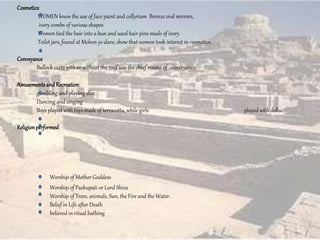
Cosmetics:
WOMEN knew the use of face paint and collyrium Bronze oval mirrors,
ivory combs of various shapes
Women tied the hair into a bun and used hair pins made of ivory.
Toilet jars, found at Mohen-jo-daro, show that women took interest in cosmetics.
Conveyance
Bullock carts with or without the roof was the chief means of conveyance.
Amusementsand Recreation:
gambling and playing dice.
Dancing and singing
Boys played with toys made of terracotta, while girls played with dolls.
Religionperformed
Worship of Mother Goddess
Worship of Pashupati or Lord Shiva
Worship of Trees, animals, Sun, the Fire and the Water.
Belief in Life after Death
believed in ritual bathing
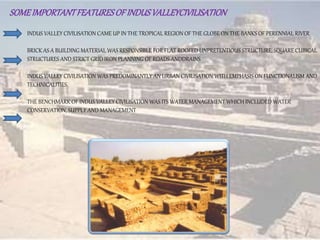
SOMEIMPORTANTFEATURESOF INDUSVALLEYCIVILISATION
INDUS VALLEY CIVILISATION CAME UP IN THE TROPICAL REGION OF THE GLOBE ON THE BANKS OF PERENNIAL RIVER
BRICK AS A BUILDING MATERIAL WAS RESPONSIBLE FOR FLAT ROOFED UNPRETENTIOUS STRUCTURE, SQUARE CUBICAL
STRUCTURES AND STRICT GRID IRON PLANNING OF ROADS ANDDRAINS
INDUS VALLEY CIVILISATION WAS PREDOMINANTLY AN URBAN CIVILISATION WITH EMPHASIS ON FUNCTIONALISM AND
TECHNICALITIES
THE BENCHMARK OF INDUS VALLEY CIVILISATION WAS ITS WATER MANAGEMENT WHICH INCLUDED WATER
CONSERVATION, SUPPLY AND MANAGEMENT
Revelationthroughstudies
The aesthetics of the buildings was not considered much
THEIR MAIN EMPHASIS WAS ON
- QUALITY OF BUILDING MATERIALS EMPLOYED
- CONSTRUCTION TECHNIQUES
- STABILITY OF CONSTRUCTION
THESE CIVILISATIONS WERE URBAN IN CHARACTER
Many of the brick houses were two stories high, with thick walls and high ceilings to keep the rooms cool in the hot
summer months.
The large platform, called the ‘Citadel’ is presumed to be the administrative seat. Other public buildings are temples
and public baths. There are also granaries where the stores are elevated above brick
Almost every house had a bathroom, usually a fine sawn burnt brick pavement, often with a surrounding curb.
Waste water was directed to covered drains, which lined the major streets. First floor bathrooms also built. There is also evidence
of vertical drains which were probably their toilet.
CITYPLANNINGININDUSVALLEYCIVILISATION
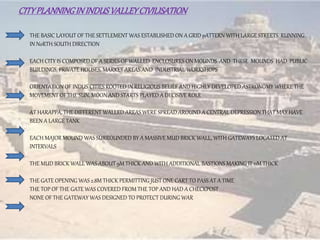
THE BASIC LAYOUT OF THE SETTLEMENT WAS ESTABLISHED ON A GRID pATTERN WITH LARGE STREETS RUNNING
IN NoRTH SOUTH DIRECTION
EACH CITY IS COMPOSED OF A SERIES OF WALLED ENCLOSURES ON MOUNDS AND THESE MOUNDS HAD PUBLIC
BUILDINGS, PRIVATE HOUSES, MARKET AREAS AND INDUSTRIAL WORKSHOPS
ORIENTATION OF INDUS CITIES ROOTED IN RELIGIOUS BELIEF AND HIGHLY DEVELOPED ASTRONOMY WHERE THE
MOVEMENT OF THE SUN, MOON AND STARTS PLAYED A DECISIVE ROLE
AT HARAPPA, THE DIFFERENT WALLED AREAS WERE SPREAD AROUND A CENTRAL DEPRESSION THAT MAY HAVE
BEEN A LARGE TANK
EACH MAJOR MOUND WAS SURROUNDED BY A MASSIVE MUD BRICK WALL, WITH GATEWAYS LOCATED AT
INTERVALS
THE MUD BRICK WALL WAS ABOUT 9M THICK AND WITH ADDITIONAL BASTIONS MAKING IT 11M THICK
THE GATE OPENING WAS 2.8M THICK PERMITTING JUST ONE CART TO PASS AT A TIME
THE TOP OF THE GATE WAS COVERED FROM THE TOP AND HAD A CHECKPOST
NONE OF THE GATEWAY WAS DESIGNED TO PROTECT DURING WAR
the city was divided into two main parts.
The higher and upper portion of the city was protected by a construction which looks like a fort. The ruling class of the towns perhaps
lived in the protected area.
THE other part of the towns was lower in height than the former and common men lived in this area
The main streets ran from north to south and east to west intersecting one another at right angles.
The streets were broad varying from 9 feet to 34 feet.
They ran straight to a mile. They were suitable for wheeled traffic. Lanes were joined with the streets.
Street lamps were provided for welfare of public.
BUILDING MATERIALS USED
A REMARKABLE UNIFORMItY IN THE SELECTION OF MATERIALS AND CONSTRUCTION
TECHNIQUES
MOST COMMON BUILDING MATERIAL USED – BURN BRICKS, MUD BRICKS, WOOD AND REEDS
MUD BRICKS, BAKED BRICKS OR StONES USED IN FOUNDATIONS OR WALLS OF THE HOUSES
DOORS AND WINDOWS MADE OF BRICKS and wood
FLOORS OF THE HOUSES WAS GENERALLY RAMMED EARTH OFTEN COVERED WITH CLEAN
SAND
BATHING AREAS AND DRAINS WERE MADE BAKED BRICKS AND SOME ROOMS PAVED WITH
TERRACOTTA CAKES
FRAGMENTS OF ROOFS DISCOVERED WERE PROBABLY MADE OF WOODEN BRICKS COVERED
WITH REEDS AND COMPACTED CLAY
BRICKS USED OF UNIFORM SIZE WITH DIMENSIONS AS FOLLOWS
- FOR HOUSES 7X14X28 CMS
- FOR CONSRUCION OF CITY WALLS 10X20X40 CMS
THE RATIO OF LENGTH: BREADTH: HEIGHT IS CONSTANT I.E. 1:2:4
MANY LARGE PUBLIC BUILDINGS HAVE BEEN FOUND OF ENTIRELY MADE OF WOOD
DRESSED STONE BLOCKS WERE ALSO WIDELY USED
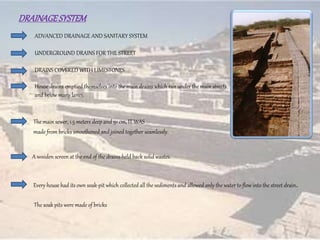
DRAINAGESYSTEM
ADVANCED DRAINAGE AND SANITARY SYSTEM
UNDERGROUND DRAINS FOR THE STREET
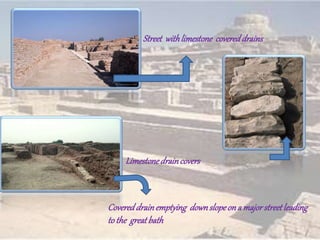
DRAINS COVERED WITH LIMESTONES
The main sewer, 1.5 meters deep and 91 cm, IT WAS
made from bricks smoothened and joined together seamlessly.
A wooden screen at the end of the drains held back solid wastes.
House drains emptied themselves into the main drains which ran under the main streets
and below many lanes.
The soak pits were made of bricks
Every house had its own soak-pit which collected all the sediments and allowed only the water to flow into the street drain.
The drainage system and drains were covered with bricks or stones and were provided with inspection traps and
main holes at regular intervals for inspection
MAINSEWERONTEMAINSTREETCARRYINg WASTEWATER
Street withlimestone covereddrains
Limestonedraincovers
Covereddrainemptying downslopeona majorstreetleading
to the greatbath
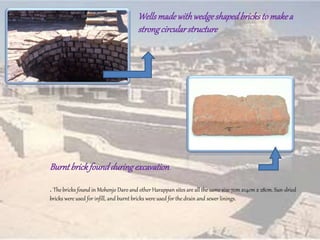
Wellsmadewithwedgeshapedbricksto makea
strongcircularstructure
Burntbrickfoundduringexcavation
. The bricks found in Mohenjo Daro and other Harappan sites are all the same size 7cm x14cm x 28cm. Sun-dried
bricks were used for infill, and burnt bricks were used for the drain and sewer linings.
IMPORTANTSITESAT
INDUSVALLEYCIVILISATION
-MOHENJODARO
-INDUSVALLEYCIVILISATION
Mohenjodaro
City had a planned layout of
Most buildings were built of fired and mortared bricks, some incorporated sun dried mud brick and wooden
superstructures
The sheer size of the city , and its
provision of public buildings and facilities suggests high level of social organisation. At the peak of its development,
mohenjodaro could have housed over 35000 residents
ThE city had central market place, with
large central wells. Individual households obtained their water from smaller wells
Waste water was channeled to covered drains that lined the major drains
Each part of the city was made of walled sections and each section included different buildings such as public
buildings , houses, markets, etc=
The city had planned layout based on street grid of rectilinear building
Some houses, presumably those of wealthier inhabitants, include rooms that appear to have been set aside for
bathing, and one building had an underground furnace (known as a hypocaust), possibly for heated bathing
Most houses had inner courtyards, with doors that opened onto side-lanes. Some buildings were two-storeyed.
Mohenjodaro consisted of two parts. One part was a citadel, containing a public bath and assembly halls
. It also held a granary where grain was stored.
The lower part of the town had streets laid out in a grid pattern. The houses were up to 3 stories high and were
made of brick
The streets had networks of covered drains.
The Great Bathof Mohenjo-Daro
The people of Mohenjo-Daro apparently practiced ritual bathing. Evidence of this is one of the more iconic images of Mohenjo-Daro, the
Great Bath.
The Great Bath is a pool built of mud bricks and is 39 feet long, 23 feet wide, and around 8 feet deep.
The "great bath" is without doubt the earliest public water tank in the ancient world.
It was sealed with a sort of tar and had a drain that allowed the bath to be drained and cleaned as necessary.
Artefacts such as bathing stones (used to scrub with) and cups (possibly used to hold ritual oils or drinks) were found near the ruins of the
Great Bath.
The "great bath" is without doubt the earliest public water tank in the ancient world.
Two wide staircases lead down into the tank from the north and south and small sockets at the edges of the stairs are
thought to have held wooden planks or treads
The floor of the tank is water tight due to finely fitted bricks laid on edge with gypsum plaster and the side walls were constructed in
a similar manner. To make the tank even more water tight, a thick layer of bitumen (natural tar) was laid along the sides of the
tank and presumably also beneath the floor.
The Granary
A granary is a structure for the storage and preservation of grain
The people of Mohenjo-Daro may have used their granary as a community bank for their harvested grains, much as we use banks
today.
It is a brick structure that was built on a massive brick foundation over 45 meters north south and 45 meters east-west.
Two rows of six rooms that appear to be foundations are arranged along a central passageway that is about 7 meters wide and partly
paved with baked bricks.
Each room measures 15.2 by 6.1 meters and has three sleeper walls with air space between them.
Houses,Sewage,and Plumbing
Houses often had two stories
a cistern or well to hold water
clay pipes to deliver water to different rooms in the house.
A central patio or open-air courtyard provided a method of ventilation for the
structure.
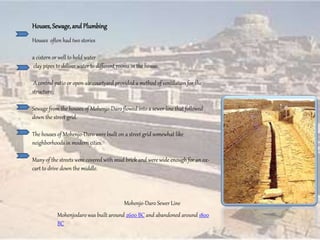
Sewage from the houses of Mohenjo-Daro flowed into a sewer line that followed
down the street grid.
The houses of Mohenjo-Daro were built on a street grid somewhat like
neighborhoods in modern cities.
Many of the streets were covered with mud brick and were wide enough for an ox-
cart to drive down the middle.
Mohenjo-Daro Sewer Line
Mohenjodaro was built around 2600 BC and abandoned around 1800
BC
HARAPPA
Streets had well organised drained system
Houses and other buildings were made sun dried or kiln baked bricks
City system based on grid system
Each house had an indoor and an outdoor kitchen
City surrounded by massive walls and large gateways
Walls were meant to control trade and protect the walls from being flooded
Each part of the city was made of walled sections and each section included different buildings such as public
buildings , houses, markets, etc
The Granary
The granary at Harappa, is a brick structure that was built on a massive brick foundation . Two rows of six rooms that appear to be are
arranged
along a central passageway that is about 7 meters wide and partly paved with baked bricks.
Each room measures 15.2 by 6.1 meters and has three sleeper walls with air space between them. A wooden superstructure supported in
some places by
large columns would have been built on top of the brick foundations, with stairs leading up from the central passage area.
Small triangular opening may have served as air ducts to allow the flow of fresh air beneath the hollow floors.
THANK YOU

INDUs.pptx

  • 1.
  • 2.
    India’s first majorcivilization flourished nearly 5,000 years ago in the valley along the Indus River. A society known to possess a sophisticated lifestyle, aesthetics, and knowledge of town planning that holds true even today. IndusValleyCivilisation earliest known urban culture of the Indian subcontinent the original inhabitants of this highly advanced civilization were of Dravidian descent. . By 5,500 BC the people of the Indus valley had invented pottery and was a prosperous farming society and the farmers used bronze tools . With time the people of the Indus Valley began to live in towns—two of the largest were at Mohenjo-daro and Harappa.
  • 3.
  • 4.
    Spreadof theIndusvalleycivilisation The civilisationspread from northern Baluchistan to coastal area of Narmada And from boundary of Afghanistan- Pakistan to banks of river Yamuna
  • 5.
    The civilisation cameinto light in 1856 AD during laying railway track b/w Karachi and Lahore Site of Harappa explored in 1920 Site of Mohenjodaro explored in 1922 This discovery considered to be one of the most important discoveries of archaeological sciences The important sites excavated are- Harappa Mohenjodaro Lothal Dholavira 3 It survived for nearly 1000 years before declining due to reasons still debated
  • 6.
    Food: wheat, RICE andbarley were cultivated in that region date palms were grown in the area COMMON DIET INCLUDED fruits, vegetables, fish, milk and meat of animals i.e. beef, mutton and poultry. Dress: dress of men and women consisted of two pieces of cloth-one resembling a dhoti and the other worn over the left shoulder and under the right ARM Men had long hair designed differently Women wore a fan shaped head dress covering there hair. Ornaments: men and women wore ornaments made of gold, silver, copper and Metals Men wore necklaces, finger rings and armlets of various designs and shapes. The women wore a head dress, ear rings, bangles, girdles, bracelets And anklets. Rich people wore expensive ornaments made of gold while the poor had ornaments made of shell, bone or copper. SOCIALLIFEOF THEPEOPLE
  • 7.
    Cosmetics: WOMEN knew theuse of face paint and collyrium Bronze oval mirrors, ivory combs of various shapes Women tied the hair into a bun and used hair pins made of ivory. Toilet jars, found at Mohen-jo-daro, show that women took interest in cosmetics. Conveyance Bullock carts with or without the roof was the chief means of conveyance. Amusementsand Recreation: gambling and playing dice. Dancing and singing Boys played with toys made of terracotta, while girls played with dolls. Religionperformed Worship of Mother Goddess Worship of Pashupati or Lord Shiva Worship of Trees, animals, Sun, the Fire and the Water. Belief in Life after Death believed in ritual bathing
  • 8.
    SOMEIMPORTANTFEATURESOF INDUSVALLEYCIVILISATION INDUS VALLEYCIVILISATION CAME UP IN THE TROPICAL REGION OF THE GLOBE ON THE BANKS OF PERENNIAL RIVER BRICK AS A BUILDING MATERIAL WAS RESPONSIBLE FOR FLAT ROOFED UNPRETENTIOUS STRUCTURE, SQUARE CUBICAL STRUCTURES AND STRICT GRID IRON PLANNING OF ROADS ANDDRAINS INDUS VALLEY CIVILISATION WAS PREDOMINANTLY AN URBAN CIVILISATION WITH EMPHASIS ON FUNCTIONALISM AND TECHNICALITIES THE BENCHMARK OF INDUS VALLEY CIVILISATION WAS ITS WATER MANAGEMENT WHICH INCLUDED WATER CONSERVATION, SUPPLY AND MANAGEMENT
  • 9.
    Revelationthroughstudies The aesthetics ofthe buildings was not considered much THEIR MAIN EMPHASIS WAS ON - QUALITY OF BUILDING MATERIALS EMPLOYED - CONSTRUCTION TECHNIQUES - STABILITY OF CONSTRUCTION THESE CIVILISATIONS WERE URBAN IN CHARACTER Many of the brick houses were two stories high, with thick walls and high ceilings to keep the rooms cool in the hot summer months. The large platform, called the ‘Citadel’ is presumed to be the administrative seat. Other public buildings are temples and public baths. There are also granaries where the stores are elevated above brick Almost every house had a bathroom, usually a fine sawn burnt brick pavement, often with a surrounding curb. Waste water was directed to covered drains, which lined the major streets. First floor bathrooms also built. There is also evidence of vertical drains which were probably their toilet.
  • 10.
    CITYPLANNINGININDUSVALLEYCIVILISATION THE BASIC LAYOUTOF THE SETTLEMENT WAS ESTABLISHED ON A GRID pATTERN WITH LARGE STREETS RUNNING IN NoRTH SOUTH DIRECTION EACH CITY IS COMPOSED OF A SERIES OF WALLED ENCLOSURES ON MOUNDS AND THESE MOUNDS HAD PUBLIC BUILDINGS, PRIVATE HOUSES, MARKET AREAS AND INDUSTRIAL WORKSHOPS ORIENTATION OF INDUS CITIES ROOTED IN RELIGIOUS BELIEF AND HIGHLY DEVELOPED ASTRONOMY WHERE THE MOVEMENT OF THE SUN, MOON AND STARTS PLAYED A DECISIVE ROLE AT HARAPPA, THE DIFFERENT WALLED AREAS WERE SPREAD AROUND A CENTRAL DEPRESSION THAT MAY HAVE BEEN A LARGE TANK EACH MAJOR MOUND WAS SURROUNDED BY A MASSIVE MUD BRICK WALL, WITH GATEWAYS LOCATED AT INTERVALS THE MUD BRICK WALL WAS ABOUT 9M THICK AND WITH ADDITIONAL BASTIONS MAKING IT 11M THICK THE GATE OPENING WAS 2.8M THICK PERMITTING JUST ONE CART TO PASS AT A TIME THE TOP OF THE GATE WAS COVERED FROM THE TOP AND HAD A CHECKPOST NONE OF THE GATEWAY WAS DESIGNED TO PROTECT DURING WAR
  • 11.
    the city wasdivided into two main parts. The higher and upper portion of the city was protected by a construction which looks like a fort. The ruling class of the towns perhaps lived in the protected area. THE other part of the towns was lower in height than the former and common men lived in this area
  • 12.
    The main streetsran from north to south and east to west intersecting one another at right angles. The streets were broad varying from 9 feet to 34 feet. They ran straight to a mile. They were suitable for wheeled traffic. Lanes were joined with the streets. Street lamps were provided for welfare of public.
  • 13.
    BUILDING MATERIALS USED AREMARKABLE UNIFORMItY IN THE SELECTION OF MATERIALS AND CONSTRUCTION TECHNIQUES MOST COMMON BUILDING MATERIAL USED – BURN BRICKS, MUD BRICKS, WOOD AND REEDS MUD BRICKS, BAKED BRICKS OR StONES USED IN FOUNDATIONS OR WALLS OF THE HOUSES DOORS AND WINDOWS MADE OF BRICKS and wood FLOORS OF THE HOUSES WAS GENERALLY RAMMED EARTH OFTEN COVERED WITH CLEAN SAND BATHING AREAS AND DRAINS WERE MADE BAKED BRICKS AND SOME ROOMS PAVED WITH TERRACOTTA CAKES FRAGMENTS OF ROOFS DISCOVERED WERE PROBABLY MADE OF WOODEN BRICKS COVERED WITH REEDS AND COMPACTED CLAY BRICKS USED OF UNIFORM SIZE WITH DIMENSIONS AS FOLLOWS - FOR HOUSES 7X14X28 CMS - FOR CONSRUCION OF CITY WALLS 10X20X40 CMS THE RATIO OF LENGTH: BREADTH: HEIGHT IS CONSTANT I.E. 1:2:4
  • 14.
    MANY LARGE PUBLICBUILDINGS HAVE BEEN FOUND OF ENTIRELY MADE OF WOOD DRESSED STONE BLOCKS WERE ALSO WIDELY USED
  • 15.
    DRAINAGESYSTEM ADVANCED DRAINAGE ANDSANITARY SYSTEM UNDERGROUND DRAINS FOR THE STREET DRAINS COVERED WITH LIMESTONES The main sewer, 1.5 meters deep and 91 cm, IT WAS made from bricks smoothened and joined together seamlessly. A wooden screen at the end of the drains held back solid wastes. House drains emptied themselves into the main drains which ran under the main streets and below many lanes. The soak pits were made of bricks Every house had its own soak-pit which collected all the sediments and allowed only the water to flow into the street drain.
  • 16.
    The drainage systemand drains were covered with bricks or stones and were provided with inspection traps and main holes at regular intervals for inspection MAINSEWERONTEMAINSTREETCARRYINg WASTEWATER
  • 17.
  • 18.
    Wellsmadewithwedgeshapedbricksto makea strongcircularstructure Burntbrickfoundduringexcavation . Thebricks found in Mohenjo Daro and other Harappan sites are all the same size 7cm x14cm x 28cm. Sun-dried bricks were used for infill, and burnt bricks were used for the drain and sewer linings.
  • 19.
  • 20.
    Mohenjodaro City had aplanned layout of Most buildings were built of fired and mortared bricks, some incorporated sun dried mud brick and wooden superstructures The sheer size of the city , and its provision of public buildings and facilities suggests high level of social organisation. At the peak of its development, mohenjodaro could have housed over 35000 residents ThE city had central market place, with large central wells. Individual households obtained their water from smaller wells Waste water was channeled to covered drains that lined the major drains Each part of the city was made of walled sections and each section included different buildings such as public buildings , houses, markets, etc= The city had planned layout based on street grid of rectilinear building
  • 21.
    Some houses, presumablythose of wealthier inhabitants, include rooms that appear to have been set aside for bathing, and one building had an underground furnace (known as a hypocaust), possibly for heated bathing Most houses had inner courtyards, with doors that opened onto side-lanes. Some buildings were two-storeyed. Mohenjodaro consisted of two parts. One part was a citadel, containing a public bath and assembly halls . It also held a granary where grain was stored. The lower part of the town had streets laid out in a grid pattern. The houses were up to 3 stories high and were made of brick The streets had networks of covered drains.
  • 22.
    The Great BathofMohenjo-Daro The people of Mohenjo-Daro apparently practiced ritual bathing. Evidence of this is one of the more iconic images of Mohenjo-Daro, the Great Bath. The Great Bath is a pool built of mud bricks and is 39 feet long, 23 feet wide, and around 8 feet deep. The "great bath" is without doubt the earliest public water tank in the ancient world. It was sealed with a sort of tar and had a drain that allowed the bath to be drained and cleaned as necessary. Artefacts such as bathing stones (used to scrub with) and cups (possibly used to hold ritual oils or drinks) were found near the ruins of the Great Bath. The "great bath" is without doubt the earliest public water tank in the ancient world. Two wide staircases lead down into the tank from the north and south and small sockets at the edges of the stairs are thought to have held wooden planks or treads
  • 23.
    The floor ofthe tank is water tight due to finely fitted bricks laid on edge with gypsum plaster and the side walls were constructed in a similar manner. To make the tank even more water tight, a thick layer of bitumen (natural tar) was laid along the sides of the tank and presumably also beneath the floor.
  • 24.
    The Granary A granaryis a structure for the storage and preservation of grain The people of Mohenjo-Daro may have used their granary as a community bank for their harvested grains, much as we use banks today. It is a brick structure that was built on a massive brick foundation over 45 meters north south and 45 meters east-west. Two rows of six rooms that appear to be foundations are arranged along a central passageway that is about 7 meters wide and partly paved with baked bricks. Each room measures 15.2 by 6.1 meters and has three sleeper walls with air space between them.
  • 25.
    Houses,Sewage,and Plumbing Houses oftenhad two stories a cistern or well to hold water clay pipes to deliver water to different rooms in the house. A central patio or open-air courtyard provided a method of ventilation for the structure. Sewage from the houses of Mohenjo-Daro flowed into a sewer line that followed down the street grid. The houses of Mohenjo-Daro were built on a street grid somewhat like neighborhoods in modern cities. Many of the streets were covered with mud brick and were wide enough for an ox- cart to drive down the middle. Mohenjo-Daro Sewer Line Mohenjodaro was built around 2600 BC and abandoned around 1800 BC
  • 26.
    HARAPPA Streets had wellorganised drained system Houses and other buildings were made sun dried or kiln baked bricks City system based on grid system Each house had an indoor and an outdoor kitchen City surrounded by massive walls and large gateways Walls were meant to control trade and protect the walls from being flooded Each part of the city was made of walled sections and each section included different buildings such as public buildings , houses, markets, etc
  • 27.
    The Granary The granaryat Harappa, is a brick structure that was built on a massive brick foundation . Two rows of six rooms that appear to be are arranged along a central passageway that is about 7 meters wide and partly paved with baked bricks. Each room measures 15.2 by 6.1 meters and has three sleeper walls with air space between them. A wooden superstructure supported in some places by large columns would have been built on top of the brick foundations, with stairs leading up from the central passage area. Small triangular opening may have served as air ducts to allow the flow of fresh air beneath the hollow floors.
  • 28.

Editor's Notes