EARTHQUAKES
Vamsi Putta
AUD 8081
WHAT IS IT? WHY IS IT?
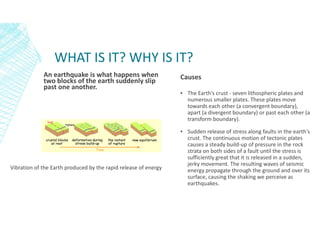
An earthquake is what happens when
two blocks of the earth suddenly slip
past one another.
Causes
▪ The Earth’s crust - seven lithospheric plates and
numerous smaller plates. These plates move
towards each other (a convergent boundary),
apart (a divergent boundary) or past each other (a
transform boundary).
▪ Sudden release of stress along faults in the earth's
crust. The continuous motion of tectonic plates
causes a steady build-up of pressure in the rock
strata on both sides of a fault until the stress is
sufficiently great that it is released in a sudden,
jerky movement. The resulting waves of seismic
energy propagate through the ground and over its
surface, causing the shaking we perceive as
earthquakes.
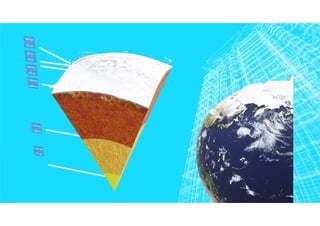
Vibration of the Earth produced by the rapid release of energy
Lithospheric plates
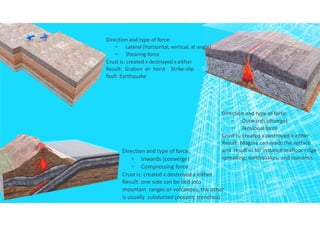
Direction and type of force:
- Inwards (converge)
- Compressing force
Crust is: created x destroyed x either
Result: one side can be lied into
mountain ranges or volcanoes, the other
is usually subducted (oceanic trenches)
Direction and type of force:
- Outwards (diverge)
- Tensional force
Crust is: created x destroyed x either
Result: Magma can reach the surface
and result in for instance seafloor ridge
spreading, earthquakes, and tsunamis.
Direction and type of force:
- Lateral (horizontal, vertical, at angle)
- Shearing force
Crust is: created x destroyed x either
Result: Graben or horst Strike-slip
fault Earthquake
TYPES
Earthquakes
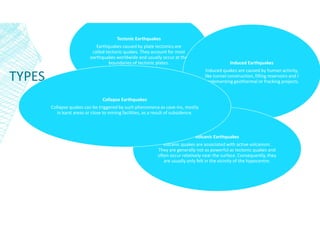
Tectonic Earthquakes
Earthquakes caused by plate tectonics are
called tectonic quakes. They account for most
earthquakes worldwide and usually occur at the
boundaries of tectonic plates. Induced Earthquakes
Induced quakes are caused by human activity,
like tunnel construction, filling reservoirs and I
implementing geothermal or fracking projects.
Volcanic Earthquakes
Volcanic quakes are associated with active volcanism.
They are generally not as powerful as tectonic quakes and
often occur relatively near the surface. Consequently, they
are usually only felt in the vicinity of the hypocentre.
Collapse Earthquakes
Collapse quakes can be triggered by such phenomena as cave-ins, mostly
in karst areas or close to mining facilities, as a result of subsidence.
GEOLOGICAL CONSIDERATION FOR
CONSTRUCTION OF BUILDING PROJECTS IN
SEISMIC AREAS
▪ Buildings should be founded on hard bedrock and never on loose soils or
Fractured rocks, this is because loose ground settles due to earthquake
vibrations.
▪ For large Buildings, raft types of foundations are desirable. Square foundations
are more stable.
▪ Only rich cement mortar and reinforced concrete should be used in
foundations.
▪ Resonance is the important factor, If the period of vibration of a structure is
the same as that of the foundation rock it will collapse because of the
resonance effect.
▪ Buildings situated in cuttings on hill slides, near sheet slopes always suffer
more when an earthquake occurs.
MAGNITUDE AND INTENSITY
Magnitude: Richter Scale
▪ It’s the measure of energy released by
an earthquake.
▪ Related to the maximum amplitude of
the S wave measured from the
seismogram
▪ Logarithmic-scale; quantitative
measure
▪ For each whole number there is a 31.5
times increase in energy
▪ Ex: an increase from 5 to 7 on the
Richter scale = an increase in energy of
992 times!!
Intensity: Mercalli Scale:
▪ Assigns an intensity or rating to measure
an earthquake at a particular location
(qualitative)
▪ I (not felt) to XII (buildings nearly
destroyed)
▪ Measures the destructive effect
▪ Intensity is a function of energy released
by fault, Geology of the location
SEISMIC SEA WAVES
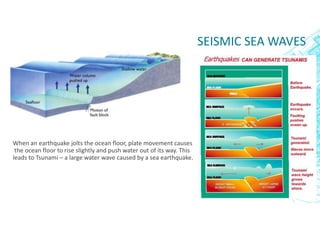
When an earthquake jolts the ocean floor, plate movement causes
the ocean floor to rise slightly and push water out of its way. This
leads to Tsunami – a large water wave caused by a sea earthquake.
SEISMIC ZONES INDIA
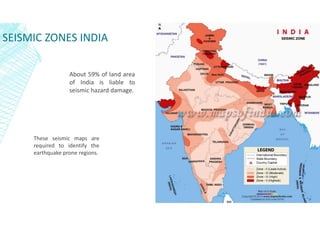
About 59% of land area
of India is liable to
seismic hazard damage.
These seismic maps are
required to identify the
earthquake prone regions.
THANK YOU
You may ask any questions now.
Do not dwell in the
past, do not dream of
the future, concentrate
the mind on the present
moment.
Three things cannot be
long hidden: the sun,
the moon, and the
truth.
The mind is everything.
What you think you
become.
-Gautama Buddha

Eathquakes Vamsi Putta

  • 1.
  • 2.
    WHAT IS IT?WHY IS IT? An earthquake is what happens when two blocks of the earth suddenly slip past one another. Causes ▪ The Earth’s crust - seven lithospheric plates and numerous smaller plates. These plates move towards each other (a convergent boundary), apart (a divergent boundary) or past each other (a transform boundary). ▪ Sudden release of stress along faults in the earth's crust. The continuous motion of tectonic plates causes a steady build-up of pressure in the rock strata on both sides of a fault until the stress is sufficiently great that it is released in a sudden, jerky movement. The resulting waves of seismic energy propagate through the ground and over its surface, causing the shaking we perceive as earthquakes. Vibration of the Earth produced by the rapid release of energy
  • 3.
  • 4.
    Direction and typeof force: - Inwards (converge) - Compressing force Crust is: created x destroyed x either Result: one side can be lied into mountain ranges or volcanoes, the other is usually subducted (oceanic trenches) Direction and type of force: - Outwards (diverge) - Tensional force Crust is: created x destroyed x either Result: Magma can reach the surface and result in for instance seafloor ridge spreading, earthquakes, and tsunamis. Direction and type of force: - Lateral (horizontal, vertical, at angle) - Shearing force Crust is: created x destroyed x either Result: Graben or horst Strike-slip fault Earthquake
  • 5.
    TYPES Earthquakes Tectonic Earthquakes Earthquakes causedby plate tectonics are called tectonic quakes. They account for most earthquakes worldwide and usually occur at the boundaries of tectonic plates. Induced Earthquakes Induced quakes are caused by human activity, like tunnel construction, filling reservoirs and I implementing geothermal or fracking projects. Volcanic Earthquakes Volcanic quakes are associated with active volcanism. They are generally not as powerful as tectonic quakes and often occur relatively near the surface. Consequently, they are usually only felt in the vicinity of the hypocentre. Collapse Earthquakes Collapse quakes can be triggered by such phenomena as cave-ins, mostly in karst areas or close to mining facilities, as a result of subsidence.
  • 7.
    GEOLOGICAL CONSIDERATION FOR CONSTRUCTIONOF BUILDING PROJECTS IN SEISMIC AREAS ▪ Buildings should be founded on hard bedrock and never on loose soils or Fractured rocks, this is because loose ground settles due to earthquake vibrations. ▪ For large Buildings, raft types of foundations are desirable. Square foundations are more stable. ▪ Only rich cement mortar and reinforced concrete should be used in foundations. ▪ Resonance is the important factor, If the period of vibration of a structure is the same as that of the foundation rock it will collapse because of the resonance effect. ▪ Buildings situated in cuttings on hill slides, near sheet slopes always suffer more when an earthquake occurs.
  • 8.
    MAGNITUDE AND INTENSITY Magnitude:Richter Scale ▪ It’s the measure of energy released by an earthquake. ▪ Related to the maximum amplitude of the S wave measured from the seismogram ▪ Logarithmic-scale; quantitative measure ▪ For each whole number there is a 31.5 times increase in energy ▪ Ex: an increase from 5 to 7 on the Richter scale = an increase in energy of 992 times!! Intensity: Mercalli Scale: ▪ Assigns an intensity or rating to measure an earthquake at a particular location (qualitative) ▪ I (not felt) to XII (buildings nearly destroyed) ▪ Measures the destructive effect ▪ Intensity is a function of energy released by fault, Geology of the location
  • 9.
    SEISMIC SEA WAVES Whenan earthquake jolts the ocean floor, plate movement causes the ocean floor to rise slightly and push water out of its way. This leads to Tsunami – a large water wave caused by a sea earthquake.
  • 10.
    SEISMIC ZONES INDIA About59% of land area of India is liable to seismic hazard damage. These seismic maps are required to identify the earthquake prone regions.
  • 11.
    THANK YOU You mayask any questions now. Do not dwell in the past, do not dream of the future, concentrate the mind on the present moment. Three things cannot be long hidden: the sun, the moon, and the truth. The mind is everything. What you think you become. -Gautama Buddha