Name: Sai Vamsi Krishna Putta (AUD8081)
Programme: Bachelors in Civil Engineering
Course : Independent Study Research
Faculty Guide: Ms.Vidya Mohanan
RED Bricks
Date: 01/01/2000
Overview:
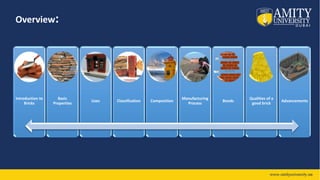
Introduction to
Bricks
Basic
Properties
Uses Classification Composition
Manufacturing
Process
Bonds
Qualities of a
good brick
Advancements
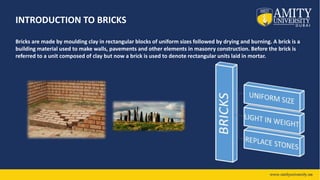
INTRODUCTION TO BRICKS
Bricks are made by moulding clay in rectangular blocks of uniform sizes followed by drying and burning. A brick is a
building material used to make walls, pavements and other elements in masonry construction. Before the brick is
referred to a unit composed of clay but now a brick is used to denote rectangular units laid in mortar.
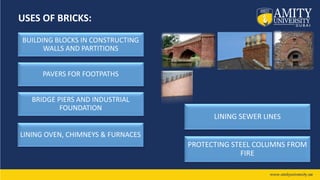
USES OF BRICKS:
BUILDING BLOCKS IN CONSTRUCTING
WALLS AND PARTITIONS
PAVERS FOR FOOTPATHS
BRIDGE PIERS AND INDUSTRIAL
FOUNDATION
LINING SEWER LINES
PROTECTING STEEL COLUMNS FROM
FIRE
LINING OVEN, CHIMNEYS & FURNACES
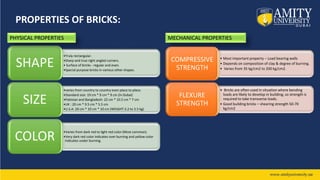
PROPERTIES OF BRICKS:
•Truly rectangular.
•Sharp and true right angled corners.
• Surface of bricks - regular and even.
•Special purpose bricks in various other shapes.
SHAPE
•varies from country to country even place to place.
•Standard size: 19 cm * 9 cm * 9 cm (In Dubai)
•Pakistan and Bangladesh: 22 cm * 10.5 cm * 7 cm
•UK : 20 cm * 9.5 cm * 5.5 cm
•U.S.A: 20 cm * 10 cm * 10 cm (WEIGHT:3.2 to 3.5 kg)
SIZE
•Varies from dark red to light red color (Most common).
•Very dark red color indicates over burning and yellow color
indicates under burning.COLOR
PHYSICAL PROPERTIES MECHANICAL PROPERTIES
• Most important property – Load bearing walls
• Depends on composition of clay & degree of burning.
• Varies from 35 kg/cm2 to 200 kg/cm2.
COMPRESSIVE
STRENGTH
• Bricks are often used in situation where bending
loads are likely to develop in building, so strength is
required to take transverse loads.
• Good building bricks – shearing strength 50-70
kg/cm2
FLEXURE
STRENGTH
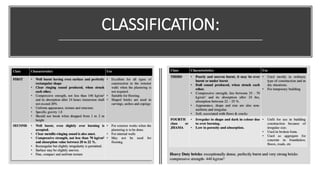
CLASSIFICATION:
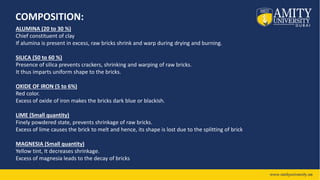
COMPOSITION:
ALUMINA (20 to 30 %)
Chief constituent of clay
If alumina is present in excess, raw bricks shrink and warp during drying and burning.
SILICA (50 to 60 %)
Presence of silica prevents crackers, shrinking and warping of raw bricks.
It thus imparts uniform shape to the bricks.
OXIDE OF IRON (5 to 6%)
Red color.
Excess of oxide of iron makes the bricks dark blue or blackish.
LIME (Small quantity)
Finely powdered state, prevents shrinkage of raw bricks.
Excess of lime causes the brick to melt and hence, its shape is lost due to the splitting of brick
MAGNESIA (Small quantity)
Yellow tint, It decreases shrinkage.
Excess of magnesia leads to the decay of bricks
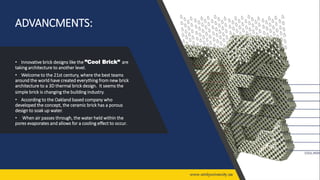
ADVANCMENTS:
• Innovative brick designs like the ”Cool Brick” are
taking architecture to another level.
• Welcome to the 21st century, where the best teams
around the world have created everything from new brick
architecture to a 3D thermal brick design. It seems the
simple brick is changing the building industry.
• According to the Oakland based company who
developed the concept, the ceramic brick has a porous
design to soak up water.
• When air passes through, the water held within the
pores evaporates and allows for a cooling effect to occur.
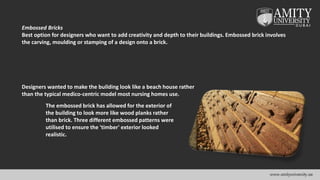
Embossed Bricks
Best option for designers who want to add creativity and depth to their buildings. Embossed brick involves
the carving, moulding or stamping of a design onto a brick.
The embossed brick has allowed for the exterior of
the building to look more like wood planks rather
than brick. Three different embossed patterns were
utilised to ensure the 'timber' exterior looked
realistic.
Designers wanted to make the building look like a beach house rather
than the typical medico-centric model most nursing homes use.
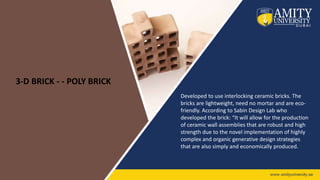
Developed to use interlocking ceramic bricks. The
bricks are lightweight, need no mortar and are eco-
friendly. According to Sabin Design Lab who
developed the brick: “It will allow for the production
of ceramic wall assemblies that are robust and high
strength due to the novel implementation of highly
complex and organic generative design strategies
that are also simply and economically produced.
3-D BRICK - - POLY BRICK
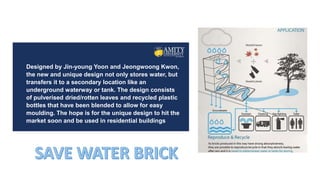
Designed by Jin-young Yoon and Jeongwoong Kwon,
the new and unique design not only stores water, but
transfers it to a secondary location like an
underground waterway or tank. The design consists
of pulverised dried/rotten leaves and recycled plastic
bottles that have been blended to allow for easy
moulding. The hope is for the unique design to hit the
market soon and be used in residential buildings
This Photo by Unknown Author is licensed under CC BY-SA

Study on bricks

  • 1.
    Name: Sai VamsiKrishna Putta (AUD8081) Programme: Bachelors in Civil Engineering Course : Independent Study Research Faculty Guide: Ms.Vidya Mohanan RED Bricks Date: 01/01/2000
  • 2.
    Overview: Introduction to Bricks Basic Properties Uses ClassificationComposition Manufacturing Process Bonds Qualities of a good brick Advancements
  • 3.
    INTRODUCTION TO BRICKS Bricksare made by moulding clay in rectangular blocks of uniform sizes followed by drying and burning. A brick is a building material used to make walls, pavements and other elements in masonry construction. Before the brick is referred to a unit composed of clay but now a brick is used to denote rectangular units laid in mortar.
  • 4.
    USES OF BRICKS: BUILDINGBLOCKS IN CONSTRUCTING WALLS AND PARTITIONS PAVERS FOR FOOTPATHS BRIDGE PIERS AND INDUSTRIAL FOUNDATION LINING SEWER LINES PROTECTING STEEL COLUMNS FROM FIRE LINING OVEN, CHIMNEYS & FURNACES
  • 5.
    PROPERTIES OF BRICKS: •Trulyrectangular. •Sharp and true right angled corners. • Surface of bricks - regular and even. •Special purpose bricks in various other shapes. SHAPE •varies from country to country even place to place. •Standard size: 19 cm * 9 cm * 9 cm (In Dubai) •Pakistan and Bangladesh: 22 cm * 10.5 cm * 7 cm •UK : 20 cm * 9.5 cm * 5.5 cm •U.S.A: 20 cm * 10 cm * 10 cm (WEIGHT:3.2 to 3.5 kg) SIZE •Varies from dark red to light red color (Most common). •Very dark red color indicates over burning and yellow color indicates under burning.COLOR PHYSICAL PROPERTIES MECHANICAL PROPERTIES • Most important property – Load bearing walls • Depends on composition of clay & degree of burning. • Varies from 35 kg/cm2 to 200 kg/cm2. COMPRESSIVE STRENGTH • Bricks are often used in situation where bending loads are likely to develop in building, so strength is required to take transverse loads. • Good building bricks – shearing strength 50-70 kg/cm2 FLEXURE STRENGTH
  • 6.
  • 7.
    COMPOSITION: ALUMINA (20 to30 %) Chief constituent of clay If alumina is present in excess, raw bricks shrink and warp during drying and burning. SILICA (50 to 60 %) Presence of silica prevents crackers, shrinking and warping of raw bricks. It thus imparts uniform shape to the bricks. OXIDE OF IRON (5 to 6%) Red color. Excess of oxide of iron makes the bricks dark blue or blackish. LIME (Small quantity) Finely powdered state, prevents shrinkage of raw bricks. Excess of lime causes the brick to melt and hence, its shape is lost due to the splitting of brick MAGNESIA (Small quantity) Yellow tint, It decreases shrinkage. Excess of magnesia leads to the decay of bricks
  • 8.
    ADVANCMENTS: • Innovative brickdesigns like the ”Cool Brick” are taking architecture to another level. • Welcome to the 21st century, where the best teams around the world have created everything from new brick architecture to a 3D thermal brick design. It seems the simple brick is changing the building industry. • According to the Oakland based company who developed the concept, the ceramic brick has a porous design to soak up water. • When air passes through, the water held within the pores evaporates and allows for a cooling effect to occur.
  • 9.
    Embossed Bricks Best optionfor designers who want to add creativity and depth to their buildings. Embossed brick involves the carving, moulding or stamping of a design onto a brick. The embossed brick has allowed for the exterior of the building to look more like wood planks rather than brick. Three different embossed patterns were utilised to ensure the 'timber' exterior looked realistic. Designers wanted to make the building look like a beach house rather than the typical medico-centric model most nursing homes use.
  • 10.
    Developed to useinterlocking ceramic bricks. The bricks are lightweight, need no mortar and are eco- friendly. According to Sabin Design Lab who developed the brick: “It will allow for the production of ceramic wall assemblies that are robust and high strength due to the novel implementation of highly complex and organic generative design strategies that are also simply and economically produced. 3-D BRICK - - POLY BRICK
  • 11.
    Designed by Jin-youngYoon and Jeongwoong Kwon, the new and unique design not only stores water, but transfers it to a secondary location like an underground waterway or tank. The design consists of pulverised dried/rotten leaves and recycled plastic bottles that have been blended to allow for easy moulding. The hope is for the unique design to hit the market soon and be used in residential buildings
  • 13.
    This Photo byUnknown Author is licensed under CC BY-SA