As one of the three ancient civilizations (5,000 BCE-1,500 BCE) —
others being the Mesopotamian and Egyptian —
Indus valley Civilization was the largest human settlement of its time
Indus valley civilization is a rich civilization and
one of the most important civilizations that
existed in the world. Ancient India during the
Harappa era had one of the largest
populations in the ancient world, far greater
than the Middle East or Europe.
Facts About the Indus Valley
Civilization
• 1. Oldest in the World
• Scientists from IIT-Kharagpur and Archaeological
Survey of India (ASI) have recently uncovered
evidence that the Indus Valley civilization is at
least 8,000 years old and not 5,500 years old as
earlier believed. This discovery, published in the
prestigious Nature journal on May 25, 2016,
makes it not just older than the Egyptian and
Mesopotamian civilizations but also the oldest in
the world.
• 2. Indus Valley Civilization was the largest among
the four ancient civilizations of the world
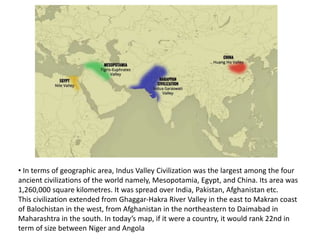
• In terms of geographic area, Indus Valley Civilization was the largest among the four
ancient civilizations of the world namely, Mesopotamia, Egypt, and China. Its area was
1,260,000 square kilometres. It was spread over India, Pakistan, Afghanistan etc.
This civilization extended from Ghaggar-Hakra River Valley in the east to Makran coast
of Balochistan in the west, from Afghanistan in the northeastern to Daimabad in
Maharashtra in the south. In today’s map, if it were a country, it would rank 22nd in
term of size between Niger and Angola
• 3. At its peak, it may had a population of over 5
million
• The Indus Valley Civilization had a total population of
over five million. This is greater than present day
population of New Zealand. Most of its inhabitants
were artisans and traders.
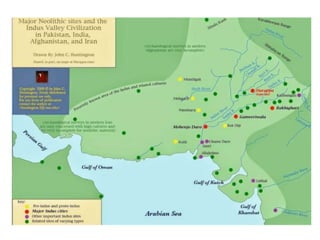
• 4. Till date over 1056 cities have been discovered
• Over 1,056 Harappan cities and settlements had
been found, of which 96 have been excavated. They
are mostly located in the broad regions of the Indus
and Ghaggar-Hakra Rivers and their
tributaries. Dholavaria, Rakhigarhi, Lothal,
Kalibangan are some of the famous urban cities
apart from Harappa and Mohenjo-Daro.
• 5.Archaeologists believe that majority of the population of Indus Valley
Civilization lived in villages. Unfortunately, archaeologists are having
tough time finding the conditions and culture and society in which they
lived because of absence of any proper evidence. Their residences,
archaeologists assume, were made of mud or wood which gets damaged
easily and hence no trace.
• 6. We still don’t know what we should actually call them
• The first settlements discovered were along the banks of river Indus, so
the archaeologist called them ‘Indus Valley Civilization.‘ However, contrary
to its name only about 100 sites are found along the Indus and its
tributaries. While over 500 sites are discovered along Gaggar - Hakra
River (which is believed to be the long-lost river, Saraswati).
• Now, many archaeologists prefer to call them as ‘Indus - Saraswati
Civilization,’ based on the two river systems. Others prefer the name
‘Harappan Civilization,’ based on the name of the first city discovered
called Harappa.
• 7. Meluhha, the ancient place of exotic items mentioned by the
Mesopotamian scribes
• We don’t know what the Indus Valley people used to call themselves. The
Mesopotamian scribes had been writing about a distance place called
Meluhha. Archaeological evidence has proved that Indus Valley civilization
and Mesopotamians were having long time trade relations. It is entirely
possible that the place the Mesopotamians called Meluhha is Indus Valley
Civilization.
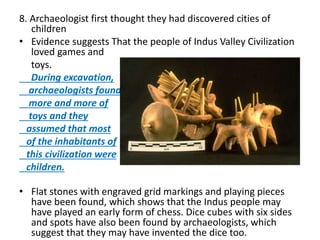
8. Archaeologist first thought they had discovered cities of
children
• Evidence suggests That the people of Indus Valley Civilization
loved games and
toys.
During excavation,
archaeologists found
more and more of
toys and they
assumed that most
of the inhabitants of
this civilization were
children.
• Flat stones with engraved grid markings and playing pieces
have been found, which shows that the Indus people may
have played an early form of chess. Dice cubes with six sides
and spots have also been found by archaeologists, which
suggest that they may have invented the dice too.
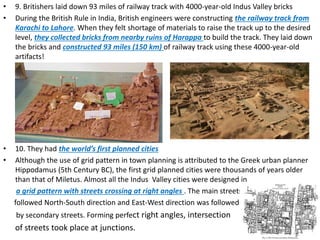
• 9. Britishers laid down 93 miles of railway track with 4000-year-old Indus Valley bricks
• During the British Rule in India, British engineers were constructing the railway track from
Karachi to Lahore. When they felt shortage of materials to raise the track up to the desired
level, they collected bricks from nearby ruins of Harappa to build the track. They laid down
the bricks and constructed 93 miles (150 km) of railway track using these 4000-year-old
artifacts!
• 10. They had the world’s first planned cities
• Although the use of grid pattern in town planning is attributed to the Greek urban planner
Hippodamus (5th Century BC), the first grid planned cities were thousands of years older
than that of Miletus. Almost all the Indus Valley cities were designed in
a grid pattern with streets crossing at right angles . The main streets
followed North-South direction and East-West direction was followed
by secondary streets. Forming perfect right angles, intersection
of streets took place at junctions.
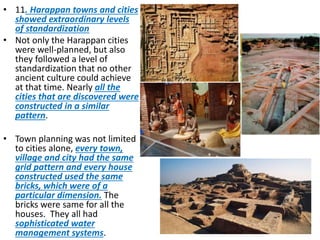
• 11. Harappan towns and cities
showed extraordinary levels
of standardization
• Not only the Harappan cities
were well-planned, but also
they followed a level of
standardization that no other
ancient culture could achieve
at that time. Nearly all the
cities that are discovered were
constructed in a similar
pattern.
• Town planning was not limited
to cities alone, every town,
village and city had the same
grid pattern and every house
constructed used the same
bricks, which were of a
particular dimension. The
bricks were same for all the
houses. They all had
sophisticated water
management systems.
• 12. The cities were densely populated but not chaotic?
• Given the systematic approach in town planning and level of sophistication
achieved by the Indus Valley people, scholars believed that even though these
cities had very dense population, they were not chaotic. Instead, they had a
very organized way of living.
• This is in total contrast to the chaotic cities of the same time from Egypt or
Mesopotamia, which make them very unique of its time.
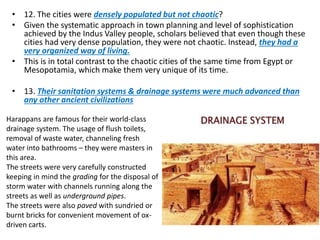
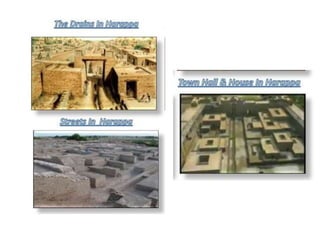
• 13. Their sanitation systems & drainage systems were much advanced than
any other ancient civilizations
Harappans are famous for their world-class
drainage system. The usage of flush toilets,
removal of waste water, channeling fresh
water into bathrooms – they were masters in
this area.
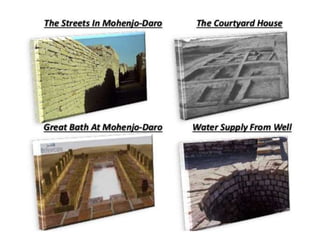
The streets were very carefully constructed
keeping in mind the grading for the disposal of
storm water with channels running along the
streets as well as underground pipes.
The streets were also paved with sundried or
burnt bricks for convenient movement of ox-
driven carts.
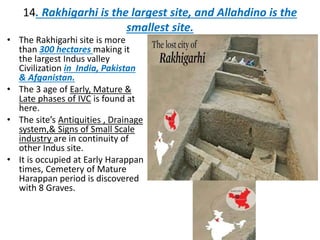
14. Rakhigarhi is the largest site, and Allahdino is the
smallest site.
• The Rakhigarhi site is more
than 300 hectares making it
the largest Indus valley
Civilization in India, Pakistan
& Afganistan.
• The 3 age of Early, Mature &
Late phases of IVC is found at
here.
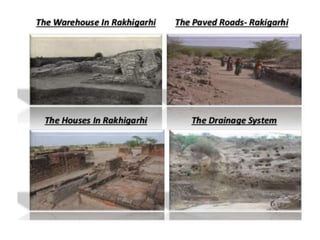
• The site’s Antiquities , Drainage
system,& Signs of Small Scale
industry are in continuity of
other Indus site.
• It is occupied at Early Harappan
times, Cemetery of Mature
Harappan period is discovered
with 8 Graves.
• 15. Haryana’s Bhirrana is oldest
known Harappan site
• Bhirrana is now considered the
oldest discovered Indus Valley
Civilization site,
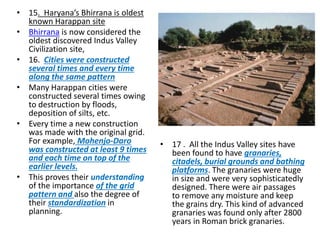
• 16. Cities were constructed
several times and every time
along the same pattern
• Many Harappan cities were
constructed several times owing
to destruction by floods,
deposition of silts, etc.
• Every time a new construction
was made with the original grid.
For example, Mohenjo-Daro
was constructed at least 9 times
and each time on top of the
earlier levels.
• This proves their understanding
of the importance of the grid
pattern and also the degree of
their standardization in
planning.
• 17 . All the Indus Valley sites have
been found to have granaries,
citadels, burial grounds and bathing
platforms. The granaries were huge
in size and were very sophisticatedly
designed. There were air passages
to remove any moisture and keep
the grains dry. This kind of advanced
granaries was found only after 2800
years in Roman brick granaries.
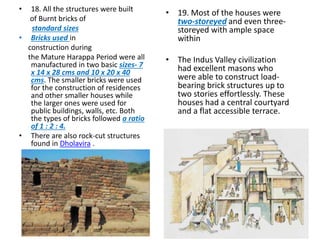
• 18. All the structures were built
of Burnt bricks of
standard sizes
• Bricks used in
construction during
the Mature Harappa Period were all
manufactured in two basic sizes- 7
x 14 x 28 cms and 10 x 20 x 40
cms. The smaller bricks were used
for the construction of residences
and other smaller houses while
the larger ones were used for
public buildings, walls, etc. Both
the types of bricks followed a ratio
of 1 : 2 : 4.
• There are also rock-cut structures
found in Dholavira .
• 19. Most of the houses were
two-storeyed and even three-
storeyed with ample space
within
• The Indus Valley civilization
had excellent masons who
were able to construct load-
bearing brick structures up to
two stories effortlessly. These
houses had a central courtyard
and a flat accessible terrace.
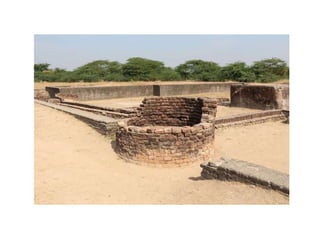
• 20. Harappan houses were the first to have the luxury of
attached bathrooms with flush toilets
• Almost all the houses in Indus Valley Civilization had
bathrooms with access to running water and toilets with
sophisticated drainage facilities. This technology is way
ahead of its time and is first seen in this civilization.
• 21. They were experts in creating complex water
management system
• In Mohenjo-Daro, archeologist found a very advanced
water management system with 80 public toilets and
more than 700 wells. Every house had its own bathroom
and wells were strategically located to supply water to
every neighborhood. There was also a system to store
rainwater. The discovery of earliest public water tank
which is now known as Great Bath shows their skills in
architecture
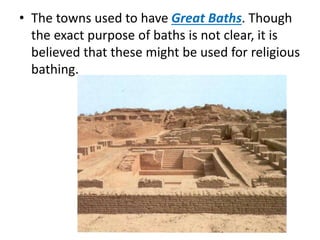
• The towns used to have Great Baths. Though
the exact purpose of baths is not clear, it is
believed that these might be used for religious
bathing.
• 22. Awareness of hygiene
• It is very clear that the Indus Valley people were
well-aware of the importance of living and
maintaining a hygienic life. They had put so much
effort to provide personal and public baths for
everyone, stormwater runoff channels,
underground wastewater systems and even
garbage disposal. These facts make their attempts
to make a healthy and hygienic life quite obvious.
• Archaeologists have found several brick containers
that were strategically located along the street
junctions of Mohenjo-Daro specifically for garbage
disposal.
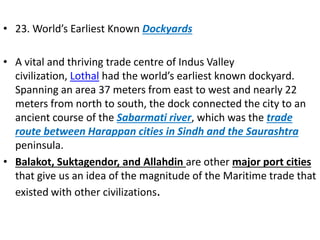
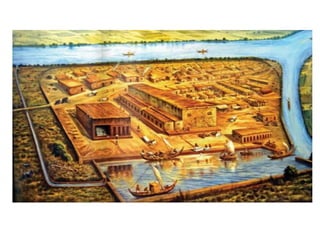
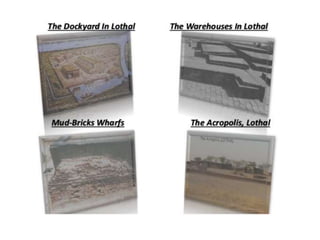
• 23. World’s Earliest Known Dockyards
• A vital and thriving trade centre of Indus Valley
civilization, Lothal had the world’s earliest known dockyard.
Spanning an area 37 meters from east to west and nearly 22
meters from north to south, the dock connected the city to an
ancient course of the Sabarmati river, which was the trade
route between Harappan cities in Sindh and the Saurashtra
peninsula.
• Balakot, Suktagendor, and Allahdin are other major port cities
that give us an idea of the magnitude of the Maritime trade that
existed with other civilizations.
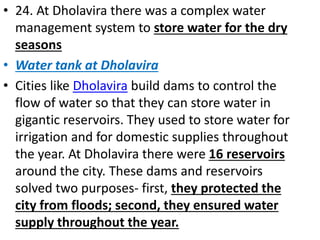
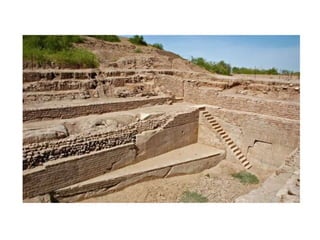
• 24. At Dholavira there was a complex water
management system to store water for the dry
seasons
• Water tank at Dholavira
• Cities like Dholavira build dams to control the
flow of water so that they can store water in
gigantic reservoirs. They used to store water for
irrigation and for domestic supplies throughout
the year. At Dholavira there were 16 reservoirs
around the city. These dams and reservoirs
solved two purposes- first, they protected the
city from floods; second, they ensured water
supply throughout the year.
Technological Achievements of Indus Valley
Civilization
• 25. The people of Indus Valley had excellent knowledge of metallurgy.
People were quite aware of certain new techniques in metallurgy. They used these
techniques to produce lead, copper, tin and bronze. These metal products were
popular items for export to oversea civilizations.
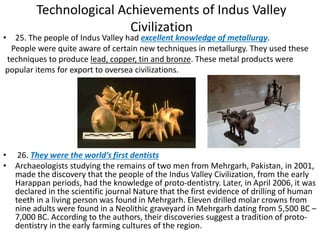
• 26. They were the world’s first dentists
• Archaeologists studying the remains of two men from Mehrgarh, Pakistan, in 2001,
made the discovery that the people of the Indus Valley Civilization, from the early
Harappan periods, had the knowledge of proto-dentistry. Later, in April 2006, it was
declared in the scientific journal Nature that the first evidence of drilling of human
teeth in a living person was found in Mehrgarh. Eleven drilled molar crowns from
nine adults were found in a Neolithic graveyard in Mehrgarh dating from 5,500 BC –
7,000 BC. According to the authors, their discoveries suggest a tradition of proto-
dentistry in the early farming cultures of the region.
27. Harappan people developed the most precise
measurements humanity had at the time
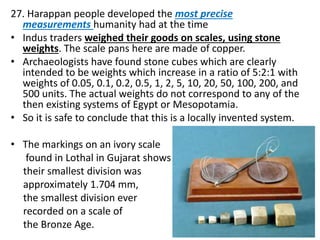
• Indus traders weighed their goods on scales, using stone
weights. The scale pans here are made of copper.
• Archaeologists have found stone cubes which are clearly
intended to be weights which increase in a ratio of 5:2:1 with
weights of 0.05, 0.1, 0.2, 0.5, 1, 2, 5, 10, 20, 50, 100, 200, and
500 units. The actual weights do not correspond to any of the
then existing systems of Egypt or Mesopotamia.
• So it is safe to conclude that this is a locally invented system.
• The markings on an ivory scale
found in Lothal in Gujarat shows
their smallest division was
approximately 1.704 mm,
the smallest division ever
recorded on a scale of
the Bronze Age.
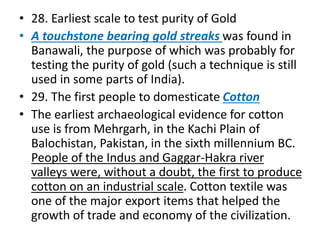
• 28. Earliest scale to test purity of Gold
• A touchstone bearing gold streaks was found in
Banawali, the purpose of which was probably for
testing the purity of gold (such a technique is still
used in some parts of India).
• 29. The first people to domesticate Cotton
• The earliest archaeological evidence for cotton
use is from Mehrgarh, in the Kachi Plain of
Balochistan, Pakistan, in the sixth millennium BC.
People of the Indus and Gaggar-Hakra river
valleys were, without a doubt, the first to produce
cotton on an industrial scale. Cotton textile was
one of the major export items that helped the
growth of trade and economy of the civilization.
• 30. IVC people invented the world’s first buttons!
• In the Indus Valley Civilization, buttons made from
seashell were used for ornamental purposes rather
than as fasteners. The first instances were found dating
around c. 2800–2600 BCE. Some buttons were carved
into geometric shapes and had holes pierced into them
in order to attach it to clothing with thread.
• 31. They made the world’s oldest signboard!
• In 1999, at Dholavira, archaeologists have discovered
what apparently is the world’s first signboard. This
board had stone symbols/letters of over 30 cms in
height inlaid in a wooden frame. Since the Indus script
has not been deciphered yet, we still don’t know what
it meant. But it is believed that it was placed at the
façade of the majestic north gate of the city’s citadel.
• 32. People were very fond of games particularly dice games
• The Harappans also made various toys and games, among them
cubical dice (with one to six holes on the faces), which were found
in sites like Mohenjo-Daro. Other toys include clay figures of
bullock carts, miniature pots, utensils etc., spinning tops, marbles
and more. Thus, we can say that not only the children but even the
adults were playful in nature.
• 33. They were very advanced in Art and Craft
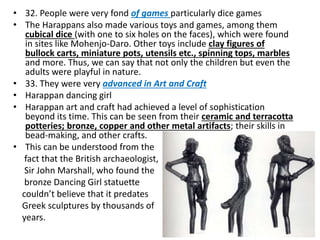
• Harappan dancing girl
• Harappan art and craft had achieved a level of sophistication
beyond its time. This can be seen from their ceramic and terracotta
potteries; bronze, copper and other metal artifacts; their skills in
bead-making, and other crafts.
• This can be understood from the
fact that the British archaeologist,
Sir John Marshall, who found the
bronze Dancing Girl statuette
couldn’t believe that it predates
Greek sculptures by thousands of
years.
Mysteries that are yet to be solved
• 34. We are not sure what happened to them
• There are several theories as of what happened to the inhabitants
of Indus Valley civilization. But scholars are certain about one thing-
it wasn’t invasion, disease or similar catastrophe that wiped out the
entire civilization. Instead, the population of these cities declined
gradually until they were finally deserted. It is quite possible that
these inhabitants migrated to different regions in search of better
land and resources. There are various reasons that have led to the
decline of the Indus Valley civilization.
• 35. Exact use of the seals is still uncertain
• More than 4000 flat, rectangular stone tablets called seals have
been found. Seals made of at least a dozen other materials are also
found. The seals bear the images of animals, god-like figures, etc.,
and inscriptions. Some of the seals were used to stamp clay on
trade goods, but they probably had other uses too. It is difficult to
say exactly what was the purpose of these ‘seals’ when the
inscriptions have not yet been deciphered.
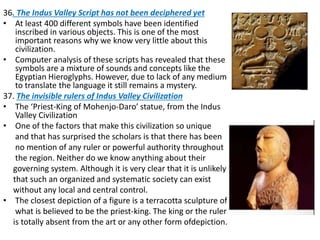
36. The Indus Valley Script has not been deciphered yet
• At least 400 different symbols have been identified
inscribed in various objects. This is one of the most
important reasons why we know very little about this
civilization.
• Computer analysis of these scripts has revealed that these
symbols are a mixture of sounds and concepts like the
Egyptian Hieroglyphs. However, due to lack of any medium
to translate the language it still remains a mystery.
37. The invisible rulers of Indus Valley Civilization
• The ‘Priest-King of Mohenjo-Daro’ statue, from the Indus
Valley Civilization
• One of the factors that make this civilization so unique
and that has surprised the scholars is that there has been
no mention of any ruler or powerful authority throughout
the region. Neither do we know anything about their
governing system. Although it is very clear that it is unlikely
that such an organized and systematic society can exist
without any local and central control.
• The closest depiction of a figure is a terracotta sculpture of
what is believed to be the priest-king. The king or the ruler
is totally absent from the art or any other form ofdepiction.
• 38. Absence of any monumental structures, temples or palaces
• Another astonishing fact that has surprised the researchers is the
absence of any structure which can be thought of central
importance like a palace or a temple. The presence of a temple or
a palace is a standard feature of every other early civilization. There
are several public buildings like the Great Baths and granaries but
no structure can be even remotely related to a palace or temple.
• 39. No imagery or evidence of Warfare
• There have been no imagery or evidence of any war-like activities
throughout the civilization nor there were any weapons found in
the cities. This makes us think that they were probably a peaceful
society. Compared to Mesopotamian city-states, who were at
constant wars with each other and depicted their battles in their art
and written works, no such image of Harappan cities has been
found.
• 40. We know nothing about political structure or religious beliefs
• Very little knowledge of their political and religious hierarchy has
been found. We don’t know whom they worshiped or how they
worshiped. There have been various debates regarding the same
but it is difficult to say anything for certain.
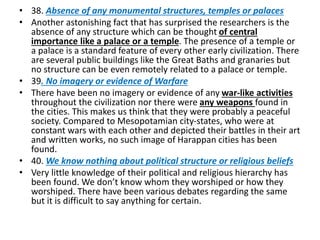
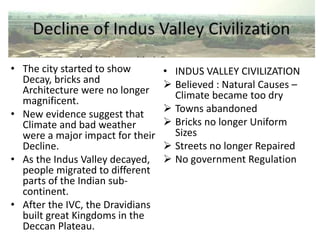
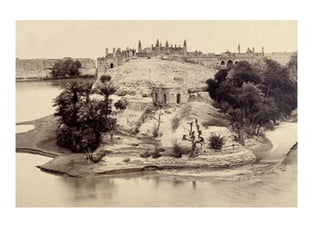
• The city started to show
Decay, bricks and
Architecture were no longer
magnificent.
• New evidence suggest that
Climate and bad weather
were a major impact for their
Decline.
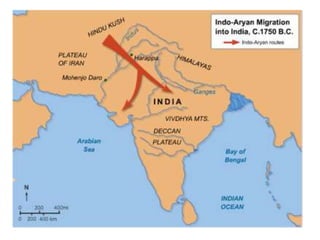
• As the Indus Valley decayed,
people migrated to different
parts of the Indian sub-
continent.
• After the IVC, the Dravidians
built great Kingdoms in the
Deccan Plateau.
• INDUS VALLEY CIVILIZATION
 Believed : Natural Causes –
Climate became too dry
 Towns abandoned
 Bricks no longer Uniform
Sizes
 Streets no longer Repaired
 No government Regulation
Indus valley.pptx
Indus valley.pptx
Indus valley.pptx

Indus valley.pptx

  • 2.
    As one ofthe three ancient civilizations (5,000 BCE-1,500 BCE) — others being the Mesopotamian and Egyptian — Indus valley Civilization was the largest human settlement of its time Indus valley civilization is a rich civilization and one of the most important civilizations that existed in the world. Ancient India during the Harappa era had one of the largest populations in the ancient world, far greater than the Middle East or Europe.
  • 3.
    Facts About theIndus Valley Civilization • 1. Oldest in the World • Scientists from IIT-Kharagpur and Archaeological Survey of India (ASI) have recently uncovered evidence that the Indus Valley civilization is at least 8,000 years old and not 5,500 years old as earlier believed. This discovery, published in the prestigious Nature journal on May 25, 2016, makes it not just older than the Egyptian and Mesopotamian civilizations but also the oldest in the world. • 2. Indus Valley Civilization was the largest among the four ancient civilizations of the world
  • 4.
    • In termsof geographic area, Indus Valley Civilization was the largest among the four ancient civilizations of the world namely, Mesopotamia, Egypt, and China. Its area was 1,260,000 square kilometres. It was spread over India, Pakistan, Afghanistan etc. This civilization extended from Ghaggar-Hakra River Valley in the east to Makran coast of Balochistan in the west, from Afghanistan in the northeastern to Daimabad in Maharashtra in the south. In today’s map, if it were a country, it would rank 22nd in term of size between Niger and Angola
  • 5.
    • 3. Atits peak, it may had a population of over 5 million • The Indus Valley Civilization had a total population of over five million. This is greater than present day population of New Zealand. Most of its inhabitants were artisans and traders. • 4. Till date over 1056 cities have been discovered • Over 1,056 Harappan cities and settlements had been found, of which 96 have been excavated. They are mostly located in the broad regions of the Indus and Ghaggar-Hakra Rivers and their tributaries. Dholavaria, Rakhigarhi, Lothal, Kalibangan are some of the famous urban cities apart from Harappa and Mohenjo-Daro.
  • 7.
    • 5.Archaeologists believethat majority of the population of Indus Valley Civilization lived in villages. Unfortunately, archaeologists are having tough time finding the conditions and culture and society in which they lived because of absence of any proper evidence. Their residences, archaeologists assume, were made of mud or wood which gets damaged easily and hence no trace. • 6. We still don’t know what we should actually call them • The first settlements discovered were along the banks of river Indus, so the archaeologist called them ‘Indus Valley Civilization.‘ However, contrary to its name only about 100 sites are found along the Indus and its tributaries. While over 500 sites are discovered along Gaggar - Hakra River (which is believed to be the long-lost river, Saraswati). • Now, many archaeologists prefer to call them as ‘Indus - Saraswati Civilization,’ based on the two river systems. Others prefer the name ‘Harappan Civilization,’ based on the name of the first city discovered called Harappa. • 7. Meluhha, the ancient place of exotic items mentioned by the Mesopotamian scribes • We don’t know what the Indus Valley people used to call themselves. The Mesopotamian scribes had been writing about a distance place called Meluhha. Archaeological evidence has proved that Indus Valley civilization and Mesopotamians were having long time trade relations. It is entirely possible that the place the Mesopotamians called Meluhha is Indus Valley Civilization.
  • 8.
    8. Archaeologist firstthought they had discovered cities of children • Evidence suggests That the people of Indus Valley Civilization loved games and toys. During excavation, archaeologists found more and more of toys and they assumed that most of the inhabitants of this civilization were children. • Flat stones with engraved grid markings and playing pieces have been found, which shows that the Indus people may have played an early form of chess. Dice cubes with six sides and spots have also been found by archaeologists, which suggest that they may have invented the dice too.
  • 9.
    • 9. Britisherslaid down 93 miles of railway track with 4000-year-old Indus Valley bricks • During the British Rule in India, British engineers were constructing the railway track from Karachi to Lahore. When they felt shortage of materials to raise the track up to the desired level, they collected bricks from nearby ruins of Harappa to build the track. They laid down the bricks and constructed 93 miles (150 km) of railway track using these 4000-year-old artifacts! • 10. They had the world’s first planned cities • Although the use of grid pattern in town planning is attributed to the Greek urban planner Hippodamus (5th Century BC), the first grid planned cities were thousands of years older than that of Miletus. Almost all the Indus Valley cities were designed in a grid pattern with streets crossing at right angles . The main streets followed North-South direction and East-West direction was followed by secondary streets. Forming perfect right angles, intersection of streets took place at junctions.
  • 10.
    • 11. Harappantowns and cities showed extraordinary levels of standardization • Not only the Harappan cities were well-planned, but also they followed a level of standardization that no other ancient culture could achieve at that time. Nearly all the cities that are discovered were constructed in a similar pattern. • Town planning was not limited to cities alone, every town, village and city had the same grid pattern and every house constructed used the same bricks, which were of a particular dimension. The bricks were same for all the houses. They all had sophisticated water management systems.
  • 11.
    • 12. Thecities were densely populated but not chaotic? • Given the systematic approach in town planning and level of sophistication achieved by the Indus Valley people, scholars believed that even though these cities had very dense population, they were not chaotic. Instead, they had a very organized way of living. • This is in total contrast to the chaotic cities of the same time from Egypt or Mesopotamia, which make them very unique of its time. • 13. Their sanitation systems & drainage systems were much advanced than any other ancient civilizations Harappans are famous for their world-class drainage system. The usage of flush toilets, removal of waste water, channeling fresh water into bathrooms – they were masters in this area. The streets were very carefully constructed keeping in mind the grading for the disposal of storm water with channels running along the streets as well as underground pipes. The streets were also paved with sundried or burnt bricks for convenient movement of ox- driven carts.
  • 12.
    14. Rakhigarhi isthe largest site, and Allahdino is the smallest site. • The Rakhigarhi site is more than 300 hectares making it the largest Indus valley Civilization in India, Pakistan & Afganistan. • The 3 age of Early, Mature & Late phases of IVC is found at here. • The site’s Antiquities , Drainage system,& Signs of Small Scale industry are in continuity of other Indus site. • It is occupied at Early Harappan times, Cemetery of Mature Harappan period is discovered with 8 Graves.
  • 14.
    • 15. Haryana’sBhirrana is oldest known Harappan site • Bhirrana is now considered the oldest discovered Indus Valley Civilization site, • 16. Cities were constructed several times and every time along the same pattern • Many Harappan cities were constructed several times owing to destruction by floods, deposition of silts, etc. • Every time a new construction was made with the original grid. For example, Mohenjo-Daro was constructed at least 9 times and each time on top of the earlier levels. • This proves their understanding of the importance of the grid pattern and also the degree of their standardization in planning. • 17 . All the Indus Valley sites have been found to have granaries, citadels, burial grounds and bathing platforms. The granaries were huge in size and were very sophisticatedly designed. There were air passages to remove any moisture and keep the grains dry. This kind of advanced granaries was found only after 2800 years in Roman brick granaries.
  • 15.
    • 18. Allthe structures were built of Burnt bricks of standard sizes • Bricks used in construction during the Mature Harappa Period were all manufactured in two basic sizes- 7 x 14 x 28 cms and 10 x 20 x 40 cms. The smaller bricks were used for the construction of residences and other smaller houses while the larger ones were used for public buildings, walls, etc. Both the types of bricks followed a ratio of 1 : 2 : 4. • There are also rock-cut structures found in Dholavira . • 19. Most of the houses were two-storeyed and even three- storeyed with ample space within • The Indus Valley civilization had excellent masons who were able to construct load- bearing brick structures up to two stories effortlessly. These houses had a central courtyard and a flat accessible terrace.
  • 16.
    • 20. Harappanhouses were the first to have the luxury of attached bathrooms with flush toilets • Almost all the houses in Indus Valley Civilization had bathrooms with access to running water and toilets with sophisticated drainage facilities. This technology is way ahead of its time and is first seen in this civilization. • 21. They were experts in creating complex water management system • In Mohenjo-Daro, archeologist found a very advanced water management system with 80 public toilets and more than 700 wells. Every house had its own bathroom and wells were strategically located to supply water to every neighborhood. There was also a system to store rainwater. The discovery of earliest public water tank which is now known as Great Bath shows their skills in architecture
  • 18.
    • The townsused to have Great Baths. Though the exact purpose of baths is not clear, it is believed that these might be used for religious bathing.
  • 19.
    • 22. Awarenessof hygiene • It is very clear that the Indus Valley people were well-aware of the importance of living and maintaining a hygienic life. They had put so much effort to provide personal and public baths for everyone, stormwater runoff channels, underground wastewater systems and even garbage disposal. These facts make their attempts to make a healthy and hygienic life quite obvious. • Archaeologists have found several brick containers that were strategically located along the street junctions of Mohenjo-Daro specifically for garbage disposal.
  • 22.
    • 23. World’sEarliest Known Dockyards • A vital and thriving trade centre of Indus Valley civilization, Lothal had the world’s earliest known dockyard. Spanning an area 37 meters from east to west and nearly 22 meters from north to south, the dock connected the city to an ancient course of the Sabarmati river, which was the trade route between Harappan cities in Sindh and the Saurashtra peninsula. • Balakot, Suktagendor, and Allahdin are other major port cities that give us an idea of the magnitude of the Maritime trade that existed with other civilizations.
  • 25.
    • 24. AtDholavira there was a complex water management system to store water for the dry seasons • Water tank at Dholavira • Cities like Dholavira build dams to control the flow of water so that they can store water in gigantic reservoirs. They used to store water for irrigation and for domestic supplies throughout the year. At Dholavira there were 16 reservoirs around the city. These dams and reservoirs solved two purposes- first, they protected the city from floods; second, they ensured water supply throughout the year.
  • 27.
    Technological Achievements ofIndus Valley Civilization • 25. The people of Indus Valley had excellent knowledge of metallurgy. People were quite aware of certain new techniques in metallurgy. They used these techniques to produce lead, copper, tin and bronze. These metal products were popular items for export to oversea civilizations. • 26. They were the world’s first dentists • Archaeologists studying the remains of two men from Mehrgarh, Pakistan, in 2001, made the discovery that the people of the Indus Valley Civilization, from the early Harappan periods, had the knowledge of proto-dentistry. Later, in April 2006, it was declared in the scientific journal Nature that the first evidence of drilling of human teeth in a living person was found in Mehrgarh. Eleven drilled molar crowns from nine adults were found in a Neolithic graveyard in Mehrgarh dating from 5,500 BC – 7,000 BC. According to the authors, their discoveries suggest a tradition of proto- dentistry in the early farming cultures of the region.
  • 28.
    27. Harappan peopledeveloped the most precise measurements humanity had at the time • Indus traders weighed their goods on scales, using stone weights. The scale pans here are made of copper. • Archaeologists have found stone cubes which are clearly intended to be weights which increase in a ratio of 5:2:1 with weights of 0.05, 0.1, 0.2, 0.5, 1, 2, 5, 10, 20, 50, 100, 200, and 500 units. The actual weights do not correspond to any of the then existing systems of Egypt or Mesopotamia. • So it is safe to conclude that this is a locally invented system. • The markings on an ivory scale found in Lothal in Gujarat shows their smallest division was approximately 1.704 mm, the smallest division ever recorded on a scale of the Bronze Age.
  • 29.
    • 28. Earliestscale to test purity of Gold • A touchstone bearing gold streaks was found in Banawali, the purpose of which was probably for testing the purity of gold (such a technique is still used in some parts of India). • 29. The first people to domesticate Cotton • The earliest archaeological evidence for cotton use is from Mehrgarh, in the Kachi Plain of Balochistan, Pakistan, in the sixth millennium BC. People of the Indus and Gaggar-Hakra river valleys were, without a doubt, the first to produce cotton on an industrial scale. Cotton textile was one of the major export items that helped the growth of trade and economy of the civilization.
  • 30.
    • 30. IVCpeople invented the world’s first buttons! • In the Indus Valley Civilization, buttons made from seashell were used for ornamental purposes rather than as fasteners. The first instances were found dating around c. 2800–2600 BCE. Some buttons were carved into geometric shapes and had holes pierced into them in order to attach it to clothing with thread. • 31. They made the world’s oldest signboard! • In 1999, at Dholavira, archaeologists have discovered what apparently is the world’s first signboard. This board had stone symbols/letters of over 30 cms in height inlaid in a wooden frame. Since the Indus script has not been deciphered yet, we still don’t know what it meant. But it is believed that it was placed at the façade of the majestic north gate of the city’s citadel.
  • 31.
    • 32. Peoplewere very fond of games particularly dice games • The Harappans also made various toys and games, among them cubical dice (with one to six holes on the faces), which were found in sites like Mohenjo-Daro. Other toys include clay figures of bullock carts, miniature pots, utensils etc., spinning tops, marbles and more. Thus, we can say that not only the children but even the adults were playful in nature. • 33. They were very advanced in Art and Craft • Harappan dancing girl • Harappan art and craft had achieved a level of sophistication beyond its time. This can be seen from their ceramic and terracotta potteries; bronze, copper and other metal artifacts; their skills in bead-making, and other crafts. • This can be understood from the fact that the British archaeologist, Sir John Marshall, who found the bronze Dancing Girl statuette couldn’t believe that it predates Greek sculptures by thousands of years.
  • 32.
    Mysteries that areyet to be solved • 34. We are not sure what happened to them • There are several theories as of what happened to the inhabitants of Indus Valley civilization. But scholars are certain about one thing- it wasn’t invasion, disease or similar catastrophe that wiped out the entire civilization. Instead, the population of these cities declined gradually until they were finally deserted. It is quite possible that these inhabitants migrated to different regions in search of better land and resources. There are various reasons that have led to the decline of the Indus Valley civilization. • 35. Exact use of the seals is still uncertain • More than 4000 flat, rectangular stone tablets called seals have been found. Seals made of at least a dozen other materials are also found. The seals bear the images of animals, god-like figures, etc., and inscriptions. Some of the seals were used to stamp clay on trade goods, but they probably had other uses too. It is difficult to say exactly what was the purpose of these ‘seals’ when the inscriptions have not yet been deciphered.
  • 33.
    36. The IndusValley Script has not been deciphered yet • At least 400 different symbols have been identified inscribed in various objects. This is one of the most important reasons why we know very little about this civilization. • Computer analysis of these scripts has revealed that these symbols are a mixture of sounds and concepts like the Egyptian Hieroglyphs. However, due to lack of any medium to translate the language it still remains a mystery. 37. The invisible rulers of Indus Valley Civilization • The ‘Priest-King of Mohenjo-Daro’ statue, from the Indus Valley Civilization • One of the factors that make this civilization so unique and that has surprised the scholars is that there has been no mention of any ruler or powerful authority throughout the region. Neither do we know anything about their governing system. Although it is very clear that it is unlikely that such an organized and systematic society can exist without any local and central control. • The closest depiction of a figure is a terracotta sculpture of what is believed to be the priest-king. The king or the ruler is totally absent from the art or any other form ofdepiction.
  • 34.
    • 38. Absenceof any monumental structures, temples or palaces • Another astonishing fact that has surprised the researchers is the absence of any structure which can be thought of central importance like a palace or a temple. The presence of a temple or a palace is a standard feature of every other early civilization. There are several public buildings like the Great Baths and granaries but no structure can be even remotely related to a palace or temple. • 39. No imagery or evidence of Warfare • There have been no imagery or evidence of any war-like activities throughout the civilization nor there were any weapons found in the cities. This makes us think that they were probably a peaceful society. Compared to Mesopotamian city-states, who were at constant wars with each other and depicted their battles in their art and written works, no such image of Harappan cities has been found. • 40. We know nothing about political structure or religious beliefs • Very little knowledge of their political and religious hierarchy has been found. We don’t know whom they worshiped or how they worshiped. There have been various debates regarding the same but it is difficult to say anything for certain.
  • 36.
    • The citystarted to show Decay, bricks and Architecture were no longer magnificent. • New evidence suggest that Climate and bad weather were a major impact for their Decline. • As the Indus Valley decayed, people migrated to different parts of the Indian sub- continent. • After the IVC, the Dravidians built great Kingdoms in the Deccan Plateau. • INDUS VALLEY CIVILIZATION  Believed : Natural Causes – Climate became too dry  Towns abandoned  Bricks no longer Uniform Sizes  Streets no longer Repaired  No government Regulation