



Understanding Marital Conflicts in
Egyptian Culture
Prof. Hani Hamed Dessoki, M.D.Psychiatry
Prof. Psychiatry
Chairman of Psychiatry Department
Beni Suef University
Supervisor of Psychiatry Department
El-Fayoum University
APA member
Agenda
• Introduction
• Normal Family Development
• Characteristics of “happy” couples
• Domestic Violence in a Sample of
Egyptian Female Psychiatric
Patients (Pilot Study)
• Understanding Marital Conflicts in
Egyptian Culture
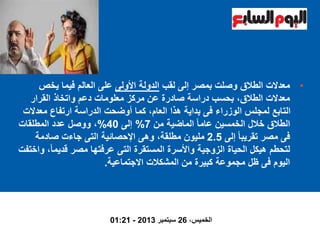
•‫لقب‬ ‫إلى‬ ‫بمصر‬ ‫وصلت‬ ‫الطالق‬ ‫معدالت‬‫األولى‬ ‫الدولة‬‫يخص‬ ‫فيما‬ ‫العالم‬ ‫على‬
‫القرار‬ ‫واتخاذ‬ ‫دعم‬ ‫معلومات‬ ‫مركز‬ ‫عن‬ ‫صادرة‬ ‫دراسة‬ ‫بحسب‬ ،‫الطالق‬ ‫معدالت‬
‫معدال‬ ‫ارتفاع‬ ‫الدراسة‬ ‫أوضحت‬ ‫كما‬ ،‫العام‬ ‫هذا‬ ‫بداية‬ ‫فى‬ ‫الوزراء‬ ‫لمجلس‬ ‫التابع‬‫ت‬
‫من‬ ‫الماضية‬ ً‫ا‬‫عام‬ ‫الخمسين‬ ‫خالل‬ ‫الطالق‬7%‫إلى‬40%‫المطلقات‬ ‫عدد‬ ‫ووصل‬ ،
‫إلى‬ ً‫ا‬‫تقريب‬ ‫مصر‬ ‫فى‬2.5‫صادمة‬ ‫جاءت‬ ‫التى‬ ‫اإلحصائية‬ ‫وهى‬ ،‫مطلقة‬ ‫مليون‬
ً‫ا‬‫قديم‬ ‫مصر‬ ‫عرفتها‬ ‫التى‬ ‫المستقرة‬ ‫واألسرة‬ ‫الزوجية‬ ‫الحياة‬ ‫هيكل‬ ‫لتحطم‬‫واختفت‬ ،
‫االجتماعية‬ ‫المشكالت‬ ‫من‬ ‫كبيرة‬ ‫مجموعة‬ ‫ظل‬ ‫فى‬ ‫اليوم‬.
،‫الخميس‬26‫سبتمبر‬2013-01:21
Marriage and Partnership
• Marriage is a legal, lasting union that is created in a
public ritual
Normal Family Development
• Satisfying relationships: balance between giving and
getting. There is “a high ratio of benefits relative to
costs”.
• Critical influences on relationship satisfaction:
• affection
• communication
• child care
• Conflict resolution seems to be one of the most critical
skills associated with family harmony.
Understanding Marital Conflicts
• Marital conflicts combine problems of communication,
alienation or some threat to the relationships security
which lead to high anxiety and erosion of the marital
system.
• Feelings of neglect, disrespect, unloved, anger,
loneliness, abandonment and growing feelings of
inadequacy all contribute to the breakdown in the
marriage.
• Cause of Marital Discord:
• Receiving too little reinforcement from the marriage.
• Two few needs given marital reinforcement.
• Marital reinforcement no longer provides satisfaction.
• New behaviors are not reinforced.
• One spouse gives more reinforcement than he or she receives.
• Marriage interferes with extramarital sources of satisfaction.
• Communication about potential sources of satisfaction is not
adequate.
• Aversive control (nagging, crying, withdrawing, or threatening)
predominates over positive reinforcement.
Development of Behavior Disorders (cont.)
• Distressed marriages include fewer rewarding exchanges
and more punishing exchanges.
• “Spouses typically reciprocate their partners’ use of
punishment, and a vicious cycle develops”.
• Parents who respond aversively to children are likely to
have aversive responses reciprocated.
UNDERSTANDING THE FAMILY
• Most important function is socialization
• Process by which children acquire the beliefs, motives, values,
and behaviors considered appropriate in their society
UNDERSTANDING THE FAMILY
• The Family as a Social System
• Parents influence children
• Children influence behavior of their parents
• Families are networks of reciprocal relationships
• Happily married mothers are more likely to have securely
attached children
• Children do best when couples coparent
Characteristics of “happy” couples
• Characteristics:
• foundation of affection and friendship
• "validation sequences“
• ability to resolve disagreements
• “positive sentiment override”
• a 5 to 1(or better) compliment -criticism ratio is
optimal
• as the ratio decreases, marriage satisfaction
decreases
• Amount of conflict relatively unimportant (all
relationships have conflict)
Distressed couples
• Engage in a wide range of destructive fighting techniques
• Personal attacks (name calling)
• Dredging up the past
• Losing focus (…and the “kitchen sink”)
• Negative behaviors
• Criticism (more common in women)
• Defensiveness
• Withdrawal (more common in men)
• Contempt
The Workaholic as Parent
• Often preoccupied with their own thoughts, “mentally absent”
• Always “rushing around”, irritable, cranky, lacking humor
• Focused on “adult pursuits”: colleagues, intellect, ‘trying to earn a
living’
• Involvement with the family is on their own terms
• Child tries to become like the parent in order to win their love and
approval
• Child measures his worth based on what he does, not by who he
is…can never meet parent’s expectations
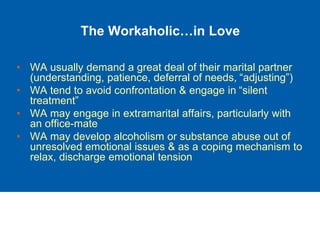
The Workaholic…in Love
• WA usually demand a great deal of their marital partner
(understanding, patience, deferral of needs, “adjusting”)
• WA tend to avoid confrontation & engage in “silent
treatment”
• WA may engage in extramarital affairs, particularly with
an office-mate
• WA may develop alcoholism or substance abuse out of
unresolved emotional issues & as a coping mechanism to
relax, discharge emotional tension
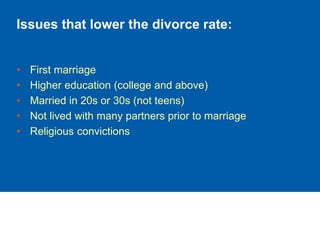
Issues that lower the divorce rate:
• First marriage
• Higher education (college and above)
• Married in 20s or 30s (not teens)
• Not lived with many partners prior to marriage
• Religious convictions
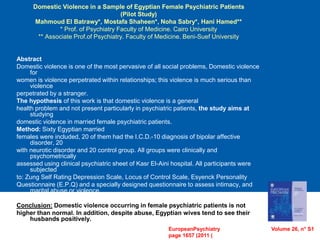
Domestic Violence in a Sample of Egyptian Female Psychiatric Patients
(Pilot Study)
Mahmoud El Batrawy*, Mostafa Shaheen*, Noha Sabry*, Hani Hamed**
* Prof. of Psychiatry Faculty of Medicine. Cairo University
** Associate Prof.of Psychiatry. Faculty of Medicine. Beni-Suef University
Abstract
Domestic violence is one of the most pervasive of all social problems, Domestic violence
for
women is violence perpetrated within relationships; this violence is much serious than
violence
perpetrated by a stranger.
The hypothesis of this work is that domestic violence is a general
health problem and not present particularly in psychiatric patients, the study aims at
studying
domestic violence in married female psychiatric patients.
Method: Sixty Egyptian married
females were included, 20 of them had the I.C.D.-10 diagnosis of bipolar affective
disorder, 20
with neurotic disorder and 20 control group. All groups were clinically and
psychometrically
assessed using clinical psychiatric sheet of Kasr El-Aini hospital. All participants were
subjected
to: Zung Self Rating Depression Scale, Locus of Control Scale, Esyenck Personality
Questionnaire (E.P.Q) and a specially designed questionnaire to assess intimacy, and
marital abuse or violence.
Conclusion: Domestic violence occurring in female psychiatric patients is not
higher than normal. In addition, despite abuse, Egyptian wives tend to see their
husbands positively.
EuropeanPsychiatry Volume 26, n° S1
page 1657 (2011 )
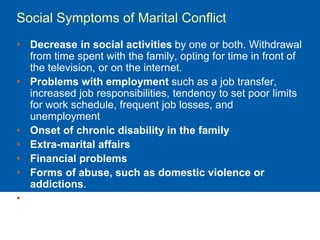
Social Symptoms of Marital Conflict
• Decrease in social activities by one or both. Withdrawal
from time spent with the family, opting for time in front of
the television, or on the internet.
• Problems with employment such as a job transfer,
increased job responsibilities, tendency to set poor limits
for work schedule, frequent job losses, and
unemployment
• Onset of chronic disability in the family
• Extra-marital affairs
• Financial problems
• Forms of abuse, such as domestic violence or
addictions.
• Disturbed child relationships
Understanding Marital Conflicts in Egyptian
Culture
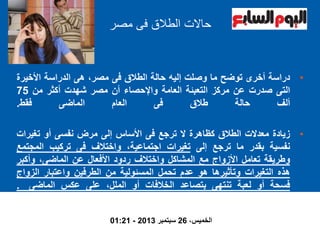
‫حاال‬‫ت‬‫مصر‬ ‫فى‬ ‫الطالق‬
•‫دراسة‬‫أخرى‬‫توضح‬‫ما‬‫وصلت‬‫إليه‬‫حالة‬‫الطالق‬‫فى‬،‫مصر‬‫هى‬‫الدراسة‬‫األخير‬‫ة‬
‫التى‬‫صدرت‬‫عن‬‫مركز‬‫التعبئة‬‫العامة‬‫واإلحصاء‬‫أن‬‫مصر‬‫شهدت‬‫أكثر‬‫من‬75
‫ألف‬‫حالة‬‫طالق‬‫فى‬‫العام‬‫الماضى‬‫فقط‬.
•‫زيادة‬‫معدالت‬‫الطالق‬‫كظاهرة‬‫ال‬‫ترجع‬‫فى‬‫األساس‬‫إلى‬‫مرض‬‫نفسى‬‫أو‬‫تغيرا‬‫ت‬
‫نفسية‬‫بقدر‬‫ما‬‫ترجع‬‫إلى‬‫تغيرات‬،‫اجتماعية‬‫واختالف‬‫فى‬‫تركيب‬‫المجت‬‫مع‬
‫وطريقة‬‫تعامل‬‫األزواج‬‫مع‬‫المشاكل‬‫واختالف‬‫ردود‬‫األفعال‬‫عن‬،‫الماضى‬‫وأكبر‬
‫هذه‬‫التغيرات‬‫وتأثيرها‬‫هو‬‫عدم‬‫تحمل‬‫المسئولية‬‫من‬‫الطرفين‬‫واعتبار‬‫الزوا‬‫ج‬
‫فسحة‬‫أو‬‫لعبة‬‫تنتهى‬‫بتصاعد‬‫الخالفات‬‫أو‬،‫الملل‬‫على‬‫عكس‬‫الماضى‬.
،‫الخميس‬26‫سبتمبر‬2013-01:21
Understanding Marital Conflicts in Egyptian
Culture
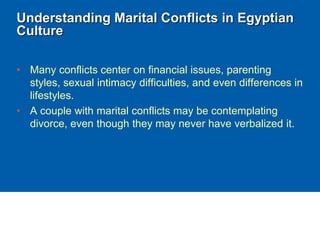
• Many conflicts center on financial issues, parenting
styles, sexual intimacy difficulties, and even differences in
lifestyles.
• A couple with marital conflicts may be contemplating
divorce, even though they may never have verbalized it.
Hanipsych, marita confilcts

Hanipsych, marita confilcts