Hands-on ethernet driver
David Chang
Software Engineer
dchang@suse.com
2
Agenda
• Introduction
• Data structure of network stack
• A brief look at linux ethernet driver
• Tips for linux ethernet driver
3
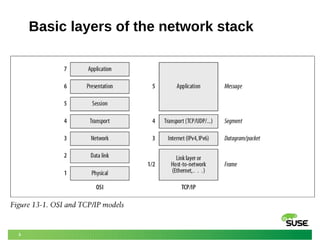
Basic layers of the network stack
4
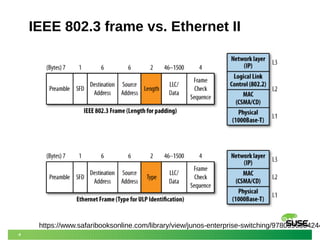
IEEE 802.3 frame vs. Ethernet II
https://www.safaribooksonline.com/library/view/junos-enterprise-switching/9780596804244
5
net_device structure
• Defined in the <include/linux/netdevice.h>
• This structure represents a network interface
• Doubly-linked list all net_device
• Allocation with alloc_netdev()
• alloc_etherdev() is a specialization of alloc_netdev()
for ethernet interfaces
6
sk_buff structure
• Defined in the <include/linux/skbuff.h>
• The socket buffer, is the most fundamental data
structure in the Linux networking code
• A doubly linked list
• Every packet sent or received is handled using this
data structure
• Allocation with dev_alloc_skb()
7
Interact between NIC device and
Kernel
• Polling
‒ Kernel side check the device constantly if new data is
available
• Interrupt
‒ NIC informs the kernel when frame is received
‒ Transmission complete, transmission error
• NAPI (New API)
‒ A mix of polling and interrupts mode
8
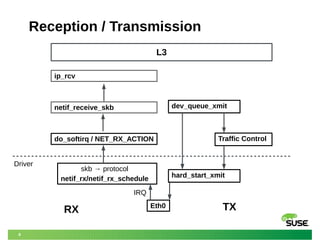
Reception / Transmission
Eth0
skb → protocol
netif_rx/netif_rx_schedule
do_softirq / NET_RX_ACTION
netif_receive_skb
ip_rcv
hard_start_xmit
dev_queue_xmit
Traffic Control
RX TX
IRQ
L3
Driver
9
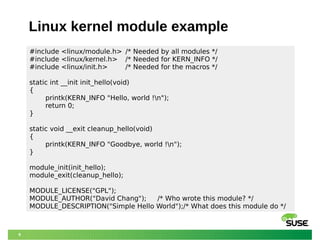
Linux kernel module example
#include <linux/module.h> /* Needed by all modules */
#include <linux/kernel.h> /* Needed for KERN_INFO */
#include <linux/init.h> /* Needed for the macros */
static int __init init_hello(void)
{
printk(KERN_INFO "Hello, world !n");
return 0;
}
static void __exit cleanup_hello(void)
{
printk(KERN_INFO "Goodbye, world !n");
}
module_init(init_hello);
module_exit(cleanup_hello);
MODULE_LICENSE("GPL");
MODULE_AUTHOR("David Chang"); /* Who wrote this module? */
MODULE_DESCRIPTION("Simple Hello World");/* What does this module do */
10
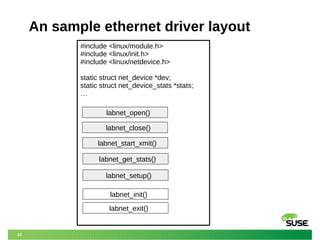
An sample ethernet driver layout
#include <linux/module.h>
#include <linux/init.h>
#include <linux/netdevice.h>
static struct net_device *dev;
static struct net_device_stats *stats;
…
labnet_open()
labnet_close()
labnet_setup()
labnet_start_xmit()
labnet_get_stats()
labnet_init()
labnet_exit()
11
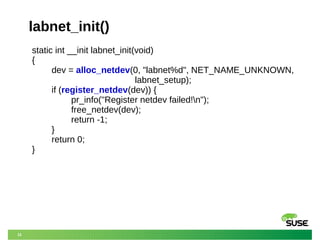
labnet_init()
static int __init labnet_init(void)
{
dev = alloc_netdev(0, "labnet%d", NET_NAME_UNKNOWN,
labnet_setup);
if (register_netdev(dev)) {
pr_info("Register netdev failed!n");
free_netdev(dev);
return -1;
}
return 0;
}
12
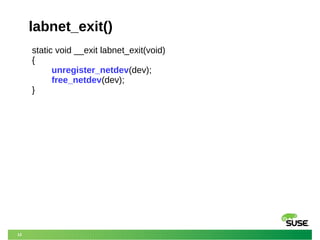
labnet_exit()
static void __exit labnet_exit(void)
{
unregister_netdev(dev);
free_netdev(dev);
}
13
labnet_setup()
static void labnet_setup(struct net_device *dev)
{
int i;
/* Assign the MAC address */
for (i = 0; i < ETH_ALEN; ++i) {
dev->dev_addr[i] = (char)i;
}
ether_setup(dev);
dev->netdev_ops = &ndo;
dev->flags |= IFF_NOARP;
stats = &dev->stats;
}
14
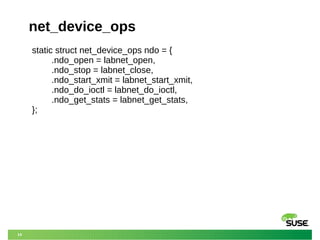
net_device_ops
static struct net_device_ops ndo = {
.ndo_open = labnet_open,
.ndo_stop = labnet_close,
.ndo_start_xmit = labnet_start_xmit,
.ndo_do_ioctl = labnet_do_ioctl,
.ndo_get_stats = labnet_get_stats,
};
15
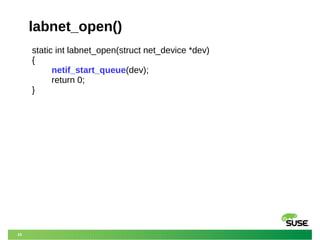
labnet_open()
static int labnet_open(struct net_device *dev)
{
netif_start_queue(dev);
return 0;
}
16
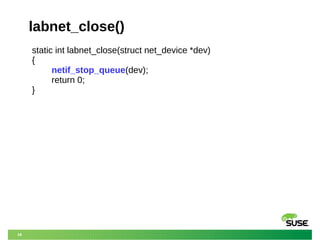
labnet_close()
static int labnet_close(struct net_device *dev)
{
netif_stop_queue(dev);
return 0;
}
17
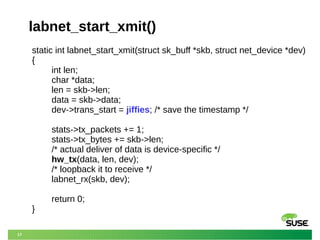
labnet_start_xmit()
static int labnet_start_xmit(struct sk_buff *skb, struct net_device *dev)
{
int len;
char *data;
len = skb->len;
data = skb->data;
dev->trans_start = jiffies; /* save the timestamp */
stats->tx_packets += 1;
stats->tx_bytes += skb->len;
/* actual deliver of data is device-specific */
hw_tx(data, len, dev);
/* loopback it to receive */
labnet_rx(skb, dev);
return 0;
}
18
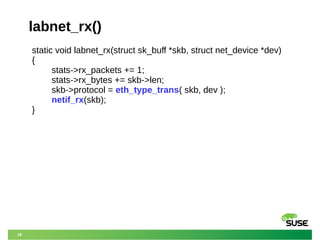
labnet_rx()
static void labnet_rx(struct sk_buff *skb, struct net_device *dev)
{
stats->rx_packets += 1;
stats->rx_bytes += skb->len;
skb->protocol = eth_type_trans( skb, dev );
netif_rx(skb);
}
19
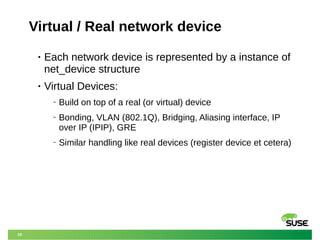
Virtual / Real network device
• Each network device is represented by a instance of
net_device structure
• Virtual Devices:
‒ Build on top of a real (or virtual) device
‒ Bonding, VLAN (802.1Q), Bridging, Aliasing interface, IP
over IP (IPIP), GRE
‒ Similar handling like real devices (register device et cetera)
20
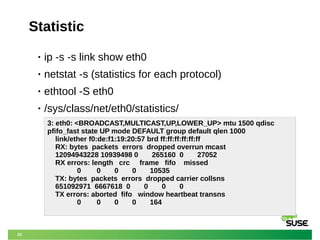
Statistic
• ip -s -s link show eth0
• netstat -s (statistics for each protocol)
• ethtool -S eth0
• /sys/class/net/eth0/statistics/
3: eth0: <BROADCAST,MULTICAST,UP,LOWER_UP> mtu 1500 qdisc
pfifo_fast state UP mode DEFAULT group default qlen 1000
link/ether f0:de:f1:19:20:57 brd ff:ff:ff:ff:ff:ff
RX: bytes packets errors dropped overrun mcast
12094943228 10939498 0 265160 0 27052
RX errors: length crc frame fifo missed
0 0 0 0 10535
TX: bytes packets errors dropped carrier collsns
651092971 6667618 0 0 0 0
TX errors: aborted fifo window heartbeat transns
0 0 0 0 164
21
Another way
• /proc/net: various networking parameters and
statistics
• /proc/sys/net: concerning various networking topics
• /sys/class/net: The class directory contains
representations of every device class that is
registered with the kernel.
22
Thank you!

Hands-on ethernet driver

  • 1.
    Hands-on ethernet driver DavidChang Software Engineer dchang@suse.com
  • 2.
    2 Agenda • Introduction • Datastructure of network stack • A brief look at linux ethernet driver • Tips for linux ethernet driver
  • 3.
    3 Basic layers ofthe network stack
  • 4.
    4 IEEE 802.3 framevs. Ethernet II https://www.safaribooksonline.com/library/view/junos-enterprise-switching/9780596804244
  • 5.
    5 net_device structure • Definedin the <include/linux/netdevice.h> • This structure represents a network interface • Doubly-linked list all net_device • Allocation with alloc_netdev() • alloc_etherdev() is a specialization of alloc_netdev() for ethernet interfaces
  • 6.
    6 sk_buff structure • Definedin the <include/linux/skbuff.h> • The socket buffer, is the most fundamental data structure in the Linux networking code • A doubly linked list • Every packet sent or received is handled using this data structure • Allocation with dev_alloc_skb()
  • 7.
    7 Interact between NICdevice and Kernel • Polling ‒ Kernel side check the device constantly if new data is available • Interrupt ‒ NIC informs the kernel when frame is received ‒ Transmission complete, transmission error • NAPI (New API) ‒ A mix of polling and interrupts mode
  • 8.
    8 Reception / Transmission Eth0 skb→ protocol netif_rx/netif_rx_schedule do_softirq / NET_RX_ACTION netif_receive_skb ip_rcv hard_start_xmit dev_queue_xmit Traffic Control RX TX IRQ L3 Driver
  • 9.
    9 Linux kernel moduleexample #include <linux/module.h> /* Needed by all modules */ #include <linux/kernel.h> /* Needed for KERN_INFO */ #include <linux/init.h> /* Needed for the macros */ static int __init init_hello(void) { printk(KERN_INFO "Hello, world !n"); return 0; } static void __exit cleanup_hello(void) { printk(KERN_INFO "Goodbye, world !n"); } module_init(init_hello); module_exit(cleanup_hello); MODULE_LICENSE("GPL"); MODULE_AUTHOR("David Chang"); /* Who wrote this module? */ MODULE_DESCRIPTION("Simple Hello World");/* What does this module do */
  • 10.
    10 An sample ethernetdriver layout #include <linux/module.h> #include <linux/init.h> #include <linux/netdevice.h> static struct net_device *dev; static struct net_device_stats *stats; … labnet_open() labnet_close() labnet_setup() labnet_start_xmit() labnet_get_stats() labnet_init() labnet_exit()
  • 11.
    11 labnet_init() static int __initlabnet_init(void) { dev = alloc_netdev(0, "labnet%d", NET_NAME_UNKNOWN, labnet_setup); if (register_netdev(dev)) { pr_info("Register netdev failed!n"); free_netdev(dev); return -1; } return 0; }
  • 12.
    12 labnet_exit() static void __exitlabnet_exit(void) { unregister_netdev(dev); free_netdev(dev); }
  • 13.
    13 labnet_setup() static void labnet_setup(structnet_device *dev) { int i; /* Assign the MAC address */ for (i = 0; i < ETH_ALEN; ++i) { dev->dev_addr[i] = (char)i; } ether_setup(dev); dev->netdev_ops = &ndo; dev->flags |= IFF_NOARP; stats = &dev->stats; }
  • 14.
    14 net_device_ops static struct net_device_opsndo = { .ndo_open = labnet_open, .ndo_stop = labnet_close, .ndo_start_xmit = labnet_start_xmit, .ndo_do_ioctl = labnet_do_ioctl, .ndo_get_stats = labnet_get_stats, };
  • 15.
    15 labnet_open() static int labnet_open(structnet_device *dev) { netif_start_queue(dev); return 0; }
  • 16.
    16 labnet_close() static int labnet_close(structnet_device *dev) { netif_stop_queue(dev); return 0; }
  • 17.
    17 labnet_start_xmit() static int labnet_start_xmit(structsk_buff *skb, struct net_device *dev) { int len; char *data; len = skb->len; data = skb->data; dev->trans_start = jiffies; /* save the timestamp */ stats->tx_packets += 1; stats->tx_bytes += skb->len; /* actual deliver of data is device-specific */ hw_tx(data, len, dev); /* loopback it to receive */ labnet_rx(skb, dev); return 0; }
  • 18.
    18 labnet_rx() static void labnet_rx(structsk_buff *skb, struct net_device *dev) { stats->rx_packets += 1; stats->rx_bytes += skb->len; skb->protocol = eth_type_trans( skb, dev ); netif_rx(skb); }
  • 19.
    19 Virtual / Realnetwork device • Each network device is represented by a instance of net_device structure • Virtual Devices: ‒ Build on top of a real (or virtual) device ‒ Bonding, VLAN (802.1Q), Bridging, Aliasing interface, IP over IP (IPIP), GRE ‒ Similar handling like real devices (register device et cetera)
  • 20.
    20 Statistic • ip -s-s link show eth0 • netstat -s (statistics for each protocol) • ethtool -S eth0 • /sys/class/net/eth0/statistics/ 3: eth0: <BROADCAST,MULTICAST,UP,LOWER_UP> mtu 1500 qdisc pfifo_fast state UP mode DEFAULT group default qlen 1000 link/ether f0:de:f1:19:20:57 brd ff:ff:ff:ff:ff:ff RX: bytes packets errors dropped overrun mcast 12094943228 10939498 0 265160 0 27052 RX errors: length crc frame fifo missed 0 0 0 0 10535 TX: bytes packets errors dropped carrier collsns 651092971 6667618 0 0 0 0 TX errors: aborted fifo window heartbeat transns 0 0 0 0 164
  • 21.
    21 Another way • /proc/net:various networking parameters and statistics • /proc/sys/net: concerning various networking topics • /sys/class/net: The class directory contains representations of every device class that is registered with the kernel.
  • 22.