Hand Hygiene
Dr: Mosa Alfageh
Introduction
 Hand Hygiene is the easiest and most important way to prevent
spread of infection.
 You use your hands for almost everything. They are easily
contaminated.
Handwashing
:
is an aseptic practice that involves scrubbing the hands with
nonantimicrobial or antimicrobial soap, water, and friction
Purpose
 1-To clean contaminated hands.
 2-To remove dirt
 3-minimize number of microorganism
 4-To prevent cross and nosocomial infection.
Indications
Hand hygiene is essential :
1-When hands are visible soiled
2-Before and after caring for a patient
3-After contact with organic material ,such as
feces ,wound drainage ,and mucus
4-In preparation for an invasive procedure ,such as
suction, catheterization ,or injections
 5-Before changing a dressing or having contact with open
wounds
 6-Befor preparing and administrating medications
 7-After removing disposable gloves
 8-Before and after using the toilet
 9-Before and after eating
 10-At the beginning and end of the shift.
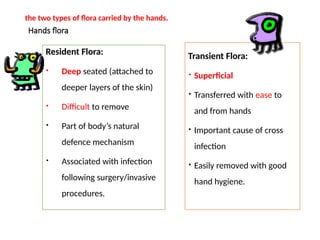
Hands flora
Resident Flora:
 Deep seated (attached to
deeper layers of the skin)
 Difficult to remove
 Part of body’s natural
defence mechanism
 Associated with infection
following surgery/invasive
procedures.
Transient Flora:
 Superficial
 Transferred with ease to
and from hands
 Important cause of cross
infection
 Easily removed with good
hand hygiene.
the two types of flora carried by the hands.
Hand Hygiene includes
:
1- Hand washing
 Washing hands with plain soap and water
 2- Antiseptic hand wash
 Washing hands with water and soap or other antiseptic agent
 3- Alcohol-based hand rub
 Rubbing hands with an alcohol-containing preparation (used after hand washing)
4- Surgical antisepsis
Hand washing with antiseptic soap or alcohol-
based handrub before operations by surgical
personnel
Level of hand hygiene
Routine
hand
hygiene
Water and plain
soap
Remove transient
microorganisms
Aseptic
hand
hygiene
Water and
antiseptic soap
Alcohol hand rub
Remove transient
microorganism
Reduce resident
microorganism
Surgical
hand
hygiene
Water and long
acting antiseptic
Remove transient
and most resident
microorganism
Hand Care
Nails
Rings
Hand creams
Cuts & abrasions
Skin Problems
Rings and Jewelry
Studies have demonstrated that skin underneath
rings is more heavily colonized than comparable
areas of skin on fingers without rings.
Fingernails
 Keep fingernails SHORT! Not excesses 1/4 inch
 Avoid artificial nails
 Avoid nail polish
Safety precautions
 Does not touch the sink during the washing procedure
Equipment
:
Soap
Tissue paper or small towels.
Sink
running water.
Trash can- nail cleaner
Procedure
Rational Actions
1-poor personal hygiene
and an open area of the
skin provide areas in which
microorganisms are able to
grow
1-inspect hands ,observing
for visible soiling, breaks or
cuts in the skin and cuticles
2-determine the type of
hand hygiene needed
2-determine amount of
contaminate of hands
Procedure… cont
.
Rational Actions
3-prevent contamination
of hands during and after
hand hygiene procedure
3-assess areas around the skin
that are contaminated
4-microorganisms collect
in jewelry and watch bands
;removing jewelry makes it
easier to wash all areas of
hands and wrists
4-remove jewelry except plain
wedding band and push watch
and long sleeves above wrist
Procedure… cont
.
Rational Actions
5-water is too hot or too cold can
chap skin ,and too much force can
cause splashing and spread
microorganisms to other
areas ,especially your clothing
5-adjust the water to
appropriate temperature and
force
6-hands are the most
contaminated part of the upper
extremities ;water should follow
from the wrists (least
contaminated areas) over the
hands ,and then down the drain
6-wet hands and wrist under
the running water ,always
keeping hands lower than
elbow s
Procedure… cont
.
Rational Actions
7- soap lather emulsifies fat
and aids in cleaning
7-lather hands with
liquid soap
8- helps to loosen soil and
microorganisms , both
resident (normally
present )and transient
(acquired from
contamination)
8-wash hands
thoroughly using a
firm ,circular motion
and friction:
a. Rub palms together
Procedure… cont
.
Rational Actions
b. Rub the back of both hands
c. Interlace and rub hands
together
Procedure… cont
.
Rational Actions
d. Interlock fingers and rub the
back of fingers of both
e. Rotational rubbing of left thumb
clasped in right palm and vice
versa
Procedure… cont
.
Rational Actions
f. Rotational rubbing, backwards
and forwards with clasped
fingers of right hand in left palm
and vice versa;
g. Rub both wrists in a rotating
manner ;
Procedure… cont
.
Rational Actions
9-Rinsing removes the loosened
microorganisms ,and re-lathering
ensures more thoroughly
cleaning . the greater the
contamination , the more
needed for longer washing
9-wash for 15 to 30 seconds ,rinse
thoroughly ,re lather ,and wash
another minutes ,using continuous
friction
10-The water should run from
cleaner areas (the wrists) over
the hands , and then down the
drain , rinsing microorganisms
away
10- rinse wrists and hands
completely
--- keep hands lower than elbows
Procedure… cont
.
Rational Actions
12-prevent
chapping .drying
should progress
from clean to less
clean , and the
cleanest areas are
now your fingers and
hands
12-dry hands thoroughly with paper
towels .
-start by patting at fingertips, then
hands ,then wrists and forearms
Procedure… cont
.
Rational Actions
13- keeps cleans hands
from touching
contaminated hands
13- turn of faucets using a
dry paper towels
14- keeps skin soft and
lubricated so it will not
crack easily
14-use hospital-approved
hand lotion if desired
Procedure… cont
.
Rational Actions
15- ensures cleanliness of
hands and nails
15-inspect hands and nails for
cleanliness
16-helps the patient
understand that hand
hygiene slows down the
spread of infection
16- provide patient
teaching .explain to the
patient the importance of
hand hygiene
Hand Hygiene: Frequently Missed Areas
Courtesy of SDS Kerr
Remember :Bacteria and viruses can
cause illness and even death
.
Hey, wait a minute!
We’re not all bad
!
And remember…
No Matter Where You Are…
No Matter What You Do…
WASH YOUR HANDS!
VIDEO
SURGICAL ASEPSIS
SURGICAL ASEPSIS
 Refers to the procedures used to keep the object or areas sterile or
completely free from micro organisms.
 In surgical asepsis all practices are directed to the elimination of
both pathogenic and nonpathogenic micro-organisms.
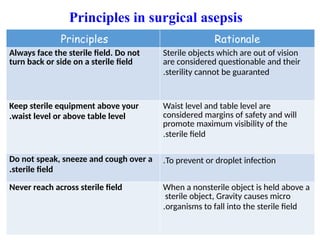
Principles in surgical asepsis
Principles Rationale
Always face the sterile field. Do not
turn back or side on a sterile field
Sterile objects which are out of vision
are considered questionable and their
sterility cannot be guaranted
.
Keep sterile equipment above your
waist level or above table level
.
Waist level and table level are
considered margins of safety and will
promote maximum visibility of the
sterile field
.
Do not speak, sneeze and cough over a
sterile field
.
To prevent or droplet infection
.
Never reach across sterile field When a nonsterile object is held above a
sterile object, Gravity causes micro
organisms to fall into the sterile field
.
Principles Rationale
Keep the unsterile objects away from
the sterile field
.
Preserve sterility by touching one
sterile item with another that is sterile
Once a sterile item touches something
that is not, it is considered
contaminated
.
Micro organisms may be transferred
whenever a non sterile object touches a
sterile field
.
Keep the sterile field dry Micro organisms do not pass easily
through a dry surface
.
The outer 1-inch margin of a sterile
area is considered a zone of
contamination
.
Proximity to a contaminated area makes
sterilty doubtful
.
Handle liquids cautiously near the
sterile field or prevent drapes or
wrappers from becoming wet
.
When a liquid wets it connects a
nonsterile field with a sterile field
.
Principles Rationale
Each sterile supply should be clearly
labeled as to its contents, time and
date of sterilization
.
To ensure sterility
.
Never assume that a object is sterile.
Always check the sterility expiration
date
.
Sterility of an object wrapped in paper
or cloth becomes doubtful after 4
weeks
.
Avoid sweeping and dusting when the
sterile objects are opened
.
Micro –organisms travel in the dust
particles
Put on mask, Wash hands, put on
gowns and gloves before handling
sterile supplies
.
To prevent contamination
.
PROCEDURES INCLUDED IN SURGICAL ASEPSIS
 Surgical hand scrub
 Donning a sterile gown
 Applying and removing a sterile gloves
1
.
Surgical hand scrub
Purpose
:
Remove as many micro organisms from
the hands as possible before the sterile
procedure
.
1.SURGICAL
HAND SCRUB
Equipment
 Warm running water
 Antiseptic Soap Solution
 Hand brush stored in a sterile container
 Transferring forceps
 Sterile towel
Steps of the procedure
1
.
Makesure fingernails are short,clean,healthy.Nail polish should be
removed
.
2
.
Remove jewelries(Rings, Bracelets)
.
3
.
Apply personal protective equipment(PPE) includes surgical shoe
covers , Cap , Facemask
and protective eyewear
.
4
.
Open disposable brush impregnated with antimicrobial soap
5
.
If no disposable brush is not available/some hospital use brush
sterilized and stored in the small bin
.
6
.
Use a transferring forceps to pick up
the brush from the sterile bin
.
7
.
Turn on the water and adjust the flow
so that the water is warm. Warm water
removes less of the protective oil of
the skin than hot water
.
8
.
Wet hands and arms. Keep hands
above elbows
Rationale: Movement of water and
dirt will flow from hands to less
clean areas thus preventing
contamination of the hands during
scrub
.
Wet hands and arms up to the elbows.
Use nail pick to clean nails under running water.
9
.
Wet scrub brush or apply antibacterial soap if not already impregnated in the
brush
.
10
.
Anatomic timed scrub: Starting with fingertips, scrub each anatomic area
(Nail, fingers each side and web space , palmar , dorsal surface and Forearm)
for around 5 minutes
.
11
.
Scrub vigorously using vertical strokes in a circular manner. Repeat with
other hand
.
Rationale: Ensures that all surfaces will be systematically scrubbed to
remove transient and resident micro organisms
.
12
.
Counted brush stroke method: Starting finger tips, scrub each
anatomic area for the designated number of strokes. Scrub vigorously
using vertical strokes
.
Wet sponge and squeeze to work up lather.
Wash each finger, hand, and arm to two inches above the elbows using
the non abrasive sponge for a total scrub time of three minutes.
Note: Use brush side only on nails and cuticles or on areas of visible soil.
13
.
Rinse hands thoroughly under warm running water, holding hands
upward. This is to allow water to drain towards the flexed elbows
.
Rationale : Prevents contamination of the hands from dirtier areas.
Remember do not touch anything before and after rinsing hands.
Touching non sterile objects would mean the surgical scrub need to be
repeated
.
14
.
Keep hands held upward to allow water to drip from the hands to
elbow
.
15
.
Dry hands with a sterile towel
.
Video
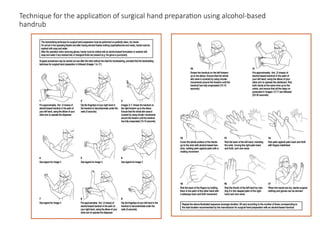
Technique for the application of surgical hand preparation using alcohol-based
handrub
USA:
Up to 2 million HAI/yr,
80,000 of them may contribute to death, and
generate 4.5 to 5.7 billion USD additional expenses/yr (WHO
figures, 2005).
UK:
320,000 HAI/yr,
5,000 of them may contribute to death, and
generate £1 billion additional expenses /year
(
WHO figures, 2005
.)
55
BETWEEN 40 AND 50% OF HAI ARE
CONSIDERED TO BE PREVENTABLE
hand was                                        hing.pptx

hand was hing.pptx

  • 1.
  • 2.
    Introduction  Hand Hygieneis the easiest and most important way to prevent spread of infection.  You use your hands for almost everything. They are easily contaminated.
  • 3.
    Handwashing : is an asepticpractice that involves scrubbing the hands with nonantimicrobial or antimicrobial soap, water, and friction
  • 4.
    Purpose  1-To cleancontaminated hands.  2-To remove dirt  3-minimize number of microorganism  4-To prevent cross and nosocomial infection.
  • 5.
    Indications Hand hygiene isessential : 1-When hands are visible soiled 2-Before and after caring for a patient 3-After contact with organic material ,such as feces ,wound drainage ,and mucus 4-In preparation for an invasive procedure ,such as suction, catheterization ,or injections
  • 6.
     5-Before changinga dressing or having contact with open wounds  6-Befor preparing and administrating medications  7-After removing disposable gloves  8-Before and after using the toilet  9-Before and after eating  10-At the beginning and end of the shift.
  • 8.
    Hands flora Resident Flora: Deep seated (attached to deeper layers of the skin)  Difficult to remove  Part of body’s natural defence mechanism  Associated with infection following surgery/invasive procedures. Transient Flora:  Superficial  Transferred with ease to and from hands  Important cause of cross infection  Easily removed with good hand hygiene. the two types of flora carried by the hands.
  • 9.
    Hand Hygiene includes : 1-Hand washing  Washing hands with plain soap and water  2- Antiseptic hand wash  Washing hands with water and soap or other antiseptic agent  3- Alcohol-based hand rub  Rubbing hands with an alcohol-containing preparation (used after hand washing)
  • 10.
    4- Surgical antisepsis Handwashing with antiseptic soap or alcohol- based handrub before operations by surgical personnel
  • 11.
    Level of handhygiene Routine hand hygiene Water and plain soap Remove transient microorganisms Aseptic hand hygiene Water and antiseptic soap Alcohol hand rub Remove transient microorganism Reduce resident microorganism Surgical hand hygiene Water and long acting antiseptic Remove transient and most resident microorganism
  • 12.
  • 13.
    Rings and Jewelry Studieshave demonstrated that skin underneath rings is more heavily colonized than comparable areas of skin on fingers without rings.
  • 14.
    Fingernails  Keep fingernailsSHORT! Not excesses 1/4 inch  Avoid artificial nails  Avoid nail polish
  • 15.
    Safety precautions  Doesnot touch the sink during the washing procedure
  • 16.
    Equipment : Soap Tissue paper orsmall towels. Sink running water. Trash can- nail cleaner
  • 17.
    Procedure Rational Actions 1-poor personalhygiene and an open area of the skin provide areas in which microorganisms are able to grow 1-inspect hands ,observing for visible soiling, breaks or cuts in the skin and cuticles 2-determine the type of hand hygiene needed 2-determine amount of contaminate of hands
  • 18.
    Procedure… cont . Rational Actions 3-preventcontamination of hands during and after hand hygiene procedure 3-assess areas around the skin that are contaminated 4-microorganisms collect in jewelry and watch bands ;removing jewelry makes it easier to wash all areas of hands and wrists 4-remove jewelry except plain wedding band and push watch and long sleeves above wrist
  • 19.
    Procedure… cont . Rational Actions 5-wateris too hot or too cold can chap skin ,and too much force can cause splashing and spread microorganisms to other areas ,especially your clothing 5-adjust the water to appropriate temperature and force 6-hands are the most contaminated part of the upper extremities ;water should follow from the wrists (least contaminated areas) over the hands ,and then down the drain 6-wet hands and wrist under the running water ,always keeping hands lower than elbow s
  • 20.
    Procedure… cont . Rational Actions 7-soap lather emulsifies fat and aids in cleaning 7-lather hands with liquid soap 8- helps to loosen soil and microorganisms , both resident (normally present )and transient (acquired from contamination) 8-wash hands thoroughly using a firm ,circular motion and friction: a. Rub palms together
  • 21.
    Procedure… cont . Rational Actions b.Rub the back of both hands c. Interlace and rub hands together
  • 22.
    Procedure… cont . Rational Actions d.Interlock fingers and rub the back of fingers of both e. Rotational rubbing of left thumb clasped in right palm and vice versa
  • 23.
    Procedure… cont . Rational Actions f.Rotational rubbing, backwards and forwards with clasped fingers of right hand in left palm and vice versa; g. Rub both wrists in a rotating manner ;
  • 24.
    Procedure… cont . Rational Actions 9-Rinsingremoves the loosened microorganisms ,and re-lathering ensures more thoroughly cleaning . the greater the contamination , the more needed for longer washing 9-wash for 15 to 30 seconds ,rinse thoroughly ,re lather ,and wash another minutes ,using continuous friction 10-The water should run from cleaner areas (the wrists) over the hands , and then down the drain , rinsing microorganisms away 10- rinse wrists and hands completely --- keep hands lower than elbows
  • 25.
    Procedure… cont . Rational Actions 12-prevent chapping.drying should progress from clean to less clean , and the cleanest areas are now your fingers and hands 12-dry hands thoroughly with paper towels . -start by patting at fingertips, then hands ,then wrists and forearms
  • 26.
    Procedure… cont . Rational Actions 13-keeps cleans hands from touching contaminated hands 13- turn of faucets using a dry paper towels 14- keeps skin soft and lubricated so it will not crack easily 14-use hospital-approved hand lotion if desired
  • 27.
    Procedure… cont . Rational Actions 15-ensures cleanliness of hands and nails 15-inspect hands and nails for cleanliness 16-helps the patient understand that hand hygiene slows down the spread of infection 16- provide patient teaching .explain to the patient the importance of hand hygiene
  • 28.
    Hand Hygiene: FrequentlyMissed Areas Courtesy of SDS Kerr
  • 29.
    Remember :Bacteria andviruses can cause illness and even death . Hey, wait a minute! We’re not all bad !
  • 30.
    And remember… No MatterWhere You Are… No Matter What You Do… WASH YOUR HANDS!
  • 31.
  • 32.
  • 33.
    SURGICAL ASEPSIS  Refersto the procedures used to keep the object or areas sterile or completely free from micro organisms.  In surgical asepsis all practices are directed to the elimination of both pathogenic and nonpathogenic micro-organisms.
  • 34.
    Principles in surgicalasepsis Principles Rationale Always face the sterile field. Do not turn back or side on a sterile field Sterile objects which are out of vision are considered questionable and their sterility cannot be guaranted . Keep sterile equipment above your waist level or above table level . Waist level and table level are considered margins of safety and will promote maximum visibility of the sterile field . Do not speak, sneeze and cough over a sterile field . To prevent or droplet infection . Never reach across sterile field When a nonsterile object is held above a sterile object, Gravity causes micro organisms to fall into the sterile field .
  • 35.
    Principles Rationale Keep theunsterile objects away from the sterile field . Preserve sterility by touching one sterile item with another that is sterile Once a sterile item touches something that is not, it is considered contaminated . Micro organisms may be transferred whenever a non sterile object touches a sterile field . Keep the sterile field dry Micro organisms do not pass easily through a dry surface . The outer 1-inch margin of a sterile area is considered a zone of contamination . Proximity to a contaminated area makes sterilty doubtful . Handle liquids cautiously near the sterile field or prevent drapes or wrappers from becoming wet . When a liquid wets it connects a nonsterile field with a sterile field .
  • 36.
    Principles Rationale Each sterilesupply should be clearly labeled as to its contents, time and date of sterilization . To ensure sterility . Never assume that a object is sterile. Always check the sterility expiration date . Sterility of an object wrapped in paper or cloth becomes doubtful after 4 weeks . Avoid sweeping and dusting when the sterile objects are opened . Micro –organisms travel in the dust particles Put on mask, Wash hands, put on gowns and gloves before handling sterile supplies . To prevent contamination .
  • 37.
    PROCEDURES INCLUDED INSURGICAL ASEPSIS  Surgical hand scrub  Donning a sterile gown  Applying and removing a sterile gloves
  • 38.
    1 . Surgical hand scrub Purpose : Removeas many micro organisms from the hands as possible before the sterile procedure .
  • 39.
  • 40.
    Equipment  Warm runningwater  Antiseptic Soap Solution  Hand brush stored in a sterile container  Transferring forceps  Sterile towel
  • 41.
    Steps of theprocedure 1 . Makesure fingernails are short,clean,healthy.Nail polish should be removed . 2 . Remove jewelries(Rings, Bracelets) . 3 . Apply personal protective equipment(PPE) includes surgical shoe covers , Cap , Facemask and protective eyewear .
  • 42.
    4 . Open disposable brushimpregnated with antimicrobial soap 5 . If no disposable brush is not available/some hospital use brush sterilized and stored in the small bin .
  • 43.
    6 . Use a transferringforceps to pick up the brush from the sterile bin . 7 . Turn on the water and adjust the flow so that the water is warm. Warm water removes less of the protective oil of the skin than hot water . 8 . Wet hands and arms. Keep hands above elbows Rationale: Movement of water and dirt will flow from hands to less clean areas thus preventing contamination of the hands during scrub .
  • 44.
    Wet hands andarms up to the elbows. Use nail pick to clean nails under running water.
  • 45.
    9 . Wet scrub brushor apply antibacterial soap if not already impregnated in the brush . 10 . Anatomic timed scrub: Starting with fingertips, scrub each anatomic area (Nail, fingers each side and web space , palmar , dorsal surface and Forearm) for around 5 minutes .
  • 46.
    11 . Scrub vigorously usingvertical strokes in a circular manner. Repeat with other hand . Rationale: Ensures that all surfaces will be systematically scrubbed to remove transient and resident micro organisms . 12 . Counted brush stroke method: Starting finger tips, scrub each anatomic area for the designated number of strokes. Scrub vigorously using vertical strokes .
  • 47.
    Wet sponge andsqueeze to work up lather. Wash each finger, hand, and arm to two inches above the elbows using the non abrasive sponge for a total scrub time of three minutes. Note: Use brush side only on nails and cuticles or on areas of visible soil.
  • 50.
    13 . Rinse hands thoroughlyunder warm running water, holding hands upward. This is to allow water to drain towards the flexed elbows . Rationale : Prevents contamination of the hands from dirtier areas. Remember do not touch anything before and after rinsing hands. Touching non sterile objects would mean the surgical scrub need to be repeated .
  • 51.
    14 . Keep hands heldupward to allow water to drip from the hands to elbow . 15 . Dry hands with a sterile towel .
  • 52.
  • 53.
    Technique for theapplication of surgical hand preparation using alcohol-based handrub
  • 55.
    USA: Up to 2million HAI/yr, 80,000 of them may contribute to death, and generate 4.5 to 5.7 billion USD additional expenses/yr (WHO figures, 2005). UK: 320,000 HAI/yr, 5,000 of them may contribute to death, and generate £1 billion additional expenses /year ( WHO figures, 2005 .) 55 BETWEEN 40 AND 50% OF HAI ARE CONSIDERED TO BE PREVENTABLE

Editor's Notes

  • #3 antimicrobial agent They limit numbers of microorganisms by destroying them or suppressing growth. Antiseptics: inhibit growth but do not kill microorganisms as alcohol. Disinfectants: destroy microorganisms but not spores as Phenol, household bleach & formaldehyde. Anti-infective drugs: antibacterials and antivirals. They damage/destroy bacterial cell walls or growth mechanisms.
  • #6 Contraindications: § No contraindication
  • #8 Discuss the two types of flora carried by the hands. What Are Your Hands Carrying? Micro-organisms found on the skin are of two categories: (A) Resident Micro-Organisms (normal flora) These are usually deep seated in the epidermis, are not readily removed and do not readily cause infections. However, during surgery/invasive procedures, they may enter deep tissues and establish an infection. (B) Transient Micro-Organisms These are organisms that are not part of the normal flora and represent recent contamination, that usually survives for a limited period of time only. They are easily removed by a good hand washing technique. They include most of the organisms responsible for cross infection, e.g. Gram-negative bacilli (E.coli, Klebsiella, Pseudomonas spp, Salmonella spp., Staph aureus, MRSA and viruses e.g. rotaviruses (Damani, N.N. (1997)).
  • #9 Antiseptic hand rub (alcohol based hand rub) Hand hygiene is a general term that applies to either handwashing, antiseptic handwash, alcohol-based handrub, or surgical hand hygiene/antisepsis. Handwashing refers to washing hands with plain soap and water. Antiseptic handwash refers to washing hands with water and soap or other detergents containing an antiseptic agent, such as triclosan or chlorhexidine. Using a waterless agent containing 60%–95% ethanol or isopropanol alcohol-containing preparation is referred to as an alcohol handrub. These agents are a new addition to the dental guidelines and have become more frequently used in the United States to improve compliance with handwashing in hospitals. In dental practices, however, sinks are readily available and the need for alcohol preparations is not as great. Surgical antisepsis refers to an antiseptic handwash or alcohol-based handrub* performed preoperatively by surgical personnel to eliminate microorganisms on hands. Antiseptic preparations for surgical hand hygiene should have persistent (long-lasting) antimicrobial activity. If using an alcohol-based handrub the hands should first be washed with soap and water. Surgical hand antisepsis Remove rings, watches, and bracelets before beginning the surgical hand scrub (II) (375,378,416). Remove debris from underneath fingernails using a nail cleaner under running water (II) (14,417). Surgical hand antisepsis using either an antimicrobial soap or an alcohol-based hand rub with persistent activity is recommended before donning sterile gloves when performing surgical procedures (IB) (115,159,232,234,237,418). When performing surgical hand antisepsis using an antimicrobial soap, scrub hands and forearms for the length of time recommended by the manufacturer, usually 2--6 minutes. Long scrub times (e.g., 10 minutes) are not necessary (IB) (117,156,205, 207,238-241). When using an alcohol-based surgical hand-scrub product with persistent activity, follow the manufacturer's instructions. Before applying the alcohol solution, prewash hands and forearms with a non-antimicrobial soap and dry hands and forearms completely. After application of the alcohol-based product as recommended, allow hands and forearms to dry thoroughly before donning sterile gloves (IB) (159,237).
  • #10 Explain that “Hand Hygiene” constitutes all of the above, but that this session will not be covering surgical scrubs. For surgical procedures, performing a surgical hand wash and putting on sterile surgeon’s gloves necessary.
  • #12 CUTICLES
  • #17 Performing Hand Hygiene: Handwashing (Medical)
  • #28  Webs of fingers •Thumbs •Palms •Nails •Backs of fingers & hands •Wrists
  • #35 The edge of the sterile field is considered unsterile. A sterile wrapper, if it becomes wet, wicks microorganisms causing contamination
  • #39 Performing surgical hand antisepsis using either an antimicrobial soap or an alcohol- based hand sanitizer with persistent activity is recommended before donning sterile gloves when performing surgical procedures.
  • #50 Rinse hands and arms from finger tips to elbows. Dry hands and arms with a sterile towel.
  • #55 WHY HH IS IMPORTANT Most common mode of transmission Most important factor in preventing spread of organisms Reduce number of infections Decrease patient length of stay Decrease use of resources Reduce number of deaths