HAND WASHING
Dr.T.V.Rao MD
Dr.T.V.Rao MD 1
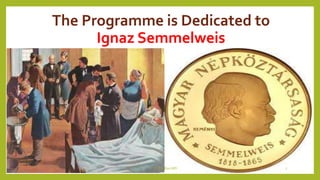
The Programme is Dedicated to
Ignaz Semmelweis
Dr.T.V.Rao MD 2
Normal flora of hands
• There are two types of microbes
colonizing hands: the resident
flora, which consists of
microorganisms residing under
the superficial cells of the
stratum corneum and the
transient flora, which colonizes
the superficial layers of the skin,
and is more amenable to removal
by routine hand hygiene
Dr.T.V.Rao MD 3
Colonization of hands with pathogens and
their role in transmission
•The hands of HCWs are commonly colonized with pathogens
like methicillin resistant S. aureus (MRSA), vancomycin
resistant Enterococcus (VRE), MDR-Gram Negative bacteria
(GNBs), Candida spp. and Clostridium difficle, which can
survive for as long as 150 h. Approximately 106 skin epithelial
cells containing viable microorganisms are shed daily from
the normal skin, which can contaminate the gowns, bed
linen, bedside furniture, and other objects in the patient's
immediate environment
Dr.T.V.Rao MD 4
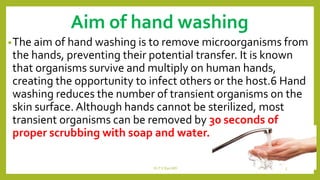
Aim of hand washing
•The aim of hand washing is to remove microorganisms from
the hands, preventing their potential transfer. It is known
that organisms survive and multiply on human hands,
creating the opportunity to infect others or the host.6 Hand
washing reduces the number of transient organisms on the
skin surface. Although hands cannot be sterilized, most
transient organisms can be removed by 30 seconds of
proper scrubbing with soap and water.
Dr.T.V.Rao MD 5
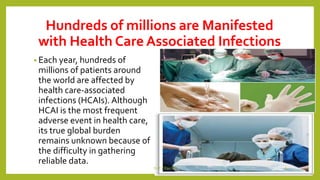
Hundreds of millions are Manifested
with Health Care Associated Infections
• Each year, hundreds of
millions of patients around
the world are affected by
health care-associated
infections (HCAIs). Although
HCAI is the most frequent
adverse event in health care,
its true global burden
remains unknown because of
the difficulty in gathering
reliable data.
Dr.T.V.Rao MD 6
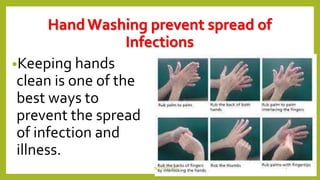
HandWashing prevent spread of
Infections
•Keeping hands
clean is one of the
best ways to
prevent the spread
of infection and
illness.
Dr.T.V.Rao MD 7
Dr.T.V.Rao MD 8
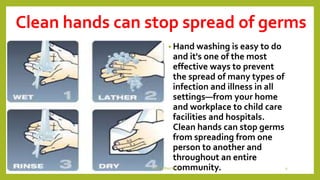
Clean hands can stop spread of germs
• Hand washing is easy to do
and it's one of the most
effective ways to prevent
the spread of many types of
infection and illness in all
settings—from your home
and workplace to child care
facilities and hospitals.
Clean hands can stop germs
from spreading from one
person to another and
throughout an entire
community.Dr.T.V.Rao MD 9
Learn more about when and
how to wash your hands.
• Before, during, and after preparing food
• Before eating food
• Before and after caring for someone who is sick
• Before and after treating a cut or wound
• After using the toilet
• After changing diapers or cleaning up a child who has used the toilet
• After blowing your nose, coughing, or sneezing
• After touching an animal, animal feed, or animal waste
• After touching garbage Dr.T.V.Rao MD 10
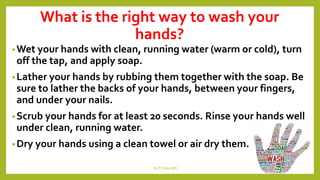
What is the right way to wash your
hands?
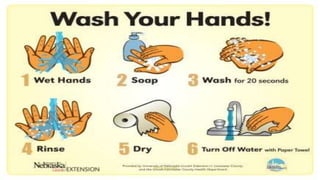
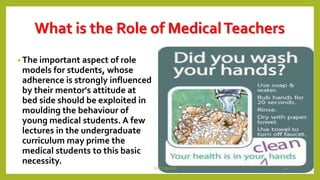
•Wet your hands with clean, running water (warm or cold), turn
off the tap, and apply soap.
•Lather your hands by rubbing them together with the soap. Be
sure to lather the backs of your hands, between your fingers,
and under your nails.
•Scrub your hands for at least 20 seconds. Rinse your hands well
under clean, running water.
•Dry your hands using a clean towel or air dry them.
Dr.T.V.Rao MD 11
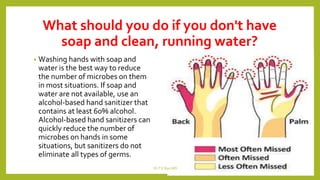
What should you do if you don't have
soap and clean, running water?
• Washing hands with soap and
water is the best way to reduce
the number of microbes on them
in most situations. If soap and
water are not available, use an
alcohol-based hand sanitizer that
contains at least 60% alcohol.
Alcohol-based hand sanitizers can
quickly reduce the number of
microbes on hands in some
situations, but sanitizers do not
eliminate all types of germs.
Dr.T.V.Rao MD 12
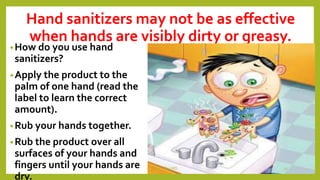
Hand sanitizers may not be as effective
when hands are visibly dirty or greasy.
•How do you use hand
sanitizers?
•Apply the product to the
palm of one hand (read the
label to learn the correct
amount).
•Rub your hands together.
•Rub the product over all
surfaces of your hands and
fingers until your hands are
dry.
Dr.T.V.Rao MD 13
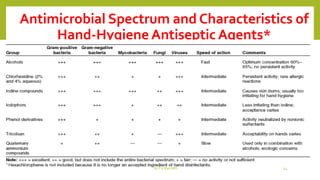
Antimicrobial Spectrum and Characteristics of
Hand-Hygiene Antiseptic Agents*
Dr.T.V.Rao MD 14
Did you know ?
1 in 5 People Don'tWashTheir Hands
•Did you know that 1 in 5 people don't wash their hands
and of those that do only 30% use soap. The CDC
recommends 15-20 seconds of vigorous hand washing
with soap and water to effectively kill germs, but only
about 5% of people wash their hands for 15-seconds or
more. The result - fecal matter including bacteria such
as E. coli can be found on just over a quarter of our hands
according to a new study by hygiene experts from
Queen Mary University of London
Dr.T.V.Rao MD 15
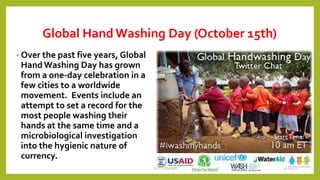
Global Hand Washing Day (October 15th)
• Over the past five years, Global
HandWashing Day has grown
from a one-day celebration in a
few cities to a worldwide
movement. Events include an
attempt to set a record for the
most people washing their
hands at the same time and a
microbiological investigation
into the hygienic nature of
currency.
Dr.T.V.Rao MD 16
As Posted by Dr Pierre GRASCHA
•Only 1 out of 5 people do not wash hands. Based on my own
observations, I think that the reality is unfortunately worse than
that. 2 in 5 or 3 in 5 is probably a more realistic figure.
•The only way to sort this problem out is to educate people as early
age as possible.When I was a child, we used to have moral
education courses every morning but nothing about the basics of
hygiene.Today we know enough about microbiological risks in
relation with lack of hygiene; then why hygiene is not
systematically explained to kids in primary schools?
Dr.T.V.Rao MD 17
PaperTowels or Hot Air Dryers -
Which is Better & Why?•The study revealed, "from a hygiene viewpoint,
paper towels are superior to electronic air dryers"
and "drying hands thoroughly with single-use,
disposable paper towels is the preferred method of
hand drying." It concluded by recommending, "The
provision of paper towels should be considered as a
means of improving hand hygiene adherence."
Dr.T.V.Rao MD 18
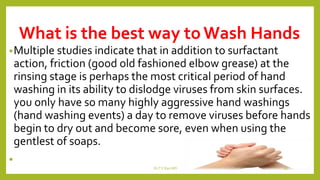
What is the best way toWash Hands
•Multiple studies indicate that in addition to surfactant
action, friction (good old fashioned elbow grease) at the
rinsing stage is perhaps the most critical period of hand
washing in its ability to dislodge viruses from skin surfaces.
you only have so many highly aggressive hand washings
(hand washing events) a day to remove viruses before hands
begin to dry out and become sore, even when using the
gentlest of soaps.
•
Dr.T.V.Rao MD 19
What is the Role of MedicalTeachers
• The important aspect of role
models for students, whose
adherence is strongly influenced
by their mentor's attitude at
bed side should be exploited in
moulding the behaviour of
young medical students. A few
lectures in the undergraduate
curriculum may prime the
medical students to this basic
necessity.
Dr.T.V.Rao MD 20
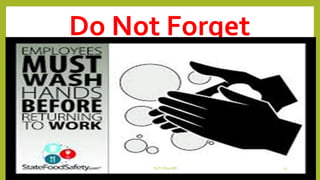
Do Not Forget
Dr.T.V.Rao MD 21
What we Need in many Hospitals
• Hand washing should become an educational priority.
Educational interventions for medical students should provide
clear evidence that HCWs hands become grossly contaminated
with pathogens upon patient contact and that alcohol hand rubs
are the easiest and most effective means of decontaminating
hands and thereby reducing the rates of HAIs. Increasing the
emphasis on infection control, giving the charge of infection
control to senior organizational members, changing the
paradigm of surveillance to continuous monitoring and effective
data feedback are some of the important measures which need
to be initiated in Indian hospitals.
Dr.T.V.Rao MD 22
Global Hand Washing Day on
Social Networking
•Global Hand Washing Day will also be celebrated virtually
onTwitter and Facebook with the #iwashmyhands hashtag.
Twitter users are encouraged to tweet #iwashmyhands to
help raise awareness about the importance of hand
washing correctly with soap. There is also an interactive
social media game available at
http://globalhandwashing.org/ghw which educates players
about hygiene and allows them to share.
Dr.T.V.Rao MD 23
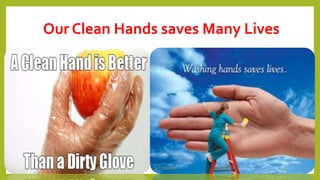
Our Clean Hands saves Many Lives
Dr.T.V.Rao MD 24
Dr.T.V.Rao MD 25
Dr.T.V.Rao MD 26
Visit me for More articles of Interest on Health
Care and Medicine on…..
Dr.T.V.Rao MD 27
•Programme Created By Dr.T.V.Rao MD
for Propagation of Hand hygiene in
the Global Health Care
•Email
•doctortvrao@gmail.com
Dr.T.V.Rao MD 28

Hand Washing

  • 1.
  • 2.
    The Programme isDedicated to Ignaz Semmelweis Dr.T.V.Rao MD 2
  • 3.
    Normal flora ofhands • There are two types of microbes colonizing hands: the resident flora, which consists of microorganisms residing under the superficial cells of the stratum corneum and the transient flora, which colonizes the superficial layers of the skin, and is more amenable to removal by routine hand hygiene Dr.T.V.Rao MD 3
  • 4.
    Colonization of handswith pathogens and their role in transmission •The hands of HCWs are commonly colonized with pathogens like methicillin resistant S. aureus (MRSA), vancomycin resistant Enterococcus (VRE), MDR-Gram Negative bacteria (GNBs), Candida spp. and Clostridium difficle, which can survive for as long as 150 h. Approximately 106 skin epithelial cells containing viable microorganisms are shed daily from the normal skin, which can contaminate the gowns, bed linen, bedside furniture, and other objects in the patient's immediate environment Dr.T.V.Rao MD 4
  • 5.
    Aim of handwashing •The aim of hand washing is to remove microorganisms from the hands, preventing their potential transfer. It is known that organisms survive and multiply on human hands, creating the opportunity to infect others or the host.6 Hand washing reduces the number of transient organisms on the skin surface. Although hands cannot be sterilized, most transient organisms can be removed by 30 seconds of proper scrubbing with soap and water. Dr.T.V.Rao MD 5
  • 6.
    Hundreds of millionsare Manifested with Health Care Associated Infections • Each year, hundreds of millions of patients around the world are affected by health care-associated infections (HCAIs). Although HCAI is the most frequent adverse event in health care, its true global burden remains unknown because of the difficulty in gathering reliable data. Dr.T.V.Rao MD 6
  • 7.
    HandWashing prevent spreadof Infections •Keeping hands clean is one of the best ways to prevent the spread of infection and illness. Dr.T.V.Rao MD 7
  • 8.
  • 9.
    Clean hands canstop spread of germs • Hand washing is easy to do and it's one of the most effective ways to prevent the spread of many types of infection and illness in all settings—from your home and workplace to child care facilities and hospitals. Clean hands can stop germs from spreading from one person to another and throughout an entire community.Dr.T.V.Rao MD 9
  • 10.
    Learn more aboutwhen and how to wash your hands. • Before, during, and after preparing food • Before eating food • Before and after caring for someone who is sick • Before and after treating a cut or wound • After using the toilet • After changing diapers or cleaning up a child who has used the toilet • After blowing your nose, coughing, or sneezing • After touching an animal, animal feed, or animal waste • After touching garbage Dr.T.V.Rao MD 10
  • 11.
    What is theright way to wash your hands? •Wet your hands with clean, running water (warm or cold), turn off the tap, and apply soap. •Lather your hands by rubbing them together with the soap. Be sure to lather the backs of your hands, between your fingers, and under your nails. •Scrub your hands for at least 20 seconds. Rinse your hands well under clean, running water. •Dry your hands using a clean towel or air dry them. Dr.T.V.Rao MD 11
  • 12.
    What should youdo if you don't have soap and clean, running water? • Washing hands with soap and water is the best way to reduce the number of microbes on them in most situations. If soap and water are not available, use an alcohol-based hand sanitizer that contains at least 60% alcohol. Alcohol-based hand sanitizers can quickly reduce the number of microbes on hands in some situations, but sanitizers do not eliminate all types of germs. Dr.T.V.Rao MD 12
  • 13.
    Hand sanitizers maynot be as effective when hands are visibly dirty or greasy. •How do you use hand sanitizers? •Apply the product to the palm of one hand (read the label to learn the correct amount). •Rub your hands together. •Rub the product over all surfaces of your hands and fingers until your hands are dry. Dr.T.V.Rao MD 13
  • 14.
    Antimicrobial Spectrum andCharacteristics of Hand-Hygiene Antiseptic Agents* Dr.T.V.Rao MD 14
  • 15.
    Did you know? 1 in 5 People Don'tWashTheir Hands •Did you know that 1 in 5 people don't wash their hands and of those that do only 30% use soap. The CDC recommends 15-20 seconds of vigorous hand washing with soap and water to effectively kill germs, but only about 5% of people wash their hands for 15-seconds or more. The result - fecal matter including bacteria such as E. coli can be found on just over a quarter of our hands according to a new study by hygiene experts from Queen Mary University of London Dr.T.V.Rao MD 15
  • 16.
    Global Hand WashingDay (October 15th) • Over the past five years, Global HandWashing Day has grown from a one-day celebration in a few cities to a worldwide movement. Events include an attempt to set a record for the most people washing their hands at the same time and a microbiological investigation into the hygienic nature of currency. Dr.T.V.Rao MD 16
  • 17.
    As Posted byDr Pierre GRASCHA •Only 1 out of 5 people do not wash hands. Based on my own observations, I think that the reality is unfortunately worse than that. 2 in 5 or 3 in 5 is probably a more realistic figure. •The only way to sort this problem out is to educate people as early age as possible.When I was a child, we used to have moral education courses every morning but nothing about the basics of hygiene.Today we know enough about microbiological risks in relation with lack of hygiene; then why hygiene is not systematically explained to kids in primary schools? Dr.T.V.Rao MD 17
  • 18.
    PaperTowels or HotAir Dryers - Which is Better & Why?•The study revealed, "from a hygiene viewpoint, paper towels are superior to electronic air dryers" and "drying hands thoroughly with single-use, disposable paper towels is the preferred method of hand drying." It concluded by recommending, "The provision of paper towels should be considered as a means of improving hand hygiene adherence." Dr.T.V.Rao MD 18
  • 19.
    What is thebest way toWash Hands •Multiple studies indicate that in addition to surfactant action, friction (good old fashioned elbow grease) at the rinsing stage is perhaps the most critical period of hand washing in its ability to dislodge viruses from skin surfaces. you only have so many highly aggressive hand washings (hand washing events) a day to remove viruses before hands begin to dry out and become sore, even when using the gentlest of soaps. • Dr.T.V.Rao MD 19
  • 20.
    What is theRole of MedicalTeachers • The important aspect of role models for students, whose adherence is strongly influenced by their mentor's attitude at bed side should be exploited in moulding the behaviour of young medical students. A few lectures in the undergraduate curriculum may prime the medical students to this basic necessity. Dr.T.V.Rao MD 20
  • 21.
  • 22.
    What we Needin many Hospitals • Hand washing should become an educational priority. Educational interventions for medical students should provide clear evidence that HCWs hands become grossly contaminated with pathogens upon patient contact and that alcohol hand rubs are the easiest and most effective means of decontaminating hands and thereby reducing the rates of HAIs. Increasing the emphasis on infection control, giving the charge of infection control to senior organizational members, changing the paradigm of surveillance to continuous monitoring and effective data feedback are some of the important measures which need to be initiated in Indian hospitals. Dr.T.V.Rao MD 22
  • 23.
    Global Hand WashingDay on Social Networking •Global Hand Washing Day will also be celebrated virtually onTwitter and Facebook with the #iwashmyhands hashtag. Twitter users are encouraged to tweet #iwashmyhands to help raise awareness about the importance of hand washing correctly with soap. There is also an interactive social media game available at http://globalhandwashing.org/ghw which educates players about hygiene and allows them to share. Dr.T.V.Rao MD 23
  • 24.
    Our Clean Handssaves Many Lives Dr.T.V.Rao MD 24
  • 25.
  • 26.
  • 27.
    Visit me forMore articles of Interest on Health Care and Medicine on….. Dr.T.V.Rao MD 27
  • 28.
    •Programme Created ByDr.T.V.Rao MD for Propagation of Hand hygiene in the Global Health Care •Email •doctortvrao@gmail.com Dr.T.V.Rao MD 28