Forage mixtures, species and
extended grazing
ACORN Conference 2016
John Duynisveld
AAFC Nappan/Holdanca Farms
Beef Nutrition and Pasture
Management Research Program
John Duynisveld
• Focus:- Sustainable beef production systems for
Eastern Canada
• Current Research Interests:
– Forage mixtures for long-term pasture productivity.
– Management strategies to lower beef production costs by
extending the grazing season.
– The role of forage bio-active components in livestock
production.
Forage Breeding and Agronomy
Yousef A. Papadopoulos
• Focus:- The role of forage species & their varieties
in modern cropping systems
• Current Study Areas:
– Exploiting genetic variability to enhance forage
productivity and resiliency.
– Productive forage legume cultivars for the long-term
sustainability under pasture management.
– Forage mixtures and nutrient cycling.
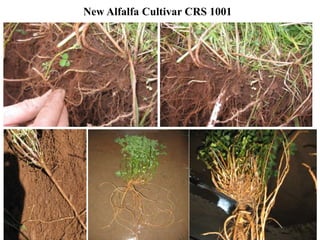
New Alfalfa Cultivar CRS 1001
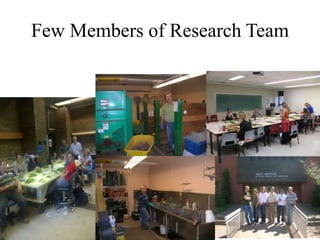
Few Members of Research Team
Holdanca Farms
• Grass based farm in Wallace Bay, NS
• Direct market variety of grass-fed meat products
• Integrated multi-species pasture management key to
our production system
• Eighty percent of product marketed direct to
consumers
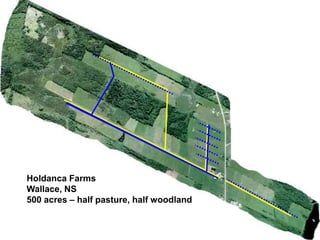
Holdanca Farms
Wallace, NS
500 acres – half pasture, half woodland
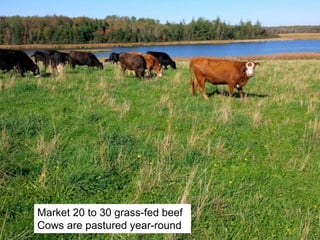
Market 20 to 30 grass-fed beef
Cows are pastured year-round
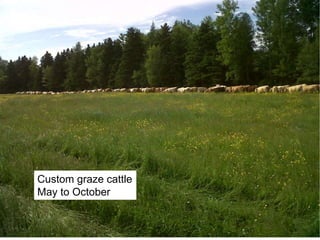
Custom graze cattle
May to October
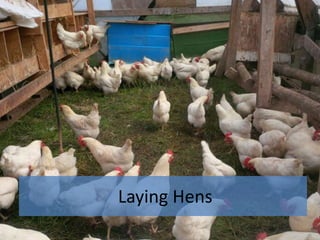
Laying Hens
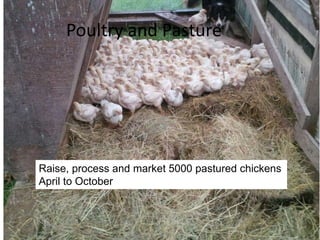
Poultry and Pasture
Raise, process and market 5000 pastured chickens
April to October
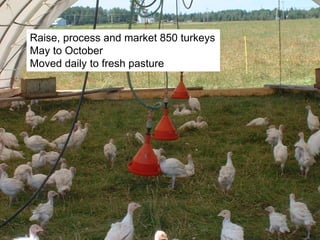
Free range TurkeysRaise, process and market 850 turkeys
May to October
Moved daily to fresh pasture
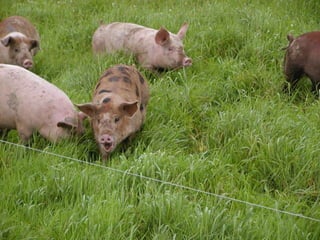
Pigs
Pasture for livestock production
• Needs to be low cost
– Often animals are not productive for much of year
• Lower input/labour
– Often part-time farmers or only part of enterprise
• Productive
= Perennial pasture
Why raise animals on pasture?
• Environmental benefits
• Natural diet for ruminants, part of mono-
gastric diets
• Healthier for us
• Better taste!
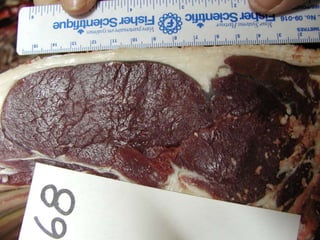
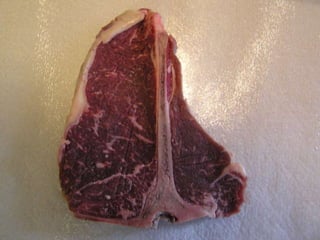
Health benefits of grass-fed meat and eggs
• Higher in vitamin E and A
• Lower saturated fats
• Higher levels of “good” fats including omega-3
fats and conjugated linoleic acid
• Fewer pathogenic bacteria
Environmental benefits of well
managed perennial pasture (partial list)
• Resilient to climate change (weather extremes)
• Builds soil (opposite of erosion)
• Biodiversity (plants, soil life, wildlife)
• Reduce GHG emissions, consume methane
• Carbon sequestration!!!!
21
Diverse forage mixtures yield better than
simple mixtures
• Papadopoulos et al. (2011) research over 5
years on forage mixtures:
– Increasing complexity of mixtures (more grass
types) increased yield of forage
– Timothy and bluegrass in mixtures can
enhance yield of forage
Why do mixtures grow more feed?
• Different grasses grow in different ways, times of year
– Both leaf structure and roots
• Increases use of available sunlight
• Increases use of available fertility and water
• May be synergies with some combinations
• Resilience for weather differences from year to year
22
Value of legumes in pastures
• Nitrogen fixation
• Forage quality – protein
• Maintain digestibility in summer
• Cattle like most legumes (very palatable)
– Will seek them when grazing
23
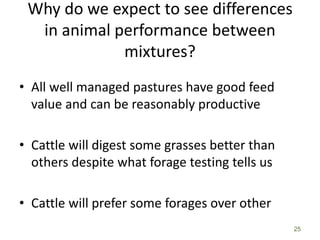
Why do we expect to see differences
in animal performance between
mixtures?
• All well managed pastures have good feed
value and can be reasonably productive
• Cattle will digest some grasses better than
others despite what forage testing tells us
• Cattle will prefer some forages over other
25
26
Beef grazing mixtures project design
Canadian Cattlemen’s Beef Cluster
• Experiment 1: identify the best simple forage
mixtures and grass cultivar (Nappan) for each
environment. Combinations of one grass grown
with either white clover, alfalfa or trefoil.
• forage yield, seasonality, persistence and forage
quality under rotational grazing by cattle (Nappan
and Kapuskasing) or simulated grazing (Quebec
City).
27
Beef grazing mixtures project design
• Experiment 2: Four grass mixtures seeded with either
alfalfa or birdsfoot trefoil (Complex mixtures)
• forage yield, seasonality, persistence and forage quality
• Animal weight gain, grazing days, animal gain per acre
• 4 core animals per treatment group for data collection
Pâturage
2
3
4
5
6
7
8
Coupes fréquentes
RendementenMS(t/ha)
2
3
4
5
6
7
8
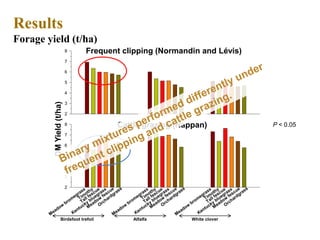
Results
Forage yield (t/ha)
P < 0.05
Frequent clipping (Normandin and Lévis)
Cattle grazing (Nappan)
DMYield(t/ha)
Birdsfoot trefoil Alfalfa White clover
Pâturage
7
8
9
10
11
12
13
14
15
Coupe fréquenteProductionestiméedelait(tlait/ha)
7
8
9
10
11
12
13
14
15
Brom
e des prés
Fléole des prés
Fétuque élevée
Pâturin
des prés
Fétuque des prés
Dactyle pelotonné
Brom
e des prés
Fléole des prés
Fétuque élevée
Pâturin
des prés
Fétuque des prés
Dactyle pelotonné
Brom
e des prés
Fléole des prés
Fétuque élevée
Pâturin
des prés
Fétuque des prés
Dactyle pelotonné
LuzerneLotier corniculé Trèfle blanc
Productionestiméedelait(tlait/ha)
Results
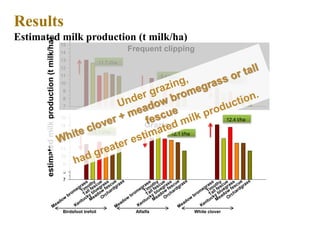
Estimated milk production (t milk/ha)
Frequent clipping
Birdsfoot trefoil Alfalfa White clover
estimatedmilkproduction(tmilk/ha)
11.7 t/ha
9.4 t/ha
8.8 t/ha
11.1 t/ha 12.1 t/ha
12.4 t/ha
Grazing
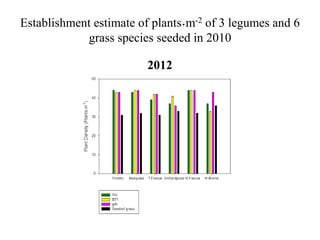
Establishment estimate of plants˖m-2 of 3 legumes and 6
grass species seeded in 2010
2012
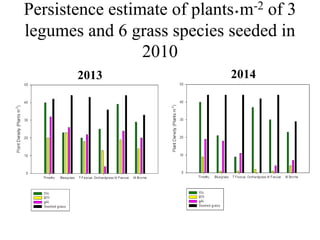
Persistence estimate of plants˖m-2 of 3
legumes and 6 grass species seeded in
2010
2013 2014
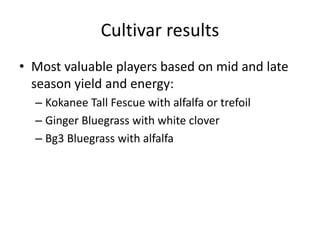
Cultivar results
• Most valuable players based on mid and late
season yield and energy:
– Kokanee Tall Fescue with alfalfa or trefoil
– Ginger Bluegrass with white clover
– Bg3 Bluegrass with alfalfa
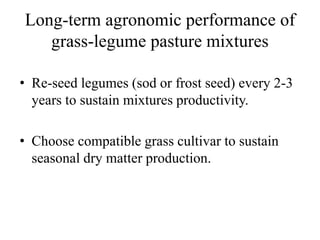
Long-term agronomic performance of
grass-legume pasture mixtures
• Re-seed legumes (sod or frost seed) every 2-3
years to sustain mixtures productivity.
• Choose compatible grass cultivar to sustain
seasonal dry matter production.
0
0.2
0.4
0.6
0.8
1
1.2
2011 2012 2013 2014 2015
Averageanimalgain,Kg/d
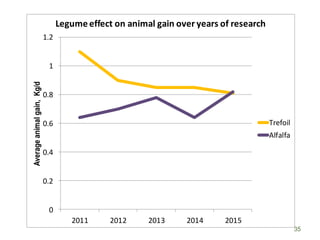
Legume effect on animal gain over years of research
Trefoil
Alfalfa
35
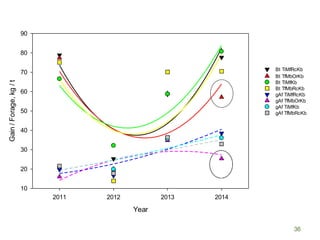
36
Year
2011 2012 2013 2014
Gain/Forage,kg/t
10
20
30
40
50
60
70
80
90
Bt TiMfRcKb
Bt TfMbOrKb
Bt TiMfKb
Bt TfMbRcKb
gAf TiMfRcKb
gAf TfMbOrKb
gAf TiMfKb
gAf TfMbRcKb
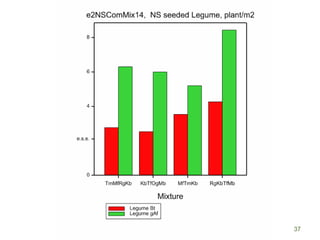
37
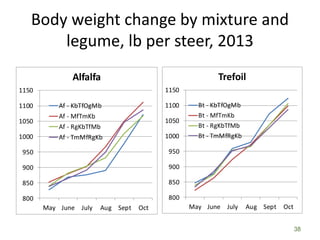
Body weight change by mixture and
legume, lb per steer, 2013
38
800
850
900
950
1000
1050
1100
1150
May June July Aug Sept Oct
Alfalfa
Af - KbTfOgMb
Af - MfTmKb
Af - RgKbTfMb
Af - TmMfRgKb
800
850
900
950
1000
1050
1100
1150
May June July Aug Sept Oct
Trefoil
Bt - KbTfOgMb
Bt - MfTmKb
Bt - RgKbTfMb
Bt - TmMfRgKb
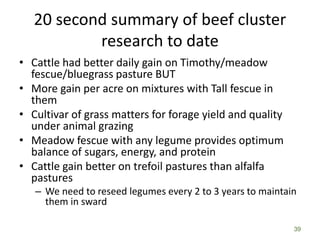
20 second summary of beef cluster
research to date
• Cattle had better daily gain on Timothy/meadow
fescue/bluegrass pasture BUT
• More gain per acre on mixtures with Tall fescue in
them
• Cultivar of grass matters for forage yield and quality
under animal grazing
• Meadow fescue with any legume provides optimum
balance of sugars, energy, and protein
• Cattle gain better on trefoil pastures than alfalfa
pastures
– We need to reseed legumes every 2 to 3 years to maintain
them in sward
39
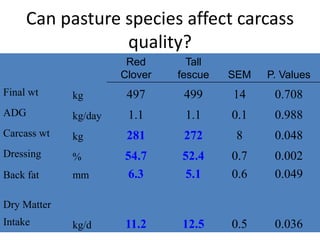
Can pasture species affect carcass
quality?
Red
Clover
Tall
fescue SEM P. Values
Final wt kg 497 499 14 0.708
ADG kg/day 1.1 1.1 0.1 0.988
Carcass wt kg 281 272 8 0.048
Dressing % 54.7 52.4 0.7 0.002
Back fat mm 6.3 5.1 0.6 0.049
Dry Matter
Intake kg/d 11.2 12.5 0.5 0.036
Goals of Extending the Grazing Season
• Reducing Feeding Costs
• Reducing Hauling Costs
• Reducing Harvesting Costs
• Reducing Manure Removal Costs
65 to 75 % of costs of calf production come
from feed, pasture and bedding.
Ranking of beef cattle
best suited to winter grazing
1. Fat dry cow
2. Late lactation bred cow
3. Bred heifer
4. Yearling to background
5. Early lactation cow
6. Weaned calf – not recommended without
supplementation
Environmental effects on
animal energy needs
• Temperature - each species has a lower critical
temperature below which maintenance energy
skyrockets
• Rain/snow – affect body temperature
• Wind – wind chill increases effect of cooler temp.
– In combination with wet weather can significantly
raise energy needs
• Mud – an important consideration in Eastern
Canada
• Distance to walk to water, feed, shelter
What can we do to cope with
environment?
• Make sure animals are in good body condition
going into fall
– fat and hair are great insulators
• Plan extended grazing areas to be in sheltered
places
• Provide artificial shelter
• Plan to fall/winter graze close to barns
45
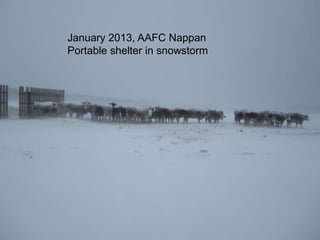
January 2013, AAFC Nappan
Portable shelter in snowstorm
46
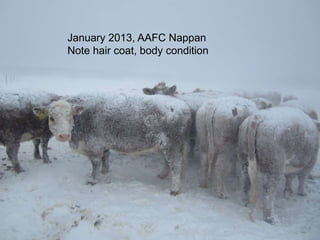
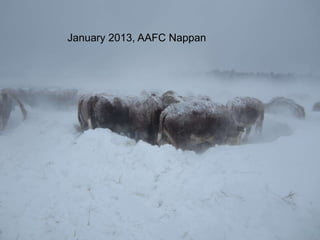
January 2013, AAFC Nappan
Note hair coat, body condition
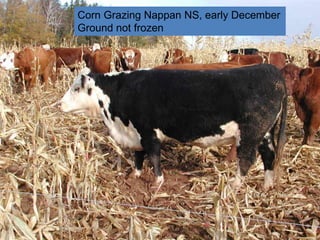
Corn Grazing Nappan NS, early December
Ground not frozen
How to avoid mud in the Maritimes
• Have as much available pasture as possible
– “snowshoe” effect, more root mass
• Move cattle to new ground as often as
possible
– Minimizes damage, spreads manure
• Graze cautiously ESPECIALLY when frost
coming out of the ground
• Fields that have been rotationally grazed
previous season have stronger sod
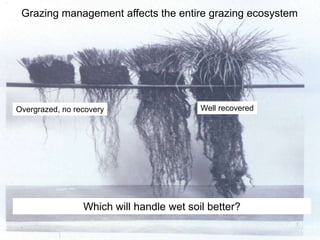
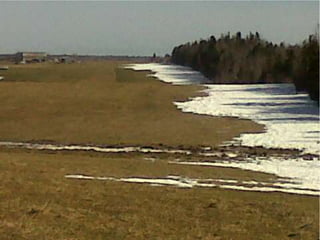
Overgrazed, no recovery Well recovered
Grazing management affects the entire grazing ecosystem
Which will handle wet soil better?
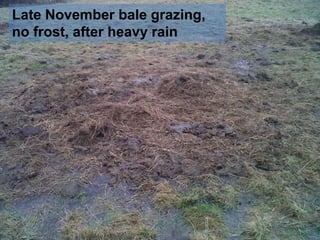
Late November bale grazing,
no frost, after heavy rain
52
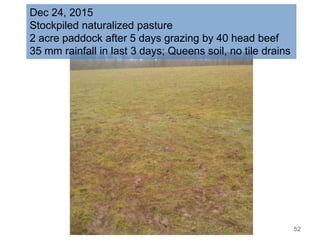
Dec 24, 2015
Stockpiled naturalized pasture
2 acre paddock after 5 days grazing by 40 head beef
35 mm rainfall in last 3 days; Queens soil, no tile drains
53
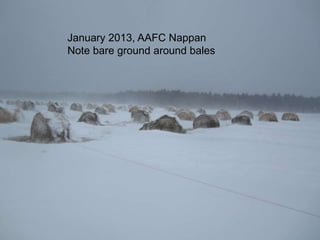
January 2013, AAFC Nappan
Note bare ground around bales
54
January 2013, AAFC Nappan
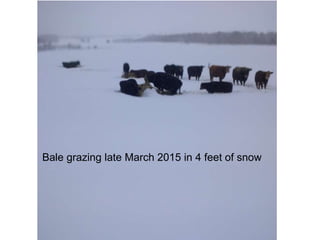
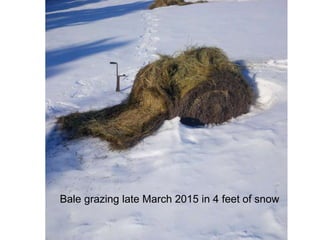
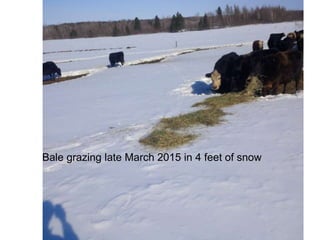
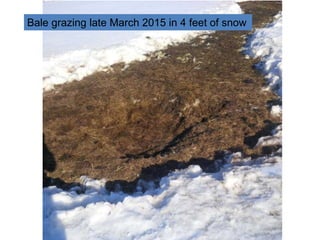
Bale grazing late March 2015 in 4 feet of snow
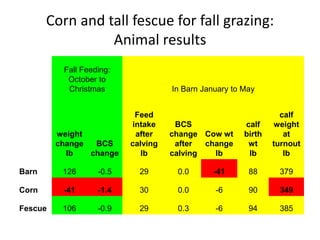
Corn and tall fescue for fall grazing:
Animal results
Fall Feeding:
October to
Christmas In Barn January to May
weight
change
lb
BCS
change
Feed
intake
after
calving
lb
BCS
change
after
calving
Cow wt
change
lb
calf
birth
wt
lb
calf
weight
at
turnout
lb
Barn 126 -0.5 29 0.0 -41 88 379
Corn -41 -1.4 30 0.0 -6 90 349
Fescue 106 -0.9 29 0.3 -6 94 385
44
46
48
50
52
54
56
58
0
2
4
6
8
10
12
14
16
1 2 3 4
TDN(%)
CP(%)anddailyintake(kg)
Day in paddock
dmi
cp
tdn
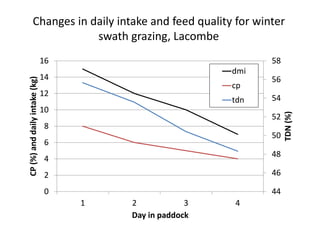
Changes in daily intake and feed quality for winter
swath grazing, Lacombe
0
0.2
0.4
0.6
0.8
1
1.2
1.4
0
1
2
3
4
5
6
7
8
9
1 2 3 4
CPintake(kg/day)
TDNintake(kg/day)
Day in paddock
tdn intake
cp intake
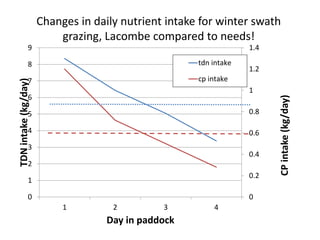
Changes in daily nutrient intake for winter swath
grazing, Lacombe compared to needs!
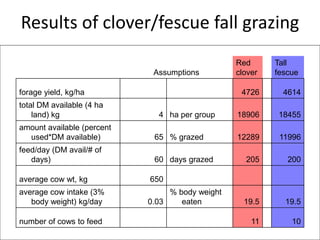
Results of clover/fescue fall grazing
Assumptions
Red
clover
Tall
fescue
forage yield, kg/ha 4726 4614
total DM available (4 ha
land) kg 4 ha per group 18906 18455
amount available (percent
used*DM available) 65 % grazed 12289 11996
feed/day (DM avail/# of
days) 60 days grazed 205 200
average cow wt, kg 650
average cow intake (3%
body weight) kg/day 0.03
% body weight
eaten 19.5 19.5
number of cows to feed 11 10
• Atlantic Canada challenges
– Variable fall weather, frozen ground not reliable
– Winter can has frequent freeze/thaw turning snow
cover into ice
• However, we can have a lot of fall grass growth
with right forage species (fescues, bluegrass)
• To minimize risks, Stockpiled pasture through to
freeze-up, bale graze through to spring
64
Economics study winter grazing in
Maritimes
• Compared 200 days barn feeding (typical
winter season) to 75 days stockpiled feed, 125
days bale graze (some successful use of this on
farms)
• 80 cow-calf herd, spring calving
• $183 saving per cow with winter grazing
65
Conclusion
• When seeding pastures, some grass and
legume species (and cultivars!) are more
suitable than others for pasture
– Some mixtures may be better for finishing
livestock, some for mature animals
• Consider winter grazing to control costs
• Let your animals graze!
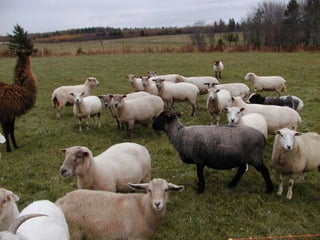
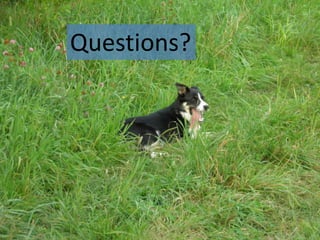
Sheep on pasture
Questions?

L4 forage mixtures

  • 1.
    Forage mixtures, speciesand extended grazing ACORN Conference 2016 John Duynisveld AAFC Nappan/Holdanca Farms
  • 2.
    Beef Nutrition andPasture Management Research Program John Duynisveld • Focus:- Sustainable beef production systems for Eastern Canada • Current Research Interests: – Forage mixtures for long-term pasture productivity. – Management strategies to lower beef production costs by extending the grazing season. – The role of forage bio-active components in livestock production.
  • 3.
    Forage Breeding andAgronomy Yousef A. Papadopoulos • Focus:- The role of forage species & their varieties in modern cropping systems • Current Study Areas: – Exploiting genetic variability to enhance forage productivity and resiliency. – Productive forage legume cultivars for the long-term sustainability under pasture management. – Forage mixtures and nutrient cycling.
  • 4.
  • 5.
    Few Members ofResearch Team
  • 6.
    Holdanca Farms • Grassbased farm in Wallace Bay, NS • Direct market variety of grass-fed meat products • Integrated multi-species pasture management key to our production system • Eighty percent of product marketed direct to consumers
  • 7.
    Holdanca Farms Wallace, NS 500acres – half pasture, half woodland
  • 8.
    Market 20 to30 grass-fed beef Cows are pastured year-round
  • 9.
  • 10.
  • 11.
    Poultry and Pasture Raise,process and market 5000 pastured chickens April to October
  • 13.
    Free range TurkeysRaise,process and market 850 turkeys May to October Moved daily to fresh pasture
  • 14.
  • 15.
    Pasture for livestockproduction • Needs to be low cost – Often animals are not productive for much of year • Lower input/labour – Often part-time farmers or only part of enterprise • Productive = Perennial pasture
  • 16.
    Why raise animalson pasture? • Environmental benefits • Natural diet for ruminants, part of mono- gastric diets • Healthier for us • Better taste!
  • 19.
    Health benefits ofgrass-fed meat and eggs • Higher in vitamin E and A • Lower saturated fats • Higher levels of “good” fats including omega-3 fats and conjugated linoleic acid • Fewer pathogenic bacteria
  • 20.
    Environmental benefits ofwell managed perennial pasture (partial list) • Resilient to climate change (weather extremes) • Builds soil (opposite of erosion) • Biodiversity (plants, soil life, wildlife) • Reduce GHG emissions, consume methane • Carbon sequestration!!!!
  • 21.
    21 Diverse forage mixturesyield better than simple mixtures • Papadopoulos et al. (2011) research over 5 years on forage mixtures: – Increasing complexity of mixtures (more grass types) increased yield of forage – Timothy and bluegrass in mixtures can enhance yield of forage
  • 22.
    Why do mixturesgrow more feed? • Different grasses grow in different ways, times of year – Both leaf structure and roots • Increases use of available sunlight • Increases use of available fertility and water • May be synergies with some combinations • Resilience for weather differences from year to year 22
  • 23.
    Value of legumesin pastures • Nitrogen fixation • Forage quality – protein • Maintain digestibility in summer • Cattle like most legumes (very palatable) – Will seek them when grazing 23
  • 25.
    Why do weexpect to see differences in animal performance between mixtures? • All well managed pastures have good feed value and can be reasonably productive • Cattle will digest some grasses better than others despite what forage testing tells us • Cattle will prefer some forages over other 25
  • 26.
    26 Beef grazing mixturesproject design Canadian Cattlemen’s Beef Cluster • Experiment 1: identify the best simple forage mixtures and grass cultivar (Nappan) for each environment. Combinations of one grass grown with either white clover, alfalfa or trefoil. • forage yield, seasonality, persistence and forage quality under rotational grazing by cattle (Nappan and Kapuskasing) or simulated grazing (Quebec City).
  • 27.
    27 Beef grazing mixturesproject design • Experiment 2: Four grass mixtures seeded with either alfalfa or birdsfoot trefoil (Complex mixtures) • forage yield, seasonality, persistence and forage quality • Animal weight gain, grazing days, animal gain per acre • 4 core animals per treatment group for data collection
  • 28.
    Pâturage 2 3 4 5 6 7 8 Coupes fréquentes RendementenMS(t/ha) 2 3 4 5 6 7 8 Results Forage yield(t/ha) P < 0.05 Frequent clipping (Normandin and Lévis) Cattle grazing (Nappan) DMYield(t/ha) Birdsfoot trefoil Alfalfa White clover
  • 29.
    Pâturage 7 8 9 10 11 12 13 14 15 Coupe fréquenteProductionestiméedelait(tlait/ha) 7 8 9 10 11 12 13 14 15 Brom e després Fléole des prés Fétuque élevée Pâturin des prés Fétuque des prés Dactyle pelotonné Brom e des prés Fléole des prés Fétuque élevée Pâturin des prés Fétuque des prés Dactyle pelotonné Brom e des prés Fléole des prés Fétuque élevée Pâturin des prés Fétuque des prés Dactyle pelotonné LuzerneLotier corniculé Trèfle blanc Productionestiméedelait(tlait/ha) Results Estimated milk production (t milk/ha) Frequent clipping Birdsfoot trefoil Alfalfa White clover estimatedmilkproduction(tmilk/ha) 11.7 t/ha 9.4 t/ha 8.8 t/ha 11.1 t/ha 12.1 t/ha 12.4 t/ha Grazing
  • 30.
    Establishment estimate ofplants˖m-2 of 3 legumes and 6 grass species seeded in 2010 2012
  • 32.
    Persistence estimate ofplants˖m-2 of 3 legumes and 6 grass species seeded in 2010 2013 2014
  • 33.
    Cultivar results • Mostvaluable players based on mid and late season yield and energy: – Kokanee Tall Fescue with alfalfa or trefoil – Ginger Bluegrass with white clover – Bg3 Bluegrass with alfalfa
  • 34.
    Long-term agronomic performanceof grass-legume pasture mixtures • Re-seed legumes (sod or frost seed) every 2-3 years to sustain mixtures productivity. • Choose compatible grass cultivar to sustain seasonal dry matter production.
  • 35.
    0 0.2 0.4 0.6 0.8 1 1.2 2011 2012 20132014 2015 Averageanimalgain,Kg/d Legume effect on animal gain over years of research Trefoil Alfalfa 35
  • 36.
    36 Year 2011 2012 20132014 Gain/Forage,kg/t 10 20 30 40 50 60 70 80 90 Bt TiMfRcKb Bt TfMbOrKb Bt TiMfKb Bt TfMbRcKb gAf TiMfRcKb gAf TfMbOrKb gAf TiMfKb gAf TfMbRcKb
  • 37.
  • 38.
    Body weight changeby mixture and legume, lb per steer, 2013 38 800 850 900 950 1000 1050 1100 1150 May June July Aug Sept Oct Alfalfa Af - KbTfOgMb Af - MfTmKb Af - RgKbTfMb Af - TmMfRgKb 800 850 900 950 1000 1050 1100 1150 May June July Aug Sept Oct Trefoil Bt - KbTfOgMb Bt - MfTmKb Bt - RgKbTfMb Bt - TmMfRgKb
  • 39.
    20 second summaryof beef cluster research to date • Cattle had better daily gain on Timothy/meadow fescue/bluegrass pasture BUT • More gain per acre on mixtures with Tall fescue in them • Cultivar of grass matters for forage yield and quality under animal grazing • Meadow fescue with any legume provides optimum balance of sugars, energy, and protein • Cattle gain better on trefoil pastures than alfalfa pastures – We need to reseed legumes every 2 to 3 years to maintain them in sward 39
  • 40.
    Can pasture speciesaffect carcass quality? Red Clover Tall fescue SEM P. Values Final wt kg 497 499 14 0.708 ADG kg/day 1.1 1.1 0.1 0.988 Carcass wt kg 281 272 8 0.048 Dressing % 54.7 52.4 0.7 0.002 Back fat mm 6.3 5.1 0.6 0.049 Dry Matter Intake kg/d 11.2 12.5 0.5 0.036
  • 41.
    Goals of Extendingthe Grazing Season • Reducing Feeding Costs • Reducing Hauling Costs • Reducing Harvesting Costs • Reducing Manure Removal Costs 65 to 75 % of costs of calf production come from feed, pasture and bedding.
  • 42.
    Ranking of beefcattle best suited to winter grazing 1. Fat dry cow 2. Late lactation bred cow 3. Bred heifer 4. Yearling to background 5. Early lactation cow 6. Weaned calf – not recommended without supplementation
  • 43.
    Environmental effects on animalenergy needs • Temperature - each species has a lower critical temperature below which maintenance energy skyrockets • Rain/snow – affect body temperature • Wind – wind chill increases effect of cooler temp. – In combination with wet weather can significantly raise energy needs • Mud – an important consideration in Eastern Canada • Distance to walk to water, feed, shelter
  • 44.
    What can wedo to cope with environment? • Make sure animals are in good body condition going into fall – fat and hair are great insulators • Plan extended grazing areas to be in sheltered places • Provide artificial shelter • Plan to fall/winter graze close to barns
  • 45.
    45 January 2013, AAFCNappan Portable shelter in snowstorm
  • 46.
    46 January 2013, AAFCNappan Note hair coat, body condition
  • 47.
    Corn Grazing NappanNS, early December Ground not frozen
  • 49.
    How to avoidmud in the Maritimes • Have as much available pasture as possible – “snowshoe” effect, more root mass • Move cattle to new ground as often as possible – Minimizes damage, spreads manure • Graze cautiously ESPECIALLY when frost coming out of the ground • Fields that have been rotationally grazed previous season have stronger sod
  • 50.
    Overgrazed, no recoveryWell recovered Grazing management affects the entire grazing ecosystem Which will handle wet soil better?
  • 51.
    Late November balegrazing, no frost, after heavy rain
  • 52.
    52 Dec 24, 2015 Stockpilednaturalized pasture 2 acre paddock after 5 days grazing by 40 head beef 35 mm rainfall in last 3 days; Queens soil, no tile drains
  • 53.
    53 January 2013, AAFCNappan Note bare ground around bales
  • 54.
  • 56.
    Bale grazing lateMarch 2015 in 4 feet of snow
  • 57.
    Bale grazing lateMarch 2015 in 4 feet of snow
  • 58.
    Bale grazing lateMarch 2015 in 4 feet of snow
  • 59.
    Bale grazing lateMarch 2015 in 4 feet of snow
  • 60.
    Corn and tallfescue for fall grazing: Animal results Fall Feeding: October to Christmas In Barn January to May weight change lb BCS change Feed intake after calving lb BCS change after calving Cow wt change lb calf birth wt lb calf weight at turnout lb Barn 126 -0.5 29 0.0 -41 88 379 Corn -41 -1.4 30 0.0 -6 90 349 Fescue 106 -0.9 29 0.3 -6 94 385
  • 61.
    44 46 48 50 52 54 56 58 0 2 4 6 8 10 12 14 16 1 2 34 TDN(%) CP(%)anddailyintake(kg) Day in paddock dmi cp tdn Changes in daily intake and feed quality for winter swath grazing, Lacombe
  • 62.
    0 0.2 0.4 0.6 0.8 1 1.2 1.4 0 1 2 3 4 5 6 7 8 9 1 2 34 CPintake(kg/day) TDNintake(kg/day) Day in paddock tdn intake cp intake Changes in daily nutrient intake for winter swath grazing, Lacombe compared to needs!
  • 63.
    Results of clover/fescuefall grazing Assumptions Red clover Tall fescue forage yield, kg/ha 4726 4614 total DM available (4 ha land) kg 4 ha per group 18906 18455 amount available (percent used*DM available) 65 % grazed 12289 11996 feed/day (DM avail/# of days) 60 days grazed 205 200 average cow wt, kg 650 average cow intake (3% body weight) kg/day 0.03 % body weight eaten 19.5 19.5 number of cows to feed 11 10
  • 64.
    • Atlantic Canadachallenges – Variable fall weather, frozen ground not reliable – Winter can has frequent freeze/thaw turning snow cover into ice • However, we can have a lot of fall grass growth with right forage species (fescues, bluegrass) • To minimize risks, Stockpiled pasture through to freeze-up, bale graze through to spring 64
  • 65.
    Economics study wintergrazing in Maritimes • Compared 200 days barn feeding (typical winter season) to 75 days stockpiled feed, 125 days bale graze (some successful use of this on farms) • 80 cow-calf herd, spring calving • $183 saving per cow with winter grazing 65
  • 66.
    Conclusion • When seedingpastures, some grass and legume species (and cultivars!) are more suitable than others for pasture – Some mixtures may be better for finishing livestock, some for mature animals • Consider winter grazing to control costs • Let your animals graze!
  • 67.