Identifying Your Soil for Rain Gardens

                                               Background
 Activity Overview                             Determining the soil type for your proposed rain garden is an important
 Students identify soil type at their          factor for calculating its size. Two other factors needed to size a garden are
 proposed rain garden location(s) using
                                               drainage area and percent slope. Together these three factors give you the
 a soil texture feel test key.
                                               square footage needed to collect and infiltrate 100% of the rain water that
 Objectives                                    falls in the drainage area. The type of soil influences the size and depth of the
 Students will:                                garden area. If the soil is sandy, rain gardens can be smaller and deeper be-
 •   Manipulate and feel soil to clas-         cause water drains quickly. If the soil has more clay, the garden will need to
     sify soils by texture using a key         be larger and shallower because water drains more slowly. It is important to
 •   Understand the relationship               allow water to drain quickly so that mosquitoes will not complete their life
     between soil particle size and            cycle from egg to insect. Determining soil type, drainage area and slope will
     water movement through soils              ensure that water will soak into the garden within 6 to 12 hours.
 •   Compare the composition of
     soil types                                There are several methods to identify the type of soil in your proposed rain
                                               garden. It is not necessary to use expensive equipment to analyze your soil
 Subjects Covered                              type; simply feeling the soil with your hands is adequate. If interested in
 Science
                                               learning more about your soil, such as its fertility, you can have your soil
 Grades                                        tested. It is also possible to test water flow through your soil to determine
 K through 12                                  soil type. This soil test is described in Earth Partnership for Schools activity,
                                               “Infiltration Test: Exploring the Flow of Water Through Soils.”
 Activity Time
 1 hour
                                               What is soil type?
 Season                                        Soil is made up of three particle sizes—sand, silt, and clay. Sand is the largest
 Any                                           particle (0.05 to 2 mm diameter); silt is intermediate (0.05 to 0.002 mm);
                                               and clay is the smallest (less than 0.002 mm). Soils have different textures
 Materials                                     depending upon the proportions of sand, silt, or clay particles in the soil.
 Soil samples, spray bottles of water,
 paper toweling, Key to Soil Texture by        A soil texture is graded into 14 texture classes or types such as sand, sandy
 Feel                                          loam, silty clay loam, loam, sandy clay, or clay. Sandy soil is any mix with
                                               over 90% sand; sandy loam is 70% sand, 15% silt, and 15% clay; clay soil
 State Standards                               is 50% clay, 25% silt, and 25 % sand; heavy clay is any mix with over 60%
 Science: C.4.2, C.4.3, C.4.4, C.4.5,
 C.4.7, C.4.8, C.8.1, C.8.2, C.8.4,
                                               clay particles.
 C.8.5, C.8.7, C.8.9, C.8.10, C.8.11,
 C.12.1, C.12.2, C.12.3, C.12.5,               The texture of the soil influences the moisture holding capacity of soil, the
 C.12.6, D.4.1, D.4.2, E.4.1, E.4.2,           drainage rate, and the soil’s ability to hold nutrients. Coarse, sandy soils
 E.4.3, E.8.3, E.8.4, F.4.4                    drain water quickly, are poor storehouses of nutrients, and create droughty
                                               conditions for plants. In clay soils water drains slowly; as a result, soil re-
                                               mains wet for long periods and often hinders root development. Plants
                                               growing in clay must be able to tolerate long periods of excessive moisture
                                               with low oxygen conditions, or endure dry, hard soil. The medium texture
                                               of silt-sized particles creates a loamy soil that is well drained and holds nutri-
                                               ents. It is ideal for most plant growth.

                                               Soils can be classified into texture classes or types by the way they feel and
                                               respond to handling. Sand feels gritty and the grains do not stick together
                                               when squeezed. Silt feels velvety or flour-like when dry and forms a weak
                                               ribbon when wet. Pulverized dry clay feels smooth; aggregates and clods are
© Earth   Partnership for Schools • University of Wisconsin – Madison Arboretum                           Perform Site Analysis 2-3
Identifying Your Soil for Rain Gardens (cont.)

                     very hard and difficult to crush by hand. Wet clay feels sticky or very smooth and satin-like when
                     rubbed and forms a long, flexible ribbon.

                     Where does organic matter fit into the soil mix?
                     Organic matter is the biological components of the soil. Organic matter is either decomposed
                     material or material in the process of decomposition; or fresh organic material; or living organ-
                     isms. Organic material plays vital roles in the soil. It acts like a sponge, being able to absorb six
                     times its weight in water. It holds on to nutrients that would otherwise wash away. Organic mat-
                     ter loosens heavy clay soil by creating spaces for air and water movement. Also, it adds nutrients
                     such as nitrogen, phosphorus, potassium, and carbon.

                     You will notice over time that your rain garden will drain water more quickly. That is because the
                     plants have a tremendous ability to infiltrate more water than soil alone. The deep-rooted plants
                     encourage infiltration two ways. First, the long roots create channels that direct water down into
                     the ground. Second, they slough one third of their roots each year, adding organic matter to the
                     garden. Additionally, the plant roots have a great capacity to absorb water that will eventually
                     transpire from the leaves and stems.


                     Activity Description
                     Collect soil samples from proposed rain garden locations on the school grounds. Collect one and
                     one-half cups of soil per sample for your classroom. Place about two teaspoons of soil in your
                     hand. Spray enough water from a spray bottle to moisten the soil to form a ball. Next, use the
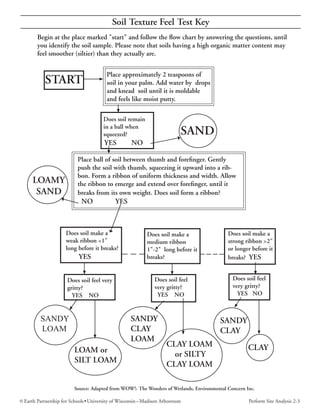
                     soil texture feel test key to determine soil type. The step-by-step directions on the key will guide
                     you through the process of soil identification. As a warm-up exercise, practice determining soil
                     type with samples that are clearly comprised of sand, silt, or clay.


                     Extensions
                     • Soil textures vary from one horizon (soil layer) to the next; therefore, try to determine the
                       texture in each of the A, B, and C horizons. Learning the soil texture of each horizon will help
                       you assess the soil’s permeability at different levels. In some soils, the water drains quickly in
                       the topsoil but drains poorly in subsoil. See Earth Partnership for Schools activity, “Soil Pro-
                       file Investigations 3-12,” for more information about soil horizons.
                     • Take soil samples in the schoolyard, and send samples to a soil testing lab for professional test-
                       ing and analysis.
                     • Determine soil type using a soil texture triangle to determine percentages of sand, silt, and
                       clay in a soil sample.
                     • Classify and compare soil texture at different locations on a slope or in eroded areas. Which
                       particles collect at the base of the slope or remain on top? Which particles erode first? Is the
                       pattern similar to particle movement on a slope? Can you predict which soils are more suscep-
                       tible to erosion?


© Earth Partnership for Schools • University of Wisconsin – Madison Arboretum                       Perform Site Analysis 2-3
Identifying Your Soil for Rain Gardens (cont.)

                     Additional Resources
                     • Hole, F. (1976). Soils of Wisconsin. Madison, WI: The University of Wisconsin Press.
                     • Kesselheim, A.S., Slattery, B.E. (1995). WOW! The wonders of wetlands. St Michaels, MD:
                       Environmental Concern Inc.
                     • Lynn, B. (1988). Discover wetlands: A curriculum guide. Olympia, WA: Washington State De-
                       partment of Ecology Publications Office.
                     • Mitsch, W. J., Gosselink, J. G. (1993). Wetlands, 2nd ed. New York, N.Y.: Van Nostrand Re-
                       inhold.
                     • Project WILD. (1992). Aquatic project WILD. Bethesda, MD: Western Regional Environmen-
                       tal Education Council.

                     Assessments
                     • Explain how soil is classified and describe two to three properties of each soil textural type.
                     • Explain the relationship between soil particle size, plant growth, and water.
                     • Determine the soil texture of three soil samples.


© Earth Partnership for Schools • University of Wisconsin – Madison Arboretum                      Perform Site Analysis 2-3
Soil Texture Feel Test Key
        Begin at the place marked "start" and follow the flow chart by answering the questions, until
        you identify the soil sample. Please note that soils having a high organic matter content may
        feel smoother (siltier) than they actually are.


                                         Place approximately 2 teaspoons of
            START                        soil in your palm. Add water by drops
                                         and knead soil until it is moldable
                                         and feels like moist putty.

                                        Does soil remain
                                        in a ball when
                                        squeezed?                           SAND
                                        YES          NO

                           Place ball of soil between thumb and forefinger. Gently
                           push the soil with thumb, squeezing it upward into a rib-
                           bon. Form a ribbon of uniform thickness and width. Allow
      LOAMY                the ribbon to emerge and extend over forefinger, until it
       SAND                breaks from its own weight. Does soil form a ribbon?
                             NO              YES


                      Does soil make a                      Does soil make a                Does soil make a
                      weak ribbon <1"                       medium ribbon                   strong ribbon >2"
                      long before it breaks?                1"-2" long before it            or longer before it
                            YES                             breaks?                         breaks? YES


                      Does soil feel very                       Does soil feel                Does soil feel
                      gritty?                                   very gritty?                  very gritty?
                        YES NO                                   YES NO                         YES NO


         SANDY                                       SANDY                               SANDY
         LOAM                                        CLAY                                CLAY
                                                     LOAM
                                                                      CLAY LOAM                      CLAY
                          LOAM or                                       or SILTY
                          SILT LOAM                                   CLAY LOAM

                          Source: Adapted from WOW!: The Wonders of Wetlands, Environmental Concern Inc.

© Earth Partnership for Schools • University of Wisconsin – Madison Arboretum                        Perform Site Analysis 2-3

Identifying Your Soil for Rain Gardens

  • 1.
    Identifying Your Soilfor Rain Gardens Background Activity Overview Determining the soil type for your proposed rain garden is an important Students identify soil type at their factor for calculating its size. Two other factors needed to size a garden are proposed rain garden location(s) using drainage area and percent slope. Together these three factors give you the a soil texture feel test key. square footage needed to collect and infiltrate 100% of the rain water that Objectives falls in the drainage area. The type of soil influences the size and depth of the Students will: garden area. If the soil is sandy, rain gardens can be smaller and deeper be- • Manipulate and feel soil to clas- cause water drains quickly. If the soil has more clay, the garden will need to sify soils by texture using a key be larger and shallower because water drains more slowly. It is important to • Understand the relationship allow water to drain quickly so that mosquitoes will not complete their life between soil particle size and cycle from egg to insect. Determining soil type, drainage area and slope will water movement through soils ensure that water will soak into the garden within 6 to 12 hours. • Compare the composition of soil types There are several methods to identify the type of soil in your proposed rain garden. It is not necessary to use expensive equipment to analyze your soil Subjects Covered type; simply feeling the soil with your hands is adequate. If interested in Science learning more about your soil, such as its fertility, you can have your soil Grades tested. It is also possible to test water flow through your soil to determine K through 12 soil type. This soil test is described in Earth Partnership for Schools activity, “Infiltration Test: Exploring the Flow of Water Through Soils.” Activity Time 1 hour What is soil type? Season Soil is made up of three particle sizes—sand, silt, and clay. Sand is the largest Any particle (0.05 to 2 mm diameter); silt is intermediate (0.05 to 0.002 mm); and clay is the smallest (less than 0.002 mm). Soils have different textures Materials depending upon the proportions of sand, silt, or clay particles in the soil. Soil samples, spray bottles of water, paper toweling, Key to Soil Texture by A soil texture is graded into 14 texture classes or types such as sand, sandy Feel loam, silty clay loam, loam, sandy clay, or clay. Sandy soil is any mix with over 90% sand; sandy loam is 70% sand, 15% silt, and 15% clay; clay soil State Standards is 50% clay, 25% silt, and 25 % sand; heavy clay is any mix with over 60% Science: C.4.2, C.4.3, C.4.4, C.4.5, C.4.7, C.4.8, C.8.1, C.8.2, C.8.4, clay particles. C.8.5, C.8.7, C.8.9, C.8.10, C.8.11, C.12.1, C.12.2, C.12.3, C.12.5, The texture of the soil influences the moisture holding capacity of soil, the C.12.6, D.4.1, D.4.2, E.4.1, E.4.2, drainage rate, and the soil’s ability to hold nutrients. Coarse, sandy soils E.4.3, E.8.3, E.8.4, F.4.4 drain water quickly, are poor storehouses of nutrients, and create droughty conditions for plants. In clay soils water drains slowly; as a result, soil re- mains wet for long periods and often hinders root development. Plants growing in clay must be able to tolerate long periods of excessive moisture with low oxygen conditions, or endure dry, hard soil. The medium texture of silt-sized particles creates a loamy soil that is well drained and holds nutri- ents. It is ideal for most plant growth. Soils can be classified into texture classes or types by the way they feel and respond to handling. Sand feels gritty and the grains do not stick together when squeezed. Silt feels velvety or flour-like when dry and forms a weak ribbon when wet. Pulverized dry clay feels smooth; aggregates and clods are © Earth Partnership for Schools • University of Wisconsin – Madison Arboretum Perform Site Analysis 2-3
  • 2.
    Identifying Your Soilfor Rain Gardens (cont.) very hard and difficult to crush by hand. Wet clay feels sticky or very smooth and satin-like when rubbed and forms a long, flexible ribbon. Where does organic matter fit into the soil mix? Organic matter is the biological components of the soil. Organic matter is either decomposed material or material in the process of decomposition; or fresh organic material; or living organ- isms. Organic material plays vital roles in the soil. It acts like a sponge, being able to absorb six times its weight in water. It holds on to nutrients that would otherwise wash away. Organic mat- ter loosens heavy clay soil by creating spaces for air and water movement. Also, it adds nutrients such as nitrogen, phosphorus, potassium, and carbon. You will notice over time that your rain garden will drain water more quickly. That is because the plants have a tremendous ability to infiltrate more water than soil alone. The deep-rooted plants encourage infiltration two ways. First, the long roots create channels that direct water down into the ground. Second, they slough one third of their roots each year, adding organic matter to the garden. Additionally, the plant roots have a great capacity to absorb water that will eventually transpire from the leaves and stems. Activity Description Collect soil samples from proposed rain garden locations on the school grounds. Collect one and one-half cups of soil per sample for your classroom. Place about two teaspoons of soil in your hand. Spray enough water from a spray bottle to moisten the soil to form a ball. Next, use the soil texture feel test key to determine soil type. The step-by-step directions on the key will guide you through the process of soil identification. As a warm-up exercise, practice determining soil type with samples that are clearly comprised of sand, silt, or clay. Extensions • Soil textures vary from one horizon (soil layer) to the next; therefore, try to determine the texture in each of the A, B, and C horizons. Learning the soil texture of each horizon will help you assess the soil’s permeability at different levels. In some soils, the water drains quickly in the topsoil but drains poorly in subsoil. See Earth Partnership for Schools activity, “Soil Pro- file Investigations 3-12,” for more information about soil horizons. • Take soil samples in the schoolyard, and send samples to a soil testing lab for professional test- ing and analysis. • Determine soil type using a soil texture triangle to determine percentages of sand, silt, and clay in a soil sample. • Classify and compare soil texture at different locations on a slope or in eroded areas. Which particles collect at the base of the slope or remain on top? Which particles erode first? Is the pattern similar to particle movement on a slope? Can you predict which soils are more suscep- tible to erosion? © Earth Partnership for Schools • University of Wisconsin – Madison Arboretum Perform Site Analysis 2-3
  • 3.
    Identifying Your Soilfor Rain Gardens (cont.) Additional Resources • Hole, F. (1976). Soils of Wisconsin. Madison, WI: The University of Wisconsin Press. • Kesselheim, A.S., Slattery, B.E. (1995). WOW! The wonders of wetlands. St Michaels, MD: Environmental Concern Inc. • Lynn, B. (1988). Discover wetlands: A curriculum guide. Olympia, WA: Washington State De- partment of Ecology Publications Office. • Mitsch, W. J., Gosselink, J. G. (1993). Wetlands, 2nd ed. New York, N.Y.: Van Nostrand Re- inhold. • Project WILD. (1992). Aquatic project WILD. Bethesda, MD: Western Regional Environmen- tal Education Council. Assessments • Explain how soil is classified and describe two to three properties of each soil textural type. • Explain the relationship between soil particle size, plant growth, and water. • Determine the soil texture of three soil samples. © Earth Partnership for Schools • University of Wisconsin – Madison Arboretum Perform Site Analysis 2-3
  • 4.
    Soil Texture FeelTest Key Begin at the place marked "start" and follow the flow chart by answering the questions, until you identify the soil sample. Please note that soils having a high organic matter content may feel smoother (siltier) than they actually are. Place approximately 2 teaspoons of START soil in your palm. Add water by drops and knead soil until it is moldable and feels like moist putty. Does soil remain in a ball when squeezed? SAND YES NO Place ball of soil between thumb and forefinger. Gently push the soil with thumb, squeezing it upward into a rib- bon. Form a ribbon of uniform thickness and width. Allow LOAMY the ribbon to emerge and extend over forefinger, until it SAND breaks from its own weight. Does soil form a ribbon? NO YES Does soil make a Does soil make a Does soil make a weak ribbon <1" medium ribbon strong ribbon >2" long before it breaks? 1"-2" long before it or longer before it YES breaks? breaks? YES Does soil feel very Does soil feel Does soil feel gritty? very gritty? very gritty? YES NO YES NO YES NO SANDY SANDY SANDY LOAM CLAY CLAY LOAM CLAY LOAM CLAY LOAM or or SILTY SILT LOAM CLAY LOAM Source: Adapted from WOW!: The Wonders of Wetlands, Environmental Concern Inc. © Earth Partnership for Schools • University of Wisconsin – Madison Arboretum Perform Site Analysis 2-3