A transdiagnostic approach to
Mikhail A.Vrubel, 1890
OUTLINE
Mikhail A.Vrubel, 1890
Prevalences Subtypes
Cognition &
Perception
Imaging Treatment
I. Levitan, 1899
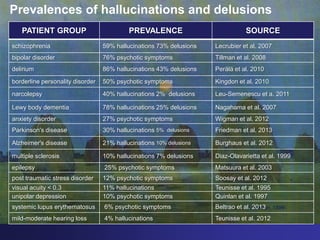
Prevalences of hallucinations and delusions
PATIENT GROUP PREVALENCE SOURCE
schizophrenia 59% hallucinations 73% delusions Lecrubier et al. 2007
bipolar disorder 76% psychotic symptoms Tillman et al. 2008
delirium 86% hallucinations 43% delusions Perälä et al. 2010
borderline personality disorder 50% psychotic symptoms Kingdon et al. 2010
narcolepsy 40% hallucinations 2% delusions Leu-Semenescu et a. 2011
Lewy body dementia 78% hallucinations 25% delusions Nagahama et al. 2007
anxiety disorder 27% psychotic symptoms Wigman et al. 2012
Parkinson's disease 30% hallucinations 5% delusions Friedman et al. 2013
Alzheimer's disease 21% hallucinations 10% delusions Burghaus et al. 2012
multiple sclerosis 10% hallucinations 7% delusions Diaz-Olavarietta et al. 1999
epilepsy 25% psychotic symptoms Matsuura et al. 2003
post traumatic stress disorder 12% psychotic symptoms Soosay et al. 2012
visual acuity < 0.3 11% hallucinations Teunisse et al. 1995
unipolar depression 10% psychotic symptoms Quinlan et al. 1997
systemic lupus erythematosus 6% psychotic symptoms Beltrao et al. 2013
mild-moderate hearing loss 4% hallucinations Teunisse et al. 2012
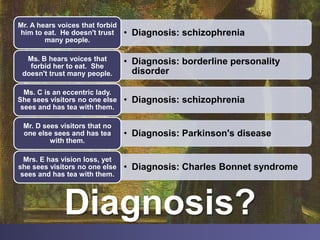
Diagnosis?
• Diagnosis: schizophrenia
Mr. A hears voices that forbid
him to eat. He doesn't trust
many people.
• Diagnosis: borderline personality
disorder
Ms. B hears voices that
forbid her to eat. She
doesn't trust many people.
• Diagnosis: schizophrenia
Ms. C is an eccentric lady.
She sees visitors no one else
sees and has tea with them.
• Diagnosis: Parkinson's disease
Mr. D sees visitors that no
one else sees and has tea
with them.
• Diagnosis: Charles Bonnet syndrome
Mrs. E has vision loss, yet
she sees visitors no one else
sees and has tea with them.
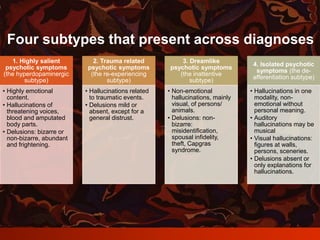
Formele denkstoornissenFour subtypes that present across diagnoses
1. Highly salient
psychotic symptoms
(the hyperdopaminergic
subtype)
• Highly emotional
content.
• Hallucinations of
threatening voices,
blood and amputated
body parts.
• Delusions: bizarre or
non-bizarre, abundant
and frightening.
2. Trauma related
psychotic symptoms
(the re-experiencing
subtype)
• Hallucinations related
to traumatic events.
• Delusions mild or
absent, except for a
general distrust.
3. Dreamlike
psychotic symptoms
(the inattentive
subtype)
• Non-emotional
hallucinations, mainly
visual, of persons/
animals.
• Delusions: non-
bizarre:
misidentification,
spousal infidelity,
theft, Capgras
syndrome.
4. Isolated psychotic
symptoms (the de-
afferentiation subtype)
• Hallucinations in one
modality, non-
emotional without
personal meaning.
• Auditory
hallucinations may be
musical
• Visual hallucinations:
figures at walls,
persons, sceneries.
• Delusions absent or
only explanations for
hallucinations.
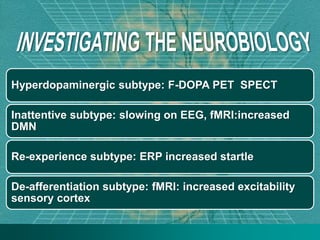
Hyperdopaminergic subtype: F-DOPA PET SPECT
Inattentive subtype: slowing on EEG, fMRI:increased
DMN
Re-experience subtype: ERP increased startle
De-afferentiation subtype: fMRI: increased excitability
sensory cortex
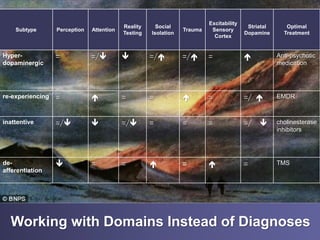
Subtype Perception Attention
Reality
Testing
Social
Isolation
Trauma
Excitability
Sensory
Cortex
Striatal
Dopamine
Optimal
Treatment
Hyper-
dopaminergic
= =/  =/ =/ =  Anti-psychotic
medication
re-experiencing =  = =  = =/  EMDR
inattentive =/  =/ = = = =/  cholinesterase
inhibitors
de-
afferentiation
 = =  =  = TMS
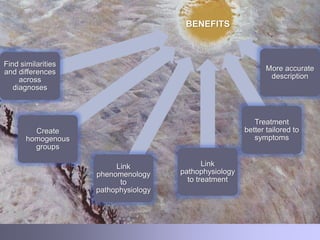
Working with Domains Instead of Diagnoses
BENEFITS
Find similarities
and differences
across
diagnoses
Create
homogenous
groups
Link
phenomenology
to
pathophysiology
Link
pathophysiology
to treatment
More accurate
description
Treatment
better tailored to
symptoms

Hallucinations transdiagnostic

  • 1.
    A transdiagnostic approachto Mikhail A.Vrubel, 1890
  • 2.
    OUTLINE Mikhail A.Vrubel, 1890 PrevalencesSubtypes Cognition & Perception Imaging Treatment
  • 3.
    I. Levitan, 1899 Prevalencesof hallucinations and delusions PATIENT GROUP PREVALENCE SOURCE schizophrenia 59% hallucinations 73% delusions Lecrubier et al. 2007 bipolar disorder 76% psychotic symptoms Tillman et al. 2008 delirium 86% hallucinations 43% delusions Perälä et al. 2010 borderline personality disorder 50% psychotic symptoms Kingdon et al. 2010 narcolepsy 40% hallucinations 2% delusions Leu-Semenescu et a. 2011 Lewy body dementia 78% hallucinations 25% delusions Nagahama et al. 2007 anxiety disorder 27% psychotic symptoms Wigman et al. 2012 Parkinson's disease 30% hallucinations 5% delusions Friedman et al. 2013 Alzheimer's disease 21% hallucinations 10% delusions Burghaus et al. 2012 multiple sclerosis 10% hallucinations 7% delusions Diaz-Olavarietta et al. 1999 epilepsy 25% psychotic symptoms Matsuura et al. 2003 post traumatic stress disorder 12% psychotic symptoms Soosay et al. 2012 visual acuity < 0.3 11% hallucinations Teunisse et al. 1995 unipolar depression 10% psychotic symptoms Quinlan et al. 1997 systemic lupus erythematosus 6% psychotic symptoms Beltrao et al. 2013 mild-moderate hearing loss 4% hallucinations Teunisse et al. 2012
  • 4.
    Diagnosis? • Diagnosis: schizophrenia Mr.A hears voices that forbid him to eat. He doesn't trust many people. • Diagnosis: borderline personality disorder Ms. B hears voices that forbid her to eat. She doesn't trust many people. • Diagnosis: schizophrenia Ms. C is an eccentric lady. She sees visitors no one else sees and has tea with them. • Diagnosis: Parkinson's disease Mr. D sees visitors that no one else sees and has tea with them. • Diagnosis: Charles Bonnet syndrome Mrs. E has vision loss, yet she sees visitors no one else sees and has tea with them.
  • 5.
    Formele denkstoornissenFour subtypesthat present across diagnoses 1. Highly salient psychotic symptoms (the hyperdopaminergic subtype) • Highly emotional content. • Hallucinations of threatening voices, blood and amputated body parts. • Delusions: bizarre or non-bizarre, abundant and frightening. 2. Trauma related psychotic symptoms (the re-experiencing subtype) • Hallucinations related to traumatic events. • Delusions mild or absent, except for a general distrust. 3. Dreamlike psychotic symptoms (the inattentive subtype) • Non-emotional hallucinations, mainly visual, of persons/ animals. • Delusions: non- bizarre: misidentification, spousal infidelity, theft, Capgras syndrome. 4. Isolated psychotic symptoms (the de- afferentiation subtype) • Hallucinations in one modality, non- emotional without personal meaning. • Auditory hallucinations may be musical • Visual hallucinations: figures at walls, persons, sceneries. • Delusions absent or only explanations for hallucinations.
  • 6.
    Hyperdopaminergic subtype: F-DOPAPET SPECT Inattentive subtype: slowing on EEG, fMRI:increased DMN Re-experience subtype: ERP increased startle De-afferentiation subtype: fMRI: increased excitability sensory cortex
  • 7.
    Subtype Perception Attention Reality Testing Social Isolation Trauma Excitability Sensory Cortex Striatal Dopamine Optimal Treatment Hyper- dopaminergic ==/  =/ =/ =  Anti-psychotic medication re-experiencing =  = =  = =/  EMDR inattentive =/  =/ = = = =/  cholinesterase inhibitors de- afferentiation  = =  =  = TMS Working with Domains Instead of Diagnoses
  • 8.