Now and The Future
Lyft Data Platform
Mark Grover | @mark_grover
Deepak Tiwari | @_deepaktiwari_
Improve people’s lives with the world’s best transportation
● 30.7M riders in 2018
● 1.9M drivers in 2018
● 1B+ cumulative rides
● 300+ markets in US &
Canada
Data is at the core of decisions at Lyft
Automated decisions
- What’s the price for the ride?
- What driver to match?
- What’s the ETA?
Analyzing business performance
- How are key business metrics
trending?
- How do predicted ETAs compare
to actual?
Human business decisions
- Which opportunities to invest in?
- Which path to take (via
experimentation)?
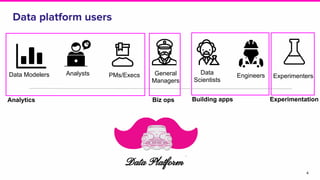
Data platform users
4
Data Modelers Analysts Data
Scientists
General
Managers
Data Platform
Engineers ExperimentersPMs/Execs
Analytics Biz ops Building apps Experimentation
By numbers...
● Millions of BI queries per
week doubling quarterly
● 5X increase in productivity
of ML models in 2018
● 20X scaling of support of
maps to users through
streaming platform in 2018
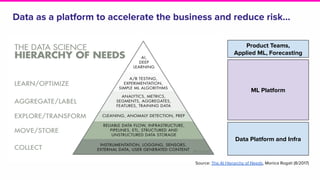
Product Teams,
Applied ML, Forecasting
ML Platform
Data Platform and Infra
Source: The AI Hierarchy of Needs, Monica Rogati (8/2017)
Data as a platform to accelerate the business and reduce risk...
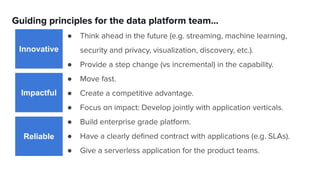
● Think ahead in the future (e.g. streaming, machine learning,
security and privacy, visualization, discovery, etc.).
● Provide a step change (vs incremental) in the capability.
● Move fast.
● Create a competitive advantage.
● Focus on impact: Develop jointly with application verticals.
● Build enterprise grade platform.
● Have a clearly defined contract with applications (e.g. SLAs).
● Give a serverless application for the product teams.
Guiding principles for the data platform team...
Innovative
Impactful
Reliable
Use case #1
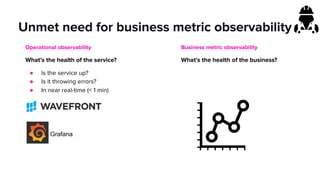
Unmet need for business metric observability
Business metric observability
What’s the health of the business?
Grafana
Operational observability
What’s the health of the service?
● Is the service up?
● Is it throwing errors?
● In near real-time (< 1 min)
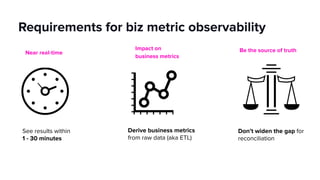
Requirements for biz metric observability
See results within
1 - 30 minutes
Be the source of truthNear real-time
Impact on
business metrics
Derive business metrics
from raw data (aka ETL)
Don’t widen the gap for
reconciliation
11
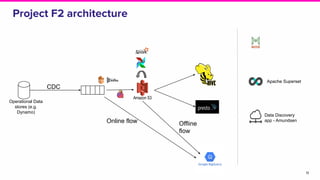
Project F2 architecture
Data Discovery
app - Amundsen
Operational Data
stores (e.g.
Dynamo)
Apache Superset
CDC
Online flow Offline
flow
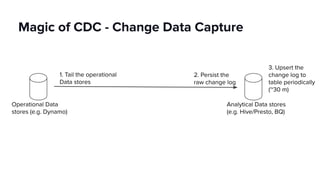
Magic of CDC - Change Data Capture
Operational Data
stores (e.g. Dynamo)
Analytical Data stores
(e.g. Hive/Presto, BQ)
1. Tail the operational
Data stores
2. Persist the
raw change log
3. Upsert the
change log to
table periodically
(~30 m)
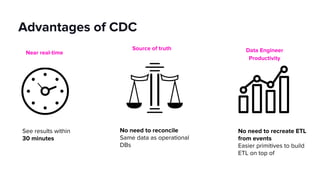
Advantages of CDC
Data Engineer
Productivity
See results within
30 minutes
Near real-time
Source of truth
No need to reconcile
Same data as operational
DBs
No need to recreate ETL
from events
Easier primitives to build
ETL on top of
● Measuring reliability
○ How to distinguish late arriving data from missing data?
○ How do you trace a single missing revision through all moving parts?
● Lots of moving parts
○ Tailer, tied to implementation of operational DB
○ Ingest pipeline
○ Kafka, Kinesis
○ Analytic Database
Challenges of the architecture
CDC + Streaming =
Lots of business
value
Use case #2
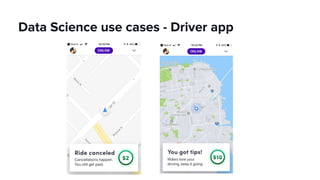
Data Science use cases - Driver app
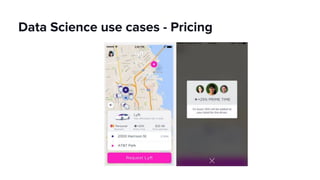
Data Science use cases - Pricing
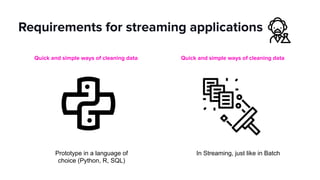
Requirements for streaming applications
In Streaming, just like in Batch
Quick and simple ways of cleaning data
Prototype in a language of
choice (Python, R, SQL)
Quick and simple ways of cleaning data
20
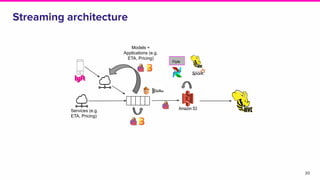
Services (e.g.
ETA, Pricing)
Models +
Applications (e.g.
ETA, Pricing)
Flyte
Streaming architecture
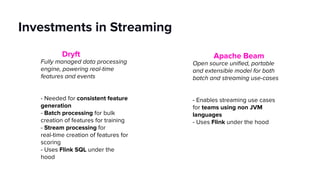
Investments in Streaming
Dryft
Fully managed data processing
engine, powering real-time
features and events
- Needed for consistent feature
generation
- Batch processing for bulk
creation of features for training
- Stream processing for
real-time creation of features for
scoring
- Uses Flink SQL under the
hood
Apache Beam
Open source unified, portable
and extensible model for both
batch and streaming use-cases
- Enables streaming use cases
for teams using non JVM
languages
- Uses Flink under the hood
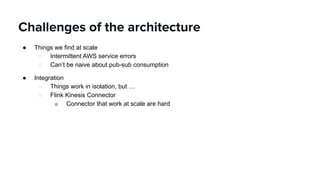
● Things we find at scale
○ Intermittent AWS service errors
○ Can’t be naive about pub-sub consumption
● Integration
○ Things work in isolation, but …
○ Flink Kinesis Connector
■ Connector that work at scale are hard
Challenges of the architecture
Sharing your batch
and streaming
compute will pay
huge benefits
The whole
shebang
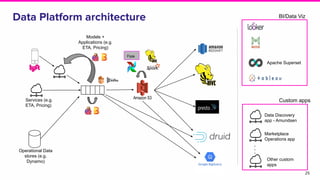
25
Data Platform architecture
Data Discovery
app - Amundsen
Services (e.g.
ETA, Pricing)
Operational Data
stores (e.g.
Dynamo)
Models +
Applications (e.g.
ETA, Pricing)
Apache Superset
BI/Data Viz
Marketplace
Operations app
...
Other custom
apps
Custom apps
Flyte
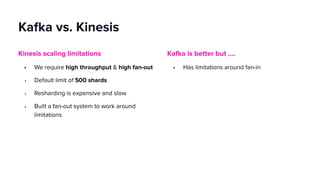
Kafka is better but ….
• Has limitations around fan-in
Kafka vs. Kinesis
Kinesis scaling limitations
• We require high throughput & high fan-out
• Default limit of 500 shards
• Resharding is expensive and slow
• Built a fan-out system to work around
limitations
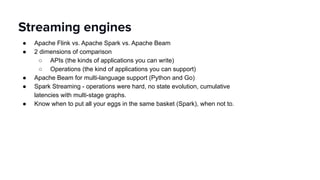
● Apache Flink vs. Apache Spark vs. Apache Beam
● 2 dimensions of comparison
○ APIs (the kinds of applications you can write)
○ Operations (the kind of applications you can support)
● Apache Beam for multi-language support (Python and Go)
● Spark Streaming - operations were hard, no state evolution, cumulative
latencies with multi-stage graphs.
● Know when to put all your eggs in the same basket (Spark), when not to.
Streaming engines
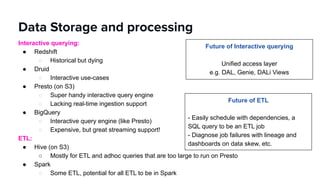
Interactive querying:
● Redshift
○ Historical but dying
● Druid
○ Interactive use-cases
● Presto (on S3)
○ Super handy interactive query engine
○ Lacking real-time ingestion support
● BigQuery
○ Interactive query engine (like Presto)
○ Expensive, but great streaming support!
ETL:
● Hive (on S3)
○ Mostly for ETL and adhoc queries that are too large to run on Presto
● Spark
○ Some ETL, potential for all ETL to be in Spark
Data Storage and processing
Future of Interactive querying
Unified access layer
e.g. DAL, Genie, DALi Views
Future of ETL
- Easily schedule with dependencies, a
SQL query to be an ETL job
- Diagnose job failures with lineage and
dashboards on data skew, etc.
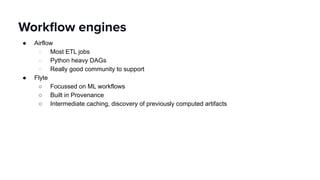
● Airflow
○ Most ETL jobs
○ Python heavy DAGs
○ Really good community to support
● Flyte
○ Focussed on ML workflows
○ Built in Provenance
○ Intermediate caching, discovery of previously computed artifacts
Workflow engines
Conclusion
● We think about data as a platform and a competitive advantage.
● Our data and platform usage is growing really really fast.
● We support Data Science, Ops, Analytics, Experimentation and other
use cases.
● We have seen tremendous benefit from CDC data + Streaming
frameworks to deliver business metric observability.
● We have learned and gained a lot in operational excellence by
sharing our batch and stream compute frameworks.
● We are investing in Data Discovery, Streaming, and Machine
Learning.
Conclusion
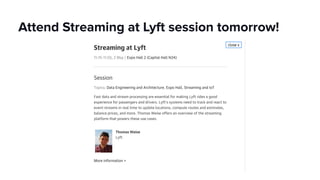
Attend Streaming at Lyft session tomorrow!
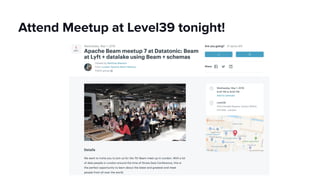
Attend Meetup at Level39 tonight!
Thank you
go.lyft.com/lyftdataplatformMay 2nd, 2019
Mark Grover | @mark_grover
Deepak Tiwari | @_deepaktiwari_

The Lyft data platform: Now and in the future

  • 1.
    Now and TheFuture Lyft Data Platform Mark Grover | @mark_grover Deepak Tiwari | @_deepaktiwari_
  • 2.
    Improve people’s liveswith the world’s best transportation ● 30.7M riders in 2018 ● 1.9M drivers in 2018 ● 1B+ cumulative rides ● 300+ markets in US & Canada
  • 3.
    Data is atthe core of decisions at Lyft Automated decisions - What’s the price for the ride? - What driver to match? - What’s the ETA? Analyzing business performance - How are key business metrics trending? - How do predicted ETAs compare to actual? Human business decisions - Which opportunities to invest in? - Which path to take (via experimentation)?
  • 4.
    Data platform users 4 DataModelers Analysts Data Scientists General Managers Data Platform Engineers ExperimentersPMs/Execs Analytics Biz ops Building apps Experimentation
  • 5.
    By numbers... ● Millionsof BI queries per week doubling quarterly ● 5X increase in productivity of ML models in 2018 ● 20X scaling of support of maps to users through streaming platform in 2018
  • 6.
    Product Teams, Applied ML,Forecasting ML Platform Data Platform and Infra Source: The AI Hierarchy of Needs, Monica Rogati (8/2017) Data as a platform to accelerate the business and reduce risk...
  • 7.
    ● Think aheadin the future (e.g. streaming, machine learning, security and privacy, visualization, discovery, etc.). ● Provide a step change (vs incremental) in the capability. ● Move fast. ● Create a competitive advantage. ● Focus on impact: Develop jointly with application verticals. ● Build enterprise grade platform. ● Have a clearly defined contract with applications (e.g. SLAs). ● Give a serverless application for the product teams. Guiding principles for the data platform team... Innovative Impactful Reliable
  • 8.
  • 9.
    Unmet need forbusiness metric observability Business metric observability What’s the health of the business? Grafana Operational observability What’s the health of the service? ● Is the service up? ● Is it throwing errors? ● In near real-time (< 1 min)
  • 10.
    Requirements for bizmetric observability See results within 1 - 30 minutes Be the source of truthNear real-time Impact on business metrics Derive business metrics from raw data (aka ETL) Don’t widen the gap for reconciliation
  • 11.
    11 Project F2 architecture DataDiscovery app - Amundsen Operational Data stores (e.g. Dynamo) Apache Superset CDC Online flow Offline flow
  • 12.
    Magic of CDC- Change Data Capture Operational Data stores (e.g. Dynamo) Analytical Data stores (e.g. Hive/Presto, BQ) 1. Tail the operational Data stores 2. Persist the raw change log 3. Upsert the change log to table periodically (~30 m)
  • 13.
    Advantages of CDC DataEngineer Productivity See results within 30 minutes Near real-time Source of truth No need to reconcile Same data as operational DBs No need to recreate ETL from events Easier primitives to build ETL on top of
  • 14.
    ● Measuring reliability ○How to distinguish late arriving data from missing data? ○ How do you trace a single missing revision through all moving parts? ● Lots of moving parts ○ Tailer, tied to implementation of operational DB ○ Ingest pipeline ○ Kafka, Kinesis ○ Analytic Database Challenges of the architecture
  • 15.
    CDC + Streaming= Lots of business value
  • 16.
  • 17.
    Data Science usecases - Driver app
  • 18.
    Data Science usecases - Pricing
  • 19.
    Requirements for streamingapplications In Streaming, just like in Batch Quick and simple ways of cleaning data Prototype in a language of choice (Python, R, SQL) Quick and simple ways of cleaning data
  • 20.
    20 Services (e.g. ETA, Pricing) Models+ Applications (e.g. ETA, Pricing) Flyte Streaming architecture
  • 21.
    Investments in Streaming Dryft Fullymanaged data processing engine, powering real-time features and events - Needed for consistent feature generation - Batch processing for bulk creation of features for training - Stream processing for real-time creation of features for scoring - Uses Flink SQL under the hood Apache Beam Open source unified, portable and extensible model for both batch and streaming use-cases - Enables streaming use cases for teams using non JVM languages - Uses Flink under the hood
  • 22.
    ● Things wefind at scale ○ Intermittent AWS service errors ○ Can’t be naive about pub-sub consumption ● Integration ○ Things work in isolation, but … ○ Flink Kinesis Connector ■ Connector that work at scale are hard Challenges of the architecture
  • 23.
    Sharing your batch andstreaming compute will pay huge benefits
  • 24.
  • 25.
    25 Data Platform architecture DataDiscovery app - Amundsen Services (e.g. ETA, Pricing) Operational Data stores (e.g. Dynamo) Models + Applications (e.g. ETA, Pricing) Apache Superset BI/Data Viz Marketplace Operations app ... Other custom apps Custom apps Flyte
  • 26.
    Kafka is betterbut …. • Has limitations around fan-in Kafka vs. Kinesis Kinesis scaling limitations • We require high throughput & high fan-out • Default limit of 500 shards • Resharding is expensive and slow • Built a fan-out system to work around limitations
  • 27.
    ● Apache Flinkvs. Apache Spark vs. Apache Beam ● 2 dimensions of comparison ○ APIs (the kinds of applications you can write) ○ Operations (the kind of applications you can support) ● Apache Beam for multi-language support (Python and Go) ● Spark Streaming - operations were hard, no state evolution, cumulative latencies with multi-stage graphs. ● Know when to put all your eggs in the same basket (Spark), when not to. Streaming engines
  • 28.
    Interactive querying: ● Redshift ○Historical but dying ● Druid ○ Interactive use-cases ● Presto (on S3) ○ Super handy interactive query engine ○ Lacking real-time ingestion support ● BigQuery ○ Interactive query engine (like Presto) ○ Expensive, but great streaming support! ETL: ● Hive (on S3) ○ Mostly for ETL and adhoc queries that are too large to run on Presto ● Spark ○ Some ETL, potential for all ETL to be in Spark Data Storage and processing Future of Interactive querying Unified access layer e.g. DAL, Genie, DALi Views Future of ETL - Easily schedule with dependencies, a SQL query to be an ETL job - Diagnose job failures with lineage and dashboards on data skew, etc.
  • 29.
    ● Airflow ○ MostETL jobs ○ Python heavy DAGs ○ Really good community to support ● Flyte ○ Focussed on ML workflows ○ Built in Provenance ○ Intermediate caching, discovery of previously computed artifacts Workflow engines
  • 30.
  • 31.
    ● We thinkabout data as a platform and a competitive advantage. ● Our data and platform usage is growing really really fast. ● We support Data Science, Ops, Analytics, Experimentation and other use cases. ● We have seen tremendous benefit from CDC data + Streaming frameworks to deliver business metric observability. ● We have learned and gained a lot in operational excellence by sharing our batch and stream compute frameworks. ● We are investing in Data Discovery, Streaming, and Machine Learning. Conclusion
  • 32.
    Attend Streaming atLyft session tomorrow!
  • 33.
    Attend Meetup atLevel39 tonight!
  • 34.
    Thank you go.lyft.com/lyftdataplatformMay 2nd,2019 Mark Grover | @mark_grover Deepak Tiwari | @_deepaktiwari_