MLOps with
Saurabh Kaushik
@saurabhkaushik
About Me:
Saurabh Kaushik
@saurabhkaushik
• Director, Product Engineering Management @Eureka.AI
• Help Telco's to monetize their data using AI and Data Products
• Engineered and deployed about 20+ AI Product Solutions
• Experience: 20+ years in various roles (Consultant/Lead/Architect/Manager/Director)
• Domain: FinTech, AdTech, MarTech
• Industry: Telco, Banking, Financial, Retail, CPG
• Tech: Data Science, ML, DL, NLP, Big Data, Java, Python, Full Stack
• Org: Products, Enterprise, Service, Tech Startups
• Speakers: Product School, NASCOM, World Startup Expo, Institute of Product
Leadership, IIMB, TechGigs
• Hobbies: Tennis, Piano, Building Bots (Botreload.com)
Why do we need MLOps?
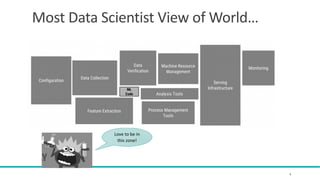
Most Data Scientist View of World…
4
Love to be in
this zone!
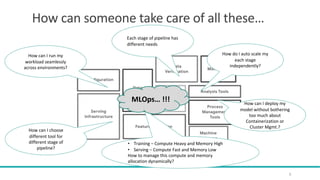
How can someone take care of all these…
5
How do I auto scale my
each stage
independently?
How can I choose
different tool for
different stage of
pipeline?
How can I run my
workload seamlessly
across environments?
How can I deploy my
model without bothering
too much about
Containerization or
Cluster Mgmt.?
Each stage of pipeline has
different needs
• Training – Compute Heavy and Memory High
• Serving – Compute Fast and Memory Low
How to manage this compute and memory
allocation dynamically?
MLOps… !!!
What is Kubeflow?
Kubeflow is the solution….
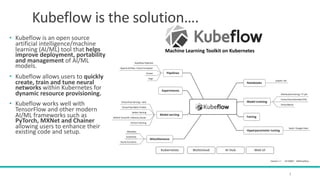
• Kubeflow is an open source
artificial intelligence/machine
learning (AI/ML) tool that helps
improve deployment, portability
and management of AI/ML
models.
• Kubeflow allows users to quickly
create, train and tune neural
networks within Kubernetes for
dynamic resource provisioning.
• Kubeflow works well with
TensorFlow and other modern
AI/ML frameworks such as
PyTorch, MXNet and Chainer
allowing users to enhance their
existing code and setup.
7
Machine Learning Toolkit on Kubernetes
Kubeflow – Origin
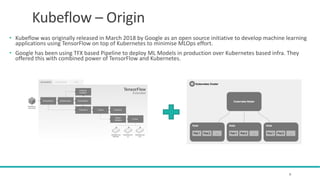
• Kubeflow was originally released in March 2018 by Google as an open source initiative to develop machine learning
applications using TensorFlow on top of Kubernetes to minimise MLOps effort.
• Google has been using TFX based Pipeline to deploy ML Models in production over Kubernetes based infra. They
offered this with combined power of TensorFlow and Kubernetes.
8
Kubeflow – Building Principals
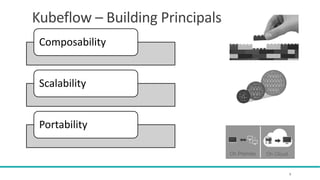
Composability
Scalability
Portability
9
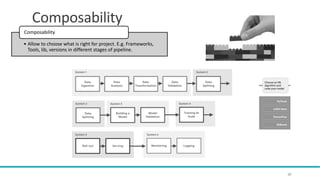
Composability
• Allow to choose what is right for project. E.g. Frameworks,
Tools, lib, versions in different stages of pipeline.
Composability
10
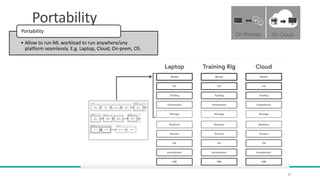
Portability
• Allow to run ML workload to run anywhere/any
platform seamlessly. E.g. Laptop, Cloud, On-prem, OS.
Portability
11
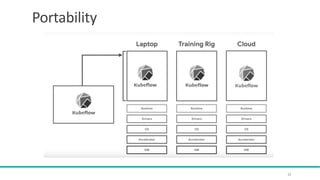
Portability
12
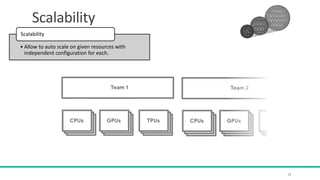
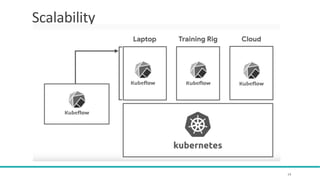
Scalability
• Allow to auto scale on given resources with
independent configuration for each.
Scalability
13
Scalability
14
What are key MLOps capabilities
in Kubeflow?
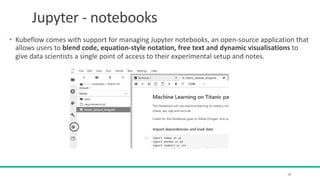
Jupyter - notebooks
• Kubeflow comes with support for managing Jupyter notebooks, an open-source application that
allows users to blend code, equation-style notation, free text and dynamic visualisations to
give data scientists a single point of access to their experimental setup and notes.
16
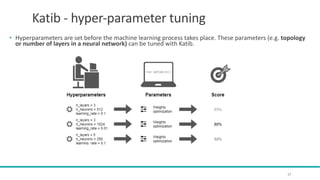
Katib - hyper-parameter tuning
• Hyperparameters are set before the machine learning process takes place. These parameters (e.g. topology
or number of layers in a neural network) can be tuned with Katib.
17
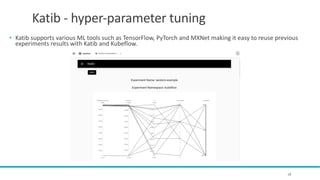
Katib - hyper-parameter tuning
• Katib supports various ML tools such as TensorFlow, PyTorch and MXNet making it easy to reuse previous
experiments results with Katib and Kubeflow.
18
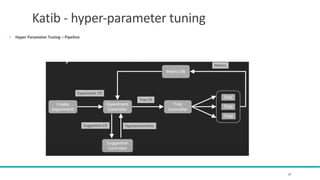
Katib - hyper-parameter tuning
• Hyper Parameter Tuning – Pipeline
19
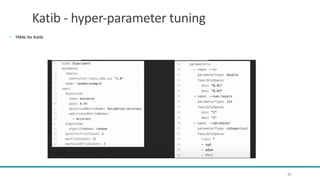
Katib - hyper-parameter tuning
• YMAL for Katib
20
Pipelines
• Kubeflow pipelines facilitate end-to-end orchestration of ML workflows, management of multiple
experiments and approaches as well as easier re-use of previously successful solutions into a new workflow.
This helps developers and data scientists save time and effort.
21
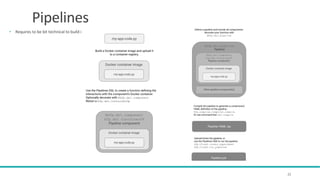
Pipelines
• Requires to be bit technical to build it.
22
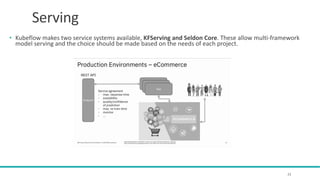
Serving
• Kubeflow makes two service systems available, KFServing and Seldon Core. These allow multi-framework
model serving and the choice should be made based on the needs of each project.
23
How does MLOps pipeline
operate with Kubeflow?
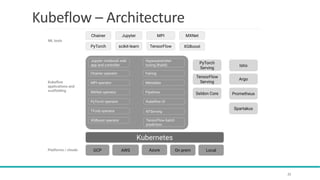
Kubeflow – Architecture
25
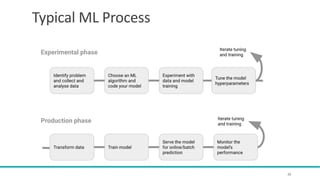
Typical ML Process
26
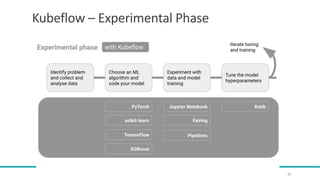
Kubeflow – Experimental Phase
27
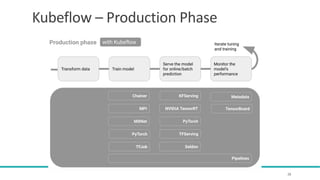
Kubeflow – Production Phase
28
Spotify – Case Study
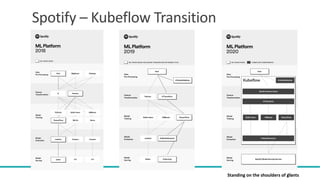
Spotify – Kubeflow Transition
30Standing on the shoulders of giants
How easy is to do MLOps with
KubeFlow?
Demo!
32
Thank you
Twitter: @saurabhkaushik
Linkedin: @saurabhkaushik

MLOps with Kubeflow

  • 1.
  • 2.
    About Me: Saurabh Kaushik @saurabhkaushik •Director, Product Engineering Management @Eureka.AI • Help Telco's to monetize their data using AI and Data Products • Engineered and deployed about 20+ AI Product Solutions • Experience: 20+ years in various roles (Consultant/Lead/Architect/Manager/Director) • Domain: FinTech, AdTech, MarTech • Industry: Telco, Banking, Financial, Retail, CPG • Tech: Data Science, ML, DL, NLP, Big Data, Java, Python, Full Stack • Org: Products, Enterprise, Service, Tech Startups • Speakers: Product School, NASCOM, World Startup Expo, Institute of Product Leadership, IIMB, TechGigs • Hobbies: Tennis, Piano, Building Bots (Botreload.com)
  • 3.
    Why do weneed MLOps?
  • 4.
    Most Data ScientistView of World… 4 Love to be in this zone!
  • 5.
    How can someonetake care of all these… 5 How do I auto scale my each stage independently? How can I choose different tool for different stage of pipeline? How can I run my workload seamlessly across environments? How can I deploy my model without bothering too much about Containerization or Cluster Mgmt.? Each stage of pipeline has different needs • Training – Compute Heavy and Memory High • Serving – Compute Fast and Memory Low How to manage this compute and memory allocation dynamically? MLOps… !!!
  • 6.
  • 7.
    Kubeflow is thesolution…. • Kubeflow is an open source artificial intelligence/machine learning (AI/ML) tool that helps improve deployment, portability and management of AI/ML models. • Kubeflow allows users to quickly create, train and tune neural networks within Kubernetes for dynamic resource provisioning. • Kubeflow works well with TensorFlow and other modern AI/ML frameworks such as PyTorch, MXNet and Chainer allowing users to enhance their existing code and setup. 7 Machine Learning Toolkit on Kubernetes
  • 8.
    Kubeflow – Origin •Kubeflow was originally released in March 2018 by Google as an open source initiative to develop machine learning applications using TensorFlow on top of Kubernetes to minimise MLOps effort. • Google has been using TFX based Pipeline to deploy ML Models in production over Kubernetes based infra. They offered this with combined power of TensorFlow and Kubernetes. 8
  • 9.
    Kubeflow – BuildingPrincipals Composability Scalability Portability 9
  • 10.
    Composability • Allow tochoose what is right for project. E.g. Frameworks, Tools, lib, versions in different stages of pipeline. Composability 10
  • 11.
    Portability • Allow torun ML workload to run anywhere/any platform seamlessly. E.g. Laptop, Cloud, On-prem, OS. Portability 11
  • 12.
  • 13.
    Scalability • Allow toauto scale on given resources with independent configuration for each. Scalability 13
  • 14.
  • 15.
    What are keyMLOps capabilities in Kubeflow?
  • 16.
    Jupyter - notebooks •Kubeflow comes with support for managing Jupyter notebooks, an open-source application that allows users to blend code, equation-style notation, free text and dynamic visualisations to give data scientists a single point of access to their experimental setup and notes. 16
  • 17.
    Katib - hyper-parametertuning • Hyperparameters are set before the machine learning process takes place. These parameters (e.g. topology or number of layers in a neural network) can be tuned with Katib. 17
  • 18.
    Katib - hyper-parametertuning • Katib supports various ML tools such as TensorFlow, PyTorch and MXNet making it easy to reuse previous experiments results with Katib and Kubeflow. 18
  • 19.
    Katib - hyper-parametertuning • Hyper Parameter Tuning – Pipeline 19
  • 20.
    Katib - hyper-parametertuning • YMAL for Katib 20
  • 21.
    Pipelines • Kubeflow pipelinesfacilitate end-to-end orchestration of ML workflows, management of multiple experiments and approaches as well as easier re-use of previously successful solutions into a new workflow. This helps developers and data scientists save time and effort. 21
  • 22.
    Pipelines • Requires tobe bit technical to build it. 22
  • 23.
    Serving • Kubeflow makestwo service systems available, KFServing and Seldon Core. These allow multi-framework model serving and the choice should be made based on the needs of each project. 23
  • 24.
    How does MLOpspipeline operate with Kubeflow?
  • 25.
  • 26.
  • 27.
  • 28.
  • 29.
  • 30.
    Spotify – KubeflowTransition 30Standing on the shoulders of giants
  • 31.
    How easy isto do MLOps with KubeFlow?
  • 32.
  • 33.