Headline Goes Here
Speaker Name or Subhead Goes Here
Hadoop & Complex (Systems) Research

Thoughts About Large Scale Data Management
GridKa School 2014, Karlsruhe, Germany | 2014-09-02	

Mirko Kämpf | Cloudera
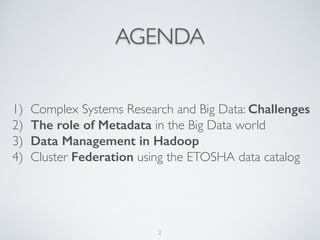
AGENDA
1) Complex Systems Research and Big Data: Challenges
2) The role of Metadata in the Big Data world	

3) Data Management in Hadoop	

4) Cluster Federation using the ETOSHA data catalog
2
COLLECT SOME INFORMATION…
• Do you work interdisciplinary?	

• Do you collect your own data?	

• Do you share data sets often?	

• Do you contribute sub sets of results?	

• Do you integrate multiple data sets?
1: CHALLENGES
• As research projects become more complex, larger groups
need scalable collaborative technology and methods.	

• As soon as datasets become to large it is impossible for them
to be copied between partners. We need data federation
for public and private (anonymous) data.	

• Research results have to be transparent and reproducible. 

This requires not just access to research papers, but also 

access to comprehensive contextual information.
4
5
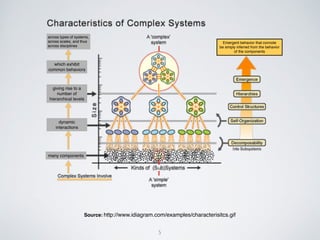
Source: http://www.idiagram.com/examples/characterisitcs.gif
across types of systems,

across scales, and thus 

across disciplines
many components
dynamic
interactions
giving rise to a
number of"
hierarchical levels
which exhibit
common behaviors
Emergent behavior that connote"
be simply inferred from the behavior "
of the components
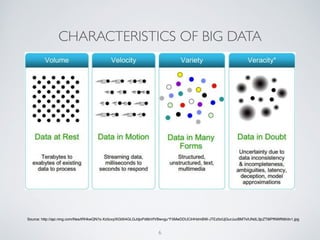
CHARACTERISTICS OF BIG DATA
6
Source: http://api.ning.com/files/tRHkwQN7s-Xz5cxylXG004GLGJdjoPd6bVfVBwvgu*F5MwDDUCiHHdmBW-JTEz0cfJjGurJucBMTkIUNdL3jcZT8IPfNWfN9/dv1.jpg
IS IT A BIG DATA PROBLEM?
• Share and integrate measured data and simulation results from
multiple sub projects on different scales (space and time) into
one large meta model. 	

• Volume: For better statistical results large datasets are required. 	

• Velocity: Becomes more important in real world real time applications.	

• Variety: New methods lead to evolution of procedures and schema updates.	

• Veracity: Data collection tools using novel methods may not be perfect.	

7
2:THE ROLE OF METADATA
• What can be expected from a data set or: “What is in it?”
• Data set description is provided by metadata.	

• How can I get access to a particular dataset? 	

• legacy systems: FTP, NFS, and HTTP downloads	

• state of the art: cloud storage & distributed file systems (Amazon S3)	

• Location, version and schema is also metadata.
8
DEFNITION: DATA & METADATA
"
from: WIKIPEDIA!
"
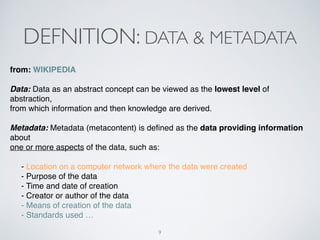
Data: Data as an abstract concept can be viewed as the lowest level of
abstraction, 

from which information and then knowledge are derived.

Metadata: Metadata (metacontent) is defined as the data providing information
about 

one or more aspects of the data, such as: 

" - Location on a computer network where the data were created" "
" - Purpose of the data"
" - Time and date of creation"
" - Creator or author of the data"
" - Means of creation of the data"
" - Standards used …

9
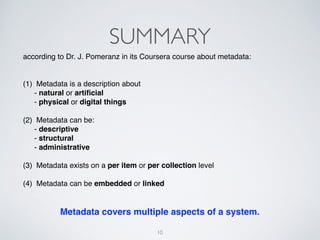
SUMMARY"
according to Dr. J. Pomeranz in its Coursera course about metadata:"
"


(1) Metadata is a description about 

" - natural or artificial"
" - physical or digital things"
"
(2) Metadata can be: "
" - descriptive"
" - structural"
" - administrative"
"
(3) Metadata exists on a per item or per collection level"
"
(4) Metadata can be embedded or linked!
"
"
10
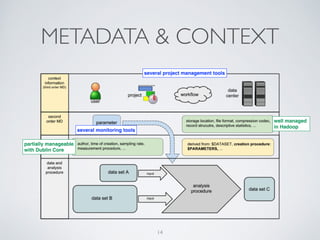
Metadata covers multiple aspects of a system.
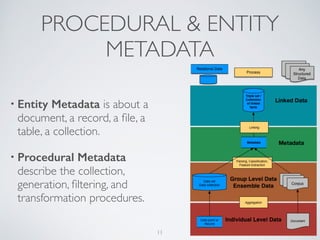
PROCEDURAL & ENTITY
METADATA
• Entity Metadata is about a
document, a record, a file, a
table, a collection.	

• Procedural Metadata
describe the collection,
generation, filtering, and
transformation procedures.
11
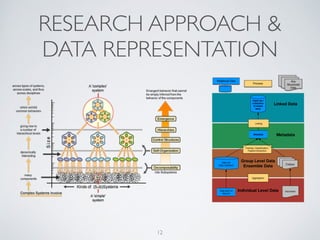
RESEARCH APPROACH &
DATA REPRESENTATION
12
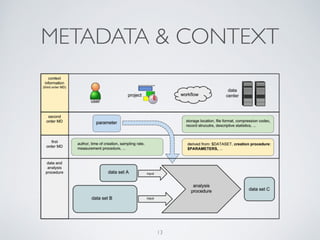
METADATA & CONTEXT
13
METADATA & CONTEXT
well managed 

in Hadoop
partially manageable

with Dublin Core
several monitoring tools
several project management tools
14
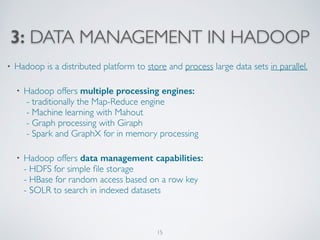
3: DATA MANAGEMENT IN HADOOP
• Hadoop is a distributed platform to store and process large data sets in parallel.

• Hadoop offers multiple processing engines:

- traditionally the Map-Reduce engine

- Machine learning with Mahout

- Graph processing with Giraph 

- Spark and GraphX for in memory processing

• Hadoop offers data management capabilities:

- HDFS for simple file storage 

- HBase for random access based on a row key

- SOLR to search in indexed datasets
15
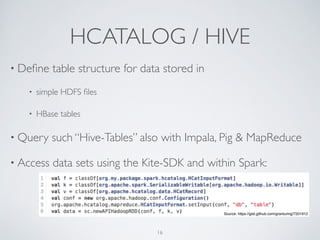
HCATALOG / HIVE
• Define table structure for data stored in	

• simple HDFS files	

• HBase tables	

• Query such “Hive-Tables” also with Impala, Pig & MapReduce	

• Access data sets using the Kite-SDK and within Spark:	

"
" Source: https://gist.github.com/granturing/7201912
16
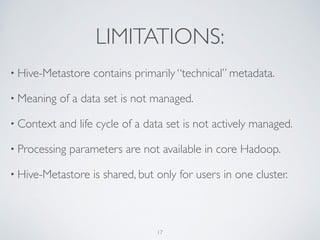
LIMITATIONS:
• Hive-Metastore contains primarily “technical” metadata.	

• Meaning of a data set is not managed.	

• Context and life cycle of a data set is not actively managed.	

• Processing parameters are not available in core Hadoop.	

• Hive-Metastore is shared, but only for users in one cluster.
17
4: WHAT IS ETOSHA?
• Etosha will be a distributed, decentralized, and fault tolerant
metadata service.	

• Its main purpose is publishing and linking of information 

about datasets. 	

• Etosha enables cluster federation for Hadoop. 	

• Etosha allows knowledge management while HCatalog and
the Hive-Metastore are focused on low-level technical
18
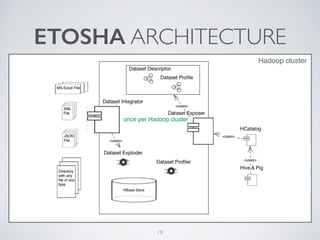
ETOSHA ARCHITECTURE
"
"
"
"
"
"
"
19
Hadoop cluster
once per Hadoop cluster
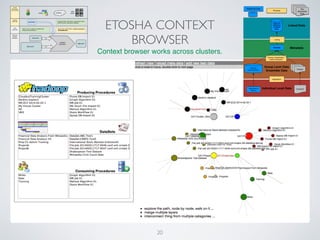
ETOSHA CONTEXT 

BROWSER
20
Context browser works across clusters.
NEXT STEPS
• Expose administrative, structural, and descriptive metadata

about Hadoop data sets via SPARQL endpoint.	

• Implement a data set discovery API to find relevant data.	

• Enable subquery delegation between Hadoop clusters.	

• Collect and publish metadata about public open datasets 

in the Etosha Data Catalog (EDC) project.
21
MANYTHANKS …	

• … to the organizers of this great event!	

• … to my friend and contributor EricTessenow.	

• … to my colleagues from Cloudera.	

• … and most importantly, to the members of the open source community!
22

Hadoop & Complex Systems Research

  • 1.
    Headline Goes Here SpeakerName or Subhead Goes Here Hadoop & Complex (Systems) Research
 Thoughts About Large Scale Data Management GridKa School 2014, Karlsruhe, Germany | 2014-09-02 Mirko Kämpf | Cloudera
  • 2.
    AGENDA 1) Complex SystemsResearch and Big Data: Challenges 2) The role of Metadata in the Big Data world 3) Data Management in Hadoop 4) Cluster Federation using the ETOSHA data catalog 2
  • 3.
    COLLECT SOME INFORMATION… •Do you work interdisciplinary? • Do you collect your own data? • Do you share data sets often? • Do you contribute sub sets of results? • Do you integrate multiple data sets?
  • 4.
    1: CHALLENGES • Asresearch projects become more complex, larger groups need scalable collaborative technology and methods. • As soon as datasets become to large it is impossible for them to be copied between partners. We need data federation for public and private (anonymous) data. • Research results have to be transparent and reproducible. 
 This requires not just access to research papers, but also 
 access to comprehensive contextual information. 4
  • 5.
    5 Source: http://www.idiagram.com/examples/characterisitcs.gif across typesof systems,
 across scales, and thus 
 across disciplines many components dynamic interactions giving rise to a number of" hierarchical levels which exhibit common behaviors Emergent behavior that connote" be simply inferred from the behavior " of the components
  • 6.
    CHARACTERISTICS OF BIGDATA 6 Source: http://api.ning.com/files/tRHkwQN7s-Xz5cxylXG004GLGJdjoPd6bVfVBwvgu*F5MwDDUCiHHdmBW-JTEz0cfJjGurJucBMTkIUNdL3jcZT8IPfNWfN9/dv1.jpg
  • 7.
    IS IT ABIG DATA PROBLEM? • Share and integrate measured data and simulation results from multiple sub projects on different scales (space and time) into one large meta model. • Volume: For better statistical results large datasets are required. • Velocity: Becomes more important in real world real time applications. • Variety: New methods lead to evolution of procedures and schema updates. • Veracity: Data collection tools using novel methods may not be perfect. 7
  • 8.
    2:THE ROLE OFMETADATA • What can be expected from a data set or: “What is in it?” • Data set description is provided by metadata. • How can I get access to a particular dataset? • legacy systems: FTP, NFS, and HTTP downloads • state of the art: cloud storage & distributed file systems (Amazon S3) • Location, version and schema is also metadata. 8
  • 9.
    DEFNITION: DATA &METADATA " from: WIKIPEDIA! " Data: Data as an abstract concept can be viewed as the lowest level of abstraction, 
 from which information and then knowledge are derived.
 Metadata: Metadata (metacontent) is defined as the data providing information about 
 one or more aspects of the data, such as: 
 " - Location on a computer network where the data were created" " " - Purpose of the data" " - Time and date of creation" " - Creator or author of the data" " - Means of creation of the data" " - Standards used …
 9
  • 10.
    SUMMARY" according to Dr.J. Pomeranz in its Coursera course about metadata:" " 
 (1) Metadata is a description about 
 " - natural or artificial" " - physical or digital things" " (2) Metadata can be: " " - descriptive" " - structural" " - administrative" " (3) Metadata exists on a per item or per collection level" " (4) Metadata can be embedded or linked! " " 10 Metadata covers multiple aspects of a system.
  • 11.
    PROCEDURAL & ENTITY METADATA •Entity Metadata is about a document, a record, a file, a table, a collection. • Procedural Metadata describe the collection, generation, filtering, and transformation procedures. 11
  • 12.
    RESEARCH APPROACH & DATAREPRESENTATION 12
  • 13.
  • 14.
    METADATA & CONTEXT wellmanaged 
 in Hadoop partially manageable
 with Dublin Core several monitoring tools several project management tools 14
  • 15.
    3: DATA MANAGEMENTIN HADOOP • Hadoop is a distributed platform to store and process large data sets in parallel.
 • Hadoop offers multiple processing engines:
 - traditionally the Map-Reduce engine
 - Machine learning with Mahout
 - Graph processing with Giraph 
 - Spark and GraphX for in memory processing
 • Hadoop offers data management capabilities:
 - HDFS for simple file storage 
 - HBase for random access based on a row key
 - SOLR to search in indexed datasets 15
  • 16.
    HCATALOG / HIVE •Define table structure for data stored in • simple HDFS files • HBase tables • Query such “Hive-Tables” also with Impala, Pig & MapReduce • Access data sets using the Kite-SDK and within Spark: " " Source: https://gist.github.com/granturing/7201912 16
  • 17.
    LIMITATIONS: • Hive-Metastore containsprimarily “technical” metadata. • Meaning of a data set is not managed. • Context and life cycle of a data set is not actively managed. • Processing parameters are not available in core Hadoop. • Hive-Metastore is shared, but only for users in one cluster. 17
  • 18.
    4: WHAT ISETOSHA? • Etosha will be a distributed, decentralized, and fault tolerant metadata service. • Its main purpose is publishing and linking of information 
 about datasets. • Etosha enables cluster federation for Hadoop. • Etosha allows knowledge management while HCatalog and the Hive-Metastore are focused on low-level technical 18
  • 19.
  • 20.
    ETOSHA CONTEXT 
 BROWSER 20 Contextbrowser works across clusters.
  • 21.
    NEXT STEPS • Exposeadministrative, structural, and descriptive metadata
 about Hadoop data sets via SPARQL endpoint. • Implement a data set discovery API to find relevant data. • Enable subquery delegation between Hadoop clusters. • Collect and publish metadata about public open datasets 
 in the Etosha Data Catalog (EDC) project. 21
  • 22.
    MANYTHANKS … • …to the organizers of this great event! • … to my friend and contributor EricTessenow. • … to my colleagues from Cloudera. • … and most importantly, to the members of the open source community! 22