
Practical Introduction to
Hadoop
Alex Gorbachev
30-May-2013
© 2012 – Pythian
Who is Pythian?
15 Years of Data
infrastructure management
consulting
170+ Top brands
6000+ databases under
management
Over 200 DBA’s, in 26
countries
Top 5% of DBA work force, 9
Oracle ACE’s, 2 Microsoft
MVP’s
Oracle, Microsoft, MySQL,
Netezza, Hadoop, MongoDB,
Oracle Apps, Enterprise
Infrastructure
© 2012 – Pythian
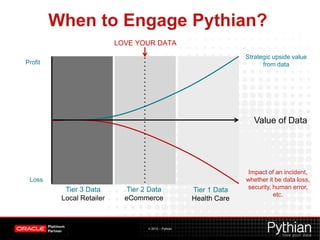
When to Engage Pythian?
Tier 3 Data
Local Retailer
Strategic upside value
from data
Tier 2 Data
eCommerce
Tier 1 Data
Health Care
Profit
Loss
Impact of an incident,
whether it be data loss,
security, human error,
etc.
Value of Data
LOVE YOUR DATA
© 2012 – Pythian
4
© 2012 Pythian
Alex Gorbachev
• Chief Technology Officer at Pythian
• Blogger
• Cloudera Champion of Big Data
• OakTable Network member
• Oracle ACE Director
• Founder of BattleAgainstAnyGuess.com
• Founder of Sydney Oracle Meetup
• IOUG Director of Communities
• EVP, Ottawa Oracle User Grou
4
© 2012 – Pythian
Given enough skill and money –
relational databases can do anything.
Sometimes it’s just unfeasibly
expensive.
What is Hadoop?
© 2012 – Pythian
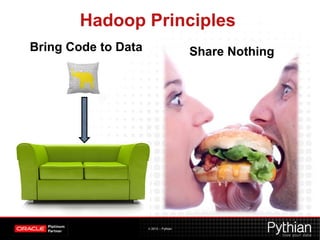
Hadoop Principles
Bring Code to Data Share Nothing
© 2012 – Pythian
Hadoop in a Nutshell
Replicated Distributed Big-
Data File System
Map-Reduce - framework for
writing massively parallel
jobs
© 2012 – Pythian
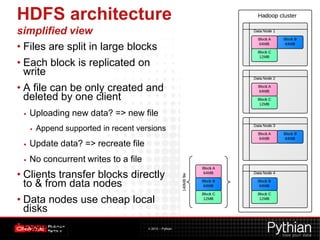
HDFS architecture
simplified view
• Files are split in large blocks
• Each block is replicated on
write
• A file can be only created and
deleted by one client
• Uploading new data? => new file
• Append supported in recent versions
• Update data? => recreate file
• No concurrent writes to a file
• Clients transfer blocks directly
to & from data nodes
• Data nodes use cheap local
disks
• Local reads are the most
efficient
© 2012 – Pythian
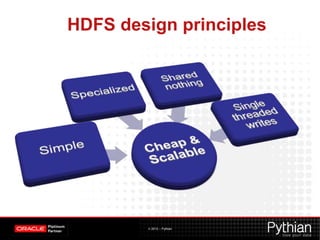
HDFS design principles
© 2012 – Pythian
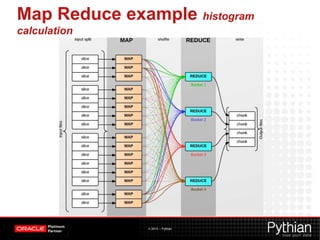
Map Reduce example histogram
calculation
© 2012 – Pythian
Map Reduce pros & cons
Advantages
• Simple programming
paradigm
• Flexible
• Highly scalable
• Good fit for HDFS – mappers
read locally
• Fault tolerant
• Task failure or node failure
doesn’t affect the whole job –
they are restartable
Pitfalls
• Low efficiency
• Lots of intermediate data
• Lots of network traffic on
shuffle
• Complex manipulation
requires pipeline of multiple
jobs
• No high-level language
• Only mappers leverage
local reads on HDFS
© 2012 – Pythian
Some components of Hadoop
ecosystem
• Hive – HiveQL is SQL like query language
• Generates MapReduce jobs
• Pig – data sets manipulation language (like create your
own query execution plan)
• Generates MapReduce jobs
• Mahout – machine learning libraries
• Generates MapReduce jobs
• Oozie – workflow scheduler services
• Sqoop – transfer data between Hadoop and relational
database
© 2012 – Pythian
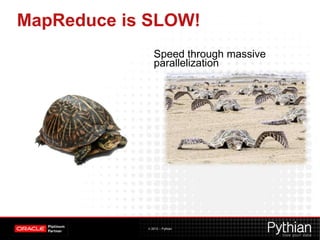
MapReduce is SLOW!
Speed through massive
parallelization
© 2012 – Pythian
Non-MR processing on Hadoop
• HBase – columnar-oriented key-value store (NoSQL)
• SQL without Map Reduce
• Impala (Cloudera)
• Drill (MapR)
• Phoenix (Salesforce.com)
• Hadapt (commercial)
• Shark – Spark in-memory analytics on Hadoop
• Platfora (commercial)
• In-memory analytics + visualization & reporting tool
© 2012 – Pythian
Hadoop Benefits
• Reliable solution based on unreliable hardware
• Designed for large files
• Load data first, structure later
• Designed to maximize throughput of large scans
• Designed to leverage parallelism
• Designed to scale
• Flexible development platform
• Solution Ecosystem
© 2012 – Pythian
• Hadoop is scalable but not fast
• Some assembly required
• Batteries not included
• Instrumentation not included
either
• DIY mindset (remember
MySQL?)
• Commercial distributions are
not free
• Simplistic security models
Hadoop Limitations
© 2012 – Pythian
How much does it cost?
$300K DIY on SuperMicro
• 100 data nodes
• 2 name nodes
• 3 racks
• 800 Sandy Bridge CPU
cores
• 6.4 TB RAM
• 600 x 2TB disks
• 1.2 PB of raw disk capacity
• 400 TB usable (triple
mirror)
• Open-source s/w, maybe
commercial distribution
© 2012 – Pythian
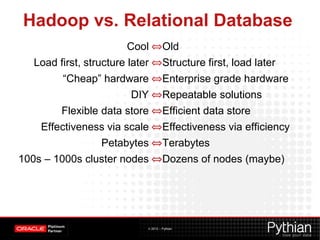
Hadoop vs. Relational Database
Cool
Load first, structure later
“Cheap” hardware
DIY
Flexible data store
Effectiveness via scale
Petabytes
100s – 1000s cluster nodes
⇔Old
⇔Structure first, load later
⇔Enterprise grade hardware
⇔Repeatable solutions
⇔Efficient data store
⇔Effectiveness via efficiency
⇔Terabytes
⇔Dozens of nodes (maybe)
Big Data and Hadoop Use Cases
© 2012 – Pythian
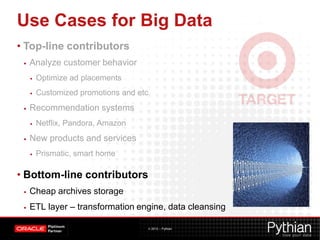
Use Cases for Big Data
• Top-line contributors
• Analyze customer behavior
• Optimize ad placements
• Customized promotions and etc
• Recommendation systems
• Netflix, Pandora, Amazon
• New products and services
• Prismatic, smart home
© 2012 – Pythian
© 2012 – Pythian
Use Cases for Big Data
• Top-line contributors
• Analyze customer behavior
• Optimize ad placements
• Customized promotions and etc
• Recommendation systems
• Netflix, Pandora, Amazon
• New products and services
• Prismatic, smart home
© 2012 – Pythian
Use Cases for Big Data
• Bottom-line contributors
• Cheap archives storage
• ETL layer – transformation engine, data cleansing
•
•
•
•
•
•
•
•
© 2012 – Pythian
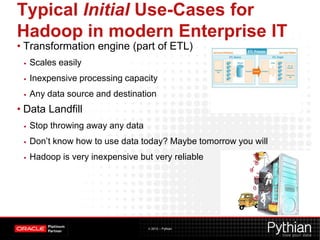
Typical Initial Use-Cases for
Hadoop in modern Enterprise IT
• Transformation engine (part of ETL)
• Scales easily
• Inexpensive processing capacity
• Any data source and destination
• Data Landfill
• Stop throwing away any data
• Don’t know how to use data today? Maybe tomorrow you will
• Hadoop is very inexpensive but very reliable
© 2012 – Pythian
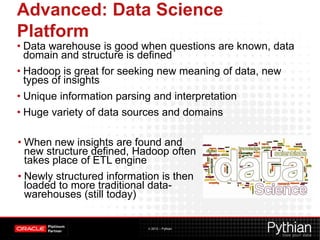
Advanced: Data Science
Platform
• Data warehouse is good when questions are known, data
domain and structure is defined
• Hadoop is great for seeking new meaning of data, new
types of insights
• Unique information parsing and interpretation
• Huge variety of data sources and domains
• When new insights are found and
new structure defined, Hadoop often
takes place of ETL engine
• Newly structured information is then
loaded to more traditional data-
warehouses (still today)
© 2012 – Pythian
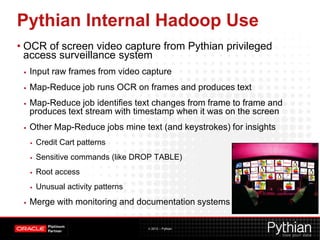
Pythian Internal Hadoop Use
• OCR of screen video capture from Pythian privileged
access surveillance system
• Input raw frames from video capture
• Map-Reduce job runs OCR on frames and produces text
• Map-Reduce job identifies text changes from frame to frame and
produces text stream with timestamp when it was on the screen
• Other Map-Reduce jobs mine text (and keystrokes) for insights
• Credit Cart patterns
• Sensitive commands (like DROP TABLE)
• Root access
• Unusual activity patterns
• Merge with monitoring and documentation systems
© 2012 – Pythian
2
Thank you & Q&A
http://www.pythian.com/blog/
http://www.facebook.com/pages/The-Pythian-Group/
http://twitter.com/pythian http://twitter.com/alexgorbachev
http://www.linkedin.com/company/pythian
1-866-PYTHIAN
sales@pythian.com gorbachev@pythian.com
To contact us…
To follow us…

Practical introduction to hadoop

  • 1.
  • 2.
    © 2012 –Pythian Who is Pythian? 15 Years of Data infrastructure management consulting 170+ Top brands 6000+ databases under management Over 200 DBA’s, in 26 countries Top 5% of DBA work force, 9 Oracle ACE’s, 2 Microsoft MVP’s Oracle, Microsoft, MySQL, Netezza, Hadoop, MongoDB, Oracle Apps, Enterprise Infrastructure
  • 3.
    © 2012 –Pythian When to Engage Pythian? Tier 3 Data Local Retailer Strategic upside value from data Tier 2 Data eCommerce Tier 1 Data Health Care Profit Loss Impact of an incident, whether it be data loss, security, human error, etc. Value of Data LOVE YOUR DATA
  • 4.
    © 2012 –Pythian 4 © 2012 Pythian Alex Gorbachev • Chief Technology Officer at Pythian • Blogger • Cloudera Champion of Big Data • OakTable Network member • Oracle ACE Director • Founder of BattleAgainstAnyGuess.com • Founder of Sydney Oracle Meetup • IOUG Director of Communities • EVP, Ottawa Oracle User Grou 4
  • 5.
    © 2012 –Pythian Given enough skill and money – relational databases can do anything. Sometimes it’s just unfeasibly expensive.
  • 6.
  • 7.
    © 2012 –Pythian Hadoop Principles Bring Code to Data Share Nothing
  • 8.
    © 2012 –Pythian Hadoop in a Nutshell Replicated Distributed Big- Data File System Map-Reduce - framework for writing massively parallel jobs
  • 9.
    © 2012 –Pythian HDFS architecture simplified view • Files are split in large blocks • Each block is replicated on write • A file can be only created and deleted by one client • Uploading new data? => new file • Append supported in recent versions • Update data? => recreate file • No concurrent writes to a file • Clients transfer blocks directly to & from data nodes • Data nodes use cheap local disks • Local reads are the most efficient
  • 10.
    © 2012 –Pythian HDFS design principles
  • 11.
    © 2012 –Pythian Map Reduce example histogram calculation
  • 12.
    © 2012 –Pythian Map Reduce pros & cons Advantages • Simple programming paradigm • Flexible • Highly scalable • Good fit for HDFS – mappers read locally • Fault tolerant • Task failure or node failure doesn’t affect the whole job – they are restartable Pitfalls • Low efficiency • Lots of intermediate data • Lots of network traffic on shuffle • Complex manipulation requires pipeline of multiple jobs • No high-level language • Only mappers leverage local reads on HDFS
  • 13.
    © 2012 –Pythian Some components of Hadoop ecosystem • Hive – HiveQL is SQL like query language • Generates MapReduce jobs • Pig – data sets manipulation language (like create your own query execution plan) • Generates MapReduce jobs • Mahout – machine learning libraries • Generates MapReduce jobs • Oozie – workflow scheduler services • Sqoop – transfer data between Hadoop and relational database
  • 14.
    © 2012 –Pythian MapReduce is SLOW! Speed through massive parallelization
  • 15.
    © 2012 –Pythian Non-MR processing on Hadoop • HBase – columnar-oriented key-value store (NoSQL) • SQL without Map Reduce • Impala (Cloudera) • Drill (MapR) • Phoenix (Salesforce.com) • Hadapt (commercial) • Shark – Spark in-memory analytics on Hadoop • Platfora (commercial) • In-memory analytics + visualization & reporting tool
  • 16.
    © 2012 –Pythian Hadoop Benefits • Reliable solution based on unreliable hardware • Designed for large files • Load data first, structure later • Designed to maximize throughput of large scans • Designed to leverage parallelism • Designed to scale • Flexible development platform • Solution Ecosystem
  • 17.
    © 2012 –Pythian • Hadoop is scalable but not fast • Some assembly required • Batteries not included • Instrumentation not included either • DIY mindset (remember MySQL?) • Commercial distributions are not free • Simplistic security models Hadoop Limitations
  • 18.
    © 2012 –Pythian How much does it cost? $300K DIY on SuperMicro • 100 data nodes • 2 name nodes • 3 racks • 800 Sandy Bridge CPU cores • 6.4 TB RAM • 600 x 2TB disks • 1.2 PB of raw disk capacity • 400 TB usable (triple mirror) • Open-source s/w, maybe commercial distribution
  • 19.
    © 2012 –Pythian Hadoop vs. Relational Database Cool Load first, structure later “Cheap” hardware DIY Flexible data store Effectiveness via scale Petabytes 100s – 1000s cluster nodes ⇔Old ⇔Structure first, load later ⇔Enterprise grade hardware ⇔Repeatable solutions ⇔Efficient data store ⇔Effectiveness via efficiency ⇔Terabytes ⇔Dozens of nodes (maybe)
  • 20.
    Big Data andHadoop Use Cases
  • 21.
    © 2012 –Pythian Use Cases for Big Data • Top-line contributors • Analyze customer behavior • Optimize ad placements • Customized promotions and etc • Recommendation systems • Netflix, Pandora, Amazon • New products and services • Prismatic, smart home
  • 22.
    © 2012 –Pythian
  • 23.
    © 2012 –Pythian Use Cases for Big Data • Top-line contributors • Analyze customer behavior • Optimize ad placements • Customized promotions and etc • Recommendation systems • Netflix, Pandora, Amazon • New products and services • Prismatic, smart home
  • 24.
    © 2012 –Pythian Use Cases for Big Data • Bottom-line contributors • Cheap archives storage • ETL layer – transformation engine, data cleansing • • • • • • • •
  • 25.
    © 2012 –Pythian Typical Initial Use-Cases for Hadoop in modern Enterprise IT • Transformation engine (part of ETL) • Scales easily • Inexpensive processing capacity • Any data source and destination • Data Landfill • Stop throwing away any data • Don’t know how to use data today? Maybe tomorrow you will • Hadoop is very inexpensive but very reliable
  • 26.
    © 2012 –Pythian Advanced: Data Science Platform • Data warehouse is good when questions are known, data domain and structure is defined • Hadoop is great for seeking new meaning of data, new types of insights • Unique information parsing and interpretation • Huge variety of data sources and domains • When new insights are found and new structure defined, Hadoop often takes place of ETL engine • Newly structured information is then loaded to more traditional data- warehouses (still today)
  • 27.
    © 2012 –Pythian Pythian Internal Hadoop Use • OCR of screen video capture from Pythian privileged access surveillance system • Input raw frames from video capture • Map-Reduce job runs OCR on frames and produces text • Map-Reduce job identifies text changes from frame to frame and produces text stream with timestamp when it was on the screen • Other Map-Reduce jobs mine text (and keystrokes) for insights • Credit Cart patterns • Sensitive commands (like DROP TABLE) • Root access • Unusual activity patterns • Merge with monitoring and documentation systems
  • 28.
    © 2012 –Pythian 2 Thank you & Q&A http://www.pythian.com/blog/ http://www.facebook.com/pages/The-Pythian-Group/ http://twitter.com/pythian http://twitter.com/alexgorbachev http://www.linkedin.com/company/pythian 1-866-PYTHIAN sales@pythian.com gorbachev@pythian.com To contact us… To follow us…

Editor's Notes

  • #6 Big Data is not new. What’s new is that it’s not cost prohibitive anymore for broad commercial adoption.
  • #8 The ideas are simple:Data is big, code is small. It is far more efficient to move the small code to the big data than vice versa. It you have a pillow and a sofa in a room, you typically move the pillow to the sofa, and not vice versa. But many developers are too comfortable with the select-than-process anti-pattern. This principle is in place to help with the throughput challenges.2. Sharing is nice, but safe sharing of data typically mean locking, queueing, bottle necks and race conditions. It is notoriously difficult to get concurrency right, and even if you do – it is slower than the alternative. Hadoop works around the whole thing. This principle is in place to deal with parallel processing challenges
  • #9 Amazon EMR uses S3. MapR uses MapRFS.Many non-MR applications too.
  • #17 Default block size is 64M,You can place any data file in HDFS. Later processing can find the meaning in the data.
  • #18 Many projects fail because people imagine a very rosy image of Hadoop. They think they can just throw all the data there and it will magically and quickly become value. Such misguided expectations also happen with other platforms and doom other projects too. To be successful with Hadoop, we need to be realistic about it.
  • #22 Patterns – pregnant 16 y.o. example
  • #23 Women on the baby registry were buying larger quantities of unscented lotion around the beginning of their second trimester. Another analyst noted that sometime in the first 20 weeks, pregnant women loaded up on supplements like calcium, magnesium and zinc.
  • #24 Patterns – pregnant 16 y.o. example
  • #25 Patterns – pregnant 16 y.o. example