Building Highly Flexible, High Performance
query engines -
Highlights from Apache Drill project
Neeraja Rentachintala
Director, Product Management
MapR Technologies
Agenda
• Apache Drill overview
• Using Drill
• Under the Hood
• Status and progress
• Demo
APACHE DRILL OVERVIEW
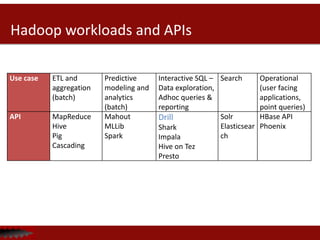
Hadoop workloads and APIs
Use case ETL and
aggregation
(batch)
Predictive
modeling and
analytics
(batch)
Interactive SQL –
Data exploration,
Adhoc queries &
reporting
Search Operational
(user facing
applications,
point queries)
API MapReduce
Hive
Pig
Cascading
Mahout
MLLib
Spark
Drill
Shark
Impala
Hive on Tez
Presto
Solr
Elasticsear
ch
HBase API
Phoenix
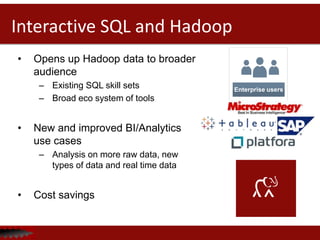
Interactive SQL and Hadoop
• Opens up Hadoop data to broader
audience
– Existing SQL skill sets
– Broad eco system of tools
• New and improved BI/Analytics
use cases
– Analysis on more raw data, new
types of data and real time data
• Cost savings
Enterprise users
Data landscape is changing
New types of applications
• Social, mobile, Web, “Internet of
Things”, Cloud…
• Iterative/Agile in nature
• More users, more data
New data models & data types
• Flexible (schema-less) data
• Rapidly changing
• Semi-structured/Nested data
{
"data": [
"id": "X999_Y999",
"from": {
"name": "Tom Brady", "id": "X12"
},
"message": "Looking forward to 2014!",
"actions": [
{
"name": "Comment",
"link": "http://www.facebook.com/X99/posts Y999"
},
{
"name": "Like",
"link": "http://www.facebook.com/X99/posts Y999"
}
],
"type": "status",
"created_time": "2013-08-02T21:27:44+0000",
"updated_time": "2013-08-02T21:27:44+0000"
}
}
JSON
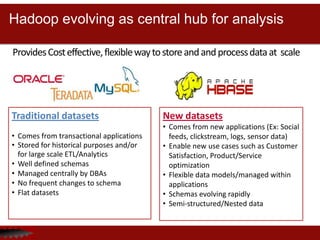
Traditional datasets
• Comes from transactional applications
• Stored for historical purposes and/or
for large scale ETL/Analytics
• Well defined schemas
• Managed centrally by DBAs
• No frequent changes to schema
• Flat datasets
New datasets
• Comes from new applications (Ex: Social
feeds, clickstream, logs, sensor data)
• Enable new use cases such as Customer
Satisfaction, Product/Service
optimization
• Flexible data models/managed within
applications
• Schemas evolving rapidly
• Semi-structured/Nested data
Hadoop evolving as central hub for analysis
ProvidesCosteffective,flexiblewaytostoreandandprocessdataat scale
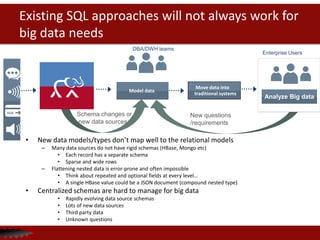
Existing SQL approaches will not always work for
big data needs
• New data models/types don’t map well to the relational models
– Many data sources do not have rigid schemas (HBase, Mongo etc)
• Each record has a separate schema
• Sparse and wide rows
– Flattening nested data is error-prone and often impossible
• Think about repeated and optional fields at every level…
• A single HBase value could be a JSON document (compound nested type)
• Centralized schemas are hard to manage for big data
• Rapidly evolving data source schemas
• Lots of new data sources
• Third party data
• Unknown questions
Model data
Move data into
traditional systems
New questions
/requirements
Schema changes or
new data sources
DBA/DWH teams
Analyze Big data
Enterprise Users
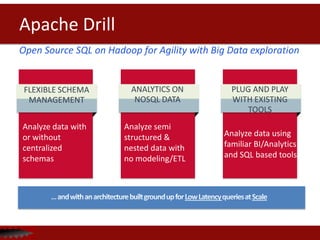
Apache Drill
Open Source SQL on Hadoop for Agility with Big Data exploration
FLEXIBLE SCHEMA
MANAGEMENT
ANALYTICS ON
NOSQL DATA
PLUG AND PLAY
WITH EXISTING
TOOLS
Analyze data with
or without
centralized
schemas
Analyze data using
familiar BI/Analytics
and SQL based tools
Analyze semi
structured &
nested data with
no modeling/ETL
Flexible schema management
{
“ID”: 1,
“NAME”: “Fairmont San Francisco”,
“DESCRIPTION”: “Historic grandeur…”,
“AVG_REVIEWER_SCORE”: “4.3”,
“AMENITY”: {“TYPE”: “gym”,
DESCRIPTION: “fitness center”
},
{“TYPE”: “wifi”,
“DESCRIPTION”: “free wifi”},
“RATE_TYPE”: “nightly”,
“PRICE”: “$199”,
“REVIEWS”: [“review_1”, “review_2”],
“ATTRACTIONS”: “Chinatown”,
}
JSON
Existing SQL
solutions X
HotelID AmenityID
1 1
1 2
ID Type Descript
ion
1 Gym Fitness
center
2 Wifi Free wifi
Drill
{
“ID”: 1,
“NAME”: “Fairmont San Francisco”,
“DESCRIPTION”: “Historic grandeur…”,
“AVG_REVIEWER_SCORE”: “4.3”,
“AMENITY”: {“TYPE”: “gym”,
DESCRIPTION: “fitness
center”
},
{“TYPE”: “wifi”,
“DESCRIPTION”: “free wifi”},
“RATE_TYPE”: “nightly”,
“PRICE”: “$199”,
“REVIEWS”: [“review_1”, “review_2”],
“ATTRACTIONS”: “Chinatown”,
}
JSON
Drill
Flexible schema management
HotelID AmenityID
1 1
1 2
ID Type Descript
ion
1 Gym Fitness
center
2 Wifi Free wifi
Drill doesn’t require any schema definitions to query data making it faster to get
insights from data for users. Drill leverages schema definitions if exists.
Key features
• Dynamic/schema-less queries
• Nested data
• Apache Hive integration
• ANSI SQL/BI tool integration
Querying files
• Direct queries on a local or a distributed file system (HDFS, S3
etc)
• Configure one or more directories in file system as “Workspaces”
– Think of this as similar to schemas in databases
– Default workspace points to “root” location
• Specify a single file or a directory as ‘Table’ within query
• Specify schema in query or let Drill discover it
• Example:
• SELECT * FROM dfs.users.`/home/mapr/sample-data/profiles.json`
dfs File system as data source
users Workspace (corresponds to a directory)
/home/mapr/sample-
data/profiles.json
Table
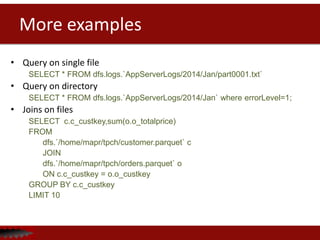
More examples
• Query on single file
SELECT * FROM dfs.logs.`AppServerLogs/2014/Jan/part0001.txt`
• Query on directory
SELECT * FROM dfs.logs.`AppServerLogs/2014/Jan` where errorLevel=1;
• Joins on files
SELECT c.c_custkey,sum(o.o_totalprice)
FROM
dfs.`/home/mapr/tpch/customer.parquet` c
JOIN
dfs.`/home/mapr/tpch/orders.parquet` o
ON c.c_custkey = o.o_custkey
GROUP BY c.c_custkey
LIMIT 10
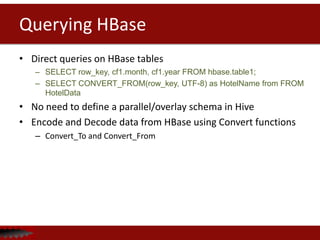
Querying HBase
• Direct queries on HBase tables
– SELECT row_key, cf1.month, cf1.year FROM hbase.table1;
– SELECT CONVERT_FROM(row_key, UTF-8) as HotelName from FROM
HotelData
• No need to define a parallel/overlay schema in Hive
• Encode and Decode data from HBase using Convert functions
– Convert_To and Convert_From
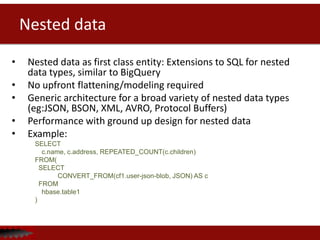
Nested data
• Nested data as first class entity: Extensions to SQL for nested
data types, similar to BigQuery
• No upfront flattening/modeling required
• Generic architecture for a broad variety of nested data types
(eg:JSON, BSON, XML, AVRO, Protocol Buffers)
• Performance with ground up design for nested data
• Example:
SELECT
c.name, c.address, REPEATED_COUNT(c.children)
FROM(
SELECT
CONVERT_FROM(cf1.user-json-blob, JSON) AS c
FROM
hbase.table1
)
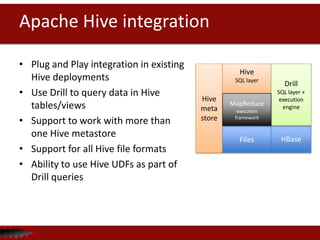
Apache Hive integration
• Plug and Play integration in existing
Hive deployments
• Use Drill to query data in Hive
tables/views
• Support to work with more than
one Hive metastore
• Support for all Hive file formats
• Ability to use Hive UDFs as part of
Drill queries
Hive
meta
store
Files HBase
Hive
SQL layer
Drill
SQL layer +
execution
engine
MapReduce
execution
framework
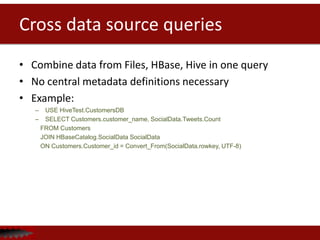
Cross data source queries
• Combine data from Files, HBase, Hive in one query
• No central metadata definitions necessary
• Example:
– USE HiveTest.CustomersDB
– SELECT Customers.customer_name, SocialData.Tweets.Count
FROM Customers
JOIN HBaseCatalog.SocialData SocialData
ON Customers.Customer_id = Convert_From(SocialData.rowkey, UTF-8)
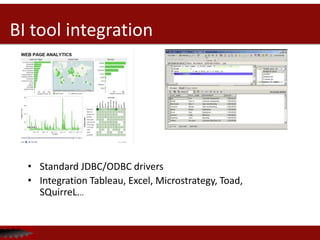
BI tool integration
• Standard JDBC/ODBC drivers
• Integration Tableau, Excel, Microstrategy, Toad,
SQuirreL...
SQL support
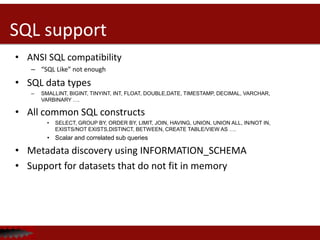
• ANSI SQL compatibility
– “SQL Like” not enough
• SQL data types
– SMALLINT, BIGINT, TINYINT, INT, FLOAT, DOUBLE,DATE, TIMESTAMP, DECIMAL, VARCHAR,
VARBINARY ….
• All common SQL constructs
• SELECT, GROUP BY, ORDER BY, LIMIT, JOIN, HAVING, UNION, UNION ALL, IN/NOT IN,
EXISTS/NOT EXISTS,DISTINCT, BETWEEN, CREATE TABLE/VIEW AS ….
• Scalar and correlated sub queries
• Metadata discovery using INFORMATION_SCHEMA
• Support for datasets that do not fit in memory
Packaging/install
• Works on all Hadoop distributions
• Easy ramp up with embedded/standalone
mode
– Try out Drill easily on your machine
– No Hadoop requirement
© MapR Technologies, confidential
Under the Hood
High Level Architecture
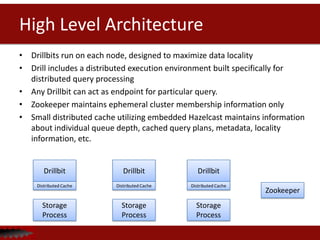
• Drillbits run on each node, designed to maximize data locality
• Drill includes a distributed execution environment built specifically for
distributed query processing
• Any Drillbit can act as endpoint for particular query.
• Zookeeper maintains ephemeral cluster membership information only
• Small distributed cache utilizing embedded Hazelcast maintains information
about individual queue depth, cached query plans, metadata, locality
information, etc.
Zookeeper
Storage
Process
Storage
Process
Storage
Process
Drillbit
Distributed Cache
Drillbit
Distributed Cache
Drillbit
Distributed Cache
Basic query flow
Zookeeper
DFS/HBase DFS/HBase DFS/HBase
Drillbit
Distributed Cache
Drillbit
Distributed Cache
Drillbit
Distributed Cache
Query
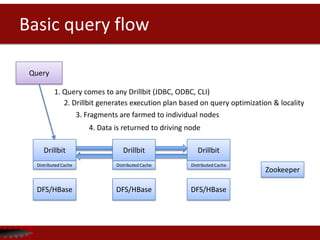
1. Query comes to any Drillbit (JDBC, ODBC, CLI)
2. Drillbit generates execution plan based on query optimization & locality
3. Fragments are farmed to individual nodes
4. Data is returned to driving node
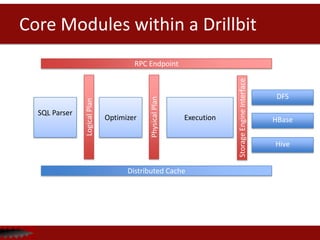
Core Modules within a Drillbit
SQL Parser
Optimizer
PhysicalPlan
DFS
HBase
RPC Endpoint
Distributed Cache
StorageEngineInterface
LogicalPlan
Execution
Hive
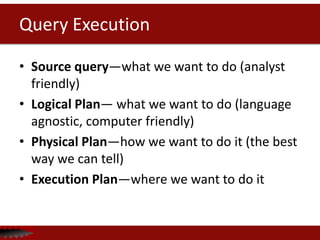
Query Execution
• Source query—what we want to do (analyst
friendly)
• Logical Plan— what we want to do (language
agnostic, computer friendly)
• Physical Plan—how we want to do it (the best
way we can tell)
• Execution Plan—where we want to do it
A Query engine that is…
• Optimistic/pipelined
• Columnar/Vectorized
• Runtime compiled
• Late binding
• Extensible
Optimistic Execution
• With a short time horizon, failures infrequent
– Don’t spend energy and time creating boundaries
and checkpoints to minimize recovery time
– Rerun entire query in face of failure
• No barriers
• No persistence unless memory overflow
Runtime Compilation
• Give JIT help
• Avoid virtual method invocation
• Avoid heap allocation and object overhead
• Minimize memory overhead
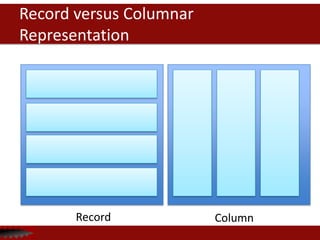
Record versus Columnar
Representation
Record Column
Data Format Example
Donut Price Icing
Bacon Maple Bar 2.19 [Maple Frosting, Bacon]
Portland Cream 1.79 [Chocolate]
The Loop 2.29 [Vanilla, Fruitloops]
Triple Chocolate
Penetration
2.79 [Chocolate, Cocoa Puffs]
Record Encoding
Bacon Maple Bar, 2.19, Maple Frosting, Bacon, Portland Cream, 1.79, Chocolate
The Loop, 2.29, Vanilla, Fruitloops, Triple Chocolate Penetration, 2.79, Chocolate,
Cocoa Puffs
Columnar Encoding
Bacon Maple Bar, Portland Cream, The Loop, Triple Chocolate Penetration
2.19, 1.79, 2.29, 2.79
Maple Frosting, Bacon, Chocolate, Vanilla, Fruitloops, Chocolate, Cocoa Puffs
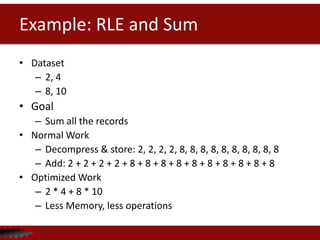
Example: RLE and Sum
• Dataset
– 2, 4
– 8, 10
• Goal
– Sum all the records
• Normal Work
– Decompress & store: 2, 2, 2, 2, 8, 8, 8, 8, 8, 8, 8, 8, 8, 8
– Add: 2 + 2 + 2 + 2 + 8 + 8 + 8 + 8 + 8 + 8 + 8 + 8 + 8 + 8
• Optimized Work
– 2 * 4 + 8 * 10
– Less Memory, less operations
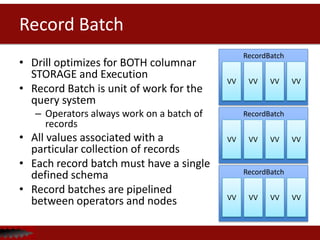
Record Batch
• Drill optimizes for BOTH columnar
STORAGE and Execution
• Record Batch is unit of work for the
query system
– Operators always work on a batch of
records
• All values associated with a
particular collection of records
• Each record batch must have a single
defined schema
• Record batches are pipelined
between operators and nodes
RecordBatch
VV VV VV VV
RecordBatch
VV VV VV VV
RecordBatch
VV VV VV VV
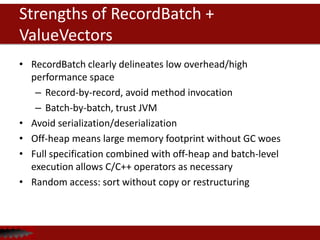
Strengths of RecordBatch +
ValueVectors
• RecordBatch clearly delineates low overhead/high
performance space
– Record-by-record, avoid method invocation
– Batch-by-batch, trust JVM
• Avoid serialization/deserialization
• Off-heap means large memory footprint without GC woes
• Full specification combined with off-heap and batch-level
execution allows C/C++ operators as necessary
• Random access: sort without copy or restructuring
Late Schema Binding
• Schema can change over course of query
• Operators are able to reconfigure themselves
on schema change events
Integration and Extensibility points
• Support UDFs
– UDFs/UDAFs using high performance Java API
• Not Hadoop centric
– Work with other NoSQL solutions including MongoDB, Cassandra, Riak, etc.
– Build one distributed query engine together than per technology
• Built in classpath scanning and plugin concept to add additional
storage engines, function and operators with zero configuration
• Support direct execution of strongly specified JSON based logical
and physical plans
– Simplifies testing
– Enables integration of alternative query languages
Comparison with MapReduce
• Barriers
– Map completion required before shuffle/reduce
commencement
– All maps must complete before reduce can start
– In chained jobs, one job must finish entirely before the
next one can start
• Persistence and Recoverability
– Data is persisted to disk between each barrier
– Serialization and deserialization are required between
execution phase
STATUS
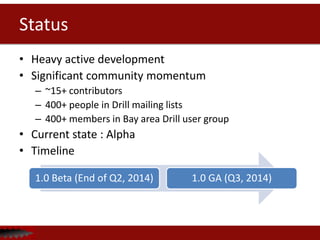
Status
• Heavy active development
• Significant community momentum
– ~15+ contributors
– 400+ people in Drill mailing lists
– 400+ members in Bay area Drill user group
• Current state : Alpha
• Timeline
1.0 Beta (End of Q2, 2014) 1.0 GA (Q3, 2014)
Interested in Apache Drill?
• Join the community
– Join the Drill mailing lists
• drill-user@incubator.apache.org
• drill-dev@incubator.apache.org
– Contribute
• Use cases/Sample queries, JIRAs, code, unit tests, documentation, ...
– Fork us on GitHub: http://github.com/apache/incubator-drill/
– Create a JIRA: https://issues.apache.org/jira/browse/DRILL
• Resources
– Try out Drill in 10mins
– http://incubator.apache.org/drill/
– https://cwiki.apache.org/confluence/display/DRILL/Apache+Drill+Wiki
DEMO

Apache Drill at ApacheCon2014

  • 1.
    Building Highly Flexible,High Performance query engines - Highlights from Apache Drill project Neeraja Rentachintala Director, Product Management MapR Technologies
  • 2.
    Agenda • Apache Drilloverview • Using Drill • Under the Hood • Status and progress • Demo
  • 3.
  • 4.
    Hadoop workloads andAPIs Use case ETL and aggregation (batch) Predictive modeling and analytics (batch) Interactive SQL – Data exploration, Adhoc queries & reporting Search Operational (user facing applications, point queries) API MapReduce Hive Pig Cascading Mahout MLLib Spark Drill Shark Impala Hive on Tez Presto Solr Elasticsear ch HBase API Phoenix
  • 5.
    Interactive SQL andHadoop • Opens up Hadoop data to broader audience – Existing SQL skill sets – Broad eco system of tools • New and improved BI/Analytics use cases – Analysis on more raw data, new types of data and real time data • Cost savings Enterprise users
  • 6.
    Data landscape ischanging New types of applications • Social, mobile, Web, “Internet of Things”, Cloud… • Iterative/Agile in nature • More users, more data New data models & data types • Flexible (schema-less) data • Rapidly changing • Semi-structured/Nested data { "data": [ "id": "X999_Y999", "from": { "name": "Tom Brady", "id": "X12" }, "message": "Looking forward to 2014!", "actions": [ { "name": "Comment", "link": "http://www.facebook.com/X99/posts Y999" }, { "name": "Like", "link": "http://www.facebook.com/X99/posts Y999" } ], "type": "status", "created_time": "2013-08-02T21:27:44+0000", "updated_time": "2013-08-02T21:27:44+0000" } } JSON
  • 7.
    Traditional datasets • Comesfrom transactional applications • Stored for historical purposes and/or for large scale ETL/Analytics • Well defined schemas • Managed centrally by DBAs • No frequent changes to schema • Flat datasets New datasets • Comes from new applications (Ex: Social feeds, clickstream, logs, sensor data) • Enable new use cases such as Customer Satisfaction, Product/Service optimization • Flexible data models/managed within applications • Schemas evolving rapidly • Semi-structured/Nested data Hadoop evolving as central hub for analysis ProvidesCosteffective,flexiblewaytostoreandandprocessdataat scale
  • 8.
    Existing SQL approacheswill not always work for big data needs • New data models/types don’t map well to the relational models – Many data sources do not have rigid schemas (HBase, Mongo etc) • Each record has a separate schema • Sparse and wide rows – Flattening nested data is error-prone and often impossible • Think about repeated and optional fields at every level… • A single HBase value could be a JSON document (compound nested type) • Centralized schemas are hard to manage for big data • Rapidly evolving data source schemas • Lots of new data sources • Third party data • Unknown questions Model data Move data into traditional systems New questions /requirements Schema changes or new data sources DBA/DWH teams Analyze Big data Enterprise Users
  • 9.
    Apache Drill Open SourceSQL on Hadoop for Agility with Big Data exploration FLEXIBLE SCHEMA MANAGEMENT ANALYTICS ON NOSQL DATA PLUG AND PLAY WITH EXISTING TOOLS Analyze data with or without centralized schemas Analyze data using familiar BI/Analytics and SQL based tools Analyze semi structured & nested data with no modeling/ETL
  • 10.
    Flexible schema management { “ID”:1, “NAME”: “Fairmont San Francisco”, “DESCRIPTION”: “Historic grandeur…”, “AVG_REVIEWER_SCORE”: “4.3”, “AMENITY”: {“TYPE”: “gym”, DESCRIPTION: “fitness center” }, {“TYPE”: “wifi”, “DESCRIPTION”: “free wifi”}, “RATE_TYPE”: “nightly”, “PRICE”: “$199”, “REVIEWS”: [“review_1”, “review_2”], “ATTRACTIONS”: “Chinatown”, } JSON Existing SQL solutions X HotelID AmenityID 1 1 1 2 ID Type Descript ion 1 Gym Fitness center 2 Wifi Free wifi
  • 11.
    Drill { “ID”: 1, “NAME”: “FairmontSan Francisco”, “DESCRIPTION”: “Historic grandeur…”, “AVG_REVIEWER_SCORE”: “4.3”, “AMENITY”: {“TYPE”: “gym”, DESCRIPTION: “fitness center” }, {“TYPE”: “wifi”, “DESCRIPTION”: “free wifi”}, “RATE_TYPE”: “nightly”, “PRICE”: “$199”, “REVIEWS”: [“review_1”, “review_2”], “ATTRACTIONS”: “Chinatown”, } JSON Drill Flexible schema management HotelID AmenityID 1 1 1 2 ID Type Descript ion 1 Gym Fitness center 2 Wifi Free wifi Drill doesn’t require any schema definitions to query data making it faster to get insights from data for users. Drill leverages schema definitions if exists.
  • 12.
    Key features • Dynamic/schema-lessqueries • Nested data • Apache Hive integration • ANSI SQL/BI tool integration
  • 13.
    Querying files • Directqueries on a local or a distributed file system (HDFS, S3 etc) • Configure one or more directories in file system as “Workspaces” – Think of this as similar to schemas in databases – Default workspace points to “root” location • Specify a single file or a directory as ‘Table’ within query • Specify schema in query or let Drill discover it • Example: • SELECT * FROM dfs.users.`/home/mapr/sample-data/profiles.json` dfs File system as data source users Workspace (corresponds to a directory) /home/mapr/sample- data/profiles.json Table
  • 14.
    More examples • Queryon single file SELECT * FROM dfs.logs.`AppServerLogs/2014/Jan/part0001.txt` • Query on directory SELECT * FROM dfs.logs.`AppServerLogs/2014/Jan` where errorLevel=1; • Joins on files SELECT c.c_custkey,sum(o.o_totalprice) FROM dfs.`/home/mapr/tpch/customer.parquet` c JOIN dfs.`/home/mapr/tpch/orders.parquet` o ON c.c_custkey = o.o_custkey GROUP BY c.c_custkey LIMIT 10
  • 15.
    Querying HBase • Directqueries on HBase tables – SELECT row_key, cf1.month, cf1.year FROM hbase.table1; – SELECT CONVERT_FROM(row_key, UTF-8) as HotelName from FROM HotelData • No need to define a parallel/overlay schema in Hive • Encode and Decode data from HBase using Convert functions – Convert_To and Convert_From
  • 16.
    Nested data • Nesteddata as first class entity: Extensions to SQL for nested data types, similar to BigQuery • No upfront flattening/modeling required • Generic architecture for a broad variety of nested data types (eg:JSON, BSON, XML, AVRO, Protocol Buffers) • Performance with ground up design for nested data • Example: SELECT c.name, c.address, REPEATED_COUNT(c.children) FROM( SELECT CONVERT_FROM(cf1.user-json-blob, JSON) AS c FROM hbase.table1 )
  • 17.
    Apache Hive integration •Plug and Play integration in existing Hive deployments • Use Drill to query data in Hive tables/views • Support to work with more than one Hive metastore • Support for all Hive file formats • Ability to use Hive UDFs as part of Drill queries Hive meta store Files HBase Hive SQL layer Drill SQL layer + execution engine MapReduce execution framework
  • 18.
    Cross data sourcequeries • Combine data from Files, HBase, Hive in one query • No central metadata definitions necessary • Example: – USE HiveTest.CustomersDB – SELECT Customers.customer_name, SocialData.Tweets.Count FROM Customers JOIN HBaseCatalog.SocialData SocialData ON Customers.Customer_id = Convert_From(SocialData.rowkey, UTF-8)
  • 19.
    BI tool integration •Standard JDBC/ODBC drivers • Integration Tableau, Excel, Microstrategy, Toad, SQuirreL...
  • 20.
    SQL support • ANSISQL compatibility – “SQL Like” not enough • SQL data types – SMALLINT, BIGINT, TINYINT, INT, FLOAT, DOUBLE,DATE, TIMESTAMP, DECIMAL, VARCHAR, VARBINARY …. • All common SQL constructs • SELECT, GROUP BY, ORDER BY, LIMIT, JOIN, HAVING, UNION, UNION ALL, IN/NOT IN, EXISTS/NOT EXISTS,DISTINCT, BETWEEN, CREATE TABLE/VIEW AS …. • Scalar and correlated sub queries • Metadata discovery using INFORMATION_SCHEMA • Support for datasets that do not fit in memory
  • 21.
    Packaging/install • Works onall Hadoop distributions • Easy ramp up with embedded/standalone mode – Try out Drill easily on your machine – No Hadoop requirement
  • 22.
    © MapR Technologies,confidential Under the Hood
  • 23.
    High Level Architecture •Drillbits run on each node, designed to maximize data locality • Drill includes a distributed execution environment built specifically for distributed query processing • Any Drillbit can act as endpoint for particular query. • Zookeeper maintains ephemeral cluster membership information only • Small distributed cache utilizing embedded Hazelcast maintains information about individual queue depth, cached query plans, metadata, locality information, etc. Zookeeper Storage Process Storage Process Storage Process Drillbit Distributed Cache Drillbit Distributed Cache Drillbit Distributed Cache
  • 24.
    Basic query flow Zookeeper DFS/HBaseDFS/HBase DFS/HBase Drillbit Distributed Cache Drillbit Distributed Cache Drillbit Distributed Cache Query 1. Query comes to any Drillbit (JDBC, ODBC, CLI) 2. Drillbit generates execution plan based on query optimization & locality 3. Fragments are farmed to individual nodes 4. Data is returned to driving node
  • 25.
    Core Modules withina Drillbit SQL Parser Optimizer PhysicalPlan DFS HBase RPC Endpoint Distributed Cache StorageEngineInterface LogicalPlan Execution Hive
  • 26.
    Query Execution • Sourcequery—what we want to do (analyst friendly) • Logical Plan— what we want to do (language agnostic, computer friendly) • Physical Plan—how we want to do it (the best way we can tell) • Execution Plan—where we want to do it
  • 27.
    A Query enginethat is… • Optimistic/pipelined • Columnar/Vectorized • Runtime compiled • Late binding • Extensible
  • 28.
    Optimistic Execution • Witha short time horizon, failures infrequent – Don’t spend energy and time creating boundaries and checkpoints to minimize recovery time – Rerun entire query in face of failure • No barriers • No persistence unless memory overflow
  • 29.
    Runtime Compilation • GiveJIT help • Avoid virtual method invocation • Avoid heap allocation and object overhead • Minimize memory overhead
  • 30.
  • 31.
    Data Format Example DonutPrice Icing Bacon Maple Bar 2.19 [Maple Frosting, Bacon] Portland Cream 1.79 [Chocolate] The Loop 2.29 [Vanilla, Fruitloops] Triple Chocolate Penetration 2.79 [Chocolate, Cocoa Puffs] Record Encoding Bacon Maple Bar, 2.19, Maple Frosting, Bacon, Portland Cream, 1.79, Chocolate The Loop, 2.29, Vanilla, Fruitloops, Triple Chocolate Penetration, 2.79, Chocolate, Cocoa Puffs Columnar Encoding Bacon Maple Bar, Portland Cream, The Loop, Triple Chocolate Penetration 2.19, 1.79, 2.29, 2.79 Maple Frosting, Bacon, Chocolate, Vanilla, Fruitloops, Chocolate, Cocoa Puffs
  • 32.
    Example: RLE andSum • Dataset – 2, 4 – 8, 10 • Goal – Sum all the records • Normal Work – Decompress & store: 2, 2, 2, 2, 8, 8, 8, 8, 8, 8, 8, 8, 8, 8 – Add: 2 + 2 + 2 + 2 + 8 + 8 + 8 + 8 + 8 + 8 + 8 + 8 + 8 + 8 • Optimized Work – 2 * 4 + 8 * 10 – Less Memory, less operations
  • 33.
    Record Batch • Drilloptimizes for BOTH columnar STORAGE and Execution • Record Batch is unit of work for the query system – Operators always work on a batch of records • All values associated with a particular collection of records • Each record batch must have a single defined schema • Record batches are pipelined between operators and nodes RecordBatch VV VV VV VV RecordBatch VV VV VV VV RecordBatch VV VV VV VV
  • 34.
    Strengths of RecordBatch+ ValueVectors • RecordBatch clearly delineates low overhead/high performance space – Record-by-record, avoid method invocation – Batch-by-batch, trust JVM • Avoid serialization/deserialization • Off-heap means large memory footprint without GC woes • Full specification combined with off-heap and batch-level execution allows C/C++ operators as necessary • Random access: sort without copy or restructuring
  • 35.
    Late Schema Binding •Schema can change over course of query • Operators are able to reconfigure themselves on schema change events
  • 36.
    Integration and Extensibilitypoints • Support UDFs – UDFs/UDAFs using high performance Java API • Not Hadoop centric – Work with other NoSQL solutions including MongoDB, Cassandra, Riak, etc. – Build one distributed query engine together than per technology • Built in classpath scanning and plugin concept to add additional storage engines, function and operators with zero configuration • Support direct execution of strongly specified JSON based logical and physical plans – Simplifies testing – Enables integration of alternative query languages
  • 37.
    Comparison with MapReduce •Barriers – Map completion required before shuffle/reduce commencement – All maps must complete before reduce can start – In chained jobs, one job must finish entirely before the next one can start • Persistence and Recoverability – Data is persisted to disk between each barrier – Serialization and deserialization are required between execution phase
  • 38.
  • 39.
    Status • Heavy activedevelopment • Significant community momentum – ~15+ contributors – 400+ people in Drill mailing lists – 400+ members in Bay area Drill user group • Current state : Alpha • Timeline 1.0 Beta (End of Q2, 2014) 1.0 GA (Q3, 2014)
  • 40.
    Interested in ApacheDrill? • Join the community – Join the Drill mailing lists • drill-user@incubator.apache.org • drill-dev@incubator.apache.org – Contribute • Use cases/Sample queries, JIRAs, code, unit tests, documentation, ... – Fork us on GitHub: http://github.com/apache/incubator-drill/ – Create a JIRA: https://issues.apache.org/jira/browse/DRILL • Resources – Try out Drill in 10mins – http://incubator.apache.org/drill/ – https://cwiki.apache.org/confluence/display/DRILL/Apache+Drill+Wiki
  • 41.

Editor's Notes

  • #5 Lot of workloads exist for Big data, batch, machine learning, search, interactive SQL, Operational/user facing applicationsApache Drill fits into the interactive SQL category
  • #17 Analytics on Semi-Structured/Nested dataUse standard SQL to query Nested data without upfront flattening/modelingExtensions to ANSI SQL to operate on nested dataGeneric architecture for a broad variety of nested data types (eg:JSON, BSON, XML, AVRO, Protocol Buffers)Performance with ground up design for Nested dataIn-memory columnar/hierarchical data model enabling SQL processing directly on Nested dataPush-down SQL functionality to HBase for query speed ups