w w w . i j m r e t . o r g I S S N : 2 4 5 6 - 5 6 2 8 Page 28
International Journal of Modern Research in Engineering and Technology (IJMRET)
www.ijmret.org Volume 3 Issue 11 ǁ November 2018.
Building an integrated vertical chain - a factor for sustainable
construction
Aneta Marichova
Associate Professor of Economics
Social Sciences Department
University of Architecture, Civil Engineering and Geodesy
Sofia, Bulgaria
ABSTRACT -The concept of sustainable construction is increasingly affecting the development of the
construction market.The specificity of construction as an economic activity and ofthe construction product
(goods and services) determine the existence of a complex vertical chain of links, involving different actors, who
tend to work in the short term and are limited to the rational use of knowledge and experience in practice.
Moreover, it is characterized by a low level of inter-company relationshipsresulting in a fragmentation of
responsibilityand complicates and hinders the realization of projects and sites,which meet the requirements of
sustainable construction. Sustainable construction requires a holistic approach and substantial changes in the
organization of construction activity, both at the market and firm level, under the active role of the state. The
aim of the study is: 1) analysis of problems in the vertical chain of connections in the construction market, 2)an
analysis of the possibilities for creating stable long-term relationships and a joint approach of clients,
contractors and subcontractors, which can provide economic, social and environmental efficiency of the
construction.
KEYWORDS -Bilateral Monopoly, Construction Firm-Buyer/Seller, Construction Market, Integrated
Vertical Chain, Sustainable Construction
I. INTRODUCTION
General trend in the development of
modern economies is increasing role of the market in
the allocation and use of scarce resources. This
means that the process is carried out from private
individuals, companies, which in their behavior are
mainly guided by their personal interest and the
realization of higher profits. Sustainable
construction is a long-term goal that requires a high
level of knowledge, competence and interaction
between all participants in the construction process.
According to analysts, the construction market
is inefficientas participants tend to work in the short
term, difficult to perceive innovationsand are limited
rationalusing the accumulated knowledge and
experience in their practice. A common feature is
also the low level of inter-company relations, which
means that the same team rarely works together
more than one project. This complicates and
hampers in practicethe realization of projects and
sites,which meet the requirements of sustainable
constructionand leads to fragmentation of
responsibility.These problems are particularly
visiblein ineffective vertical relationshipsbetween
participating companies. In other words, each project
involves companies that are collected temporarily
only for the realization of the project and specific
goals. At the same time, these firms are likely to be
involved in other projects where they coordinate
their actions and allocate resources to other
companies involved in the supply chain. Each
construction firm realizes simultaneously several
different, individual projects within the framework
of its more widely defined mission and vision for
development, which requires coordinating its actions
with other companies outside the scope of each
project. Unlike the construction market, other
industrial activities are characterized by relatively
few independent elements and a much higher level
of coordination and management that allows the use
of standardized procedures and products and
provides higher quality, improved management and
economies of scale. This suggests that the
construction market is necessary improvement of the
level of communication between the participating
companies, development of partnership, whether
formally through contracts or simply achieved
through informal relations, which allow the creation
of multidisciplinary teams of investors, architects,
designers, contractors, end-users at the very
beginning of the project. A partnership is required,
which means a joint approach by customers,
contractors and subcontractors to optimize costs,
create more value at each stage of the chain, deepen
the specialization and differentiation of each
w w w . i j m r e t . o r g I S S N : 2 4 5 6 - 5 6 2 8 Page 29
International Journal of Modern Research in Engineering and Technology (IJMRET)
www.ijmret.org Volume 3 Issue 11 ǁ November 2018.
intermediate product, enhance the quality of the
finished product, which can provide economic,
social and environmental efficiency of
construction.The vicious circle must break,in which
construction companies say they can build
sustainable,if customers want, customers want
sustainable construction if they meet their wishes
and provide the desired return on investment,
designers are ready to design sustainably if investors
are willing to pay,and investors are willing to pay if
there is a demand for sustainable construction.
Realizing this goal is far from simple, especially
when there is no trust and effective cooperation
between the participants [1]. On the one hand, there
is no commitment from larger contractors to
subcontractors for training, education, innovation
development, initiatives to improve organization and
management of the activity, improvement of
working conditions and environmental protection.
On the other hand, the subcontractors (who actually
carry out the projects) accept the projects they
realize as prototypes, which is why many of the
problems that have arisen during the implementation
of some projects are not analyzed, but they are
assumed to be normal functioning of the business.
At the same time, solving a problem, a task in a
single project, can and should be passed as a positive
experience in subsequent projects. For this purpose it
is necessary link between all participants sharing
experiences and multiply each had a positive effect.
Gathering information and revealing the essence of
the problem can only happen with the active
participation of all employees in a given company
and the other companies participating in the vertical
chain. Motivation and incentives for employees are a
factor to overcome the problem and create a more
efficient organization.
Many of the problems are created by other
participants at other stages of the construction
process, resulting from short-sighted vertical chain
management and difficult to remove from one firm.
Contractors and sub-contractors do not want to
recognize the impact of their behavior on other
activities and stages. As a result, the problems are
solved in a piece for the moment, which means high
costs and inefficiency. Furthermore, there is often a
causal link between problems along the chain and
solving a problem means awareness of dependence
and acommon desire to overcome the problem
through long-term cooperation, which is rarely
happening.Theconstruction market prevailing short-
term contract, which means that the parties have no
interest in investing time and resources in such
endeavors. Moreover, in the context of a decline in
construction activity, short-term contracts allow the
contractor to rationalize, optimize its activity by
stopping it and reducing the number of
subcontractors with which it works. This policy does
not provide sustainability of construction in the long
term and opportunities for quality improvement. The
absence of a uniform standard,adequate legal
norms,guidelines for design work,construction and
maintenance of sustainable construction sitesdo not
allow effective cooperation of all participants in the
vertical chain of construction activities. These
problems in the vertical chain of value creation in
construction, objectively indicate a need for
improvement and more effective management. The
aim of the survey is: 1) analysis of problems in the
vertical chain of connections in the construction
market, 2)an analysis of the possibilities for creating
stable long-term relationships and a joint approach
of clients, contractors and subcontractors, which can
provide economic, social and environmental
efficiency, or sustainable construction.
II. ANALYSIS OF VERTICAL
CONNECTIONS OF THE
CONSTRUCTION MARKET
The specificity of construction as an economic
activity and the construction product (goods and
services) determine the existence of a complex
vertical chain of links, involving different actors, as
buyers and sellers which create value at each stage
of construction and perform different tasks and
functions (Fig.1).
In this vertical chain main subject and
factor is the investor - the person, which finances the
entire construction activity own and credit funds.
The investor may be public - the state or
municipalities, or private, physical person -
companies, households. Public investment in
construction (mostly in infrastructure) depend to a
large extent the possibilities of the state budget to
fund major building projects the country's priorities
in the given period, its fiscal policy and various
political factors. Private investment in construction
depends above all expectations of economic agents
for future economic development, expected return
from the construction object, the credit policy of the
banks and many other primarily psychological
factors. Investments in construction are investments
in real capital, real assets, which means that they do
not exist or rarely exist an element of speculative
capital. On the other hand however, often the
investment solution itself is speculative, resulting
primarily from the impact of future expected factors
risk assessment and expectations of high returns
over a relatively longer period of time.
The creation of each construction product
starts with the determination of the requirements, the
preferences of the investor (client) regarding the
construction site (area, technology, terms, quality,
price). The expressed claims of each client are a
function of his knowledge for about what is being
sought on the market, with what technology can be
realized. They find their place in the development of
individual, unique construction project (from the
w w w . i j m r e t . o r g I S S N : 2 4 5 6 - 5 6 2 8 Page 30
International Journal of Modern Research in Engineering and Technology (IJMRET)
www.ijmret.org Volume 3 Issue 11 ǁ November 2018.
point of view of location, infrastructure,
functionality, design, ecology, etc.), which embodies
the highly qualified work of architects and
designers/constructors. The created service-level
project is re-supplied to the investor for corrections,
changes and a final decision (to start or to refuse
realization),which is broken down by its estimate of
expected return, expected changes in economic
conditions, expected changes in the market, etc. In
this connection, the investor is a buyer and the
construction company is a seller (vendor) of a
service, commissioned an external investor. The
contractor works with subcontractors to whom it
entrusts the execution of certain tasks for the
realization of the final product. The executive firm is
now a buyer, and the sellers of the service are
subcontractors. These are usually small companies
who perform separate activities in which they are
specialized or activities related to maintenance,
repairs that are not of interest to large companies.
The creation and realization of the end product
means that the investor and the construction
company are the sellers of this product to the end
user (households, firms).Therefore, the participants
in the construction process simultaneously perform
the function of a buyer of a product from a previous
participant and a seller of the product to the next
participant. This means that in every unit from the
vertical chain of relationships construction firm as a
buyer of resources and services can be monopsony
or oligopsony, on the other hand, as the seller of the
created product may be in the role of a monopoly or
oligopoly on the market [2], which substantially
changes the behavior and conditions of market
equilibrium.
Fig.1. Vertical connections between the different
actors involved in the construction process
At each stage of the construction process,
construction firms - contractors and subcontractors
use, combine in a certain way (depending on the
technology chosen) different materials, labor,
including the basic and most expensive resource -
the land. They incur costs for their purchase from the
respective suppliers and generate revenue from the
product they sell. The volume of these costs and
revenues is, in principle, a function of the specifics
of the activity performed.
Every participant in the chain searches,
collects, analyzes different offers from contractors
and subcontractors, and chooses one to work with
and control over its activities. This costs each
company significant transaction costs (external)
[3],which influences the formation of the final price
of the construction product.
These specifics of the construction market
require an in-depth analysis of the market activity of
the construction firm at the entrance and exit. In
addition, the construction market includes different
market segments, both on the part of different buyers
and their different behavior, both on the part of
companies, offering different construction activities
with different geographic, territorial locations. Every
segment has a different number of buyers / sellers
with different characteristics, different behavior
formed under the influence of various factors, and
mainly a function of the different competitive
conditions, which determines their different market
power.
In order to explore the real relationships
and behavior of investors (clients), contractors and
subcontractors as buyers and sellers on the
construction market, we will accept the assumption
that the two markets - the product and resource
(factor) markets have a perfectly competitive
structure and create an ideal market outcome. As a
result of structural changes in the market/industry,
the behavior of participants (buyers gaining market
influence) and market equilibrium conditions
changes.
2.1. Equilibrium in perfect competition of
product and resource construction market
On the perfectly competitive construction market
total demand is formed by all firms buyers a
standardized construction product and the total
supply is formed by the supply of all firms-
contractors, sellers of the given standardized
construction product. From the total demand and
supply of the given standardized construction
product, the equilibrium price and the equilibrium
price, which is fixed and no buyer or seller can
affect it.
The construction firm-buyer and a perfect
competitor on the construction product market,
aiming at maximizing profits to determine the
optimum volume of construction output it will buy,
must compare the Marginal Revenue of Construction
Product - MRCP, that you will receive at the sale of
the marginal/additional construction product with
the price it has to pay or with the transaction external
marginal costs to conclude the deal with the
subcontractor and the purchase of the marginal
additional construction product - MCCP(Marginal
Cost of Construction Product).
The firm - a perfect competitor to the
product construction market is the recipient of the
Investor
Firm -
contractor
Firm -
subcontractor Client
Аrchitects and
designers
Financial
institutions
Labor market
and land
market
Advertising
and media
Suppliers of
equipment
Suppliers of
raw and
materials
w w w . i j m r e t . o r g I S S N : 2 4 5 6 - 5 6 2 8 Page 31
International Journal of Modern Research in Engineering and Technology (IJMRET)
www.ijmret.org Volume 3 Issue 11 ǁ November 2018.
price of the created construction product, so that
each unit of output, incl. and the last
produced/additional will be realized at the
determined market price of the product РCP(Price
Construction Product). The proposed marginal
construction product – MСP(Marginal Construction
Product) multiplied by the corresponding market
price of the product, will determine the marginal
revenue of the buyer company: MRCP=MСP.РCP.
The marginal revenue from the construction
product (MRCP)reflects the demand for construction
output by the respective buyer and is graphically
depicted with a negative slope search curve, because
of diminishing returns to variable factor in a short
run. At the market-set, fixed price, it can buy an
optimal volume of construction output following the
rule -equal marginal revenue with marginal
transaction costs. If the marginal revenue
(MRCP)from the sale of marginal/additional
construction product is greater than the transaction
costs the seller, the construction company will
increase the volume of their purchases, and vice
versa - if the marginal revenue from construction
product is less than the transaction costs, it will
reduce the volume of purchases (contracts).
The firm seller of construction product and
the perfect competitor maximizes your profits by
striving to equalize the marginal revenue - MRCP
from the sale of an additional unit of construction
output (equal to the price - РCP under perfect
competition) with the marginal costs - MCCP (equal
to the average cost and product price) for its creation
- MRCP=MCCP. It determines the optimal volume of
construction output it will offer and sell at this
current market price, following the rule - the market
price of the product (marginal revenue) is equal to
the marginal cost of creating each additional unit
product. If marginal revenue, i.e. the cost - PCP is
greater than the marginal cost - MRCP=РCP>MCCP,
the company has an interest in increasing the volume
of the product offered and vice versa - if
MRCP=PCP<MCCP, its interest dictates shortening the
volume of the product offered(performed activities
that are negotiated with the buyer). Therefore, the
curve of offering the sales company of construction
products in a market with perfect competition is the
classic positive slope and shows a right connection
between price and supply volume of output. The
equalization of the total demand for construction
products, determined by the marginal revenue from
the construction product - MRCP, which the buyer
will receive and the total supply of construction
output determined by the seller's marginal cost -
MCCP determines the equilibrium price P*CP, the
equilibrium quantities (Q*CP) and the equilibrium of
the construction market (р. E), where buyers and
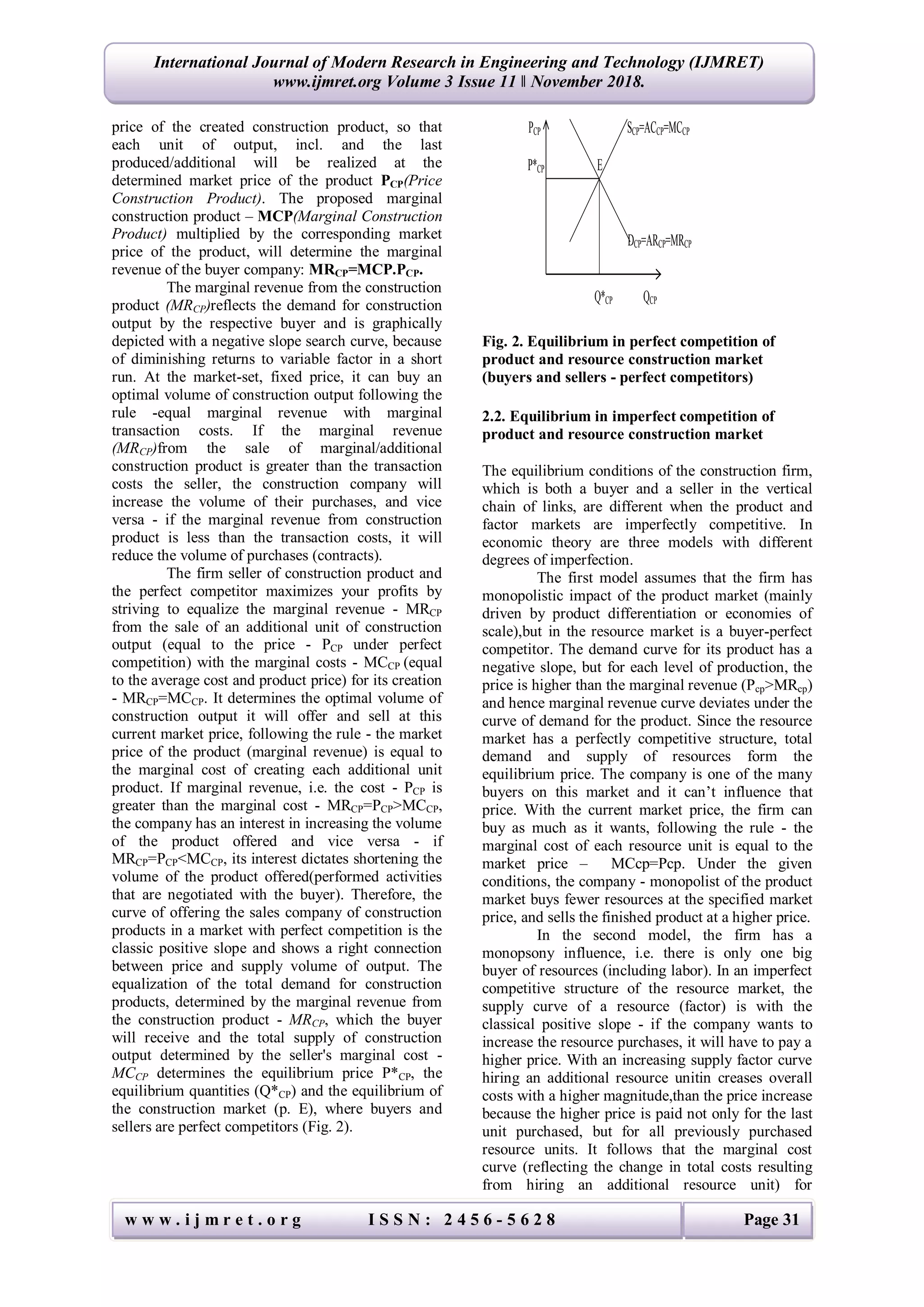
sellers are perfect competitors (Fig. 2).
Fig. 2. Equilibrium in perfect competition of
product and resource construction market
(buyers and sellers - perfect competitors)
2.2. Equilibrium in imperfect competition of
product and resource construction market
The equilibrium conditions of the construction firm,
which is both a buyer and a seller in the vertical
chain of links, are different when the product and
factor markets are imperfectly competitive. In
economic theory are three models with different
degrees of imperfection.
The first model assumes that the firm has
monopolistic impact of the product market (mainly
driven by product differentiation or economies of
scale),but in the resource market is a buyer-perfect
competitor. The demand curve for its product has a
negative slope, but for each level of production, the
price is higher than the marginal revenue (Pср>MRср)
and hence marginal revenue curve deviates under the
curve of demand for the product. Since the resource
market has a perfectly competitive structure, total
demand and supply of resources form the
equilibrium price. The company is one of the many
buyers on this market and it can’t influence that
price. With the current market price, the firm can
buy as much as it wants, following the rule - the
marginal cost of each resource unit is equal to the
market price – MCср=Pср. Under the given
conditions, the company - monopolist of the product
market buys fewer resources at the specified market
price, and sells the finished product at a higher price.
In the second model, the firm has a
monopsony influence, i.e. there is only one big
buyer of resources (including labor). In an imperfect
competitive structure of the resource market, the
supply curve of a resource (factor) is with the
classical positive slope - if the company wants to
increase the resource purchases, it will have to pay a
higher price. With an increasing supply factor curve
hiring an additional resource unitin creases overall
costs with a higher magnitude,than the price increase
because the higher price is paid not only for the last
unit purchased, but for all previously purchased
resource units. It follows that the marginal cost
curve (reflecting the change in total costs resulting
from hiring an additional resource unit) for
PCP SCP=ACCP=MCCP
P*CP Е
DCP=ARCP=MRCP
Q*CP QCP
w w w . i j m r e t . o r g I S S N : 2 4 5 6 - 5 6 2 8 Page 32
International Journal of Modern Research in Engineering and Technology (IJMRET)
www.ijmret.org Volume 3 Issue 11 ǁ November 2018.
purchasing resources is growing and located above
and to the left of the supply curve or above average
labor costs. In a monopsony market, the firm realizes
its monopsony power by purchasing less resources
(defined by equality of marginal revenue with
marginal cost) at a lower price - MRCP=MCcp>Pcp,
compared to a perfectly competitive market.
The third model analyzes the behavior of a
firm (seller) with a monopoly influence on the
product market and a monopsony influence (buyer)
on the resource market, i.e. a combination of the
previous two. Under these circumstances, the market
is in equilibrium when the monopsony and
monopoly company equals the marginal revenue
from the end product with the marginal cost of
purchasing the necessary resources for its
production. Due to the monopolistic influence of the
company on the product market the price of the
created product is higher than the competitive price
and the demand quantity is lower. Since demand for
resources is a function of demand for the resource-
produced product, and as a result of monopoly-
monopsony power, the price and quantity of
resources purchased are lower than the competitors.
2.3. Behavior of the construction firm with a
bilateral monopoly on the product and resource
market
The most common model of the construction market
is the model that implies a market structure with two
market participants, a monopoly on the part of the
product market, and a monopsony on the part of
resourcemarket. When a single seller (monopoly)
and single buyer (monopsony) collide on one
market, the market structure is defined as bilateral
monopoly.
If the firm-buyer of a construction product
is a monopsony and the construction firm- seller has
a monopoly impact on the product market, their
behavior changes substantially:
1) The construction firm-seller that has a
monopoly/oligopoly influence on the product
market, resulting from product differentiation, asset-
specific differentiation or economies of scale control
this market and has market power, that allows it to
impose and maintain a price of the product offered
higher than marginal revenue- PСР>MRCP. It will
seek to negotiate with the company-buyer the
volume of output it has to perform for which the
marginal revenue is equal to its marginal cost of
product creation (purchasing resources and
organizing production subject to the buyer's
requirements in the contract) - MRСР=MCСР and a
price - PСР, at which to sell such output, higher than
the specified equality - PСР>MRСР=MCСР.
2) The construction firm-buyer of the
construction product is monopsonic impacton the
market.In thissituation, its search for a construction
product with certain characteristics will be
determined by the marginal revenue it will obtain
from the realization of the product at a later stage,
but because of the monopoly position of the seller,
the market price for each quantity is higher than the
marginal revenue for that quantity and therefore the
marginal revenue curve is below the demand curve
(average income).
On the other hand, the firm-buyer and
monopsony is facing a supply (in this case a
monopoly), which may itself and independently used
in its own interest. It is well known that within the
monopoly market structure for the monopolist there
is no uniquely defined supply curve. Consequently,
the marginal cost curve for production can also be
seen as a curve, identical to its supply (with a
positive slope and an expression of average costs).
At the conclusion of the contract, the buyer is
primarily interested in marginal (transactional,
external) costs incurred by the transaction and which
will compare with the marginal revenue from the
realized construction product at the respective
market price. Due to monopsonic position the buyer
company marginal costs are higher than the
transaction price (average costs) because the higher
price applies not only to the last concluded
transaction but also to all previous ones) and the
marginal cost curve of the monopsony is above the
supply curve of the monopoly.
3) The marginal costs and revenue allow
to determine the decisions the participants in the
dealshouldadopt in order to maximize their profits
and achieve market equilibrium. The monopsony as
the only buyer in the market, maximizes the profit in
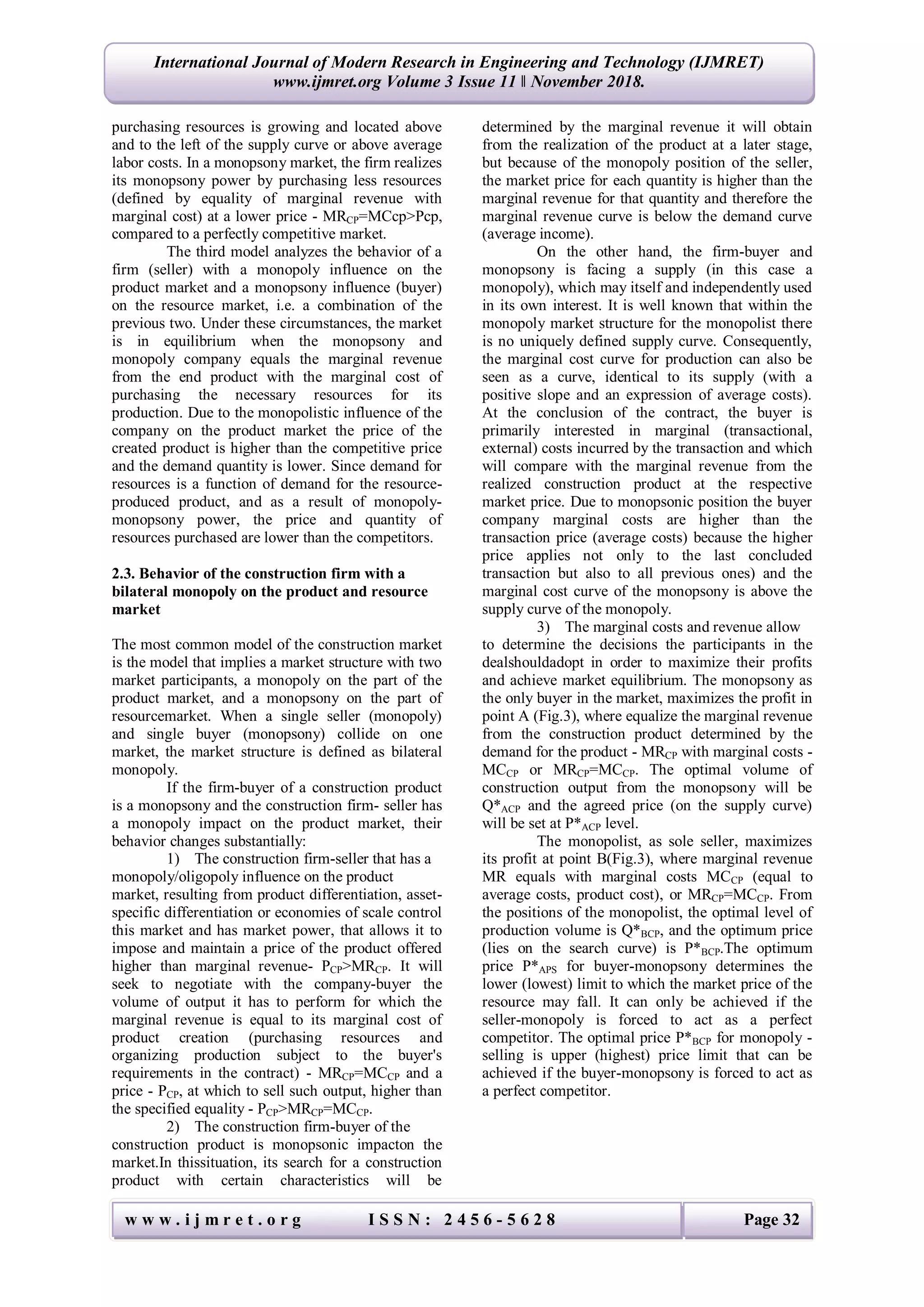
point A (Fig.3), where equalize the marginal revenue
from the construction product determined by the
demand for the product - MRCP with marginal costs -
MCCP or MRCP=MCCP. The optimal volume of
construction output from the monopsony will be
Q*ACP and the agreed price (on the supply curve)
will be set at P*ACP level.
The monopolist, as sole seller, maximizes
its profit at point B(Fig.3), where marginal revenue
MR equals with marginal costs МСCP (equal to
average costs, product cost), or MRCP=МСCP. From
the positions of the monopolist, the optimal level of
production volume is Q*BCP, and the optimum price
(lies on the search curve) is P*BCP.The optimum
price P*APS for buyer-monopsony determines the
lower (lowest) limit to which the market price of the
resource may fall. It can only be achieved if the
seller-monopoly is forced to act as a perfect
competitor. The optimal price P*BCP for monopoly -
selling is upper (highest) price limit that can be
achieved if the buyer-monopsony is forced to act as
a perfect competitor.
w w w . i j m r e t . o r g I S S N : 2 4 5 6 - 5 6 2 8 Page 33
International Journal of Modern Research in Engineering and Technology (IJMRET)
www.ijmret.org Volume 3 Issue 11 ǁ November 2018.
Fig. 3. Equilibrium of the construction market
with bilateral monopoly (monopsony buyer and
seller-monopoly)
The analysis of market behavior in this case
can’t give a single answer about what the
equilibrium price and quantity will be since the
different objectives of the two parties with market
power on both markets can’t be realized at the same
time. Under these conditions can only determine
price limits (between P*ACP - P*BCP) within which
the negotiations will be conducted between the
participants - the construction firm-buyer and the
construction firm-seller. The level of which will be
determined agreed price depends on the skills and
strength to bargain the buyer and seller, as well as
the specifics of the construction market segment:
Many large, small, equivalent sellers are
operating on the housing market in an effective
monopoly competition. The large number of buyers
(each household in the country is a potential buyer in
this segment) have an ever-increasing market impact
and opportunities for imposing conditions and prices
on the conclusion of contracts. Construction
companies can respond to increasing market power
to buyers by improving, developing and
differentiating their product and activity and creating
loyal consumers.
In the market for non-residential
construction, buyers are usually several large
investors - oligopsony, with significant market
power. They almost always one-sidedly define the
parameters of the transaction and impose their
requirements for quality, price, timeliness of the
projects and objects. The buyers (oligopsony)
usually work with several firm (sellers) based on
repeated contracts, transaction specifics, and
experience. The effect of this specialization is the
differentiation of the company's product and the
increasing monopoly power of the seller.
In the civil construction market, the buyer is always
only one - the assignor, in the face of various state
institutions. This is a typical monopsony market with
a large market power that fully determines the
operating conditions of construction companies. A
seller on this market is a large company (monopolist,
which reduces the market power of the buyer) with
differentiated assets and specialized in the
construction, which works with various small
contractors and subcontractors. In this case, a typical
bilateral monopoly in both markets the final result in
terms of agreed price and volume of work is usually
similar to the ideal market outcome (effect) in the
perfect competition, which increases economic
efficiency.
Therefore, the different market segments
the buyer and the seller have different market power,
and the final market outcome (price/quantity)
depends on which of the parties will take leadership
positions in pricing, although none of the price
options dictate prevents the realization of maximum
aggregate profit. In a market with a bilateral
monopoly the interests of both participants with
market power obviously difficult to realize at the
same time. The buyer's power must be sufficient to
prevent monopoly increases seller's prices, and the
seller's power must be sufficient to prevent
monopsony high prices from the buyer. Higher
efficiency and sustainable construction can be
achieved by improving of the vertical relationships
between all participants in the construction process,
which allows a reduction in the market power of the
buyer and the seller.
III. BUILDING AN INTEGRATED
VERTICAL CHAIN – A FACTOR FOR
SUSTAINABLE CONSTRUCTION
Problems in the vertical chain of connections in the
construction market, the impact of unfavorable
factors make the seller and the buyer look for a
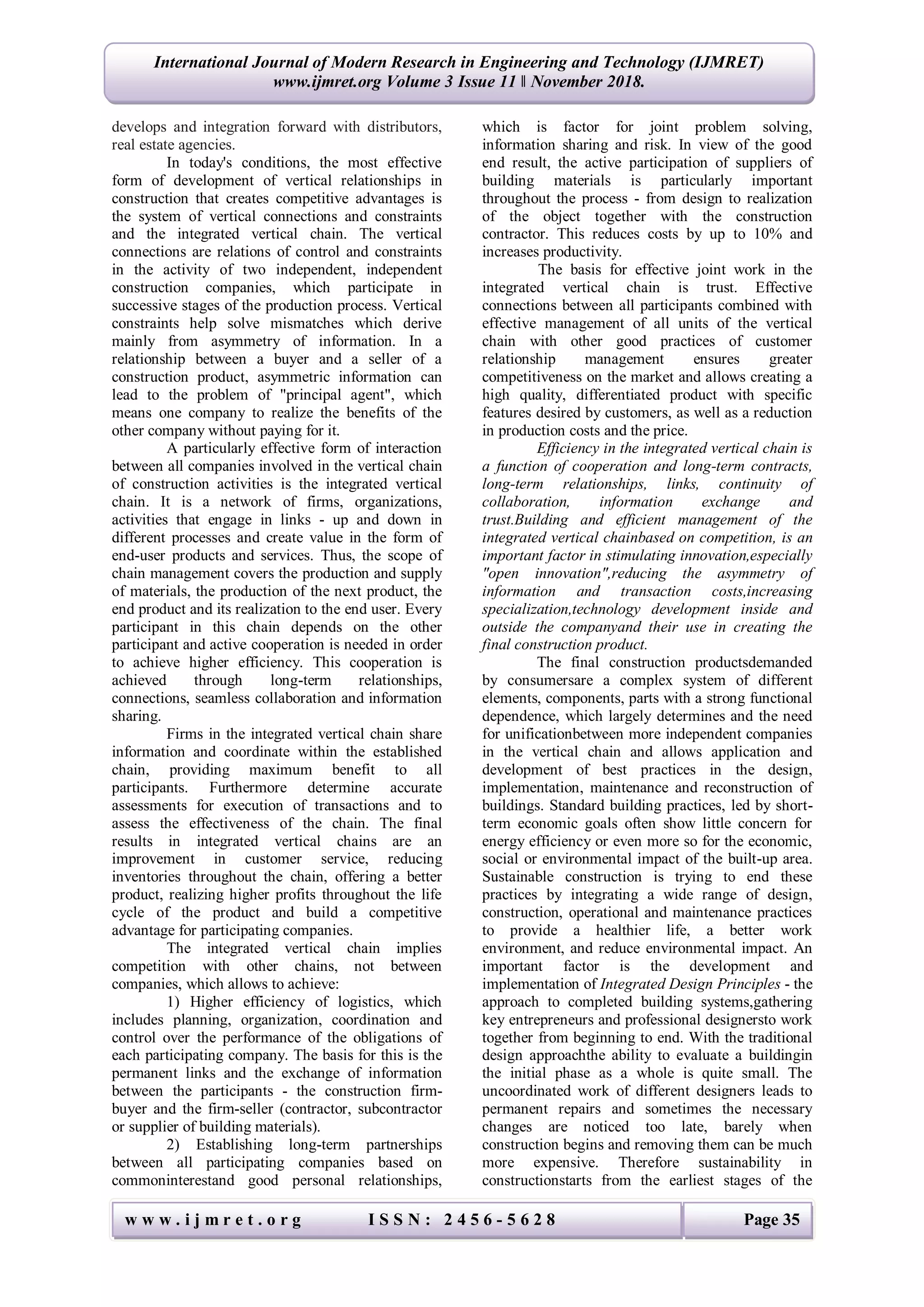
relatively stable relationship. The choice of vertical
relationships for each firm depends on the nature of
the relationship between the firm and its partners
(buyers and suppliers) and is determined by the
frequency and complexity of the transactions
between the two parties (Fig. 4). Market transactions
are preferred for occasional or regular transactions,
which are the subject of these transactions - a
product with common features. The specificity of the
transaction, the product subject to the transaction
and its increasing frequency imposes the vertical
integration policy as the most effective.The
integrated vertical control chain and the system of
vertical connections and constraints occupy an
intermediate place but have a growing importance in
company policy and practice, both because of the
higher end efficiency and because of the limitations
and control of vertical mergers imposed by antitrust
law in each country.
PCP
MCCP
P*BCP A
MRCP
SCP=ACCP=MCCP
P*ACP DCP=ARCP=MRCP
B
Q*BCP Q*ACP QCP
w w w . i j m r e t . o r g I S S N : 2 4 5 6 - 5 6 2 8 Page 34
International Journal of Modern Research in Engineering and Technology (IJMRET)
www.ijmret.org Volume 3 Issue 11 ǁ November 2018.
Fig. 4. Selecting the vertical relationship of the
construction company
The process of vertical integration is mainly
aimed at uniting the successfully functioning units of
the production process into a single chain. Due to the
specifics of the construction market there are four
types of transactions that make vertical integration
particularly effective [4]:
1) Transactions that require the use of
specific assets by the seller or buyer. The specificity
of the company assets is one of the main motives for
vertical integration. These transactions include
specialist vendor assets that are used only by a few
buyers or physically specialized, specific buyer
assets that require specific resources provided by a
small number (often a single supplier) of suppliers
and also the specialization and specificity of the
human resources used in a given production that are
acquire only subject to the requirements of the
buyer.
2) Uncertainty of the deal, which makes
control very difficult.
3) Asymmetry of information received by
the buyer (when the resource provider presents true
but incomplete information to their partner).
4) Need for extensive coordination, which
means high costs and time to realize the goal.
The main reason for the vertical integration
of companies is the increase in transaction costs.
Merging with subcontractors and/or suppliers and/or
distributors reduces these costs and turns them into
internal company costs.
In addition, control over important raw
materials can provide the company with competitive
advantages over other companies that are now
denied access to this source of raw materials.
Vertical mergers with feedstock suppliers create
prerequisites for increased costs for competitors'
production or penetration costs for new firms.
Through the merger, the suppliers become
employees of the company which ensures their
loyalty and reduces asymmetry of information. On
the other hand, vertical mergers of companies enable
rhythmically to be supplied with vital raw materials,
better control over the quality of raw materials used,
and reduction of production and transport costs.
Most often, vertical integration with sellers
(resource providers) or forward with buyers leads to
an increase in production capacity, technology
competencies of the company and creates
opportunities for using and transferring larger cash
flows between individual enterprises and stimulating
research and innovation. So large, leading
construction companies create complex holding
structures, which bring together a large number of
subsidiaries, specialized in a particular activity from
the different stages of the construction process or in
the production of a product for a particular market
segment. This is also proof of the high degree of
horizontal integration achieved in them, which is an
important condition for their higher efficiency -
achieved economies of scale, pooling more financial
resources and flexibility, adaptability to market
changes. In addition, these companies include in
their structure and companies related to the
investment activity, the valuation and realization of
real estates and of course the production and trade of
building materials. These processes of horizontal
and vertical mergers cover the whole process of
vertical links in the construction market and reduce
the monopoly power of suppliers and buyers.
Because of the high resource intensity of
construction activity, the construction company links
as buyers of building materials with its suppliers are
particularly important. The supply of building
materials is carried out by several large companies
involved in an oligopoly structure (the concentration
of this market reaches 60-70%) which are the active
part of the entire construction process. These
companies realize significant economies of scale and
have high production potential, which is an
important factor in reducing costs and hence in raw
material prices. In turn, construction companies
(contractors and subcontractors) also aim to reduce
their costs (usually by around 20-30%) and provide
timely, reliable supplies and receive materials,
different components at a lower cost, at best,
favorable conditions for the payment of credit. Large
construction companies negotiate directly with large
manufacturers or wholesalers at discounts for large
purchases. The highly concentrated market, with low
competition between the suppliers of building
materials on the one hand and on the other hand the
low concentrated and high competition construction
market, gives the impression that strong suppliers
exercise their market power. Practice shows that the
suppliers of building materials do not use or impose
a monopoly or oligopolistic power on the
construction market. For these reasons, large unions
of suppliers of building materials and construction
companies are rare in practice.
Large construction companies build their
own production bases for building materials, near
the territory where they are localized, which
provides them with stability, rhythmic delivery and,
most importantly, lower transaction and
transportation costs or buy small companies -
manufacturers of building materials.Similarly
Characteristicsoftransactions
General Mixed Specific
Random,irregular
Frequencyof
transactions
Regular,permanent
Market Dealswithan
transactions arbitrator
Verticalconnectionsandlimitations
Integratedsupplychains
Market Bilateral Vertical
transactions transactionsintegration
w w w . i j m r e t . o r g I S S N : 2 4 5 6 - 5 6 2 8 Page 35
International Journal of Modern Research in Engineering and Technology (IJMRET)
www.ijmret.org Volume 3 Issue 11 ǁ November 2018.
develops and integration forward with distributors,
real estate agencies.
In today's conditions, the most effective
form of development of vertical relationships in
construction that creates competitive advantages is
the system of vertical connections and constraints
and the integrated vertical chain. The vertical
connections are relations of control and constraints
in the activity of two independent, independent
construction companies, which participate in
successive stages of the production process. Vertical
constraints help solve mismatches which derive
mainly from asymmetry of information. In a
relationship between a buyer and a seller of a
construction product, asymmetric information can
lead to the problem of "principal agent", which
means one company to realize the benefits of the
other company without paying for it.
A particularly effective form of interaction
between all companies involved in the vertical chain
of construction activities is the integrated vertical
chain. It is a network of firms, organizations,
activities that engage in links - up and down in
different processes and create value in the form of
end-user products and services. Thus, the scope of
chain management covers the production and supply
of materials, the production of the next product, the
end product and its realization to the end user. Every
participant in this chain depends on the other
participant and active cooperation is needed in order
to achieve higher efficiency. This cooperation is
achieved through long-term relationships,
connections, seamless collaboration and information
sharing.
Firms in the integrated vertical chain share
information and coordinate within the established
chain, providing maximum benefit to all
participants. Furthermore determine accurate
assessments for execution of transactions and to
assess the effectiveness of the chain. The final
results in integrated vertical chains are an
improvement in customer service, reducing
inventories throughout the chain, offering a better
product, realizing higher profits throughout the life
cycle of the product and build a competitive
advantage for participating companies.
The integrated vertical chain implies
competition with other chains, not between
companies, which allows to achieve:
1) Higher efficiency of logistics, which
includes planning, organization, coordination and
control over the performance of the obligations of
each participating company. The basis for this is the
permanent links and the exchange of information
between the participants - the construction firm-
buyer and the firm-seller (contractor, subcontractor
or supplier of building materials).
2) Establishing long-term partnerships
between all participating companies based on
commoninterestand good personal relationships,
which is factor for joint problem solving,
information sharing and risk. In view of the good
end result, the active participation of suppliers of
building materials is particularly important
throughout the process - from design to realization
of the object together with the construction
contractor. This reduces costs by up to 10% and
increases productivity.
The basis for effective joint work in the
integrated vertical chain is trust. Effective
connections between all participants combined with
effective management of all units of the vertical
chain with other good practices of customer
relationship management ensures greater
competitiveness on the market and allows creating a
high quality, differentiated product with specific
features desired by customers, as well as a reduction
in production costs and the price.
Efficiency in the integrated vertical chain is
a function of cooperation and long-term contracts,
long-term relationships, links, continuity of
collaboration, information exchange and
trust.Building and efficient management of the
integrated vertical chainbased on competition, is an
important factor in stimulating innovation,especially
"open innovation",reducing the asymmetry of
information and transaction costs,increasing
specialization,technology development inside and
outside the companyand their use in creating the
final construction product.
The final construction productsdemanded
by consumersare a complex system of different
elements, components, parts with a strong functional
dependence, which largely determines and the need
for unificationbetween more independent companies
in the vertical chain and allows application and
development of best practices in the design,
implementation, maintenance and reconstruction of
buildings. Standard building practices, led by short-
term economic goals often show little concern for
energy efficiency or even more so for the economic,
social or environmental impact of the built-up area.
Sustainable construction is trying to end these
practices by integrating a wide range of design,
construction, operational and maintenance practices
to provide a healthier life, a better work
environment, and reduce environmental impact. An
important factor is the development and
implementation of Integrated Design Principles - the
approach to completed building systems,gathering
key entrepreneurs and professional designersto work
together from beginning to end. With the traditional
design approachthe ability to evaluate a buildingin
the initial phase as a whole is quite small. The
uncoordinated work of different designers leads to
permanent repairs and sometimes the necessary
changes are noticed too late, barely when
construction begins and removing them can be much
more expensive. Therefore sustainability in
constructionstarts from the earliest stages of the
w w w . i j m r e t . o r g I S S N : 2 4 5 6 - 5 6 2 8 Page 36
International Journal of Modern Research in Engineering and Technology (IJMRET)
www.ijmret.org Volume 3 Issue 11 ǁ November 2018.
projectand requires responsible engagementof all
participants in the process: investors and clients,
architects, designers, construction firms-contractors
and subcontractors, suppliers of raw materials,
administrative authorities, lawyers, researchers,
which in fact means creating of an integrated vertical
chain and substantial changes in the organization,
coordination and management of the construction
company at all levels.
Integrated vertical chainallowsthe
implementation of the Integration and Co-operation
Strategy,which is particularly important todaydue to
the fact that most innovations are complementary
and not interchangeable. Complementary
innovations are the result of a chain reaction,
triggered by the emergence of an innovation and the
existence and development of complementary,
specific assets in different activities or different
companies, and any such specific asset is the result
of another such specific asset and can’t
independently fulfill its purpose. The
interdependence of specific assets also implies the
creation of a package of complementary products
(goods and/or services) that increase the satisfaction
of the end customer. The ability of managers to
identify, develop and use their specific assets in
combination with other specific assets of other
companies, participants in the vertical chain of
created value it is unique and often very difficult to
realize. Integration and Co-operation Strategy allows
a firm to specialize its assets and use them more
efficiently with a new combination and joint use
with other specialized assets from other companies,
which is a factor for realizing economies of scale
and offering an integrated solution for customers.
One major opportunity to improve the links
between the firms in the vertical chain and especially
for the development of the small subcontractors is to
unification with other companies and create strategic
alliances. They are defined as "voluntary
partnerships between firms on the basis of
contractual relationships that allow for development
and change through cooperative production and the
development of the end product created through the
transfer of technology, knowledge and services" [5],
with the participating companies retain their relative
independence in the time of its existence, i.e. are
practically excluded and no merger and takeover
processes are observed.
Strategic alliances can be realized both
between companies that are equal partners and
between companies with different market positions
and potential [6]. If a small company participates in
a union with a big, established firm on the market, it
gives it access to the experience of the big ones, to
the "good practices", the opportunity to improve the
internal organization, to improve its activity, to
expand the knowledge and to create a new, allowing
initiate necessary changes. The creation of an
alliance involving small, medium, equivalent firms
limits the potential, reduces the flexibility to the
dynamics of the environment and their future
development. A small business has a chance to
succeed if it participates in a strategic alliance where
other actors have innovative capabilities and
therefore the potential for technological and market
change.
If for small business players in such a
system the result is a better business and learning of
"good practices", for big, key players, building these
relationships is an opportunity to realize economies
of scale and/or economies of scope, reducing
switching costs associated with choice of suppliers
and other contractors, which stimulates the
development of innovations in a product,
technology, and allows the creation of a higher
added value for customers and thus the realization of
higher profits. An important factor in achieving the
desired success, greater than the success that can be
realized in each individual company taken or a
synergy effect is the realization of the necessary
control and coordination of the overall activity.
The links in the strategic alliance are
developing on the activities of the included firms
that create separate parts, elements, components of
the final general product. The company leader, a key
player, sets the standards, the product requirements
created at each stage of total production. Under these
conditions, the small company must develop and
deepen its specialization and differentiation of the
created product. Realizing a common objective
requires maintenance of formal and informal links
between different companies and personalities based
on the generic resource created by acquiring
different assets. A key success factor is access to
information, experience and their exchange in order
to solve current problems. Building effective links at
all levels, formal and informal, the trust between all
subjects is critical for each union.
The unification between companies can to
ensure a more efficient allocation and use of scarce
resources, the realization of a synergistic effect in
one or more companies, successful adaptation to
external changes, through know-how, knowledge
sharing, information, technology and products,
which in turn increases the productivity and
effectiveness of vertical links.
A more effective partnership between the
public and private sectors can also be realized by
creating a construction cluster, which includes
interconnected companies/subjects, involved in the
vertical chain of created value - construction
company with strong positions (leader), investors,
suppliers of construction equipment, raw materials,
architectural and design offices, contractors and
subcontractors, distributors, marketing and
advertising agencies, state and local public
institutions, universities, research units, construction
(branch) organizations, each with specific rights and
obligations. Clusters are geographically concentrated
w w w . i j m r e t . o r g I S S N : 2 4 5 6 - 5 6 2 8 Page 37
International Journal of Modern Research in Engineering and Technology (IJMRET)
www.ijmret.org Volume 3 Issue 11 ǁ November 2018.
associations (region, state, or even a city, and may
be extended to neighboring towns, regions, or even
neighboring countries), which primarily recognize
the priority of education and research and provide
specialized training, education, information,
research, technical support of the participating firms
and whose activities as a whole are developed on
competition and cooperation [7].
The efficiency of clusters is due to the
applied integrative approach to various activities,
projects that are interconnected, complementary.
The main factor ensuring the efficient functioning of
the construction cluster is the availability of a basic,
leading company (often called anchor), well-built
infrastructure, access to markets, raw materials,
social services and financial resources. Most cluster
participants are not direct competitors, they work on
different market segments, have common problems,
opportunities and threats in their business. Practice
proves that the success of the cluster is primarily a
function of the development and use of intangible
assets (innovation, knowledge and education) that
are the basis for building an effective system of
inter-firm relationships on trust.
Opportunities for coordination and mutual
improvement of activity in each cluster reduce the
risk of ineffective competition or limiting the
intensity of rivalry. The realization of these
processes depends to a great extent on the built
personal relationships, communication and networks
of private persons and institutions. Close links with
buyers, suppliers, and other institutions are an
important factor for the realization of competitive
advantages company goals, while at the same time
the system does not exclude competition between
participating companies, on the contrary- it implies.
Especially important is the availability of an
educated workforce, proximity to research, higher
education, an entrepreneurial spirit and culture that
values education and knowledge. These services
must be provided by public institutions.
The public sector plays the role of an
intermediary between participating private firms, a
role of initiator of programs and concrete
implementation plans, a listener of problems that
need to be quickly mastered and resolved. Public
institutions at national or local level have three main
objectives:
1) Ensure cooperation, interaction and
equality to all actors involved and to create
conditions for a strategic partnership.
2) To maintain the necessary infrastructure
- transport, social and opportunities for permanent
development, training and raising the qualification
of the required workforce.
3) Ensure coordination of the different
programs and funding of interconnected activities,
not individual activities and projects that are isolated
from one another.
Interaction, cooperation and competition
with all participating companies in the construction
cluster requires the creation and implementation of
new business models, where specialization, the
development of open innovation of the company and
its co-operation with other interconnected and
complementary companies and assets are central.
The creation of the construction cluster facilitates
the creation of an effective integrated vertical link
system, because it includes from related and
supporting the main production activities, "from the
development of innovation and the idea to its
realization".
IV. CONCLUSION
Requirements and principles of sustainable
construction impact more and more on the overall
construction process -from the design, construction,
exploitation and destruction of a building and
require effective cooperation of all participants in
the vertical chain of construction activities. The
object of study in the article are the complex
relationships between the companies participating in
the vertical chain of value creation in the
construction. The specificity of construction as an
economic activity and of the construction product
(goods and services) determine the existence of a
complex vertical chain of links, involving different
actors, which they perform simultaneously the
function of the buyer of the product from a previous
participant and vendor product to the next
participant. In practice, this means that in every unit
of the vertical chain has conditions for bilateral
monopoly - the construction company as a purchaser
of resources and services can be a monopson or
oligopson,and on the other hand the exit,as the seller
of the created product may be in the role of a
monopoly or oligopoly on the market,with
significant market power which it determinesand the
main problem of vertical links. The buyer's power
must be sufficient to prevent monopoly increases
seller's prices, and the seller's power must be
sufficient to prevent monopsony high prices from
the buyer, which is a factor in increasing the
economic efficiency of the market, and improving
the relationships between the participants in the
vertical chain.
The problems show that it is necessary link
between all participants sharing experiences and
multiply each had a positive effect. The final
construction products which are in demand by
consumers are a complex system of different
elements, components, parts with strong functional
dependence, which to a large extent defines and the
need for unification between most independent firms
in a vertical chain, and is a factor for the application
and development of best practices in the field of
w w w . i j m r e t . o r g I S S N : 2 4 5 6 - 5 6 2 8 Page 38
International Journal of Modern Research in Engineering and Technology (IJMRET)
www.ijmret.org Volume 3 Issue 11 ǁ November 2018.
design, construction, maintenance and
reconstruction.
There is a need for partnership, which
means a joint approach of clients, contractors and
subcontractors in order to ensure the economic,
social and environmental efficiency of the
construction. In modern conditions, the most
efficient form of development and improvement of
vertical relationships in construction is the integrated
vertical chain. Integrated vertical chain is based on
competition and includes a network of companies,
organizations, activities that cover the entire
construction process (from production and supply of
materials, the production of various intermediates, to
the creation of the final product and its realization)
and create value in the form of end-user products
and services. Efficiency is achieved through
cooperation and long-term contracts, long-term
relationships, links, continuity of collaboration,
information sharing and trust. The establishment and
effective management of an integrated vertical chain
of links and competitive relationships is an imortant
factor in stimulating innovation, especially "open
innovation", reducing information asymmetry and
transaction costs, increasing specialization,
developing technology inside and outside the
company and their use in creating the final
construction product.
The study shows that the construction
marketit is necessary to improve the level of
communicationbetween participating companies,
partnership development,whether formally by
arrangements (strategic alliances, construction
cluster)or through informal relationshipswhich allow
the construction of multidisciplinary teamsright from
the beginning of a project,whose main purpose is to
create an objectmeeting the requirements of
sustainable construction.Sustainable construction
requires the commitment of all participants in the
process from start to finish: investors and clients,
architects, constructors, contractors and
subcontractors, suppliers,administrative authorities,
researchers, which in practice means building an
integrated vertical chain.
REFERENCES
[1] D. Myers, Construction Economics: A new
approach. (London. Spon Press, 2004), 281-
285
[2] A. Bridge, C. Tisdell, The Determinants of the
Vertical Boundaries of the Construction
Firms,Construction Management and
Economics, (22 /8), 2006, 807-825
[3] R. Coase,The Nature of the Firm, Economica,
4 (16), 1937, 386–405
[4] O. Williamson, The Economic Institutions of
Capitalism. (New York: Free Press, 1985)
[5] R. Gulati, Alliances and networks,Strategic
Management Journal,Vol. 19, 1998, 293–331
[6] M. Iansiti, R. Levien, Strategy as
Ecology,Harvard Business Review,Mar, 82(3),
2004, 68-78,
[7] M. Porter, Clusters and the new economics of
competition, Harvard Business Review,
Nov/Dec.,76(6), 1998, 77-90

Building an integrated vertical chain - a factor for sustainable construction

  • 1.
    w w w. i j m r e t . o r g I S S N : 2 4 5 6 - 5 6 2 8 Page 28 International Journal of Modern Research in Engineering and Technology (IJMRET) www.ijmret.org Volume 3 Issue 11 ǁ November 2018. Building an integrated vertical chain - a factor for sustainable construction Aneta Marichova Associate Professor of Economics Social Sciences Department University of Architecture, Civil Engineering and Geodesy Sofia, Bulgaria ABSTRACT -The concept of sustainable construction is increasingly affecting the development of the construction market.The specificity of construction as an economic activity and ofthe construction product (goods and services) determine the existence of a complex vertical chain of links, involving different actors, who tend to work in the short term and are limited to the rational use of knowledge and experience in practice. Moreover, it is characterized by a low level of inter-company relationshipsresulting in a fragmentation of responsibilityand complicates and hinders the realization of projects and sites,which meet the requirements of sustainable construction. Sustainable construction requires a holistic approach and substantial changes in the organization of construction activity, both at the market and firm level, under the active role of the state. The aim of the study is: 1) analysis of problems in the vertical chain of connections in the construction market, 2)an analysis of the possibilities for creating stable long-term relationships and a joint approach of clients, contractors and subcontractors, which can provide economic, social and environmental efficiency of the construction. KEYWORDS -Bilateral Monopoly, Construction Firm-Buyer/Seller, Construction Market, Integrated Vertical Chain, Sustainable Construction I. INTRODUCTION General trend in the development of modern economies is increasing role of the market in the allocation and use of scarce resources. This means that the process is carried out from private individuals, companies, which in their behavior are mainly guided by their personal interest and the realization of higher profits. Sustainable construction is a long-term goal that requires a high level of knowledge, competence and interaction between all participants in the construction process. According to analysts, the construction market is inefficientas participants tend to work in the short term, difficult to perceive innovationsand are limited rationalusing the accumulated knowledge and experience in their practice. A common feature is also the low level of inter-company relations, which means that the same team rarely works together more than one project. This complicates and hampers in practicethe realization of projects and sites,which meet the requirements of sustainable constructionand leads to fragmentation of responsibility.These problems are particularly visiblein ineffective vertical relationshipsbetween participating companies. In other words, each project involves companies that are collected temporarily only for the realization of the project and specific goals. At the same time, these firms are likely to be involved in other projects where they coordinate their actions and allocate resources to other companies involved in the supply chain. Each construction firm realizes simultaneously several different, individual projects within the framework of its more widely defined mission and vision for development, which requires coordinating its actions with other companies outside the scope of each project. Unlike the construction market, other industrial activities are characterized by relatively few independent elements and a much higher level of coordination and management that allows the use of standardized procedures and products and provides higher quality, improved management and economies of scale. This suggests that the construction market is necessary improvement of the level of communication between the participating companies, development of partnership, whether formally through contracts or simply achieved through informal relations, which allow the creation of multidisciplinary teams of investors, architects, designers, contractors, end-users at the very beginning of the project. A partnership is required, which means a joint approach by customers, contractors and subcontractors to optimize costs, create more value at each stage of the chain, deepen the specialization and differentiation of each
  • 2.
    w w w. i j m r e t . o r g I S S N : 2 4 5 6 - 5 6 2 8 Page 29 International Journal of Modern Research in Engineering and Technology (IJMRET) www.ijmret.org Volume 3 Issue 11 ǁ November 2018. intermediate product, enhance the quality of the finished product, which can provide economic, social and environmental efficiency of construction.The vicious circle must break,in which construction companies say they can build sustainable,if customers want, customers want sustainable construction if they meet their wishes and provide the desired return on investment, designers are ready to design sustainably if investors are willing to pay,and investors are willing to pay if there is a demand for sustainable construction. Realizing this goal is far from simple, especially when there is no trust and effective cooperation between the participants [1]. On the one hand, there is no commitment from larger contractors to subcontractors for training, education, innovation development, initiatives to improve organization and management of the activity, improvement of working conditions and environmental protection. On the other hand, the subcontractors (who actually carry out the projects) accept the projects they realize as prototypes, which is why many of the problems that have arisen during the implementation of some projects are not analyzed, but they are assumed to be normal functioning of the business. At the same time, solving a problem, a task in a single project, can and should be passed as a positive experience in subsequent projects. For this purpose it is necessary link between all participants sharing experiences and multiply each had a positive effect. Gathering information and revealing the essence of the problem can only happen with the active participation of all employees in a given company and the other companies participating in the vertical chain. Motivation and incentives for employees are a factor to overcome the problem and create a more efficient organization. Many of the problems are created by other participants at other stages of the construction process, resulting from short-sighted vertical chain management and difficult to remove from one firm. Contractors and sub-contractors do not want to recognize the impact of their behavior on other activities and stages. As a result, the problems are solved in a piece for the moment, which means high costs and inefficiency. Furthermore, there is often a causal link between problems along the chain and solving a problem means awareness of dependence and acommon desire to overcome the problem through long-term cooperation, which is rarely happening.Theconstruction market prevailing short- term contract, which means that the parties have no interest in investing time and resources in such endeavors. Moreover, in the context of a decline in construction activity, short-term contracts allow the contractor to rationalize, optimize its activity by stopping it and reducing the number of subcontractors with which it works. This policy does not provide sustainability of construction in the long term and opportunities for quality improvement. The absence of a uniform standard,adequate legal norms,guidelines for design work,construction and maintenance of sustainable construction sitesdo not allow effective cooperation of all participants in the vertical chain of construction activities. These problems in the vertical chain of value creation in construction, objectively indicate a need for improvement and more effective management. The aim of the survey is: 1) analysis of problems in the vertical chain of connections in the construction market, 2)an analysis of the possibilities for creating stable long-term relationships and a joint approach of clients, contractors and subcontractors, which can provide economic, social and environmental efficiency, or sustainable construction. II. ANALYSIS OF VERTICAL CONNECTIONS OF THE CONSTRUCTION MARKET The specificity of construction as an economic activity and the construction product (goods and services) determine the existence of a complex vertical chain of links, involving different actors, as buyers and sellers which create value at each stage of construction and perform different tasks and functions (Fig.1). In this vertical chain main subject and factor is the investor - the person, which finances the entire construction activity own and credit funds. The investor may be public - the state or municipalities, or private, physical person - companies, households. Public investment in construction (mostly in infrastructure) depend to a large extent the possibilities of the state budget to fund major building projects the country's priorities in the given period, its fiscal policy and various political factors. Private investment in construction depends above all expectations of economic agents for future economic development, expected return from the construction object, the credit policy of the banks and many other primarily psychological factors. Investments in construction are investments in real capital, real assets, which means that they do not exist or rarely exist an element of speculative capital. On the other hand however, often the investment solution itself is speculative, resulting primarily from the impact of future expected factors risk assessment and expectations of high returns over a relatively longer period of time. The creation of each construction product starts with the determination of the requirements, the preferences of the investor (client) regarding the construction site (area, technology, terms, quality, price). The expressed claims of each client are a function of his knowledge for about what is being sought on the market, with what technology can be realized. They find their place in the development of individual, unique construction project (from the
  • 3.
    w w w. i j m r e t . o r g I S S N : 2 4 5 6 - 5 6 2 8 Page 30 International Journal of Modern Research in Engineering and Technology (IJMRET) www.ijmret.org Volume 3 Issue 11 ǁ November 2018. point of view of location, infrastructure, functionality, design, ecology, etc.), which embodies the highly qualified work of architects and designers/constructors. The created service-level project is re-supplied to the investor for corrections, changes and a final decision (to start or to refuse realization),which is broken down by its estimate of expected return, expected changes in economic conditions, expected changes in the market, etc. In this connection, the investor is a buyer and the construction company is a seller (vendor) of a service, commissioned an external investor. The contractor works with subcontractors to whom it entrusts the execution of certain tasks for the realization of the final product. The executive firm is now a buyer, and the sellers of the service are subcontractors. These are usually small companies who perform separate activities in which they are specialized or activities related to maintenance, repairs that are not of interest to large companies. The creation and realization of the end product means that the investor and the construction company are the sellers of this product to the end user (households, firms).Therefore, the participants in the construction process simultaneously perform the function of a buyer of a product from a previous participant and a seller of the product to the next participant. This means that in every unit from the vertical chain of relationships construction firm as a buyer of resources and services can be monopsony or oligopsony, on the other hand, as the seller of the created product may be in the role of a monopoly or oligopoly on the market [2], which substantially changes the behavior and conditions of market equilibrium. Fig.1. Vertical connections between the different actors involved in the construction process At each stage of the construction process, construction firms - contractors and subcontractors use, combine in a certain way (depending on the technology chosen) different materials, labor, including the basic and most expensive resource - the land. They incur costs for their purchase from the respective suppliers and generate revenue from the product they sell. The volume of these costs and revenues is, in principle, a function of the specifics of the activity performed. Every participant in the chain searches, collects, analyzes different offers from contractors and subcontractors, and chooses one to work with and control over its activities. This costs each company significant transaction costs (external) [3],which influences the formation of the final price of the construction product. These specifics of the construction market require an in-depth analysis of the market activity of the construction firm at the entrance and exit. In addition, the construction market includes different market segments, both on the part of different buyers and their different behavior, both on the part of companies, offering different construction activities with different geographic, territorial locations. Every segment has a different number of buyers / sellers with different characteristics, different behavior formed under the influence of various factors, and mainly a function of the different competitive conditions, which determines their different market power. In order to explore the real relationships and behavior of investors (clients), contractors and subcontractors as buyers and sellers on the construction market, we will accept the assumption that the two markets - the product and resource (factor) markets have a perfectly competitive structure and create an ideal market outcome. As a result of structural changes in the market/industry, the behavior of participants (buyers gaining market influence) and market equilibrium conditions changes. 2.1. Equilibrium in perfect competition of product and resource construction market On the perfectly competitive construction market total demand is formed by all firms buyers a standardized construction product and the total supply is formed by the supply of all firms- contractors, sellers of the given standardized construction product. From the total demand and supply of the given standardized construction product, the equilibrium price and the equilibrium price, which is fixed and no buyer or seller can affect it. The construction firm-buyer and a perfect competitor on the construction product market, aiming at maximizing profits to determine the optimum volume of construction output it will buy, must compare the Marginal Revenue of Construction Product - MRCP, that you will receive at the sale of the marginal/additional construction product with the price it has to pay or with the transaction external marginal costs to conclude the deal with the subcontractor and the purchase of the marginal additional construction product - MCCP(Marginal Cost of Construction Product). The firm - a perfect competitor to the product construction market is the recipient of the Investor Firm - contractor Firm - subcontractor Client Аrchitects and designers Financial institutions Labor market and land market Advertising and media Suppliers of equipment Suppliers of raw and materials
  • 4.
    w w w. i j m r e t . o r g I S S N : 2 4 5 6 - 5 6 2 8 Page 31 International Journal of Modern Research in Engineering and Technology (IJMRET) www.ijmret.org Volume 3 Issue 11 ǁ November 2018. price of the created construction product, so that each unit of output, incl. and the last produced/additional will be realized at the determined market price of the product РCP(Price Construction Product). The proposed marginal construction product – MСP(Marginal Construction Product) multiplied by the corresponding market price of the product, will determine the marginal revenue of the buyer company: MRCP=MСP.РCP. The marginal revenue from the construction product (MRCP)reflects the demand for construction output by the respective buyer and is graphically depicted with a negative slope search curve, because of diminishing returns to variable factor in a short run. At the market-set, fixed price, it can buy an optimal volume of construction output following the rule -equal marginal revenue with marginal transaction costs. If the marginal revenue (MRCP)from the sale of marginal/additional construction product is greater than the transaction costs the seller, the construction company will increase the volume of their purchases, and vice versa - if the marginal revenue from construction product is less than the transaction costs, it will reduce the volume of purchases (contracts). The firm seller of construction product and the perfect competitor maximizes your profits by striving to equalize the marginal revenue - MRCP from the sale of an additional unit of construction output (equal to the price - РCP under perfect competition) with the marginal costs - MCCP (equal to the average cost and product price) for its creation - MRCP=MCCP. It determines the optimal volume of construction output it will offer and sell at this current market price, following the rule - the market price of the product (marginal revenue) is equal to the marginal cost of creating each additional unit product. If marginal revenue, i.e. the cost - PCP is greater than the marginal cost - MRCP=РCP>MCCP, the company has an interest in increasing the volume of the product offered and vice versa - if MRCP=PCP<MCCP, its interest dictates shortening the volume of the product offered(performed activities that are negotiated with the buyer). Therefore, the curve of offering the sales company of construction products in a market with perfect competition is the classic positive slope and shows a right connection between price and supply volume of output. The equalization of the total demand for construction products, determined by the marginal revenue from the construction product - MRCP, which the buyer will receive and the total supply of construction output determined by the seller's marginal cost - MCCP determines the equilibrium price P*CP, the equilibrium quantities (Q*CP) and the equilibrium of the construction market (р. E), where buyers and sellers are perfect competitors (Fig. 2). Fig. 2. Equilibrium in perfect competition of product and resource construction market (buyers and sellers - perfect competitors) 2.2. Equilibrium in imperfect competition of product and resource construction market The equilibrium conditions of the construction firm, which is both a buyer and a seller in the vertical chain of links, are different when the product and factor markets are imperfectly competitive. In economic theory are three models with different degrees of imperfection. The first model assumes that the firm has monopolistic impact of the product market (mainly driven by product differentiation or economies of scale),but in the resource market is a buyer-perfect competitor. The demand curve for its product has a negative slope, but for each level of production, the price is higher than the marginal revenue (Pср>MRср) and hence marginal revenue curve deviates under the curve of demand for the product. Since the resource market has a perfectly competitive structure, total demand and supply of resources form the equilibrium price. The company is one of the many buyers on this market and it can’t influence that price. With the current market price, the firm can buy as much as it wants, following the rule - the marginal cost of each resource unit is equal to the market price – MCср=Pср. Under the given conditions, the company - monopolist of the product market buys fewer resources at the specified market price, and sells the finished product at a higher price. In the second model, the firm has a monopsony influence, i.e. there is only one big buyer of resources (including labor). In an imperfect competitive structure of the resource market, the supply curve of a resource (factor) is with the classical positive slope - if the company wants to increase the resource purchases, it will have to pay a higher price. With an increasing supply factor curve hiring an additional resource unitin creases overall costs with a higher magnitude,than the price increase because the higher price is paid not only for the last unit purchased, but for all previously purchased resource units. It follows that the marginal cost curve (reflecting the change in total costs resulting from hiring an additional resource unit) for PCP SCP=ACCP=MCCP P*CP Е DCP=ARCP=MRCP Q*CP QCP
  • 5.
    w w w. i j m r e t . o r g I S S N : 2 4 5 6 - 5 6 2 8 Page 32 International Journal of Modern Research in Engineering and Technology (IJMRET) www.ijmret.org Volume 3 Issue 11 ǁ November 2018. purchasing resources is growing and located above and to the left of the supply curve or above average labor costs. In a monopsony market, the firm realizes its monopsony power by purchasing less resources (defined by equality of marginal revenue with marginal cost) at a lower price - MRCP=MCcp>Pcp, compared to a perfectly competitive market. The third model analyzes the behavior of a firm (seller) with a monopoly influence on the product market and a monopsony influence (buyer) on the resource market, i.e. a combination of the previous two. Under these circumstances, the market is in equilibrium when the monopsony and monopoly company equals the marginal revenue from the end product with the marginal cost of purchasing the necessary resources for its production. Due to the monopolistic influence of the company on the product market the price of the created product is higher than the competitive price and the demand quantity is lower. Since demand for resources is a function of demand for the resource- produced product, and as a result of monopoly- monopsony power, the price and quantity of resources purchased are lower than the competitors. 2.3. Behavior of the construction firm with a bilateral monopoly on the product and resource market The most common model of the construction market is the model that implies a market structure with two market participants, a monopoly on the part of the product market, and a monopsony on the part of resourcemarket. When a single seller (monopoly) and single buyer (monopsony) collide on one market, the market structure is defined as bilateral monopoly. If the firm-buyer of a construction product is a monopsony and the construction firm- seller has a monopoly impact on the product market, their behavior changes substantially: 1) The construction firm-seller that has a monopoly/oligopoly influence on the product market, resulting from product differentiation, asset- specific differentiation or economies of scale control this market and has market power, that allows it to impose and maintain a price of the product offered higher than marginal revenue- PСР>MRCP. It will seek to negotiate with the company-buyer the volume of output it has to perform for which the marginal revenue is equal to its marginal cost of product creation (purchasing resources and organizing production subject to the buyer's requirements in the contract) - MRСР=MCСР and a price - PСР, at which to sell such output, higher than the specified equality - PСР>MRСР=MCСР. 2) The construction firm-buyer of the construction product is monopsonic impacton the market.In thissituation, its search for a construction product with certain characteristics will be determined by the marginal revenue it will obtain from the realization of the product at a later stage, but because of the monopoly position of the seller, the market price for each quantity is higher than the marginal revenue for that quantity and therefore the marginal revenue curve is below the demand curve (average income). On the other hand, the firm-buyer and monopsony is facing a supply (in this case a monopoly), which may itself and independently used in its own interest. It is well known that within the monopoly market structure for the monopolist there is no uniquely defined supply curve. Consequently, the marginal cost curve for production can also be seen as a curve, identical to its supply (with a positive slope and an expression of average costs). At the conclusion of the contract, the buyer is primarily interested in marginal (transactional, external) costs incurred by the transaction and which will compare with the marginal revenue from the realized construction product at the respective market price. Due to monopsonic position the buyer company marginal costs are higher than the transaction price (average costs) because the higher price applies not only to the last concluded transaction but also to all previous ones) and the marginal cost curve of the monopsony is above the supply curve of the monopoly. 3) The marginal costs and revenue allow to determine the decisions the participants in the dealshouldadopt in order to maximize their profits and achieve market equilibrium. The monopsony as the only buyer in the market, maximizes the profit in point A (Fig.3), where equalize the marginal revenue from the construction product determined by the demand for the product - MRCP with marginal costs - MCCP or MRCP=MCCP. The optimal volume of construction output from the monopsony will be Q*ACP and the agreed price (on the supply curve) will be set at P*ACP level. The monopolist, as sole seller, maximizes its profit at point B(Fig.3), where marginal revenue MR equals with marginal costs МСCP (equal to average costs, product cost), or MRCP=МСCP. From the positions of the monopolist, the optimal level of production volume is Q*BCP, and the optimum price (lies on the search curve) is P*BCP.The optimum price P*APS for buyer-monopsony determines the lower (lowest) limit to which the market price of the resource may fall. It can only be achieved if the seller-monopoly is forced to act as a perfect competitor. The optimal price P*BCP for monopoly - selling is upper (highest) price limit that can be achieved if the buyer-monopsony is forced to act as a perfect competitor.
  • 6.
    w w w. i j m r e t . o r g I S S N : 2 4 5 6 - 5 6 2 8 Page 33 International Journal of Modern Research in Engineering and Technology (IJMRET) www.ijmret.org Volume 3 Issue 11 ǁ November 2018. Fig. 3. Equilibrium of the construction market with bilateral monopoly (monopsony buyer and seller-monopoly) The analysis of market behavior in this case can’t give a single answer about what the equilibrium price and quantity will be since the different objectives of the two parties with market power on both markets can’t be realized at the same time. Under these conditions can only determine price limits (between P*ACP - P*BCP) within which the negotiations will be conducted between the participants - the construction firm-buyer and the construction firm-seller. The level of which will be determined agreed price depends on the skills and strength to bargain the buyer and seller, as well as the specifics of the construction market segment: Many large, small, equivalent sellers are operating on the housing market in an effective monopoly competition. The large number of buyers (each household in the country is a potential buyer in this segment) have an ever-increasing market impact and opportunities for imposing conditions and prices on the conclusion of contracts. Construction companies can respond to increasing market power to buyers by improving, developing and differentiating their product and activity and creating loyal consumers. In the market for non-residential construction, buyers are usually several large investors - oligopsony, with significant market power. They almost always one-sidedly define the parameters of the transaction and impose their requirements for quality, price, timeliness of the projects and objects. The buyers (oligopsony) usually work with several firm (sellers) based on repeated contracts, transaction specifics, and experience. The effect of this specialization is the differentiation of the company's product and the increasing monopoly power of the seller. In the civil construction market, the buyer is always only one - the assignor, in the face of various state institutions. This is a typical monopsony market with a large market power that fully determines the operating conditions of construction companies. A seller on this market is a large company (monopolist, which reduces the market power of the buyer) with differentiated assets and specialized in the construction, which works with various small contractors and subcontractors. In this case, a typical bilateral monopoly in both markets the final result in terms of agreed price and volume of work is usually similar to the ideal market outcome (effect) in the perfect competition, which increases economic efficiency. Therefore, the different market segments the buyer and the seller have different market power, and the final market outcome (price/quantity) depends on which of the parties will take leadership positions in pricing, although none of the price options dictate prevents the realization of maximum aggregate profit. In a market with a bilateral monopoly the interests of both participants with market power obviously difficult to realize at the same time. The buyer's power must be sufficient to prevent monopoly increases seller's prices, and the seller's power must be sufficient to prevent monopsony high prices from the buyer. Higher efficiency and sustainable construction can be achieved by improving of the vertical relationships between all participants in the construction process, which allows a reduction in the market power of the buyer and the seller. III. BUILDING AN INTEGRATED VERTICAL CHAIN – A FACTOR FOR SUSTAINABLE CONSTRUCTION Problems in the vertical chain of connections in the construction market, the impact of unfavorable factors make the seller and the buyer look for a relatively stable relationship. The choice of vertical relationships for each firm depends on the nature of the relationship between the firm and its partners (buyers and suppliers) and is determined by the frequency and complexity of the transactions between the two parties (Fig. 4). Market transactions are preferred for occasional or regular transactions, which are the subject of these transactions - a product with common features. The specificity of the transaction, the product subject to the transaction and its increasing frequency imposes the vertical integration policy as the most effective.The integrated vertical control chain and the system of vertical connections and constraints occupy an intermediate place but have a growing importance in company policy and practice, both because of the higher end efficiency and because of the limitations and control of vertical mergers imposed by antitrust law in each country. PCP MCCP P*BCP A MRCP SCP=ACCP=MCCP P*ACP DCP=ARCP=MRCP B Q*BCP Q*ACP QCP
  • 7.
    w w w. i j m r e t . o r g I S S N : 2 4 5 6 - 5 6 2 8 Page 34 International Journal of Modern Research in Engineering and Technology (IJMRET) www.ijmret.org Volume 3 Issue 11 ǁ November 2018. Fig. 4. Selecting the vertical relationship of the construction company The process of vertical integration is mainly aimed at uniting the successfully functioning units of the production process into a single chain. Due to the specifics of the construction market there are four types of transactions that make vertical integration particularly effective [4]: 1) Transactions that require the use of specific assets by the seller or buyer. The specificity of the company assets is one of the main motives for vertical integration. These transactions include specialist vendor assets that are used only by a few buyers or physically specialized, specific buyer assets that require specific resources provided by a small number (often a single supplier) of suppliers and also the specialization and specificity of the human resources used in a given production that are acquire only subject to the requirements of the buyer. 2) Uncertainty of the deal, which makes control very difficult. 3) Asymmetry of information received by the buyer (when the resource provider presents true but incomplete information to their partner). 4) Need for extensive coordination, which means high costs and time to realize the goal. The main reason for the vertical integration of companies is the increase in transaction costs. Merging with subcontractors and/or suppliers and/or distributors reduces these costs and turns them into internal company costs. In addition, control over important raw materials can provide the company with competitive advantages over other companies that are now denied access to this source of raw materials. Vertical mergers with feedstock suppliers create prerequisites for increased costs for competitors' production or penetration costs for new firms. Through the merger, the suppliers become employees of the company which ensures their loyalty and reduces asymmetry of information. On the other hand, vertical mergers of companies enable rhythmically to be supplied with vital raw materials, better control over the quality of raw materials used, and reduction of production and transport costs. Most often, vertical integration with sellers (resource providers) or forward with buyers leads to an increase in production capacity, technology competencies of the company and creates opportunities for using and transferring larger cash flows between individual enterprises and stimulating research and innovation. So large, leading construction companies create complex holding structures, which bring together a large number of subsidiaries, specialized in a particular activity from the different stages of the construction process or in the production of a product for a particular market segment. This is also proof of the high degree of horizontal integration achieved in them, which is an important condition for their higher efficiency - achieved economies of scale, pooling more financial resources and flexibility, adaptability to market changes. In addition, these companies include in their structure and companies related to the investment activity, the valuation and realization of real estates and of course the production and trade of building materials. These processes of horizontal and vertical mergers cover the whole process of vertical links in the construction market and reduce the monopoly power of suppliers and buyers. Because of the high resource intensity of construction activity, the construction company links as buyers of building materials with its suppliers are particularly important. The supply of building materials is carried out by several large companies involved in an oligopoly structure (the concentration of this market reaches 60-70%) which are the active part of the entire construction process. These companies realize significant economies of scale and have high production potential, which is an important factor in reducing costs and hence in raw material prices. In turn, construction companies (contractors and subcontractors) also aim to reduce their costs (usually by around 20-30%) and provide timely, reliable supplies and receive materials, different components at a lower cost, at best, favorable conditions for the payment of credit. Large construction companies negotiate directly with large manufacturers or wholesalers at discounts for large purchases. The highly concentrated market, with low competition between the suppliers of building materials on the one hand and on the other hand the low concentrated and high competition construction market, gives the impression that strong suppliers exercise their market power. Practice shows that the suppliers of building materials do not use or impose a monopoly or oligopolistic power on the construction market. For these reasons, large unions of suppliers of building materials and construction companies are rare in practice. Large construction companies build their own production bases for building materials, near the territory where they are localized, which provides them with stability, rhythmic delivery and, most importantly, lower transaction and transportation costs or buy small companies - manufacturers of building materials.Similarly Characteristicsoftransactions General Mixed Specific Random,irregular Frequencyof transactions Regular,permanent Market Dealswithan transactions arbitrator Verticalconnectionsandlimitations Integratedsupplychains Market Bilateral Vertical transactions transactionsintegration
  • 8.
    w w w. i j m r e t . o r g I S S N : 2 4 5 6 - 5 6 2 8 Page 35 International Journal of Modern Research in Engineering and Technology (IJMRET) www.ijmret.org Volume 3 Issue 11 ǁ November 2018. develops and integration forward with distributors, real estate agencies. In today's conditions, the most effective form of development of vertical relationships in construction that creates competitive advantages is the system of vertical connections and constraints and the integrated vertical chain. The vertical connections are relations of control and constraints in the activity of two independent, independent construction companies, which participate in successive stages of the production process. Vertical constraints help solve mismatches which derive mainly from asymmetry of information. In a relationship between a buyer and a seller of a construction product, asymmetric information can lead to the problem of "principal agent", which means one company to realize the benefits of the other company without paying for it. A particularly effective form of interaction between all companies involved in the vertical chain of construction activities is the integrated vertical chain. It is a network of firms, organizations, activities that engage in links - up and down in different processes and create value in the form of end-user products and services. Thus, the scope of chain management covers the production and supply of materials, the production of the next product, the end product and its realization to the end user. Every participant in this chain depends on the other participant and active cooperation is needed in order to achieve higher efficiency. This cooperation is achieved through long-term relationships, connections, seamless collaboration and information sharing. Firms in the integrated vertical chain share information and coordinate within the established chain, providing maximum benefit to all participants. Furthermore determine accurate assessments for execution of transactions and to assess the effectiveness of the chain. The final results in integrated vertical chains are an improvement in customer service, reducing inventories throughout the chain, offering a better product, realizing higher profits throughout the life cycle of the product and build a competitive advantage for participating companies. The integrated vertical chain implies competition with other chains, not between companies, which allows to achieve: 1) Higher efficiency of logistics, which includes planning, organization, coordination and control over the performance of the obligations of each participating company. The basis for this is the permanent links and the exchange of information between the participants - the construction firm- buyer and the firm-seller (contractor, subcontractor or supplier of building materials). 2) Establishing long-term partnerships between all participating companies based on commoninterestand good personal relationships, which is factor for joint problem solving, information sharing and risk. In view of the good end result, the active participation of suppliers of building materials is particularly important throughout the process - from design to realization of the object together with the construction contractor. This reduces costs by up to 10% and increases productivity. The basis for effective joint work in the integrated vertical chain is trust. Effective connections between all participants combined with effective management of all units of the vertical chain with other good practices of customer relationship management ensures greater competitiveness on the market and allows creating a high quality, differentiated product with specific features desired by customers, as well as a reduction in production costs and the price. Efficiency in the integrated vertical chain is a function of cooperation and long-term contracts, long-term relationships, links, continuity of collaboration, information exchange and trust.Building and efficient management of the integrated vertical chainbased on competition, is an important factor in stimulating innovation,especially "open innovation",reducing the asymmetry of information and transaction costs,increasing specialization,technology development inside and outside the companyand their use in creating the final construction product. The final construction productsdemanded by consumersare a complex system of different elements, components, parts with a strong functional dependence, which largely determines and the need for unificationbetween more independent companies in the vertical chain and allows application and development of best practices in the design, implementation, maintenance and reconstruction of buildings. Standard building practices, led by short- term economic goals often show little concern for energy efficiency or even more so for the economic, social or environmental impact of the built-up area. Sustainable construction is trying to end these practices by integrating a wide range of design, construction, operational and maintenance practices to provide a healthier life, a better work environment, and reduce environmental impact. An important factor is the development and implementation of Integrated Design Principles - the approach to completed building systems,gathering key entrepreneurs and professional designersto work together from beginning to end. With the traditional design approachthe ability to evaluate a buildingin the initial phase as a whole is quite small. The uncoordinated work of different designers leads to permanent repairs and sometimes the necessary changes are noticed too late, barely when construction begins and removing them can be much more expensive. Therefore sustainability in constructionstarts from the earliest stages of the
  • 9.
    w w w. i j m r e t . o r g I S S N : 2 4 5 6 - 5 6 2 8 Page 36 International Journal of Modern Research in Engineering and Technology (IJMRET) www.ijmret.org Volume 3 Issue 11 ǁ November 2018. projectand requires responsible engagementof all participants in the process: investors and clients, architects, designers, construction firms-contractors and subcontractors, suppliers of raw materials, administrative authorities, lawyers, researchers, which in fact means creating of an integrated vertical chain and substantial changes in the organization, coordination and management of the construction company at all levels. Integrated vertical chainallowsthe implementation of the Integration and Co-operation Strategy,which is particularly important todaydue to the fact that most innovations are complementary and not interchangeable. Complementary innovations are the result of a chain reaction, triggered by the emergence of an innovation and the existence and development of complementary, specific assets in different activities or different companies, and any such specific asset is the result of another such specific asset and can’t independently fulfill its purpose. The interdependence of specific assets also implies the creation of a package of complementary products (goods and/or services) that increase the satisfaction of the end customer. The ability of managers to identify, develop and use their specific assets in combination with other specific assets of other companies, participants in the vertical chain of created value it is unique and often very difficult to realize. Integration and Co-operation Strategy allows a firm to specialize its assets and use them more efficiently with a new combination and joint use with other specialized assets from other companies, which is a factor for realizing economies of scale and offering an integrated solution for customers. One major opportunity to improve the links between the firms in the vertical chain and especially for the development of the small subcontractors is to unification with other companies and create strategic alliances. They are defined as "voluntary partnerships between firms on the basis of contractual relationships that allow for development and change through cooperative production and the development of the end product created through the transfer of technology, knowledge and services" [5], with the participating companies retain their relative independence in the time of its existence, i.e. are practically excluded and no merger and takeover processes are observed. Strategic alliances can be realized both between companies that are equal partners and between companies with different market positions and potential [6]. If a small company participates in a union with a big, established firm on the market, it gives it access to the experience of the big ones, to the "good practices", the opportunity to improve the internal organization, to improve its activity, to expand the knowledge and to create a new, allowing initiate necessary changes. The creation of an alliance involving small, medium, equivalent firms limits the potential, reduces the flexibility to the dynamics of the environment and their future development. A small business has a chance to succeed if it participates in a strategic alliance where other actors have innovative capabilities and therefore the potential for technological and market change. If for small business players in such a system the result is a better business and learning of "good practices", for big, key players, building these relationships is an opportunity to realize economies of scale and/or economies of scope, reducing switching costs associated with choice of suppliers and other contractors, which stimulates the development of innovations in a product, technology, and allows the creation of a higher added value for customers and thus the realization of higher profits. An important factor in achieving the desired success, greater than the success that can be realized in each individual company taken or a synergy effect is the realization of the necessary control and coordination of the overall activity. The links in the strategic alliance are developing on the activities of the included firms that create separate parts, elements, components of the final general product. The company leader, a key player, sets the standards, the product requirements created at each stage of total production. Under these conditions, the small company must develop and deepen its specialization and differentiation of the created product. Realizing a common objective requires maintenance of formal and informal links between different companies and personalities based on the generic resource created by acquiring different assets. A key success factor is access to information, experience and their exchange in order to solve current problems. Building effective links at all levels, formal and informal, the trust between all subjects is critical for each union. The unification between companies can to ensure a more efficient allocation and use of scarce resources, the realization of a synergistic effect in one or more companies, successful adaptation to external changes, through know-how, knowledge sharing, information, technology and products, which in turn increases the productivity and effectiveness of vertical links. A more effective partnership between the public and private sectors can also be realized by creating a construction cluster, which includes interconnected companies/subjects, involved in the vertical chain of created value - construction company with strong positions (leader), investors, suppliers of construction equipment, raw materials, architectural and design offices, contractors and subcontractors, distributors, marketing and advertising agencies, state and local public institutions, universities, research units, construction (branch) organizations, each with specific rights and obligations. Clusters are geographically concentrated
  • 10.
    w w w. i j m r e t . o r g I S S N : 2 4 5 6 - 5 6 2 8 Page 37 International Journal of Modern Research in Engineering and Technology (IJMRET) www.ijmret.org Volume 3 Issue 11 ǁ November 2018. associations (region, state, or even a city, and may be extended to neighboring towns, regions, or even neighboring countries), which primarily recognize the priority of education and research and provide specialized training, education, information, research, technical support of the participating firms and whose activities as a whole are developed on competition and cooperation [7]. The efficiency of clusters is due to the applied integrative approach to various activities, projects that are interconnected, complementary. The main factor ensuring the efficient functioning of the construction cluster is the availability of a basic, leading company (often called anchor), well-built infrastructure, access to markets, raw materials, social services and financial resources. Most cluster participants are not direct competitors, they work on different market segments, have common problems, opportunities and threats in their business. Practice proves that the success of the cluster is primarily a function of the development and use of intangible assets (innovation, knowledge and education) that are the basis for building an effective system of inter-firm relationships on trust. Opportunities for coordination and mutual improvement of activity in each cluster reduce the risk of ineffective competition or limiting the intensity of rivalry. The realization of these processes depends to a great extent on the built personal relationships, communication and networks of private persons and institutions. Close links with buyers, suppliers, and other institutions are an important factor for the realization of competitive advantages company goals, while at the same time the system does not exclude competition between participating companies, on the contrary- it implies. Especially important is the availability of an educated workforce, proximity to research, higher education, an entrepreneurial spirit and culture that values education and knowledge. These services must be provided by public institutions. The public sector plays the role of an intermediary between participating private firms, a role of initiator of programs and concrete implementation plans, a listener of problems that need to be quickly mastered and resolved. Public institutions at national or local level have three main objectives: 1) Ensure cooperation, interaction and equality to all actors involved and to create conditions for a strategic partnership. 2) To maintain the necessary infrastructure - transport, social and opportunities for permanent development, training and raising the qualification of the required workforce. 3) Ensure coordination of the different programs and funding of interconnected activities, not individual activities and projects that are isolated from one another. Interaction, cooperation and competition with all participating companies in the construction cluster requires the creation and implementation of new business models, where specialization, the development of open innovation of the company and its co-operation with other interconnected and complementary companies and assets are central. The creation of the construction cluster facilitates the creation of an effective integrated vertical link system, because it includes from related and supporting the main production activities, "from the development of innovation and the idea to its realization". IV. CONCLUSION Requirements and principles of sustainable construction impact more and more on the overall construction process -from the design, construction, exploitation and destruction of a building and require effective cooperation of all participants in the vertical chain of construction activities. The object of study in the article are the complex relationships between the companies participating in the vertical chain of value creation in the construction. The specificity of construction as an economic activity and of the construction product (goods and services) determine the existence of a complex vertical chain of links, involving different actors, which they perform simultaneously the function of the buyer of the product from a previous participant and vendor product to the next participant. In practice, this means that in every unit of the vertical chain has conditions for bilateral monopoly - the construction company as a purchaser of resources and services can be a monopson or oligopson,and on the other hand the exit,as the seller of the created product may be in the role of a monopoly or oligopoly on the market,with significant market power which it determinesand the main problem of vertical links. The buyer's power must be sufficient to prevent monopoly increases seller's prices, and the seller's power must be sufficient to prevent monopsony high prices from the buyer, which is a factor in increasing the economic efficiency of the market, and improving the relationships between the participants in the vertical chain. The problems show that it is necessary link between all participants sharing experiences and multiply each had a positive effect. The final construction products which are in demand by consumers are a complex system of different elements, components, parts with strong functional dependence, which to a large extent defines and the need for unification between most independent firms in a vertical chain, and is a factor for the application and development of best practices in the field of
  • 11.
    w w w. i j m r e t . o r g I S S N : 2 4 5 6 - 5 6 2 8 Page 38 International Journal of Modern Research in Engineering and Technology (IJMRET) www.ijmret.org Volume 3 Issue 11 ǁ November 2018. design, construction, maintenance and reconstruction. There is a need for partnership, which means a joint approach of clients, contractors and subcontractors in order to ensure the economic, social and environmental efficiency of the construction. In modern conditions, the most efficient form of development and improvement of vertical relationships in construction is the integrated vertical chain. Integrated vertical chain is based on competition and includes a network of companies, organizations, activities that cover the entire construction process (from production and supply of materials, the production of various intermediates, to the creation of the final product and its realization) and create value in the form of end-user products and services. Efficiency is achieved through cooperation and long-term contracts, long-term relationships, links, continuity of collaboration, information sharing and trust. The establishment and effective management of an integrated vertical chain of links and competitive relationships is an imortant factor in stimulating innovation, especially "open innovation", reducing information asymmetry and transaction costs, increasing specialization, developing technology inside and outside the company and their use in creating the final construction product. The study shows that the construction marketit is necessary to improve the level of communicationbetween participating companies, partnership development,whether formally by arrangements (strategic alliances, construction cluster)or through informal relationshipswhich allow the construction of multidisciplinary teamsright from the beginning of a project,whose main purpose is to create an objectmeeting the requirements of sustainable construction.Sustainable construction requires the commitment of all participants in the process from start to finish: investors and clients, architects, constructors, contractors and subcontractors, suppliers,administrative authorities, researchers, which in practice means building an integrated vertical chain. REFERENCES [1] D. Myers, Construction Economics: A new approach. (London. Spon Press, 2004), 281- 285 [2] A. Bridge, C. Tisdell, The Determinants of the Vertical Boundaries of the Construction Firms,Construction Management and Economics, (22 /8), 2006, 807-825 [3] R. Coase,The Nature of the Firm, Economica, 4 (16), 1937, 386–405 [4] O. Williamson, The Economic Institutions of Capitalism. (New York: Free Press, 1985) [5] R. Gulati, Alliances and networks,Strategic Management Journal,Vol. 19, 1998, 293–331 [6] M. Iansiti, R. Levien, Strategy as Ecology,Harvard Business Review,Mar, 82(3), 2004, 68-78, [7] M. Porter, Clusters and the new economics of competition, Harvard Business Review, Nov/Dec.,76(6), 1998, 77-90