Harshada Nazirkar et al Int. Journal of Engineering Research and Applications www.ijera.com
ISSN : 2248-9622, Vol. 4, Issue 3( Version 1), March 2014, pp.808-811
www.ijera.com 808 | P a g e
Recognization of Satellite Images of Large Scale Data Based on
Map- Reduce Framework
Vidya Jadhav, Harshada Nazirkar, Sneha Idekar, Prof. P.A. Bandgar.
Dept. of Information Technology,
JSPM’s BSIOTR (W), Pune
Abstract
Today in the world of cloud and grid computing integration of data from heterogeneous databases is
inevitable.This will become complex when size of the database is very large. M-R is a new framework
specifically designed for processing huge datasets on distributed sources. Apache’s Hadoop is an
implementation of M-R.Currently Hadoop has been applied successfully for file based datasets.
This project proposes to utilize the parallel and distributed processing capability of Hadoop M-R for handling
Images on large datasets.The presented methodology of land-cover recognition provides a scalable solution for
automatic satellite imagery analysis, especially when GIS data is not readily available, or surface change may
occur due to catastrophic events such as flooding, hurricane, and snow storm, etc.Here,we are using algorithms
such as Image Differentiation,Image Duplication,Zoom-In,Gray-Scale.
Index Terms: Map-Reduce (M-R), HDFS(Hadoop Distributed File System) ,HIPI(Hadoop Image Processing
Interface)
I. INTRODUCTION
Hadoop is a large-scale distributed batch
processing infrastructure. While it can be used on a
single machine, its true power lies in its ability to
scale to hundreds or thousands of computers, each
with several processor cores. Hadoop is also designed
to efficiently distribute large amounts of work across
a set of machines. Hadoop is built to process "web-
scale" data on the order of hundreds of gigabytes to
terabytes or petabytes. At this scale, it is likely that
the input data set will not even fit on a single
computer's hard drive, much less in memory. So
Hadoop includes a distributed file system which
breaks up input data and sends fractions of the
original data to several machines in your cluster to
hold. This results in the problem being processed in
parallel using all of the machines in the cluster and
computes output results as efficiently as possible.
The entire Earth surface has been
documented with satellite imagery. The amount of
data continues to grow as higher resolutions and
temporal information become available. With this
increasing amount of surface and temporal data,
recognition, segmentation, and event detection in
satellite images with a highly scalable system
becomes more and more desirable. a semantic
taxonomy is constructed for the land-cover
classification of satellite images. Both the training and
running of the classifiers are implemented in a
distributed Hadoop computing platform.A scalable
modeling system implemented in the Hadoop M-R
framework is used for training the classifiers and
performing subsequent image classification.
II. LITERATURE SURVEY
Performing large-scale computation is
difficult. To work with this volume of data requires
distributing parts of the problem to multiple machines
to handle in parallel. Whenever multiple machines
are used in cooperation with one another, the
probability of failures rises. In a single-machine
environment, failure is not something that program
designers explicitly worry about very often: if the
machine has crashed, then there is no way for the
program to recover anyway.
Performing computation on large volumes
of data has been done before, usually in a distributed
setting. What makes Hadoop unique is its simplified
programming model which allows the user to quickly
write and test distributed systems, and its efficient,
automatic distribution of data and work across
machines and in turn utilizing the underlying
parallelism of the CPU cores.
Grid scheduling of computers can be done
with existing systems such as Condor. But Condor
does not automatically distribute data: a separate
SAN must be managed in addition to the compute
cluster. Furthermore, collaboration between multiple
compute nodes must be managed with a
communication system such as MPI. This
programming model is challenging to work with and
can lead to the introduction of subtle errors.
III. PROPOSED SYSTEM
In a Hadoop cluster, data is distributed to all
the nodes of the cluster as it is being loaded in. The
HDFS will split large data files into chunks which are
RESEARCH ARTICLE OPEN ACCESS
Harshada Nazirkar et al Int. Journal of Engineering Research and Applications www.ijera.com
ISSN : 2248-9622, Vol. 4, Issue 3( Version 1), March 2014, pp.808-811
www.ijera.com 809 | P a g e
managed by different nodes in the cluster. In addition
to this each chunk is replicated across several
machines, so that a single machine failure does not
result in any data being unavailable. An active
monitoring system then re-replicates the data in
response to system failures which can result in partial
storage. Even though the file chunks are replicated
and distributed across several machines, they form a
single namespace, so their contents are universally
accessible.
Data is conceptually record-oriented in the
Hadoop programming framework. Individual input
files are broken into lines or into other formats
specific to the application logic. Each process
running on a node in the cluster then processes a
subset of these records. The Hadoop framework then
schedules these processes in proximity to the location
of data/records using knowledge from the distributed
file system. Since files are spread across the
distributed file system as chunks, each compute
process running on a node operates on a subset of the
data. Which data operated on by a node is chosen
based on its locality to the node: most data is read
from the local disk straight into the CPU, alleviating
strain on network bandwidth and preventing
unnecessary network transfers. This strategy
of moving computation to the data, instead of moving
the data to the computation allows Hadoop to achieve
high data locality which in turn results in high
performance.
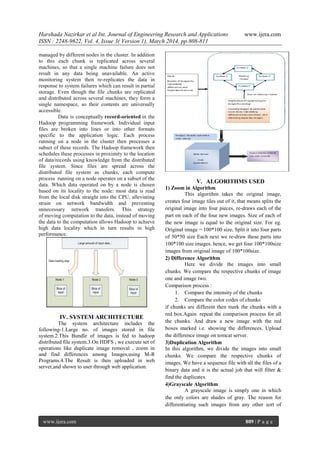
IV. SYSTEM ARCHITECTURE
The system architecture includes the
following-1.Large no. of images stored in file
system.2.This Bundle of images is fed to hadoop
distributed file system.3.On HDFS , we execute set of
operations like duplicate image removal , zoom in
and find differences among Images,using M-R
Programs.4.The Result is then uploaded in web
server,and shown to user through web application.
V. ALGORITHMS USED
1) Zoom in Algorithm
This algorithm takes the original image,
creates four image tiles out of it, that means splits the
original image into four pieces, re-draws each of the
part on each of the four new images. Size of each of
the new image is equal to the original size. For eg.
Original image = 100*100 size, Split it into four parts
of 50*50 size Each next we re-draw these parts into
100*100 size images. hence, we get four 100*100size
images from original image of 100*100size.
2) Difference Algorithm
Here we divide the images into small
chunks. We compare the respective chunks of image
one and image two.
Comparison process :
1. Compare the intensity of the chunks
2. Compare the color codes of chunks
if chunks are different then mark the chunks with a
red box.Again repeat the comparison process for all
the chunks. And draw a new image with the red
boxes marked i.e. showing the differences. Upload
the difference image on tomcat server.
3)Duplication Algorithm
In this algorithm, we divide the images into small
chunks. We compare the respective chunks of
images. We have a sequence file with all the files of a
binary data and it is the actual job that will filter &
find the duplicates.
4)Grayscale Algorithm
A grayscale image is simply one in which
the only colors are shades of gray. The reason for
differentiating such images from any other sort of
Harshada Nazirkar et al Int. Journal of Engineering Research and Applications www.ijera.com
ISSN : 2248-9622, Vol. 4, Issue 3( Version 1), March 2014, pp.808-811
www.ijera.com 810 | P a g e
color image is that less information needs to be
provided for each pixel. In fact a `gray' color is one in
which the red, green and blue components all have
equal intensity in RGB space, and so it is only
necessary to specify a single intensity value for each
pixel, as opposed to the three intensities needed to
specify each pixel in a full color image. Often, the
grayscale intensity is stored as an 8-bit integer giving
256 possible different shades of gray from black to
white.
VI. TECHNOLOGY USED
M-R Framework
MapReduce is also a data processing model .
Its greatest advantage is the easy scaling of data
processing over multiple computing nodes. Under the
MapReduce model, the data processing primitives are
called mappers and reducers . Decomposing a data
processing application into mappers and reducers is
sometimes nontrivial. But, once you write an
application in the MapReduce form, scaling the
application to run over hundreds, thousands, or even
tens of thousands of machines in a cluster is merely a
confi guration change. This simple scalability is what
has attracted many programmers to the MapReduce
model.
 Pseudo-code for map and reduce functions for
word counting
map(String filename, String document)
{
List<String> T = tokenize(document);
for each token in T
{
emit ((String)token, (Integer) 1);
}
}
reduce(String token, List<Integer> values)
{
Integer sum = 0;
Understanding MapReduce 13
for each value in values
{
sum = sum + value;
} emit ((String)token, (Integer) sum);
}
The HIPI Framework
HIPI was created to empower researchers
and present them with a capable tool that would
enable research involving image processing and
vision to be performed extremely easily. With the
knowledge that HIPI would be used for researchers
and as an educational tool, we designed HIPI with the
following goals in mind.
1. Provide an open, extendible library for image
processing and computer vision applications in a
MapReduce framework
2. Store images efficiently for use in MapReduce
applications
3. Allow for simple filtering of a set of images
4. Present users with an intuitive interface for
image-based op- erations and hide the details of
the MapReduce framework
5. HIPI will set up applications so that they are
highly paral lelized and balanced so that users do
not have to worry about such details
VII. ACKNOWLEDGEMENT
We take this opportunity to thank our
project guide and Head of the Department Prof.
P.A.Bandgar for their valuable guidance and
mentoring through out this project. Additionally, we
must give great thanks to Miss. Sneha Mam and
Mr.Bhagat sir for guidance and support.
REFERENCES
[1] J. Dean and S. Ghemawat, Mapreduce: Simplified
data processing on large clusters, Communications
of the ACM, vol. 51, no. 1, pp. 107-113, Jan.
2008.
[2] T. White, Hadoop: The Definitive Guide, 2nd ed.
O’Reilly Media / Yahoo Press, 2010.
[3] J. Talbot, R. M. Yoo, and C. Kozyrakis,
Phoenix++: Modular mapreduce for shared-
memory systems, in Proc. of the Second
International Workshop on MapReduce and Its
Applications, New York, NY, USA: ACM, 2011,
pp. 9- 16.
[4] B. He, W. Fang, Q. Luo, N. K. Govindaraju, and
T. Wang, Mars: A mapreduce framework on
graphics processors, in Proc. of the 17th
International Conference on Parallel Architectures
and Compilation Techniques, New York, NY,
USA: ACM, 2008, pp. 260-269.
[5] J. Ekanayake, H. Li, B. Zhang, T. Gunarathne, S.-
H. Bae, J. Qiu, and G. Fox, Twister: A runtime for
iterative mapreduce, in Proc. of the 19th ACM Int.
Symposium on High Performance Distributed
Computing, New York, NY, USA: ACM, 2010,
pp. 810-818.
[6] ADAMS, A., JACOBS, D., DOLSON, J., TICO,
M., PULLI, K., TALVALA, E., AJDIN, B.,
VAQUERO, D., LENSCH, H., AND
HOROWITZ, M. 2010. The frankencamera: an
experimental platform for computational
photography. ACM SIGGRAPH 2010 papers, 1–
12.
[7] APACHE, 2010. Hadoop mapreduce framework.
http://hadoop.apache.org/mapreduce/.
[9] CONNER, J. 2009. Customizing input file formats
for image processing in hadoop. Arizona State
University. Online at: http://hpc. asu. edu/node/97.
[10] P. M. Atkinson and A. R. L. Tatnall. Neral
networks in remote sensing. International Journal
of Remote Sensing , 18(4):699–709, April 1997.
Harshada Nazirkar et al Int. Journal of Engineering Research and Applications www.ijera.com
ISSN : 2248-9622, Vol. 4, Issue 3( Version 1), March 2014, pp.808-811
www.ijera.com 811 | P a g e
BIOGRAPHIES
V.D.Jadhavis pursuing B.E
degree in Information Technology
from JSPM’s BSIOTR (W),
University of Pune, Maharashtra,
India.
H.J.Nazirkar is pursuing B.E
degree in Information Technology
from JSPM’s BSIOTR (w),
University of Pune, Maharashtra,
India.
S.M.Idekar is pursuing B.E degree
in Information Technology from
JSPM’s BSIOTR (W), University
Of Pune, Maharashtra, India.
P.A.Bandgar, has received her
Master’s from SCOE, Pune,
Currently working as a Head of the
department in Information
Technology atJSPM’s BSIOTR
(W), Pune, Maharashtra, India. Her
Research interest is in the field of
Image processing.

Eg4301808811

  • 1.
    Harshada Nazirkar etal Int. Journal of Engineering Research and Applications www.ijera.com ISSN : 2248-9622, Vol. 4, Issue 3( Version 1), March 2014, pp.808-811 www.ijera.com 808 | P a g e Recognization of Satellite Images of Large Scale Data Based on Map- Reduce Framework Vidya Jadhav, Harshada Nazirkar, Sneha Idekar, Prof. P.A. Bandgar. Dept. of Information Technology, JSPM’s BSIOTR (W), Pune Abstract Today in the world of cloud and grid computing integration of data from heterogeneous databases is inevitable.This will become complex when size of the database is very large. M-R is a new framework specifically designed for processing huge datasets on distributed sources. Apache’s Hadoop is an implementation of M-R.Currently Hadoop has been applied successfully for file based datasets. This project proposes to utilize the parallel and distributed processing capability of Hadoop M-R for handling Images on large datasets.The presented methodology of land-cover recognition provides a scalable solution for automatic satellite imagery analysis, especially when GIS data is not readily available, or surface change may occur due to catastrophic events such as flooding, hurricane, and snow storm, etc.Here,we are using algorithms such as Image Differentiation,Image Duplication,Zoom-In,Gray-Scale. Index Terms: Map-Reduce (M-R), HDFS(Hadoop Distributed File System) ,HIPI(Hadoop Image Processing Interface) I. INTRODUCTION Hadoop is a large-scale distributed batch processing infrastructure. While it can be used on a single machine, its true power lies in its ability to scale to hundreds or thousands of computers, each with several processor cores. Hadoop is also designed to efficiently distribute large amounts of work across a set of machines. Hadoop is built to process "web- scale" data on the order of hundreds of gigabytes to terabytes or petabytes. At this scale, it is likely that the input data set will not even fit on a single computer's hard drive, much less in memory. So Hadoop includes a distributed file system which breaks up input data and sends fractions of the original data to several machines in your cluster to hold. This results in the problem being processed in parallel using all of the machines in the cluster and computes output results as efficiently as possible. The entire Earth surface has been documented with satellite imagery. The amount of data continues to grow as higher resolutions and temporal information become available. With this increasing amount of surface and temporal data, recognition, segmentation, and event detection in satellite images with a highly scalable system becomes more and more desirable. a semantic taxonomy is constructed for the land-cover classification of satellite images. Both the training and running of the classifiers are implemented in a distributed Hadoop computing platform.A scalable modeling system implemented in the Hadoop M-R framework is used for training the classifiers and performing subsequent image classification. II. LITERATURE SURVEY Performing large-scale computation is difficult. To work with this volume of data requires distributing parts of the problem to multiple machines to handle in parallel. Whenever multiple machines are used in cooperation with one another, the probability of failures rises. In a single-machine environment, failure is not something that program designers explicitly worry about very often: if the machine has crashed, then there is no way for the program to recover anyway. Performing computation on large volumes of data has been done before, usually in a distributed setting. What makes Hadoop unique is its simplified programming model which allows the user to quickly write and test distributed systems, and its efficient, automatic distribution of data and work across machines and in turn utilizing the underlying parallelism of the CPU cores. Grid scheduling of computers can be done with existing systems such as Condor. But Condor does not automatically distribute data: a separate SAN must be managed in addition to the compute cluster. Furthermore, collaboration between multiple compute nodes must be managed with a communication system such as MPI. This programming model is challenging to work with and can lead to the introduction of subtle errors. III. PROPOSED SYSTEM In a Hadoop cluster, data is distributed to all the nodes of the cluster as it is being loaded in. The HDFS will split large data files into chunks which are RESEARCH ARTICLE OPEN ACCESS
  • 2.
    Harshada Nazirkar etal Int. Journal of Engineering Research and Applications www.ijera.com ISSN : 2248-9622, Vol. 4, Issue 3( Version 1), March 2014, pp.808-811 www.ijera.com 809 | P a g e managed by different nodes in the cluster. In addition to this each chunk is replicated across several machines, so that a single machine failure does not result in any data being unavailable. An active monitoring system then re-replicates the data in response to system failures which can result in partial storage. Even though the file chunks are replicated and distributed across several machines, they form a single namespace, so their contents are universally accessible. Data is conceptually record-oriented in the Hadoop programming framework. Individual input files are broken into lines or into other formats specific to the application logic. Each process running on a node in the cluster then processes a subset of these records. The Hadoop framework then schedules these processes in proximity to the location of data/records using knowledge from the distributed file system. Since files are spread across the distributed file system as chunks, each compute process running on a node operates on a subset of the data. Which data operated on by a node is chosen based on its locality to the node: most data is read from the local disk straight into the CPU, alleviating strain on network bandwidth and preventing unnecessary network transfers. This strategy of moving computation to the data, instead of moving the data to the computation allows Hadoop to achieve high data locality which in turn results in high performance. IV. SYSTEM ARCHITECTURE The system architecture includes the following-1.Large no. of images stored in file system.2.This Bundle of images is fed to hadoop distributed file system.3.On HDFS , we execute set of operations like duplicate image removal , zoom in and find differences among Images,using M-R Programs.4.The Result is then uploaded in web server,and shown to user through web application. V. ALGORITHMS USED 1) Zoom in Algorithm This algorithm takes the original image, creates four image tiles out of it, that means splits the original image into four pieces, re-draws each of the part on each of the four new images. Size of each of the new image is equal to the original size. For eg. Original image = 100*100 size, Split it into four parts of 50*50 size Each next we re-draw these parts into 100*100 size images. hence, we get four 100*100size images from original image of 100*100size. 2) Difference Algorithm Here we divide the images into small chunks. We compare the respective chunks of image one and image two. Comparison process : 1. Compare the intensity of the chunks 2. Compare the color codes of chunks if chunks are different then mark the chunks with a red box.Again repeat the comparison process for all the chunks. And draw a new image with the red boxes marked i.e. showing the differences. Upload the difference image on tomcat server. 3)Duplication Algorithm In this algorithm, we divide the images into small chunks. We compare the respective chunks of images. We have a sequence file with all the files of a binary data and it is the actual job that will filter & find the duplicates. 4)Grayscale Algorithm A grayscale image is simply one in which the only colors are shades of gray. The reason for differentiating such images from any other sort of
  • 3.
    Harshada Nazirkar etal Int. Journal of Engineering Research and Applications www.ijera.com ISSN : 2248-9622, Vol. 4, Issue 3( Version 1), March 2014, pp.808-811 www.ijera.com 810 | P a g e color image is that less information needs to be provided for each pixel. In fact a `gray' color is one in which the red, green and blue components all have equal intensity in RGB space, and so it is only necessary to specify a single intensity value for each pixel, as opposed to the three intensities needed to specify each pixel in a full color image. Often, the grayscale intensity is stored as an 8-bit integer giving 256 possible different shades of gray from black to white. VI. TECHNOLOGY USED M-R Framework MapReduce is also a data processing model . Its greatest advantage is the easy scaling of data processing over multiple computing nodes. Under the MapReduce model, the data processing primitives are called mappers and reducers . Decomposing a data processing application into mappers and reducers is sometimes nontrivial. But, once you write an application in the MapReduce form, scaling the application to run over hundreds, thousands, or even tens of thousands of machines in a cluster is merely a confi guration change. This simple scalability is what has attracted many programmers to the MapReduce model.  Pseudo-code for map and reduce functions for word counting map(String filename, String document) { List<String> T = tokenize(document); for each token in T { emit ((String)token, (Integer) 1); } } reduce(String token, List<Integer> values) { Integer sum = 0; Understanding MapReduce 13 for each value in values { sum = sum + value; } emit ((String)token, (Integer) sum); } The HIPI Framework HIPI was created to empower researchers and present them with a capable tool that would enable research involving image processing and vision to be performed extremely easily. With the knowledge that HIPI would be used for researchers and as an educational tool, we designed HIPI with the following goals in mind. 1. Provide an open, extendible library for image processing and computer vision applications in a MapReduce framework 2. Store images efficiently for use in MapReduce applications 3. Allow for simple filtering of a set of images 4. Present users with an intuitive interface for image-based op- erations and hide the details of the MapReduce framework 5. HIPI will set up applications so that they are highly paral lelized and balanced so that users do not have to worry about such details VII. ACKNOWLEDGEMENT We take this opportunity to thank our project guide and Head of the Department Prof. P.A.Bandgar for their valuable guidance and mentoring through out this project. Additionally, we must give great thanks to Miss. Sneha Mam and Mr.Bhagat sir for guidance and support. REFERENCES [1] J. Dean and S. Ghemawat, Mapreduce: Simplified data processing on large clusters, Communications of the ACM, vol. 51, no. 1, pp. 107-113, Jan. 2008. [2] T. White, Hadoop: The Definitive Guide, 2nd ed. O’Reilly Media / Yahoo Press, 2010. [3] J. Talbot, R. M. Yoo, and C. Kozyrakis, Phoenix++: Modular mapreduce for shared- memory systems, in Proc. of the Second International Workshop on MapReduce and Its Applications, New York, NY, USA: ACM, 2011, pp. 9- 16. [4] B. He, W. Fang, Q. Luo, N. K. Govindaraju, and T. Wang, Mars: A mapreduce framework on graphics processors, in Proc. of the 17th International Conference on Parallel Architectures and Compilation Techniques, New York, NY, USA: ACM, 2008, pp. 260-269. [5] J. Ekanayake, H. Li, B. Zhang, T. Gunarathne, S.- H. Bae, J. Qiu, and G. Fox, Twister: A runtime for iterative mapreduce, in Proc. of the 19th ACM Int. Symposium on High Performance Distributed Computing, New York, NY, USA: ACM, 2010, pp. 810-818. [6] ADAMS, A., JACOBS, D., DOLSON, J., TICO, M., PULLI, K., TALVALA, E., AJDIN, B., VAQUERO, D., LENSCH, H., AND HOROWITZ, M. 2010. The frankencamera: an experimental platform for computational photography. ACM SIGGRAPH 2010 papers, 1– 12. [7] APACHE, 2010. Hadoop mapreduce framework. http://hadoop.apache.org/mapreduce/. [9] CONNER, J. 2009. Customizing input file formats for image processing in hadoop. Arizona State University. Online at: http://hpc. asu. edu/node/97. [10] P. M. Atkinson and A. R. L. Tatnall. Neral networks in remote sensing. International Journal of Remote Sensing , 18(4):699–709, April 1997.
  • 4.
    Harshada Nazirkar etal Int. Journal of Engineering Research and Applications www.ijera.com ISSN : 2248-9622, Vol. 4, Issue 3( Version 1), March 2014, pp.808-811 www.ijera.com 811 | P a g e BIOGRAPHIES V.D.Jadhavis pursuing B.E degree in Information Technology from JSPM’s BSIOTR (W), University of Pune, Maharashtra, India. H.J.Nazirkar is pursuing B.E degree in Information Technology from JSPM’s BSIOTR (w), University of Pune, Maharashtra, India. S.M.Idekar is pursuing B.E degree in Information Technology from JSPM’s BSIOTR (W), University Of Pune, Maharashtra, India. P.A.Bandgar, has received her Master’s from SCOE, Pune, Currently working as a Head of the department in Information Technology atJSPM’s BSIOTR (W), Pune, Maharashtra, India. Her Research interest is in the field of Image processing.