06.05.2014
2
Hadoop 2 - More
than MapReduce!
uweseiler
06.05.2014
2
About me
Big Data Nerd
TravelpiratePhotography Enthusiast
Hadoop Trainer NoSQL Fan Boy
06.05.2014
2
About me
Big Data Nerd
TravelpiratePhotography Enthusiast
Hadoop Trainer NoSQL Fan Boy
06.05.2014
2
Agenda
• Introduction to Hadoop 2
• MapReduce 2
• Tez, Hive & Stinger Initiative
• Spark
06.05.2014
2
Agenda
• Introduction to Hadoop 2
• MapReduce 2
• Tez, Hive & Stinger Initiative
• Spark
06.05.2014
2
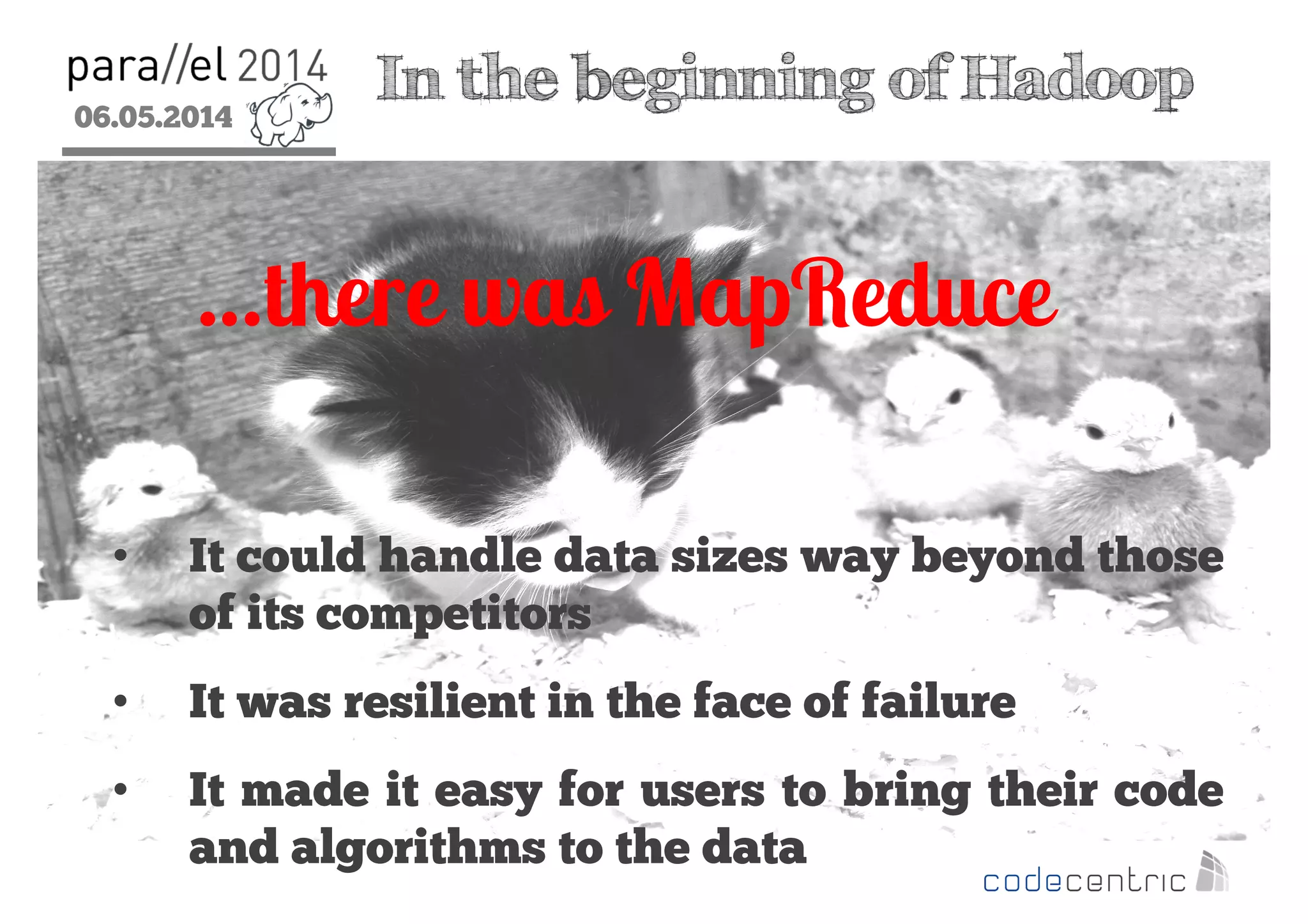
…there was MapReduce
In the beginning of Hadoop
• It could handle data sizes way beyond those
of its competitors
• It was resilient in the face of failure
• It made it easy for users to bring their code
and algorithms to the data
06.05.2014
2
…but it was too low level
Hadoop 1 (2007)
06.05.2014
2
…but it was too rigid
Hadoop 1 (2007)
06.05.2014
2
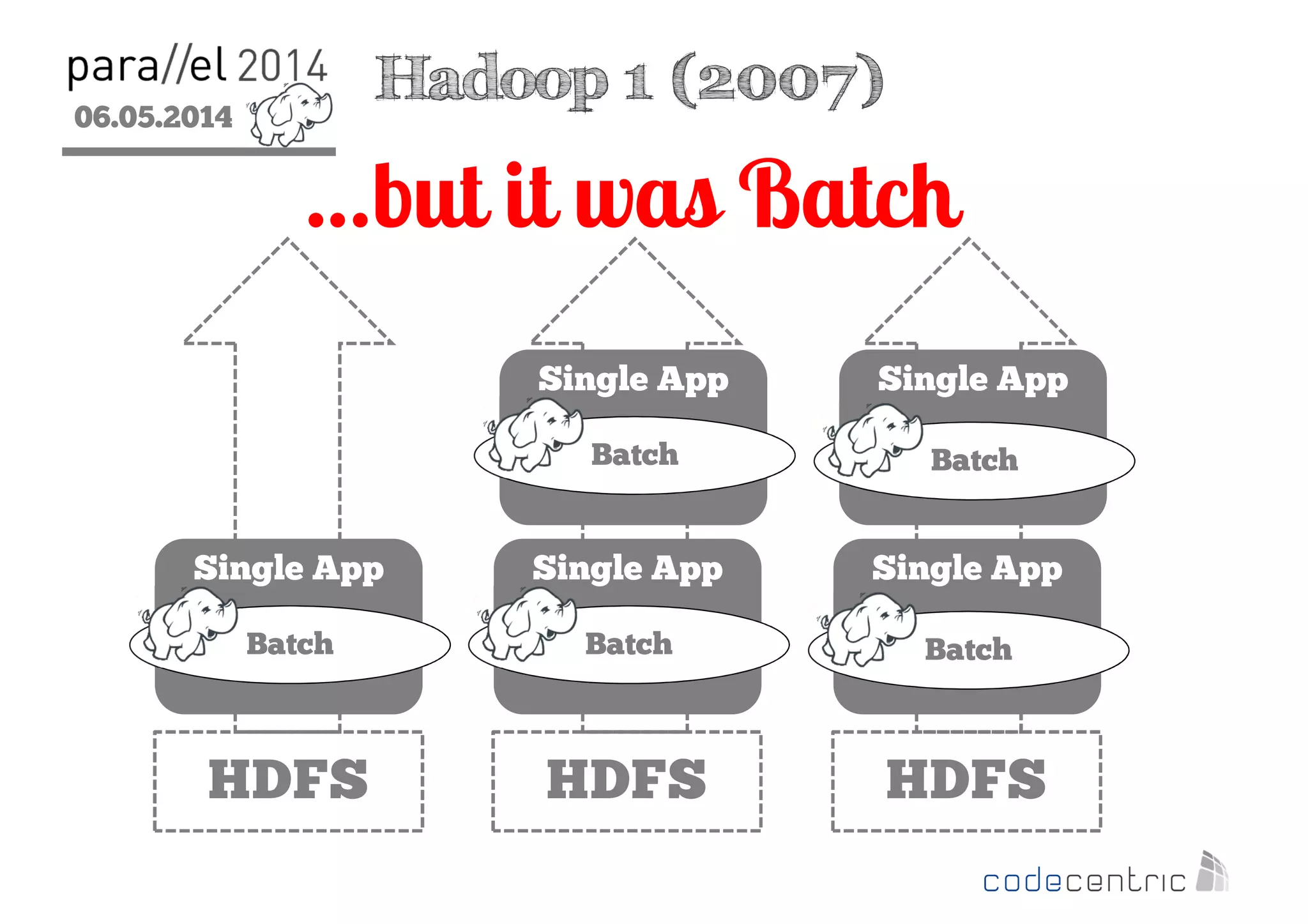
HDFS
…but it was Batch
HDFS HDFS
Single App
Batch
Single App
Batch
Single App
Batch
Single App
Batch
Single App
Batch
Hadoop 1 (2007)
06.05.2014
2
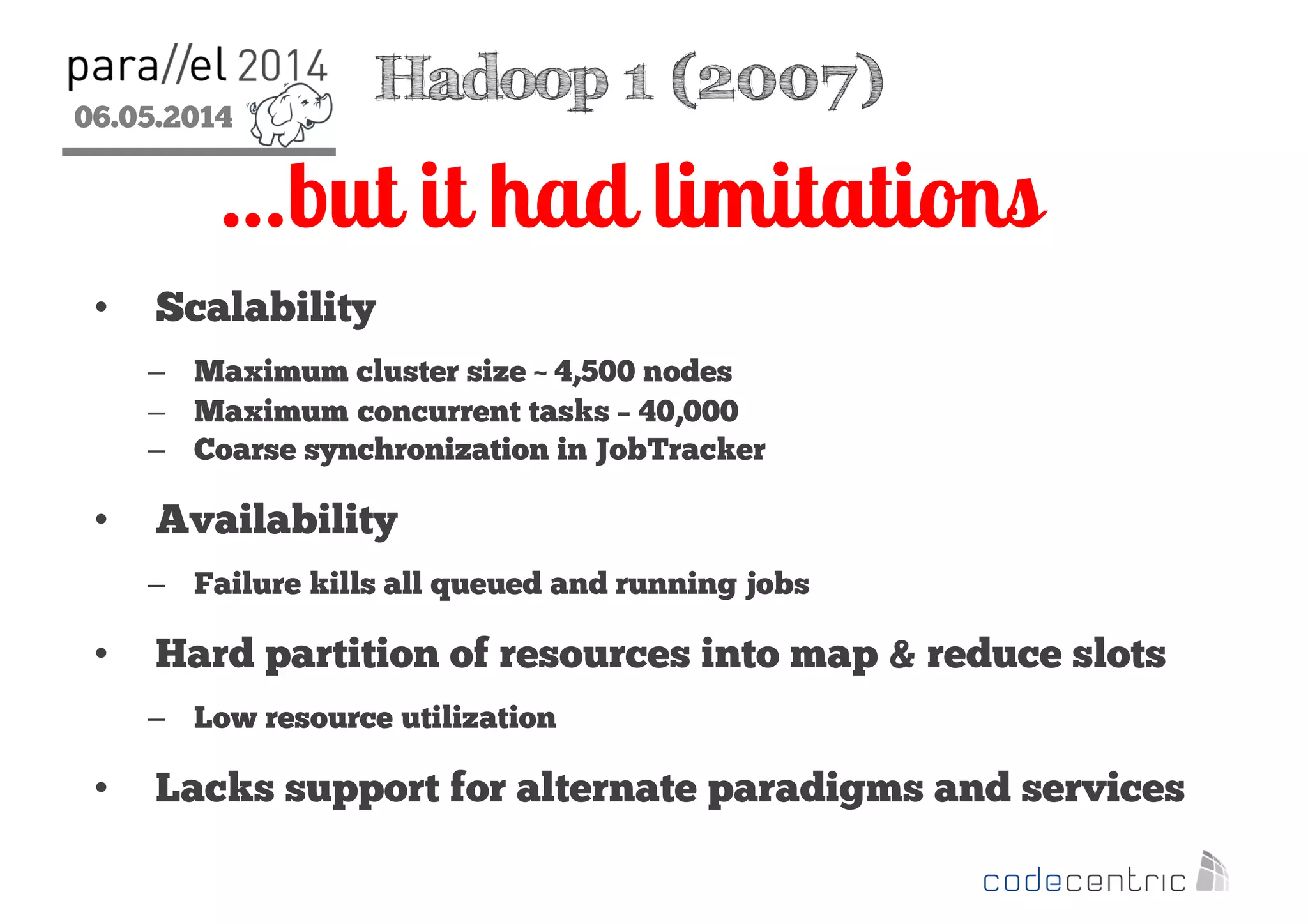
…but it had limitations
Hadoop 1 (2007)
• Scalability
– Maximum cluster size ~ 4,500 nodes
– Maximum concurrent tasks – 40,000
– Coarse synchronization in JobTracker
• Availability
– Failure kills all queued and running jobs
• Hard partition of resources into map & reduce slots
– Low resource utilization
• Lacks support for alternate paradigms and services
06.05.2014
2
YARN to the rescue!
Hadoop 2 (2013)
06.05.2014
2
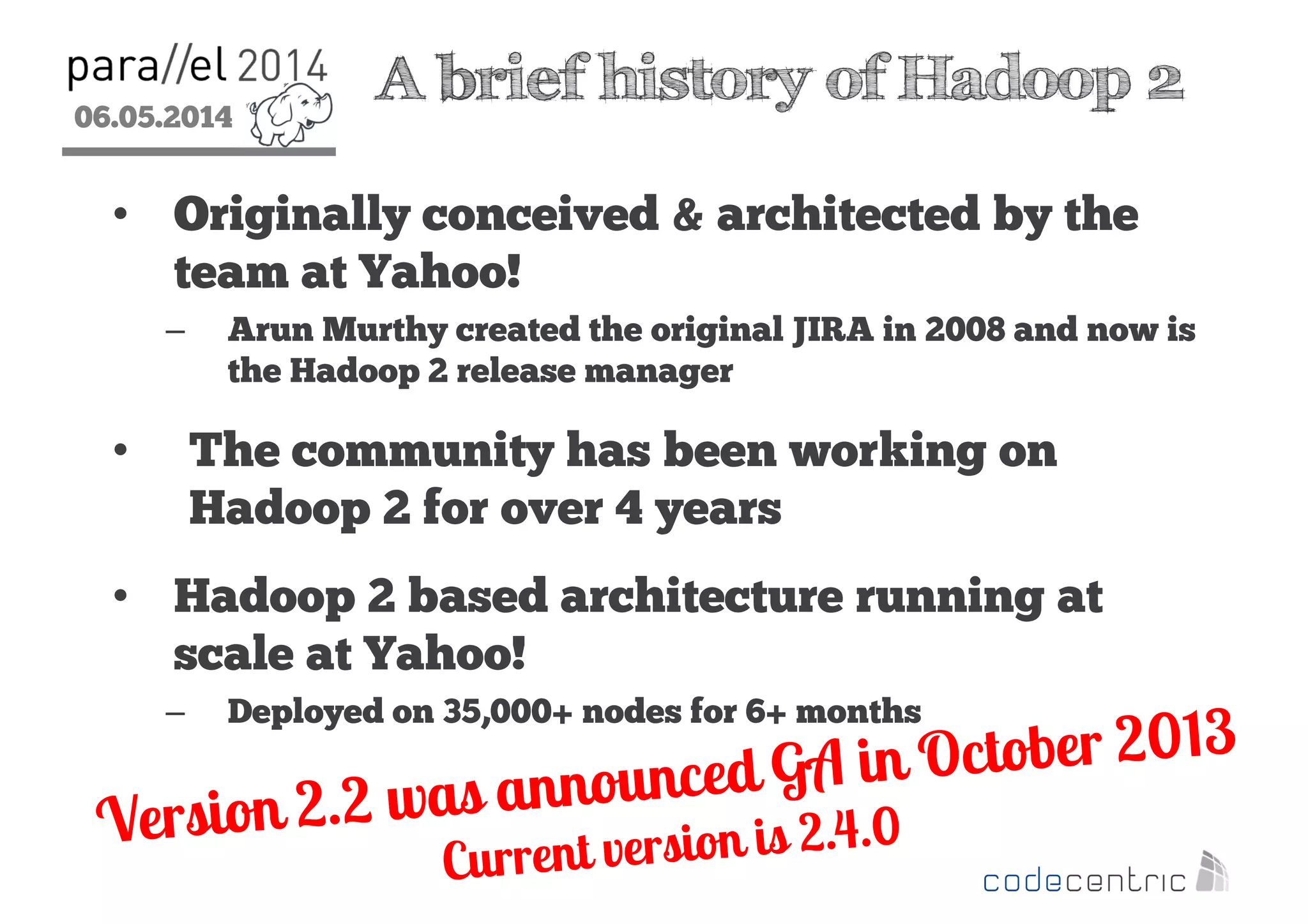
A brief history of Hadoop 2
• Originally conceived & architected by the
team at Yahoo!
– Arun Murthy created the original JIRA in 2008 and now is
the Hadoop 2 release manager
• The community has been working on
Hadoop 2 for over 4 years
• Hadoop 2 based architecture running at
scale at Yahoo!
– Deployed on 35,000+ nodes for 6+ months
06.05.2014
2
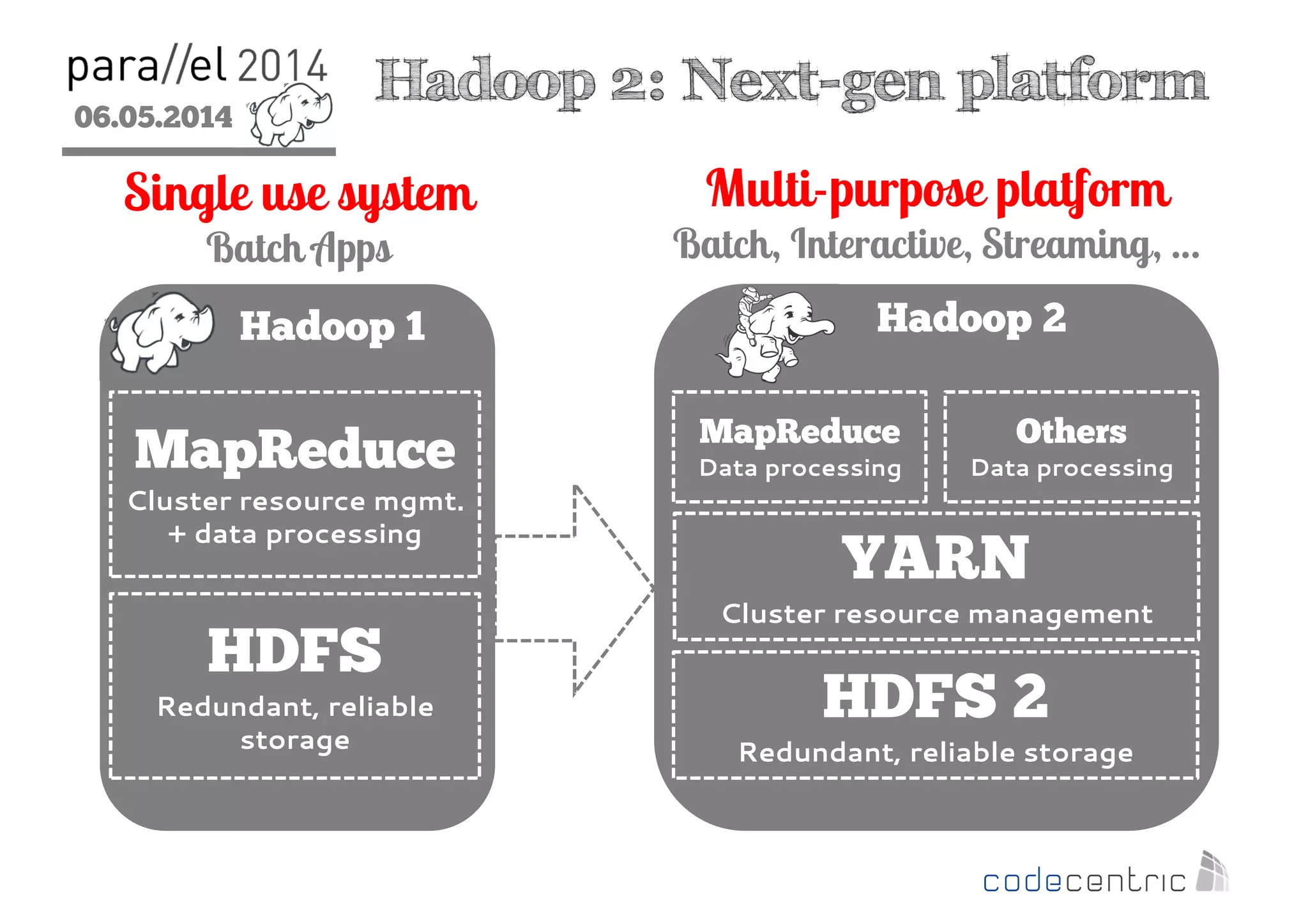
Hadoop 1
HDFS
Redundant, reliable
storage
Hadoop 2: Next-gen platform
MapReduce
Cluster resource mgmt.
+ data processing
Hadoop 2
HDFS 2
Redundant, reliable storage
MapReduce
Data processing
Single use system
Batch Apps
Multi-purpose platform
Batch, Interactive, Streaming, …
YARN
Cluster resource management
Others
Data processing
06.05.2014
2
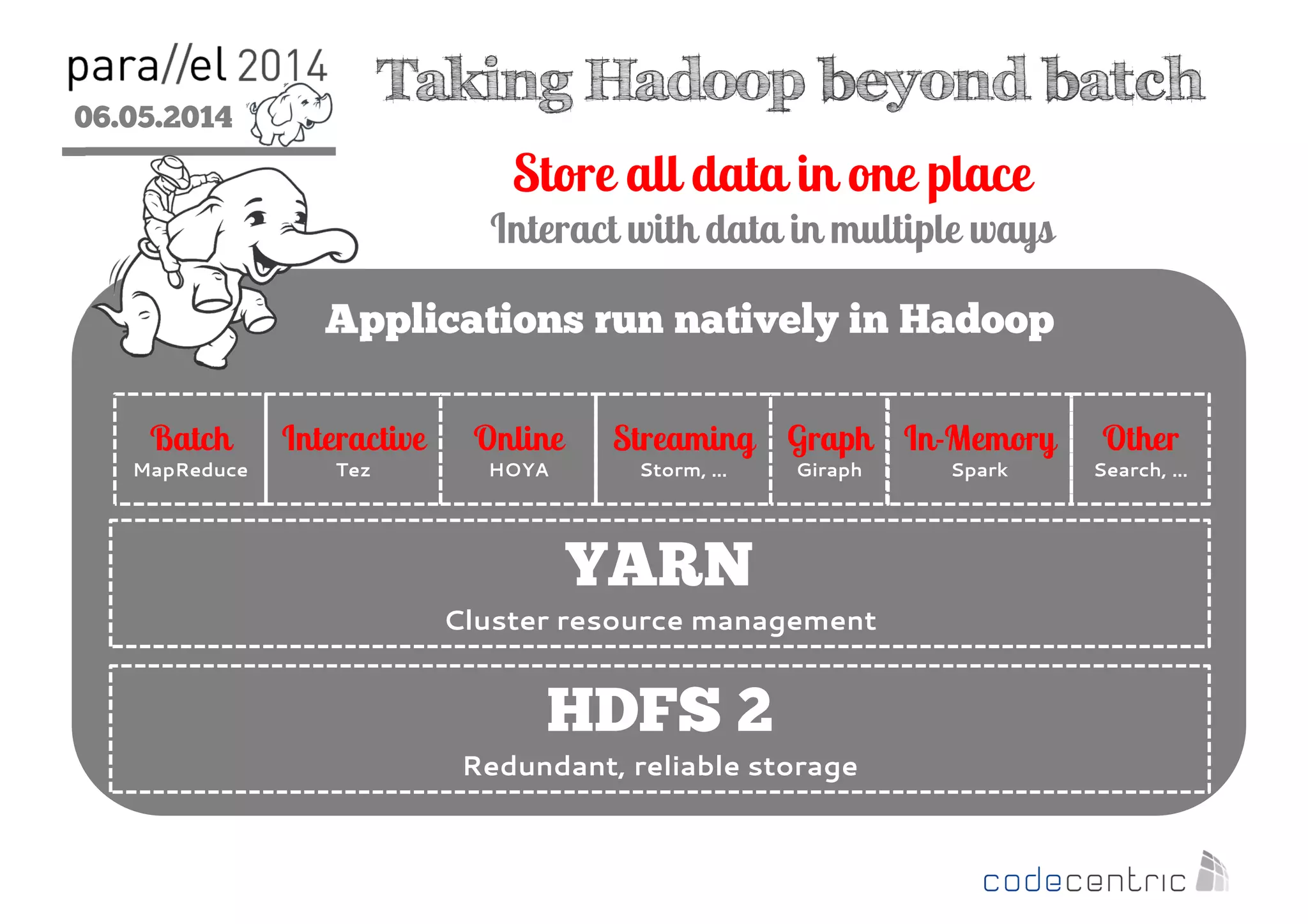
Taking Hadoop beyond batch
Applications run natively in Hadoop
HDFS 2
Redundant, reliable storage
Batch
MapReduce
Store all data in one place
Interact with data in multiple ways
YARN
Cluster resource management
Interactive
Tez
Online
HOYA
Streaming
Storm, …
Graph
Giraph
In-Memory
Spark
Other
Search, …
06.05.2014
2
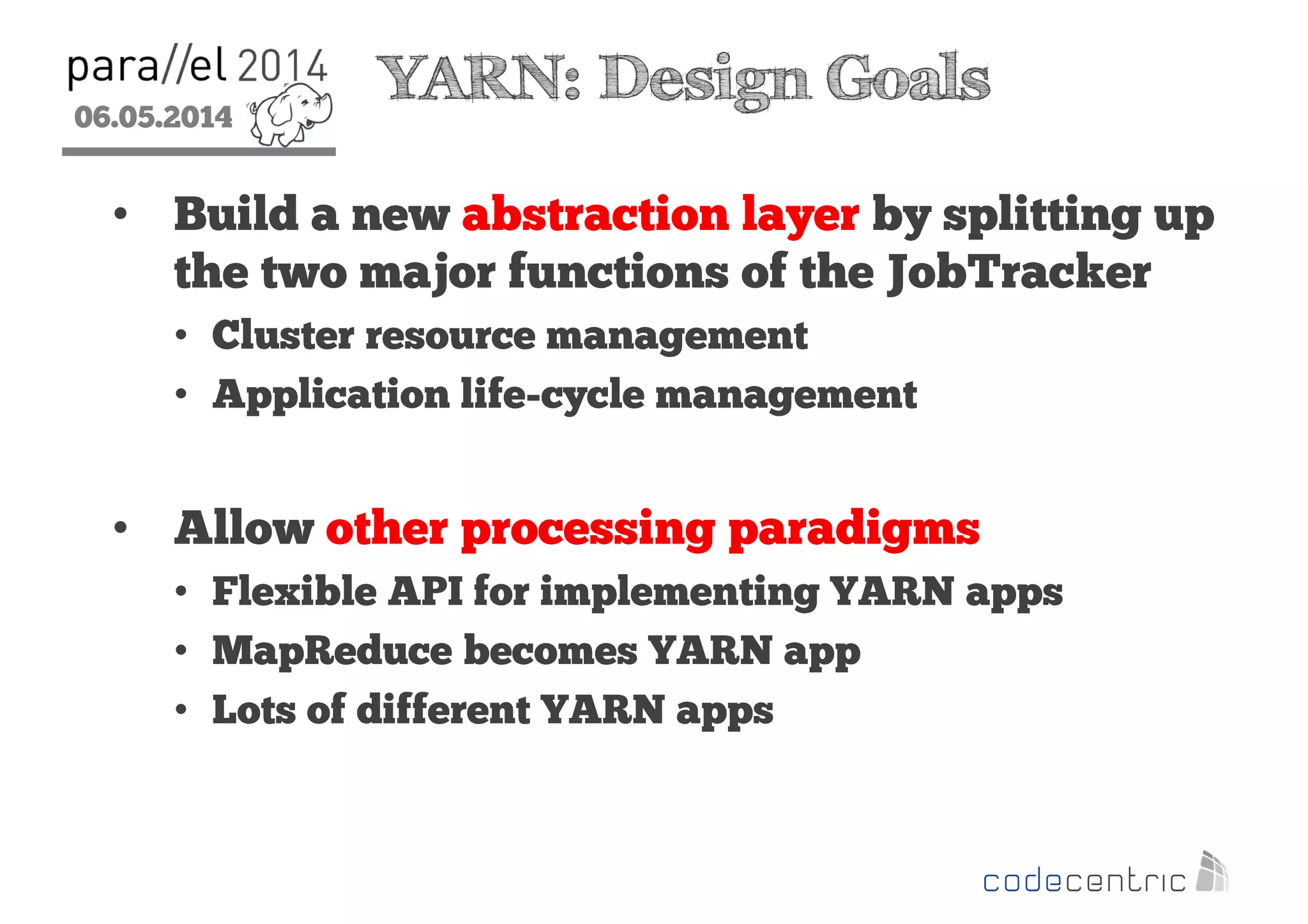
YARN: Design Goals
• Build a new abstraction layer by splitting up
the two major functions of the JobTracker
• Cluster resource management
• Application life-cycle management
• Allow other processing paradigms
• Flexible API for implementing YARN apps
• MapReduce becomes YARN app
• Lots of different YARN apps
06.05.2014
2
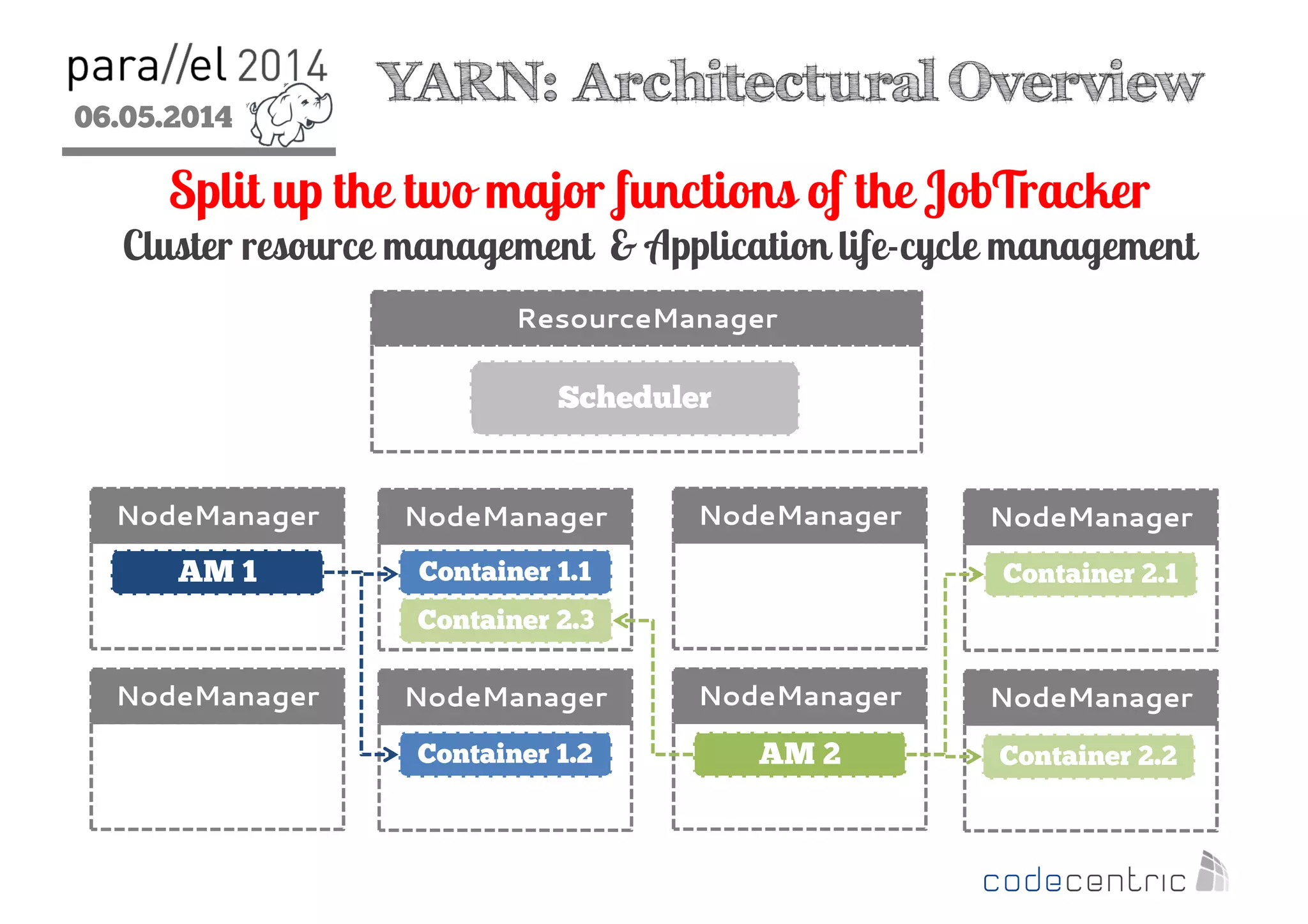
YARN: Architectural Overview
Split up the two major functions of the JobTracker
Cluster resource management & Application life-cycle management
ResourceManager
NodeManager NodeManager NodeManager NodeManager
Scheduler
AM 1
Container 1.2
Container 1.1
AM 2
Container 2.1
Container 2.2
Container 2.3
06.05.2014
2
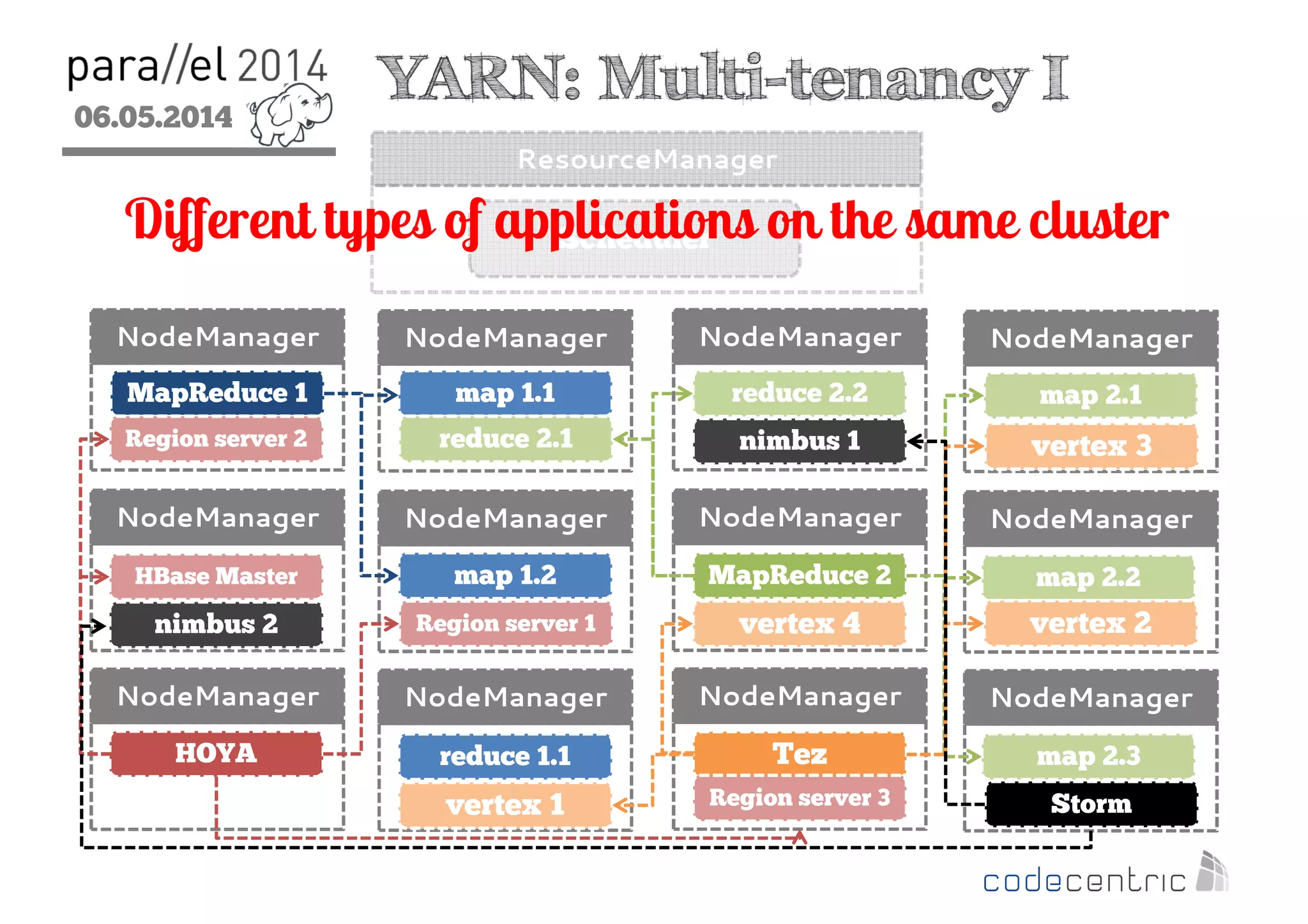
YARN: Multi-tenancy I
ResourceManager
NodeManager NodeManager NodeManager NodeManager
Scheduler
MapReduce 1
map 1.2
map 1.1
MapReduce 2
map 2.1
map 2.2
reduce 2.1
NodeManager NodeManager NodeManager NodeManager
reduce 1.1 Tez map 2.3
reduce 2.2
vertex 1
vertex 2
vertex 3
vertex 4
HOYA
HBase Master
Region server 1
Region server 2
Region server 3 Storm
nimbus 1
nimbus 2
Different types of applications on the same cluster
06.05.2014
2
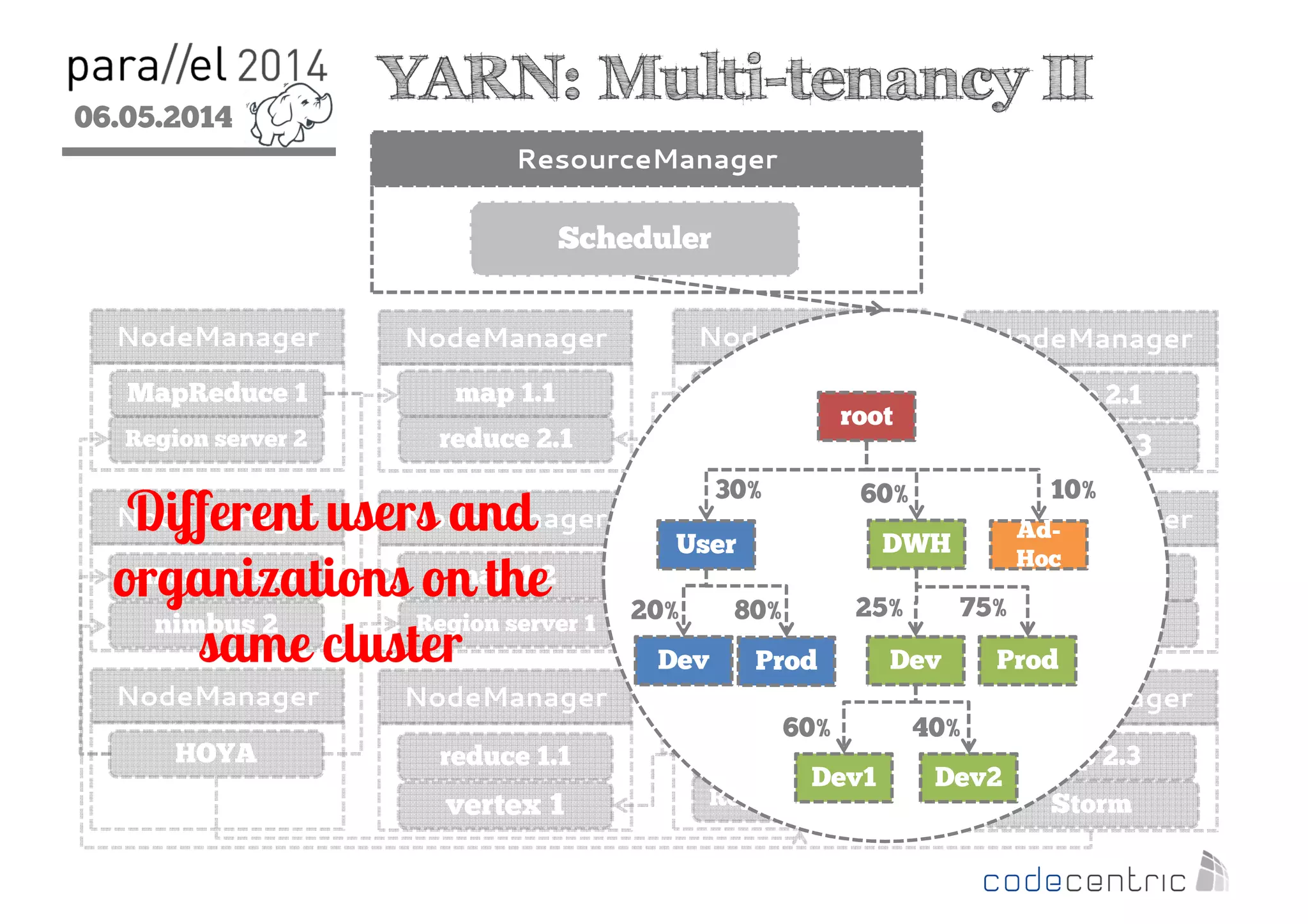
YARN: Multi-tenancy II
ResourceManager
NodeManager NodeManager NodeManager NodeManager
Scheduler
MapReduce 1
map 1.2
map 1.1
MapReduce 2
map 2.1
map 2.2
reduce 2.1
NodeManager NodeManager NodeManager NodeManager
reduce 1.1 Tez map 2.3
reduce 2.2
vertex 1
vertex 2
vertex 3
vertex 4
HOYA
HBase Master
Region server 1
Region server 2
Region server 3 Storm
nimbus 1
nimbus 2
DWHUser
Ad-
Hoc
root
30% 60% 10%
Dev Prod
20% 80%
Dev Prod
Dev1 Dev2
25% 75%
60% 40%
Different users and
organizations on the
same cluster
06.05.2014
2
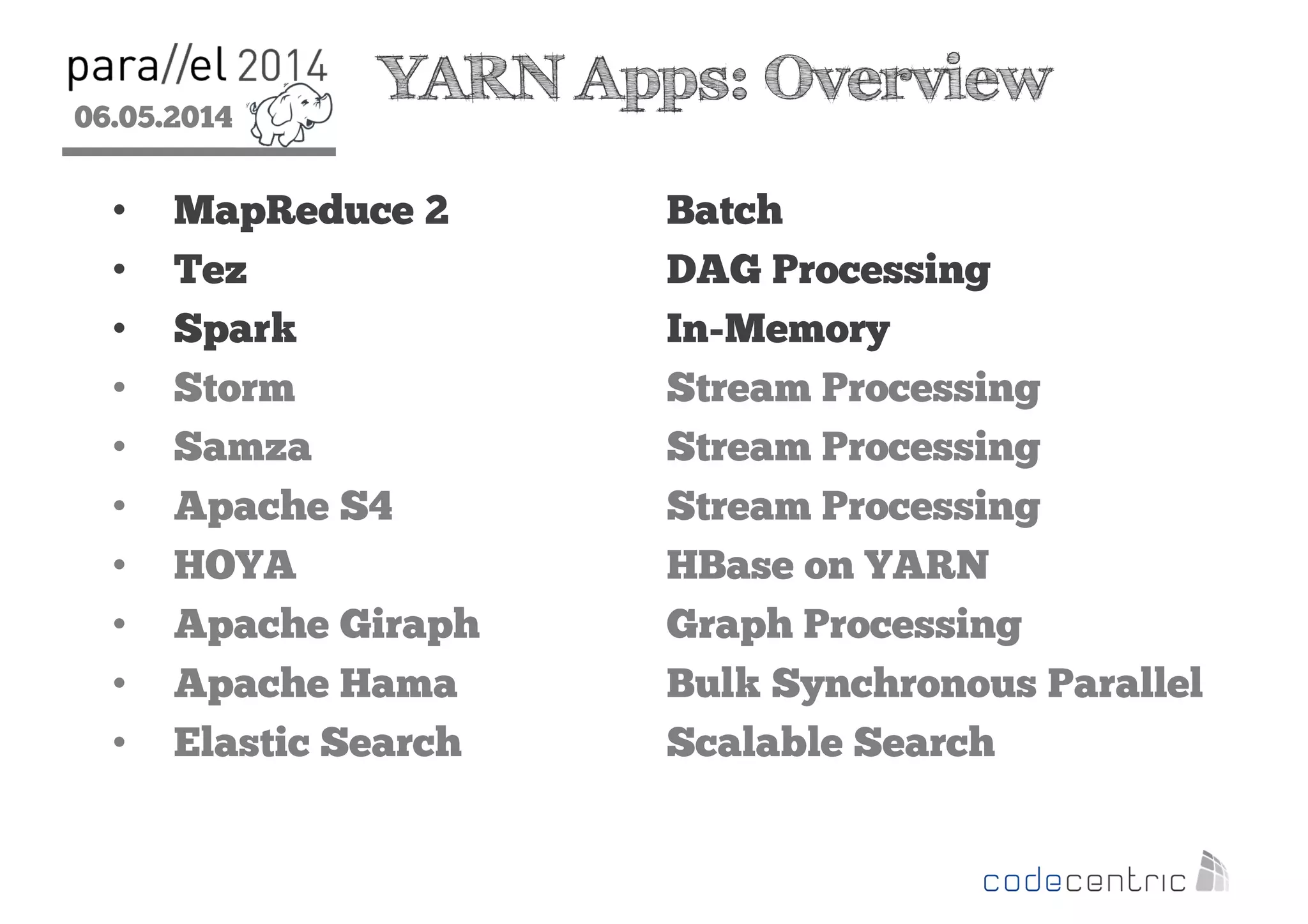
YARN Apps: Overview
• MapReduce 2 Batch
• Tez DAG Processing
• Spark In-Memory
• Storm Stream Processing
• Samza Stream Processing
• Apache S4 Stream Processing
• HOYA HBase on YARN
• Apache Giraph Graph Processing
• Apache Hama Bulk Synchronous Parallel
• Elastic Search Scalable Search
06.05.2014
2
Agenda
• Introduction to Hadoop 2
• MapReduce 2
• Tez, Hive & Stinger Initiative
• Spark
06.05.2014
2
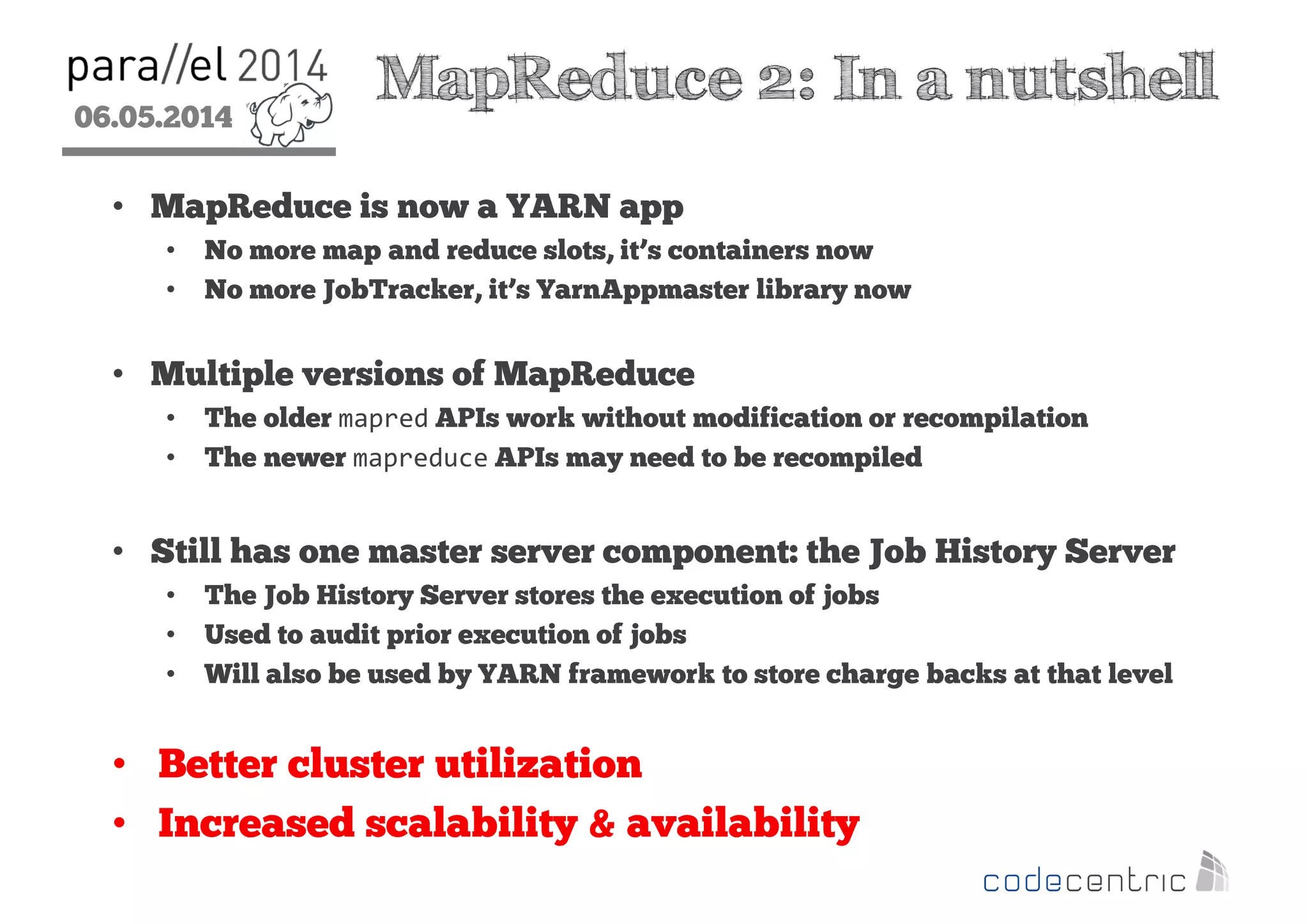
MapReduce 2: In a nutshell
• MapReduce is now a YARN app
• No more map and reduce slots, it’s containers now
• No more JobTracker, it’s YarnAppmaster library now
• Multiple versions of MapReduce
• The older mapred APIs work without modification or recompilation
• The newer mapreduce APIs may need to be recompiled
• Still has one master server component: the Job History Server
• The Job History Server stores the execution of jobs
• Used to audit prior execution of jobs
• Will also be used by YARN framework to store charge backs at that level
• Better cluster utilization
• Increased scalability & availability
06.05.2014
2
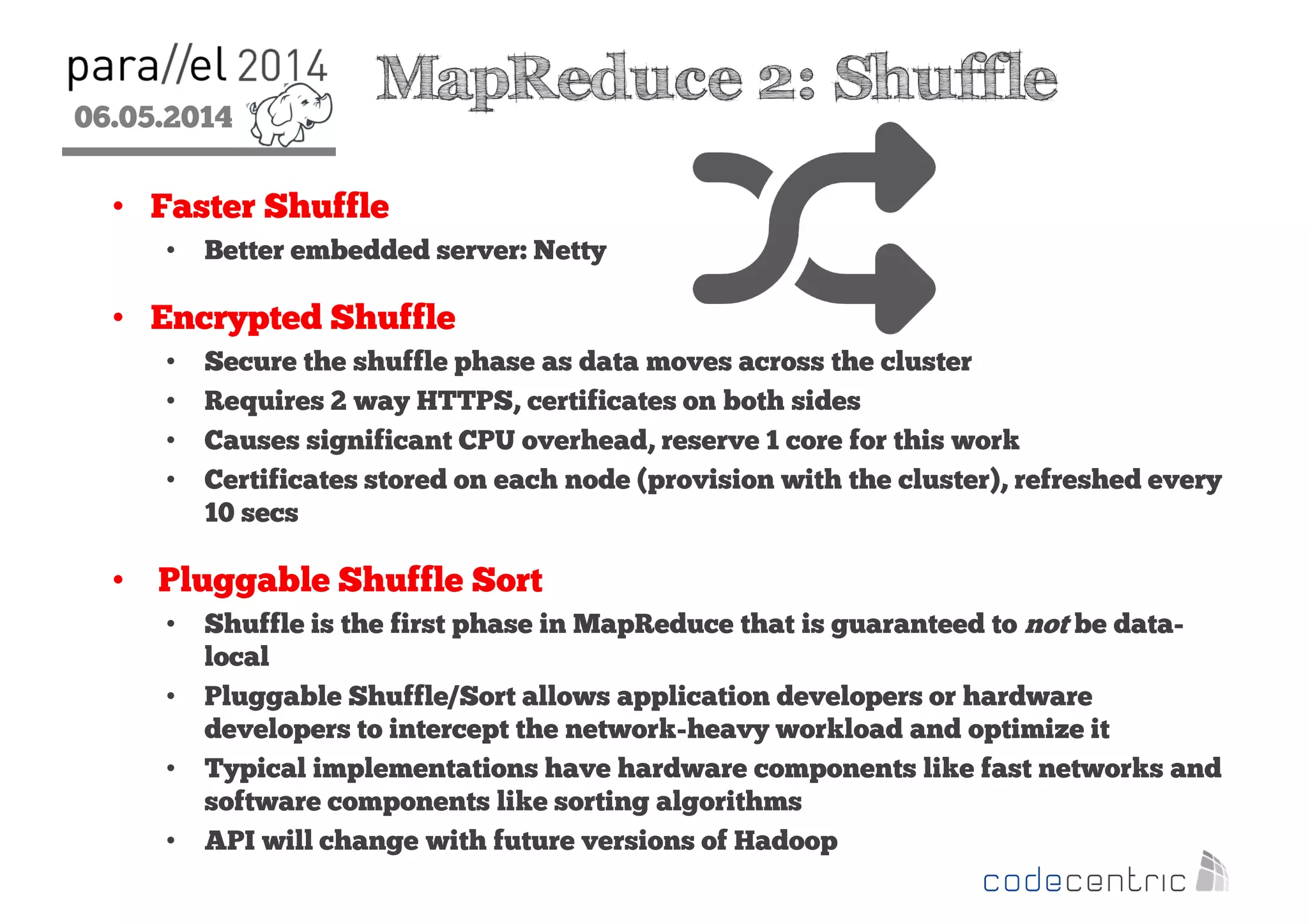
MapReduce 2: Shuffle
• Faster Shuffle
• Better embedded server: Netty
• Encrypted Shuffle
• Secure the shuffle phase as data moves across the cluster
• Requires 2 way HTTPS, certificates on both sides
• Causes significant CPU overhead, reserve 1 core for this work
• Certificates stored on each node (provision with the cluster), refreshed every
10 secs
• Pluggable Shuffle Sort
• Shuffle is the first phase in MapReduce that is guaranteed to not be data-
local
• Pluggable Shuffle/Sort allows application developers or hardware
developers to intercept the network-heavy workload and optimize it
• Typical implementations have hardware components like fast networks and
software components like sorting algorithms
• API will change with future versions of Hadoop
06.05.2014
2
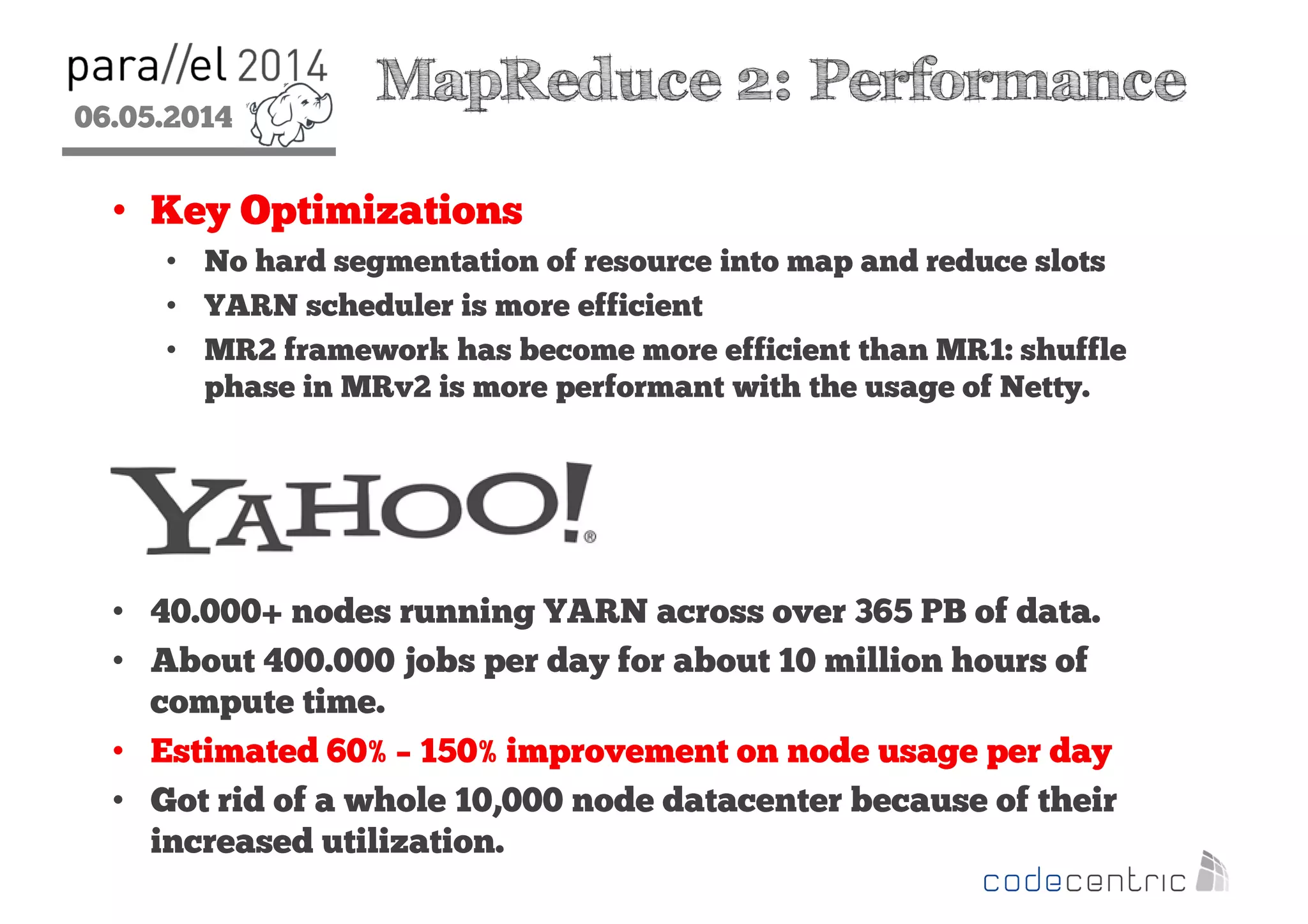
MapReduce 2: Performance
• Key Optimizations
• No hard segmentation of resource into map and reduce slots
• YARN scheduler is more efficient
• MR2 framework has become more efficient than MR1: shuffle
phase in MRv2 is more performant with the usage of Netty.
• 40.000+ nodes running YARN across over 365 PB of data.
• About 400.000 jobs per day for about 10 million hours of
compute time.
• Estimated 60% – 150% improvement on node usage per day
• Got rid of a whole 10,000 node datacenter because of their
increased utilization.
06.05.2014
2
Agenda
• Introduction to Hadoop 2
• MapReduce 2
• Tez, Hive & Stinger Initiative
• Spark
06.05.2014
2
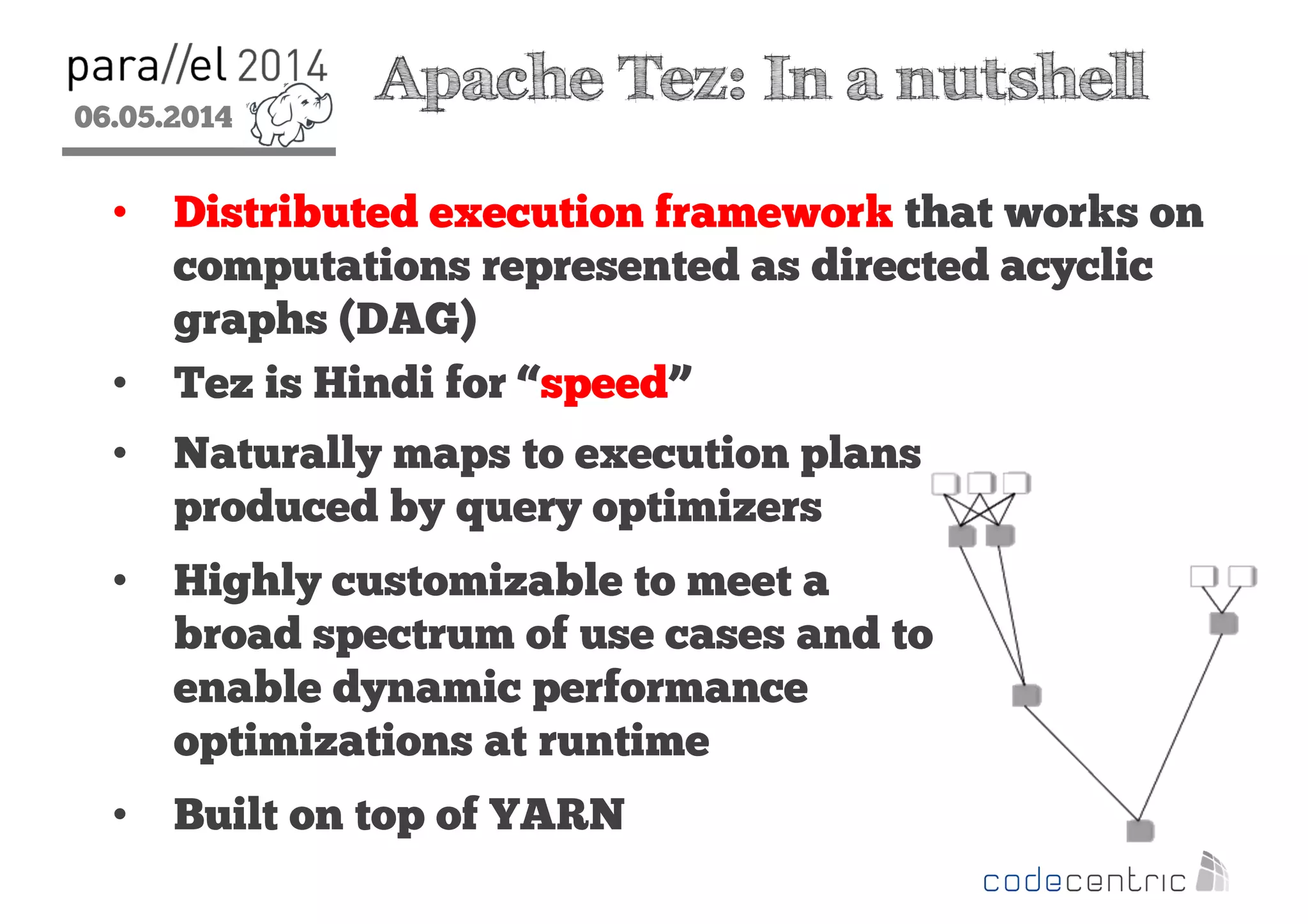
Apache Tez: In a nutshell
• Distributed execution framework that works on
computations represented as directed acyclic
graphs (DAG)
• Tez is Hindi for “speed”
• Naturally maps to execution plans
produced by query optimizers
• Highly customizable to meet a
broad spectrum of use cases and to
enable dynamic performance
optimizations at runtime
• Built on top of YARN
06.05.2014
2
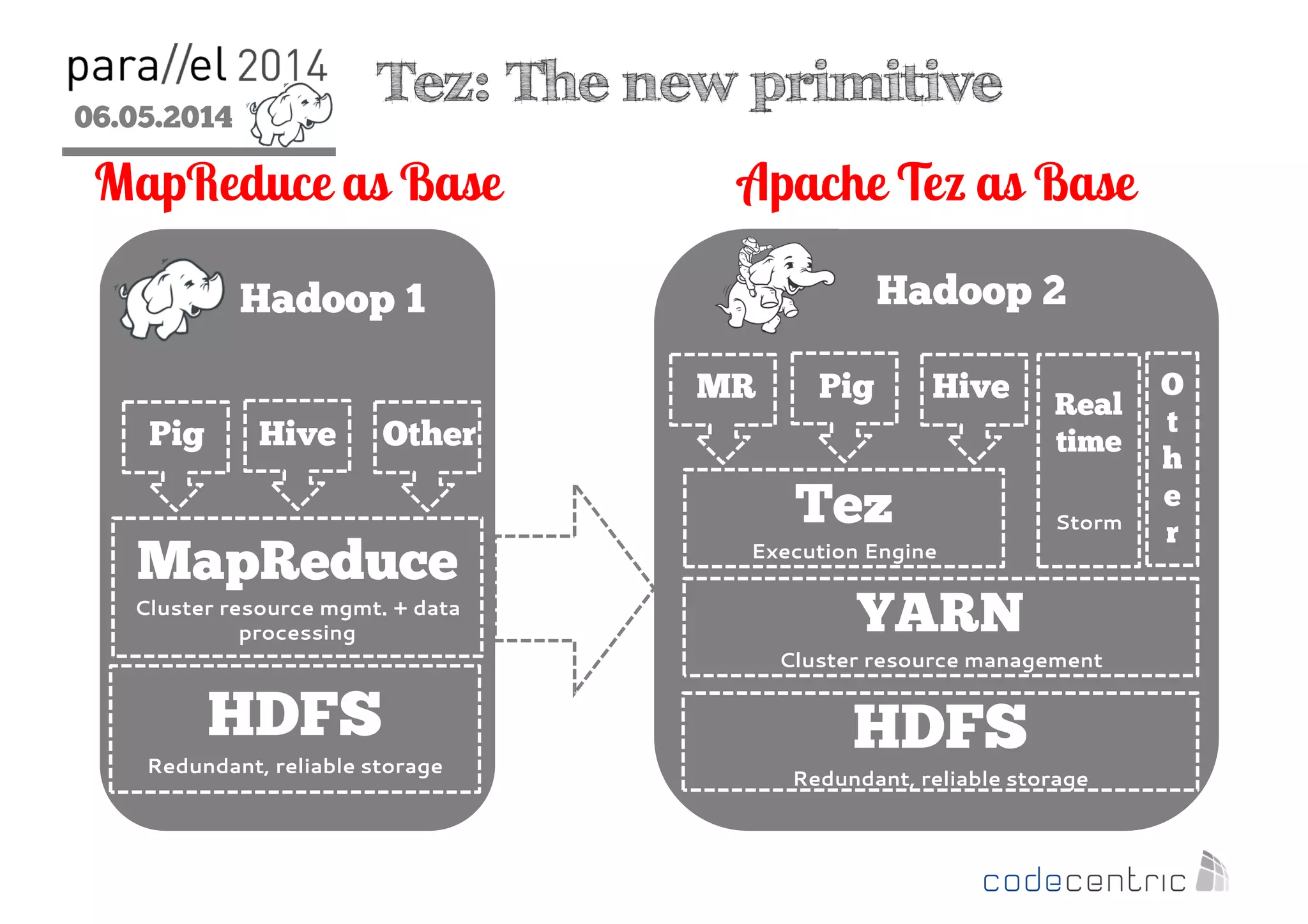
Hadoop 1
HDFS
Redundant, reliable storage
Tez: The new primitive
MapReduce
Cluster resource mgmt. + data
processing
Hadoop 2
MapReduce as Base Apache Tez as Base
Pig Hive Other
HDFS
Redundant, reliable storage
YARN
Cluster resource management
Tez
Execution Engine
MR Pig Hive Real
time
Storm
O
t
h
e
r
06.05.2014
2
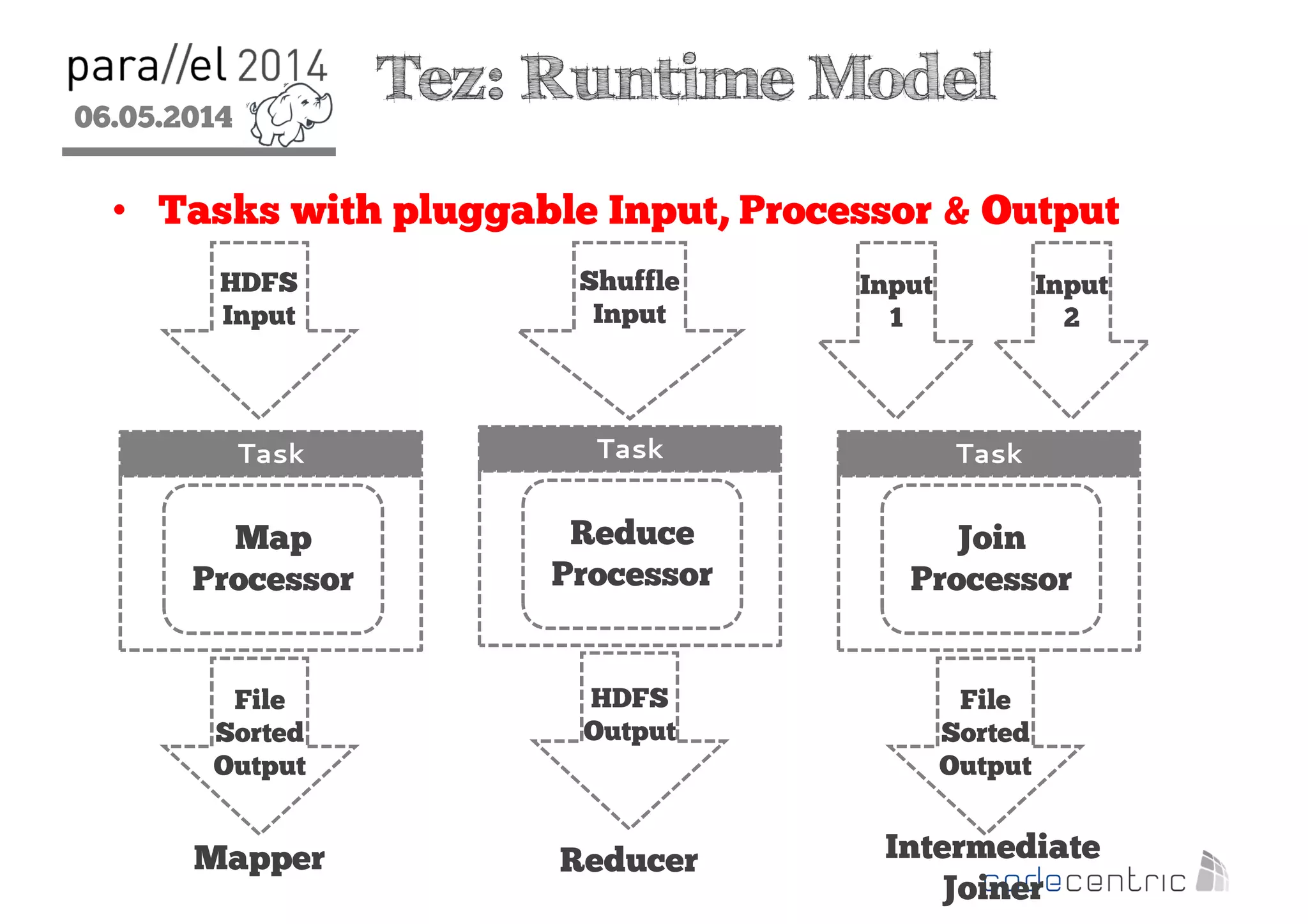
Tez: Runtime Model
• Tasks with pluggable Input, Processor & Output
Task
HDFS
Input
Map
Processor
File
Sorted
Output
Mapper
Task
Reduce
Processor
Reducer
Shuffle
Input
HDFS
Output
Task
Input
1
Join
Processor
File
Sorted
Output
Intermediate
Joiner
Input
2
06.05.2014
2
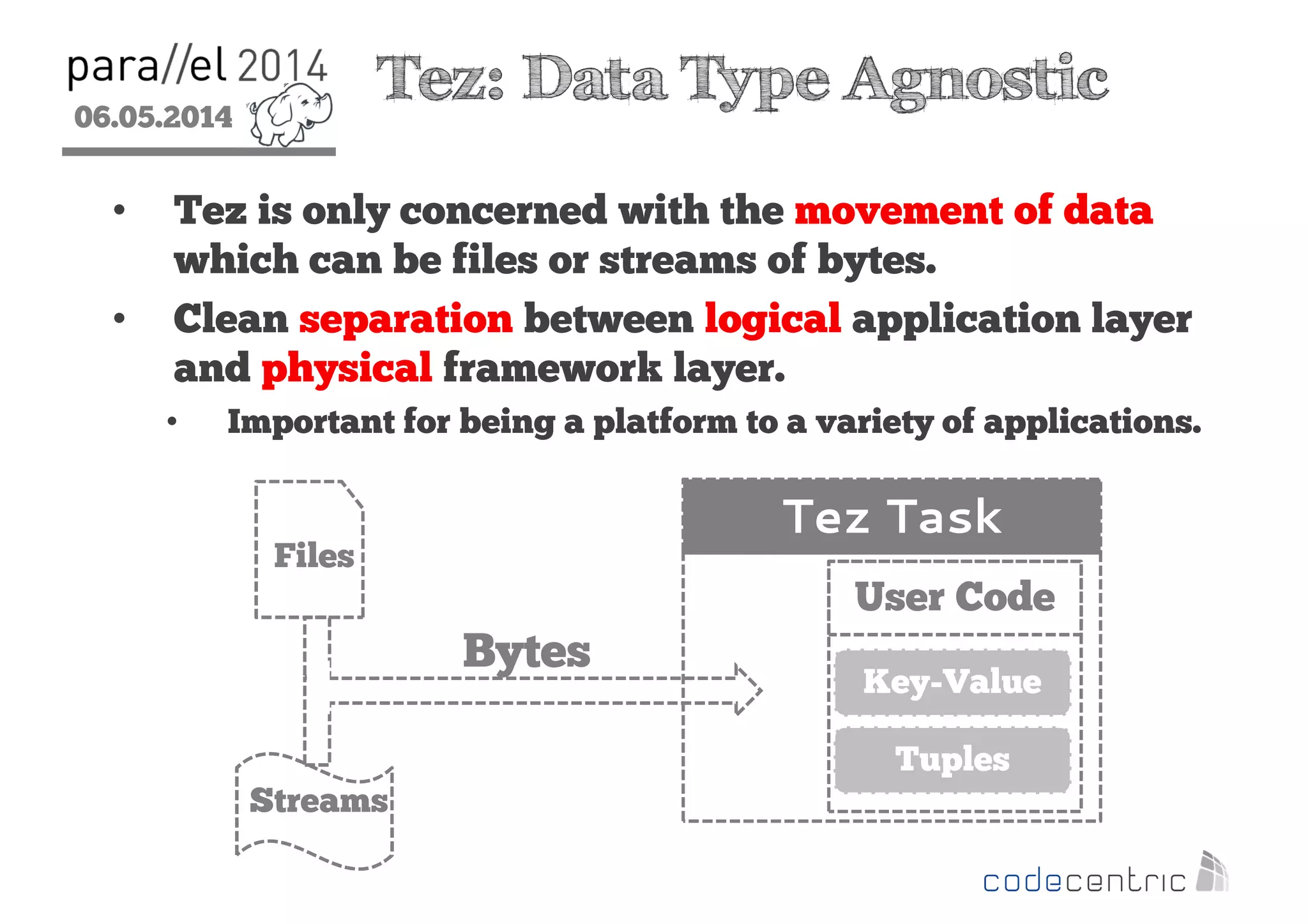
Tez: Data Type Agnostic
• Tez is only concerned with the movement of data
which can be files or streams of bytes.
• Clean separation between logical application layer
and physical framework layer.
• Important for being a platform to a variety of applications.
Files
Streams
Tez Task
User Code
Key-Value
Tuples
Bytes
06.05.2014
2
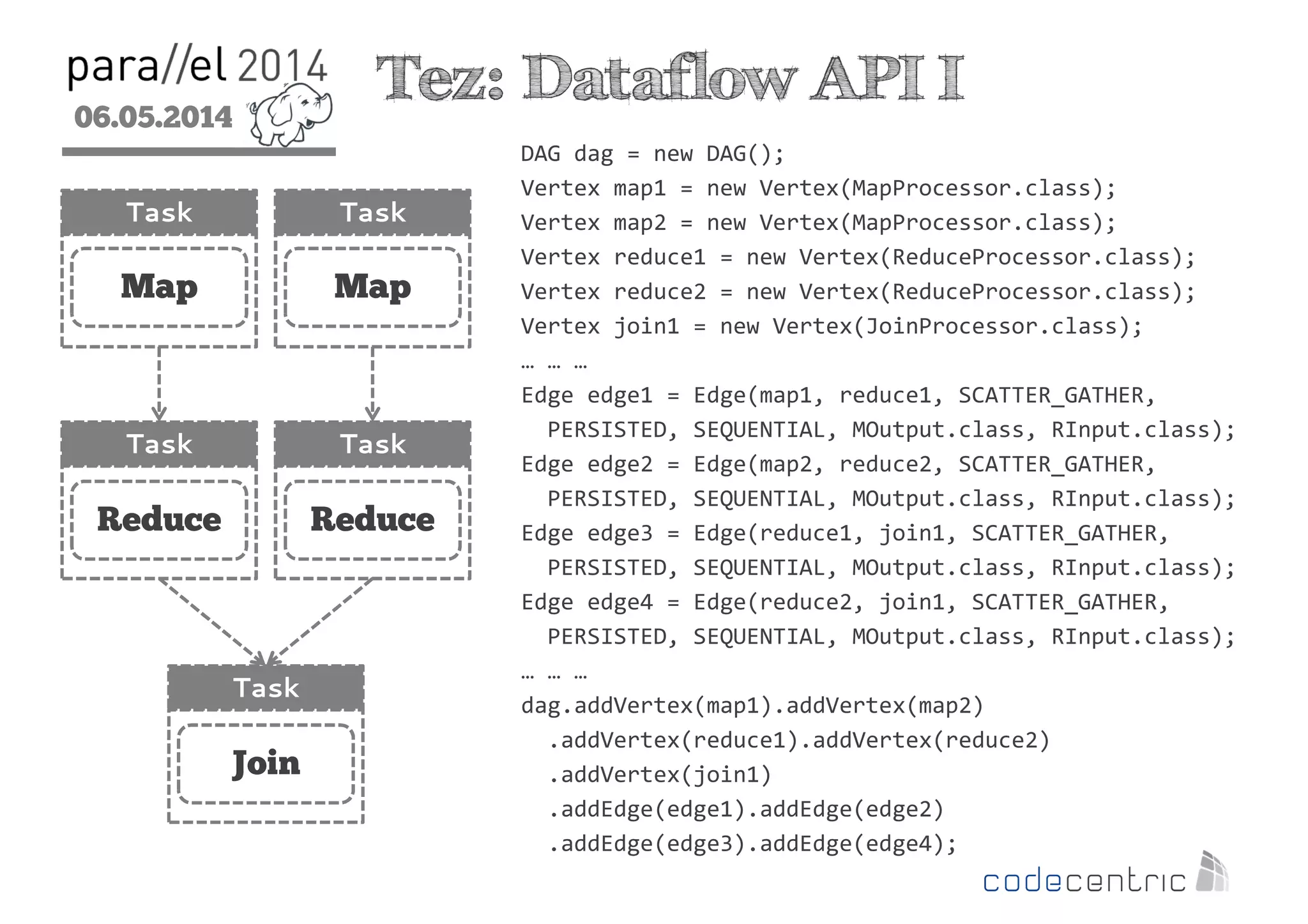
Tez: Dataflow API I
Task
Map
Task
Map
Task
Reduce
Task
Reduce
Task
Join
DAG dag = new DAG();
Vertex map1 = new Vertex(MapProcessor.class);
Vertex map2 = new Vertex(MapProcessor.class);
Vertex reduce1 = new Vertex(ReduceProcessor.class);
Vertex reduce2 = new Vertex(ReduceProcessor.class);
Vertex join1 = new Vertex(JoinProcessor.class);
… … …
Edge edge1 = Edge(map1, reduce1, SCATTER_GATHER,
PERSISTED, SEQUENTIAL, MOutput.class, RInput.class);
Edge edge2 = Edge(map2, reduce2, SCATTER_GATHER,
PERSISTED, SEQUENTIAL, MOutput.class, RInput.class);
Edge edge3 = Edge(reduce1, join1, SCATTER_GATHER,
PERSISTED, SEQUENTIAL, MOutput.class, RInput.class);
Edge edge4 = Edge(reduce2, join1, SCATTER_GATHER,
PERSISTED, SEQUENTIAL, MOutput.class, RInput.class);
… … …
dag.addVertex(map1).addVertex(map2)
.addVertex(reduce1).addVertex(reduce2)
.addVertex(join1)
.addEdge(edge1).addEdge(edge2)
.addEdge(edge3).addEdge(edge4);
06.05.2014
2
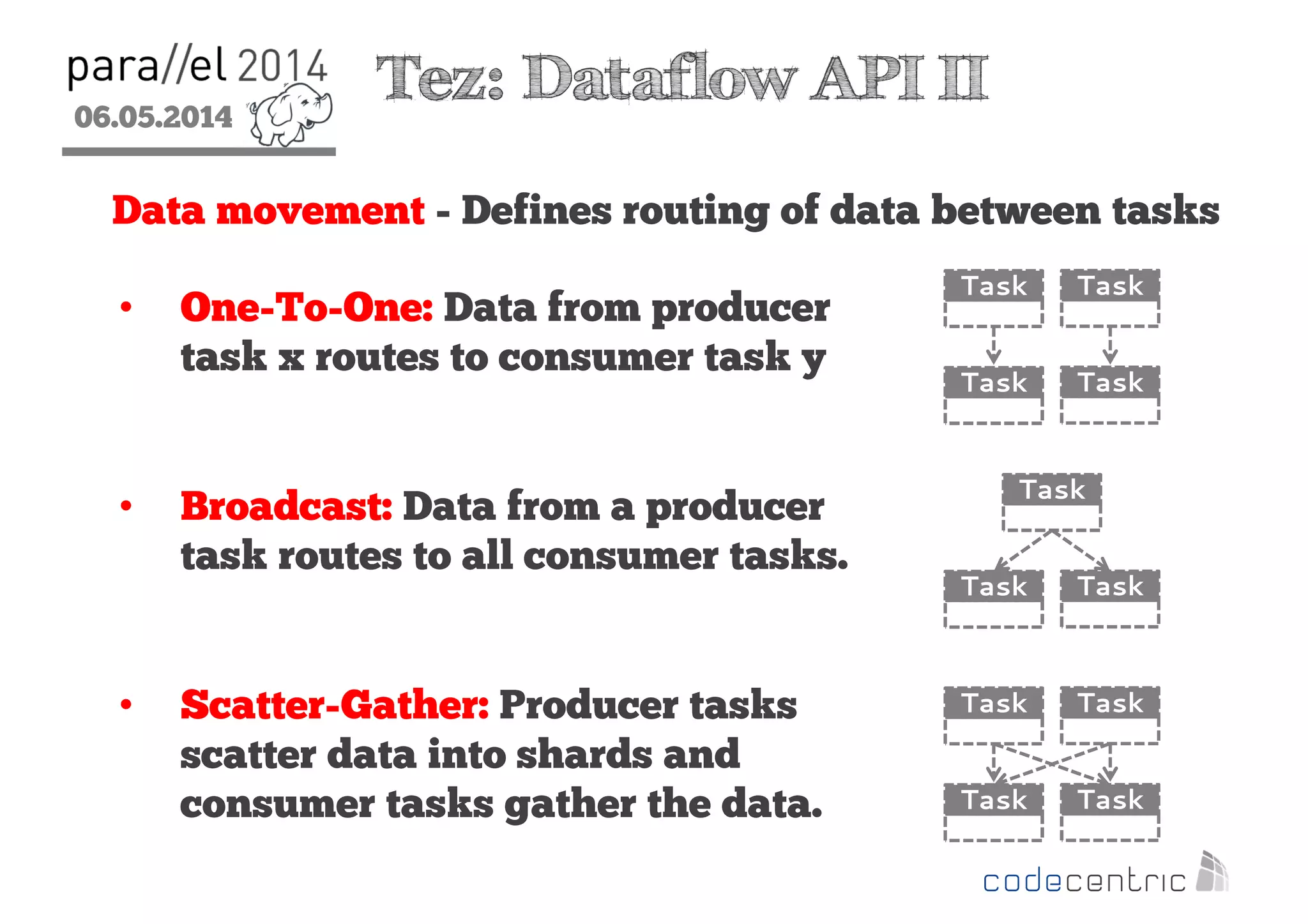
Tez: Dataflow API II
Data movement - Defines routing of data between tasks
Task
Task
Task
Task
Task
Task Task
Task
Task
Task
Task
• One-To-One: Data from producer
task x routes to consumer task y
• Broadcast: Data from a producer
task routes to all consumer tasks.
• Scatter-Gather: Producer tasks
scatter data into shards and
consumer tasks gather the data.
06.05.2014
2
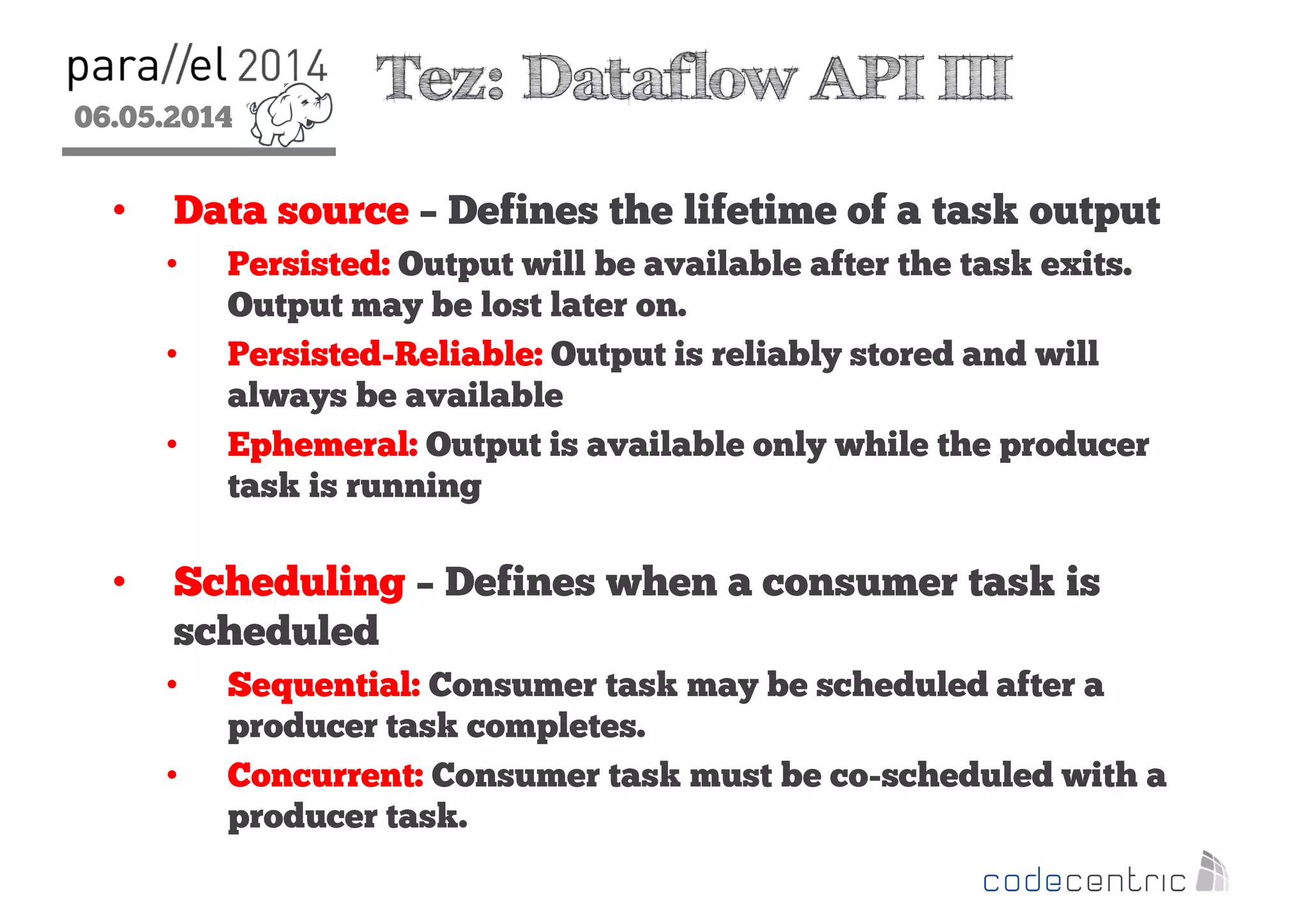
Tez: Dataflow API III
• Data source – Defines the lifetime of a task output
• Persisted: Output will be available after the task exits.
Output may be lost later on.
• Persisted-Reliable: Output is reliably stored and will
always be available
• Ephemeral: Output is available only while the producer
task is running
• Scheduling – Defines when a consumer task is
scheduled
• Sequential: Consumer task may be scheduled after a
producer task completes.
• Concurrent: Consumer task must be co-scheduled with a
producer task.
06.05.2014
2
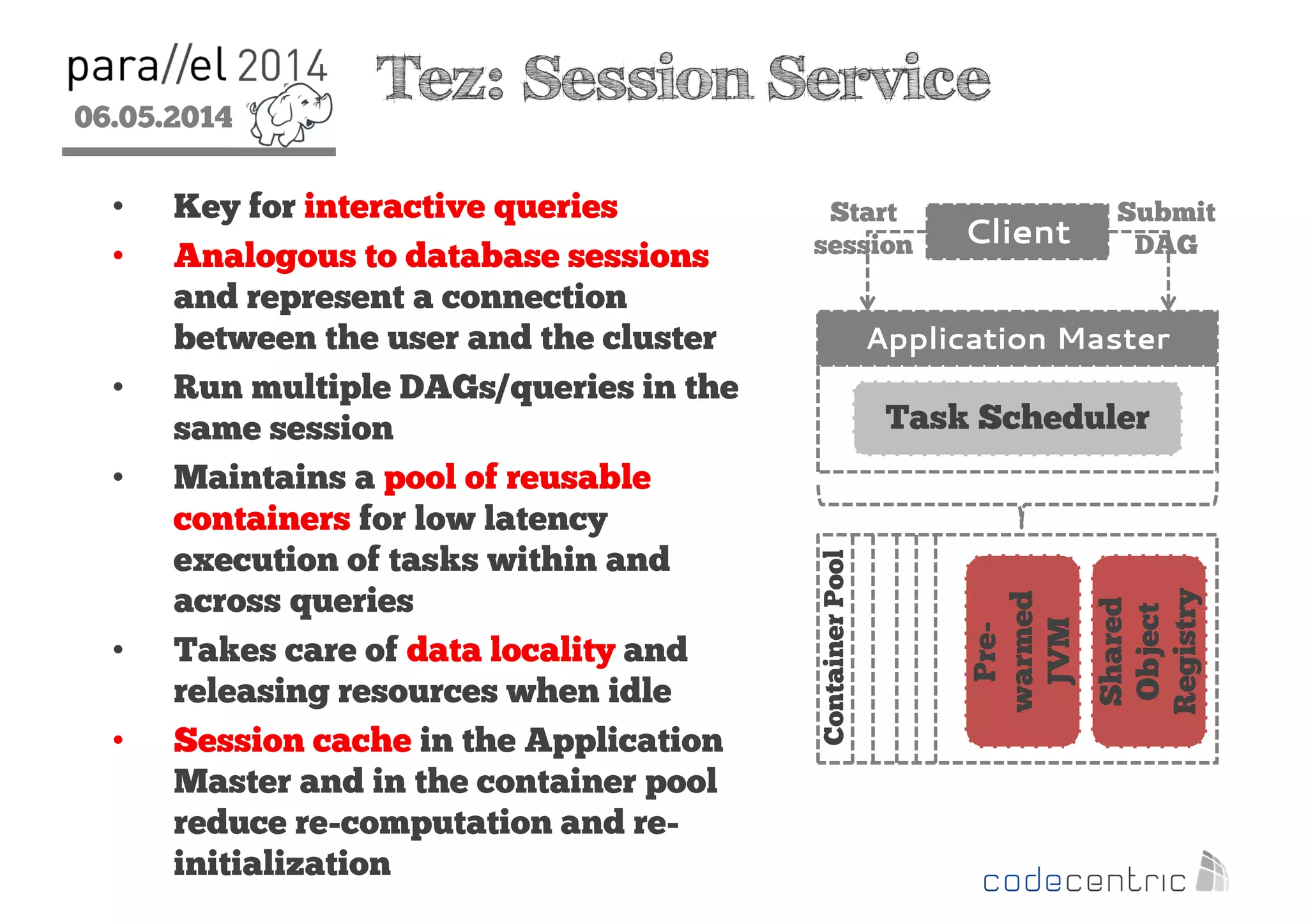
Tez: Session Service
• Key for interactive queries
• Analogous to database sessions
and represent a connection
between the user and the cluster
• Run multiple DAGs/queries in the
same session
• Maintains a pool of reusable
containers for low latency
execution of tasks within and
across queries
• Takes care of data locality and
releasing resources when idle
• Session cache in the Application
Master and in the container pool
reduce re-computation and re-
initialization
Application Master
Task Scheduler
Client
Shared
Object
Registry
Pre-
warmed
JVM
ContainerPool
Start
session
Submit
DAG
06.05.2014
2
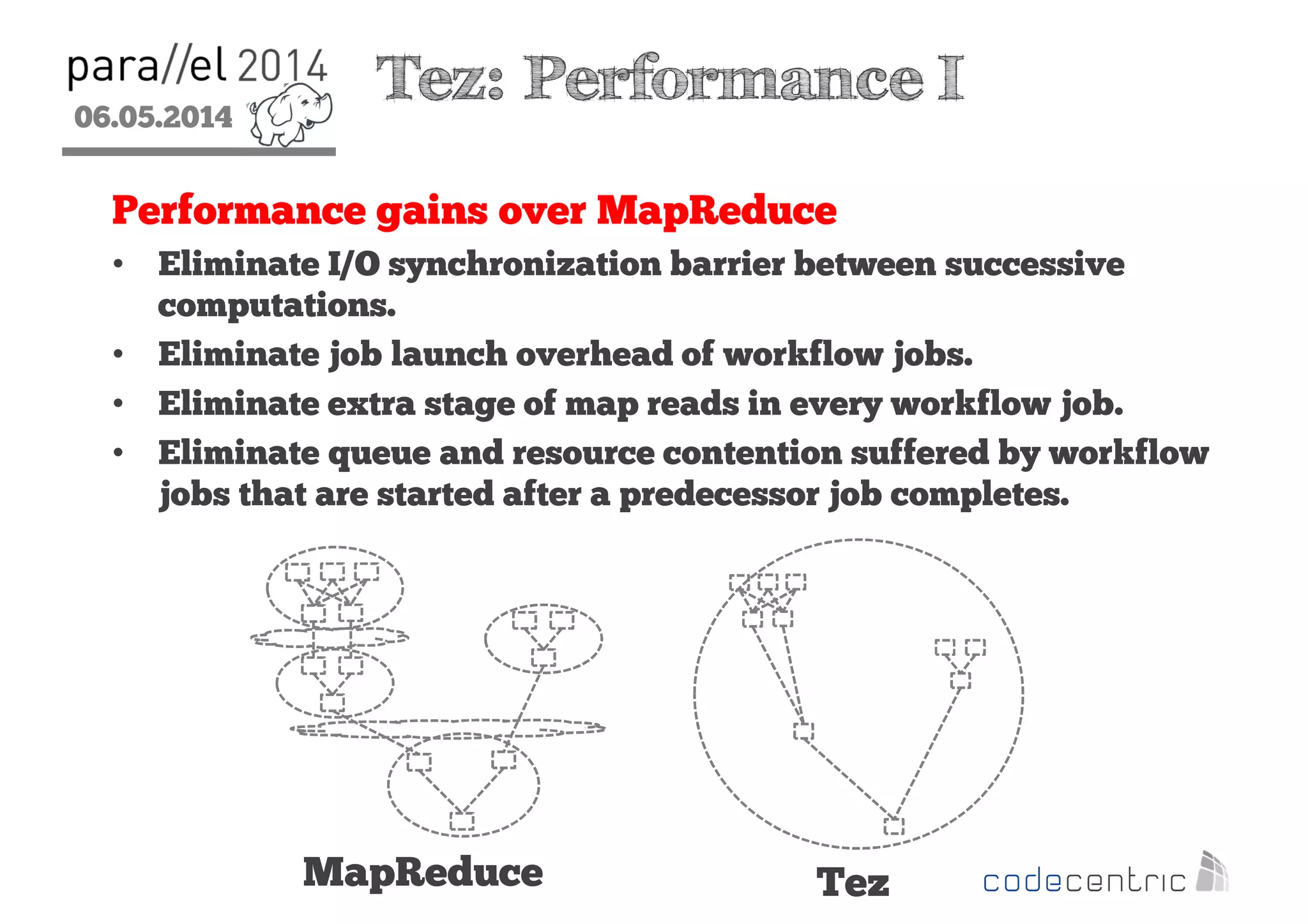
Tez: Performance I
Performance gains over MapReduce
• Eliminate I/O synchronization barrier between successive
computations.
• Eliminate job launch overhead of workflow jobs.
• Eliminate extra stage of map reads in every workflow job.
• Eliminate queue and resource contention suffered by workflow
jobs that are started after a predecessor job completes.
MapReduce Tez
06.05.2014
2
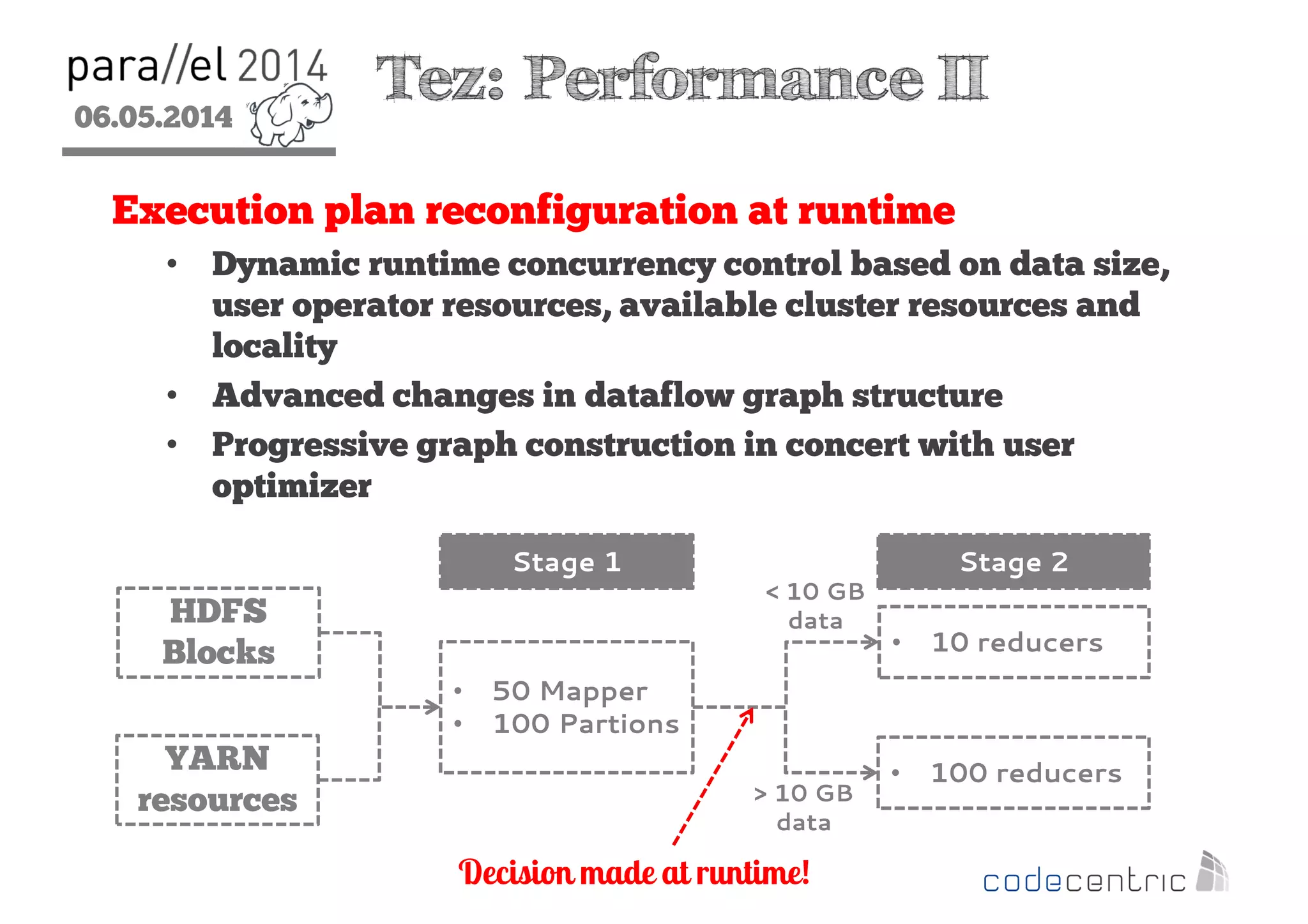
Tez: Performance II
Execution plan reconfiguration at runtime
• Dynamic runtime concurrency control based on data size,
user operator resources, available cluster resources and
locality
• Advanced changes in dataflow graph structure
• Progressive graph construction in concert with user
optimizer
• 50 Mapper
• 100 Partions
Stage 1
HDFS
Blocks
YARN
resources
• 10 reducers
Stage 2
• 100 reducers
< 10 GB
data
> 10 GB
data
Decision made at runtime!
06.05.2014
2
Tez: Performance III
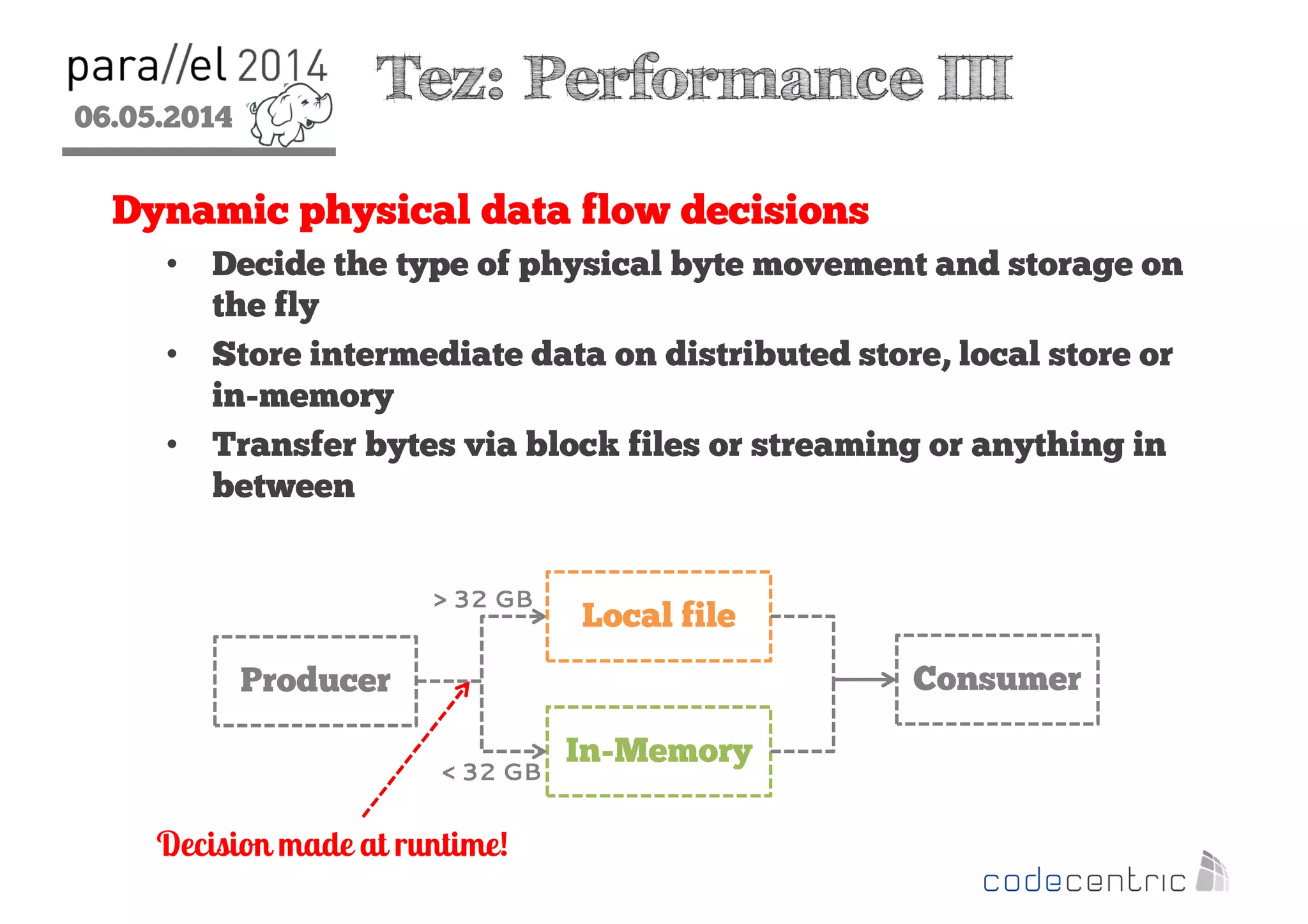
Dynamic physical data flow decisions
• Decide the type of physical byte movement and storage on
the fly
• Store intermediate data on distributed store, local store or
in-memory
• Transfer bytes via block files or streaming or anything in
between
Producer Consumer
Local file
In-Memory
Decision made at runtime!
< 32 GB
> 32 GB
06.05.2014
2
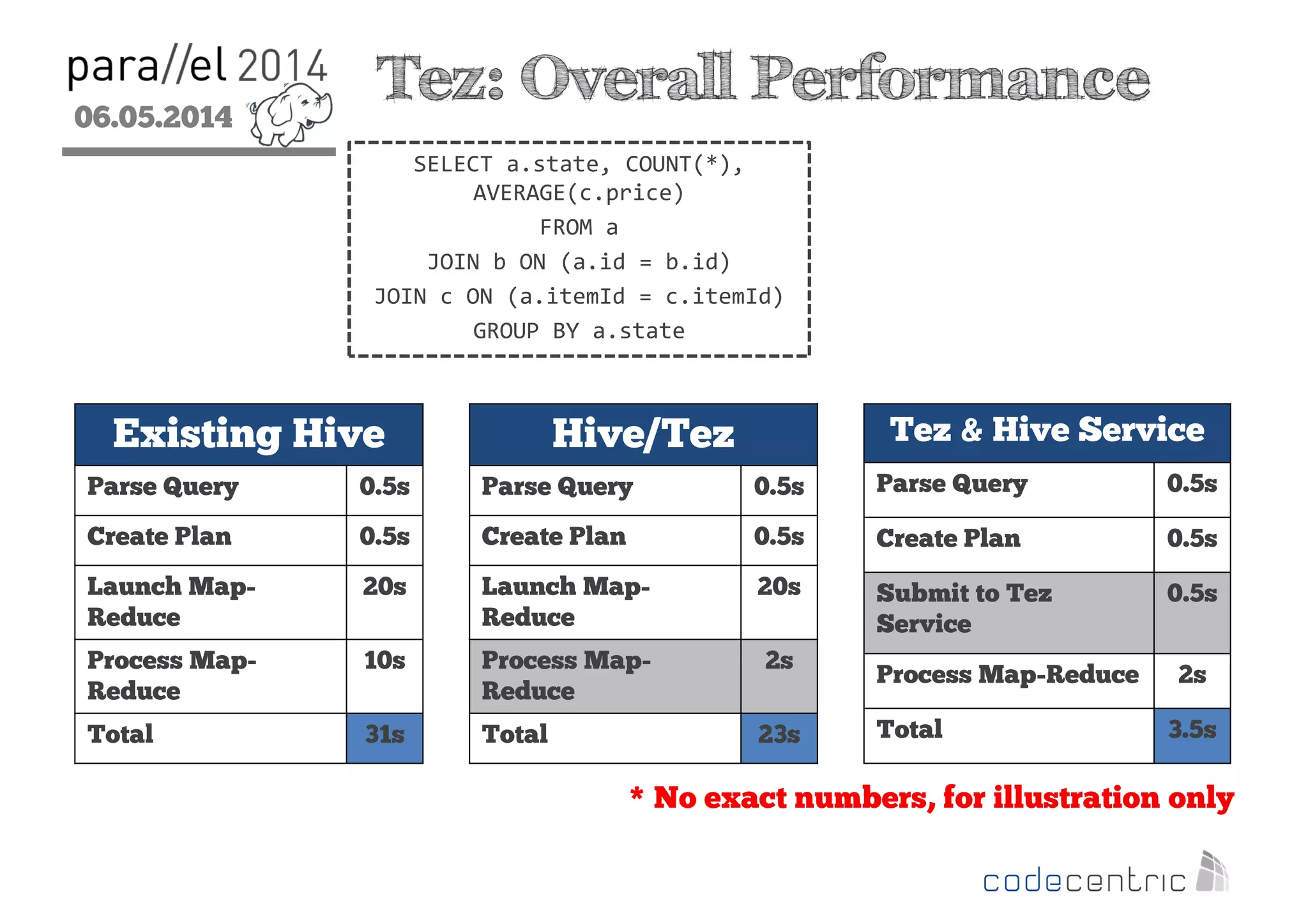
Tez: Overall Performance
SELECT a.state, COUNT(*),
AVERAGE(c.price)
FROM a
JOIN b ON (a.id = b.id)
JOIN c ON (a.itemId = c.itemId)
GROUP BY a.state
Existing Hive
Parse Query 0.5s
Create Plan 0.5s
Launch Map-
Reduce
20s
Process Map-
Reduce
10s
Total 31s
Hive/Tez
Parse Query 0.5s
Create Plan 0.5s
Launch Map-
Reduce
20s
Process Map-
Reduce
2s
Total 23s
Tez & Hive Service
Parse Query 0.5s
Create Plan 0.5s
Submit to Tez
Service
0.5s
Process Map-Reduce 2s
Total 3.5s
* No exact numbers, for illustration only
06.05.2014
2
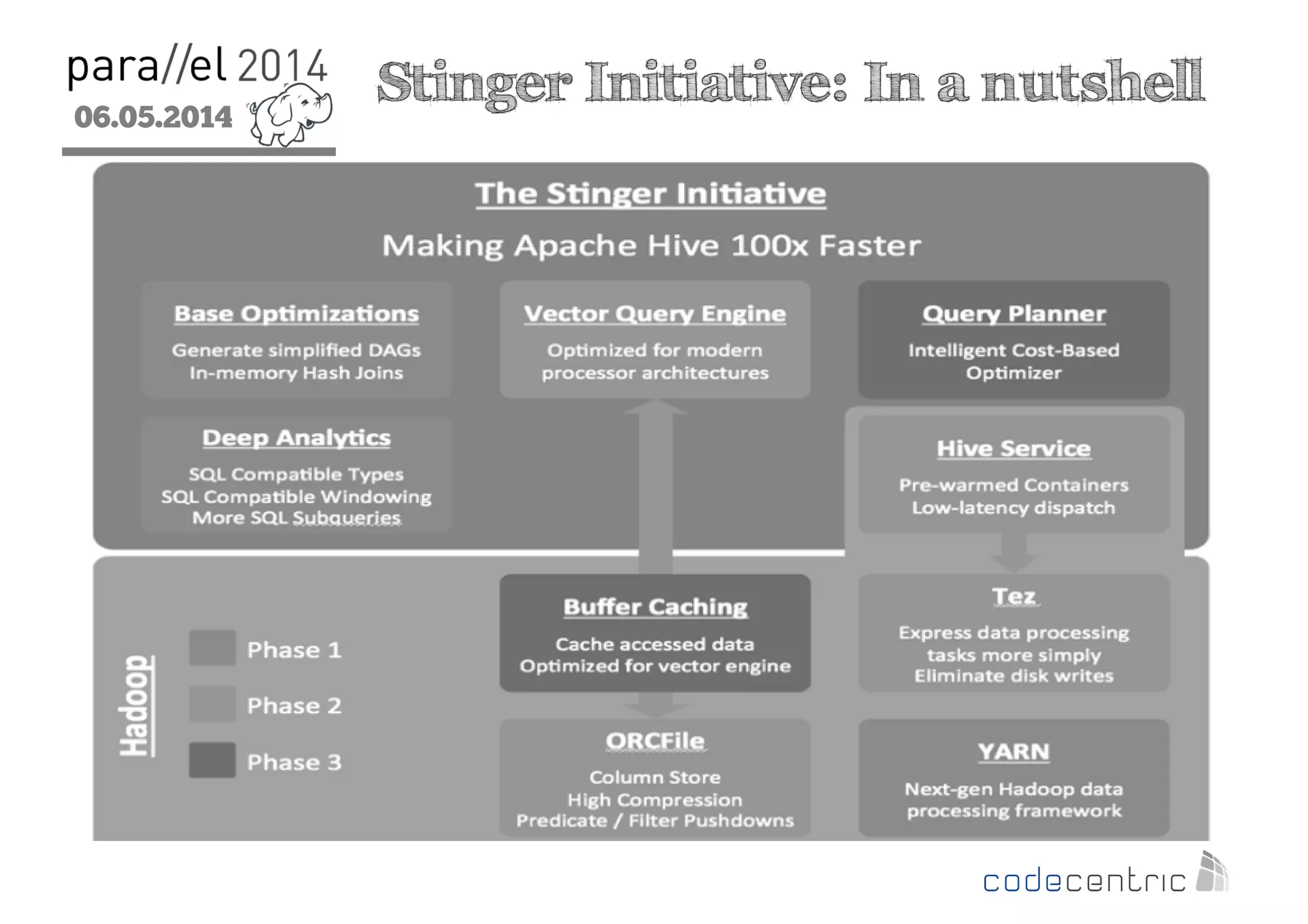
Stinger Initiative: In a nutshell
06.05.2014
2
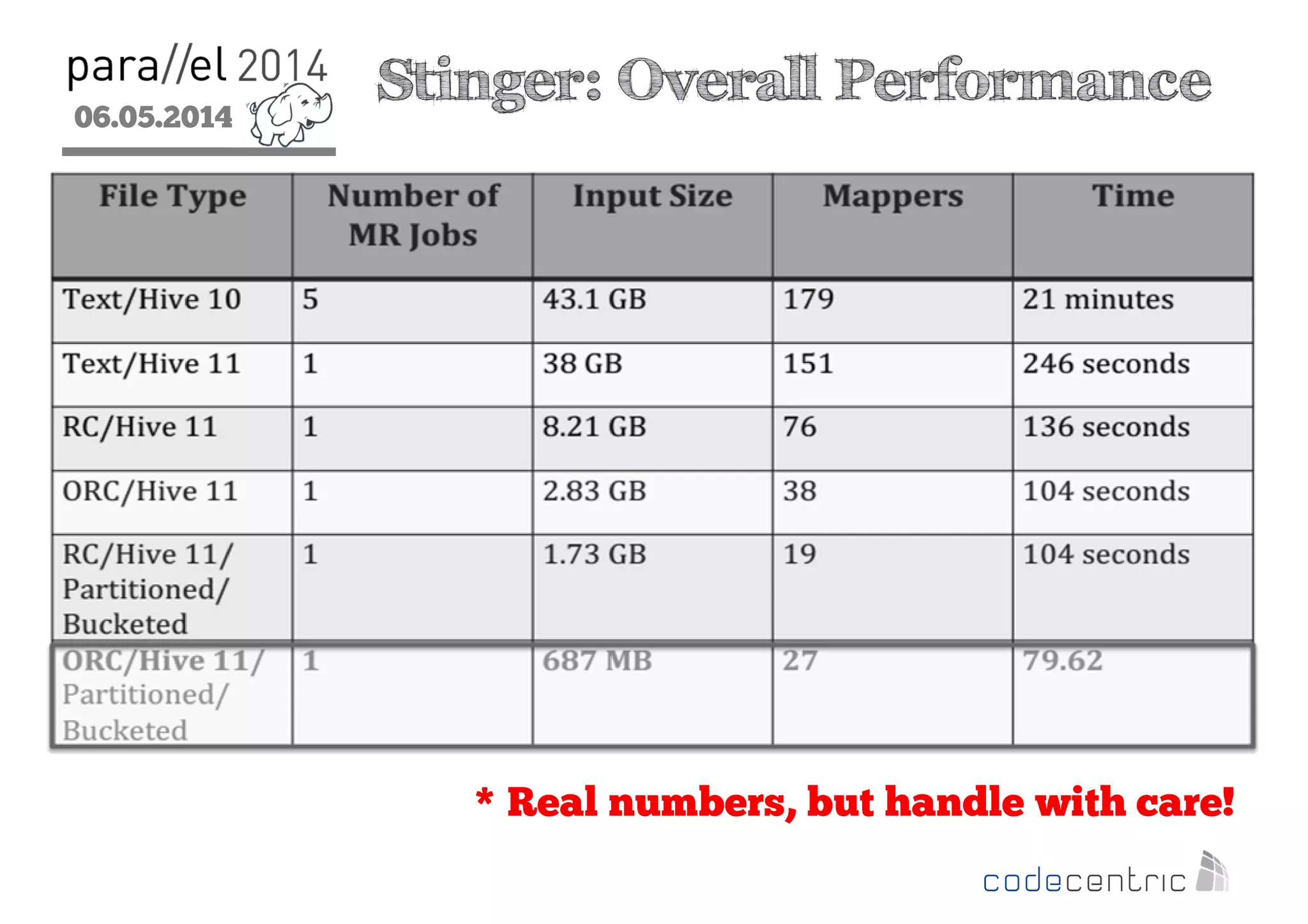
Stinger: Overall Performance
* Real numbers, but handle with care!
06.05.2014
2
Tez: Getting started
• Stinger Phase 3 has been delivered with Hive 0.13
• Incorporated in Hortonworks Data Platform (HDP) 2.1
• Can also be integrated into CHD and MapR
• Switch the execution engine (using the Hive Shell)
set hive.execution.engine=tez;
• Query with HiveQL as usual, check the log output and
compare the execution times
• Get comfortable with all the other goodies of Stinger
Phase 3
• Run the same query multiple times to make usage of Tez Service
• Make usage of vectorization (only with ORC format):
create table data_orc stored as orc as select * from data;
set hive.vectorized.execution.enabled;
explain select * from data_orc;
06.05.2014
2
Agenda
• Introduction to Hadoop 2
• MapReduce 2
• Tez, Hive & Stinger Initiative
• Spark
06.05.2014
2
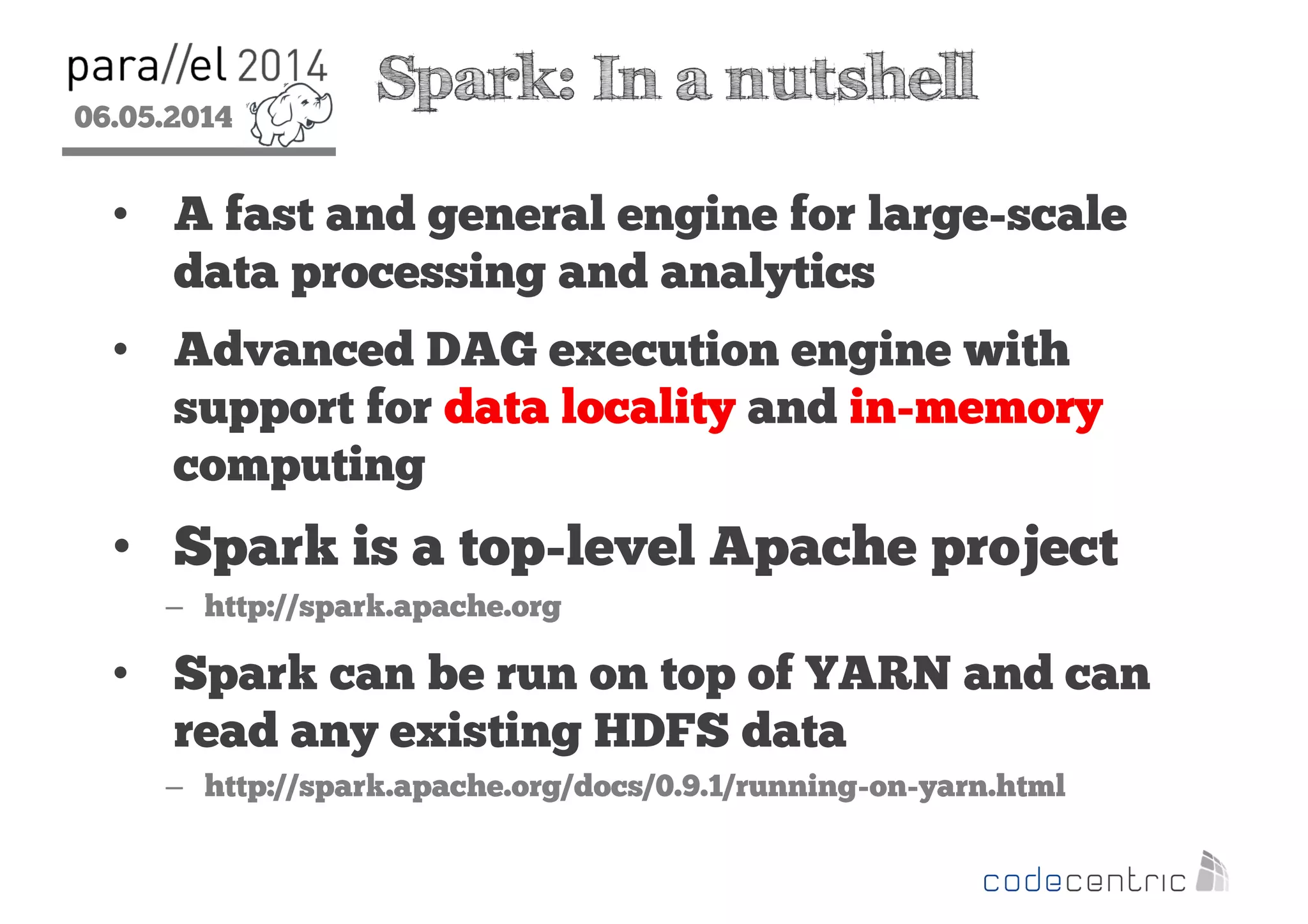
Spark: In a nutshell
• A fast and general engine for large-scale
data processing and analytics
• Advanced DAG execution engine with
support for data locality and in-memory
computing
• Spark is a top-level Apache project
– http://spark.apache.org
• Spark can be run on top of YARN and can
read any existing HDFS data
– http://spark.apache.org/docs/0.9.1/running-on-yarn.html
06.05.2014
2
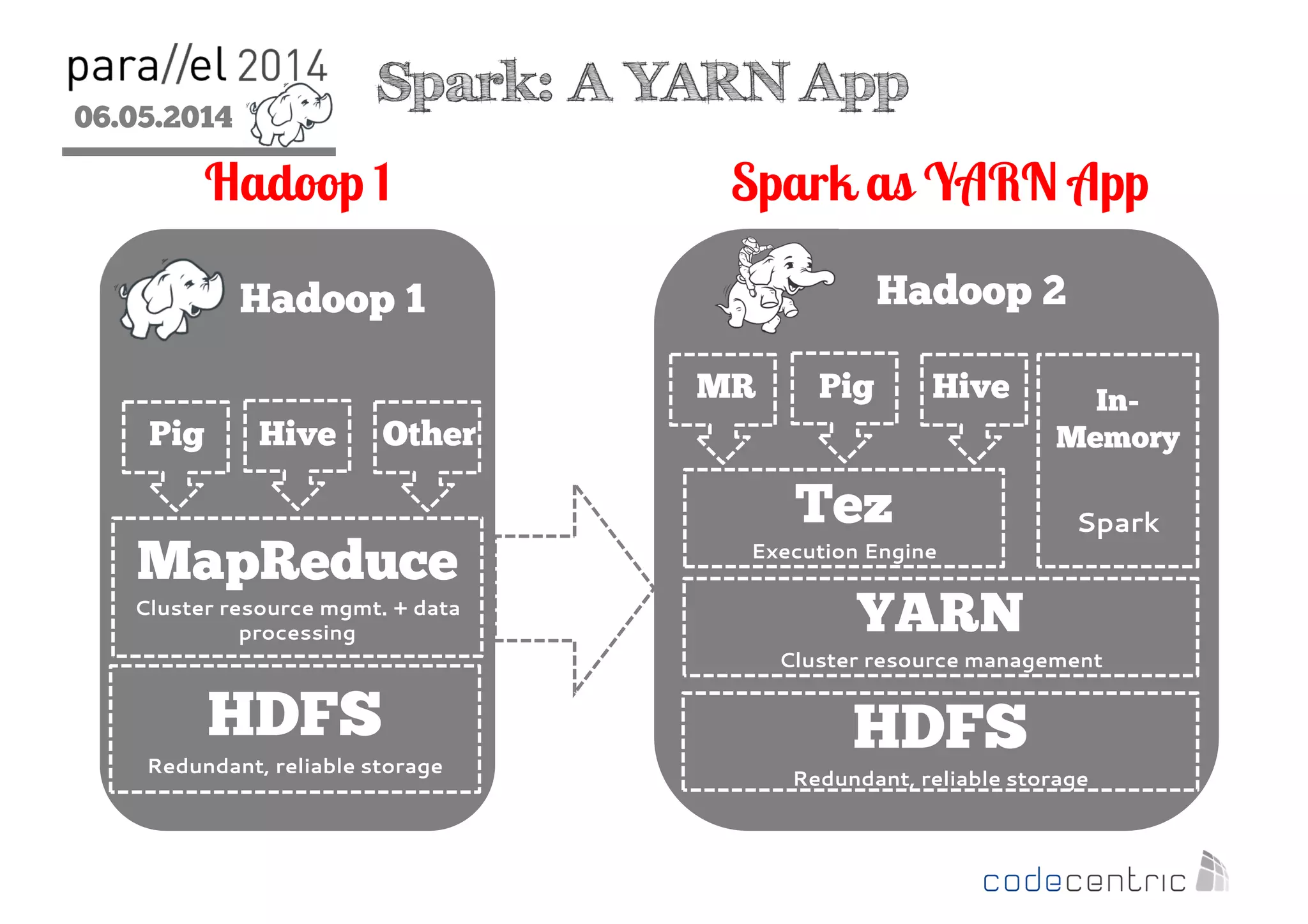
Hadoop 1
HDFS
Redundant, reliable storage
Spark: A YARN App
MapReduce
Cluster resource mgmt. + data
processing
Hadoop 2
Hadoop 1 Spark as YARN App
Pig Hive Other
HDFS
Redundant, reliable storage
YARN
Cluster resource management
Tez
Execution Engine
MR Pig Hive In-
Memory
Spark
06.05.2014
2
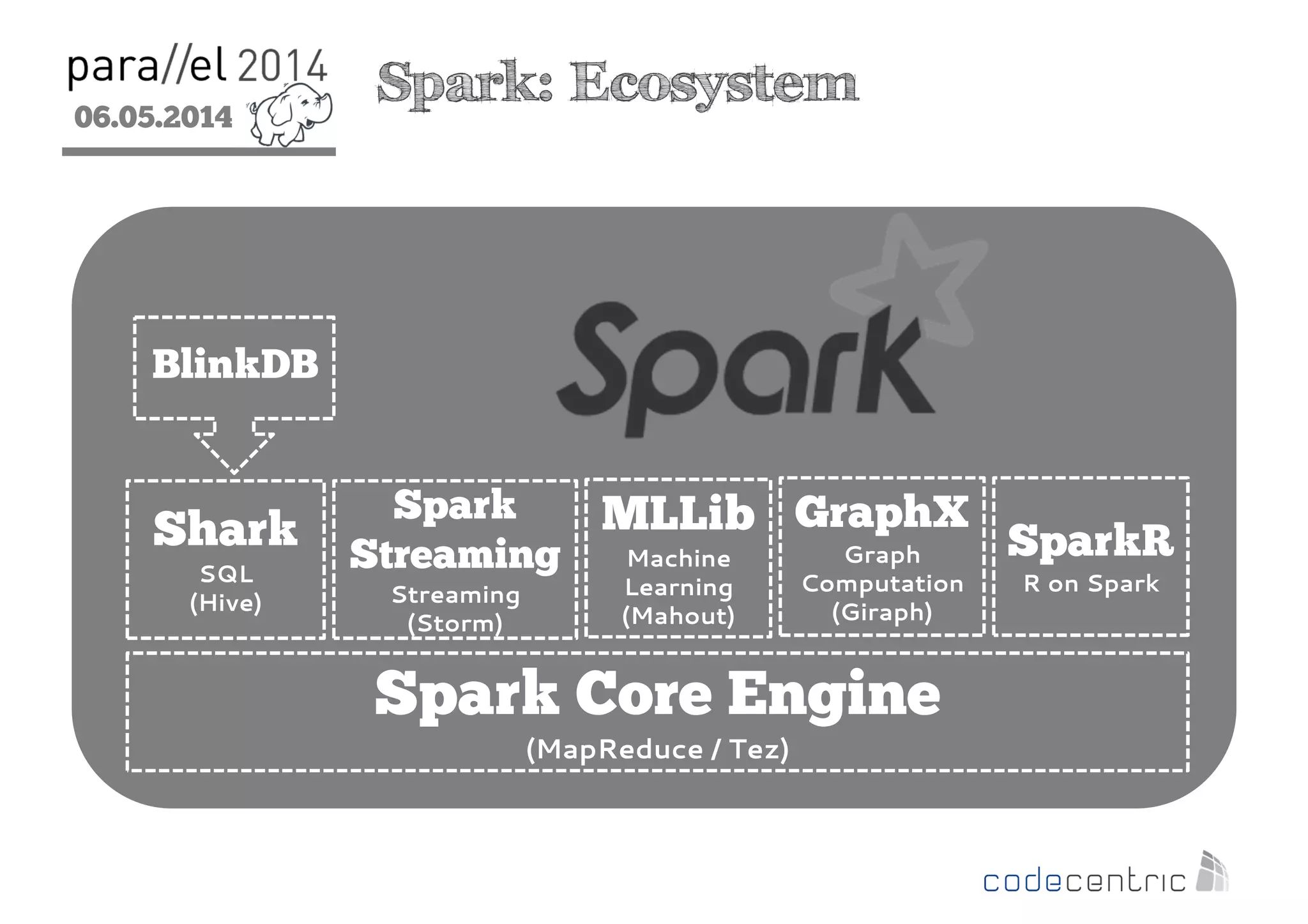
HDFS
Redundant, reliable storage
Spark: Ecosystem
MapReduce
Cluster resource mgmt. + data
processing
BlinkDB
Spark Core Engine
(MapReduce / Tez)
Shark
SQL
(Hive)
Spark
Streaming
Streaming
(Storm)
MLLib
Machine
Learning
(Mahout)
SparkR
R on Spark
GraphX
Graph
Computation
(Giraph)
06.05.2014
2
Spark: Runtime Model
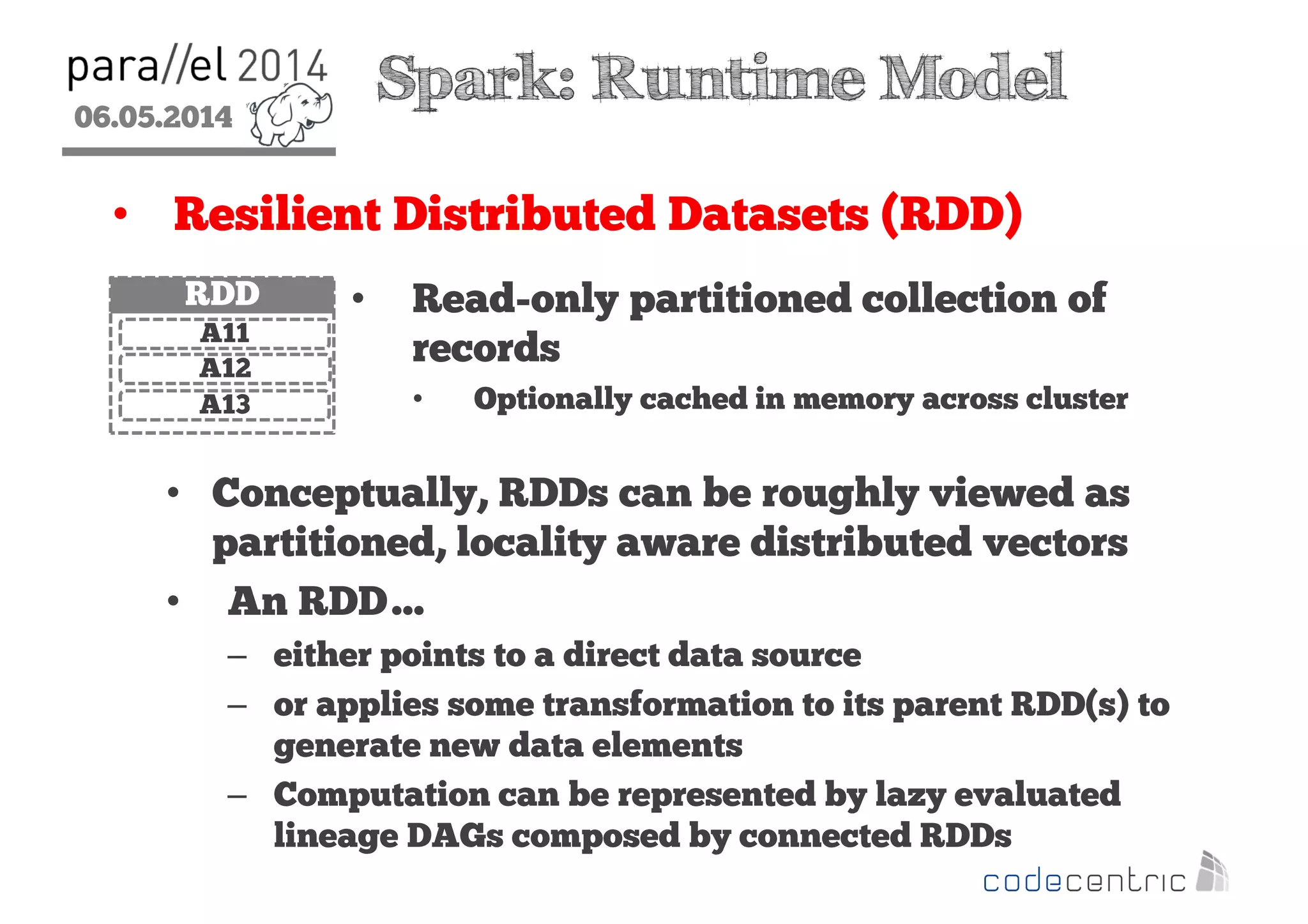
• Resilient Distributed Datasets (RDD)
• Read-only partitioned collection of
records
• Optionally cached in memory across cluster
• Conceptually, RDDs can be roughly viewed as
partitioned, locality aware distributed vectors
• An RDD…
– either points to a direct data source
– or applies some transformation to its parent RDD(s) to
generate new data elements
– Computation can be represented by lazy evaluated
lineage DAGs composed by connected RDDs
RDD
A11
A12
A13
06.05.2014
2
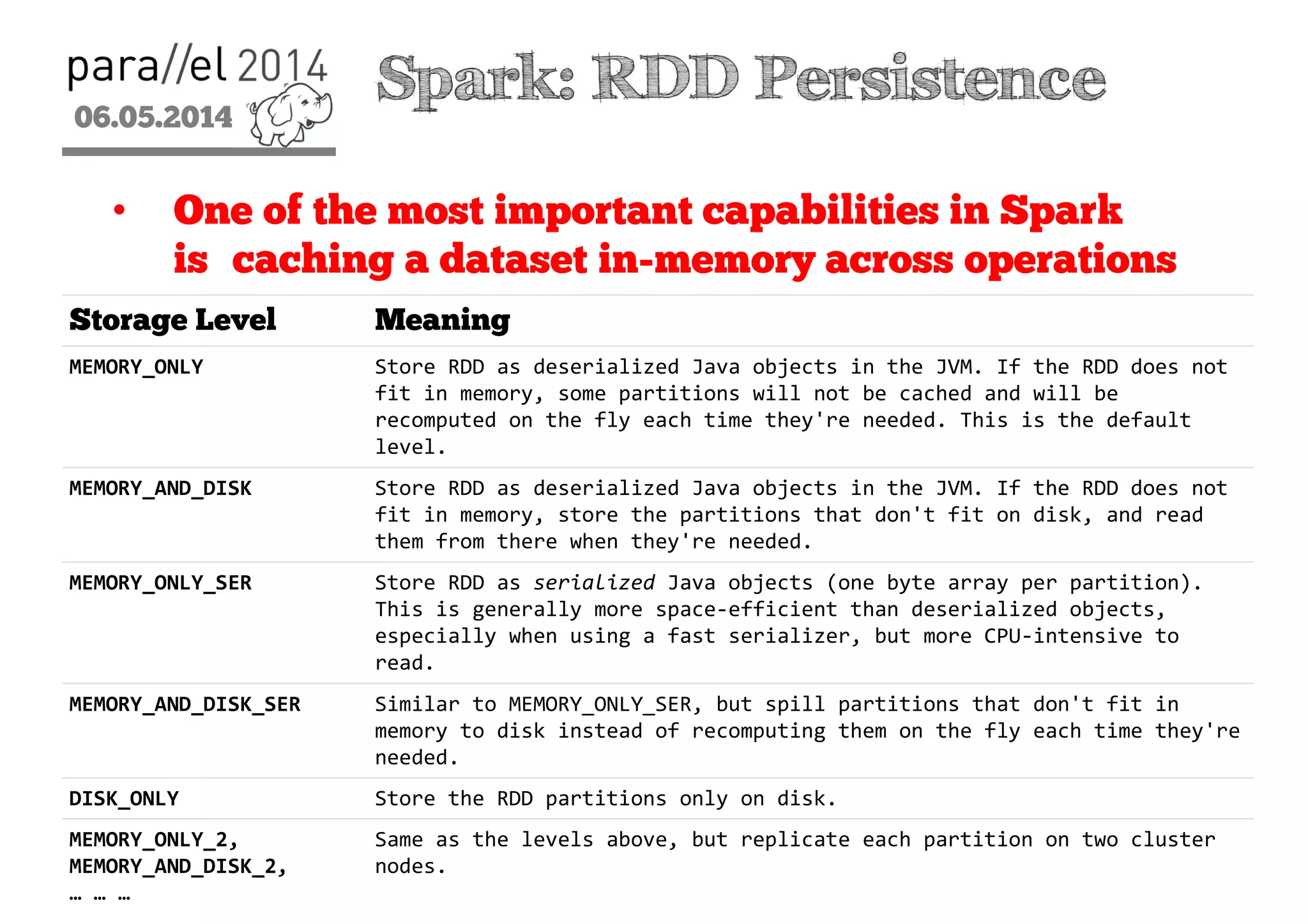
Spark: RDD Persistence
• One of the most important capabilities in Spark
is caching a dataset in-memory across operations
Storage Level Meaning
MEMORY_ONLY Store RDD as deserialized Java objects in the JVM. If the RDD does not
fit in memory, some partitions will not be cached and will be
recomputed on the fly each time they're needed. This is the default
level.
MEMORY_AND_DISK Store RDD as deserialized Java objects in the JVM. If the RDD does not
fit in memory, store the partitions that don't fit on disk, and read
them from there when they're needed.
MEMORY_ONLY_SER Store RDD as serialized Java objects (one byte array per partition).
This is generally more space-efficient than deserialized objects,
especially when using a fast serializer, but more CPU-intensive to
read.
MEMORY_AND_DISK_SER Similar to MEMORY_ONLY_SER, but spill partitions that don't fit in
memory to disk instead of recomputing them on the fly each time they're
needed.
DISK_ONLY Store the RDD partitions only on disk.
MEMORY_ONLY_2,
MEMORY_AND_DISK_2,
… … …
Same as the levels above, but replicate each partition on two cluster
nodes.
06.05.2014
2
Spark: RDD Operations
• Transformations - Create new datasets from
existing ones
• map(func)
• filter(func)
• sample(withReplacement,fraction, seed)
• union(otherDataset)
• distinct([numTasks]))
• groupByKey([numTasks])
• … … …
• Actions - Return a value to the client after running a
computation on the dataset
• reduce(func)
• count()
• first()
• foreach(func)
• saveAsTextFile(path)
• … … …
06.05.2014
2
Spark: Dataflow
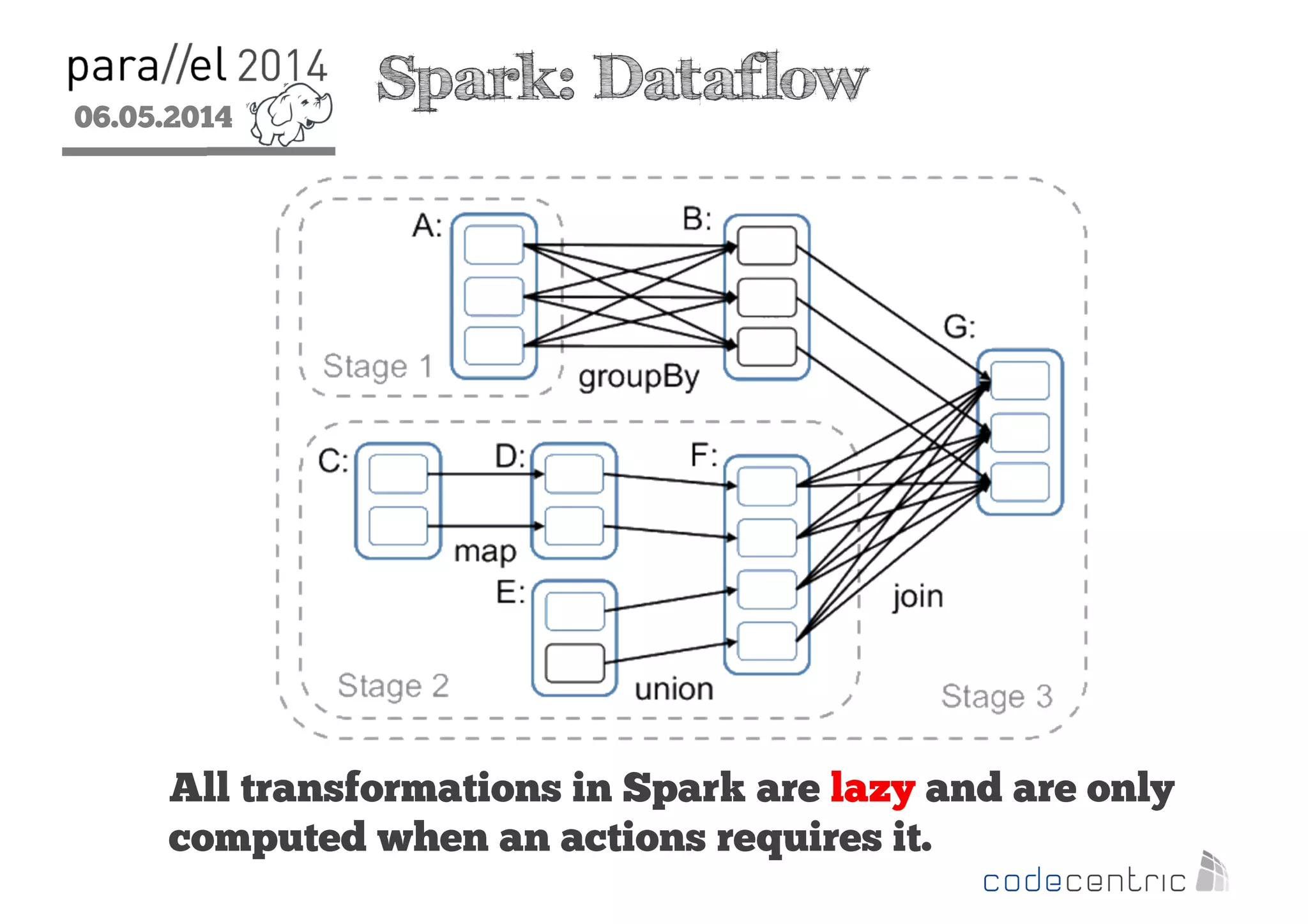
All transformations in Spark are lazy and are only
computed when an actions requires it.
06.05.2014
2
Spark: In-Memory Magic I
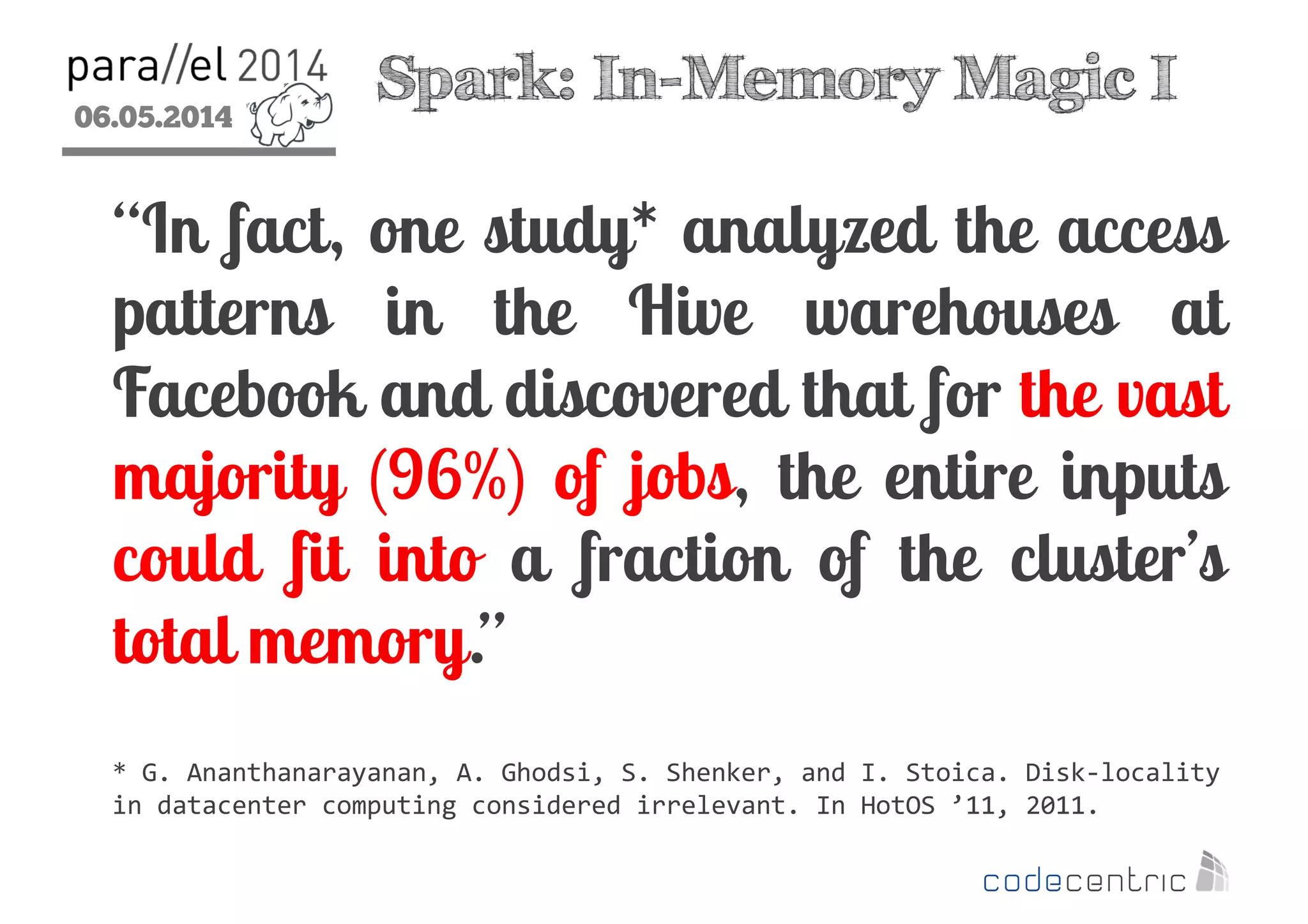
“In fact, one study* analyzed the access
patterns in the Hive warehouses at
Facebook and discovered that for the vast
majority (96%) of jobs, the entire inputs
could fit into a fraction of the cluster’s
total memory.”
* G. Ananthanarayanan, A. Ghodsi, S. Shenker, and I. Stoica. Disk-locality
in datacenter computing considered irrelevant. In HotOS ’11, 2011.
06.05.2014
2
Spark: In-Memory Magic II
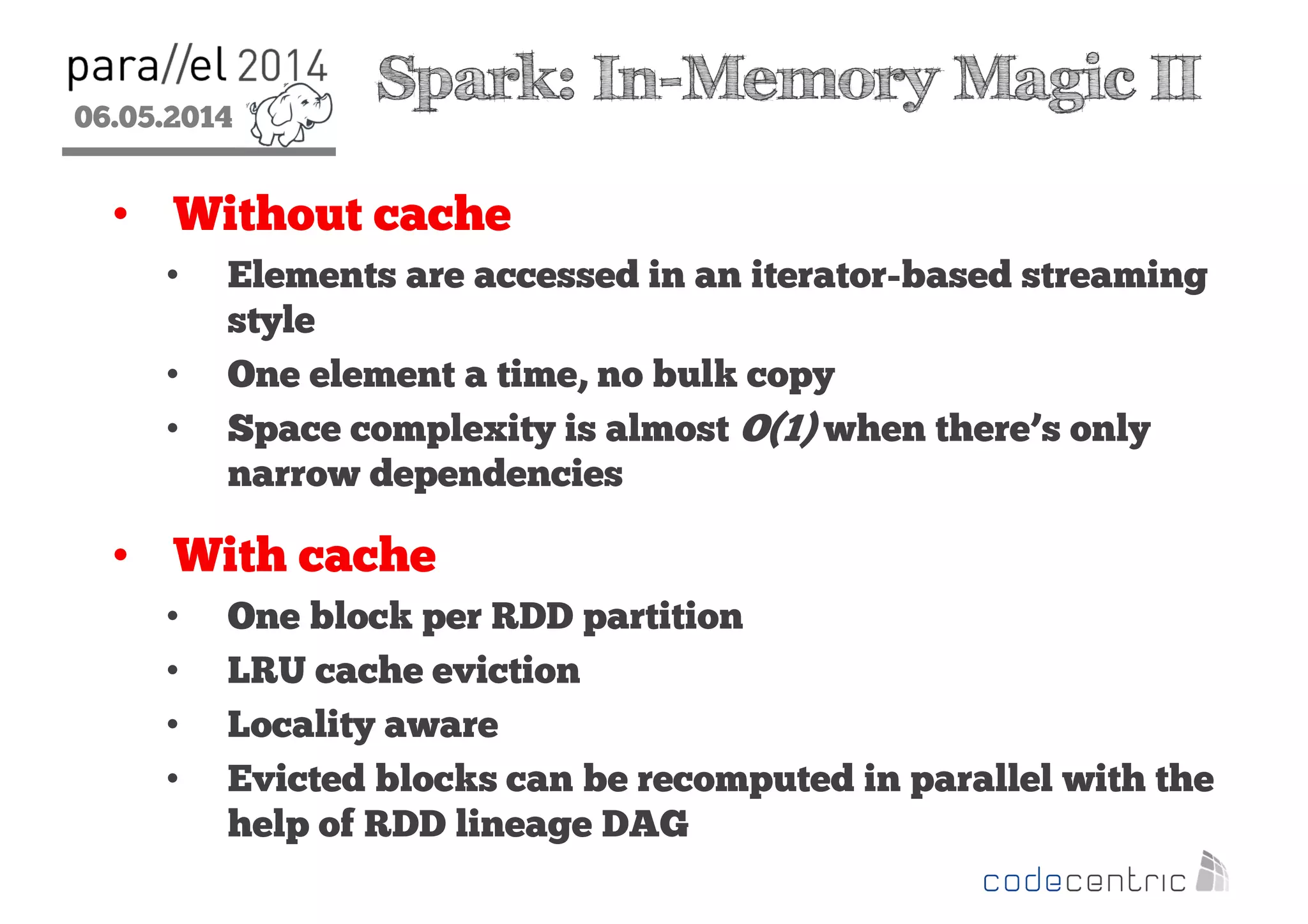
• Without cache
• Elements are accessed in an iterator-based streaming
style
• One element a time, no bulk copy
• Space complexity is almost O(1) when there’s only
narrow dependencies
• With cache
• One block per RDD partition
• LRU cache eviction
• Locality aware
• Evicted blocks can be recomputed in parallel with the
help of RDD lineage DAG
06.05.2014
2
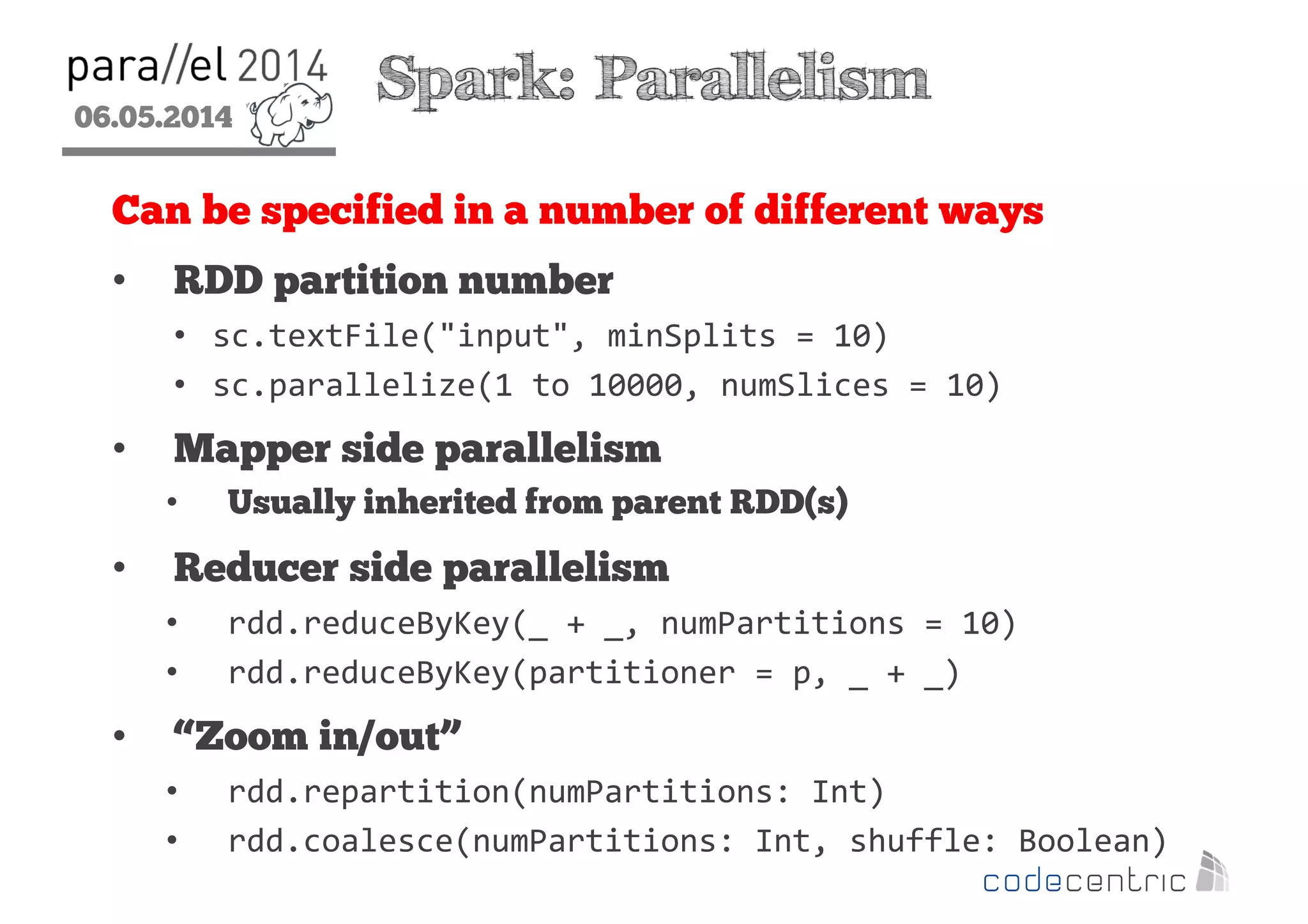
Spark: Parallelism
Can be specified in a number of different ways
• RDD partition number
• sc.textFile("input", minSplits = 10)
• sc.parallelize(1 to 10000, numSlices = 10)
• Mapper side parallelism
• Usually inherited from parent RDD(s)
• Reducer side parallelism
• rdd.reduceByKey(_ + _, numPartitions = 10)
• rdd.reduceByKey(partitioner = p, _ + _)
• “Zoom in/out”
• rdd.repartition(numPartitions: Int)
• rdd.coalesce(numPartitions: Int, shuffle: Boolean)
06.05.2014
2
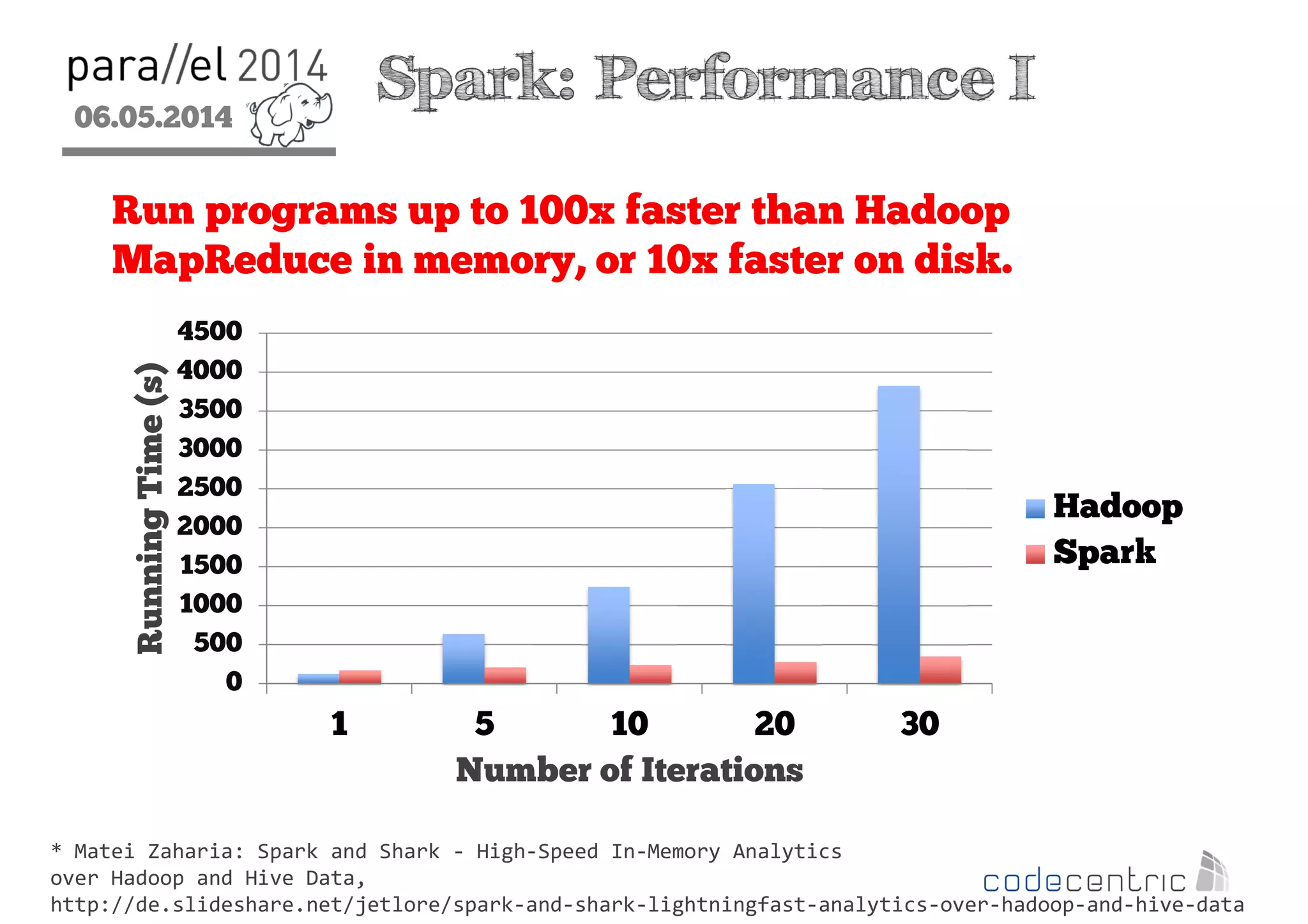
Spark: Performance I
* Matei Zaharia: Spark and Shark - High-Speed In-Memory Analytics
over Hadoop and Hive Data,
http://de.slideshare.net/jetlore/spark-and-shark-lightningfast-analytics-over-hadoop-and-hive-data
Run programs up to 100x faster than Hadoop
MapReduce in memory, or 10x faster on disk.
0
500
1000
1500
2000
2500
3000
3500
4000
4500
1 5 10 20 30
RunningTime(s)
Number of Iterations
Hadoop
Spark
06.05.2014
2
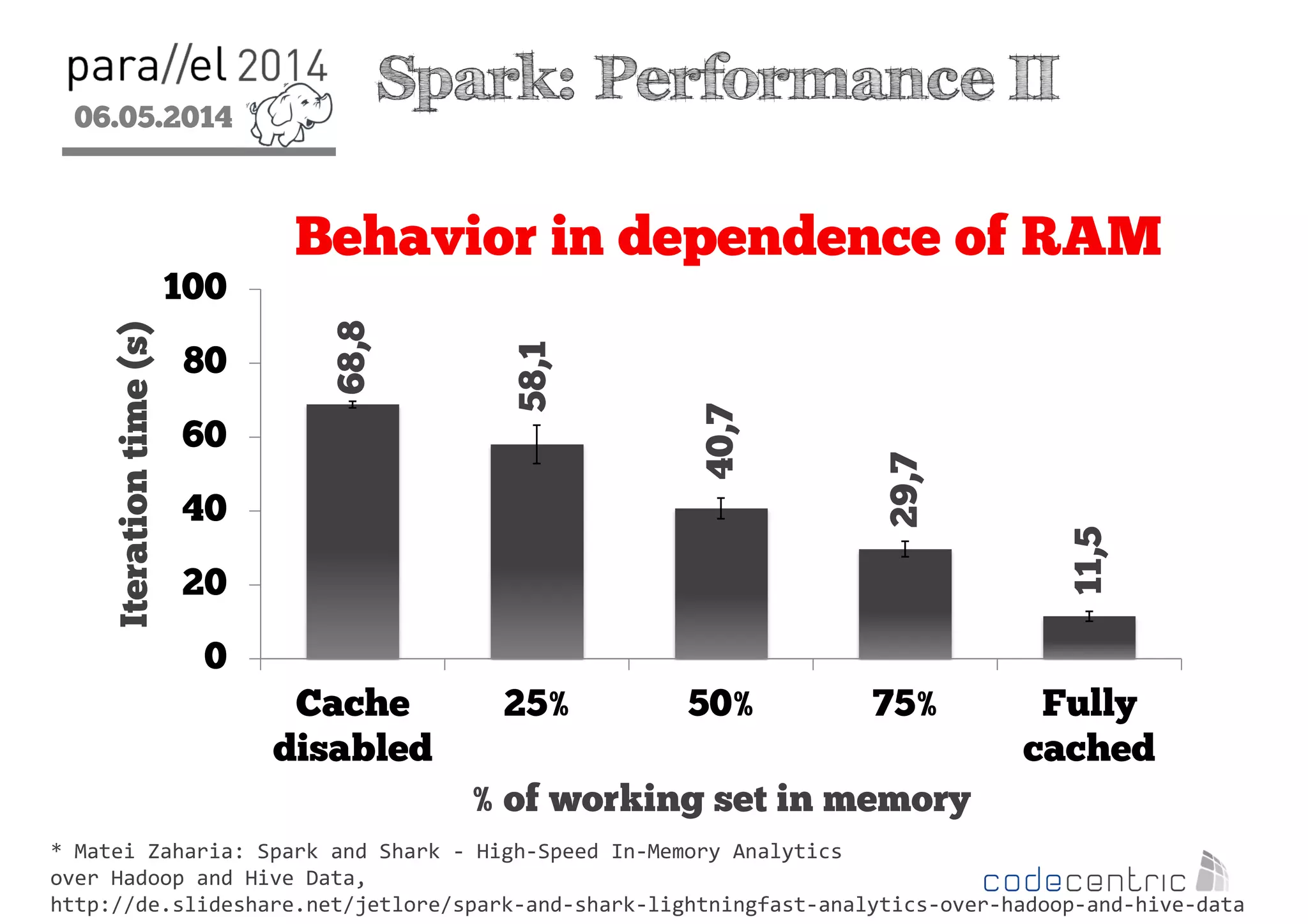
Spark: Performance II
68,8
58,1
40,7
29,7
11,5
0
20
40
60
80
100
Cache
disabled
25% 50% 75% Fully
cached
Iterationtime(s)
% of working set in memory
Behavior in dependence of RAM
* Matei Zaharia: Spark and Shark - High-Speed In-Memory Analytics
over Hadoop and Hive Data,
http://de.slideshare.net/jetlore/spark-and-shark-lightningfast-analytics-over-hadoop-and-hive-data
06.05.2014
2
Spark: Getting started
• Easiest to start with the standalone version
• Can be integrated with CDH and HDP
• MapR recently integrated the whole stack
• Spark has Scala, Java and Perl API
• Start with the Quick Start Tour
http://spark.apache.org/docs/latest/quick-start.html
• Make sure to check the ecosystem
06.05.2014
2
Hadoop 2: Summary
1. It’s about scale & performance
2. New programming models
3. MapReduce is here to stay
4. Tez vs. Spark: Fight!
06.05.2014
2
About us
specializes on...
Big Data Nerds Agile Ninjas Continuous Delivery Gurus
Enterprise Java Specialists Performance Geeks
Join us!
06.05.2014
2
About us
specializes on...
Big Data Nerds Agile Ninjas Continuous Delivery Gurus
Enterprise Java Specialists Performance Geeks
Join us!
06.05.2014
2
Trainings
Developer Training
• 19. - 22.05.2014, Düsseldorf
• 30.06 - 03.07.2014, München
• 04. - 07.08.2014, Frankfurt
Admin Training
• 26. - 28.05.2014, Düsseldorf
• 07. - 09.07.2014, München
• 11. - 13.08.2014, Frankfurt
Details:
https://www.codecentric.de/schulungen-und-workshops/
06.05.2014
2
Thanks for listening

Hadoop 2 - More than MapReduce

  • 1.
    06.05.2014 2 Hadoop 2 -More than MapReduce! uweseiler
  • 2.
    06.05.2014 2 About me Big DataNerd TravelpiratePhotography Enthusiast Hadoop Trainer NoSQL Fan Boy
  • 3.
    06.05.2014 2 About me Big DataNerd TravelpiratePhotography Enthusiast Hadoop Trainer NoSQL Fan Boy
  • 4.
    06.05.2014 2 Agenda • Introduction toHadoop 2 • MapReduce 2 • Tez, Hive & Stinger Initiative • Spark
  • 5.
    06.05.2014 2 Agenda • Introduction toHadoop 2 • MapReduce 2 • Tez, Hive & Stinger Initiative • Spark
  • 6.
    06.05.2014 2 …there was MapReduce Inthe beginning of Hadoop • It could handle data sizes way beyond those of its competitors • It was resilient in the face of failure • It made it easy for users to bring their code and algorithms to the data
  • 7.
    06.05.2014 2 …but it wastoo low level Hadoop 1 (2007)
  • 8.
    06.05.2014 2 …but it wastoo rigid Hadoop 1 (2007)
  • 9.
    06.05.2014 2 HDFS …but it wasBatch HDFS HDFS Single App Batch Single App Batch Single App Batch Single App Batch Single App Batch Hadoop 1 (2007)
  • 10.
    06.05.2014 2 …but it hadlimitations Hadoop 1 (2007) • Scalability – Maximum cluster size ~ 4,500 nodes – Maximum concurrent tasks – 40,000 – Coarse synchronization in JobTracker • Availability – Failure kills all queued and running jobs • Hard partition of resources into map & reduce slots – Low resource utilization • Lacks support for alternate paradigms and services
  • 11.
    06.05.2014 2 YARN to therescue! Hadoop 2 (2013)
  • 12.
    06.05.2014 2 A brief historyof Hadoop 2 • Originally conceived & architected by the team at Yahoo! – Arun Murthy created the original JIRA in 2008 and now is the Hadoop 2 release manager • The community has been working on Hadoop 2 for over 4 years • Hadoop 2 based architecture running at scale at Yahoo! – Deployed on 35,000+ nodes for 6+ months
  • 13.
    06.05.2014 2 Hadoop 1 HDFS Redundant, reliable storage Hadoop2: Next-gen platform MapReduce Cluster resource mgmt. + data processing Hadoop 2 HDFS 2 Redundant, reliable storage MapReduce Data processing Single use system Batch Apps Multi-purpose platform Batch, Interactive, Streaming, … YARN Cluster resource management Others Data processing
  • 14.
    06.05.2014 2 Taking Hadoop beyondbatch Applications run natively in Hadoop HDFS 2 Redundant, reliable storage Batch MapReduce Store all data in one place Interact with data in multiple ways YARN Cluster resource management Interactive Tez Online HOYA Streaming Storm, … Graph Giraph In-Memory Spark Other Search, …
  • 15.
    06.05.2014 2 YARN: Design Goals •Build a new abstraction layer by splitting up the two major functions of the JobTracker • Cluster resource management • Application life-cycle management • Allow other processing paradigms • Flexible API for implementing YARN apps • MapReduce becomes YARN app • Lots of different YARN apps
  • 16.
    06.05.2014 2 YARN: Architectural Overview Splitup the two major functions of the JobTracker Cluster resource management & Application life-cycle management ResourceManager NodeManager NodeManager NodeManager NodeManager NodeManager NodeManager NodeManager NodeManager Scheduler AM 1 Container 1.2 Container 1.1 AM 2 Container 2.1 Container 2.2 Container 2.3
  • 17.
    06.05.2014 2 YARN: Multi-tenancy I ResourceManager NodeManagerNodeManager NodeManager NodeManager NodeManager NodeManager NodeManager NodeManager Scheduler MapReduce 1 map 1.2 map 1.1 MapReduce 2 map 2.1 map 2.2 reduce 2.1 NodeManager NodeManager NodeManager NodeManager reduce 1.1 Tez map 2.3 reduce 2.2 vertex 1 vertex 2 vertex 3 vertex 4 HOYA HBase Master Region server 1 Region server 2 Region server 3 Storm nimbus 1 nimbus 2 Different types of applications on the same cluster
  • 18.
    06.05.2014 2 YARN: Multi-tenancy II ResourceManager NodeManagerNodeManager NodeManager NodeManager NodeManager NodeManager NodeManager NodeManager Scheduler MapReduce 1 map 1.2 map 1.1 MapReduce 2 map 2.1 map 2.2 reduce 2.1 NodeManager NodeManager NodeManager NodeManager reduce 1.1 Tez map 2.3 reduce 2.2 vertex 1 vertex 2 vertex 3 vertex 4 HOYA HBase Master Region server 1 Region server 2 Region server 3 Storm nimbus 1 nimbus 2 DWHUser Ad- Hoc root 30% 60% 10% Dev Prod 20% 80% Dev Prod Dev1 Dev2 25% 75% 60% 40% Different users and organizations on the same cluster
  • 19.
    06.05.2014 2 YARN Apps: Overview •MapReduce 2 Batch • Tez DAG Processing • Spark In-Memory • Storm Stream Processing • Samza Stream Processing • Apache S4 Stream Processing • HOYA HBase on YARN • Apache Giraph Graph Processing • Apache Hama Bulk Synchronous Parallel • Elastic Search Scalable Search
  • 20.
    06.05.2014 2 Agenda • Introduction toHadoop 2 • MapReduce 2 • Tez, Hive & Stinger Initiative • Spark
  • 21.
    06.05.2014 2 MapReduce 2: Ina nutshell • MapReduce is now a YARN app • No more map and reduce slots, it’s containers now • No more JobTracker, it’s YarnAppmaster library now • Multiple versions of MapReduce • The older mapred APIs work without modification or recompilation • The newer mapreduce APIs may need to be recompiled • Still has one master server component: the Job History Server • The Job History Server stores the execution of jobs • Used to audit prior execution of jobs • Will also be used by YARN framework to store charge backs at that level • Better cluster utilization • Increased scalability & availability
  • 22.
    06.05.2014 2 MapReduce 2: Shuffle •Faster Shuffle • Better embedded server: Netty • Encrypted Shuffle • Secure the shuffle phase as data moves across the cluster • Requires 2 way HTTPS, certificates on both sides • Causes significant CPU overhead, reserve 1 core for this work • Certificates stored on each node (provision with the cluster), refreshed every 10 secs • Pluggable Shuffle Sort • Shuffle is the first phase in MapReduce that is guaranteed to not be data- local • Pluggable Shuffle/Sort allows application developers or hardware developers to intercept the network-heavy workload and optimize it • Typical implementations have hardware components like fast networks and software components like sorting algorithms • API will change with future versions of Hadoop
  • 23.
    06.05.2014 2 MapReduce 2: Performance •Key Optimizations • No hard segmentation of resource into map and reduce slots • YARN scheduler is more efficient • MR2 framework has become more efficient than MR1: shuffle phase in MRv2 is more performant with the usage of Netty. • 40.000+ nodes running YARN across over 365 PB of data. • About 400.000 jobs per day for about 10 million hours of compute time. • Estimated 60% – 150% improvement on node usage per day • Got rid of a whole 10,000 node datacenter because of their increased utilization.
  • 24.
    06.05.2014 2 Agenda • Introduction toHadoop 2 • MapReduce 2 • Tez, Hive & Stinger Initiative • Spark
  • 25.
    06.05.2014 2 Apache Tez: Ina nutshell • Distributed execution framework that works on computations represented as directed acyclic graphs (DAG) • Tez is Hindi for “speed” • Naturally maps to execution plans produced by query optimizers • Highly customizable to meet a broad spectrum of use cases and to enable dynamic performance optimizations at runtime • Built on top of YARN
  • 26.
    06.05.2014 2 Hadoop 1 HDFS Redundant, reliablestorage Tez: The new primitive MapReduce Cluster resource mgmt. + data processing Hadoop 2 MapReduce as Base Apache Tez as Base Pig Hive Other HDFS Redundant, reliable storage YARN Cluster resource management Tez Execution Engine MR Pig Hive Real time Storm O t h e r
  • 27.
    06.05.2014 2 Tez: Runtime Model •Tasks with pluggable Input, Processor & Output Task HDFS Input Map Processor File Sorted Output Mapper Task Reduce Processor Reducer Shuffle Input HDFS Output Task Input 1 Join Processor File Sorted Output Intermediate Joiner Input 2
  • 28.
    06.05.2014 2 Tez: Data TypeAgnostic • Tez is only concerned with the movement of data which can be files or streams of bytes. • Clean separation between logical application layer and physical framework layer. • Important for being a platform to a variety of applications. Files Streams Tez Task User Code Key-Value Tuples Bytes
  • 29.
    06.05.2014 2 Tez: Dataflow APII Task Map Task Map Task Reduce Task Reduce Task Join DAG dag = new DAG(); Vertex map1 = new Vertex(MapProcessor.class); Vertex map2 = new Vertex(MapProcessor.class); Vertex reduce1 = new Vertex(ReduceProcessor.class); Vertex reduce2 = new Vertex(ReduceProcessor.class); Vertex join1 = new Vertex(JoinProcessor.class); … … … Edge edge1 = Edge(map1, reduce1, SCATTER_GATHER, PERSISTED, SEQUENTIAL, MOutput.class, RInput.class); Edge edge2 = Edge(map2, reduce2, SCATTER_GATHER, PERSISTED, SEQUENTIAL, MOutput.class, RInput.class); Edge edge3 = Edge(reduce1, join1, SCATTER_GATHER, PERSISTED, SEQUENTIAL, MOutput.class, RInput.class); Edge edge4 = Edge(reduce2, join1, SCATTER_GATHER, PERSISTED, SEQUENTIAL, MOutput.class, RInput.class); … … … dag.addVertex(map1).addVertex(map2) .addVertex(reduce1).addVertex(reduce2) .addVertex(join1) .addEdge(edge1).addEdge(edge2) .addEdge(edge3).addEdge(edge4);
  • 30.
    06.05.2014 2 Tez: Dataflow APIII Data movement - Defines routing of data between tasks Task Task Task Task Task Task Task Task Task Task Task • One-To-One: Data from producer task x routes to consumer task y • Broadcast: Data from a producer task routes to all consumer tasks. • Scatter-Gather: Producer tasks scatter data into shards and consumer tasks gather the data.
  • 31.
    06.05.2014 2 Tez: Dataflow APIIII • Data source – Defines the lifetime of a task output • Persisted: Output will be available after the task exits. Output may be lost later on. • Persisted-Reliable: Output is reliably stored and will always be available • Ephemeral: Output is available only while the producer task is running • Scheduling – Defines when a consumer task is scheduled • Sequential: Consumer task may be scheduled after a producer task completes. • Concurrent: Consumer task must be co-scheduled with a producer task.
  • 32.
    06.05.2014 2 Tez: Session Service •Key for interactive queries • Analogous to database sessions and represent a connection between the user and the cluster • Run multiple DAGs/queries in the same session • Maintains a pool of reusable containers for low latency execution of tasks within and across queries • Takes care of data locality and releasing resources when idle • Session cache in the Application Master and in the container pool reduce re-computation and re- initialization Application Master Task Scheduler Client Shared Object Registry Pre- warmed JVM ContainerPool Start session Submit DAG
  • 33.
    06.05.2014 2 Tez: Performance I Performancegains over MapReduce • Eliminate I/O synchronization barrier between successive computations. • Eliminate job launch overhead of workflow jobs. • Eliminate extra stage of map reads in every workflow job. • Eliminate queue and resource contention suffered by workflow jobs that are started after a predecessor job completes. MapReduce Tez
  • 34.
    06.05.2014 2 Tez: Performance II Executionplan reconfiguration at runtime • Dynamic runtime concurrency control based on data size, user operator resources, available cluster resources and locality • Advanced changes in dataflow graph structure • Progressive graph construction in concert with user optimizer • 50 Mapper • 100 Partions Stage 1 HDFS Blocks YARN resources • 10 reducers Stage 2 • 100 reducers < 10 GB data > 10 GB data Decision made at runtime!
  • 35.
    06.05.2014 2 Tez: Performance III Dynamicphysical data flow decisions • Decide the type of physical byte movement and storage on the fly • Store intermediate data on distributed store, local store or in-memory • Transfer bytes via block files or streaming or anything in between Producer Consumer Local file In-Memory Decision made at runtime! < 32 GB > 32 GB
  • 36.
    06.05.2014 2 Tez: Overall Performance SELECTa.state, COUNT(*), AVERAGE(c.price) FROM a JOIN b ON (a.id = b.id) JOIN c ON (a.itemId = c.itemId) GROUP BY a.state Existing Hive Parse Query 0.5s Create Plan 0.5s Launch Map- Reduce 20s Process Map- Reduce 10s Total 31s Hive/Tez Parse Query 0.5s Create Plan 0.5s Launch Map- Reduce 20s Process Map- Reduce 2s Total 23s Tez & Hive Service Parse Query 0.5s Create Plan 0.5s Submit to Tez Service 0.5s Process Map-Reduce 2s Total 3.5s * No exact numbers, for illustration only
  • 37.
  • 38.
    06.05.2014 2 Stinger: Overall Performance *Real numbers, but handle with care!
  • 39.
    06.05.2014 2 Tez: Getting started •Stinger Phase 3 has been delivered with Hive 0.13 • Incorporated in Hortonworks Data Platform (HDP) 2.1 • Can also be integrated into CHD and MapR • Switch the execution engine (using the Hive Shell) set hive.execution.engine=tez; • Query with HiveQL as usual, check the log output and compare the execution times • Get comfortable with all the other goodies of Stinger Phase 3 • Run the same query multiple times to make usage of Tez Service • Make usage of vectorization (only with ORC format): create table data_orc stored as orc as select * from data; set hive.vectorized.execution.enabled; explain select * from data_orc;
  • 40.
    06.05.2014 2 Agenda • Introduction toHadoop 2 • MapReduce 2 • Tez, Hive & Stinger Initiative • Spark
  • 41.
    06.05.2014 2 Spark: In anutshell • A fast and general engine for large-scale data processing and analytics • Advanced DAG execution engine with support for data locality and in-memory computing • Spark is a top-level Apache project – http://spark.apache.org • Spark can be run on top of YARN and can read any existing HDFS data – http://spark.apache.org/docs/0.9.1/running-on-yarn.html
  • 42.
    06.05.2014 2 Hadoop 1 HDFS Redundant, reliablestorage Spark: A YARN App MapReduce Cluster resource mgmt. + data processing Hadoop 2 Hadoop 1 Spark as YARN App Pig Hive Other HDFS Redundant, reliable storage YARN Cluster resource management Tez Execution Engine MR Pig Hive In- Memory Spark
  • 43.
    06.05.2014 2 HDFS Redundant, reliable storage Spark:Ecosystem MapReduce Cluster resource mgmt. + data processing BlinkDB Spark Core Engine (MapReduce / Tez) Shark SQL (Hive) Spark Streaming Streaming (Storm) MLLib Machine Learning (Mahout) SparkR R on Spark GraphX Graph Computation (Giraph)
  • 44.
    06.05.2014 2 Spark: Runtime Model •Resilient Distributed Datasets (RDD) • Read-only partitioned collection of records • Optionally cached in memory across cluster • Conceptually, RDDs can be roughly viewed as partitioned, locality aware distributed vectors • An RDD… – either points to a direct data source – or applies some transformation to its parent RDD(s) to generate new data elements – Computation can be represented by lazy evaluated lineage DAGs composed by connected RDDs RDD A11 A12 A13
  • 45.
    06.05.2014 2 Spark: RDD Persistence •One of the most important capabilities in Spark is caching a dataset in-memory across operations Storage Level Meaning MEMORY_ONLY Store RDD as deserialized Java objects in the JVM. If the RDD does not fit in memory, some partitions will not be cached and will be recomputed on the fly each time they're needed. This is the default level. MEMORY_AND_DISK Store RDD as deserialized Java objects in the JVM. If the RDD does not fit in memory, store the partitions that don't fit on disk, and read them from there when they're needed. MEMORY_ONLY_SER Store RDD as serialized Java objects (one byte array per partition). This is generally more space-efficient than deserialized objects, especially when using a fast serializer, but more CPU-intensive to read. MEMORY_AND_DISK_SER Similar to MEMORY_ONLY_SER, but spill partitions that don't fit in memory to disk instead of recomputing them on the fly each time they're needed. DISK_ONLY Store the RDD partitions only on disk. MEMORY_ONLY_2, MEMORY_AND_DISK_2, … … … Same as the levels above, but replicate each partition on two cluster nodes.
  • 46.
    06.05.2014 2 Spark: RDD Operations •Transformations - Create new datasets from existing ones • map(func) • filter(func) • sample(withReplacement,fraction, seed) • union(otherDataset) • distinct([numTasks])) • groupByKey([numTasks]) • … … … • Actions - Return a value to the client after running a computation on the dataset • reduce(func) • count() • first() • foreach(func) • saveAsTextFile(path) • … … …
  • 47.
    06.05.2014 2 Spark: Dataflow All transformationsin Spark are lazy and are only computed when an actions requires it.
  • 48.
    06.05.2014 2 Spark: In-Memory MagicI “In fact, one study* analyzed the access patterns in the Hive warehouses at Facebook and discovered that for the vast majority (96%) of jobs, the entire inputs could fit into a fraction of the cluster’s total memory.” * G. Ananthanarayanan, A. Ghodsi, S. Shenker, and I. Stoica. Disk-locality in datacenter computing considered irrelevant. In HotOS ’11, 2011.
  • 49.
    06.05.2014 2 Spark: In-Memory MagicII • Without cache • Elements are accessed in an iterator-based streaming style • One element a time, no bulk copy • Space complexity is almost O(1) when there’s only narrow dependencies • With cache • One block per RDD partition • LRU cache eviction • Locality aware • Evicted blocks can be recomputed in parallel with the help of RDD lineage DAG
  • 50.
    06.05.2014 2 Spark: Parallelism Can bespecified in a number of different ways • RDD partition number • sc.textFile("input", minSplits = 10) • sc.parallelize(1 to 10000, numSlices = 10) • Mapper side parallelism • Usually inherited from parent RDD(s) • Reducer side parallelism • rdd.reduceByKey(_ + _, numPartitions = 10) • rdd.reduceByKey(partitioner = p, _ + _) • “Zoom in/out” • rdd.repartition(numPartitions: Int) • rdd.coalesce(numPartitions: Int, shuffle: Boolean)
  • 51.
    06.05.2014 2 Spark: Performance I *Matei Zaharia: Spark and Shark - High-Speed In-Memory Analytics over Hadoop and Hive Data, http://de.slideshare.net/jetlore/spark-and-shark-lightningfast-analytics-over-hadoop-and-hive-data Run programs up to 100x faster than Hadoop MapReduce in memory, or 10x faster on disk. 0 500 1000 1500 2000 2500 3000 3500 4000 4500 1 5 10 20 30 RunningTime(s) Number of Iterations Hadoop Spark
  • 52.
    06.05.2014 2 Spark: Performance II 68,8 58,1 40,7 29,7 11,5 0 20 40 60 80 100 Cache disabled 25%50% 75% Fully cached Iterationtime(s) % of working set in memory Behavior in dependence of RAM * Matei Zaharia: Spark and Shark - High-Speed In-Memory Analytics over Hadoop and Hive Data, http://de.slideshare.net/jetlore/spark-and-shark-lightningfast-analytics-over-hadoop-and-hive-data
  • 53.
    06.05.2014 2 Spark: Getting started •Easiest to start with the standalone version • Can be integrated with CDH and HDP • MapR recently integrated the whole stack • Spark has Scala, Java and Perl API • Start with the Quick Start Tour http://spark.apache.org/docs/latest/quick-start.html • Make sure to check the ecosystem
  • 54.
    06.05.2014 2 Hadoop 2: Summary 1.It’s about scale & performance 2. New programming models 3. MapReduce is here to stay 4. Tez vs. Spark: Fight!
  • 55.
    06.05.2014 2 About us specializes on... BigData Nerds Agile Ninjas Continuous Delivery Gurus Enterprise Java Specialists Performance Geeks Join us!
  • 56.
    06.05.2014 2 About us specializes on... BigData Nerds Agile Ninjas Continuous Delivery Gurus Enterprise Java Specialists Performance Geeks Join us!
  • 57.
    06.05.2014 2 Trainings Developer Training • 19.- 22.05.2014, Düsseldorf • 30.06 - 03.07.2014, München • 04. - 07.08.2014, Frankfurt Admin Training • 26. - 28.05.2014, Düsseldorf • 07. - 09.07.2014, München • 11. - 13.08.2014, Frankfurt Details: https://www.codecentric.de/schulungen-und-workshops/
  • 58.