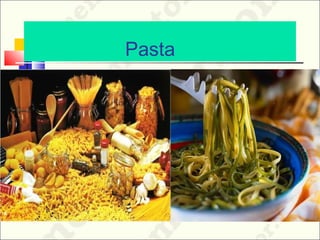
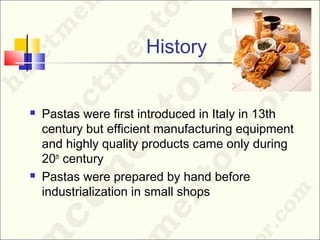
Pasta
History
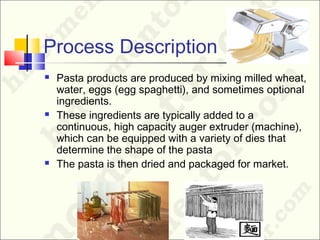
 Pastas were first introduced in Italy in 13th
century but efficient manufacturing equipment
and highly quality products came only during
20th
century
 Pastas were prepared by hand before
industrialization in small shops
Process Description
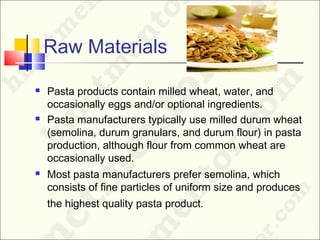
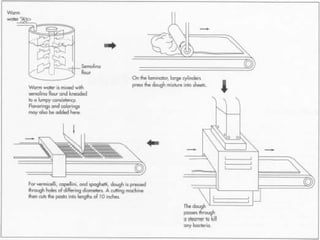
 Pasta products are produced by mixing milled wheat,
water, eggs (egg spaghetti), and sometimes optional
ingredients.
 These ingredients are typically added to a
continuous, high capacity auger extruder (machine),
which can be equipped with a variety of dies that
determine the shape of the pasta
 The pasta is then dried and packaged for market.
Raw Materials
 Pasta products contain milled wheat, water, and
occasionally eggs and/or optional ingredients.
 Pasta manufacturers typically use milled durum wheat
(semolina, durum granulars, and durum flour) in pasta
production, although flour from common wheat are
occasionally used.
 Most pasta manufacturers prefer semolina, which
consists of fine particles of uniform size and produces
the highest quality pasta product.
Raw Materials …contd
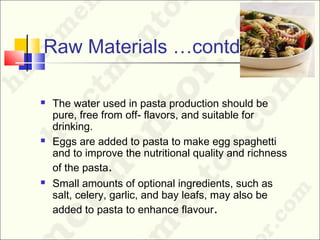
 The water used in pasta production should be
pure, free from off- flavors, and suitable for
drinking.
 Eggs are added to pasta to make egg spaghetti
and to improve the nutritional quality and richness
of the pasta.
 Small amounts of optional ingredients, such as
salt, celery, garlic, and bay leafs, may also be
added to pasta to enhance flavour.
Wheat Milling
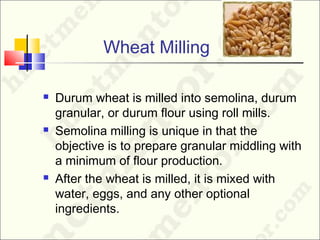
 Durum wheat is milled into semolina, durum
granular, or durum flour using roll mills.
 Semolina milling is unique in that the
objective is to prepare granular middling with
a minimum of flour production.
 After the wheat is milled, it is mixed with
water, eggs, and any other optional
ingredients.
Mixing
 In the mixing operation, water is added to the
milled wheat in a mixing trough to produce dough
with a moisture content of approximately 31
percent.
 Eggs and any optional ingredients may also be
added.
 Most modern pasta presses are equipped with a
vacuum chamber to remove air bubbles from the
pasta before extruding.
Extruding
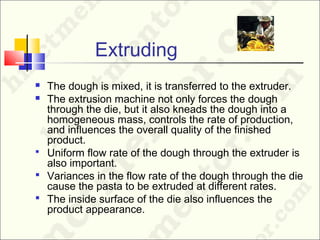
 The dough is mixed, it is transferred to the extruder.
 The extrusion machine not only forces the dough
through the die, but it also kneads the dough into a
homogeneous mass, controls the rate of production,
and influences the overall quality of the finished
product.
 Uniform flow rate of the dough through the extruder is
also important.
 Variances in the flow rate of the dough through the die
cause the pasta to be extruded at different rates.
 The inside surface of the die also influences the
product appearance.
Drying
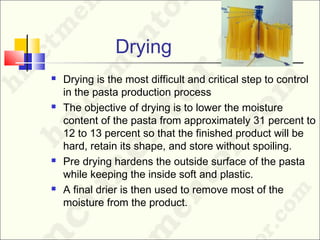
 Drying is the most difficult and critical step to control
in the pasta production process
 The objective of drying is to lower the moisture
content of the pasta from approximately 31 percent to
12 to 13 percent so that the finished product will be
hard, retain its shape, and store without spoiling.
 Pre drying hardens the outside surface of the pasta
while keeping the inside soft and plastic.
 A final drier is then used to remove most of the
moisture from the product.
Packaging
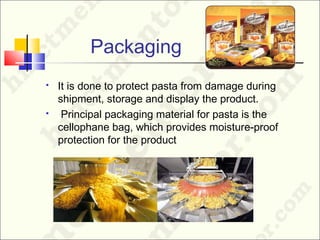
 It is done to protect pasta from damage during
shipment, storage and display the product.
 Principal packaging material for pasta is the
cellophane bag, which provides moisture-proof
protection for the product
Cooking Pasta
 Pasta should be cooked al dente , or ‘to the tooth’
which means it should be stopped cooking when the
pasta still feels firm to the bite not soft and mushy.
 Pleasure of eating pasta is its texture and it is lost if
it is over cooked.
 Cooking time differ for every shape and size of
pasta, it also depends upon the kind of flour used and
the moisture content
 Pasta is cooked and served immediately wherever it
is possible.

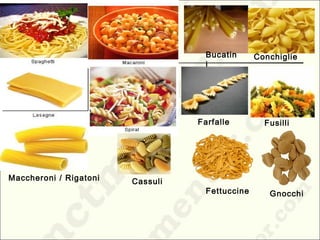
Bucatin
i
Conchiglie
Farfalle Fusilli
Maccheroni / Rigatoni
Fettuccine Gnocchi
Cassuli
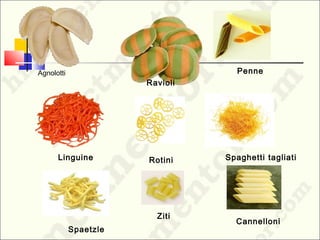
Agnolotti
Ravioli
Penne
Linguine Rotini Spaghetti tagliati
Spaetzle
Ziti
Cannelloni
Thank you
… an
anish banerjee
initiative

Pasta

  • 1.
  • 2.
    History  Pastas werefirst introduced in Italy in 13th century but efficient manufacturing equipment and highly quality products came only during 20th century  Pastas were prepared by hand before industrialization in small shops
  • 3.
    Process Description  Pastaproducts are produced by mixing milled wheat, water, eggs (egg spaghetti), and sometimes optional ingredients.  These ingredients are typically added to a continuous, high capacity auger extruder (machine), which can be equipped with a variety of dies that determine the shape of the pasta  The pasta is then dried and packaged for market.
  • 4.
    Raw Materials  Pastaproducts contain milled wheat, water, and occasionally eggs and/or optional ingredients.  Pasta manufacturers typically use milled durum wheat (semolina, durum granulars, and durum flour) in pasta production, although flour from common wheat are occasionally used.  Most pasta manufacturers prefer semolina, which consists of fine particles of uniform size and produces the highest quality pasta product.
  • 5.
    Raw Materials …contd The water used in pasta production should be pure, free from off- flavors, and suitable for drinking.  Eggs are added to pasta to make egg spaghetti and to improve the nutritional quality and richness of the pasta.  Small amounts of optional ingredients, such as salt, celery, garlic, and bay leafs, may also be added to pasta to enhance flavour.
  • 6.
    Wheat Milling  Durumwheat is milled into semolina, durum granular, or durum flour using roll mills.  Semolina milling is unique in that the objective is to prepare granular middling with a minimum of flour production.  After the wheat is milled, it is mixed with water, eggs, and any other optional ingredients.
  • 7.
    Mixing  In themixing operation, water is added to the milled wheat in a mixing trough to produce dough with a moisture content of approximately 31 percent.  Eggs and any optional ingredients may also be added.  Most modern pasta presses are equipped with a vacuum chamber to remove air bubbles from the pasta before extruding.
  • 8.
    Extruding  The doughis mixed, it is transferred to the extruder.  The extrusion machine not only forces the dough through the die, but it also kneads the dough into a homogeneous mass, controls the rate of production, and influences the overall quality of the finished product.  Uniform flow rate of the dough through the extruder is also important.  Variances in the flow rate of the dough through the die cause the pasta to be extruded at different rates.  The inside surface of the die also influences the product appearance.
  • 10.
    Drying  Drying isthe most difficult and critical step to control in the pasta production process  The objective of drying is to lower the moisture content of the pasta from approximately 31 percent to 12 to 13 percent so that the finished product will be hard, retain its shape, and store without spoiling.  Pre drying hardens the outside surface of the pasta while keeping the inside soft and plastic.  A final drier is then used to remove most of the moisture from the product.
  • 11.
    Packaging  It isdone to protect pasta from damage during shipment, storage and display the product.  Principal packaging material for pasta is the cellophane bag, which provides moisture-proof protection for the product
  • 12.
    Cooking Pasta  Pastashould be cooked al dente , or ‘to the tooth’ which means it should be stopped cooking when the pasta still feels firm to the bite not soft and mushy.  Pleasure of eating pasta is its texture and it is lost if it is over cooked.  Cooking time differ for every shape and size of pasta, it also depends upon the kind of flour used and the moisture content  Pasta is cooked and served immediately wherever it is possible.
  • 13.
     Bucatin i Conchiglie Farfalle Fusilli Maccheroni /Rigatoni Fettuccine Gnocchi Cassuli
  • 14.
    Agnolotti Ravioli Penne Linguine Rotini Spaghettitagliati Spaetzle Ziti Cannelloni
  • 15.
    Thank you … an anishbanerjee initiative