Dr Ralph R.J. Thompson
BA (Cantab.) MSc (Oxon.) PhD (Bris.) FHEA
University of Edinburgh
© Ralph Thompson 2018, University of Edinburgh
Licensed under a Creative Commons Attribution licence 4.0
All images CC0, Pixabay
Animal Learning
How animals change their behaviour in response to
information from their environment
This presentation is developed by Ralph Thompson and based on one
used at the University of Edinburgh with elements (particularly images)
removed for copyright reasons.
It is intended as a basis for lectures, to which images/graphics can be
added and the lecture adapted for the purposes needed. The use of a
coloured background to aid accessibility may benefit some students.
Reflective/class questions are shown in light blue. Addition of other
reflective or class response questions to check understanding and
promote engagement is recommended.
© Ralph Thompson 2018, University of Edinburgh
Licensed under a Creative Commons Attribution licence 4.0
NOTES ON THIS PRESENTATION
by Dr Ralph Thompson
University of Edinburgh
© Ralph Thompson 2018, University of Edinburgh, licensed under a Creative Commons Attribution licence 4.0
Objectives
• To introduce learning theory to you if you are new to the
ideas
• To make you think about learning in some new ways if
you already know learning theory (not all Pavlov and Skinner)
– Learning in the context of ethology/emotion
• Giving you the knowledge to…
– understand why animals change their behaviour with experience
– plan the training of animals, but more practical training later on
(including in your assessment)
– Understand and critically evaluate training methods used by
others
© Ralph Thompson 2018, University of Edinburgh, licensed under a Creative Commons Attribution licence 4.0
Overview
• What is Learning?
– stimuli
• Types of learning
– Non-associative
– Associative
• Reinforcement
– Shaping
– Factors affecting reinforcement
• Examples from research
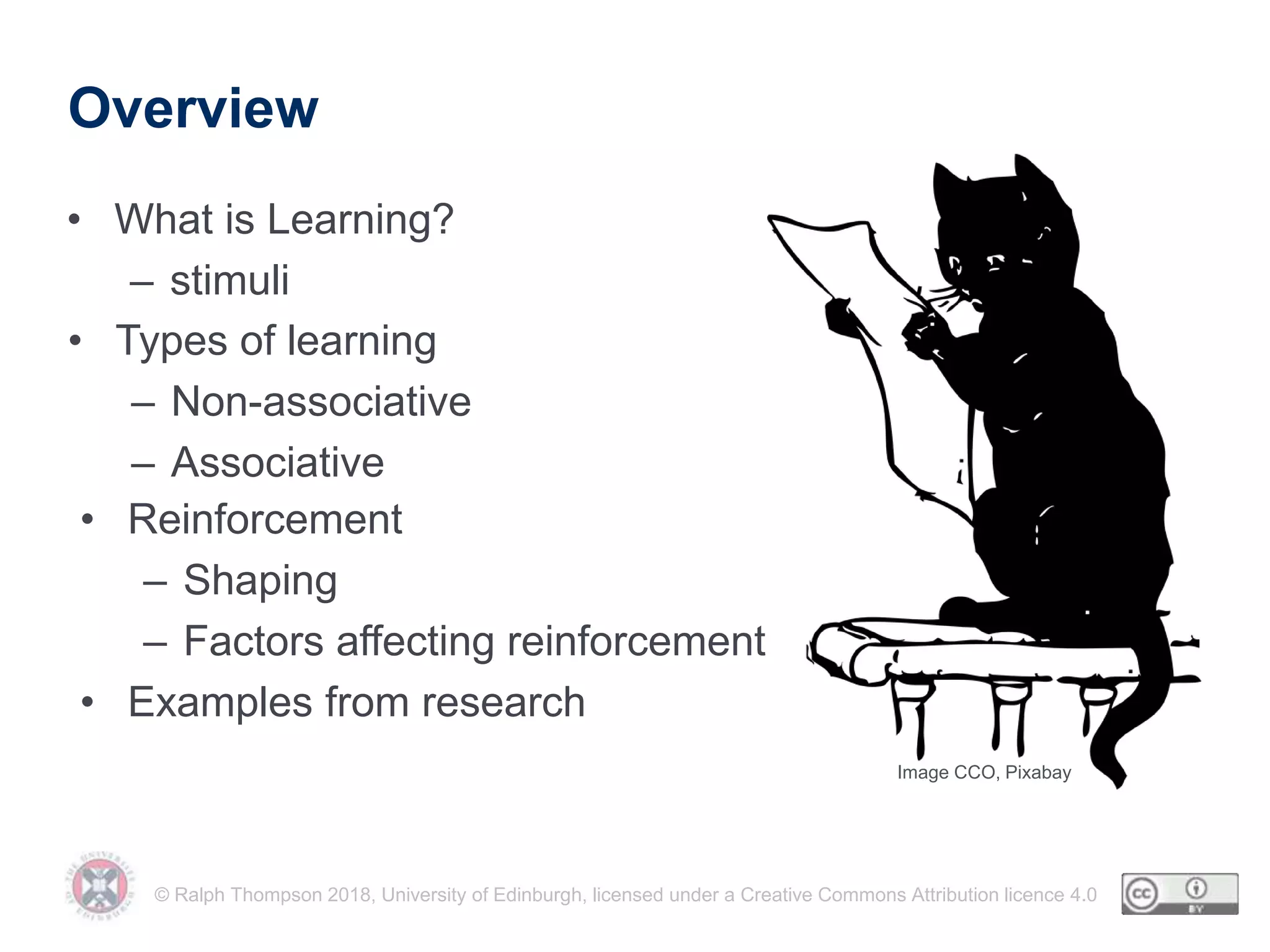
Image CCO, Pixabay
© Ralph Thompson 2018, University of Edinburgh, licensed under a Creative Commons Attribution licence 4.0
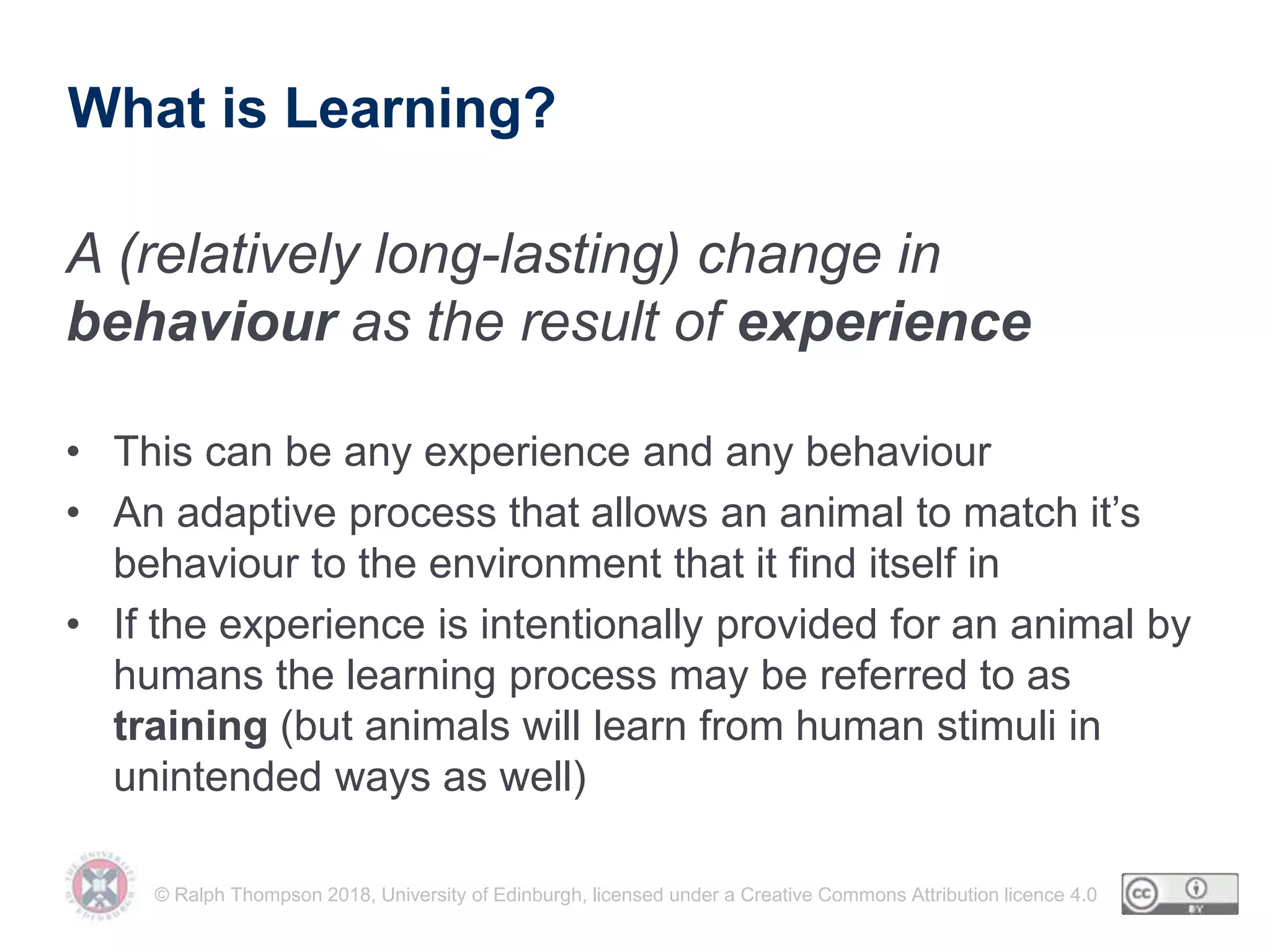
What is Learning?
A (relatively long-lasting) change in
behaviour as the result of experience
• This can be any experience and any behaviour
• An adaptive process that allows an animal to match it’s
behaviour to the environment that it find itself in
• If the experience is intentionally provided for an animal by
humans the learning process may be referred to as
training (but animals will learn from human stimuli in
unintended ways as well)
© Ralph Thompson 2018, University of Edinburgh, licensed under a Creative Commons Attribution licence 4.0
Learning…
• ...is a form of cognition
• …involves/motivated by emotion
© Ralph Thompson 2018, University of Edinburgh, licensed under a Creative Commons Attribution licence 4.0
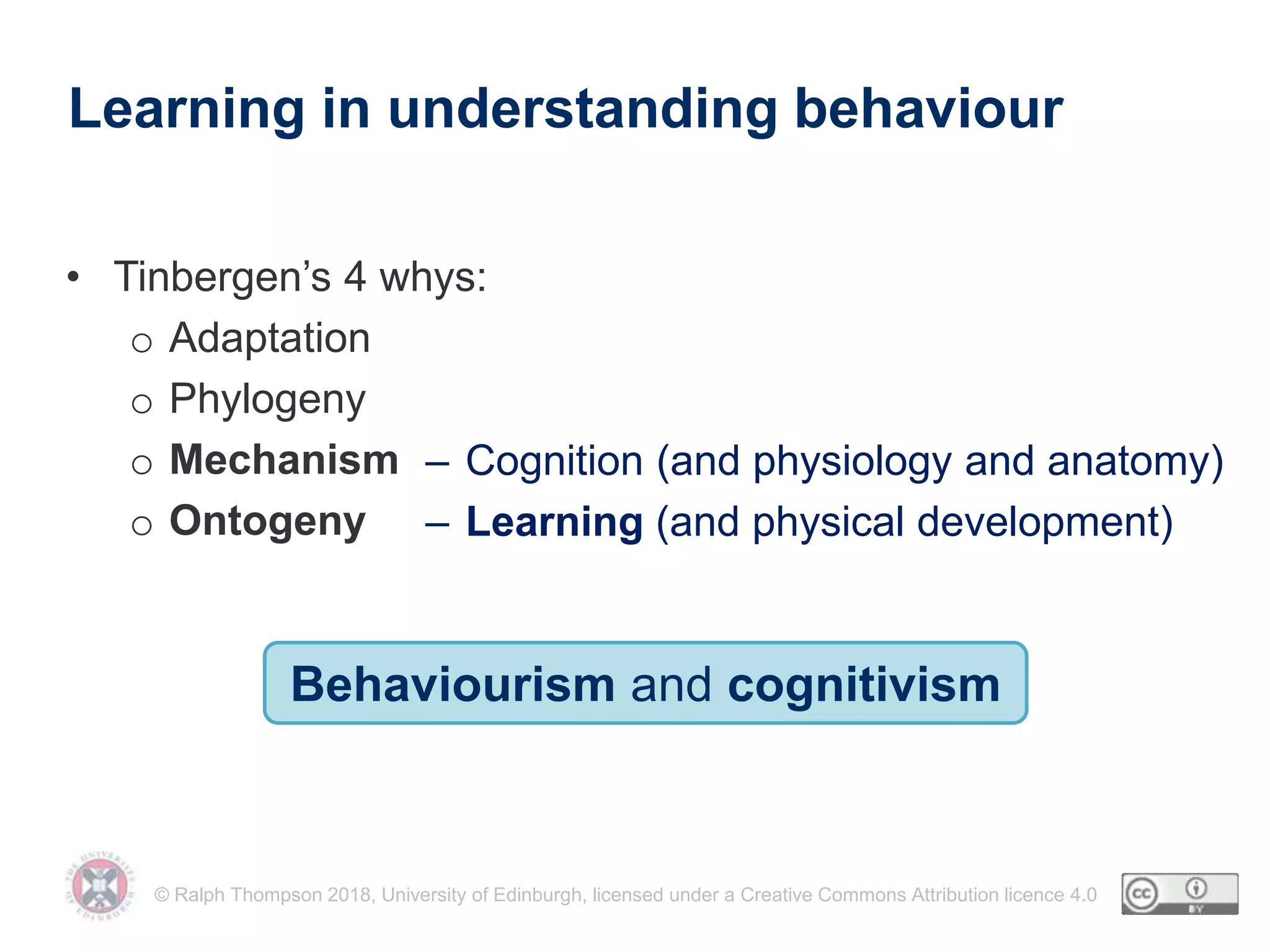
Learning in understanding behaviour
• Tinbergen’s 4 whys:
o Adaptation
o Phylogeny
o Mechanism
o Ontogeny
– Cognition (and physiology and anatomy)
– Learning (and physical development)
Behaviourism and cognitivism
© Ralph Thompson 2018, University of Edinburgh, licensed under a Creative Commons Attribution licence 4.0
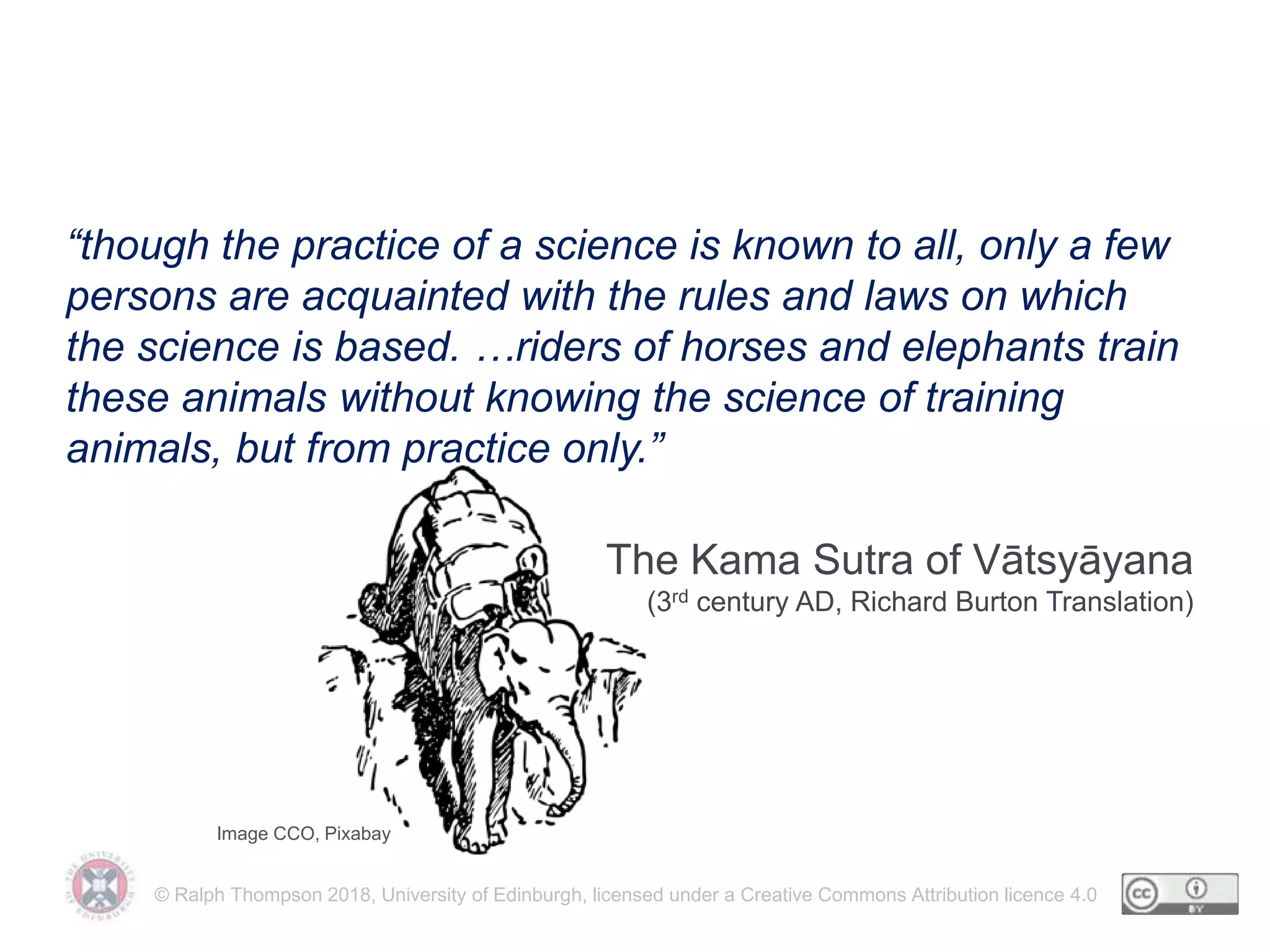
Doing isn’t always understanding
“though the practice of a science is known to all, only a few
persons are acquainted with the rules and laws on which
the science is based. …riders of horses and elephants train
these animals without knowing the science of training
animals, but from practice only.”
The Kama Sutra of Vātsyāyana
(3rd century AD, Richard Burton Translation)
Image CCO, Pixabay
© Ralph Thompson 2018, University of Edinburgh, licensed under a Creative Commons Attribution licence 4.0
Why learn?
Learning allows animals to change their behaviour in
response to experience
• Behaviour can fit novel or changing environments
• Behaviours can be formed that are too complex to
encode genetically
Learning occurs all the time
• In the wild
• In captivity
• During training
© Ralph Thompson 2018, University of Edinburgh, licensed under a Creative Commons Attribution licence 4.0
Stimuli
• We call quanta of information that are sensed by the
animal and cause a response stimuli (singular stimulus)
– The response can be immediate behaviour or learning
or both
– We are most often concerned with external
(environmental) stimuli but they can also be internal to
the animal (e.g. internal pain)
– There are infinite number of potential stimuli in
nature…
© Ralph Thompson 2018, University of Edinburgh, licensed under a Creative Commons Attribution licence 4.0
Stimulus importance
• Animals needs to know which stimuli to respond to.
– They must have a way of identifying which
environmental information is most important to them
– How can they do this?
• ‘Innate’ value / salience
– What kind of stimuli should be most salient for
animals?
– What stimuli are most salient for you?
– Are innate evolved responses enough? When would
they be most/least useful?
© Ralph Thompson 2018, University of Edinburgh, licensed under a Creative Commons Attribution licence 4.0
Stimulus importance
• Learned value
– Determining which stimuli are meaningful through
repeated exposure or exposure during sensitive
periods (non-associative learning)
– Pairing meaningful stimuli that are related to each
other (associative learning)
• Both are constantly updated during the life of an animal,
though the animal may be more sensitive at particular
periods
• May also depend on motivational state (e.g. hunger)
© Ralph Thompson 2018, University of Edinburgh, licensed under a Creative Commons Attribution licence 4.0
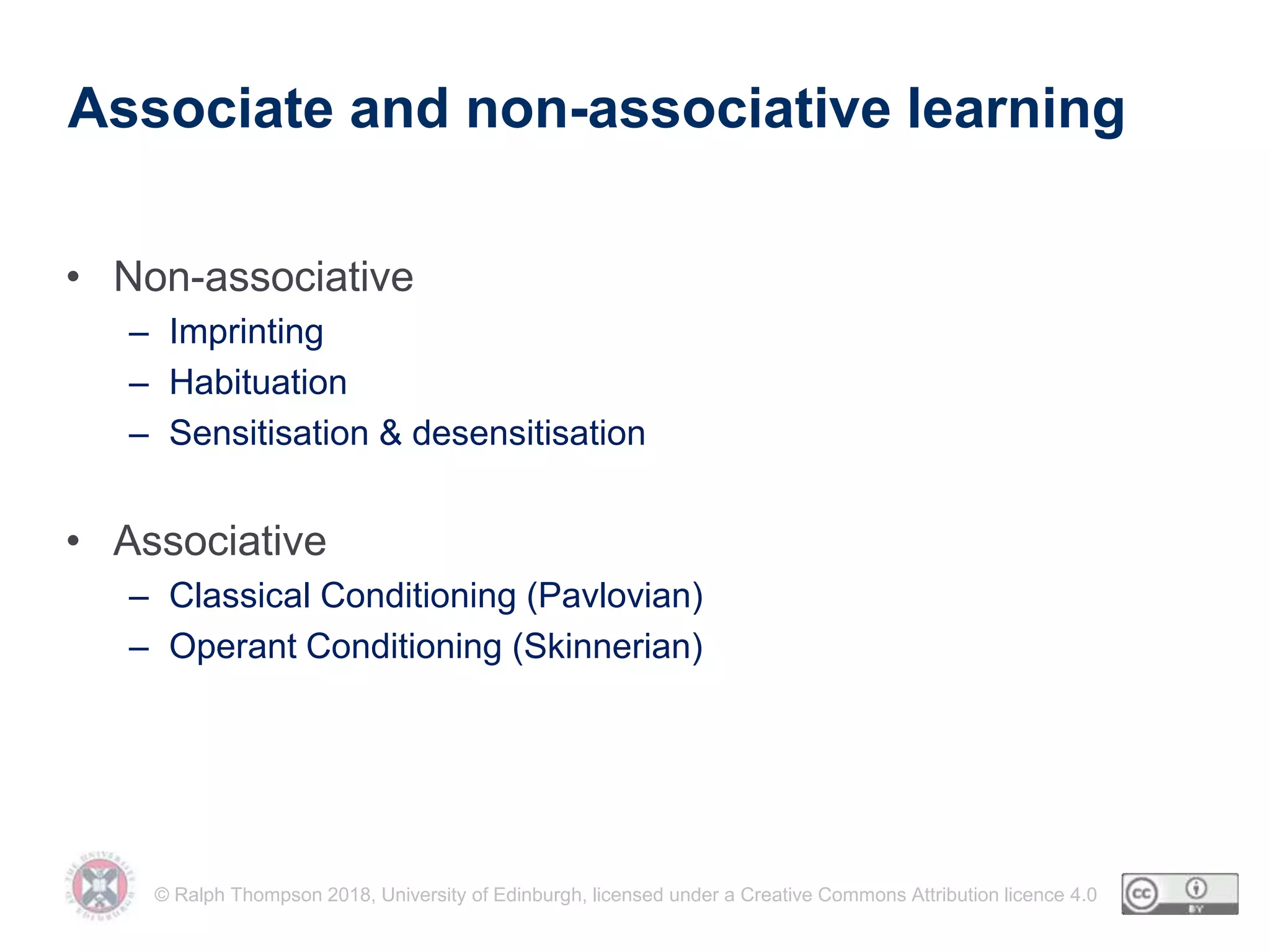
Associate and non-associative learning
• Non-associative
– Imprinting
– Habituation
– Sensitisation & desensitisation
• Associative
– Classical Conditioning (Pavlovian)
– Operant Conditioning (Skinnerian)
© Ralph Thompson 2018, University of Edinburgh, licensed under a Creative Commons Attribution licence 4.0
Non-associative
learning
Add image
© Ralph Thompson 2018, University of Edinburgh, licensed under a Creative Commons Attribution licence 4.0
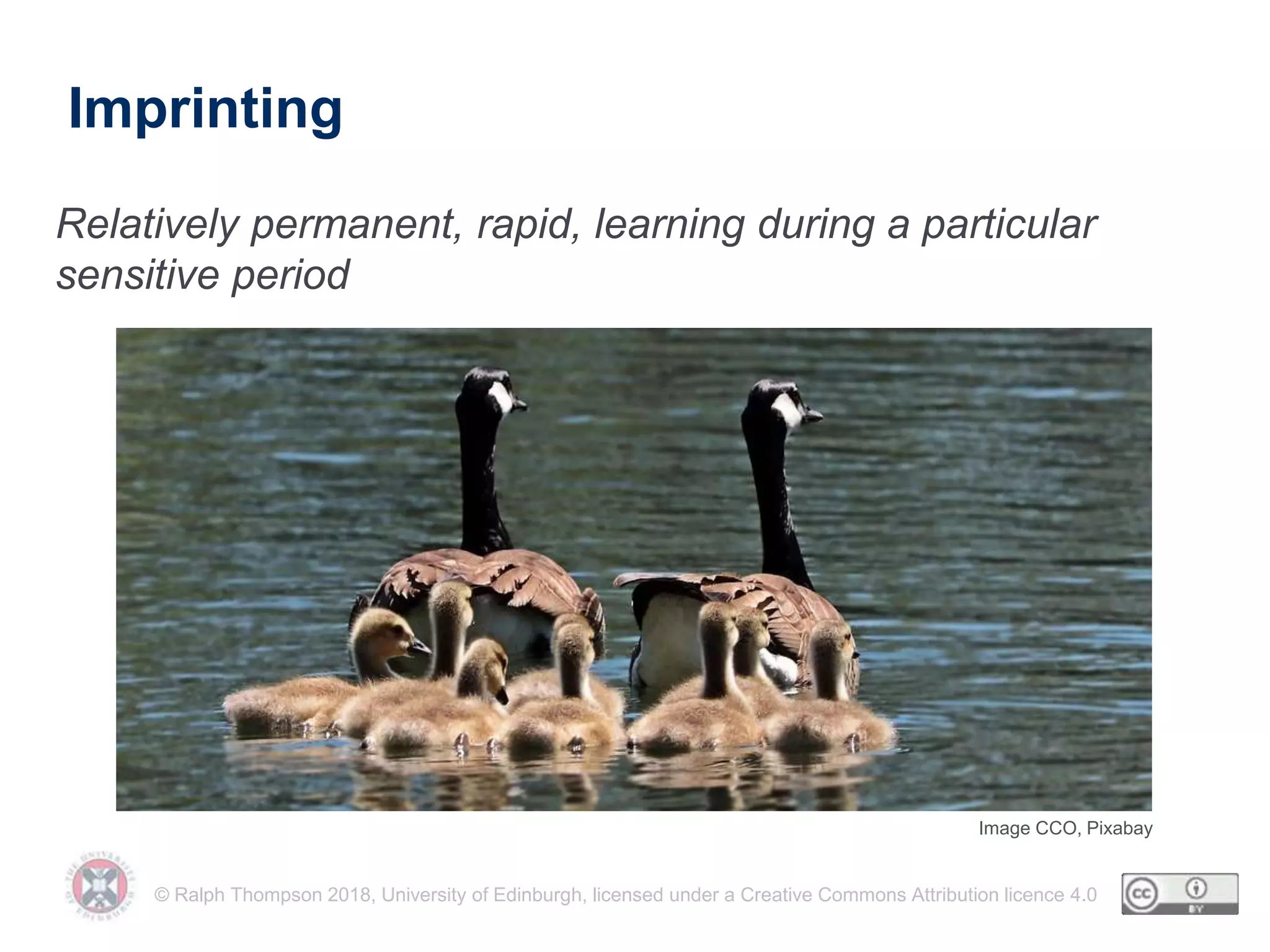
Imprinting
Relatively permanent, rapid, learning during a particular
sensitive period
Image CCO, Pixabay
© Ralph Thompson 2018, University of Edinburgh, licensed under a Creative Commons Attribution licence 4.0
Habituation
A decrease (or cessation) in response following repeated
exposure to the stimulus
• Stimulus is not (or is not longer) biologically relevant
• Can be generalised (apply to similar stimuli)
• Particularly important in prey animals (as they are likely to be
neophobic)
• To be effective must be gradual and not forceful
• May occur to accidental/unintentional stimuli
(e.g. riding school horses)
© Ralph Thompson 2018, University of Edinburgh, licensed under a Creative Commons Attribution licence 4.0
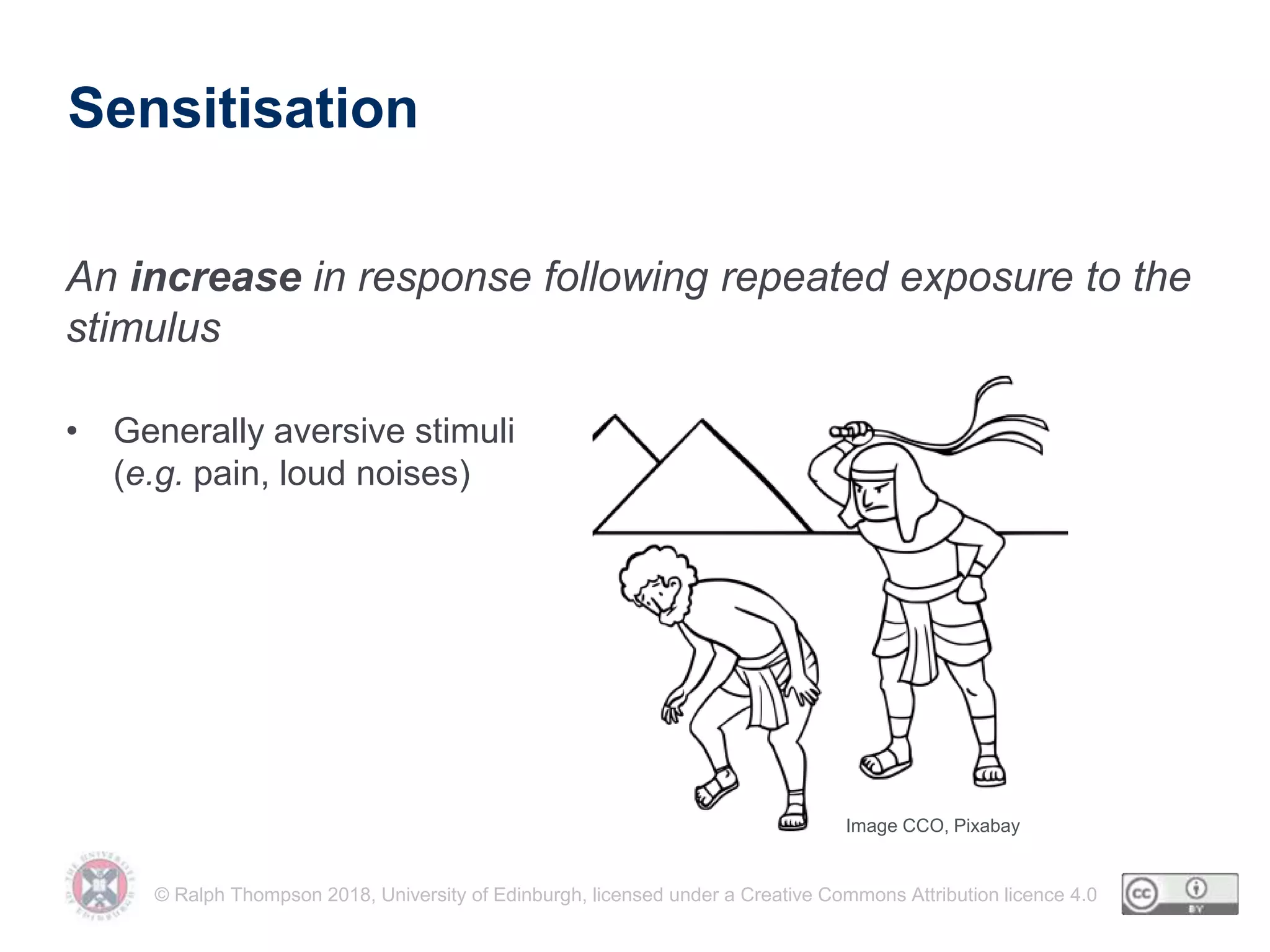
Sensitisation
• Generally aversive stimuli
(e.g. pain, loud noises)
An increase in response following repeated exposure to the
stimulus
Image CCO, Pixabay
© Ralph Thompson 2018, University of Edinburgh, licensed under a Creative Commons Attribution licence 4.0
Desensitisation
• Similar to habituation, but to a previously sensitised stimulus
A decrease (or cessation) of a previously sensitised
response following repeated exposure to the stimulus
© Ralph Thompson 2018, University of Edinburgh, licensed under a Creative Commons Attribution licence 4.0
Associative learning
Add image
© Ralph Thompson 2018, University of Edinburgh, licensed under a Creative Commons Attribution licence 4.0
Classical Conditioning
• Also known as Pavlovian Conditioning
• Pairing of a conditioned stimulus with an unconditioned stimulus
• The CS must predict the US
• Produces a conditioned response (CR) to the CS similar to the
unconditioned response (UR) to the US
• Associates with novel stimuli with appropriate responses
• e.g. salivating in response to sound of food being prepared
A learned association between a previously neutral
stimulus (CS) and a previously meaningful stimulus (US)
© Ralph Thompson 2018, University of Edinburgh, licensed under a Creative Commons Attribution licence 4.0
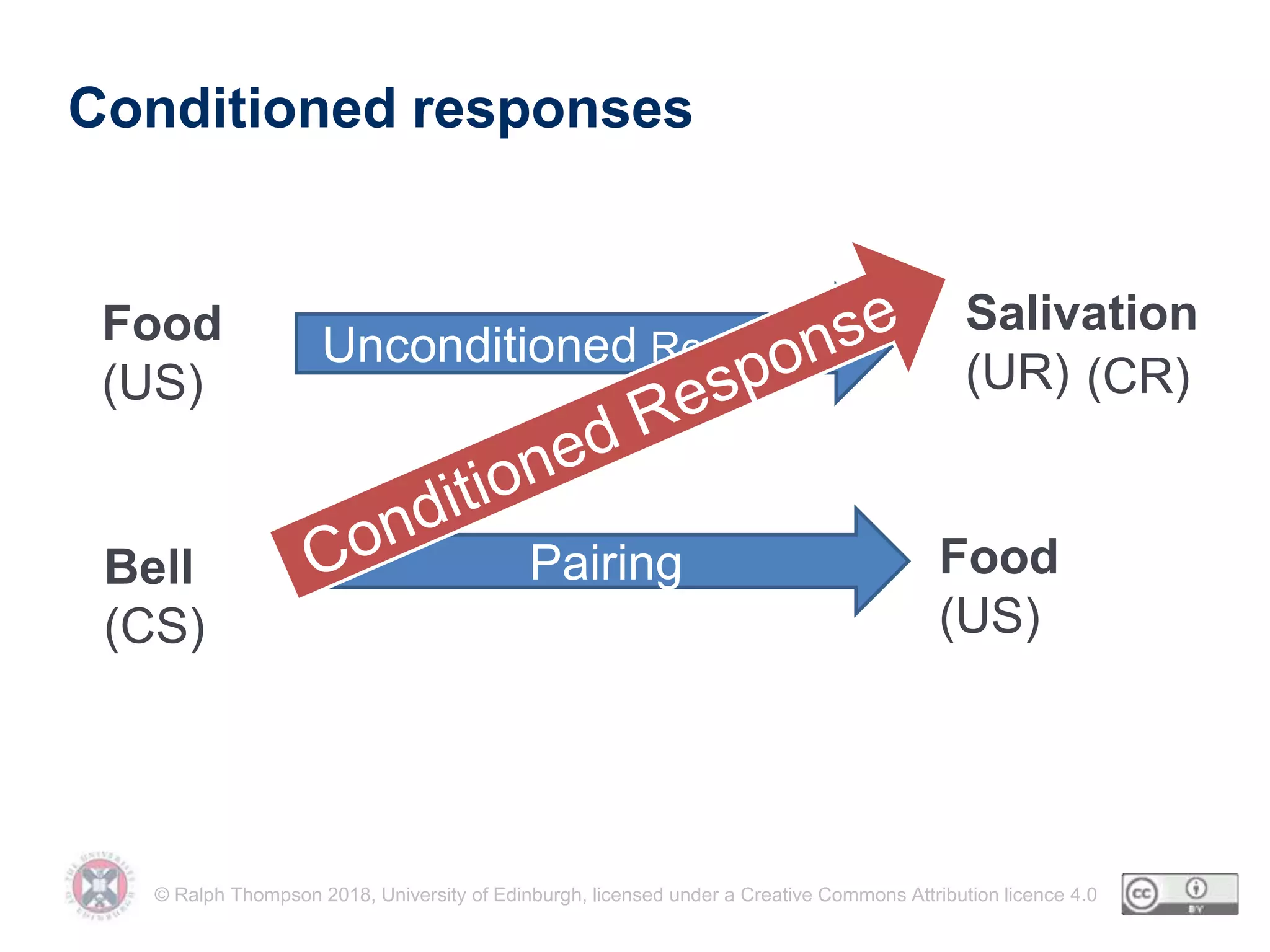
Conditioned responses
Bell
(CS)
Food
(US)
Food
(US)
Salivation
(UR)
Pairing
Unconditioned Response
(CR)
© Ralph Thompson 2018, University of Edinburgh, licensed under a Creative Commons Attribution licence 4.0
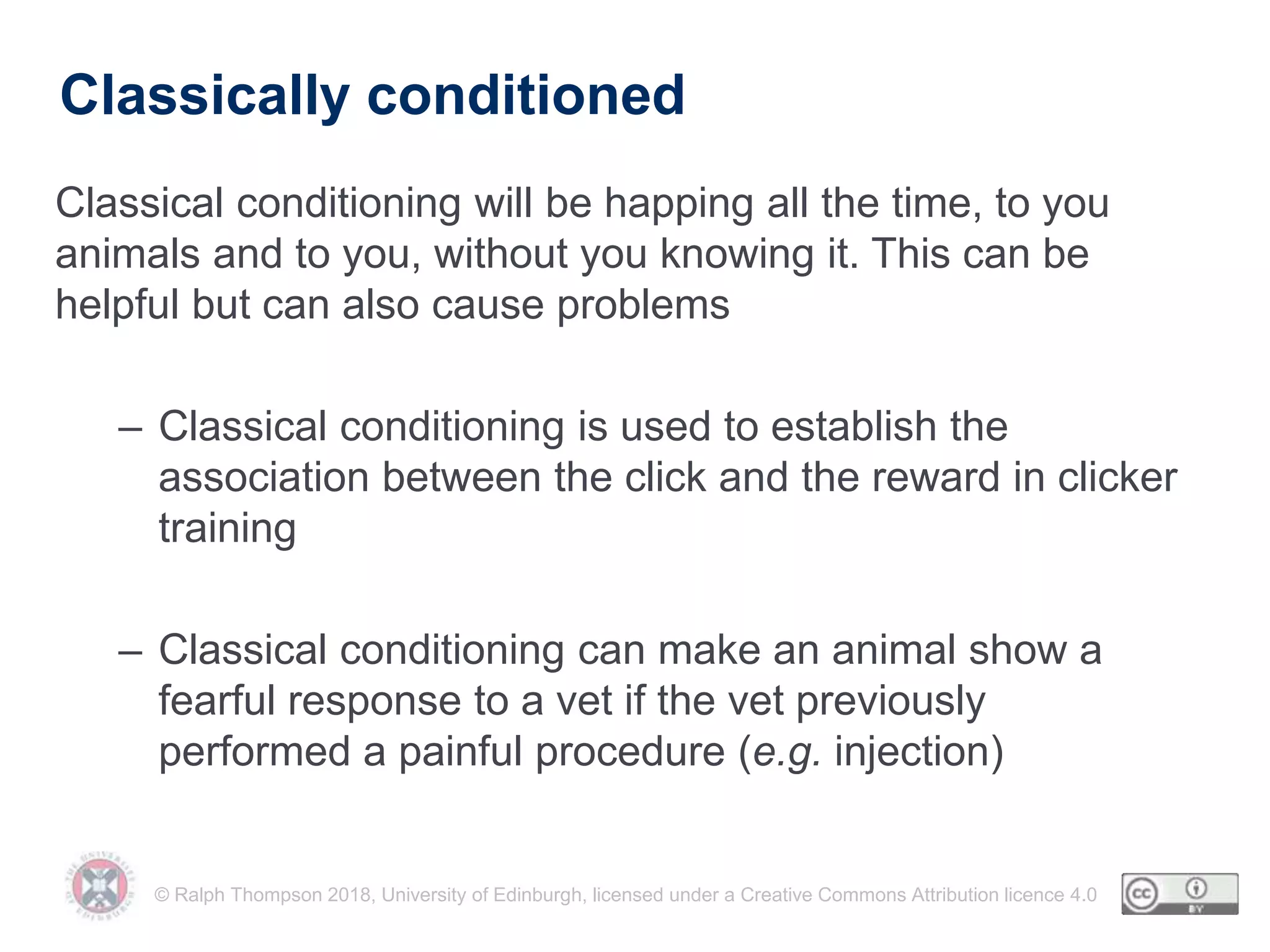
Classically conditioned
Classical conditioning will be happing all the time, to you
animals and to you, without you knowing it. This can be
helpful but can also cause problems
– Classical conditioning is used to establish the
association between the click and the reward in clicker
training
– Classical conditioning can make an animal show a
fearful response to a vet if the vet previously
performed a painful procedure (e.g. injection)
© Ralph Thompson 2018, University of Edinburgh, licensed under a Creative Commons Attribution licence 4.0
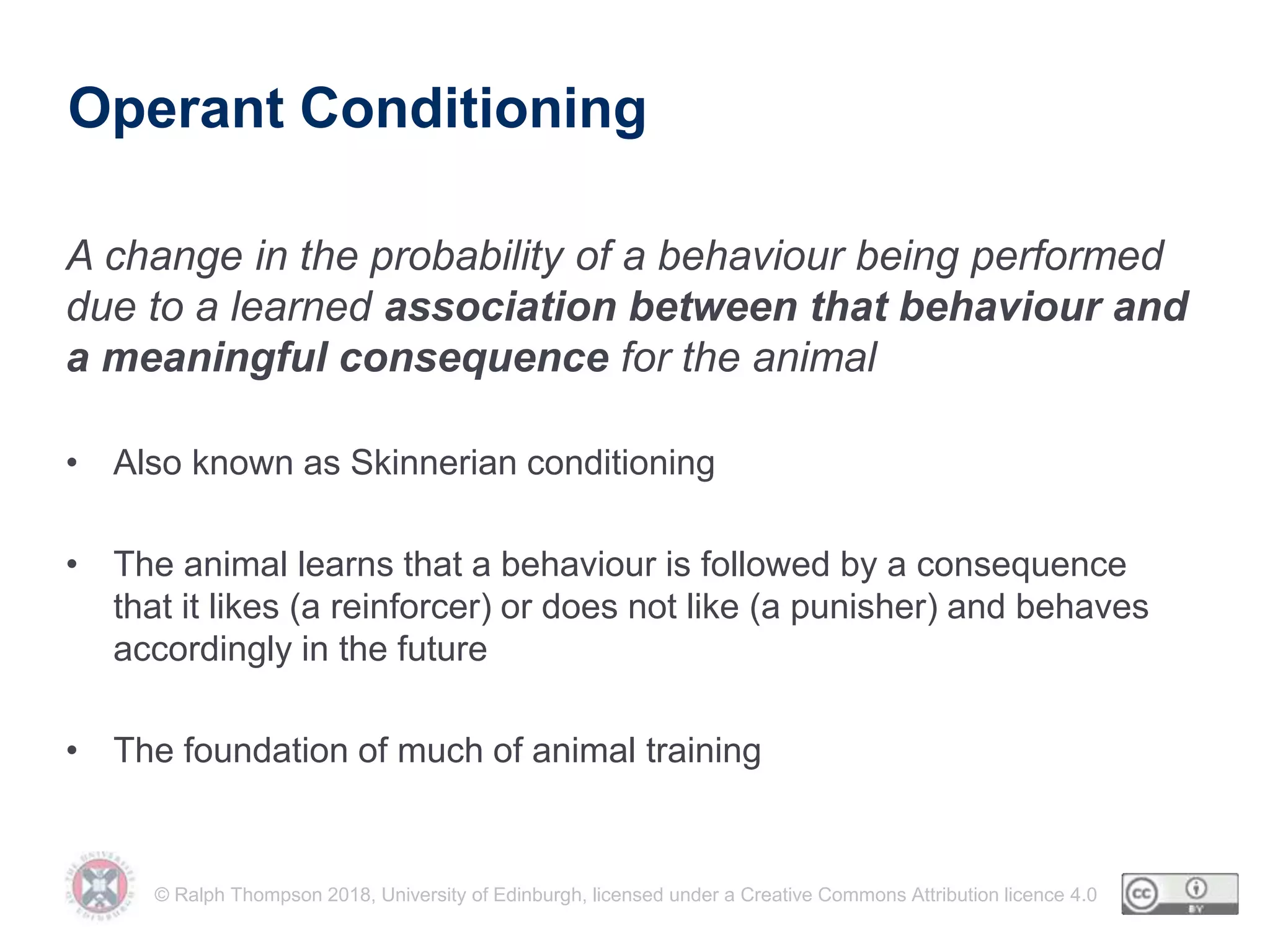
Operant Conditioning
• Also known as Skinnerian conditioning
• The animal learns that a behaviour is followed by a consequence
that it likes (a reinforcer) or does not like (a punisher) and behaves
accordingly in the future
• The foundation of much of animal training
A change in the probability of a behaviour being performed
due to a learned association between that behaviour and
a meaningful consequence for the animal
© Ralph Thompson 2018, University of Edinburgh, licensed under a Creative Commons Attribution licence 4.0
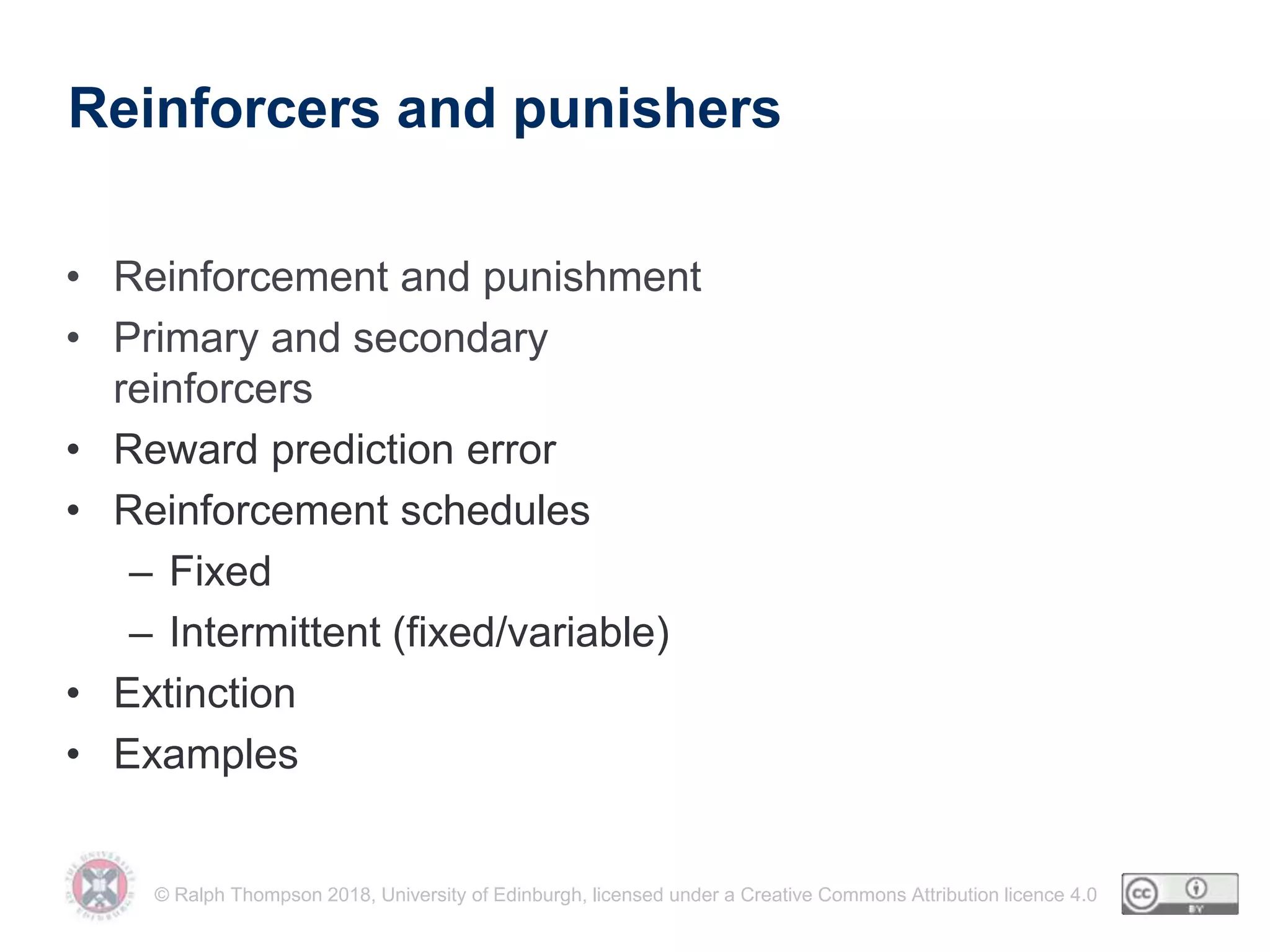
Reinforcers and punishers
• Reinforcement and punishment
• Primary and secondary
reinforcers
• Reward prediction error
• Reinforcement schedules
– Fixed
– Intermittent (fixed/variable)
• Extinction
• Examples
© Ralph Thompson 2018, University of Edinburgh, licensed under a Creative Commons Attribution licence 4.0
Reinforcers and emotion
• Reinforcement and punishment referring to change in
the affective state of the animal and hence the change in
likelihood of performing a behaviour which it is contingent
upon
• Reinforcers and punishes can be appetitive and
aversive…
© Ralph Thompson 2018, University of Edinburgh, licensed under a Creative Commons Attribution licence 4.0
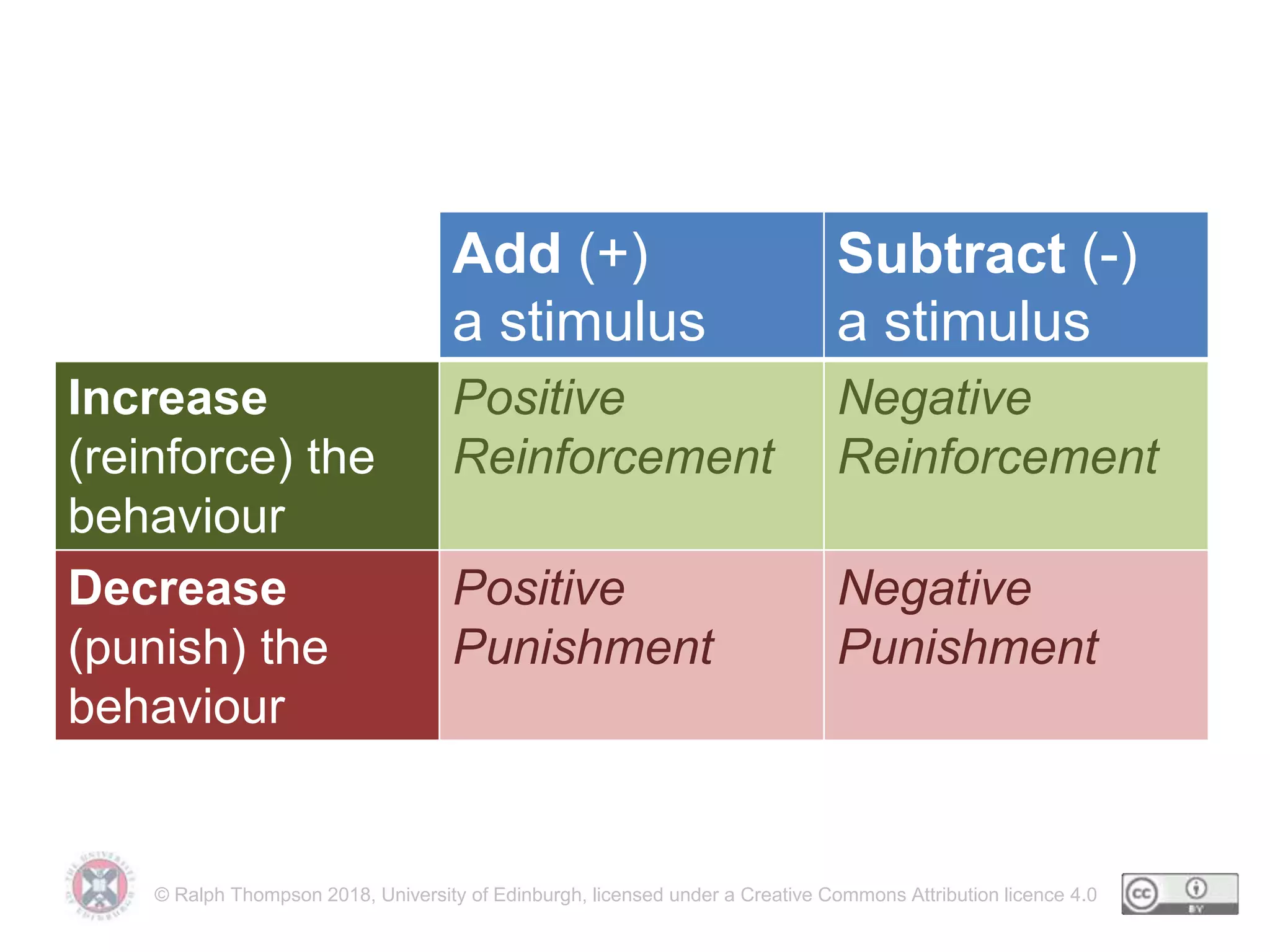
Reinforcers and punishers table
Add (+)
a stimulus
Subtract (-)
a stimulus
Increase
(reinforce) the
behaviour
Positive
Reinforcement
Negative
Reinforcement
Decrease
(punish) the
behaviour
Positive
Punishment
Negative
Punishment
© Ralph Thompson 2018, University of Edinburgh, licensed under a Creative Commons Attribution licence 4.0
Primary Reinforcers
• Have an evolved biological meaning for the animal
• Things that should be approached or avoided in the
ancestral environment
– Not necessarily still useful
© Ralph Thompson 2018, University of Edinburgh, licensed under a Creative Commons Attribution licence 4.0
Secondary Reinforcers
• Have become reinforcing / punishing through
learned association (classical conditioning)
– e.g. clicker
Add image
© Ralph Thompson 2018, University of Edinburgh, licensed under a Creative Commons Attribution licence 4.0
Reinforcement schedules
• Continual reinforcement – every occurrence of the
CS/behaviour is paired with the US/reinforcer
• Partial reinforcement – only some of the some
occurrences of the CS/behaviour are paired with the
US/reinforcer
– The lower the proportion of CS/behaviours that are
paired with the US/reinforcer the more slowly
conditioning occurs
– Can be interval or ratio, fixed or variable
© Ralph Thompson 2018, University of Edinburgh, licensed under a Creative Commons Attribution licence 4.0
Reinforcement
• When the probability of the US in the absence of the CS
increases the strength of learning decreases
– The CS must be a useful predictor of the US
• The CS can also predict the absence of a US (reduced
prob. of US following CS)
– This is inhibitory conditioning
© Ralph Thompson 2018, University of Edinburgh, licensed under a Creative Commons Attribution licence 4.0
Extinction
Once pairing has occurred the response can be
extinguished if the CS is presented to the animals without
the US, or the behaviour is performed with the
reinforcer/punisher
– The strength of the CR declines gradually
– CR acquired through partial reinforcement takes
longer to extinguish (because the animal is not
expecting all occurrences to be paired)
© Ralph Thompson 2018, University of Edinburgh, licensed under a Creative Commons Attribution licence 4.0
Equipotentiality?
• Equipotentiality – any animal can be conditioned to
perform any response with any stimulus as long as it can
perform the behaviour and sense the stimuli
• Is this what we observe?
• Some behaviours may seem naturally more appropriate
to some contingencies (e.g. escape behaviours for an
electric shock)
© Ralph Thompson 2018, University of Edinburgh, licensed under a Creative Commons Attribution licence 4.0
Factors affecting learning
• Motivational state
– e.g. hunger
• Biological predisposition
• Environment
– Distractors
– Anxiety
• Age
– e.g. horses handled when young show lower
neophobia
– e.g. old dogs decline in learning and memory ability
© Ralph Thompson 2018, University of Edinburgh, licensed under a Creative Commons Attribution licence 4.0
Summary
• Learning changes the behaviour of an animal in response to it’s
experience and occurs all of the time
• Learning can be non-associative (as with habituation and
sensitisation)
• …or associative (as with classical and operant conditioning)
• Reinforcement and punishment change the probability of an animal
performing an operant behaviour
• These can be used to train animals though shaping
• Timing and strength of predictive links between CS and US are
important
• It is important to recognise the effects of motivation and sensory bias
when training or understanding learning
This presentation is developed by Ralph Thompson and based on one
used at the University of Edinburgh with elements (particularly images)
removed for copyright reasons.
It is intended as a basis for lectures, to which images/graphics can be
added and the lecture adapted for the purposes needed. The use of a
coloured background to aid accessibility may benefit some students.
Reflective/class questions are shown in light blue. Addition of other
reflective or class response questions to check understanding and
promote engagement is recommended.
© Ralph Thompson 2018, University of Edinburgh
Licensed under a Creative Commons Attribution licence 4.0
NOTES ON THIS PRESENTATION
by Dr Ralph Thompson
University of Edinburgh

Animal Learning theory lecture

  • 1.
    Dr Ralph R.J.Thompson BA (Cantab.) MSc (Oxon.) PhD (Bris.) FHEA University of Edinburgh © Ralph Thompson 2018, University of Edinburgh Licensed under a Creative Commons Attribution licence 4.0 All images CC0, Pixabay Animal Learning How animals change their behaviour in response to information from their environment
  • 2.
    This presentation isdeveloped by Ralph Thompson and based on one used at the University of Edinburgh with elements (particularly images) removed for copyright reasons. It is intended as a basis for lectures, to which images/graphics can be added and the lecture adapted for the purposes needed. The use of a coloured background to aid accessibility may benefit some students. Reflective/class questions are shown in light blue. Addition of other reflective or class response questions to check understanding and promote engagement is recommended. © Ralph Thompson 2018, University of Edinburgh Licensed under a Creative Commons Attribution licence 4.0 NOTES ON THIS PRESENTATION by Dr Ralph Thompson University of Edinburgh
  • 3.
    © Ralph Thompson2018, University of Edinburgh, licensed under a Creative Commons Attribution licence 4.0 Objectives • To introduce learning theory to you if you are new to the ideas • To make you think about learning in some new ways if you already know learning theory (not all Pavlov and Skinner) – Learning in the context of ethology/emotion • Giving you the knowledge to… – understand why animals change their behaviour with experience – plan the training of animals, but more practical training later on (including in your assessment) – Understand and critically evaluate training methods used by others
  • 4.
    © Ralph Thompson2018, University of Edinburgh, licensed under a Creative Commons Attribution licence 4.0 Overview • What is Learning? – stimuli • Types of learning – Non-associative – Associative • Reinforcement – Shaping – Factors affecting reinforcement • Examples from research Image CCO, Pixabay
  • 5.
    © Ralph Thompson2018, University of Edinburgh, licensed under a Creative Commons Attribution licence 4.0 What is Learning? A (relatively long-lasting) change in behaviour as the result of experience • This can be any experience and any behaviour • An adaptive process that allows an animal to match it’s behaviour to the environment that it find itself in • If the experience is intentionally provided for an animal by humans the learning process may be referred to as training (but animals will learn from human stimuli in unintended ways as well)
  • 6.
    © Ralph Thompson2018, University of Edinburgh, licensed under a Creative Commons Attribution licence 4.0 Learning… • ...is a form of cognition • …involves/motivated by emotion
  • 7.
    © Ralph Thompson2018, University of Edinburgh, licensed under a Creative Commons Attribution licence 4.0 Learning in understanding behaviour • Tinbergen’s 4 whys: o Adaptation o Phylogeny o Mechanism o Ontogeny – Cognition (and physiology and anatomy) – Learning (and physical development) Behaviourism and cognitivism
  • 8.
    © Ralph Thompson2018, University of Edinburgh, licensed under a Creative Commons Attribution licence 4.0 Doing isn’t always understanding “though the practice of a science is known to all, only a few persons are acquainted with the rules and laws on which the science is based. …riders of horses and elephants train these animals without knowing the science of training animals, but from practice only.” The Kama Sutra of Vātsyāyana (3rd century AD, Richard Burton Translation) Image CCO, Pixabay
  • 9.
    © Ralph Thompson2018, University of Edinburgh, licensed under a Creative Commons Attribution licence 4.0 Why learn? Learning allows animals to change their behaviour in response to experience • Behaviour can fit novel or changing environments • Behaviours can be formed that are too complex to encode genetically Learning occurs all the time • In the wild • In captivity • During training
  • 10.
    © Ralph Thompson2018, University of Edinburgh, licensed under a Creative Commons Attribution licence 4.0 Stimuli • We call quanta of information that are sensed by the animal and cause a response stimuli (singular stimulus) – The response can be immediate behaviour or learning or both – We are most often concerned with external (environmental) stimuli but they can also be internal to the animal (e.g. internal pain) – There are infinite number of potential stimuli in nature…
  • 11.
    © Ralph Thompson2018, University of Edinburgh, licensed under a Creative Commons Attribution licence 4.0 Stimulus importance • Animals needs to know which stimuli to respond to. – They must have a way of identifying which environmental information is most important to them – How can they do this? • ‘Innate’ value / salience – What kind of stimuli should be most salient for animals? – What stimuli are most salient for you? – Are innate evolved responses enough? When would they be most/least useful?
  • 12.
    © Ralph Thompson2018, University of Edinburgh, licensed under a Creative Commons Attribution licence 4.0 Stimulus importance • Learned value – Determining which stimuli are meaningful through repeated exposure or exposure during sensitive periods (non-associative learning) – Pairing meaningful stimuli that are related to each other (associative learning) • Both are constantly updated during the life of an animal, though the animal may be more sensitive at particular periods • May also depend on motivational state (e.g. hunger)
  • 13.
    © Ralph Thompson2018, University of Edinburgh, licensed under a Creative Commons Attribution licence 4.0 Associate and non-associative learning • Non-associative – Imprinting – Habituation – Sensitisation & desensitisation • Associative – Classical Conditioning (Pavlovian) – Operant Conditioning (Skinnerian)
  • 14.
    © Ralph Thompson2018, University of Edinburgh, licensed under a Creative Commons Attribution licence 4.0 Non-associative learning Add image
  • 15.
    © Ralph Thompson2018, University of Edinburgh, licensed under a Creative Commons Attribution licence 4.0 Imprinting Relatively permanent, rapid, learning during a particular sensitive period Image CCO, Pixabay
  • 16.
    © Ralph Thompson2018, University of Edinburgh, licensed under a Creative Commons Attribution licence 4.0 Habituation A decrease (or cessation) in response following repeated exposure to the stimulus • Stimulus is not (or is not longer) biologically relevant • Can be generalised (apply to similar stimuli) • Particularly important in prey animals (as they are likely to be neophobic) • To be effective must be gradual and not forceful • May occur to accidental/unintentional stimuli (e.g. riding school horses)
  • 17.
    © Ralph Thompson2018, University of Edinburgh, licensed under a Creative Commons Attribution licence 4.0 Sensitisation • Generally aversive stimuli (e.g. pain, loud noises) An increase in response following repeated exposure to the stimulus Image CCO, Pixabay
  • 18.
    © Ralph Thompson2018, University of Edinburgh, licensed under a Creative Commons Attribution licence 4.0 Desensitisation • Similar to habituation, but to a previously sensitised stimulus A decrease (or cessation) of a previously sensitised response following repeated exposure to the stimulus
  • 19.
    © Ralph Thompson2018, University of Edinburgh, licensed under a Creative Commons Attribution licence 4.0 Associative learning Add image
  • 20.
    © Ralph Thompson2018, University of Edinburgh, licensed under a Creative Commons Attribution licence 4.0 Classical Conditioning • Also known as Pavlovian Conditioning • Pairing of a conditioned stimulus with an unconditioned stimulus • The CS must predict the US • Produces a conditioned response (CR) to the CS similar to the unconditioned response (UR) to the US • Associates with novel stimuli with appropriate responses • e.g. salivating in response to sound of food being prepared A learned association between a previously neutral stimulus (CS) and a previously meaningful stimulus (US)
  • 21.
    © Ralph Thompson2018, University of Edinburgh, licensed under a Creative Commons Attribution licence 4.0 Conditioned responses Bell (CS) Food (US) Food (US) Salivation (UR) Pairing Unconditioned Response (CR)
  • 22.
    © Ralph Thompson2018, University of Edinburgh, licensed under a Creative Commons Attribution licence 4.0 Classically conditioned Classical conditioning will be happing all the time, to you animals and to you, without you knowing it. This can be helpful but can also cause problems – Classical conditioning is used to establish the association between the click and the reward in clicker training – Classical conditioning can make an animal show a fearful response to a vet if the vet previously performed a painful procedure (e.g. injection)
  • 23.
    © Ralph Thompson2018, University of Edinburgh, licensed under a Creative Commons Attribution licence 4.0 Operant Conditioning • Also known as Skinnerian conditioning • The animal learns that a behaviour is followed by a consequence that it likes (a reinforcer) or does not like (a punisher) and behaves accordingly in the future • The foundation of much of animal training A change in the probability of a behaviour being performed due to a learned association between that behaviour and a meaningful consequence for the animal
  • 24.
    © Ralph Thompson2018, University of Edinburgh, licensed under a Creative Commons Attribution licence 4.0 Reinforcers and punishers • Reinforcement and punishment • Primary and secondary reinforcers • Reward prediction error • Reinforcement schedules – Fixed – Intermittent (fixed/variable) • Extinction • Examples
  • 25.
    © Ralph Thompson2018, University of Edinburgh, licensed under a Creative Commons Attribution licence 4.0 Reinforcers and emotion • Reinforcement and punishment referring to change in the affective state of the animal and hence the change in likelihood of performing a behaviour which it is contingent upon • Reinforcers and punishes can be appetitive and aversive…
  • 26.
    © Ralph Thompson2018, University of Edinburgh, licensed under a Creative Commons Attribution licence 4.0 Reinforcers and punishers table Add (+) a stimulus Subtract (-) a stimulus Increase (reinforce) the behaviour Positive Reinforcement Negative Reinforcement Decrease (punish) the behaviour Positive Punishment Negative Punishment
  • 27.
    © Ralph Thompson2018, University of Edinburgh, licensed under a Creative Commons Attribution licence 4.0 Primary Reinforcers • Have an evolved biological meaning for the animal • Things that should be approached or avoided in the ancestral environment – Not necessarily still useful
  • 28.
    © Ralph Thompson2018, University of Edinburgh, licensed under a Creative Commons Attribution licence 4.0 Secondary Reinforcers • Have become reinforcing / punishing through learned association (classical conditioning) – e.g. clicker Add image
  • 29.
    © Ralph Thompson2018, University of Edinburgh, licensed under a Creative Commons Attribution licence 4.0 Reinforcement schedules • Continual reinforcement – every occurrence of the CS/behaviour is paired with the US/reinforcer • Partial reinforcement – only some of the some occurrences of the CS/behaviour are paired with the US/reinforcer – The lower the proportion of CS/behaviours that are paired with the US/reinforcer the more slowly conditioning occurs – Can be interval or ratio, fixed or variable
  • 30.
    © Ralph Thompson2018, University of Edinburgh, licensed under a Creative Commons Attribution licence 4.0 Reinforcement • When the probability of the US in the absence of the CS increases the strength of learning decreases – The CS must be a useful predictor of the US • The CS can also predict the absence of a US (reduced prob. of US following CS) – This is inhibitory conditioning
  • 31.
    © Ralph Thompson2018, University of Edinburgh, licensed under a Creative Commons Attribution licence 4.0 Extinction Once pairing has occurred the response can be extinguished if the CS is presented to the animals without the US, or the behaviour is performed with the reinforcer/punisher – The strength of the CR declines gradually – CR acquired through partial reinforcement takes longer to extinguish (because the animal is not expecting all occurrences to be paired)
  • 32.
    © Ralph Thompson2018, University of Edinburgh, licensed under a Creative Commons Attribution licence 4.0 Equipotentiality? • Equipotentiality – any animal can be conditioned to perform any response with any stimulus as long as it can perform the behaviour and sense the stimuli • Is this what we observe? • Some behaviours may seem naturally more appropriate to some contingencies (e.g. escape behaviours for an electric shock)
  • 33.
    © Ralph Thompson2018, University of Edinburgh, licensed under a Creative Commons Attribution licence 4.0 Factors affecting learning • Motivational state – e.g. hunger • Biological predisposition • Environment – Distractors – Anxiety • Age – e.g. horses handled when young show lower neophobia – e.g. old dogs decline in learning and memory ability
  • 34.
    © Ralph Thompson2018, University of Edinburgh, licensed under a Creative Commons Attribution licence 4.0 Summary • Learning changes the behaviour of an animal in response to it’s experience and occurs all of the time • Learning can be non-associative (as with habituation and sensitisation) • …or associative (as with classical and operant conditioning) • Reinforcement and punishment change the probability of an animal performing an operant behaviour • These can be used to train animals though shaping • Timing and strength of predictive links between CS and US are important • It is important to recognise the effects of motivation and sensory bias when training or understanding learning
  • 35.
    This presentation isdeveloped by Ralph Thompson and based on one used at the University of Edinburgh with elements (particularly images) removed for copyright reasons. It is intended as a basis for lectures, to which images/graphics can be added and the lecture adapted for the purposes needed. The use of a coloured background to aid accessibility may benefit some students. Reflective/class questions are shown in light blue. Addition of other reflective or class response questions to check understanding and promote engagement is recommended. © Ralph Thompson 2018, University of Edinburgh Licensed under a Creative Commons Attribution licence 4.0 NOTES ON THIS PRESENTATION by Dr Ralph Thompson University of Edinburgh

Editor's Notes

  • #10 Examples: Farms all animals learning about environment  especially important with dairy cow's etc. where animals interact with machines and people daily also could be source of enrichment  Wild in captivity used to aid husbandry and as enrichment free living, animals learn about human systems as well as natural world an understanding of learning could help to reduce conflict between humans and wild animals